Demand for a Constituent Assembly
Demand for a Constituent Assembly
- making of the constitution
- September 23, 2025
Demand for a Constituent Assembly
The concept of a Constituent Assembly for India was first introduced by M.N. Roy, a key figure in the communist movement, in 1934. The Indian National Congress (INC) officially demanded the formation of a Constituent Assembly to draft the Constitution of India for the first time in 1935. By 1938, Jawaharlal Nehru, speaking on behalf of the INC, asserted that “the Constitution of free India must be framed, without outside interference, by a Constituent Assembly elected based on adult franchise.”
The British Government accepted this demand in principle in the ‘August Offer’ of 1940. In 1942, Sir Stafford Cripps, a Cabinet member, traveled to India with a draft proposal from the British Government aimed at creating an independent Constitution to be enacted after World War II. However, the Cripps Proposals were rejected by the Muslim League, which sought the division of India into two autonomous states, each with its own Constituent Assembly.
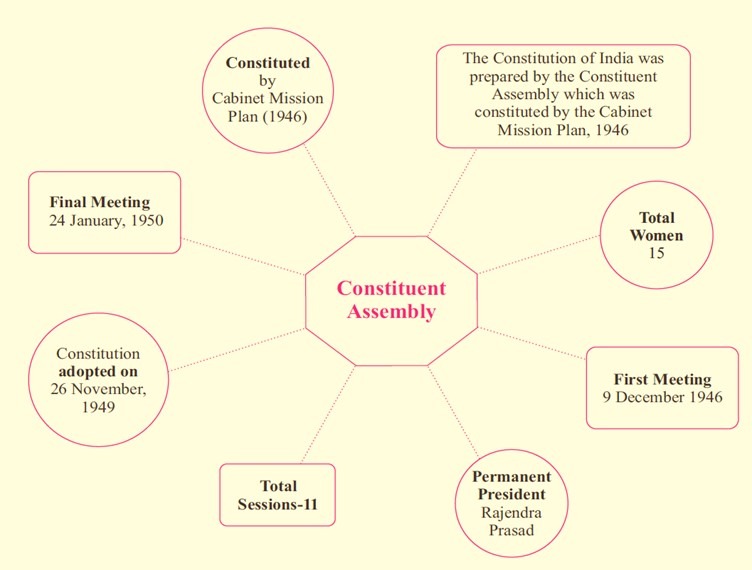
In response, a Cabinet Mission was sent to India. Although the Mission dismissed the idea of establishing two separate Constituent Assemblies, it proposed a framework for a single Constituent Assembly that was generally acceptable to the Muslim League.
This sequence of events highlighted the growing demand for self-governance and the need for a constitutional framework that represented the diverse interests of the Indian population.