
DEMAND FOR A CONSTITUENT ASSEMBLY
DEMAND FOR A CONSTITUENT ASSEMBLY
- Making of the Constitution
- September 16, 2025
Demand for a Constituent Assembly
The concept of a Constituent Assembly for India was first introduced by M.N. Roy, a key figure in the communist movement, in 1934. The Indian National Congress (INC) officially demanded the formation of a Constituent Assembly to draft the Constitution of India for the first time in 1935. By 1938, Jawaharlal Nehru, speaking on behalf of the INC, asserted that “the Constitution of free India must be framed, without outside interference, by a Constituent Assembly elected based on adult franchise.”
The British Government accepted this demand in principle in the ‘August Offer’ of 1940. In 1942, Sir Stafford Cripps, a Cabinet member, traveled to India with a draft proposal from the British Government aimed at creating an independent Constitution to be enacted after World War II. However, the Cripps Proposals were rejected by the Muslim League, which sought the division of India into two autonomous states, each with its own Constituent Assembly.
In response, a Cabinet Mission was sent to India. Although the Mission dismissed the idea of establishing two separate Constituent Assemblies, it proposed a framework for a single Constituent Assembly that was generally acceptable to the Muslim League.
This sequence of events highlighted the growing demand for self-governance and the need for a constitutional framework that represented the diverse interests of the Indian population.
Composition of the Constituent Assembly
The Constituent Assembly of India was formed in November 1946 according to the plan outlined by the Cabinet Mission. The key features of this scheme were as follows:
- Total Strength: The Constituent Assembly consisted of 389 members. Of these, 296 seats were designated for British India, while 93 seats were allocated to the princely states. Specifically, 292 members from British India were to be elected from the eleven governors’ provinces, and four members were to come from the four Chief Commissioners’ provinces, with one from each.
- Proportional Representation: Seats for each province and princely state (or group of states in the case of smaller states) were allocated based on their population. Generally, one seat was assigned for approximately every million people.
- Community Representation: The seats allocated to each British province were divided among three primary communities—Muslims, Sikhs, and General (all individuals excluding Muslims and Sikhs)—according to their respective populations.
- Election of Representatives: Representatives for each community were elected by the members of that community from the provincial legislative assembly, using the method of proportional representation through the single transferable vote.
- Nominations from Princely States: Representatives from the princely states were to be nominated by the heads of those states.
Thus, the Constituent Assembly functioned as both a partly elected and partly nominated body. The members were indirectly elected by representatives of the provincial assemblies, which were themselves elected through a limited franchise. Elections for the 296 seats allotted to British Indian provinces took place in July-August 1946. The Indian National Congress secured 208 seats, the Muslim League won 73 seats, and the remaining 15 seats were held by smaller groups and independents. However, the 93 seats allotted to the princely states remained unfilled due to their decision to abstain from the Constituent Assembly.
Although the Constituent Assembly was not directly elected by the people of India through universal adult franchise, it included representatives from various segments of Indian society, including Hindus, Muslims, Sikhs, Parsis, Anglo-Indians, Indian Christians, Scheduled Castes (SCs), Scheduled Tribes (STs), and women. The Assembly comprised many prominent personalities of the time, with the notable exception of Mahatma Gandhi.
Working of the Constituent Assembly
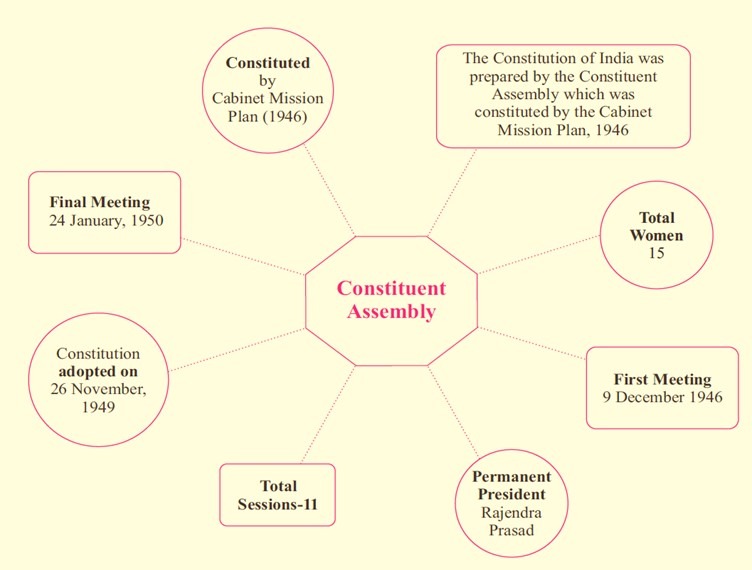
The Constituent Assembly of India convened for its first meeting on December 9, 1946. The Muslim League opted to boycott this meeting, asserting their demand for a separate state of Pakistan. Consequently, only 211 members attended. Dr. Sachchidananda Sinha, the oldest member present, was elected as the temporary President of the Assembly, following the French parliamentary practice. Later, Dr. Rajendra Prasad was elected as the President of the Assembly, while H.C. Mukherjee and V.T. Krishnamachari served as the Vice-Presidents, marking the Assembly’s unique structure with two Vice-Presidents.