Indian Councils Act of 1909
Indian Councils Act of 1909
- The Crown Rule (1858-1947)
- September 16, 2025
Indian Councils Act of 1909
The Indian Councils Act of 1909, commonly referred to as the Morley-Minto Reforms (named after then Secretary of State for India, Lord Morley, and then Viceroy of India, Lord Minto), introduced several crucial features:
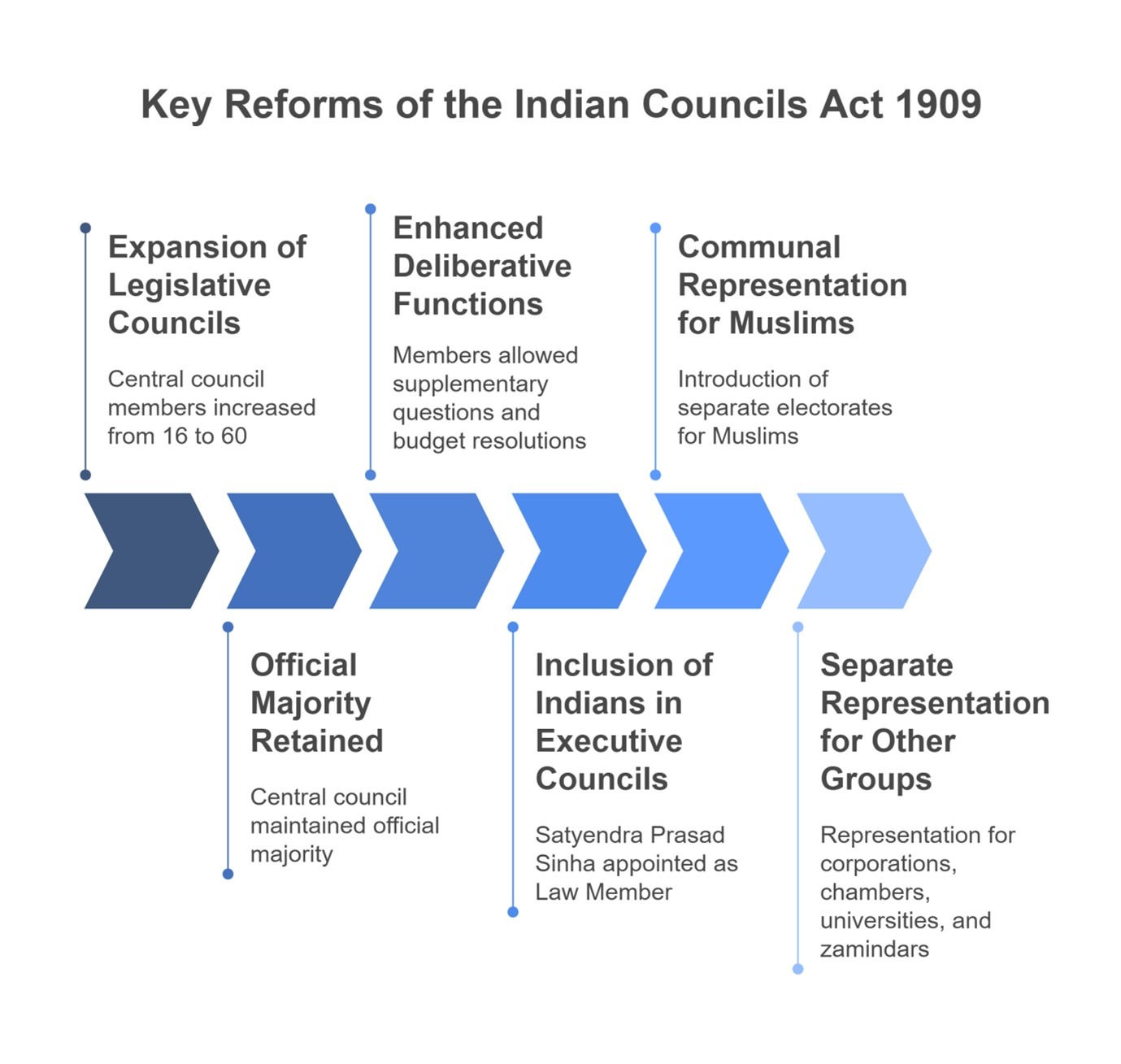
1. Expansion of Legislative Councils: The Act significantly increased the membership of both the Central and provincial legislative councils. The number of members in the Central legislative council was raised from 16 to 60, while the number of members in provincial councils varied.
2. Official Majority Retained: While the Act maintained an official majority in the Central legislative council, it allowed the provincial legislative councils to have a non-official majority.
3. Enhanced Deliberative Functions: The Act enlarged the deliberative roles of the legislative councils at both levels. Members were permitted to ask supplementary questions, move resolutions regarding the budget, and engage in more detailed discussions.
4. Inclusion of Indians in Executive Councils: For the first time, the Act provided for the inclusion of Indians in the executive councils of the Viceroy and Governors. Satyendra Prasad Sinha became the first Indian member of the Viceroy’s executive council, serving as the Law Member.
5. Communal Representation for Muslims: The Act established a system of communal representation by introducing the concept of a “separate electorate” for Muslims. Under this system, Muslim representatives were to be elected solely by Muslim voters, which effectively legitimized communalism in the electoral process. As a result, Lord Minto became known as the Father of the Communal Electorate.
6. Separate Representation for Other Groups: The Act also provided for separate representation for presidency corporations, chambers of commerce, universities, and zamindars.