Charter Act of 1853
Charter Act of 1853
- The Company Rule (1773-1858)
- September 16, 2025
Charter Act of 1853
The British Parliament passed a number of Charter Acts between 1793 and 1853, this being the final one. It was an important turning point in the constitution.
This Act’s characteristics were as follows:
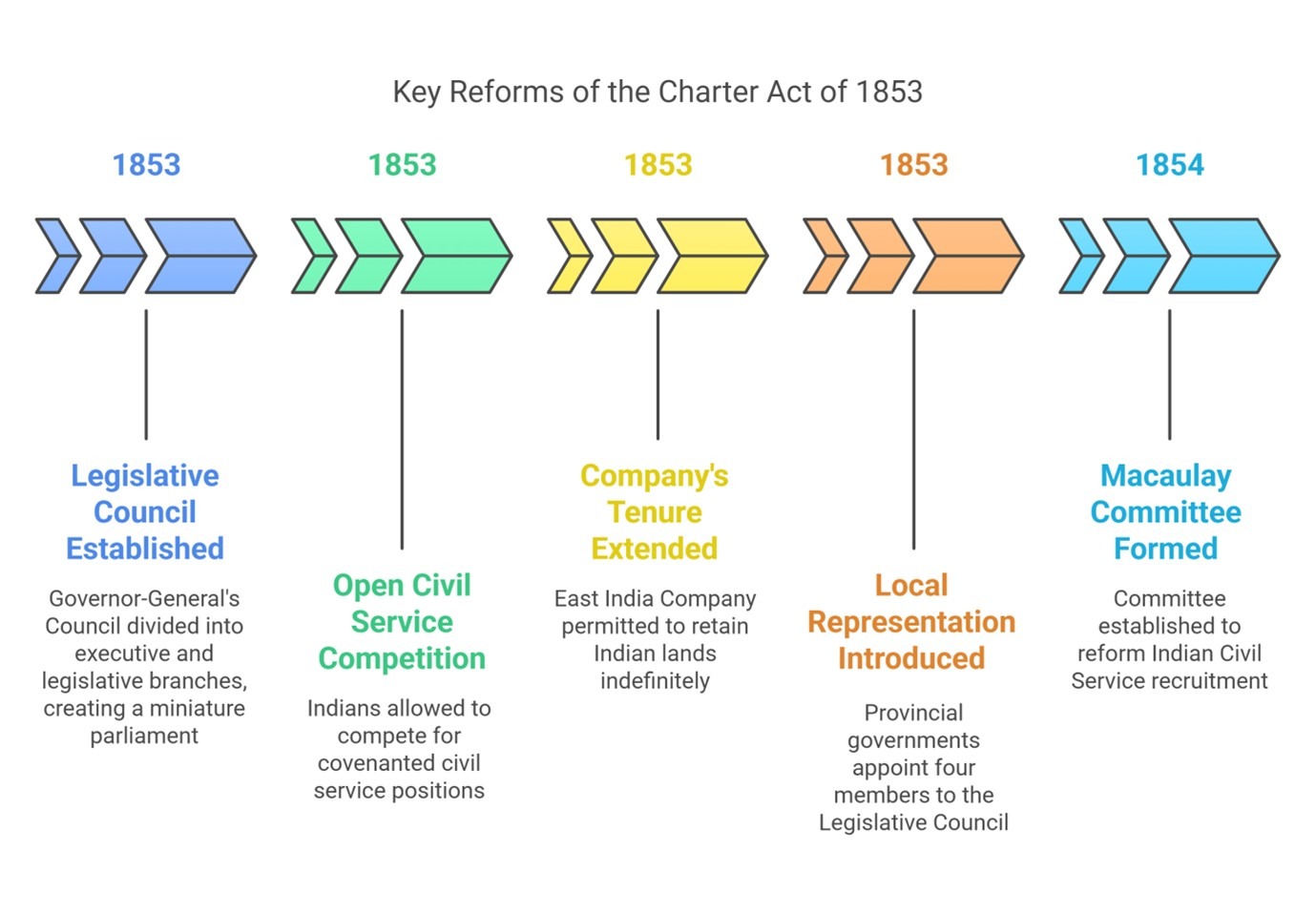
1. It separated the Governor-General’s Council’s executive and legislative branches for the first time. It allowed for the council to have six more members, known as legislative councillors. Stated differently, it created a distinct legislative body for the Governor-General, which became known as the Indian (Central) Legislative body. Using the same processes as the British Parliament, this council’s legislative branch operated as a miniature parliament. As a result, legislation was for the first time regarded as a unique government role that called for unique tools and procedures.
2. It instituted a system of open competition for civil servant recruitment and selection. Thus, the Indians were likewise granted access to the covenanted civil service3. Consequently, in 1854, the Committee on the Indian Civil Service, sometimes known as the Macaulay Committee, was established.
3. It gave the Company more authority and permitted it to hold onto Indian lands held in trust for the British Crown. However, in contrast to the earlier Charters, it did not set a certain time frame. This was a blatant sign that the Parliament could end the Company’s reign whenever it pleased.
4. It brought local representation to the Indian (Central) Legislative Council for the first time. Four out of the Governor General’s Council’s six new lawmakers were appointed by the local (provincial) governments of Madras, Bombay, Bengal and Agra.