Indian Independence Act of 1947
Indian Independence Act of 1947
- The Crown Rule (1858-1947)
- September 16, 2025
Indian Independence Act of 1947
On February 20, 1947, British Prime Minister Clement Attlee announced that British rule in India would cease by June 30, 1948, after which power would be transferred to responsible Indian leaders. This announcement was met with heightened agitation from the Muslim League, which demanded the partition of the country. On June 3, 1947, the British Government clarified that any Constitution drafted by the Constituent Assembly (formed in 1946) would not be applicable in areas unwilling to accept it. On the same day, Lord Mountbatten, the Viceroy of India, proposed the partition plan, known as the Mountbatten Plan, which was accepted by both the Congress and the Muslim League. The plan was promptly enacted through the Indian Independence Act of 1947.
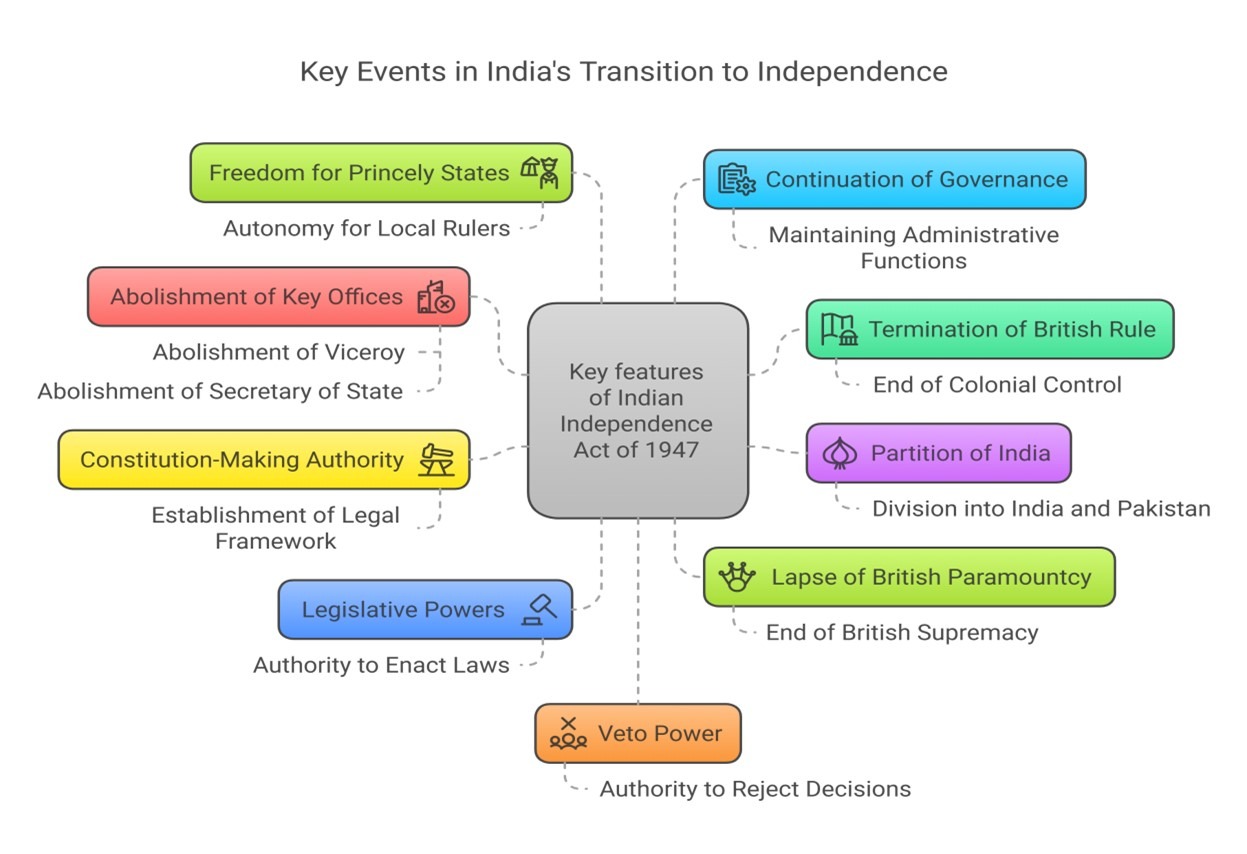
Key features of this Act included:
1. Termination of British Rule:
- The Act officially ended British rule in India, declaring India an independent and sovereign state as of August 15, 1947.
2. Partition of India:
- It provided for the partition of India and the creation of two independent dominions—India and Pakistan—with the right to secede from the British Commonwealth.
3. Abolishment of the Office of Viceroy:
- The position of Viceroy was abolished and replaced by a Governor-General for each dominion, who would be appointed by the British King upon the advice of the dominion cabinet. The British Government would have no responsibility regarding the governance of India or Pakistan.
4. Constitution-Making Authority:
- The Act empowered the Constituent Assemblies of both dominions to draft and adopt their respective constitutions and to repeal any acts of the British Parliament, including the Independence Act itself.
These provisions marked a pivotal moment in Indian history, culminating in the establishment of independent governance in India and Pakistan.
5. Legislative Powers of Constituent Assemblies:
- The Act empowered the Constituent Assemblies of both dominions to legislate for their respective territories until new constitutions were developed and implemented. No Act of the British Parliament passed after August 15, 1947, would apply to either of the new dominions unless specifically extended by law from the legislature of that dominion.
6. Abolishment of the Secretary of State for India:
- The Act abolished the office of the Secretary of State for India, transferring his responsibilities to the Secretary of State for Commonwealth Affairs.
7. Lapse of British Paramountcy:
- The Act declared the lapse of British paramountcy over the Indian princely states and ended treaty relations with tribal areas effective from August 15, 1947.
8. Freedom for Princely States:
- The Act granted Indian princely states the freedom to either join the Dominion of India or the Dominion of Pakistan, or choose to remain independent.
9. Continuation of Governance:
- It provided for the continuation of governance in each of the dominions and provinces under the Government of India Act of 1935 until new constitutions were framed. The dominions were permitted to make modifications to the Act as necessary.
10. Veto Power:
- The Act removed the British Monarch’s right to veto bills or request the reservation of certain bills for royal approval. This power was retained for the Governor-General, who was authorized to assent to any bill in the name of His Majesty.
11. Governor-General and Nominal Heads:
- The Act designated the Governor-General of India and provincial governors as constitutional (nominal) heads of their respective states, requiring them to act based on the advice of the respective councils of ministers in all matters.
12. Removal of the Title “Emperor of India”:
- The Act eliminated the title “Emperor of India” from the royal titles held by the King of England.
13. Civil Service Appointments:
- The appointment of civil servants and the reservation of posts by the Secretary of State for India were discontinued. However, members of the civil services who were appointed before August 15, 1947, continued to enjoy all benefits entitled to them up to that time.
At the stroke of midnight on August 14-15, 1947, British rule officially ended, and power was transferred to the two newly independent Dominions of India and Pakistan. Lord Mountbatten became the first Governor-General of the Dominion of India, swearing in Jawaharlal Nehru as its first Prime Minister. The Constituent Assembly of India, formed in 1946, subsequently became the Parliament of the Indian Dominion.