
Indian Councils Act of 1861
Indian Councils Act of 1861
- The Crown Rule (1858-1947)
- September 16, 2025
Indian Councils Act of 1861
Following the significant revolt of 1857, the British Government recognized the need to enlist the cooperation of Indians in the administration of their country. To move towards this goal of inclusion, three acts were enacted by the British Parliament in 1861, 1892, and 1909. The Indian Councils Act of 1861 serves as a crucial milestone in the constitutional and political history of India.
Key features of the Indian Councils Act of 1861 include:
1. Introduction of Representative Institutions: The Act marked the beginning of representative institutions by involving Indians in the law-making process. It stipulated that the Viceroy should appoint some Indians as non-official members of his expanded council. In 1862, Lord Canning, the then Viceroy, nominated three Indians to his legislative council: the Raja of Benaras, the Maharaja of Patiala, and Sir Dinkar Rao.
2. Decentralization of Power: The Act initiated the process of decentralization by restoring legislative powers to the Bombay and Madras Presidencies. This change reversed the centralizing trend that began with the Regulating Act of 1773 and peaked under the Charter Act of 1833. This policy of legislative devolution ultimately led to granting almost complete internal autonomy to the provinces in 1937.
3. Establishment of New Legislative Councils: The Act provided for the creation of new legislative councils for Bengal, the North-Western Provinces, and Punjab, which were established in 1862, 1886, and 1897, respectively.
4. Empowerment of the Viceroy: It empowered the Viceroy to create rules and orders for the efficient functioning of the council. Additionally, it recognized the ‘portfolio’ system introduced by Lord Canning in 1859, whereby members of the Viceroy’s council were assigned responsibility for one or more government departments and authorized to issue final decisions on behalf of the council regarding matters in their department(s).
5. Ordinance Authority: The Act allowed the Viceroy to issue ordinances without the approval of the legislative council during emergencies, with each ordinance having a lifespan of six months.
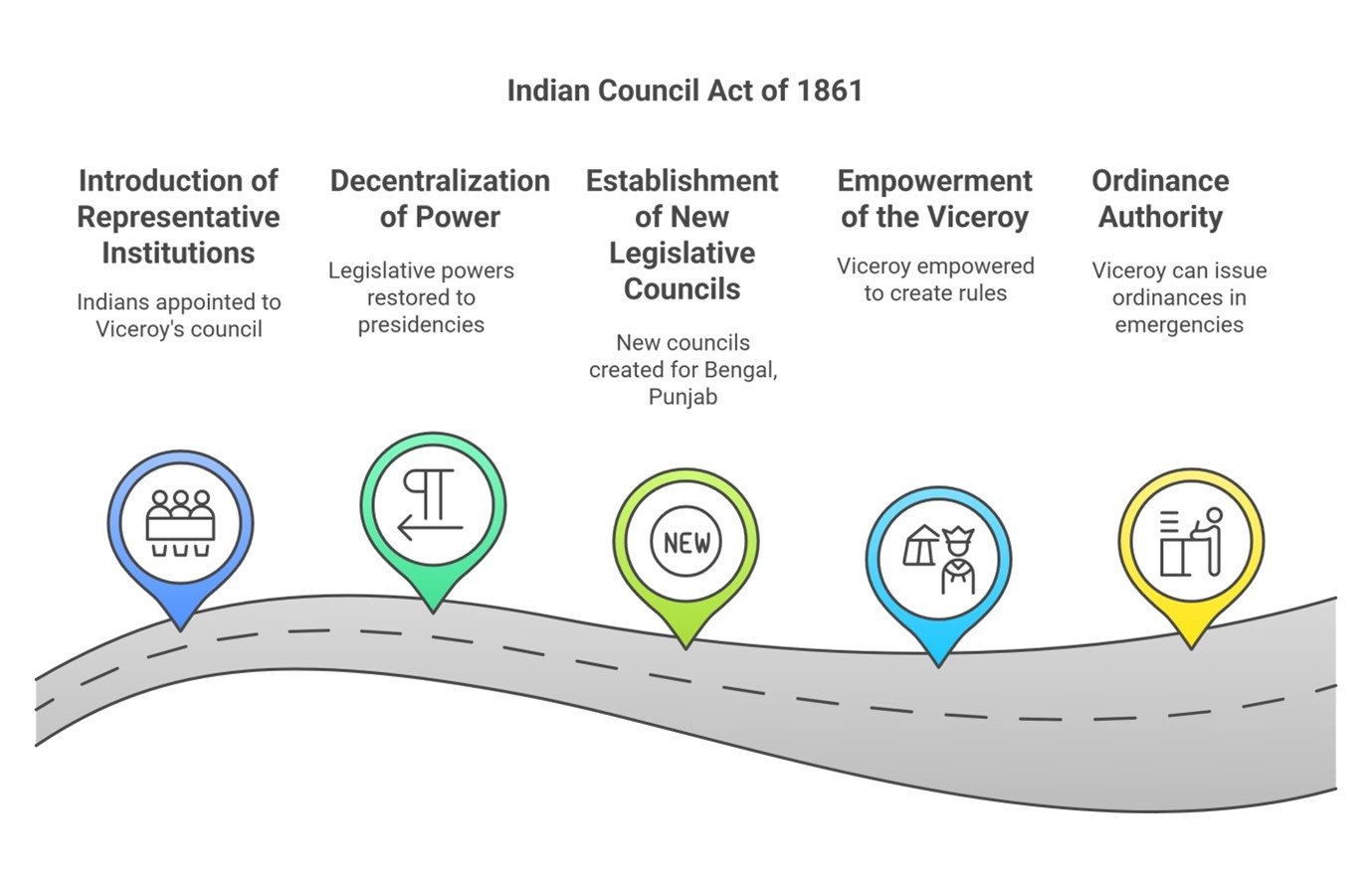
These features reflect the significant steps taken towards inclusivity and governance reform in colonial India.