The Company Rule (1773-1858)
Regulating Act of 1773
Since it was the first move the British Government took to regulate and supervise the East India Company’s operations in India, the Regulating Act of 1773 was noteworthy for its constitutional implications.
It established the foundation for central administration in India and was the first legislation to recognize the Company’s political and administrative responsibilities.
Key features of the Act included:
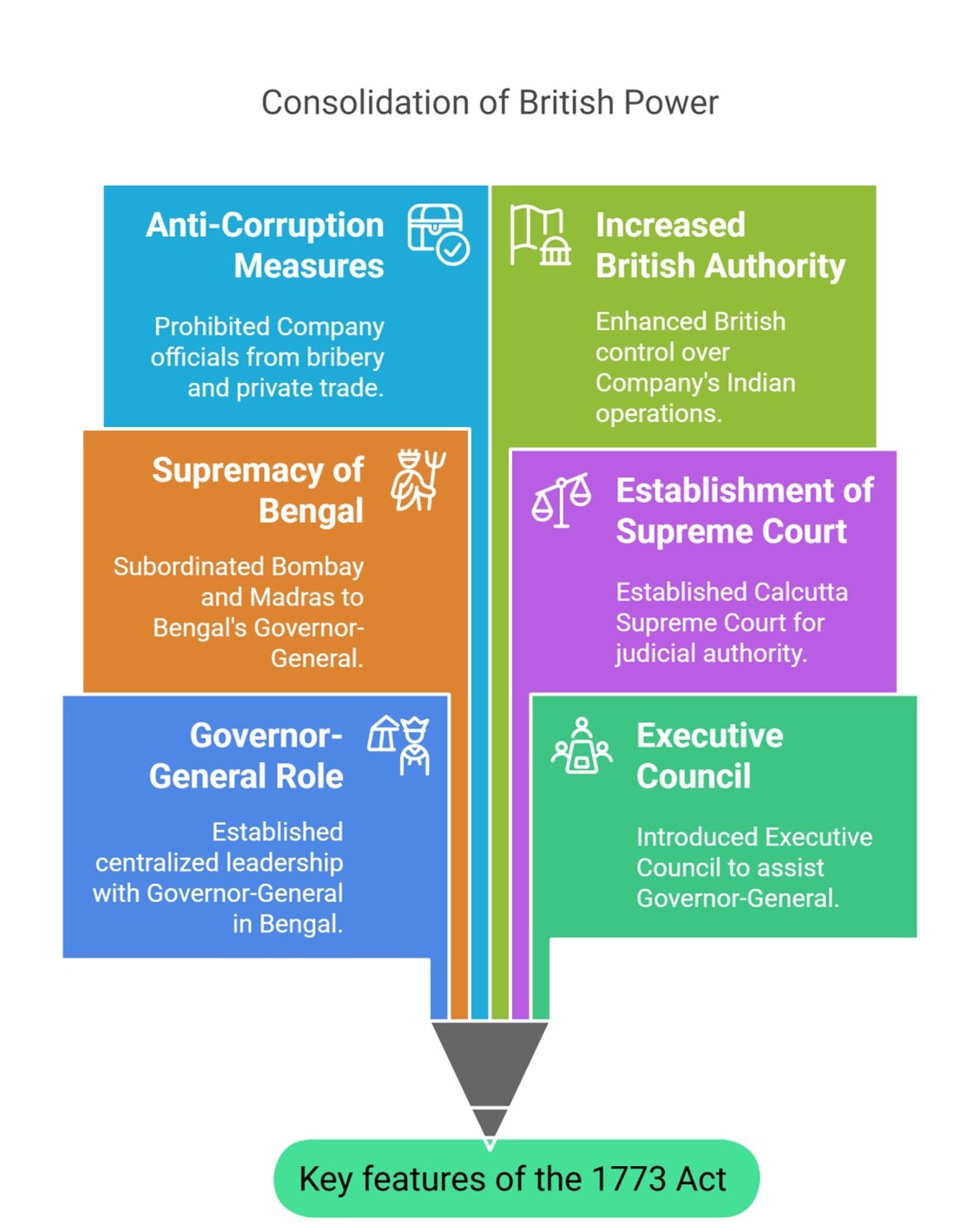
- The designation of the Governor of Bengal as the “Governor-General of Bengal,” along with the creation of a four-member Executive Council to support him. Lord Warren Hastings was the first Governor-General to be appointed under this legislation.
- Unlike earlier, when the three presidencies were independent of one another, it placed the governors of Bombay and Madras under the governor-general of Bengal.
- It provided for the creation of a Supreme Court at Calcutta (1774) consisting of a chief justice and three other judges.
- It barred the Company’s servants from receiving presents or bribes from the “natives” or participating in any kind of private trade.
- By compelling the Court of Directors, the Company’s governing body, to report on its revenue, civil, and military activities in India, it increased the British Government’s authority over the Company.
Amending Act of 1781
To address the shortcomings of the Regulating Act of 1773, the British Parliament enacted the Amending Act of 1781, also known as the Act of Settlement.
The main features of this Act included:
- For acts taken in their official capacities, it exempted the Council and the Governor-General from the Supreme Court’s jurisdiction. In addition, it exempted Company employees from Supreme Court jurisdiction with regard to their official duties.
- It excluded issues pertaining to revenues collection and revenue-related matters from the Supreme Court’s purview.
- It established that the Supreme Court would have jurisdiction over all inhabitants of Calcutta and mandated that the court administer personal laws to defendants, meaning Hindus would be tried under Hindu law and Muslims under Mohammedan law.
- It specified that appeals from Provincial Courts would be directed to the Governor-General-in-Council rather than the Supreme Court.
- It granted the Governor-General-in-Council the authority to create regulations for the Provincial Courts and Councils.
The 1784 Pitt’s India Act
The Pitt’s India Act2 of 1784 was the following significant law. This Act’s characteristics were as follows:
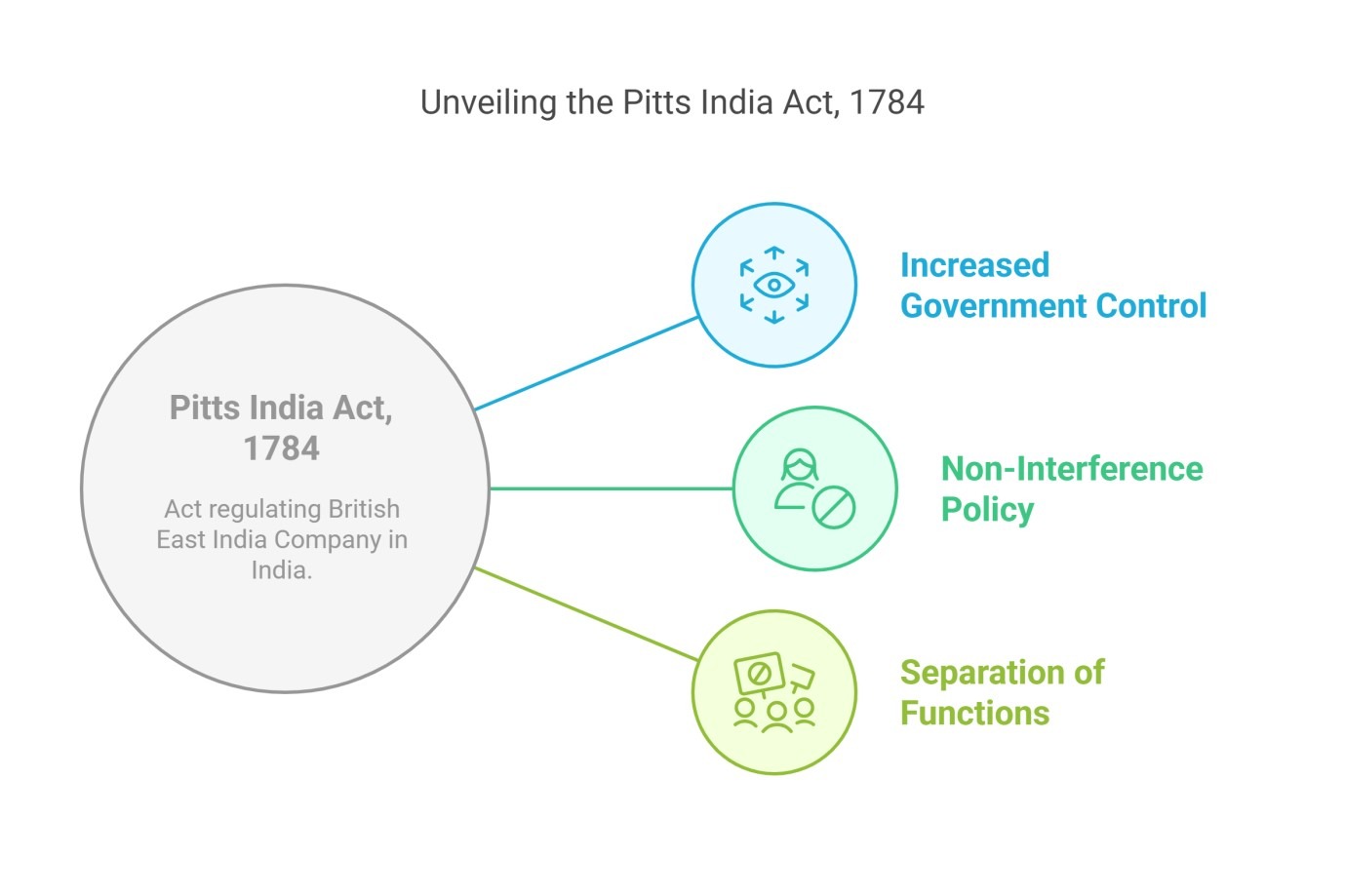
- It made a distinction between the company’s political and commercial operations.
- It established a new organization called the Board of Control to oversee political activities while allowing the Court of Directors to oversee business affairs. As a result, it created a double government.
- It gave the Board of Control the authority to oversee and manage all aspects of the military and civil administration or income generation of the British colonies in India.
Therefore, the legislation was noteworthy for two reasons: first, the Company’s Indian lands were referred to as “British possessions in India” for the first time; and second, the British Government was granted complete authority over the management of the company’s operations in India.
The 1786 Act
Lord Cornwallis was named Governor-General of Bengal in 1786. In order to accept that position, he made two demands:
He ought to have the authority to overrule his council’s judgment in certain circumstances.
In addition, he would serve as Commander-in-Chief.
As a result, both provisions were made by the Act of 1786.
The 1793 Charter Act
This Act’s characteristics were as follows:
- It increased the supreme authority granted to Lord Cornwallis, to all next governors general and governors of presidency, over his council.
- It granted the Governor-General additional authority and command over the administrations of the Bombay and Madras sub-presidencies.
- It gave the company an additional twenty years of trade exclusivity in India.
- It stated that unless specifically designated, the Commander-in-Chief was not to serve on the Governor-General’s council.
- It stipulated that the Board of Control members and their employees would now be compensated using Indian income.
The 1813 Charter Act
This Act’s characteristics were as follows:
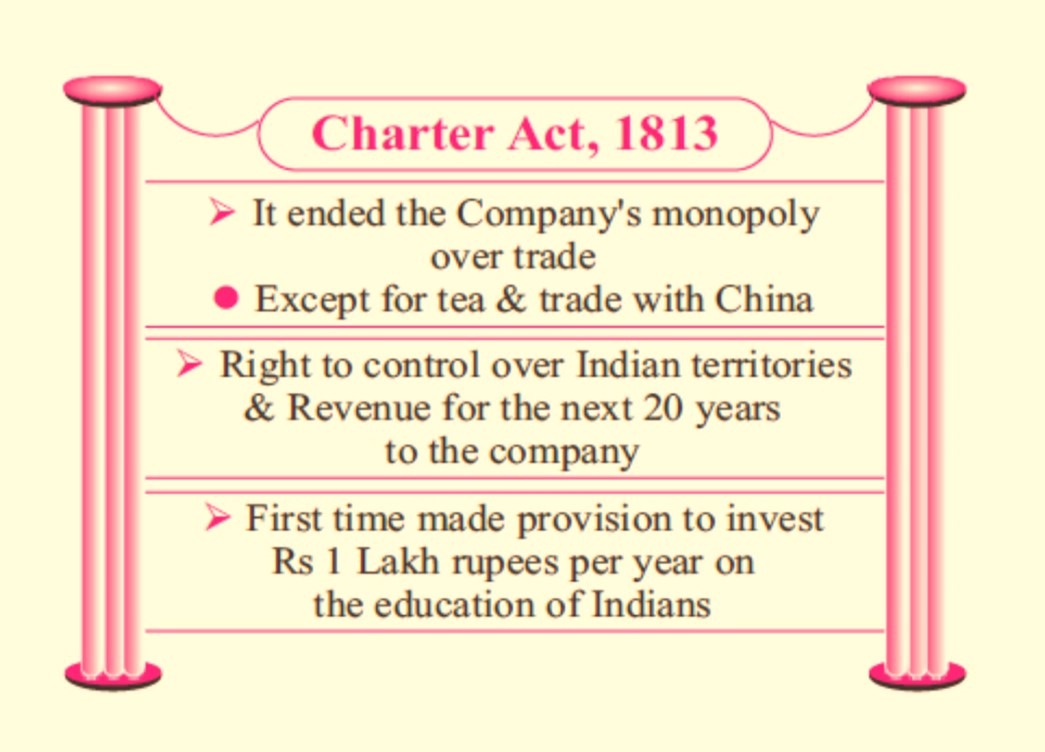
- It ended the company’s trade monopoly in India, which means All British merchants were allowed to deal with India. Nonetheless, it maintained the company’s monopoly on tea and trade with China.
- It affirmed the British Crown’s authority over the Company’s Indian holdings.
- It made it possible for Christian missionaries to travel to India in order to educate the populace.
- It made it possible for the people who lived in the British colonies in India to receive an education in the West.
- It gave Indian local governments the authority to tax citizens. They might also impose penalties on those who fail to pay taxes.
Charter Act of 1833
In British India, this Act was the last step toward centralization.
This Act’s characteristics were as follows:
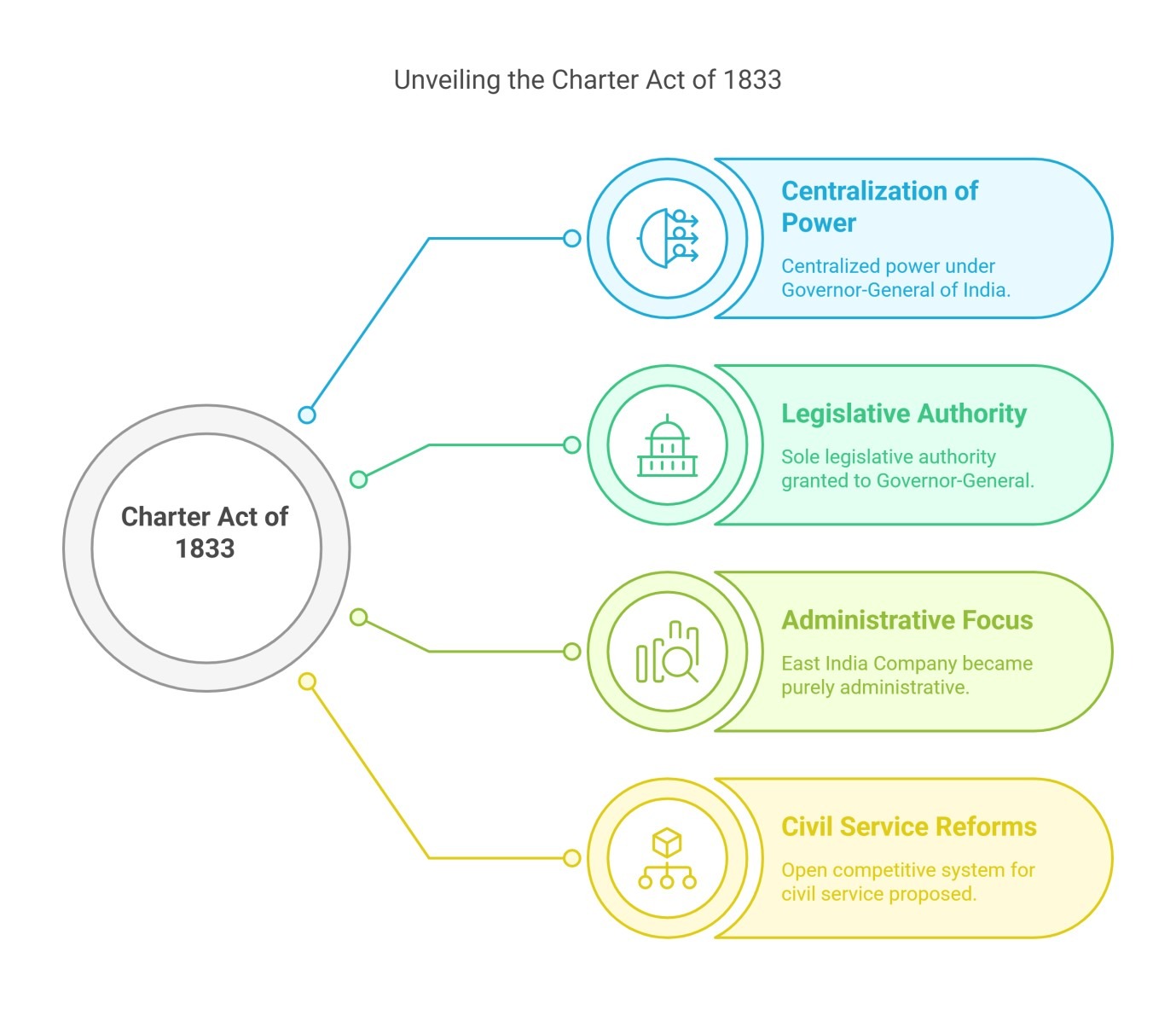
- It gave the governor general of Bengal complete civil and military authority and made him the governor general of India. As a result, the legislation established the Government of India for the first time, with jurisdiction over all of the British-owned territory in India. India’s first governor general was Lord William Bentick.
- It took away the legislative authority of the governors of Madras and Bombay. For all of British India, the Governor-General of India was granted sole legislative authority. The laws created under this act were referred to as Acts, whereas the laws issued under the earlier acts were known as Regulations.
- It turned the East India Company into a purely administrative organization and put an end to its commercial operations. According to this clause, the Company owned its holdings in India “in trust for His Majesty, His heirs and successors.”
- The Charter Act of 1833 declared that Indians should not be prohibited from holding any position, office, or job within the Company and aimed to establish an open competitive system for the selection of civil servants. But once the Court of Directors objected, this clause was removed.
Charter Act of 1853
The British Parliament passed a number of Charter Acts between 1793 and 1853, this being the final one. It was an important turning point in the constitution.
This Act’s characteristics were as follows:
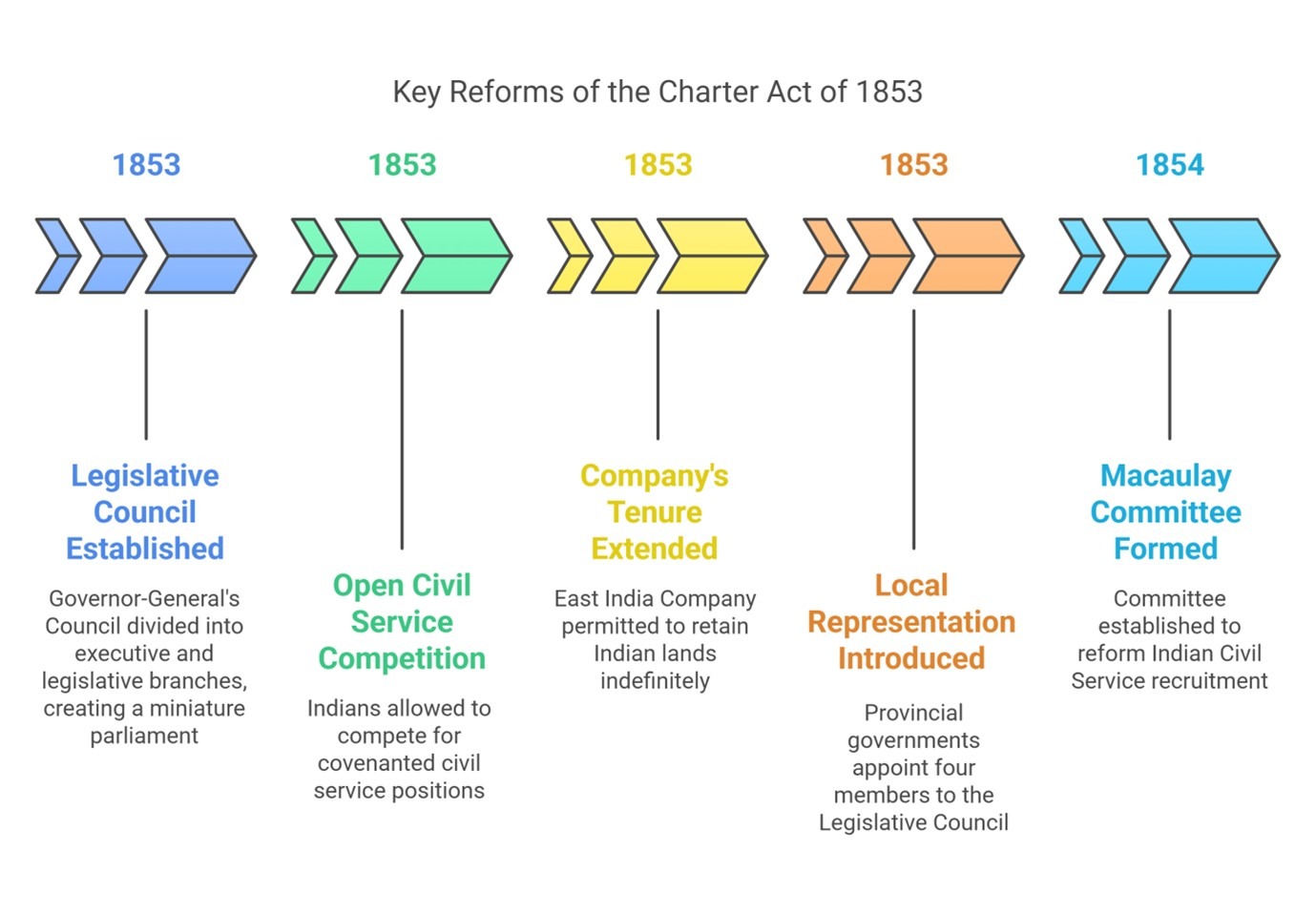
- It separated the Governor-General’s Council’s executive and legislative branches for the first time. It allowed for the council to have six more members, known as legislative councillors. Stated differently, it created a distinct legislative body for the Governor-General, which became known as the Indian (Central) Legislative body. Using the same processes as the British Parliament, this council’s legislative branch operated as a miniature parliament. As a result, legislation was for the first time regarded as a unique government role that called for unique tools and procedures.
- It instituted a system of open competition for civil servant recruitment and selection. Thus, the Indians were likewise granted access to the covenanted civil service3. Consequently, in 1854, the Committee on the Indian Civil Service, sometimes known as the Macaulay Committee, was established.
- It gave the Company more authority and permitted it to hold onto Indian lands held in trust for the British Crown. However, in contrast to the earlier Charters, it did not set a certain time frame. This was a blatant sign that the Parliament could end the Company’s reign whenever it pleased.
- It brought local representation to the Indian (Central) Legislative Council for the first time. Four out of the Governor General’s Council’s six new lawmakers were appointed by the local (provincial) governments of Madras, Bombay, Bengal and Agra.