Creation of Union Territories
The concept of union territories emerged from the administrative structure established during British rule, with areas categorized as “scheduled districts” in 1874. After independence, these territories were initially classified as Part ‘C’ States and Part ‘D’ Territories. In 1956, the 7th Constitutional Amendment Act and the States Reorganisation Act formally created union territories. Some of these territories were later elevated to statehood, such as Himachal Pradesh, Manipur, Tripura, Mizoram, Arunachal Pradesh, and Goa.
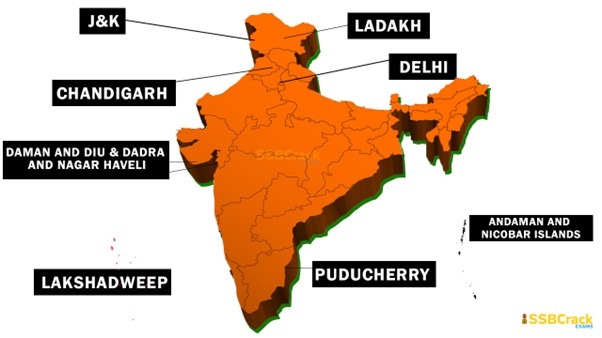
Current Union Territories (as of now)
- Andaman and Nicobar Islands – Established in 1956
- Delhi – Established in 1956 (designated as the National Capital Territory in 1992)
- Lakshadweep – Established in 1956
- Dadra and Nagar Haveli – Acquired in 1961
- Daman and Diu – Acquired in 1962
- Puducherry – Established in 1962 (previously known as Pondicherry until 2006)
- Chandigarh – Established in 1966
- Jammu and Kashmir – Created in 2019 following the bifurcation of the earlier state
- Ladakh – Created in 2019 as a separate union territory
The creation of union territories serves a variety of administrative and political purposes, including:
- Political and Administrative Considerations: Areas like Delhi and Chandigarh are tailored for better governance.
- Cultural Distinctiveness: Territories like Puducherry, Dadra and Nagar Haveli, and Daman and Diu offer unique cultural identities.
- Strategic Importance: Regions like Andaman and Nicobar Islands and Lakshadweep are strategically significant.
- Special Treatment for Backward and Tribal Communities: Areas such as Mizoram, Manipur, Tripura, and Arunachal Pradesh were initially designated as union territories to focus on developmental initiatives before advancing to statehood.
Administration of Union Territories in India
The administration of Union Territories (UTs) in India is governed by Articles 239 to 241 of the Constitution. Despite being grouped under a common category, UTs have different administrative structures. The following points outline their governance framework:
Governance Structure
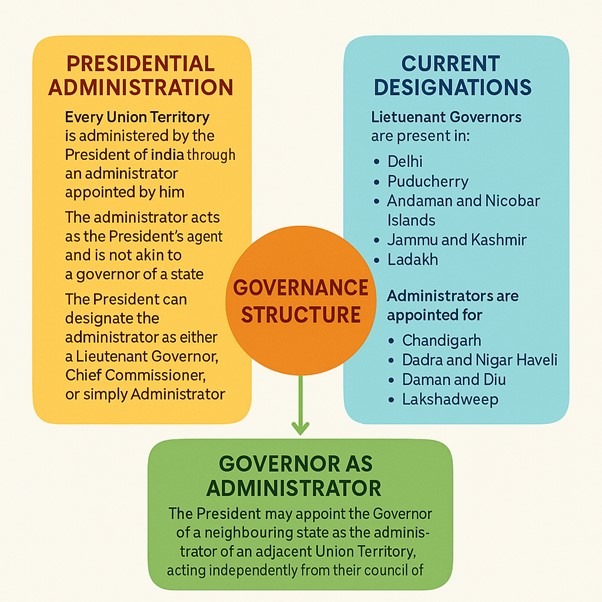
1. Presidential Administration:
- Every Union Territory is administered by the President of Indiathrough an administrator appointed by him.
- The administrator acts as the President’s agent and is not akin to a governor of a state.
- The President can designate the administrator as either a Lieutenant Governor, Chief Commissioner,or simply Administrator.
2. Current Designations:
- Lieutenant Governorsare present in:
- Delhi
- Puducherry
- Andaman and Nicobar Islands
- Jammu and Kashmir
- Ladakh
- Lieutenant Governorsare present in:
- Administratorsare appointed for:
- Chandigarh
- Dadra and Nagar Haveli
- Daman and Diu
- Lakshadweep
- Administratorsare appointed for:
3. Governor as Administrator:
- The President may appoint the Governor of a neighboring state as the administrator of an adjacent Union Territory, acting independently from their council of ministers.
Legislative Framework
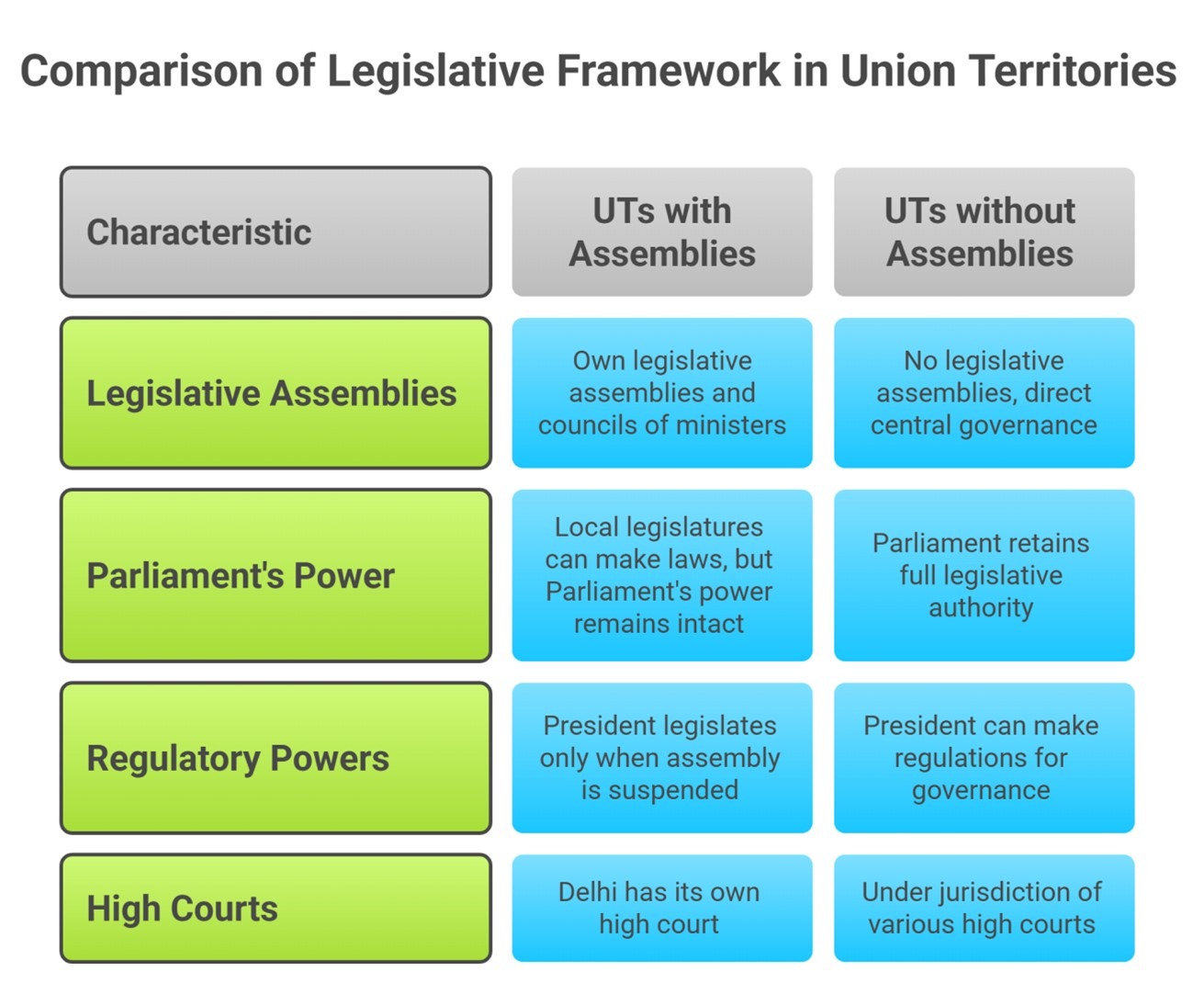
1. Legislative Assemblies:
- Puducherry (1963), Delhi (1992), and Jammu and Kashmir (2019)possess their own legislative assemblies and councils of ministers, headed by a Chief Minister.
- The remaining UTs do not have such political institutions, which allows for direct governance by the Central Government.
2. Parliament’s Power:
- The Parliament retains the authority to legislate on any subject within the three lists, including the State List.
- For Puducherry, Delhi, and Jammu and Kashmir, local legislatures can make laws on State List subjects, but Parliament’s legislative power remains intact irrespective of local legislative assemblies.
3. Regulatory Powers:
- The President can make regulations for the governance of Andaman and Nicobar Islands, Lakshadweep, Dadra and Nagar Haveli, Daman and Diu, and Ladakh.
- In Puducherry, the President may legislate only when the assembly is suspended or dissolved.
4. High Courts:
- The Parliament may establish a high court for a union territory or place it under an adjacent state’s high court’s jurisdiction.
- Delhihas its own high court, while other UTs are under the jurisdiction of various high courts, depending on their location.
Special Provisions for Delhi
The 69th Constitutional Amendment Act of 1991 provides special administrative status for Delhi, renaming it the National Capital Territory of Delhi (NCT):
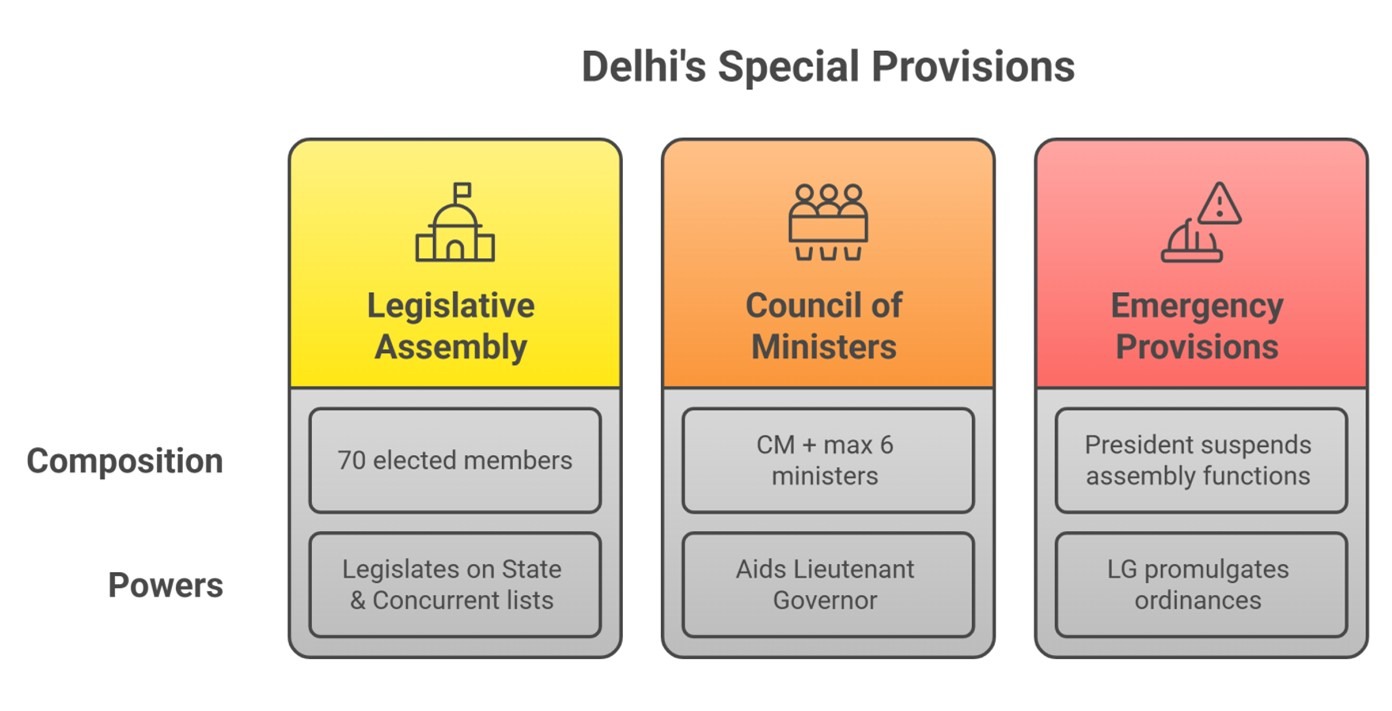
1. Legislative Assembly:
- The strength of the legislative assembly is fixed at 70 members, directly elected by the people, with elections managed by the Election Commission of India.
- The assembly can legislate on matters of the State List and Concurrent List, excluding public order, police, and land.
2. Council of Ministers:
- Composed of a Chief Minister and a maximum of six other ministers (10% of the assembly).
- The Chief Minister is appointed by the President, while the other ministers are appointed on the Chief Minister’s advice.
- The council is collectively responsible to the assembly and aids the Lieutenant Governor in performing functions except when acting in discretion.
3. Emergency Provisions:
- In case of administrative difficulties, the President can suspend the operation of the assembly’s functions, similar to President’s Ruleunder Article 356 for states.
- The Lieutenant Governor can also promulgate ordinances during the assembly’s recess, which must be approved by the assembly within six weeks of its reassembly.