
TOne Academy

Supreme Court

Home / Polity / Supreme Court

Supreme Court

     The Supreme Court of India is the highest judicial authority in the country, establishing an integrated judicial system with a hierarchy that includes High Courts and subordinate courts. Unlike the United States, which has a dual judiciary system (federal and state courts), India maintains a unified judiciary, ensuring that all laws, both central and state, are enforced through one system.

Establishment

    The Supreme Court was inaugurated on January 28, 1950, succeeding the Federal Court of India created under the Government of India Act of 1935. Its jurisdiction is broader than that of its predecessor, as it replaced the British Privy Council as the highest court of appeal.

Constitutional Provisions

      Articles 124 to 147 in Part V of the Constitution govern the organization, independence, jurisdiction, powers, and procedures of the Supreme Court, with Parliament authorized to regulate these aspects.

Composition and Appointment

    • Current Structure: The Supreme Court currently consists of 34 judges, including one Chief Justice and 33 other judges. This number was increased from 31 to 34 judges in 2019, following the Supreme Court (Number of Judges) Amendment Act, 2019. Originally, the Supreme Court had eight members.


    • Appointment Process: The President appoints the judges of the Supreme Court:
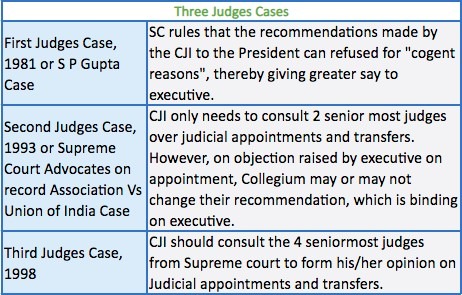
        • The Chief Justice is appointed after consulting with other Supreme Court judges and high court judges as deemed necessary.
        • Other judges are appointed by the President following consultation with the Chief Justice and relevant judges.


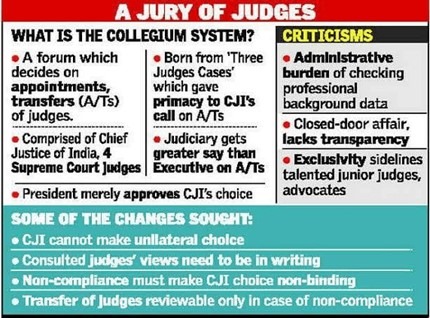
The collegium system is the way by which judges of the Supreme Court and High Courts are appointed and transferred.  It is not rooted in the Constitution or a specific law promulgated by Parliament; 

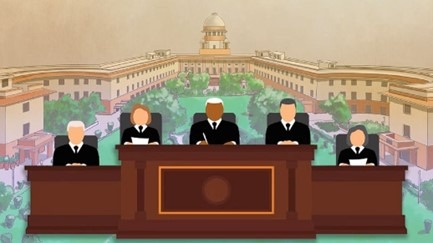
The collegium system evolved out of a series of judgments of the Supreme Court that are called the “Judges Cases”.


Controversy over Consultation

The interpretation of “consultation” has been a matter of judicial evolution:

    • In the First Judges Case (1982), the Supreme Court held that consultation merely implies an exchange of views and does not require concurrence.
    • In the Second Judges Case (1993), the Court reversed this position, ruling that consultation requires concurrence, making the Chief Justice’s advice binding on the President.
    • The Third Judges Case (1998) further stressed that consultation must involve a collegium of the four senior-most judges, indicating that the Chief Justice’s sole opinion is insufficient for recommendations.


In 2014, the 99th Constitutional Amendment Act and the National Judicial Appointments Commission (NJAC) Act sought to establish the NJAC for appointing judges, replacing the collegium system. However, in a landmark verdict in the Fourth Judges Case (2015), the Supreme Court declared both the amendment and the NJAC Act unconstitutional, reinstating the collegium system to safeguard judicial independence.


Appointment of Chief Justice

     Historically, from 1950 to 1973, the senior-most judge of the Supreme Court was conventionally appointed as Chief Justice of India. This practice was deviated from in 1973 when A.N. Ray was appointed Chief Justice by superseding three senior judges. A similar violation occurred in 1977 with the appointment of M.U. Beg. However, the Supreme Court curtailed this discretion in the Second Judges Case (1993), ruling that only the senior-most judge should be appointed as the Chief Justice.


      The Supreme Court of India plays a crucial role in upholding the Constitution, ensuring justice, and maintaining the rule of law. Its structure, appointment processes, and independence measures are central to its effectiveness as the apex judicial authority in the country. The ongoing evolution of its appointment process reflects the delicate balance between maintaining judicial independence and ensuring accountability within the framework of a constitutional democracy.

Qualifications, Oath, and Salaries of Supreme Court Judges

Qualifications of Judges

To be appointed as a judge of the Supreme Court, an individual must meet the following qualifications:

1. Citizenship: The candidate must be a citizen of India.

2. Experience:

        • (a) Have served as a judge of a High Court (or High Courts in succession) for at least five years; or
        • (b) Have been an advocate of a High Court (or High Courts in succession) for at least ten years; or
        • (c) Be recognized as a distinguished jurist in the opinion of the President.


It is important to note that the Constitution does not specify a minimum age for appointment as a judge of the Supreme Court.

Oath or Affirmation

       Before taking office, a newly appointed judge of the Supreme Court must make and subscribe to an oath or affirmation before the President or an appointed representative. In the oath, the judge swears to:


    1. Bear true faith and allegiance to the Constitution of India.
    2. Uphold the sovereignty and integrity of India.
    3. Perform the duties of the office faithfully, to the best of their ability, knowledge, and judgment, without fear, favor, affection, or ill-will.
    4. Uphold the Constitution and the laws.

Salaries and Allowances

       The salaries, allowances, privileges, leave, and pensions of Supreme Court judges are determined by Parliament. Once appointed, their conditions of service cannot be altered to their disadvantage except during a financial emergency. In 2018, the salary of the Chief Justice was raised to ₹2.80 lakh per month, while the salary of other judges was set at ₹2.50 lakh per month. They also receive a sumptuary allowance and various facilities such as free accommodation, medical care, and transportation.

Upon retirement, the Chief Justice and judges are entitled to a pension of 50% of their last drawn salary.

Tenure and Removal

Tenure of Judges

The Constitution does not specify a fixed term for Supreme Court judges; however, it lays out several key provisions regarding their tenure:

    1. Judges hold office until they reach the age of 65 years. Any questions regarding a judge’s age are determined by an authority as provided by Parliament.
    2. Judges can resign by submitting their resignation to the President.
    3. Judges can be removed from office by the President upon the recommendation of Parliament.

Removal of Judges

The procedure for removing a judge of the Supreme Court is as follows:

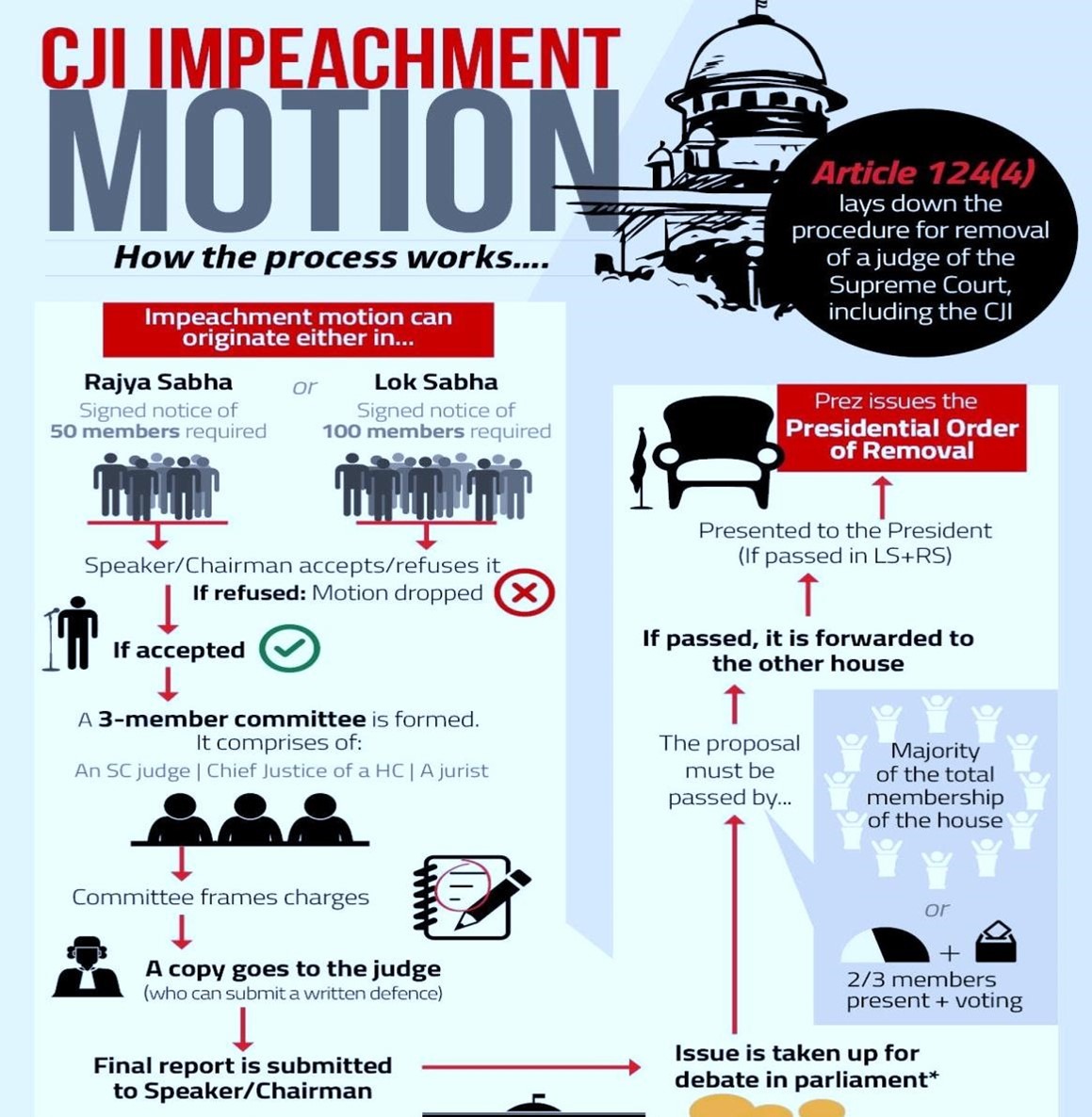
    • The President can issue a removal order only after an address for removal has been presented by Parliament in the same session. This address must be supported by a special majority, meaning it must receive a majority of the total membership of each House as well as a two-thirds majority of those present and voting.

The Judges Enquiry Act (1968) regulates the impeachment process:

1. A removal motion must be signed by 100 members in the Lok Sabha or 50 members in the Rajya Sabha and submitted to the Speaker or Chairman.

2. The Speaker or Chairman may either admit or refuse the motion.

3. If admitted, the Speaker or Chairman forms a three-member committee to investigate the charges, consisting of:

        • A Chief Justice or a judge of the Supreme Court.
        • A Chief Justice of a High Court.
        • A distinguished jurist.

4. If the committee finds the judge guilty of misbehavior or incapacitation, the matter is brought before the House for consideration.

5. Once the motion is passed by both Houses of Parliament with a special majority, an address is presented to the President for the removal of the judge.

6. Finally, the President issues the order for removal.


Notably, no Supreme Court judge has been impeached to date. The first impeachment attempt was against Justice V. Ramaswami (1991–1993), who was found guilty of misbehavior by the inquiry Committee, but the impeachment motion failed in the Lok Sabha due to opposition abstaining from voting.


     The Supreme Court of India serves as the apex judicial authority in the country and plays a crucial role in the Indian democratic and legal system. Below are the key aspects related to the composition, functions, powers, and independence of the Supreme Court.


Acting, Ad-Hoc, and Retired Judges

Acting Chief Justice:

The President can appoint a Supreme Court judge as the Acting Chief Justice under the following conditions:

    1. When the office of the Chief Justice becomes vacant.
    2. When the Chief Justice is temporarily absent or unable to perform duties.


Ad Hoc Judge:

    • In cases of a lack of quorum for holding or continuing a session of the Supreme Court, the Chief Justice can appoint a High Court judge as an ad hoc judge for a temporary period. This appointment requires consultation with the Chief Justice of the concerned High Court and prior consent from the President. The ad hoc judge enjoys all powers, jurisdiction, and privileges of a Supreme Court judge during their tenure.


Retired Judge:

    • The Chief Justice can also request a retired Supreme Court or High Court judge, who is eligible for Supreme Court appointment, to act as a judge temporarily, with the prior consent of the President. The appointed retired judge is entitled to allowances determined by the President and retains full jurisdiction and powers, although they are not officially deemed a Supreme Court judge.

Seat and Procedure

Seat of the Supreme Court:

    • Delhi is designated as the seat of the Supreme Court, although the Chief Justice can establish additional seats with Presidential approval.


Procedure of the Court:

    • The Supreme Court can create rules to regulate its practices and procedures with Presidential approval. Constitutional cases or references made by the President under Article 143 are decided by a Bench of at least five judges, while other cases are resolved by single judges or division benches. Judgments are delivered openly, usually decided by majority vote.

Independence of the Supreme Court

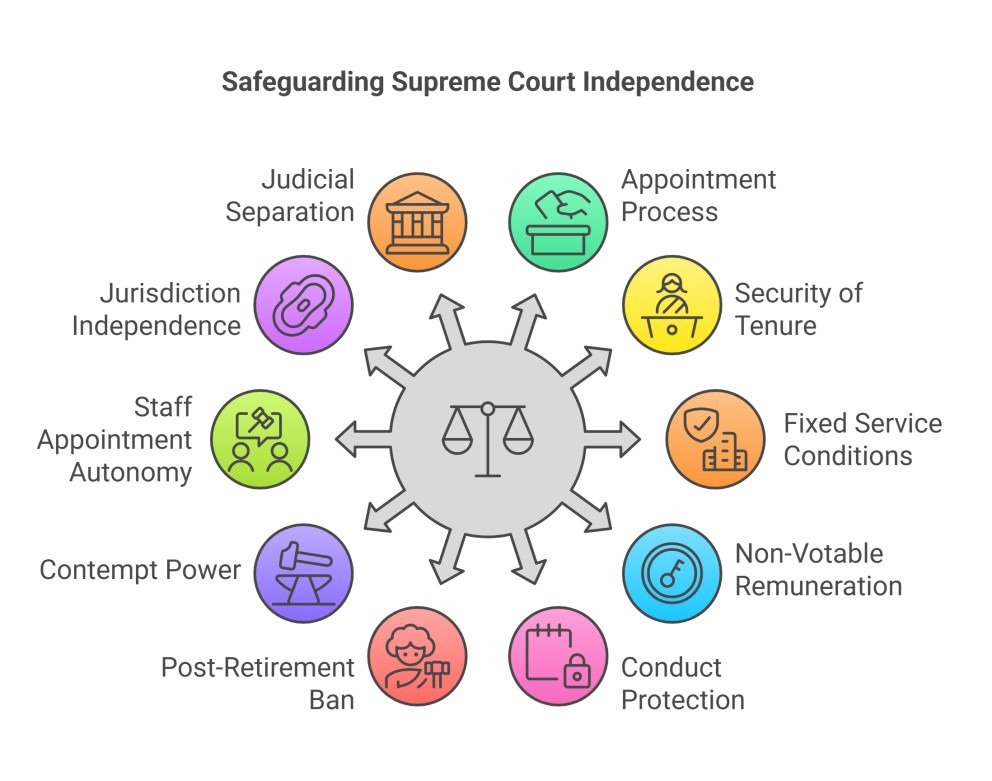
The independence of the Supreme Court is vital for its effective functioning. The Constitution includes several provisions to safeguard this independence:

1. Mode of Appointment: Judges are appointed by the President after consultation with members of the judiciary, reducing the executive’s absolute discretion in appointments.


2. Security of Tenure: They can only be removed from office in accordance with constitutional provisions, thus ensuring that they do not hold office at the pleasure of the President.


3. Fixed Service Conditions: Their service conditions, including salaries and pensions, are determined by Parliament and cannot be altered detrimentally after appointment, except during a financial emergency.


4. Expenses Charged on Consolidated Fund: Their remuneration is charged on the Consolidated Fund of India, making it non-votable by Parliament.


5. Conduct of Judges: The Constitution prohibits discussions regarding the conduct of Supreme Court judges in Parliament, except during impeachment motions.


6. Ban on Post-Retirement Practice: Retired judges are prohibited from practicing or acting in any court or authority in India to prevent any favoritism.


7. Contempt of Court: The Supreme Court can punish individuals for contempt, ensuring that its authority is respected.


8. Freedom to Appoint Staff: The Chief Justice has the autonomy to appoint officers for the Supreme Court without executive intervention.


9. Independence of Jurisdiction: The Parliament cannot curtail the Supreme Court’s jurisdiction; it can only extend it.


10. Judicial Separation: The Constitution directs a separation of the judiciary from the executive, ensuring that executive authorities do not exercise judicial powers.
 

Jurisdiction and Powers of the Supreme Court

      The Supreme Court possesses extensive jurisdiction and varied powers, and it is not only a federal court but also serves as the highest court of appeal while being the final guardian and interpreter of the Constitution.

Classification of Jurisdiction and Powers

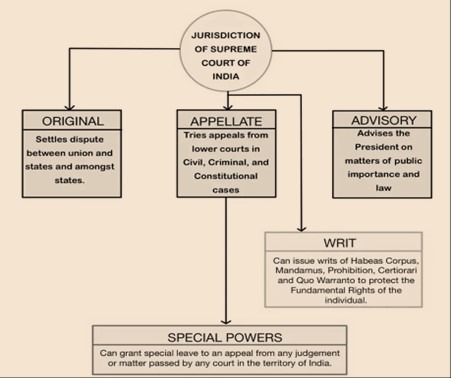
1. Original Jurisdiction:

    • Exclusive original jurisdiction over disputes between the Centre and states, or among states.
    • These disputes must pertain to legal questions, excluding political matters or private citizen suits against the state.


2. Writ Jurisdiction:

    • Empowered to issue writs for the enforcement of Fundamental Rights, the Supreme Court has original jurisdiction allowing aggrieved citizens to approach it directly. Its writ jurisdiction is concurrent with that of High Courts, which have broader powers.


3. Appellate Jurisdiction:

    • Functions as the highest appellate court, hearing appeals in constitutional, civil, and criminal matters.
    • The Supreme Court can also hear appeals by special leave from any court or tribunal.


4. Advisory Jurisdiction:

    • Article 143 allows the President to consult the Supreme Court on important legal or factual questions. Opinions offered are advisory and not binding on the President.


5. Court of Record:

    • The Supreme Court’s decisions and proceedings are recorded and hold evidentiary value. It has the authority to punish contempt of court.


6. Judicial Review:

    • The Supreme Court has the power to examine the constitutionality of legislative enactments and executive orders from both the Central and state governments. If such actions violate the Constitution, they can be declared illegal, unconstitutional, and void.


7. Constitutional Interpretation:

    • The Supreme Court acts as the ultimate interpreter of the Constitution, establishing the spirit and context of its provisions. The Court utilizes various doctrines to aid in this interpretation, including:

Judicial Doctrine:

    • A doctrine is a principle, theory, or position that is usually applied and upheld by courts of law.
    • In Indian Constitutional law also, there are different judicial doctrines that develop over time as per the interpretation given by the judiciary.
    • Some of the important judicial doctrines are discussed in this article.

Doctrine of Basic Structure

About:

    • The constituents ofbasic structure are not clearly defined by the Supreme Court of India.
    • Parliamentary democracy, fundamental rightssecularism,federalismjudicial review are all held by courts as the basic structure of Indian Constitution.


Origin:

    • The origins of the basic structure doctrine are found in the German Constitution which, after the Nazi regime, was amended to protect some basic laws.


Important Judgements:

    • InKesavananda Bharati case 1973, the Supreme Court of India for the first time ruled that the parliament has the power to amend any part of the constitution but it cannot alter the “basic structure of the constitution”.
  •  
    • It was reaffirmed by the SC in theIndira Nehru Gandhi v Raj Narain case (1975).
        • The SC court invalidated a provision of the 39thAmendment Act (1975) which kept the election disputes involving the Prime Minister and the Speaker of Lok Sabha outside the jurisdiction of all courts.
  •  
    • Basic structure doctrine was reaffirmed in the Minerva Mills case, 1980and later in the Waman Rao case, 1981.
        • In this case the Supreme Court examined the validity of Article 31Aand Article 31B of the Constitution of India with respect to the doctrine of basic structure.

Doctrine of Separation of Powers

About:

    • It mainly signifies the division of powers between various organs of the state; executive, legislature and judiciary.
    • Separation of powerssignifies mainly three formulations of Governmental powers:
        • The same person should not form part of more than one of the three organs of the state.
        • One organ should not interfere with any other organ of the state.
        • One organ should not exercise the functions assigned to any other organ.
  •  

Constitutional Provisions:

    • Article-50 of the Directive Principles of State Policy (DPSP)of the Indian Constitution separates the judiciary from executive as, “the state shall take steps to separate judiciary from the executive in the public services of the state and except this there is no formal and dogmatic division of power”.
  •  

Important Judgements:

    • In Ram Jawaya v. State of Punjab (1955) case,the SC held: “Indian Constitution has not indeed recognized the doctrine of separation of powers in its absolute rigidity but the functions of the different parts or branches of the government have been sufficiently differentiated.”
  •  
    • In Indira Nehru Gandhi v. Raj Narain (1975), the SC held: “Separation of powers is part of the basic structure of the constitution. None of the three separate organs of the republic can take over the functions assigned to the other”.

Doctrine of Pith and Substance

About:

    • Pith means ‘true nature’and Substance means ‘the most important or essential part of something’.


Origin:

    • The doctrine wasfirst acknowledged in the Canadian Constitution and In India, it came to be adopted in the pre-independence period, under the Government of India Act, 1935.


Applicability:

    • The Doctrine of Pith and Substanceis usually applied where the question arises of determining whether a particular law relates to a particular subject (mentioned in Seventh Schedule), the court looks to the substance of the matter.
    • Apart from its applicability in cases related to the competency of the legislature(Article 246), the Doctrine of Pith and Substance is also applied in cases related to repugnancy in laws made by Parliament and laws made by the State Legislatures (Article 254).
          • The doctrine is employed in such cases to resolve the inconsistency between laws made by the Centre and the State Legislature.


Important Judgement:

    • In Prafulla v. Bank of Commerce (1946),the SC held that a State law, dealing with money lending (a State subject), is not invalid, merely because it incidentally affects promissory notes.

Doctrine of Incidental or Ancillary Powers

About:

    • It has developed as an addition to the Doctrine of Pith and Substance.
    • This doctrine is invokedwhen there is a need to aid the principal legislation in question.
    • The Doctrine of Pith and Substance deals only with subjects but the Doctrine of Incidental or Ancillary Powers deals with the power to legislate on such subjects and the matters connected thereto.


Origin:

    • The evolution of this Doctrine can be traced back to“R. v. Waterfield (1963)”, a decision of the English Court of Appeal.


Constitutional Provision:

    • Article 4 talks about power to make consequential changes in the law on matters supplemental and incidentalto the law providing for altering the names of states under Article 2 and 3.
    • Article 169talks about the power given to the parliament on abolition or creation of Legislative Councils in States “as may be necessary to give effect to the provisions of the law and may also contain such supplemental, incidental and consequential provisions as Parliament may deem necessary.”


Important Judgement:

    • The SC in theState of Rajasthan v. G Chawla (1958) stated: “The power to legislate on a topic of legislation carries with it the power to legislate on an ancillary matter which can be said to be reasonably included in the power given.”

Doctrine of Severability

About:

    • It is also known as the doctrine of separabilityand protects the Fundamental Rights of the citizens.
    • As per clause (1) of theArticle 13 of the Constitution, if any of the laws enforced in India are inconsistent with the provisions of fundamental rights, they shall, to the extent of that inconsistency, be void.
        • The whole law/act would not be held invalid, but only the provisions which are not in consistencywith the Fundamental rights.


Limitation:

    • If the valid and invalid part are so closely mixed up with each other that it cannot be separated then the whole law or act will be held invalid.


Origin:

    • The Doctrine of Severability finds its roots in Englandin the case of Nordenfelt v. Maxim Nordenfelt Guns and Ammunition Company Ltd. where the issue was related to a Trade clause.


Important Judgements:

    • In K. Gopalan v. State of Madras (1950),the SC held that in case of inconsistency to the Constitution, only the disputed provision of the Act will be void and not the whole of it, and every attempt should be made to save as much as possible of the act.


    • In State of Bombay v. F.N. Balsara (1951),eight sections of the Bombay Prohibition Act were declared invalid, the Supreme Court said that the portion which was invalid to the extent of fundamental rights was separable from the rest of the act.

Doctrine of Eclipse

About:

    • It is applied when any law/act violates the Fundamental Rights (FR).
        • In such a case, theFR overshadows the law/act and makes it unenforceable but not void ab initio (Having no legal effect from inception).
    • They can be reinforced if the restrictions posed by the fundamental rights are removed.
    • It is only against the citizensthat these laws/acts remain in a dormant condition but remain in operation as against non-citizens who are not entitled to fundamental rights.


Constitutional Provisions:

    • Doctrine of eclipse is contained inArticle 13(1) of the Indian Constitution. The doctrine of eclipse does not apply to post-constitutional laws.


Important Judgement:

    • It was first introduced in India inBhikaji Narain Dhakras v. State of Madhya Pradesh (1955) where in the Central Provinces and Berar Motor Vehicles (Amendment) Act, 1947 empowered the Provincial Government to take up the entire Provincial Motor Transport Business, these are violative of article 19(1) (g).

        • The Supreme Court held that the impugned law became, for the time being, eclipsed by the fundamental right.

Doctrine of Territorial Nexus

About:

    • It says that laws made by a State Legislature arenot applicable outside the state, except when there is a sufficient nexus between the state and the object.


Constitutional Provisions:

    • The doctrine derives its power from Article 245of the Indian Constitution.
        • Article 245 (2) provides that no law made by the Parliament would be invalid on the ground that it would have extra-territorial operatione. takes effect outside the territory of India.
  •  

Important Judgements:

    • In H. Wadia v. Income Tax Commissioner (1948),it was held that a question of extraterritoriality of enactment can never be raised against a Supreme Legislative Authority on the grounds of questioning its validity.
  •  
    • In the State of Bombay vs RMDC (1952),the SC held that there existed a sufficient Territorial Nexus to enable the Bombay Legislature to tax the respondent as all the activities which the competitor is ordinarily expected to undertake took place mostly within Bombay.

Doctrine of Colourable Legislation

About:

    • This Doctrine is also called “Fraud on the Constitution”.
    • The Doctrine of Colourable Legislationcomes into play when a Legislature does not possess the power to make law upon a particular subject but nonetheless indirectly makes one.
        • By applying this principle the fate of the Impugned Legislation is decided.


Origin:

    • This Doctrine traces its origin to a Latin Maxim which, in this context, implies: “Whatever legislature cannot do directly, it cannot do indirectly”.
  •  

Constitutional Provision:

    • The doctrine is usually applied toArticle 246 which has demarcated the Legislative Competence of the Parliament and the State Legislative Assemblies by outlining the different subjects under Union list, State list and Concurrent list.
  •  

Limitation:

    • The doctrine has no application where the powers of a Legislature are not fetteredby any Constitutional limitation.
        • It is alsonot applicable to Subordinate Legislation.
  •  

Important Judgement:

    • In S Joshi v. Ajit Mills (1977),the SC observed that “In the statute of force, the colourable exercise of or extortion on administrative force or misrepresentation on the constitution, are articulations which only imply that the assembly is clumsy to authorise a specific law, albeit the mark of competency is struck on it, and afterwards it is colourable enactment.”

Doctrine of Pleasure

Origin:

    • The doctrine of pleasure has its origins in English lawas per which, a civil servant holds office during the pleasure of the Crown.


Constitutional Provisions:

    • Under Article 155, the Governor of a Stateis appointed by the President and holds the office during the pleasure of the President.
    • Under Article 310, the civil servants (members of the Defence Services, Civil Services, All-India Services or persons holding military posts or civil posts under the Centre/State) hold office at the pleasure of the President or the Governoras the case may be.


Limitation:

    • Article 311places restrictions on this doctrine and provides safeguards to civil servants against any arbitrary dismissal from their posts.


Important Judgements:

    • The SC in State of Bihar v. Abdul Majid (1954),held that the English Common Law has not been adopted in its entirety and with all its rigorous implications.
  •  
    • In Union of India v. Tulsiram Patel (1965),the SC held that the “pleasure doctrine” was neither a relic of the feudal age nor was it based on any special prerogative of the British Crown but was based upon public policy.

Doctrine of Harmonious Construction

About:

    • The term harmonious construction refers to such construction by which harmony or oneness amongst various provisions of an enactment is arrived at.
    • When the words of statutory provision bear more than one meaning and there is a doubt as to which meaning should prevail, their interpretation should be in a way that each has a separate effect and neither is redundant or nullified.


Origin:

    • The Doctrine of Harmonious construction originated through interpretations given by courts in a number of cases.
        • The evolution of the doctrine can be traced back to the very first amendment made in the Constitution of India with the landmark judgment of Shankari Prasad v. Union of India.


Principles of rule of Harmonious construction:

    • In the landmark case of CIT v. Hindustan Bulk Carriers (2003)the supreme court laid down five principles of rule of harmonious construction:
        • The courts must avoid a head-on clash of seemingly contradicting provisions and they must construe the contradictory provisions.
        • The provision of one section cannot be used to defeat the provision contained in another unless the court, despite all its efforts, is unable to find a way to reconcile their differences
        • When it is impossible to completely reconcile the differences in contradictory provisions, the courts must interpret them in such a way so that effect is given to both the provisions as much as possible.
        • Courts must also keep in mind that interpretation that reduces one provision to useless number or death is not harmonious construction.
        • To harmonize is not to destroy any statutory provision or to render it fruitless.


Important Judgements:

    • In the Re-Kerala education bill 1951case it was held that in deciding the fundamental rights the court must consider the directive principle and adopt the principle of harmonious construction. So, two possibilities are given effect as much as possible by striking a balance.


    • In East India hotels ltd. V. Union of India (2001) case, it was held that an Act is to be read as a whole, the different provisions have to be harmonized and the effect to be given to all of them.


8. Original Jurisdiction:

The Supreme Court has exclusive original jurisdiction in disputes involving:

    • The Centre and one or more states.
    • The Centre and states on one side vs. other states on the other.
    • Two or more states.


9. Writ Jurisdiction:

    • It can issue writs for the enforcement of Fundamental Rights, enabling aggrieved citizens to approach the Supreme Court directly. This jurisdiction is concurrent with that of High Courts, which can also issue writs.


10. Appellate Jurisdiction:

    • The Supreme Court serves as the highest appellate authority, hearing appeals in constitutional, civil, and criminal matters. Appeals may arise from high court judgments, and the Supreme Court has the discretion to grant special leave to appeal in various cases.


11. Advisory Jurisdiction:

    • Under Article 143, the President can consult the Supreme Court on important legal matters or disputes arising from pre-constitution treaties. The Court’s advisory opinions are not binding but provide authoritative guidance.


12. Court of Record:

    • The Supreme Court’s proceedings are recorded, and these records hold evidentiary value. It has the authority to punish for contempt of court to maintain its dignity and authority.


13. Constitutional Interpretation:

    • The Supreme Court is responsible for ensuring an accurate interpretation of the Constitution, applying various doctrines to reach just outcomes.
 

Supreme Court Advocates

Categories of Advocates

Senior Advocates:

    • Designated by the Supreme Court or High Courts based on expertise, standing, or special knowledge. Senior Advocates must work in conjunction with advocates-on-record for Supreme Court appearances and cannot engage in drafting or advisory work without a junior.


Advocates-on-Record:

    • These advocates are authorized to file documents and appear for parties in the Supreme Court, acting as the direct representatives in cases.


Other Advocates:

    • Members whose names are entered on any State Bar Council’s roll. They can present cases but cannot file documents directly in the Supreme Court.

Comparison: Indian and American Supreme Courts

Aspect

Indian Supreme Court

American Supreme Court

Original Jurisdiction

Limited to federal cases

Covers federal cases, naval activities, and ambassadorial matters

Appellate Jurisdiction

Includes constitutional, civil, and criminal cases

Confined to constitutional cases

Special Leave to Appeal

Wide discretion to grant special leave for any judgment

No such plenary power

Advisory Jurisdiction

Has advisory jurisdiction

Lacks advisory jurisdiction

Judicial Review Scope

Limited scope

Broader scope

Defending Citizen Rights

Based on ‘procedure established by law’

Based on ‘due process of law’

Jurisdiction Modification

Parliament can expand jurisdiction

Jurisdiction limited to what Constitution allows

Judicial Control Over States

Holds power over state high courts

No equivalent power

Articles Related to the Supreme Court at a Glance


Article No.

Subject Matter

124

Establishment and Constitution of the Supreme Court

124A

National Judicial Appointments Commission

124B

Functions of the Commission

124C

Power of Parliament to make laws

125

Salaries, etc., of