
Functions and Operations of the State Human Rights Commission
The State Human Rights Commission (SHRC) is tasked with protecting and promoting human rights within their respective jurisdictions. Below are the specific functions and operations of the Commission as well as details regarding the establishment of Human Rights Courts.
Functions of the Commission
The SHRC has several critical functions aimed at safeguarding human rights:
1. Inquiry into Violations:
- Investigates allegations of human rights violations or negligence by public servants, either suo motu (on its own initiative) or on the basis of petitions or court orders.
2. Court Interventions:
- Intervenes in ongoing legal proceedings involving allegations of human rights violations before any court.
3. Inspection of Detention Facilities:
- Conducts visits to jails and detention centers to assess living conditions and make recommendations for improvements.
4. Review of Legal Safeguards:
- Reviews constitutional and legal safeguards for protecting human rights and recommends measures for their effective implementation.
5. Addressing Inhibiting Factors:
- Evaluates factors that hinder the enjoyment of human rights, including issues like terrorism, and recommends remedial measures.
6. Research and Promotion:
- Undertakes and promotes research in the field of human rights to develop awareness and knowledge about rights among the populace.
7. Awareness Programs:
- Spreads human rights literacy and promotes awareness among the public regarding available safeguards.
8. Encouraging NGO Efforts:
- Supports the initiatives of non-governmental organizations (NGOs) working in the human rights sector.
9. Additional Functions:
- Performs any other functions deemed necessary for the promotion and protection of human rights.

Working of the Commission
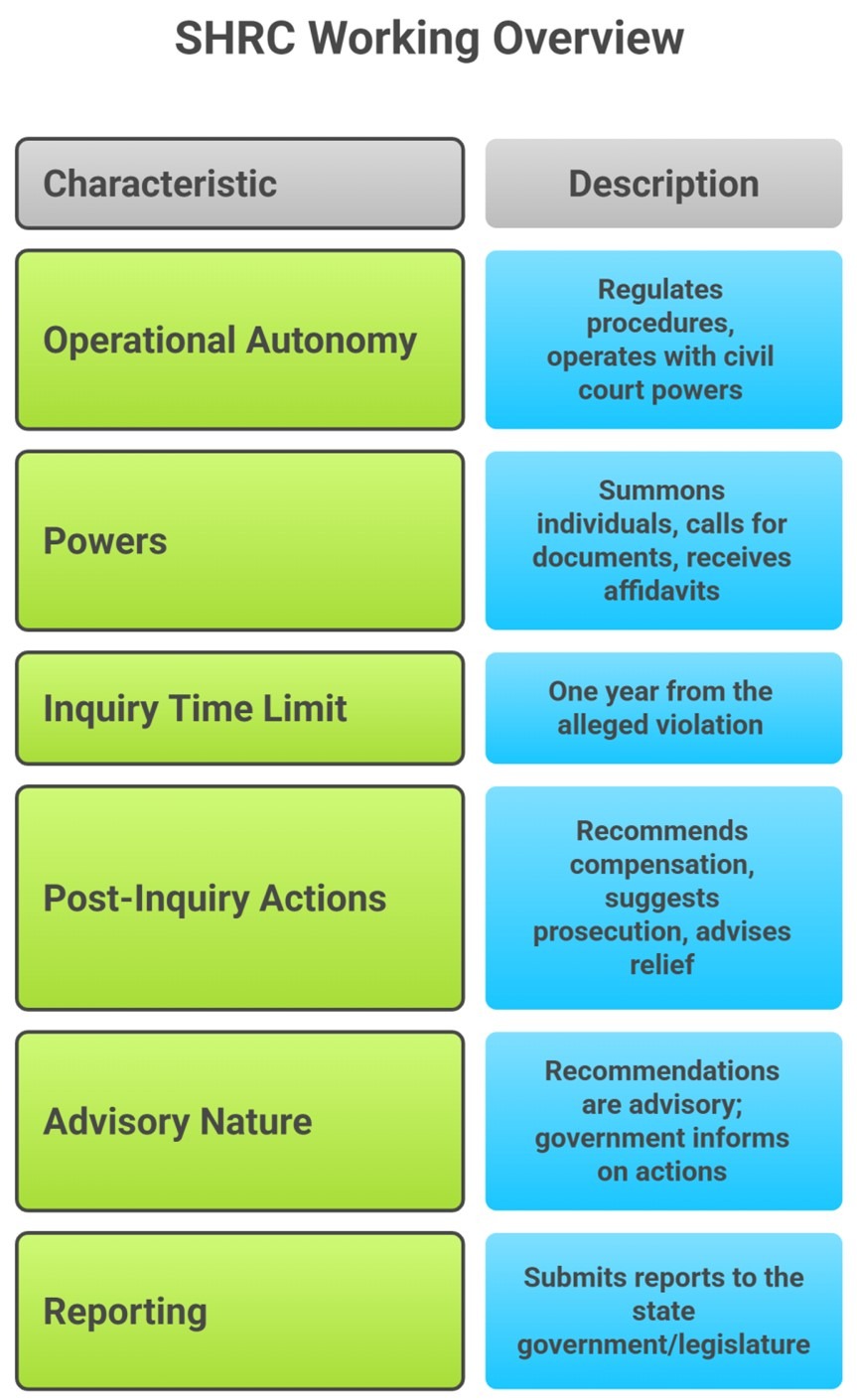
Operational Autonomy:
- The Commission regulates its own procedures and operates with the powers of a civil court, enabling it to conduct inquiries with judicial authority.
Powers:
- It can summon individuals, call for documents, receive affidavits, requisition public records, and issue summons for witnesses during its investigations.
Time Limitation for Inquiries:
- The SHRC can inquire into cases of human rights violations only if they are reported within one year of the alleged violation.
Post-Inquiry Actions:
- After completing an inquiry, the Commission may take several actions:
- Recommend compensation or damages for victims to the relevant state authority.
- Suggest the initiation of prosecution against responsible public servants.
- Advise on granting immediate interim relief to victims.
- Approach the Supreme Court or High Court for necessary judicial directions.
- After completing an inquiry, the Commission may take several actions:
Advisory Nature:
- The recommendations of the SHRC are primarily advisory and are not binding on the state government or authority. However, the government must inform the Commission about actions taken on its recommendations within one month.
Reporting:
- The Commission submits its annual or special reports to the state government, which are then laid before the state legislature along with explanations for any non-acceptance of recommendations.
Establishment of Human Rights Courts
The Protection of Human Rights Act, 1993 also provides for the establishment of Human Rights Courts to ensure the swift trial of human rights violations.
1. Establishment:
- These courts can be set up in each district by the state government, but only with the concurrence of the Chief Justice of the state’s High Court.
2. Prosecution:
- For every Human Rights Court, the state government designates a public prosecutor or appoints a special public prosecutor, who must have at least seven years of legal practice.
The State Human Rights Commission plays a vital role in safeguarding human rights through its investigative powers, monitoring of government actions, and recommendations for policy improvements. The establishment of Human Rights Courts further enhances the legal framework for addressing human rights violations swiftly and effectively. Together, these mechanisms aim to foster a culture of respect for human rights across the nation.
Protection of Human Rights (Amendment) Act, 2019
The Protection of Human Rights (Amendment) Act, 2019 introduced several key changes aimed at strengthening the framework of human rights protection in India through the enhancement and reorganization of the National Human Rights Commission (NHRC) and the State Human Rights Commissions (SHRCs). Below are the primary provisions or features of the Amendment Act:
Key Provisions
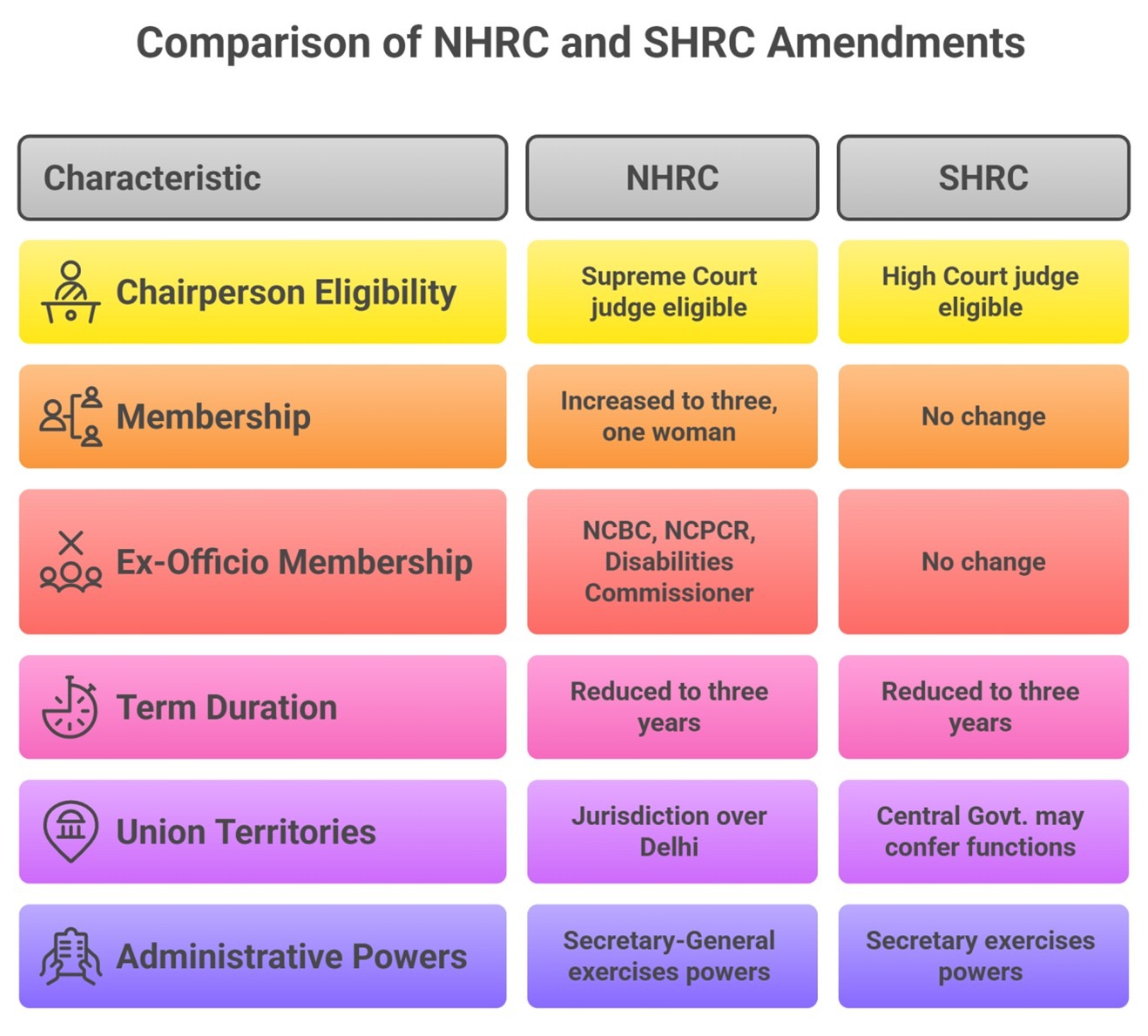
1. Eligibility for Chairperson of NHRC:
- The Amendment allows a person who has served as a judge of the Supreme Court to be eligible for appointment as the Chairperson of the NHRC, in addition to the existing provision for the Chief Justice of India.
2. Increase in Membership:
- The number of members appointed to the NHRC from among those with knowledge or experience in human rights was increased from two to three, with a requirement that at least one member must be a woman.
3. Ex-Officio Membership:
- The Chairpersons of the National Commission for Backward Classes (NCBC), the National Commission for Protection of Child Rights (NCPCR), and the Chief Commissioner for Persons with Disabilities were designated as ex-officio members of the NHRC.
4. Reduction of Term Duration:
- The term of office for the Chairperson and members of both the NHRC and SHRCs was reduced from five years to three years, but they remain eligible for re-appointment.
5. Eligibility for Chairperson of SHRC:
- Similar to the NHRC, the Amendment allows a person who has been a judge of a High Court to be appointed as the Chairperson of the SHRC, in addition to those who have served as Chief Justices of High Courts.
6. Functions of SHRCs for Union Territories:
- The Amendment provided that the Central Government may confer upon State Human Rights Commissions the functions related to human rights for Union Territories (excluding Delhi). In contrast, the NHRC maintains jurisdiction over the Union Territory of Delhi.
7. Administrative Powers:
- The Secretary-General of the NHRC is given the authority to exercise all administrative and financial powers (except for judicial functions and the power to make regulations), under the control of the Chairperson.
- Similarly, the Secretary of the SHRC is authorized to exercise all administrative and financial powers of the Commission, also under the Chairperson’s control.
The Protection of Human Rights (Amendment) Act, 2019, marks a significant step towards enhancing the effectiveness of human rights bodies in India by improving the eligibility criteria for leadership roles, increasing female representation, and clarifying the administrative powers necessary for efficient functioning. This Act ultimately aims to strengthen the mechanisms in place for the promotion and protection of human rights across the nation.