
TOne Academy

Parliamentary Group

Home / Polity / Parliamentary Group

Parliamentary Group

Establishment of the Parliamentary Forum

     The Indian Parliamentary Group (IPG) was established to foster inter-parliamentary relations and enhance collaboration among parliamentarians, reflecting the increasing interdependence of nations in a global context. M.N. Kaul and S.L. Shakdher emphasized the need for parliamentarians to collaborate in safeguarding democracy and addressing global challenges, ultimately transforming them into opportunities for peace and prosperity.

Composition of the Indian Parliamentary Group (IPG)

    The IPG is an autonomous body formed in 1949 following a motion adopted by the Constituent Assembly. Its membership is open to all members of Parliament, including former members, who can become associate members with limited rights. However, associate members do not have representation at IPG meetings or the Inter-Parliamentary Union (IPU) and Commonwealth Parliamentary Association (CPA) conferences.


Leadership:

    • The Speaker of the Lok Sabha serves as the ex-officio President of the IPG.
    • The Deputy Speaker of the Lok Sabha and the Deputy Chairman of the Rajya Sabha act as ex-officio Vice-Presidents.
    • The Secretary-General of the Lok Sabha functions as the ex-officio Secretary-General of the IPG.

Objectives of the Indian Parliamentary Group

The aims of the IPG include:

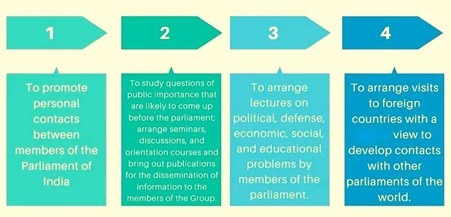
1. Promoting Contacts: Enhance personal connections among members of the Indian Parliament.


2. Public Importance Studies: Study matters of public significance likely to arise in Parliament and organize seminars and discussions to disseminate information to members.


3. Educational Lectures: Arrange lectures on various political, defense, economic, social, and educational issues by members and distinguished figures.


4. International Engagement: Organize visits to foreign countries to foster connections with members of other parliaments.
 

Functions of the Indian Parliamentary Group

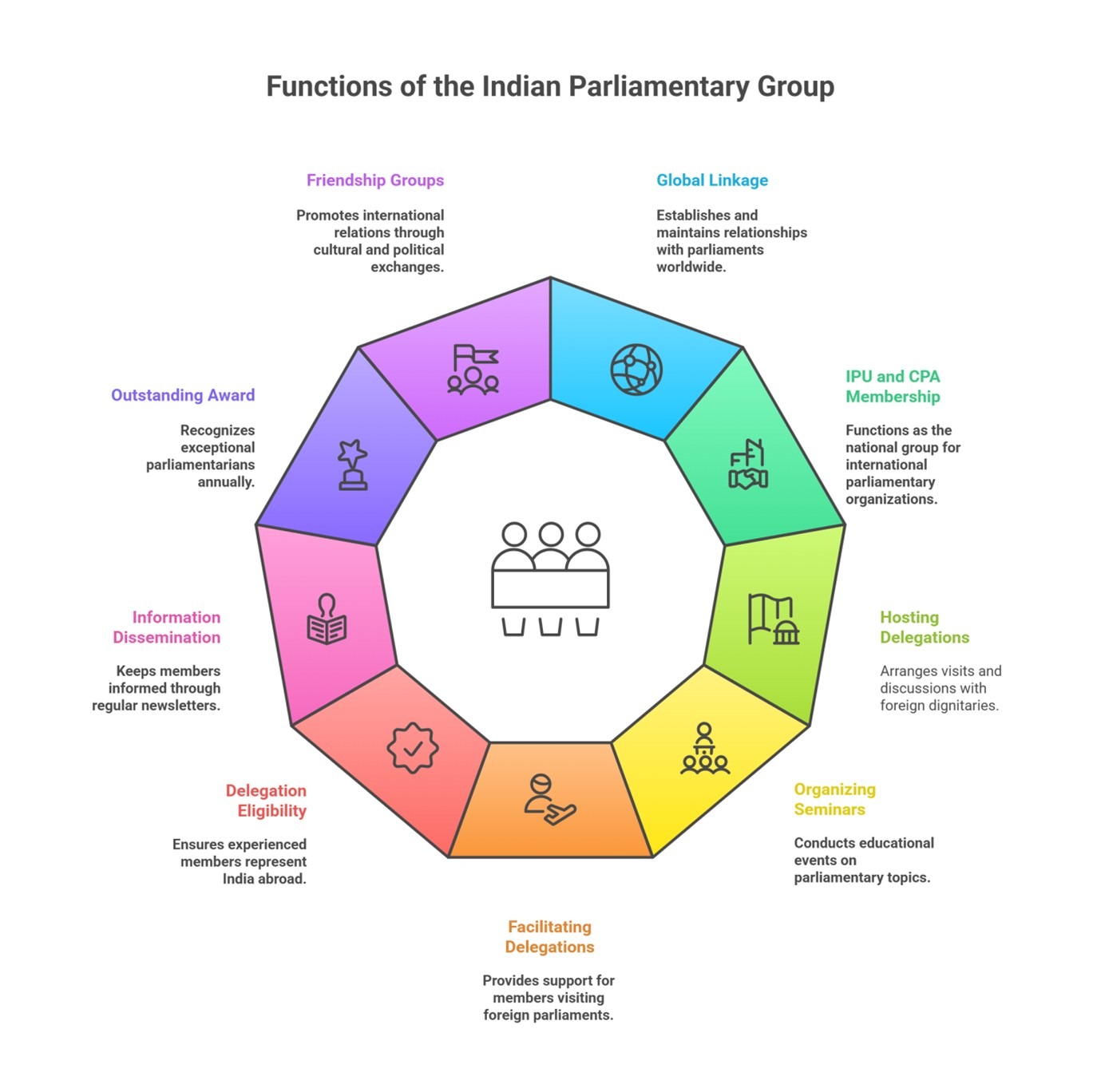
The IPG undertakes various functions, including:

1. Linkage with Global Parliaments: Acts as a conduit between the Indian Parliament and parliaments worldwide, maintaining relationships through exchanges of delegations, goodwill missions, and correspondence.


2. Membership of IPU and CPA: Functions as the National Group of the Inter-Parliamentary Union (IPU) and the primary branch of the Commonwealth Parliamentary Association (CPA) in India.


3. Hosting Delegations: Arranges addresses to members from visiting foreign Heads of State and discussions by prominent individuals.


4. Organizing Seminars: Conducts seminars and symposia on relevant parliamentary subjects at both national and international levels.


5. Facilitating Parliamentary Delegations: Provides letters of introduction to members visiting abroad, allowing them to connect with other national groups of the IPU and CPA.


6.Eligibility for Delegation: Ensures only members who have been part of the IPG for at least six months are included in delegations to foreign countries.


7. Information Dissemination: Maintains an ongoing flow of information to members through a quarterly IPG Newsletter sent to all members, including associates.


8. Outstanding Parliamentarian Award: Since 1995, the IPG awards the title of Outstanding Parliamentarian annually, with nominations managed by a committee appointed by the Speaker of the Lok Sabha.


9. Parliamentary Friendship Groups: Establishes Friendship Groups with other countries to promote political, social, and cultural connections, as well as to facilitate the exchange of experiences related to parliamentary activities.


The IPG plays an essential role in enhancing governance, promoting democratic values, and fostering collaborations that contribute to India’s parliamentary effectiveness on the global stage.

The Group and the Inter-Parliamentary Union (IPU)

      The Inter-Parliamentary Union (IPU) is an international organization comprising the parliaments of sovereign states, currently consisting of 153 member parliaments. Its primary goals are to promote peace and cooperation among peoples and to firmly establish representative institutions. The IPU facilitates communication, coordination, and sharing of experiences among parliaments and parliamentarians, contributing to a better understanding of how representative institutions operate. Additionally, it addresses pressing international issues, advocating for effective parliamentary actions and enhancements to the functioning of international institutions.

Advantages of Membership in the Indian Parliamentary Group (IPG) as the National Group of the IPU:

1. Networking Opportunities: Members of Indian Parliamentary delegations can develop contacts with parliamentarians from IPU member countries.


2. Understanding Global Reforms: Participation in events allows members to study and comprehend contemporary changes and reforms occurring worldwide.


3. Facilitated Meetings: The Group provides opportunities to meet parliamentarians from other countries during international visits or when foreign Parliament members visit India.


4. Delegation Participation: Group members are eligible to join Indian Parliamentary delegations to Inter-Parliamentary Conferences abroad.


In recent years, members of the Group have held various influential positions within IPU bodies, including office bearers in committees, rapporteurs, and chairpersons of drafting committees. This involvement has enabled the Group to effectively present India’s viewpoints on important issues discussed in IPU meetings.

The Group and the Commonwealth Parliamentary Association (CPA)

    The Commonwealth Parliamentary Association (CPA) is an association of around 17,000 Commonwealth parliamentarians across 175 national, state, provincial, and territorial parliaments. The CPA aims to promote knowledge and understanding of the constitutional, legislative, economic, social, and cultural systems within a parliamentary democratic framework, particularly pertinent to Commonwealth countries and those with historical ties to it. Its mission is to advance parliamentary democracy by enhancing knowledge and understanding of democratic governance and fostering a well-informed parliamentary community that can deepen the Commonwealth’s democratic commitment.

Advantages of Membership in the Indian Parliamentary Group (IPG) as the Main Branch of the CPA:

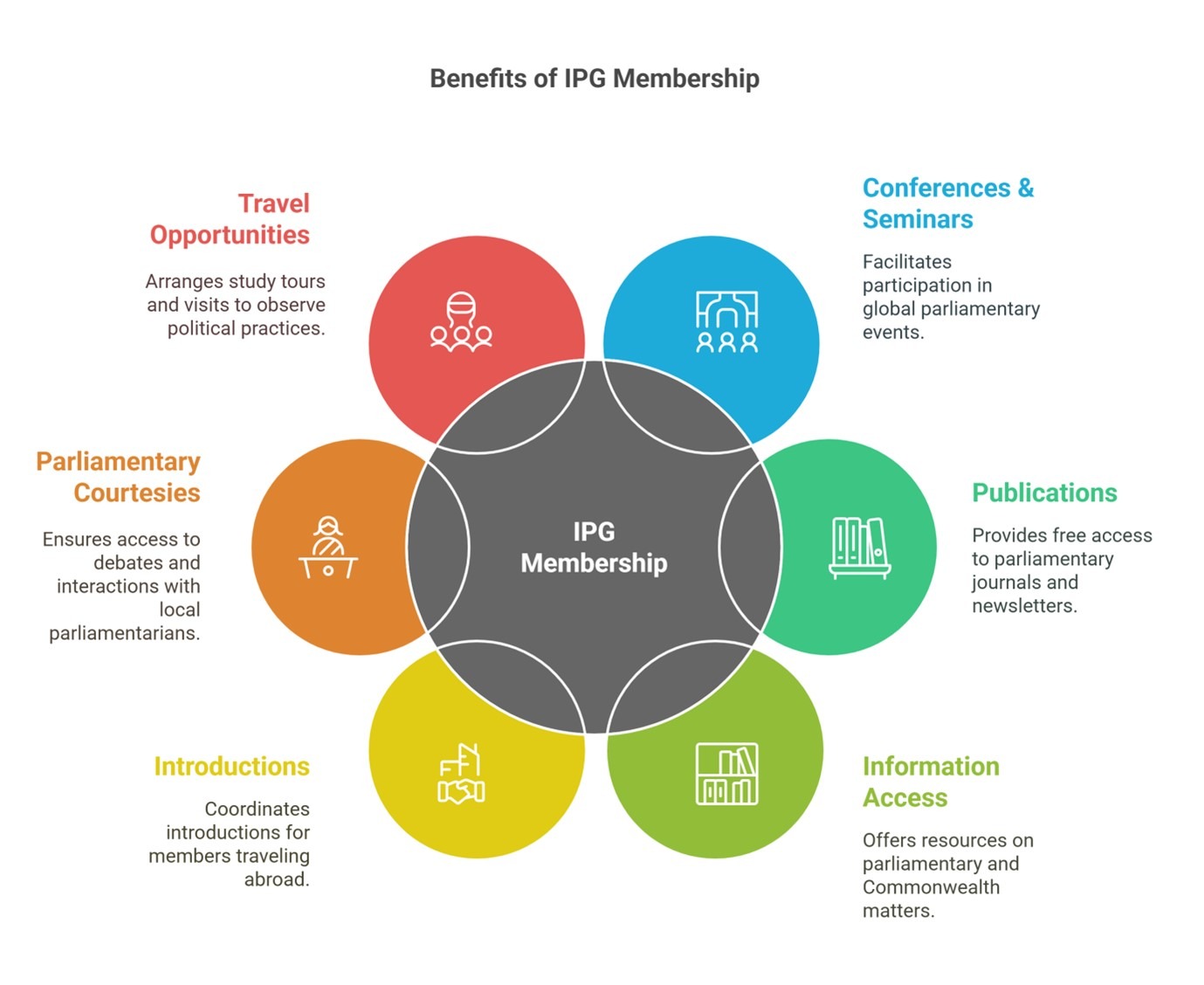
1. Conferences and Seminars: Membership facilitates participation in plenary and regional conferences, seminars, and delegation exchanges.


2. Publications: Members receive “The Parliamentarian” quarterly and the bi-monthly newsletter “First Reading” at no cost.


3. Access to Information: The Parliamentary Information and Reference Centre of the CPA Secretariat provides members with information regarding parliamentary, constitutional, and Commonwealth matters.


4. Introductions: CPA branches assist in coordinating introductions for members traveling to other jurisdictions.


5. Parliamentary Courtesies: Members visiting other Commonwealth countries typically receive parliamentary courtesies, including access to debates and local parliamentarians.


6. Travel Opportunities: Certain branches offer a designated number of members the opportunity to undertake study tours of Commonwealth and other countries to observe political and procedural practices. Other branches also arrange ad hoc visits for members.


These affiliations with the IPU and CPA enable the Indian Parliamentary Group to enhance its effectiveness, promote democracy, and strengthen international cooperation among legislative bodies