
TOne Academy

Parliamentary Forums

Home / Polity / Parliamentary Forums

Parliamentary Forums

Establishment of the Forums

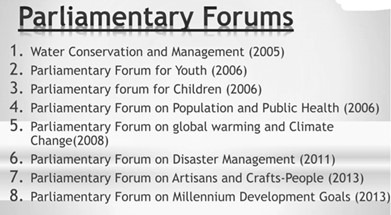
     The first Parliamentary Forum on Water Conservation and Management was established in 2005, marking the beginning of a series of forums aimed at addressing critical issues through parliamentary engagement. Currently, there are eight Parliamentary Forums in total:


    1. Parliamentary Forum on Water Conservation and Management (2005)
    2. Parliamentary Forum on Youth (2006)
    3. Parliamentary Forum on Children (2006)
    4. Parliamentary Forum on Population and Public Health (2006)
    5. Parliamentary Forum on Global Warming and Climate Change (2008)
    6. Parliamentary Forum on Disaster Management (2011)
    7. Parliamentary Forum on Artisans and Crafts-people (2013)
    8. Parliamentary Forum on Millennium Development Goals (2013)
 

Objectives of the Forums

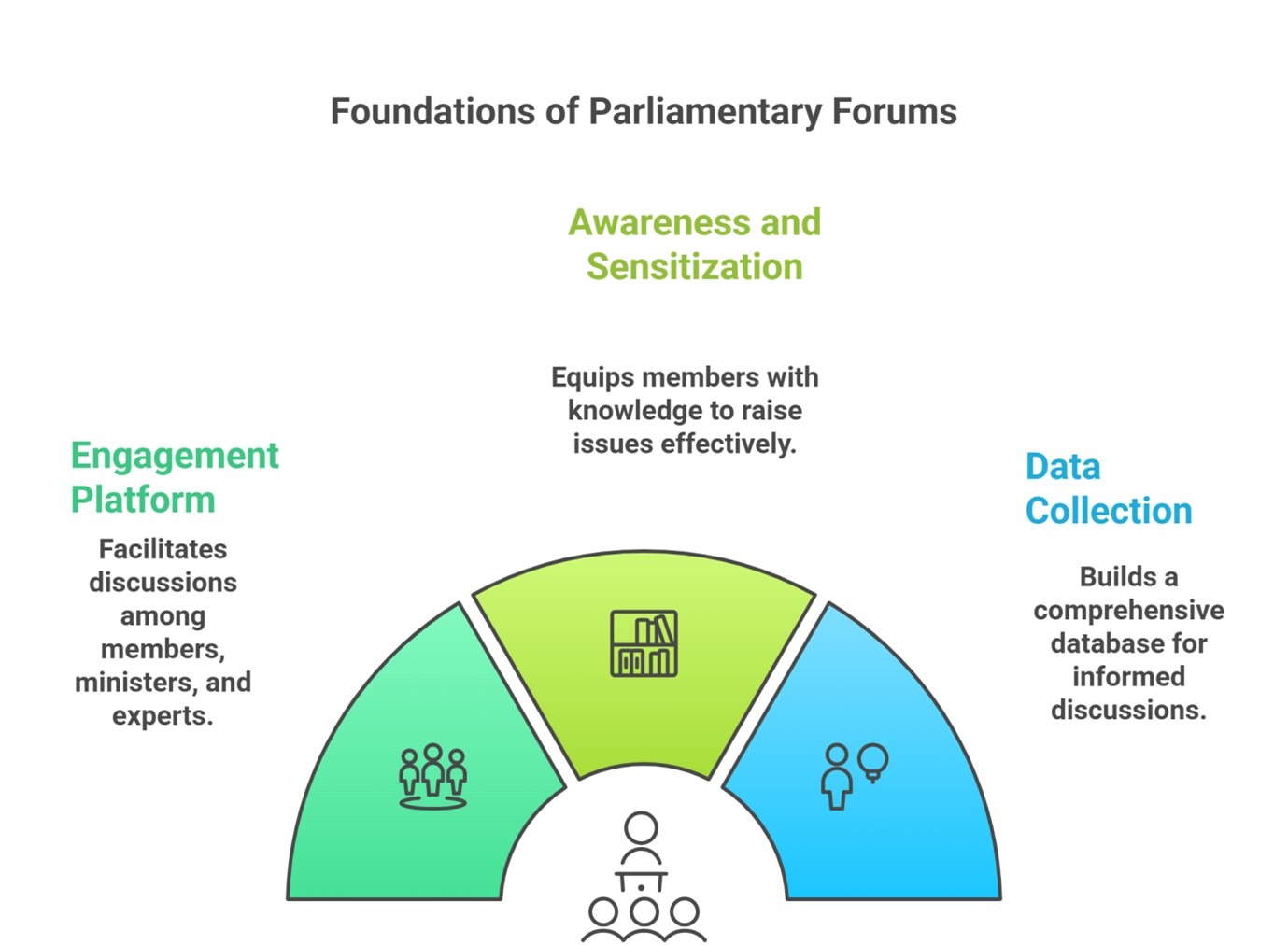
The objectives behind establishing these Parliamentary Forums include:

1. Platform for Engagement:

    • To provide a platform for members to engage with relevant ministers, experts, and officials, facilitating focused discussions on critical issues to promote a result-oriented approach towards implementation.


2. Awareness and Sensitization:

    • To sensitize members about key areas of concern and the ground-level situation, equipping them with the latest information and technical know-how to effectively raise issues in parliamentary discussions and Departmentally-Related Standing Committees (DRSCs).


3. Data Collection:

    • To build a database on critical issues by collecting information from ministries, NGOs, media, and other sources, ensuring that members can participate meaningfully in discussions and seek clarifications from experts present at meetings.
 

Importantly, the Parliamentary Forums do not interfere with the jurisdiction of the Departmentally-Related Standing Committees of the concerned ministries or departments.

Composition of the Forums

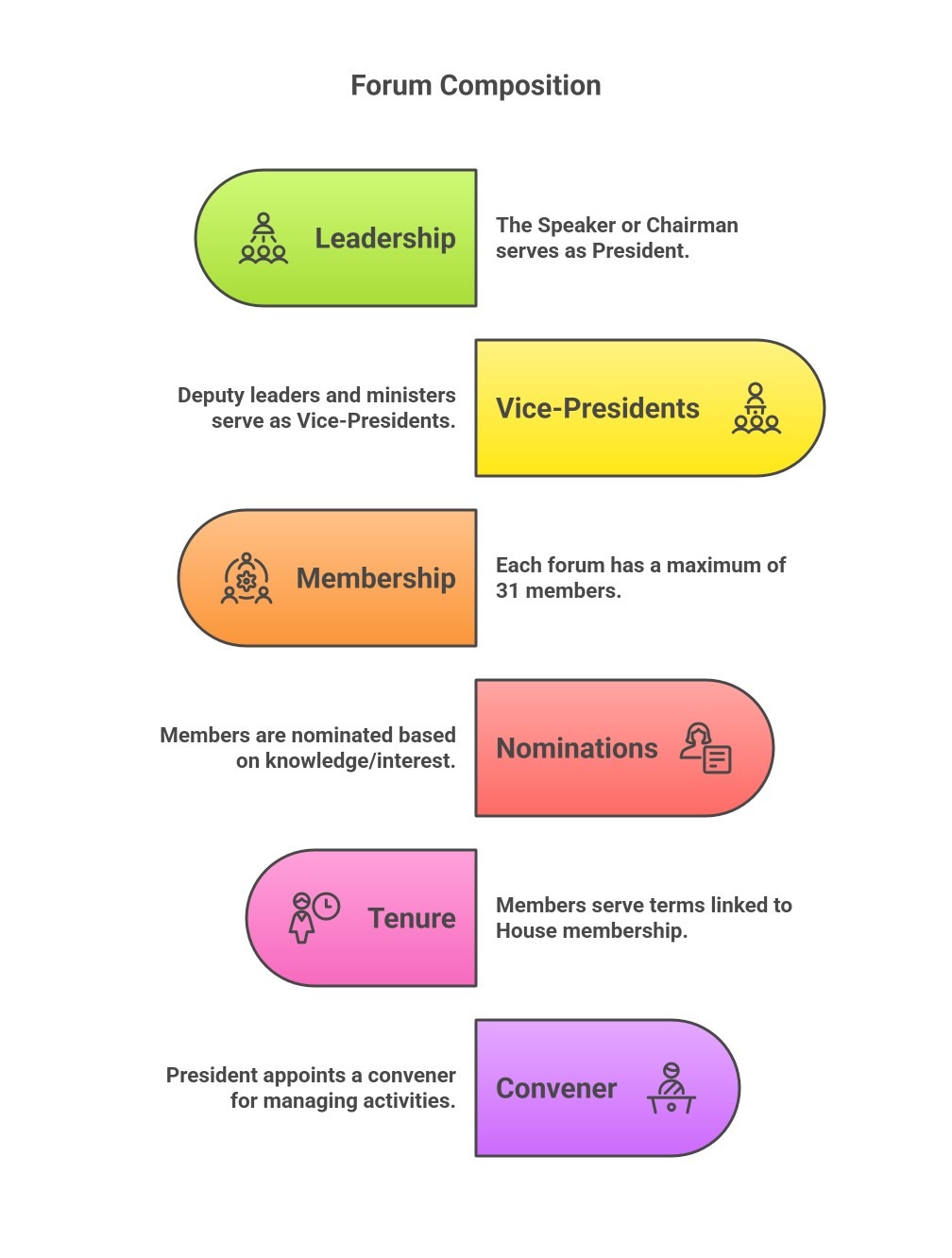
    • Leadership: The Speaker of the Lok Sabha serves as the ex-officio President of all the Forums, except for the Parliamentary Forum on Population and Public Health, where the Chairman of the Rajya Sabha is the ex-officio President and the Speaker acts as the Co-President.
    • Vice-Presidents: The Deputy Chairman of the Rajya Sabha, Deputy Speaker of the Lok Sabha, relevant ministers, and the Chairpersons of the DRSCs serve as ex-officio Vice-Presidents.
    • Membership: Each Forum consists of no more than 31 members (excluding the President, Co-President, and Vice-Presidents), with a distribution of up to 21 members from the Lok Sabha and up to 10 from the Rajya Sabha.
    • Nominations: Members other than the leadership are nominated by the Speaker or Chairman from among party leaders or their nominees who have special knowledge or a keen interest in the respective subjects.
    • Tenure: Members serve for a term coterminous with their membership in the respective Houses and can resign by addressing their resignation to the Speaker or Chairman.
    • Convener: The President of each Forum appoints a member-convener to manage regular activities and meetings in consultation with the President.
Functions of the Forums

Parliamentary Forum on Water Conservation and Management

    1. Problem Identification: Identify issues related to water resources and make recommendations for consideration by the government and relevant organizations.
    2. Member Engagement: Encourage involvement of Members of Parliament in water conservation efforts within their constituencies.
    3. Awareness Initiatives: Organize seminars and workshops to raise awareness about efficient water management practices.
    4. Additional Tasks: Undertake any other relevant tasks deemed necessary for promoting water conservation.

Parliamentary Forum on Youth

    1. Focused Deliberation: Discuss strategies to leverage the potential of youth as a key resource for development initiatives.
    2. Awareness Building: Enhance awareness among public leaders and grassroots activists regarding the role of youth in achieving socio-economic change.
    3. Regular Interaction: Maintain ongoing dialogues with youth representatives to understand their aspirations and challenges better.
    4. Parliament Outreach: Explore ways to improve Parliament’s outreach to various youth segments to bolster their faith in democratic institutions and encourage active participation.
    5. Policy Consultation: Consult with experts and academicians on redesigning public policies related to youth empowerment.


These forums serve as essential platforms for parliamentary engagement on critical societal issues, facilitating dialogue and action across various sectors.

Functions of Various Parliamentary Forums

Parliamentary Forum on Children

The functions of this forum include:

1. Raising Awareness: Enhance awareness among Parliamentarians regarding critical issues affecting children’s well-being, ensuring they provide leadership to secure children’s rightful place in development.


2. Platform for Exchange: Provide a structured platform for Parliamentarians to share ideas, views, experiences, and best practices related to children’s issues through workshops and seminars.


3. Interface with Civil Society: Facilitate interactions with civil society, including the voluntary sector, media, and corporate sector, to highlight children’s issues and foster strategic partnerships.


4. Engagement with UN Agencies: Enable Parliamentarians to interact with specialized UN agencies like UNICEF and other multilateral organizations to discuss expert reports, studies, and trends relevant to children’s development.


5. Additional Tasks: Undertake any other related tasks or projects as deemed necessary.

Parliamentary Forum on Population and Public Health

The functions of this forum include:

1. Deliberations on Population Stabilization: Focus on strategies for population stabilization and related issues.


2. Public Health Strategies: Discuss and formulate strategies concerning public health matters.


3. Awareness Building: Increase awareness about population control and public health at all societal levels, particularly grassroots levels.


4. Consultations with Experts: Hold dialogues with national and international experts, including interactions with organizations like the WHO and the United Nations Population Fund.

Parliamentary Forum on Global Warming and Climate Change

The functions of this forum include:

1. Problem Identification: Identify issues related to global warming and climate change, making recommendations for government and organizational action.


2. Parliamentary Involvement: Find ways to engage Members of Parliament in discussions with specialists from national and international entities focused on global warming and climate change.


3. Awareness Workshops: Organize seminars and workshops to educate Parliament members about the causes and effects of global warming and climate change.


4. Spread Awareness: Encourage MPs to raise awareness on preventing global warming and climate change.


5. Additional Tasks: Undertake other tasks deemed necessary.

Parliamentary Forum on Disaster Management

The functions of this forum include:

1. Identifying Disaster Management Issues: Recognize problems related to disaster management and recommend appropriate actions.


2. Parliamentary Engagement: Identify ways for MPs to engage with specialists in disaster management to work on developing new technologies for disaster mitigation.


3. Seminars on Disaster Awareness: Organize seminars and workshops to create awareness about the causes and effects of disasters.


4. Awareness Initiatives: Focus on engaging Parliament members to enhance awareness of disaster management issues.


5. Additional Tasks: Undertake any other relevant tasks.

Parliamentary Forum on Artisans and Craftspeople

The functions of this forum include:

1. Awareness on Artisans: Increase Parliamentarians’ awareness of critical issues affecting artisans and craftspeople, promoting the preservation and promotion of traditional art and crafts.


2. Platform for Ideas Exchange: Provide a structured setting for exchanging ideas, experiences, and best practices related to artisanship through workshops and seminars.


3. Civil Society Interface: Create a platform for highlighting issues faced by artisans in collaboration with the voluntary sector, media, and corporate sector.


4. Government Interaction: Facilitate interactions with various government ministries and organizations that focus on artisans, such as the Khadi and Village Industries Commission and Coir Board.


5. Comprehensive Dialogue: Engage in discussions regarding the preservation of traditional crafts with experts and organizations at both national and international levels.


6. Additional Tasks: Undertake further tasks or projects as deemed necessary.

Parliamentary Forum on Millennium Development Goals

The functions of this forum include:

1. Review and Awareness: Assess and raise awareness among Parliamentarians about critical issues related to the Millennium Development Goals (MDGs).


2. Exchange of Best Practices: Create a platform for Parliamentarians to share ideas and best practices regarding the implementation of MDGs through structured methods like workshops and seminars.


3. Civil Society Interface: Highlight issues surrounding the MDGs, such as poverty reduction, education, gender equality, child mortality reduction, maternal health, disease control, and environmental sustainability.


4. Engagement with UN Agencies: Facilitate institutional interactions with specialized UN agencies and multilateral organizations regarding the progress of MDGs.


5. Additional Tasks: Undertake any other relevant tasks or projects as needed.


These forums play a crucial role in facilitating focused discussions and collaborative efforts to address various critical issues affecting diverse sectors of society.