TOne Academy

Parliament

Home / Polity / Parliament

Parliament

    The Parliament, as the legislative arm of the Union government, holds a central and paramount position within India’s democratic political framework, a consequence of adopting the parliamentary system of governance, often referred to as the ‘Westminster’ model.

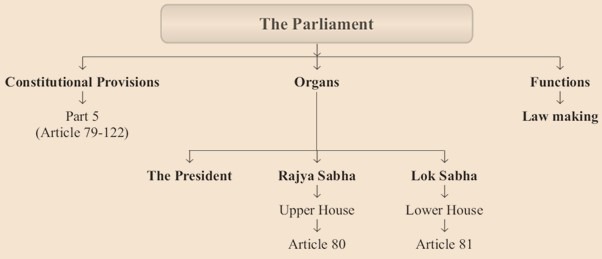
   Articles 79 to 122 in Part V of the Constitution delineate the structure, composition, tenure, parliamentary officials, operational procedures, special rights, and authority of the Parliament.

Organisation of Parliament

   As per the Constitution, the Indian Parliament is a tripartite body comprising the President, the Council of States (Rajya Sabha), and the House of the People (Lok Sabha). In 1954, the Hindi designations ‘Rajya Sabha’ and ‘Lok Sabha’ were officially adopted for the Council of States and the House of the People, respectively.

    The Rajya Sabha functions as the Upper House (Second Chamber or House of Elders), representing the states and union territories of the Indian Union, while the Lok Sabha serves as the Lower House (First Chamber or Popular House), representing the populace of India in its entirety.
 

Composition of the Two Houses

    The Council of States (Rajya Sabha): The maximum permissible strength of the Rajya Sabha is fixed at 250 members, of which 238 represent the states and union territories, chosen through indirect elections, and 12 are nominated by the President from individuals with special knowledge or practical experience in fields such as literature, science, art, and social service.

The allocation of seats to states and union territories is outlined in the Fourth Schedule of the Constitution. Elections to the Rajya Sabha utilise the system of proportional representation by means of the single transferable vote, and voting occurs through secret ballot.

      The House of the People (Lok Sabha): The maximum authorised strength of the Lok Sabha is 550 members, comprising 530 members elected directly from territorial constituencies in the states and 20 members to represent the union territories, also chosen through direct election. The Constitution also initially made provision for the President to nominate not more than two members from the Anglo-Indian community if deemed inadequately represented.
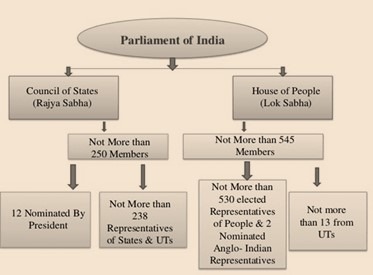


      However, this provision is no longer in effect. The allocation of seats to states is based on population, ensuring, as far as practicable, a uniform ratio between the number of seats allocated to each state and its population. Similarly, states are divided into territorial constituencies in a manner that maintains a reasonable proportion between the population of each constituency and the number of seats allotted to it. Seats are reserved in the Lok Sabha for Scheduled Castes (SCs) and Scheduled Tribes (STs) based on their population ratios in the respective states.

System of Elections to Lok Sabha

      Elections to the Lok Sabha are conducted based on adult suffrage, with every citizen aged eighteen years or older being entitled to vote, unless disqualified by law. The system employed is that of direct election from territorial constituencies, with the candidate securing the majority of votes in a constituency being declared elected.

Duration of Two Houses

      The Rajya Sabha is a permanent body and is not subject to dissolution. However, one-third of its members retire every two years, with elections being held regularly to fill these vacancies and the presidential nominations also occurring periodically. The term of office for a member of the Rajya Sabha is six years.

    The Lok Sabha has a normal term of five years from the date of its first sitting. However, the President is empowered to dissolve the Lok Sabha even before the expiry of its full term. The term of the Lok Sabha can be extended during a Proclamation of Emergency by an Act of Parliament for a period not exceeding one year at a time and in no case extending beyond a period of six months after the emergency has ceased to operate.

Membership of Parliament

Qualifications:

     To be eligible for membership in either House of Parliament, a person must be a citizen of India, must have attained 30 years of age for the Rajya Sabha and 25 years of age for the Lok Sabha, and must possess such other qualifications as may be prescribed by or under any law made by Parliament.

Disqualifications:

      A person is disqualified from being chosen as, and for being, a member of either House of Parliament under specific conditions outlined in Article 102. These include holding an office of profit under the Government of India or the government of any state (with certain exceptions), being of unsound mind, being an undischarged insolvent, not being a citizen of India, or being disqualified under any law made by Parliament. The Tenth Schedule of the Constitution contains provisions relating to the disqualification of members on the ground of defection.

Oath or Affirmation:

     Every member of either House of Parliament, before taking their seat, is required to make and subscribe before the President or a person appointed by them an oath or affirmation according to the form set out in the Third Schedule of the Constitution.

Salaries and Allowances:

 Members of Parliament receive salaries and allowances as determined by Parliament through law.

Presiding Officers of Parliament:

    • Rajya Sabha: The Vice-President of India is the ex-officio Chairman of the Rajya Sabha. The Rajya Sabha also elects a Deputy Chairman from among its members who presides in the absence of the Chairman.
    • Lok Sabha: The Lok Sabha elects a Speaker and a Deputy Speaker from among its members. The Speaker presides over the sittings of the House and maintains order.


Vacation of Seats: A member of either House vacates their seat if they incur any of the disqualifications, resign their seat, or remain absent from all meetings of the House for a period of sixty days without the permission of the House.


Aspect

Details

Qualifications

– Must be a citizen of India- Minimum age: 30 years for Rajya Sabha, 25 years for Lok Sabha- Must meet other qualifications prescribed by law made by Parliament

Disqualifications

As per Article 102:- Holds an office of profit under the Government (with exceptions)- Unsound mind (declared by a competent court)- Undischarged insolvent- Not a citizen of India- Disqualified under any Parliament-made law- Disqualified on grounds of defection (Tenth Schedule)

Oath or Affirmation

– Must take an oath/affirmation before taking seat- To be made before the President or an appointed person- As per the Third Schedule of the Constitution

Salaries and Allowances

– Determined by law made by Parliament

Presiding Officers

Rajya Sabha:- Chairman: Vice-President of India (ex-officio)- Deputy Chairman: Elected by Rajya Sabha membersLok Sabha:- Speaker and Deputy Speaker: Elected from among Lok Sabha members

Vacation of Seats

– On incurring disqualifications- By resignation- Absence for 60 consecutive days without House’s permission


Difference Between Lok Sabha and Rajya Sabha


Aspect

Lok Sabha

Rajya Sabha

Composition

– Representatives of States and UTs directly elected by the people. – 2 nominated Anglo-Indian members by President.

– Representatives of States and 2 UTs elected by elected members of state/UT assemblies. – 12 nominated members by President.

Duration

– Subject to dissolution. – Normally functions for 5 years.

– Permanent house. – Term of a member: 6 years. – 1/3rd members retire every second year.

Qualification

– Minimum age: 25 years. – Must subscribe to oath under Third Schedule. – Must be an elector for any Parliamentary constituency.

– Minimum age: 30 years. – Must subscribe to oath under Third Schedule. – Must be an elector for any Parliamentary constituency.

Disqualification

– As per Constitution. – RPA, 1951: President is the final authority (may consult Election Commission). – 10th Schedule: Speaker is the authority (subject to judicial review).

– As per Constitution. – RPA, 1951: President is the final authority (may consult Election Commission). – 10th Schedule: Chairman is the authority (subject to judicial review).

Special Powers

– Can pass No-confidence motion. – Can introduce Money Bill. – Can pass resolution for discontinuation of National Emergency.

– Can authorize Parliament to make laws on State subjects. – Can authorize creation of All India Services.


Dissolution of LS and lapse of the bills


Bills Which Lapse

Bills Which Do Not Lapse

– All pending bills which originated in Lok Sabha and are still pending there.

– A bill that originated and is pending in Rajya Sabha.

– Certain bills to be examined by the Committee on Government Assurances.

– A bill passed by both Houses but pending President’s assent.


– A bill sent for reconsideration by the President.


Leaders in Parliament

      Each House of Parliament has a Leader of the House. The Prime Minister is usually the Leader of the Lok Sabha. In the Rajya Sabha, a minister who is a member of that House is appointed as the Leader. Both Houses also recognise a Leader of the Opposition, who is the leader of the largest opposition party having the requisite strength.


      The Leader of the Opposition exists in both the Lok Sabha and Rajya Sabha. To be recognized as such, the individual must lead the largest opposition party in the respective House and that party must hold at least one-tenth of the total seats, a criterion known as the Mavlankar Rule. Although the position is not mentioned in the Constitution, it has been granted statutory recognition under the Salary and Allowances of Leaders of Opposition in Parliament Act, 1977. In the Lok Sabha, the recognition is made by the Speaker, while in the Rajya Sabha, it is done by the Chairman. The Leader of the Opposition enjoys a rank equivalent to that of a Cabinet Minister. Similar systems exist in other democracies—for example, in the United Kingdom, the opposition forms a Shadow Cabinet and the Leader of the Opposition is often referred to as the alternative Prime Minister, while in the United States, the equivalent position is known as the Minority Leader.


      A Whip is essentially the assistant floor leader in a legislature, appointed by a political party to ensure discipline among its members, particularly during voting. While the position of Whip is not mentioned in the Constitution, nor in the Rules of the House or any Parliamentary statute, it is an integral part of parliamentary functioning, rooted in the conventions of the parliamentary system inherited from Britain. In practice, each political party—whether in power or opposition—appoints its own Whip in Parliament. A Chief Whip, usually a senior party member, is responsible for issuing directions, and is supported by additional Whips. Disobedience of a whip’s instructions can lead to disqualification under the Tenth Schedule of the Constitution, also known as the Anti-defection Law. However, whips do not apply in all situations; for instance, in Presidential elections, legislators are free to vote as they choose, and whips cannot mandate a voting pattern.


Aspect

Leader of House

Leader of Opposition

Whip

Constitutional Status

Not mentioned in the Constitution; governed by Rules of House (Lok Sabha & Rajya Sabha).

Recognised first in 1969; Statutory recognition in 1977 (Salary Act).

Not mentioned in the Constitution, Rules of House, or Parliamentary Statute.

Appointment

– PM is the Leader if he is a member of the House. – Otherwise, a minister nominated by the PM.

Requires not less than 1/10 of total seats for official recognition as opposition.

Based on conventions of parliamentary government.

Status/Rank

Not specifically mentioned.

Has the status of a cabinet minister. Called “Alternative Prime Minister” by Ivor Jennings.

Acts as assistant floor leader. Ensures attendance and party line voting.

Functions

Leads the House in legislative and administrative work.

Represents the opposition, participates actively in debates and policy checks.

– Ensures member attendance. – Secures support on votes. – Regulates and monitors party behavior.

Sessions of Parliament


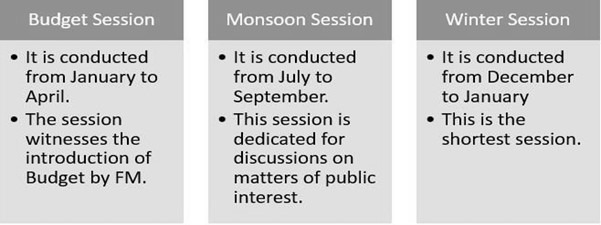
       Summoning, Prorogation, and Dissolution: The President is empowered to summon each House of Parliament to meet at such time and place as they think fit, but six months shall not intervene between its last sitting in one session and the date appointed for its first sitting in the next session. The President can also prorogue (terminate a session of) either House or dissolve the Lok Sabha.


Term

Meaning / Description

Authority / Details

Recess

Period between two sessions of Parliament when it is not in session

House is not formally adjourned but not conducting business

Summon

Official call to members to be present

Issued by the President (must summon Parliament at least twice a year)

Adjournment

Suspension of a sitting for a specified time (hours, days, or weeks)

Done by the Presiding Officer (Speaker/Chairman)

Adjournment sine die

Termination of a sitting for an indefinite period

Declared by Presiding Officer when business is completed

Quorum

Minimum number of members needed to conduct business – 1/10th of total strength

If no quorum, Presiding Officer may adjourn or suspend the meeting

Prorogation

Formal end of a session of Parliament (not just a sitting)

Usually follows adjournment sine die; done by the President

Dissolution

Official termination of the Lok Sabha (Rajya Sabha is never dissolved)

Done by the President in two ways: 1) Automatic – after 5 years 2) Discretionary – when President decides


Effect: All pending business lapses, except certain cases (e.g., bills in Rajya Sabha not yet passed by Lok Sabha may not lapse)

Lame-duck Session

Last session of outgoing Lok Sabha after new Lok Sabha is elected

Existing members remain till new House is formed


Joint Sitting of Two Houses:

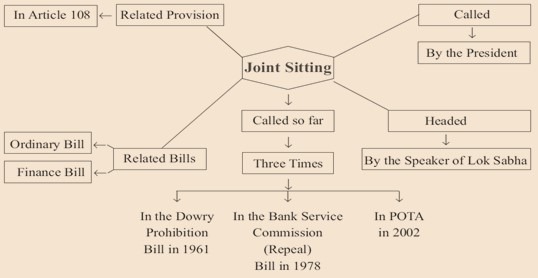
     The Constitution provides for a joint sitting of both Houses in case of disagreement on a non-money bill that has been passed by one House and is rejected or amended by the other House, or if more than six months have elapsed without the other House passing the bill. The President summons the joint sitting, and the Speaker of the Lok Sabha presides over it.
 

Devices of Parliamentary Proceedings

Parliament employs various mechanisms to conduct its business and hold the government accountable.

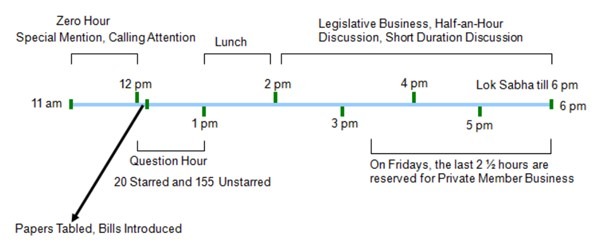
    • Question Hour: The first hour of every sitting of both Houses is usually devoted to questions, where members seek information from ministers on government policies and actions.
    • Purpose: Members of Parliament (MPs) ask questions, and ministers from the Executive are obligated to respond.

Types of Questions:

    1. Starred Question
        • Answered orally
        • Supplementary questions are permitted
    2. Unstarred Question
        • Answered in written form
        • No supplementary questions allowed
    3. Short Notice Question
        • Asked with less than 10 days’ notice
        • Answered orally


Legal Basis: It is provided for in the Rules of Procedure of Parliament.

    • Zero Hour: Immediately following the Question Hour, members can raise matters of urgent public importance without prior notice.

Purpose: MPs raise urgent public matters without prior notice.

Key Features:

    • Not mentioned in the Rules of Procedure or the Constitution
    • No prior notice required
    • Informal in nature; a unique Indian innovation
    • Resolutions: These are formal expressions of the opinion or will of the House on a specific matter.
    • Motions: Proposals moved by members to initiate discussion or seek a decision of the House on various issues. Motions are broadly categorised as:
        • Substantive Motion: A self-contained proposal dealing with a significant matter.
        • Substitute Motion: An alternative proposal moved in place of the original motion.
        • Subsidiary Motion: A motion dependent on the original motion or proceedings of the House, further divided into ancillary motions and superseding motions.
        • Censure Motion: Moved to express disapproval of the government’s policies or actions, it must state the reasons for its adoption and can be moved against individual ministers, a group, or the entire Council of Ministers.
        • No-Confidence Motion: Moved to test the confidence of the Lok Sabha in the Council of Ministers. If passed, it can lead to the government’s resignation. It does not need to state reasons and can only be moved against the entire Council of Ministers.
        • Motion of Thanks: Discussed at the beginning of the first session after each general election and the first session of every fiscal year, it addresses the President’s speech outlining government policies and programmes. Its passage is essential and signifies the confidence of the House in the government.


Motion

Description

Adjournment Motion

– Adjourns the business of the House to discuss a definite matter of urgent public importance. – Consent of the Speaker is required. – Not available in Rajya Sabha.

Calling Attention Motion

– MP may call attention of a Minister to a matter of urgent public importance. – Clarificatory questions can be asked on Minister’s statement.

Motion of Thanks

– Used for discussion on President’s address on government’s policy and agenda. – MPs may move amendments. – Prime Minister responds to the motion.

No-confidence Motion

– To check the majority enjoyed by the Government in the Lok Sabha. – No grounds needed to be stated. – If passed, leads to resignation of Council of Ministers.

Censure Motion

– Expresses strong disapproval. – Can be moved against individual ministers or members. – If passed, has no impact on the government.

Privilege Motion

– Moved when a member feels a Minister has breached privilege of the House or a member by withholding facts.

Cut Motion

– Seeks a reduction in the amount of a demand presented by the government. – At the discretion of Lok Sabha.


Legislative Procedure in Parliament

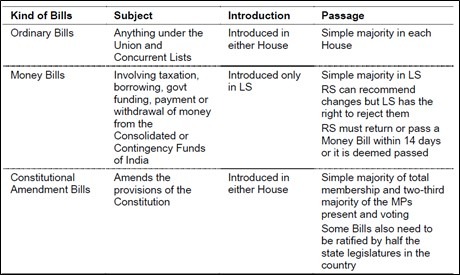
     The procedure for enacting legislation is generally the same in both Houses. A bill, which is a draft of a legislative proposal, becomes an Act or law after being duly passed by both Houses and receiving presidential assent. Bills can be classified as Public Bills (introduced by ministers) or Private Bills (introduced by any other member).

      Bills are also categorised based on their subject matter into Ordinary Bills, Money Bills, Financial Bills, and Constitution Amendment Bills.

Ordinary Bills:

   Can be introduced in either House by a minister or a private member without the President’s recommendation. They pass through three readings in each House, followed by scrutiny and potential amendments in the second House. If there is disagreement, a joint sitting can be convened.

Money Bills:

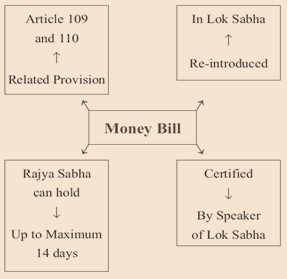
     Can only be introduced in the Lok Sabha on the recommendation of the President and only by a minister. The Rajya Sabha has restricted powers regarding Money Bills; it can suggest amendments, but the Lok Sabha may or may not accept them. A Money Bill passed by the Lok Sabha is deemed to have been passed by both Houses if the Rajya Sabha does not return it within 14 days. The Speaker of the Lok Sabha certifies whether a bill is a Money Bill. The President can either assent to or withhold assent from a Money Bill but cannot return it for reconsideration.
 

Financial Bills:

     Deal with fiscal matters but differ from Money Bills. They are of three types and have specific procedures for their introduction and passage, often involving the President’s recommendation and varying degrees of the Rajya Sabha’s involvement.

Constitution Amendment Bills:

    • Have a distinct procedure outlined in Article 368 and are discussed in detail in Chapter 10.


Aspect

Public Bill

Private Bill

Introduced by

A Minister

Any member other than a Minister (i.e., Private Member)

Notice Period

7 days

30 days

Chance of Approval

Higher – usually has government backing

Lower – lacks government support

Implication of Rejection

May indicate loss of parliamentary confidence

No impact on the government’s stability

Departmental Assistance

Receives help from the concerned government department

No official assistance provided

Budget in Parliament

    • The annual financial statement (budget), estimating the receipts and expenditure of the Government of India for each financial year, is presented to both Houses.
    • The Constitution refers to the budget as ‘Annual financial statement.’
    • Article 112 deals with ‘Annual financial statement’
    • The President lays before both ‘houses of Parliament’ theAnnual financial statement.

Demand for Grants and Related Financial Procedures in Parliament

    • Prior Presidential Recommendation is mandatory for introducing a Demand for Grants.
    • To withdraw money from the Consolidated Fund of India, Parliament must pass an Appropriation Bill.

Taxation and Finance Bills

    • Taxes can only be levied or collected through a law passed by Parliament.
    • This requires passing a Finance Bill, which:
        • Can be introduced only in the Lok Sabha
        • Requires the prior recommendation of the President
    • Parliament is empowered to reduce or abolish a tax, but cannot increase it beyond what is proposed in the Finance Bill.

Voting on Demands for Grants

    • Only the Lok Sabha has the privilege to vote on the Demands for Grants; the Rajya Sabha does not have this right.

Types of Expenditure from the Consolidated Fund of India

    1. Charged Expenditure – Automatically charged; not votable in Parliament (e.g., salaries of the President, judges, etc.)
    2. Voted Expenditure – Requires approval by the Lok Sabha through voting.

Budget Classification

    • The Union Budget must compulsorily distinguish between:
        • Expenditure on revenue account, and
        • Other (capital) expenditures


Stages in Budget


Stage

In Lok Sabha

In Rajya Sabha

(i)

General Discussion on the Budget

General Discussion on the Budget

(ii)

Vote on Account

Consideration of Demands for Grants by the Departmentally-Related Standing Committees

(iii)

Consideration of Demands for Grants by the Departmentally-Related Standing Committees

Discussion on the working of the Ministries

(iv)

Discussion and Voting on Demands for Grants

Consideration and return of the Appropriation Bill to the Lok Sabha

(v)

Consideration and passing of the Appropriation Bill

Consideration and return of the Finance Bill to the Lok Sabha

(vi)

Consideration and passing of the Finance Bill

Consideration and return of the Finance Bill to the Lok Sabha


Voting on demand for Grants

    • The voting of demands for grants is the exclusive privilege of the Lok Sabha.
    • ‘Charged expenditure’ on the Consolidated Fund of India can only be ‘discussed’.
    • Each demand is voted separately by the Lok Sabha.
    • Members can also move to reduce any demand for grants (through cut motions)
    • But increase or upward revisions of estimates are not permissible.
    • Cut motions are moved to bring ‘moral pressure’ on the executive (rarely passed as it would amount to want of parliamentary confidence).


Type of Cut Motion

Proposed Reduction

Purpose

Key Features

Policy Cut Motion

Reduce amount to 1

Expresses disapproval of the policy underlying the demand

Suggests an alternative policy; initiates a policy-level debate

Economy Cut Motion

Reduce by a specified amount

Aims to reduce expenditure in a particular area

May involve lump sum cuts or elimination of specific items; discussion must relate to economic impact

Token Cut Motion

Reduce by 100

Used to highlight a specific grievance within government policy or functioning

Grievance must be clearly specified and discussion limited to that issue


Articles 113 and 114 provide for the presentation of various kinds of demands for grants by the Parliament


Type of Grant

Reason / Purpose

Supplementary Grant

When the amount granted for a particular service is found to be insufficient

Additional Grant

For additional expenditure on a new service not included in the budget

Excess Grant

When expenditure exceeds the amount originally granted

Token Grant

To transfer funds between services; reappropriation without increasing the total budget

Vote on Credit

To meet unforeseen or urgent expenditure, typically due to emergencies or calamities

Vote on Account

Interim budget to meet government expenses for a short period (typically 2 months) until full budget is passed


The Constitution establishes the Consolidated Fund of India, the Public Account of India, and the Contingency Fund of India.


Name of the Fund

Article

Custody

Objective / Description

Consolidated Fund of India

Article 266(1)

Parliament

Includes all revenues (tax & non-tax), borrowings (e.g., Treasury Bills, Ways and Means Advances)

Public Account of India

Article 266(2)

Executive (Govt)

Covers all public money other than CF—e.g., Provident Fund, Post Office Savings, etc.

Contingency Fund of India

Article 267

President (Operated by Finance Secretary)

For urgent, unforeseen expenditure; post-expenditure approval is sought from Parliament


The budget documents presented to the Parliament comprise of the following :

(i) Budget Speech

(ii) Annual Financial Statement

(iii) Demands for Grants

(iv) Appropriation Bill

(v) Finance Bill

(vi) Statements mandated under the FRBM Act:

(a) Macro-Economic Framework Statement

(b) Fiscal Policy Strategy Statement

(c) Medium Term Fiscal Policy Statement

(vii) Expenditure Budget

(viii) Receipts Budget

(ix) Expenditure Profile

(x) Memorandum Explaining the Provisions in the Finance Bill

(xi) Budget at a Glance

(xii) Outcome Budget


Earlier, the Economic Survey also used to be presented to the Parliament along with the budget. Now, it is presented one day or few days before the presentation of the budget. This report is prepared by the finance ministry and indicates the status of the national economy.


Aspect

Ordinary Bill

Money Bill

Financial Bill (Type 1)

Financial Bill (Type 2)

Objective

General legislation

Deal only with matters in Article 110 (e.g., taxation, borrowing, expenditure)

Deal with money matters + other provisions

Contains expenditure from Consolidated Fund but does not fall under Article 110

House of Introduction

Lok Sabha or Rajya Sabha

Lok Sabha only

Lok Sabha only

Lok Sabha or Rajya Sabha

Prior President’s Permission

Not required

Required

Required

Not required

Joint Sitting

Allowed

Not allowed

Allowed

Allowed

Lok Sabha vs Rajya Sabha Role

Equal powers (LS = RS)

Lok Sabha has supremacy (LS >>> RS)

Equal powers (LS = RS)

Equal powers (LS = RS)

President’s Recommendation

Not needed

Needed

Needed

Not needed

Duration RS Can Hold the Bill

Up to 6 months

14 days only

Up to 6 months

Up to 6 months

Multifunctional Role of Parliament

Parliament performs a multitude of functions.

    • Legislative Functions: Enacting laws on subjects in the Union List and Concurrent List.
    • Deliberative Functions: Providing a forum for discussing matters of public importance.
    • Critical Functions: Holding the executive accountable through questions, debates, and motions.
    • Constituent Functions: Possessing the power to amend the Constitution.
    • Judicial Functions: Participating in the impeachment of the President and removal of judges.
    • Electoral Functions: Electing the President and Vice-President (in conjunction with state legislatures).
    • Ombudsman Functions: Addressing grievances through committees and parliamentary forums.

Ineffectiveness of Parliamentary Control

    • Despite its significant roles, the effectiveness of parliamentary control over the executive is sometimes questioned due to factors such as the majority enjoyed by the ruling party, the increasing use of ordinances, and limitations in time and resources.

Position of Rajya Sabha

    • While the Lok Sabha is considered the more powerful House due to its direct representation of the people and control over finances, the Rajya Sabha plays crucial roles such as representing the states’ interests, providing a forum for experienced members, and acting as a check on hasty legislation. However, it has limitations, particularly in financial matters.

Parliamentary Privileges

Parliamentary privileges are special rights and immunities enjoyed by the Houses collectively and by their members individually, ensuring their independence and effective functioning.


    • Collective Privileges: Include the right to publish reports and proceedings, to exclude strangers, and to punish members or outsiders for breach of privilege or contempt of the House.
    • Individual Privileges: Include freedom of speech in Parliament and immunity from arrest in civil cases during the session and a certain period before and after.


The sources of parliamentary privileges were initially based on those of the British House of Commons as of January 26, 1950, until defined by Parliament. Subsequent amendments have maintained this position, with freedom of speech and the right to publish proceedings being explicitly mentioned in the Constitution.

Sovereignty of Parliament

    • The concept of parliamentary sovereignty, as understood in the British context, implies the supreme legal authority of Parliament. However, in India, while Parliament is a powerful legislative body, its sovereignty is not absolute due to the written and federal nature of the Constitution, the system of judicial review, and the fundamental rights guaranteed to citizens.