
Evolution of Panchayati Raj
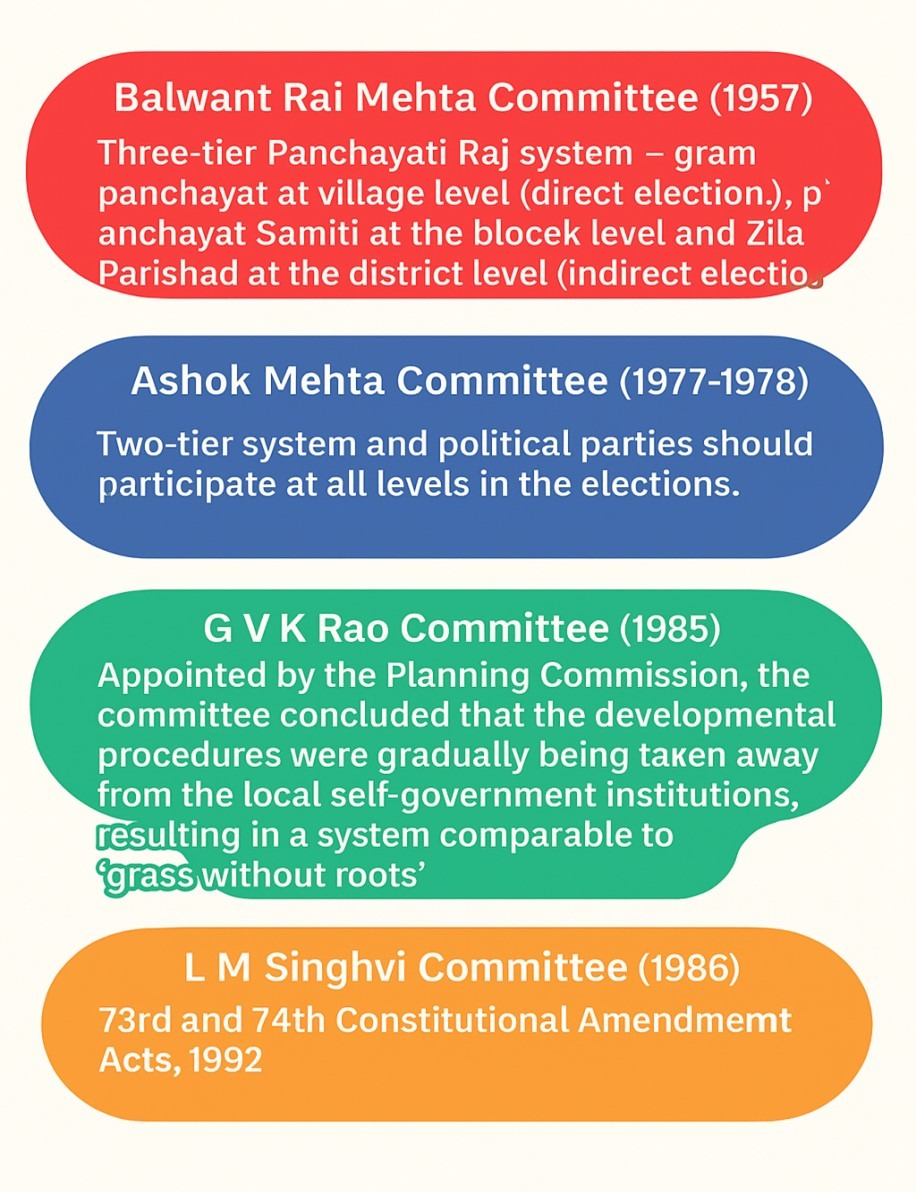
1.Balwant Rai Mehta Committee (1957):
The foundation of the Panchayati Raj system was laid by the Balwant Rai Mehta Committee, appointed by the Government of India. This committee examined the Community Development Programme (1952) and the National Extension Service (1953), subsequently recommending the following:
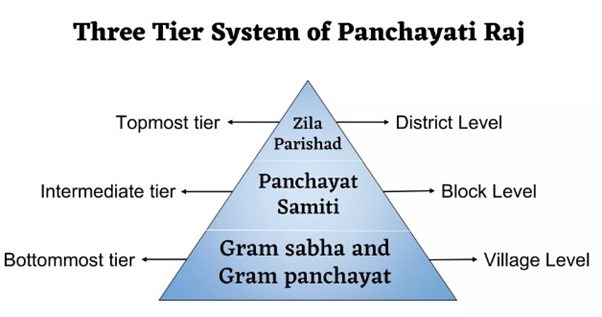
1. Three-Tier Structure: Establishment of a three-tier Panchayati Raj system that includes:
- Gram Panchayatat the village level.
- Panchayat Samitiat the block level.
- Zila Parishadat the district level, linked through indirect elections.
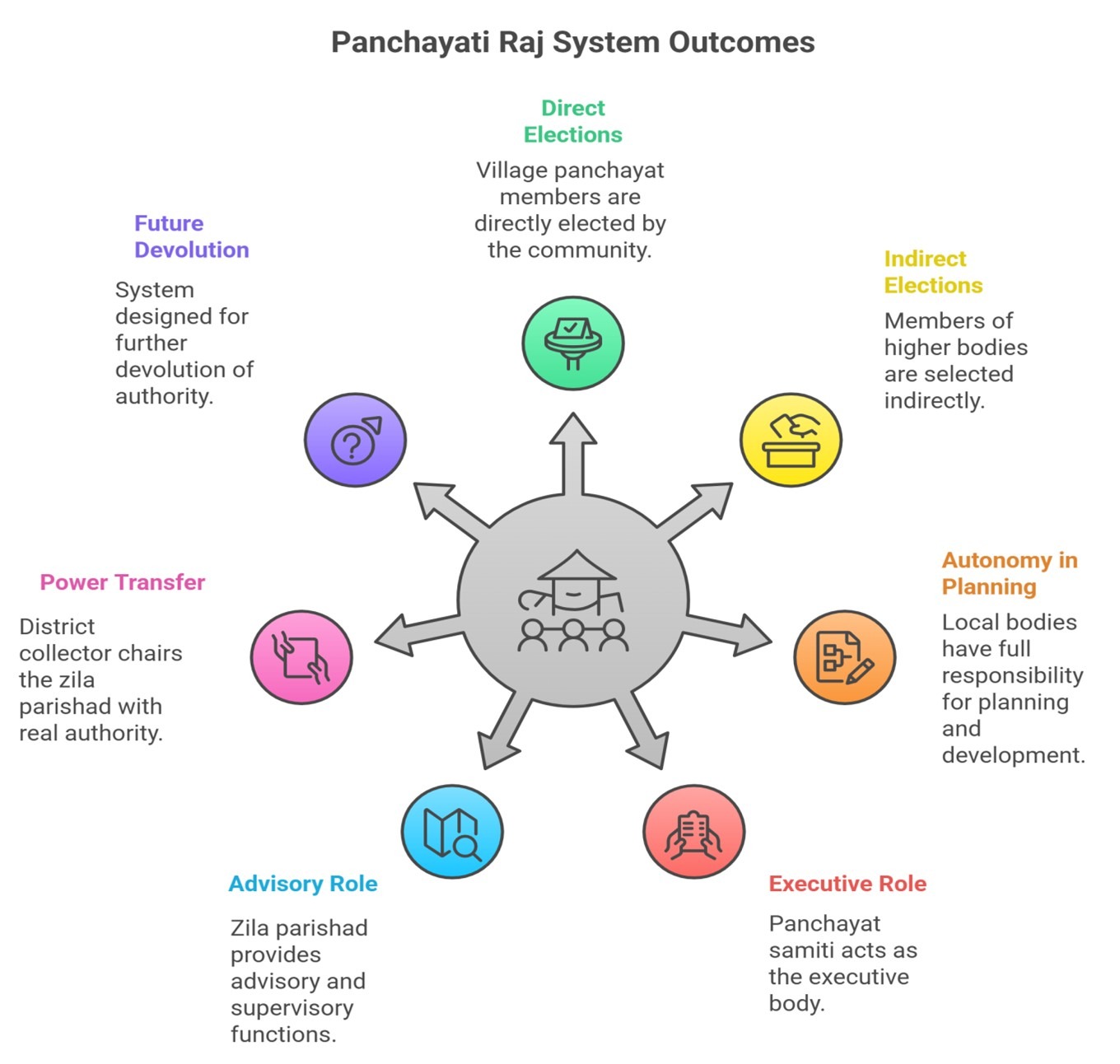
2. Direct and Indirect Elections: The village panchayat members would be elected directly, while members of the panchayat samiti and zila parishad would be selected indirectly.
3. Autonomy in Planning and Development: All planning and development responsibilities should be vested in these local bodies.
4. Roles of the Bodies:
- The panchayat samiti acts as the executive body.
- The zila parishad serves as an advisory, coordinating, and supervisory body.
5. Chairmanship and Power Transfer: The district collector serves as the chairman of the zila parishad, which is intended to have real power through genuine transfers of authority and resources.
6. Future Devolution: A system for further devolution of authority was recommended for future enhancements to local governance.
The recommendations were accepted by the National Development Council in January 1958, allowing states the freedom to design their systems while maintaining basic common principles.
Adoption Across States:
- Rajasthan was the first state to implement the Panchayati Raj system on October 2, 1959, followed by Andhra Pradesh the same year.
- By the mid-1960s, others states adopted variances of the system, leading to a mix of two to four-tier systems depending on local needs and governance structures.
Study Teams and Committees
Since the inception of Panchayati Raj, various study teams, committees, and working groups have been formed to assess and improve the system. A few significant examples include:
Year | Name of the Study Team/Committee | Chairman |
1960 | Committee on Rationalisation of Panchayat Statistics | V.R. Rao |
1961 | Working Group on Panchayats and Cooperatives | S.D. Mishra |
1961 | Study Team on Panchayati Raj Administration | V. Iswaran |
1962 | Study Team on Nyaya Panchayats | G.R. Rajgopal |
1963 | Study Team on the Position of Gram Sabha | R.R. Diwakar |
1963 | Study Group on Budgeting and Accounting Procedures | M. Rama Krishnayya |
1963 | Study Team on Panchayati Raj Finances | K. Santhanam |
1965 | Committee on Panchayati Raj Elections | K. Santhanam |
1965 | Study Team on Audit and Accounts of Panchayati Raj | R.K. Khanna |
1966 | Committee on Panchayati Raj Training Centres | G. Ramachandran |
1969 | Study Team on Community Development and Panchayati Raj | V. Ramanathan |
1972 | Working Group for Planning on Community Development | N. Ramakrishnayya |
1976 | Committee on Community Development and Panchayati Raj | Smt. Daya Choubey |
2. Ashok Mehta Committee (1978)
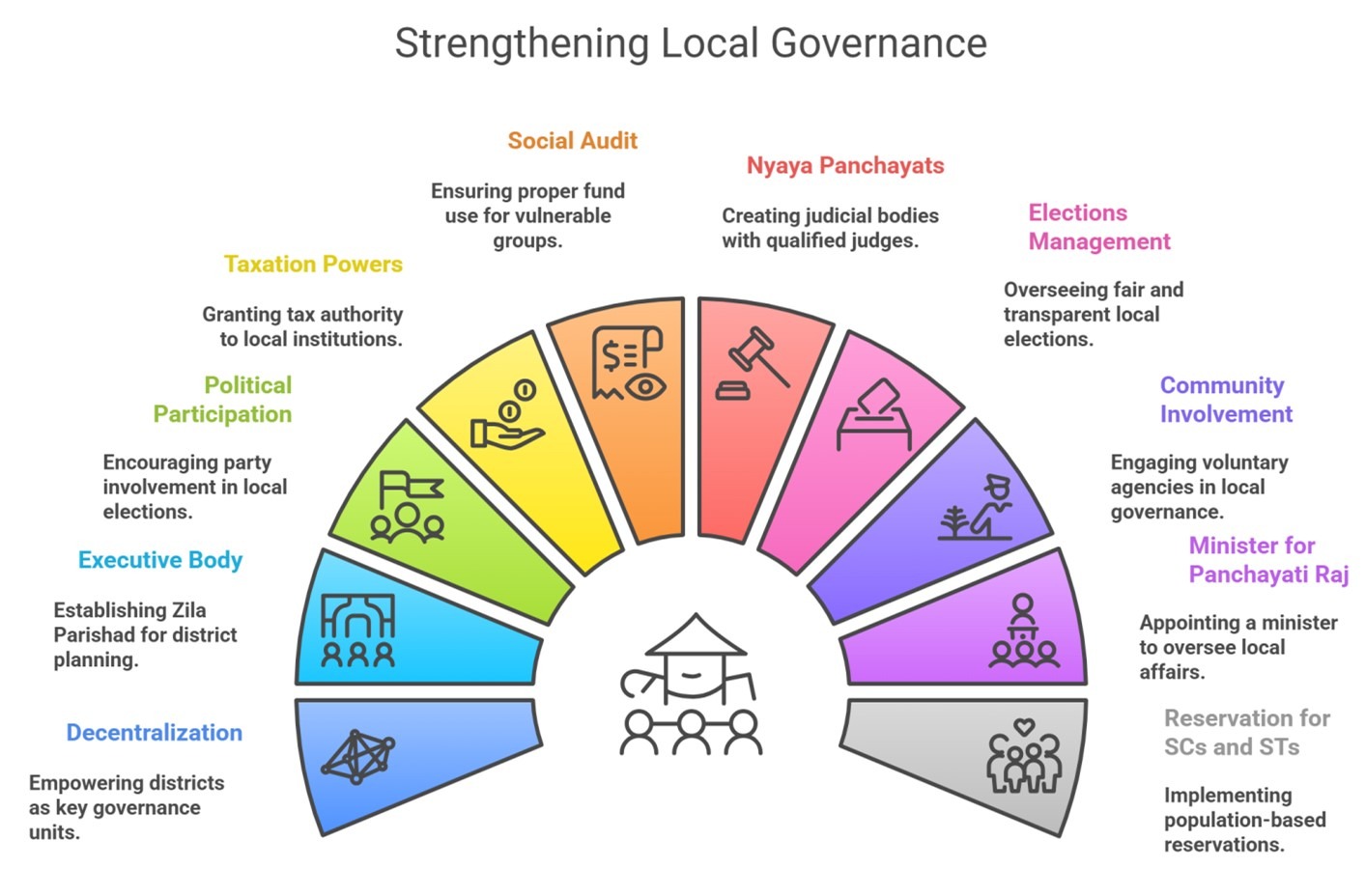
The Ashok Mehta Committee was appointed to evaluate and strengthen the Panchayati Raj system. Its 132 recommendations included:
- Two-Tier System: Replace the existing three-tier system with a two-tier structure consisting of:
- Zila Parishad at the district level.
- Mandal Panchayat comprising a group of villages (15,000-20,000 population).
- Decentralization: Advocate that the district should be the principal unit for decentralized governance below the state level.
- Executive Body: Zila Parishad should act as the executive body responsible for planning at the district level.
- Political Participation: Political parties should officially participate in all levels of panchayat elections.
- Taxation Powers: Grant Panchayati Raj institutions the power to levy taxes to mobilize their own financial resources.
- Social Audit: Implement regular social audits to ensure funds allocated for vulnerable groups are properly spent.
- Protection from Supersession: States should avoid superseding panchayati raj institutions, and if necessary, elections should be held within six months of such supersession.
- Nyaya Panchayats: Recommend the establishment of separate judicial panchayats headed by qualified judges.
- Elections Management: The Chief Electoral Officer, in consultation with the Chief Election Commissioner, should oversee panchayati raj elections.
- Development Functions: Transfer development responsibilities to the Zila Parishad.
- Community Involvement: Urge voluntary agencies to support the Panchayati Raj system.
- Minister for Panchayati Raj: Appoint a minister to oversee Panchayati Raj affairs.
- Reservation for SCs and STs: Implement reservation based on population.
- Constitutional Recognition: Seek constitutional recognition for Panchayati Raj institutions to ensure their status and continuity.
- Two-Tier System: Replace the existing three-tier system with a two-tier structure consisting of:
Though the recommendations could not be widely implemented due to changes in government, states like Karnataka, West Bengal, and Andhra Pradesh took steps toward revitalizing the Panchayati Raj.
3. G.V.K. Rao Committee (1985)
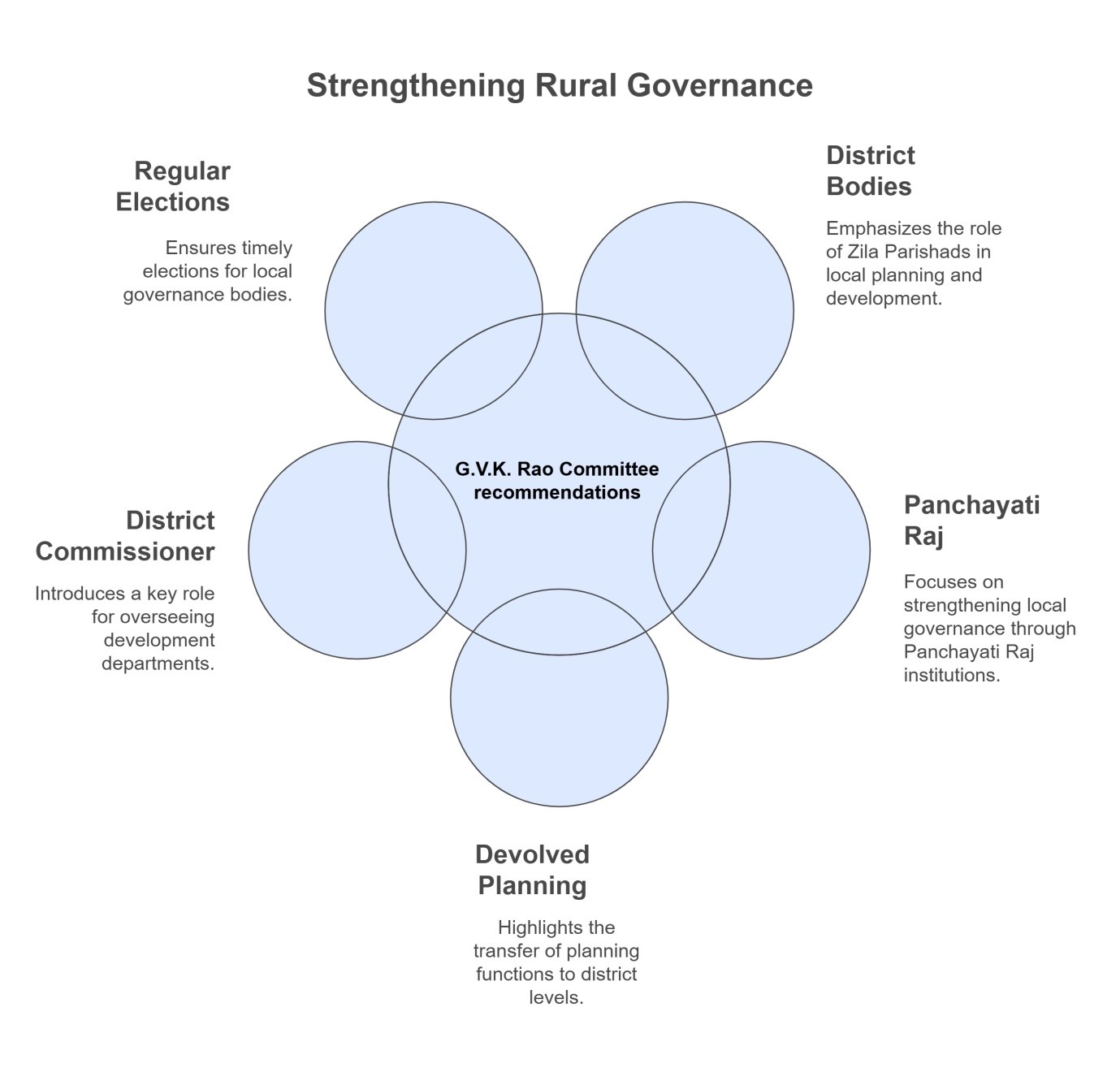
The G.V.K. Rao Committee reviewed administrative arrangements for rural development and poverty alleviation. Key recommendations included:
- District Bodies: Highlight the Zila Parishad’s pivotal role in planning and development.
- Role of Panchayati Raj: Strengthen the Panchayati Raj institutions’ role in planning, implementation, and monitoring of rural development programs.
- Devolve Planning Functions: Transfer certain planning functions from the state to district levels.
- District Development Commissioner: Create a position for a District Development Commissioner to oversee all development departments.
- Regular Elections: Ensure timely elections for Panchayati Raj institutions.
4. L.M. Singhvi Committee (1986)
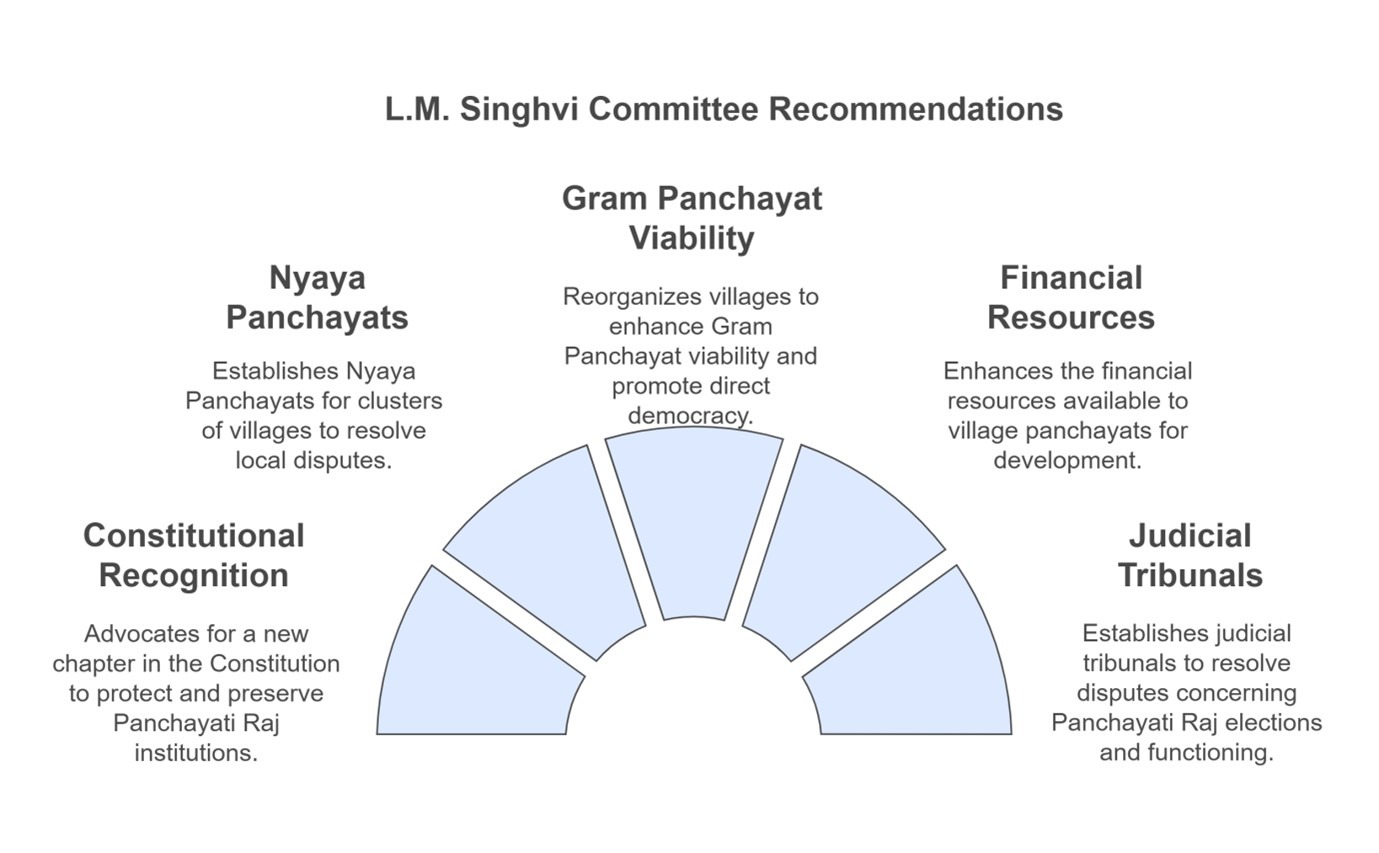
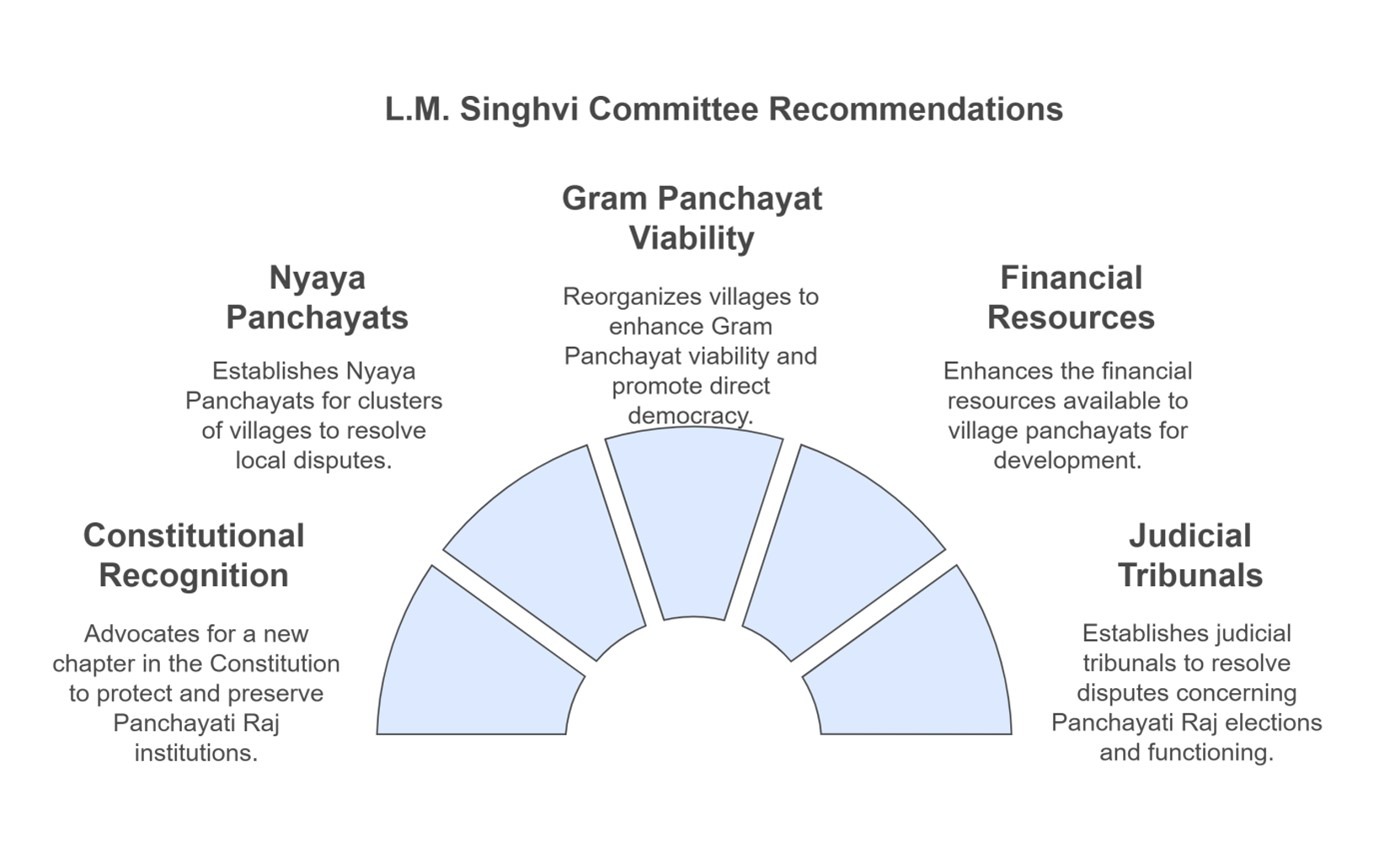
The L.M. Singhvi Committee aimed at revitalizing Panchayati Raj Institutions proposed:
- Constitutional Recognition: Advocate for a new chapter in the Constitution to protect and preserve Panchayati Raj institutions.
- Nyaya Panchayats: Establish Nyaya Panchayats for clusters of villages.
- Gram Panchayat Viability: Reorganize villages to enhance Gram Panchayat viability and promote the Gram Sabha as a direct democracy embodiment.
- Financial Resources: Enhance the financial resources available to village panchayats.
- Judicial Tribunals: Establish judicial tribunals to resolve disputes concerning Panchayati Raj elections and functioning.
5. Thungon Committee (1988)
The Thungon Committee recommended strengthening the Panchayati Raj system by:
- Constitutional Recognition: Call for constitutional recognition of Panchayati Raj bodies.
- Three-Tier System: Recommend a three-tier structure with village, block, and district panchayats.
- Zila Parishad as the Pivot: Position the Zila Parishad as the main agency for planning and development within the district.
- Fixed Tenure: Establish a five-year fixed tenure for Panchayati Raj institutions.
- Maximum Supersession: Limit any supersession period to six months.
- Planning Coordination: Create a planning and coordination committee at the state level.
- Reservation: Ensure reservations for SCs, STs, and women based on population.
- State Finance Commission: Establish a commission for financial allocations to Panchayati Raj institutions.
Gadgil Committee
The Gadgil Committee, officially known as the Committee on Policy and Programmes, was constituted in 1988 under the chairmanship of V.N. Gadgil. Its main objective was to evaluate how to enhance the effectiveness of Panchayati Raj institutions in India. The committee made several key recommendations aimed at strengthening local self-governance and ensuring the success of the Panchayati Raj system.
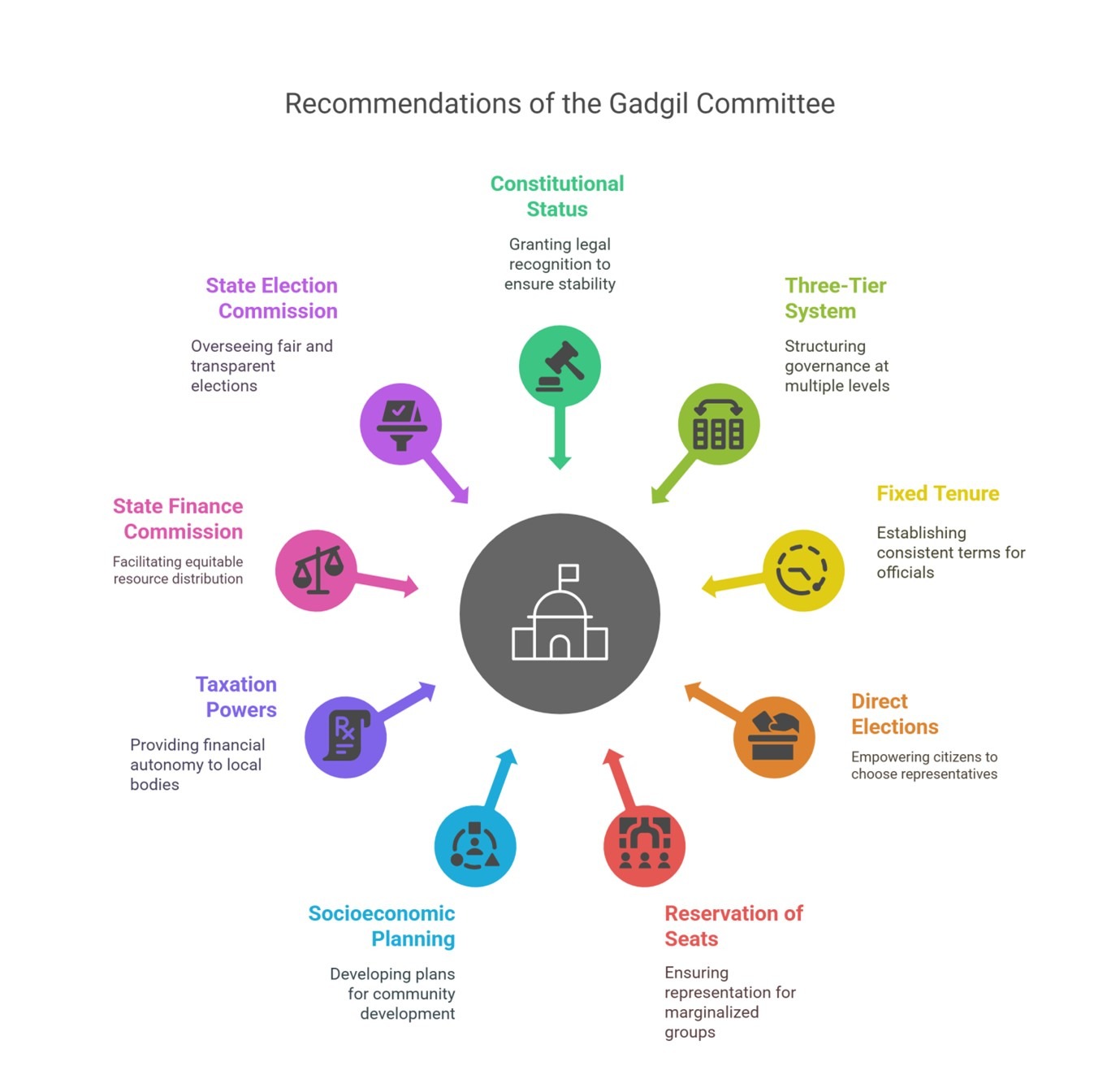
Recommendations of the Gadgil Committee
- Constitutional Status: The committee recommended granting constitutional status to the Panchayati Raj institutions to ensure their stability and integrity.
- Three-Tier System: It proposed a three-tier system of Panchayati Raj comprising:
- Gram Panchayat(village level)
- Panchayat Samiti(block level)
- Zila Parishad(district level)
- Fixed Tenure: A fixed term of five years for all Panchayati Raj institutions was recommended.
- Direct Elections: Members at all three levels of Panchayati Raj should be directly elected by the people to enhance democratic representation.
- Reservation of Seats: The committee called for reservations for Scheduled Castes (SCs), Scheduled Tribes (STs), and women to ensure adequate representation.
- Socioeconomic Planning: Panchayati Raj bodies should be responsible for preparing and implementing plans for socioeconomic development, with specific subjects outlined in the Constitution.
- Taxation Powers: Panchayati Raj bodies should have the authority to levy, collect, and appropriate taxes and duties to enhance their financial independence.
- State Finance Commission: The establishment of a State Finance Commission was recommended to facilitate the equitable distribution of financial resources to Panchayati Raj institutions.
- State Election Commission: A State Election Commission should be constituted to oversee and conduct elections to the Panchayati Raj institutions, ensuring free and fair electoral processes.
The recommendations of the Gadgil Committee were foundational in shaping the legislative efforts to enhance the Panchayati Raj system in India.
Constitutionalization of Panchayati Raj
Rajiv Gandhi Government
In July 1989, the Rajiv Gandhi Government introduced the 64th Constitutional Amendment Bill in the Lok Sabha to constitutionalize Panchayati Raj institutions. Although the Lok Sabha passed the bill in August 1989, it faced opposition in the Rajya Sabha and was ultimately not approved, primarily due to concerns regarding centralization in India’s federal structure.
V.P. Singh Government
The National Front Government, under V.P. Singh in November 1989, pledged to strengthen Panchayati Raj institutions. A two-day conference of Chief Ministers was held in June 1990 to discuss proposals for constitutional amendments to enhance these institutions. However, the government fell, resulting in the lapse of the proposed bill introduced in September 1990.
Narasimha Rao Government
Under P.V. Narasimha Rao, the Congress Government revisited the issue of constitutionalizing Panchayati Raj bodies. They introduced a modified constitutional amendment bill in September 1991 that removed controversial elements and addressed the initial concerns. This effort culminated in the 73rd Constitutional Amendment Act, which was enacted on April 24, 1992.
This amendment officially recognized the importance of local self-governance and provided a structured framework for the operation of Panchayati Raj institutions throughout India, ensuring their establishment, governance, and electoral processes.
The Gadgil Committee played a critical role in setting the stage for the constitutionalization of the Panchayati Raj system in India, leading to the 73rd Amendment, which empowered local governance and sought to enhance grassroots democracy. Subsequent governmental efforts further solidified these initiatives, recognizing the importance of local self-governance in India’s democratic fabric.
73rd Amendment Act of 1992
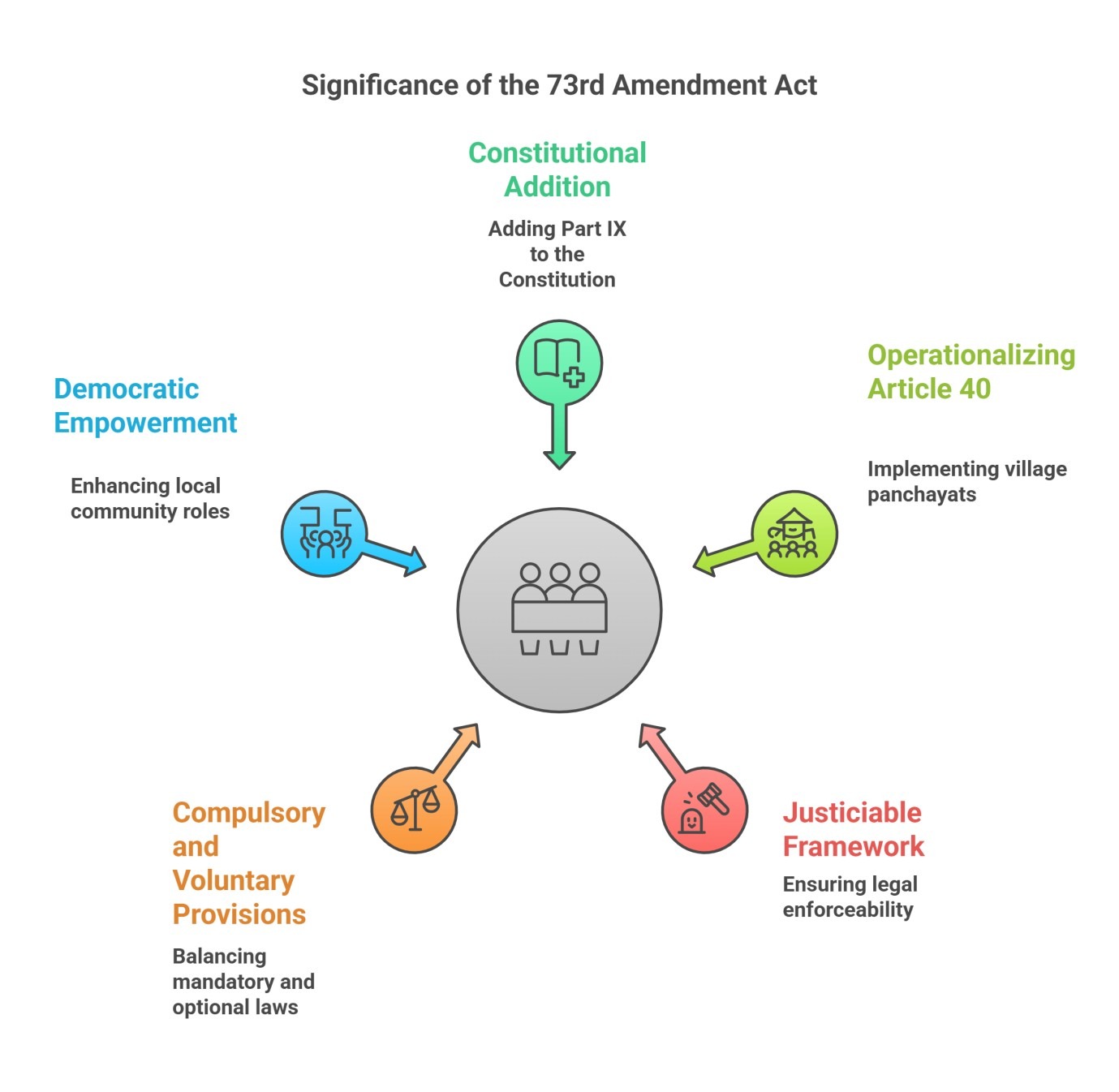
The 73rd Amendment Act is a landmark legislation that introduced significant constitutional changes to promote local self-governance in rural India through the establishment of the Panchayati Raj system. It effectively aims to empower local governance, enhance democracy at the grassroots level, and ensure community participation in development.
Significance of the Act
1. Constitutional Addition: The Act added a new Part IX to the Constitution, titled “The Panchayats,” which includes Articles 243 to 243-O and outlines the framework for Panchayati Raj institutions.
2. Operationalizing Article 40: It gave practical effect to Article 40 of the Constitution, which mandates the state to organize village panchayats and endow them with necessary powers for self-governance.
3. Justiciable Framework: By granting constitutional status to Panchayati Raj institutions, the Act places them under the purview of justiciable law, ensuring that state governments are obliged to implement the new system according to the Act’s provisions.
4. Compulsory and Voluntary Provisions: The Act distinguishes between compulsory provisions, which must be included in state laws, and voluntary provisions, which states can adopt based on local conditions.
5. Democratic Empowerment: It marked a shift from representative democracy to participatory democracy, enhancing the role of local communities in governance and decision-making.
Salient Features of the 73rd Amendment Act
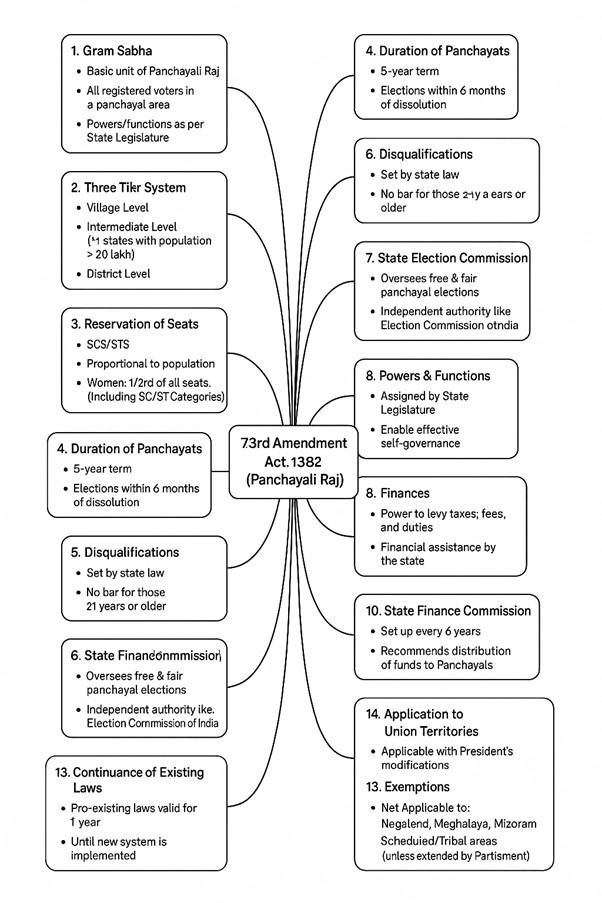
1. Gram Sabha:
- The Act establishes the Gram Sabhaas the foundational unit of the panchayati raj system, comprising all registered voters within the panchayat area. It can exercise powers and perform functions as determined by the state legislature.
2. Three-Tier System:
- A three-tier systemof panchayati raj is mandated, consisting of:
- Gram Panchayatat the village level.
- Panchayat Samitiat the block level.
- Zila Parishadat the district level.
- States with populations under 20 lakh may exclude the intermediate level.
- A three-tier systemof panchayati raj is mandated, consisting of:
3. Elections:
- Members of all levels of panchayats are to be elected directly by the electorate, while the chairpersons of intermediate and district panchayats are elected indirectly from among the elected members.
4. Reservation of Seats:
- Reservations are mandated for SCs and STs in Panchayati Raj institutions proportional to their population. Additionally, at least one-third of the total seats at all levels must be reserved for women, including those reserved for SC and ST women.
5. Duration of Panchayats:
- Panchayati Raj institutions are provided a five-year term, with provisions for timely elections after dissolution.
6. Disqualifications:
- Specific disqualifications for membership in panchayats are defined, while ensuring that age-based disqualifications (for members below 25) do not apply if they are 21 or older.
7. State Election Commission:
- The conduct of panchayati raj elections is managed by a State Election Commission, which ensures free and fair elections, similar to elections for state legislatures.
8. Powers and Functions:
- The state legislature can bestow appropriate powers and responsibilities upon the Panchayati Raj institutions to enable them to function as effective self-governing bodies.
9. Finances:
- Panchayati Raj institutions can levy taxes and duties, and the state is mandated to ensure adequate financial resources through grants and other mechanisms.
10. Finance Commission:
- A state finance commission must be constituted every five years to assess and review the financial position of the panchayats and make recommendations for resource allocation.
11. Application to Union Territories:
- The provisions of this Part apply to Union Territories, with potential modifications by the President.
12. Exemptions:
- The Act does not apply to Nagaland, Meghalaya, Mizoram, and certain scheduled and tribal areas, although the Parliament can extend provisions with exceptions.
13. Continuance of Existing Laws:
- Existing state laws concerning panchayats remain effective for one year following the Act’s commencement, ensuring a transition to the new system.
14. Bar to Court Interference:
- The Act prohibits court interference regarding the electoral matters of panchayats, safeguarding the integrity of local electoral processes.
Eleventh Schedule
The Eleventh Schedule includes 29 functional items assigned to Panchayati Raj institutions, reflecting their responsibilities and areas of governance:
- Agriculture, including agricultural extension
- Land improvement, implementation of land reforms, land
consolidation and soil conservation
- Minor irrigation, water management and watershed development
- Animal husbandry, dairying and poultry
- Fisheries
- Social forestry and farm forestry
- Minor forest produce
- Small-scale industries, including food processing industries
- Khadi, village and cottage industries
- Rural housing
- Drinking water
- Fuel and fodder
- Roads, culverts, bridges, ferries, waterways and other means of
communication
- Rural electrification, including distribution of electricity
- Non-conventional energy sources
- Poverty alleviation programme
- Education, including primary and secondary schools
- Technical training and vocational education
- Adult and non-formal education
- Libraries
- Cultural activities
- Markets and fairs
- Health and sanitation including hospitals, primary health centres and dispensaries
- Family welfare
- Women and child development
- Social welfare, including welfare of the handicapped and
mentally retarded
- Welfare of the weaker sections, and in particular, of the
scheduled castes and the scheduled tribes
- Public distribution system
- Maintenance of community assets
73rd Amendment Act of 1992: Compulsory and Voluntary Provisions
The 73rd Amendment Act of 1992 revolutionized local governance in India by establishing a constitutional framework for the Panchayati Raj system. This amendment categorized its provisions into compulsory (mandatory) and voluntary (discretionary) provisions.
A. Compulsory Provisions
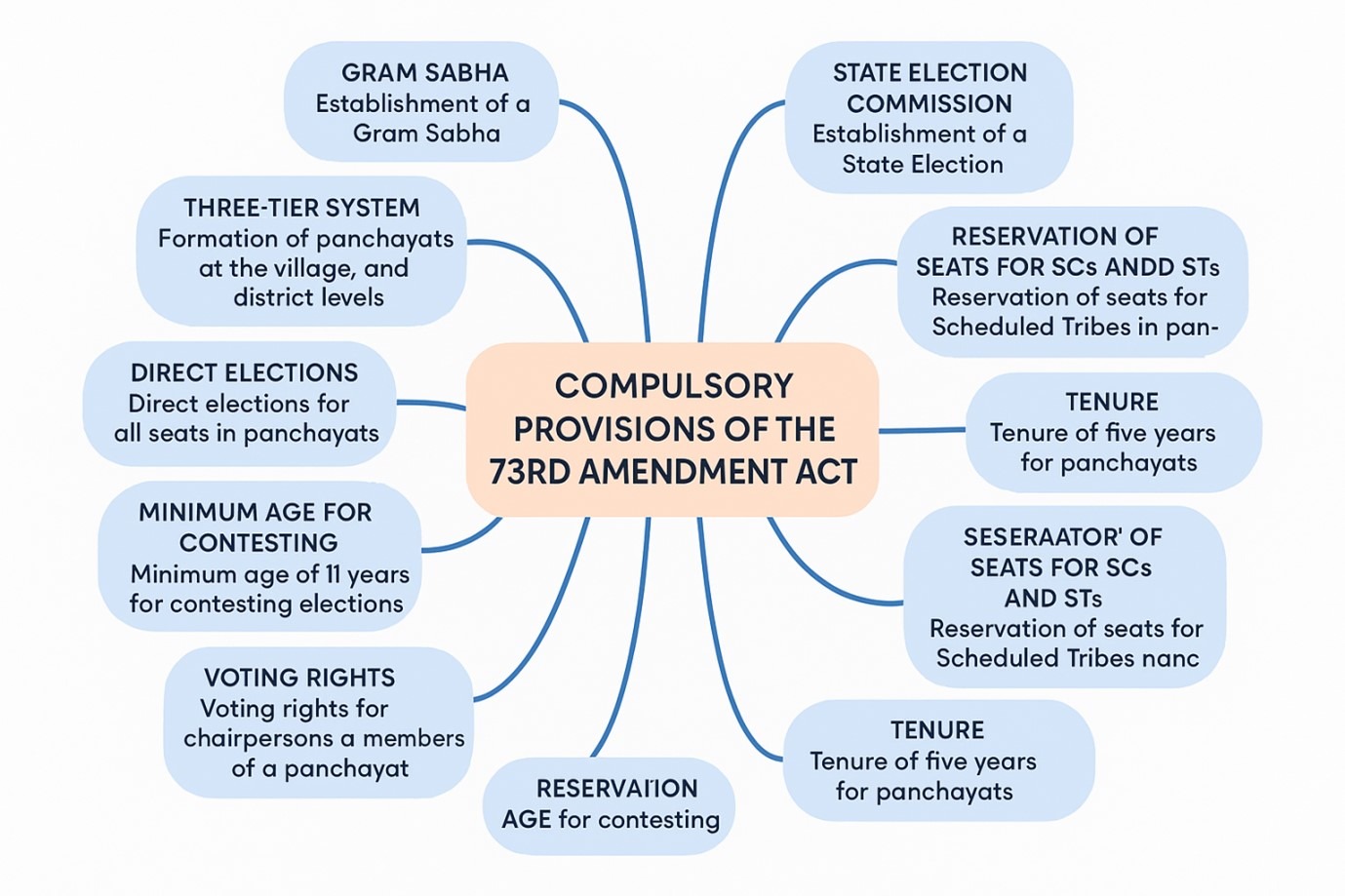
The compulsory provisions of the 73rd Amendment Act that must be included in the state laws for the Panchayati Raj system are as follows:
1. Gram Sabha: Establishment of a Gram Sabha at the village or group of villages level.
2. Three-Tier System: Formation of panchayats at the village, intermediate, and district levels.
3. Direct Elections: Direct elections for all seats in panchayats at all three levels.
4. Indirect Elections: Indirect elections for the chairpersons of the intermediate and district panchayats.
5. Voting Rights: Voting rights for both chairpersons and members of a panchayat, whether elected directly or indirectly.
6. Minimum Age for Contesting: Setting the minimum age for contesting elections to panchayats at 21 years.
7. Reservation of Seats for SCs and STs: Reservation of seats for Scheduled Castes (SCs) and Scheduled Tribes (STs) in all panchayats proportionate to their populations.
8. Women’s Reservation: Reservation of at least one-third of total seats for women at all levels of panchayati raj institutions.
9. Tenure: A fixed tenure of five yearsfor all panchayats, with provisions for holding elections within six months if a panchayat is superseded.
10. State Election Commission: Establishment of a State Election Commission to oversee elections to panchayati raj institutions.
11. State Finance Commission: Constitution of a State Finance Commission every five years to review and recommend the financial positions of the panchayats.
B. Voluntary Provisions
The voluntary provisions are those that state governments can adopt at their discretion:
- Empowering Gram Sabha: Endowing the Gram Sabha with specific powers and functions at the village level.
- Election of Chairpersons: Determining how the chairperson of the village panchayat is elected.
- Representation: Offering representation to chairpersons of village panchayats in intermediate panchayats or, where applicable, in district panchayats.
- Reserve Seats for Backward Classes: Providing for the reservation of seats in panchayats for backward classes.
- Direct Local Governance: Granting powers to panchayats to operate as self-governing bodies (autonomous institutions).
- Devolution of Powers: Delegating powers and responsibilities to panchayats for the preparation of plans for economic development and social justice, including functions from the Eleventh Schedule.
- Taxation Powers: Allowing panchayats to levy, collect, and appropriate taxes, duties, tolls, and fees.
- Assignment of Government Levies: Assigning taxes, duties, and fees collected by the state government to panchayats.
- Grants-in-Aid: Making provisions for grants-in-aid to panchayats from the consolidated fund of the state.
- Funds for Panchayats: Establishing funds for crediting all moneys of the panchayats.
PESA Act of 1996 (Extension Act)
PESA (Provisions of the Panchayats (Extension to Scheduled Areas) Act, 1996 extends the provisions of Part IX of the Constitution to the Fifth Schedule areas with specific modifications.
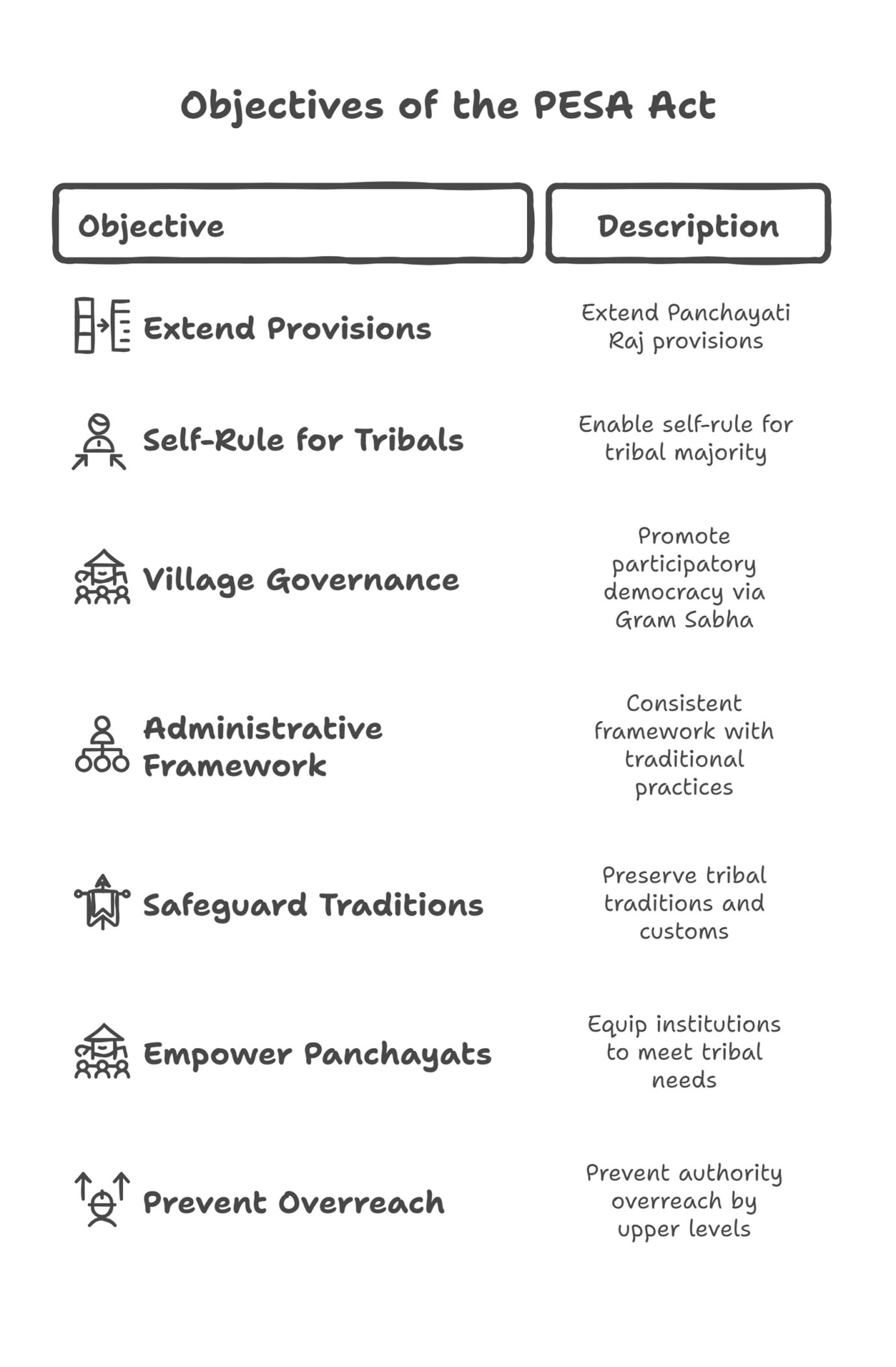
Objectives of the PESA Act
- Extend Provisions: Extend Panchayati Raj provisions to scheduled areas with certain modifications.
- Self-Rule for Tribals: Enable self-rule for the majority of the tribal population.
- Village Governance: Promote governance through participatory democracy, making the Gram Sabha central to all activities.
- Administrative Framework: Establish a framework consistent with traditional practices for governance.
- Safeguard Traditions: Preserve the traditions and customs of tribal communities.
- Empower Ragat Panchayats: Equip Panchayati Raj institutions at appropriate levels with powers essential to meet tribal needs.
- Prevent Higher-Level Overreach: Prevent upper-level panchayats from assuming authority over lower-level panchayats.
The PESA (Panchayats (Extension to Scheduled Areas) Act) has several key features aimed at empowering local self-governance in Scheduled Areas. Here’s a summary of the important provisions:
- State Legislation Alignment: State laws governing Panchayats in Scheduled Areas must respect local customary laws and traditional practices.
- Village Definition: A village is defined as a community managing its affairs based on traditions, which can consist of one or more habitations.
- Gram Sabha Composition: Each village must have a Gram Sabha composed of eligible voters from the electoral rolls for that Panchayat.
- Safeguard Customs: The Gram Sabha is responsible for preserving local traditions, cultural identity, and customary dispute resolution methods.
- Development Responsibility: The Gram Sabha must approve plans and programs for social and economic development and identify beneficiaries for poverty alleviation programs.
- Fund Utilization Certification: The Panchayat must obtain certification from the Gram Sabha regarding the utilization of funds for approved projects.
- Reservation of Seats: Seats in Panchayats are reserved for Scheduled Tribes based on population, with at least half reserved for STs. Chairperson positions at all levels are reserved for STs.
- Nominations: The state government can nominate up to one-tenth of Panchayat members for underrepresented Scheduled Tribes at the intermediate or district levels.
- Land Acquisition Consultation: The Gram Sabha must be consulted before land acquisition for development projects and before resettling affected persons.
- Water Body Management: Minor water bodies’ management is entrusted to Panchayats.
- Mineral Prospecting Recommendations: Recommendations from Gram Sabhas or Panchayats are mandatory for granting prospecting licenses or mining leases for minor minerals.
- Auction Concessions: Prior recommendations from the Gram Sabha or Panchayats are necessary for granting exploitation concessions for minor minerals through auction.
- Powers of Panchayats and Gram Sabha:
- Prohibition enforcement and regulation of intoxicants.
- Ownership of minor forest produce.
- Prevention of unlawful land alienation and restoration actions.
- Management of village markets and control over money lending to Scheduled Tribes.
- Control over social sector institutions and local resource planning.
- Safeguards Against Overreach: State legislation must ensure higher-level Panchayats do not undermine the authority of lower-level Panchayats or Gram Sabhas.
- Administrative Patterns: The State Legislature should align with the Sixth Schedule of the Constitution in designing district-level administrative arrangements in Scheduled Areas.
- Inconsistency with Existing Laws: Any law inconsistent with the PESA provisions will cease to be effective one year after the Act’s presidential assent, with existing Panchayats continuing until their term expires unless dissolved sooner.
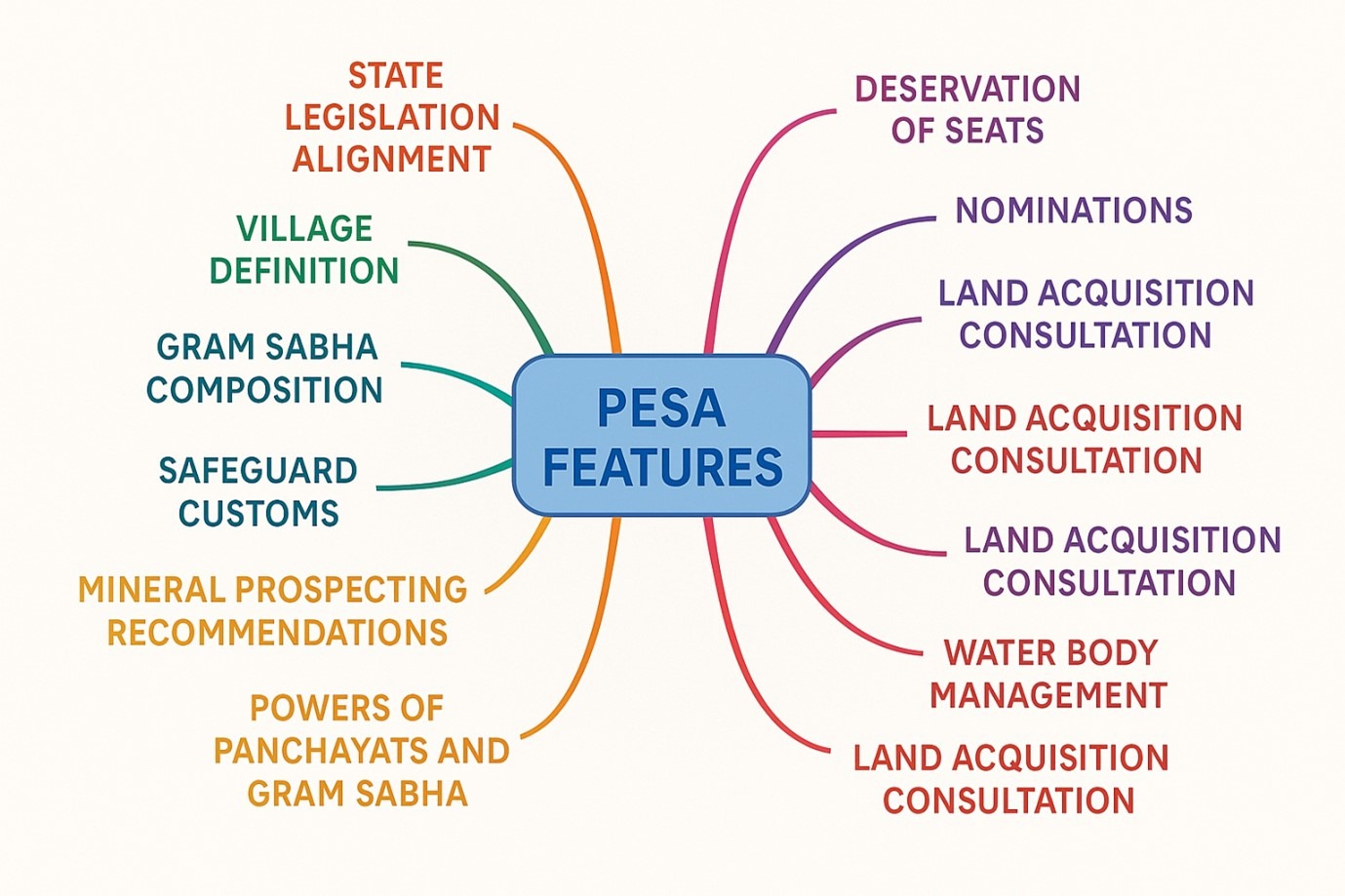
These features collectively aim to enhance local self-governance, protect local customs, and ensure that development efforts are community-driven in Scheduled Areas.
Financial Position Of Panchayati Raj Institutions
The financial position and performance of Panchayati Raj Institutions (PRIs) in India have been significant topics of analysis, particularly by the Second Administrative Reforms Commission. The commission outlined the following insights regarding the finances of PRIs, their revenue sources, and the reasons for their ineffective performance:
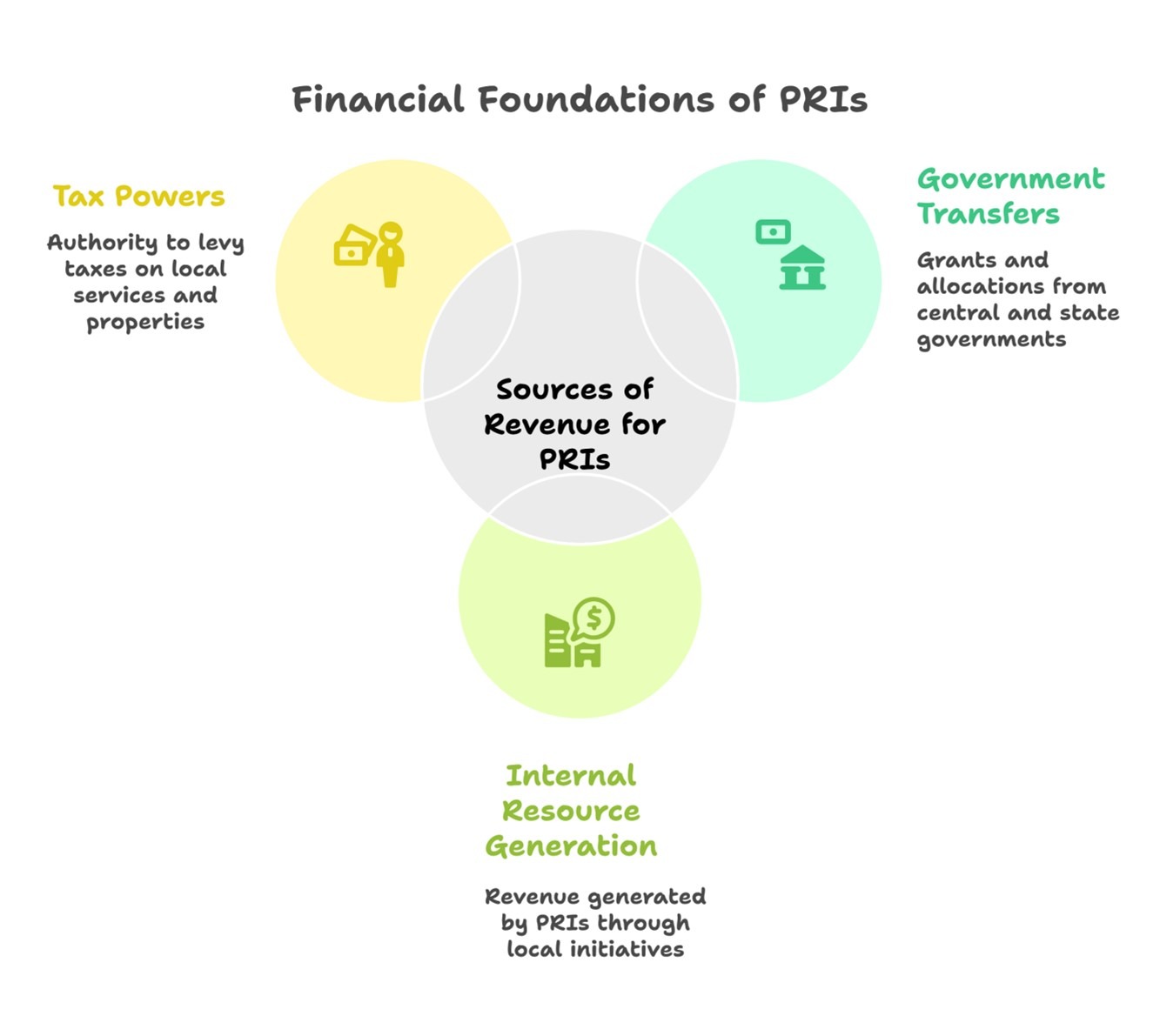
Sources of Revenue for PRIs
1. Government Transfers:
- Grants from the Union Governmentbased on Central Finance Commission recommendations (Article 280).
- Devolution from the State Governmentbased on State Finance Commission recommendations (Article 243-I).
- Loans and grants from State Governments.
- Programme-specific allocations under Centrally Sponsored Schemes and Additional Central Assistance.
2. Internal Resource Generation:
- PRIs have limited own revenue sources, with the Gram Panchayats being more capable of generating funds compared to higher tiers (Intermediary and District Panchayats).
3. Tax Powers:
- State Panchayati Raj Acts primarily empower Village Panchayats with various taxations such as property tax, land tax, vehicle tolls, and fees related to local services (sanitation, water, etc.).
Financial Problems Faced by PRIs
1. Inadequate Fiscal Empowerment:
- PRIs largely depend on government grants, with weak internal revenue generation. While some states (like Kerala, Karnataka, and Tamil Nadu) perform better in empowerment, reliance on external funds remains.
2. Limited Own Resource Mobilization:
- Internal revenue generation is hindered by a narrow tax base and reluctance from Panchayats to actively collect taxes.
3. Conditional Funding:
- The tied nature of grants limits flexibility in expenditure, often leading to unsuitable resource allocation for local needs.
4. Bureaucratic Control:
- Excessive control from state bureaucracies impedes the autonomy of Gram Panchayats, forcing elected leaders to engage more with bureaucratic processes than with their constituents.
5. Ineffective Utilization of Fiscal Powers:
- Despite having the authority to levy taxes, many Gram Panchayats do not exercise these powers, often citing community relationships as a barrier.
6. Weak Role of Gram Sabhas:
- The potential of Gram Sabhas for promoting transparency and accountability is undermined by unclear powers and lack of procedures in state acts.
7. Creation of Parallel Bodies:
- The establishment of parallel organizations for service delivery complicates governance, bypasses PRIs, and can lead to inefficient usage of resources.
8. Inadequate Infrastructure and Training:
- Many Gram Panchayats lack basic infrastructure, full-time staff, and adequate training for representatives, hindering their operational effectiveness.
Overall, the financial health of PRIs is critically tied to their ability to generate their own resources and the extent to which they can function independently from state control. Improving the financial autonomy and capacity of PRIs, alongside empowering Gram Sabhas, is essential for effective local governance and community engagement. Enhancements in infrastructure and training for elected representatives would further bolster the effectiveness of the Panchayati Raj system.