
Official Language
Article XVII of the Constitution addresses the official language within Articles 343 to 351. The stipulations are categorized into four sections – Language of the Union, Regional languages, Language of the judiciary and texts of laws, and Special directives.
LANGUAGE OF THE UNION
The Constitution includes the following provisions regarding the official language of the Union.
- Hindi, written in Devanagari script, is designated as the official language of the Union. However, the format of numerals to be utilized for official purposes within the Union must be the international form of Indian numerals instead of the Devanagari numerals.
- Nonetheless, for a duration of fifteen years from the inception of the Constitution (i.e., from 1950 to 1965), the English language shall remain in use for all official purposes of the Union as it was before 1950.
- Even after the fifteen-year period, the Parliament may allow for the ongoing usage of the English language for specific purposes.
- At the conclusion of five years, and again at ten years, from the start of the Constitution, the president should appoint a commission to provide recommendations regarding the gradual promotion of the Hindi language, limitations on the use of the English language, and related issues.
- A parliamentary committee shall be formed to review the commission’s recommendations and report its perspectives to the president.
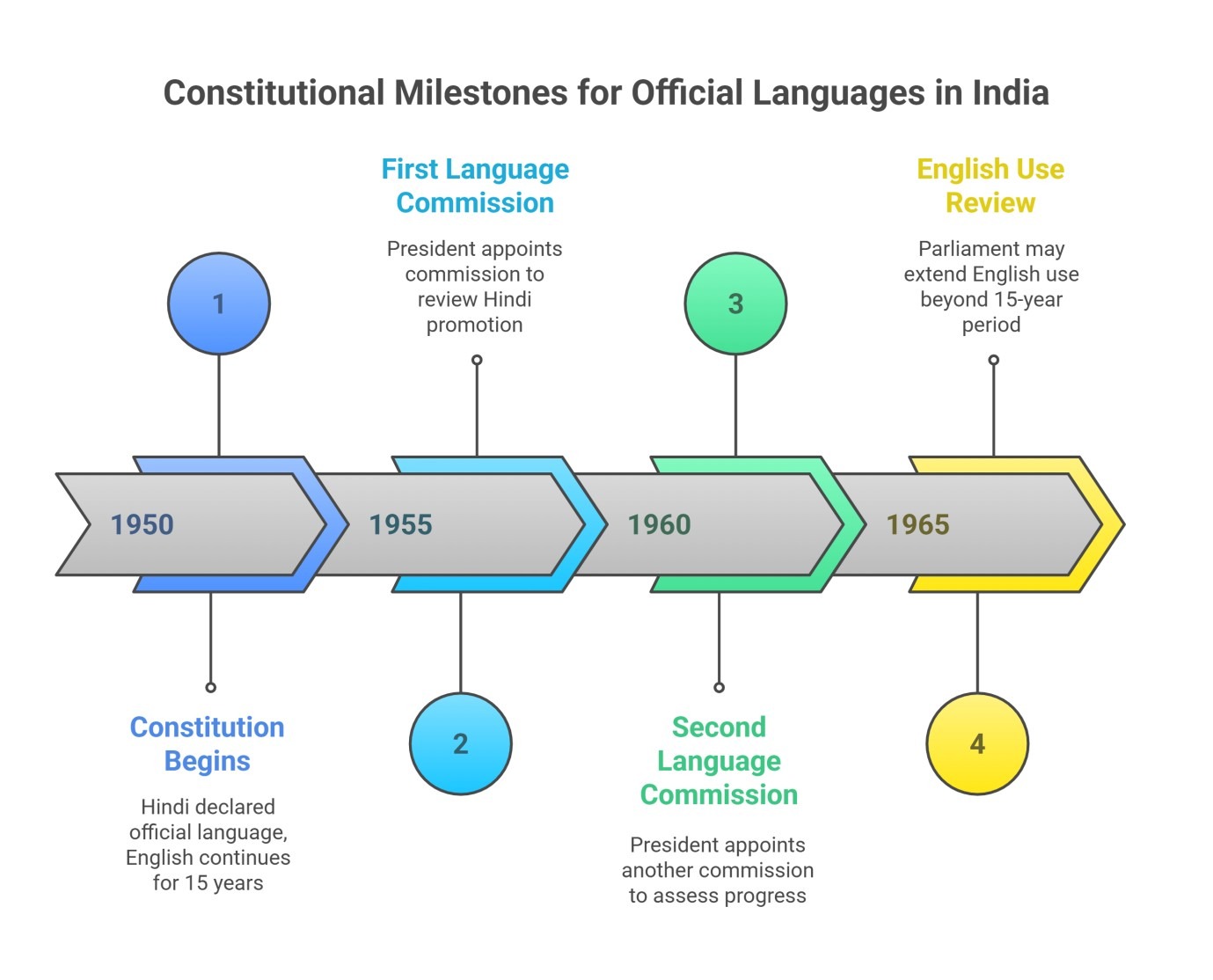
In alignment with this, in 1955, the president established an Official Language Commission chaired by B.G. Kher. The commission delivered its findings to the President in 1956. The findings were evaluated by a parliamentary committee convened in 1957 overseen by Gobind Ballabh Pant. However, another Official Language Commission (as indicated by the Constitution) was not established in 1960. Subsequently, in 1963, the Parliament passed the Official Languages Act. The act permits the continued use of English (even after 1965), alongside Hindi, for all official purposes of the Union and for business transactions within Parliament. Importantly, this act allows for the indefinite use of English (without any time constraints). Additionally, the act was revised in 1967 to enforce the compulsory use of English, along with Hindi, in certain circumstances.
REGIONAL LANGUAGES
The Constitution does not designate the official language for different states. In this context, it stipulates the following provisions:
1. The legislature of a state may select one or more of the languages spoken in the state or Hindi as the official language of that state. Until that decision is made, English shall remain the official language of that state. Under this provision, most states have chosen the dominant regional language as their official language. For instance, Andhra Pradesh has selected Telugu, Kerala– Malayalam, Assam–Assamese, West Bengal–Bengali, Odisha–Odia. The nine northern states of Himachal Pradesh, Uttar Pradesh, Uttarakhand, Madhya Pradesh, Chhattisgarh, Bihar, Jharkhand, Haryana, and Rajasthan have designated Hindi. Gujarat has adopted Hindi alongside Gujarati. Likewise, Goa employs Marathi in addition to Konkani. Jammu and Kashmir has chosen Urdu (not Kashmiri). Conversely, certain northeastern states like Meghalaya, Arunachal Pradesh, and Nagaland have opted for English. Notably, states are not constrained to select only from the languages listed in the Eighth Schedule of the Constitution.
2. For now, the official language of the Union (i.e., English) will serve as the common language for communication between the Union and the states or among various states. However, two or more states may mutually agree to use Hindi (instead of English) for communication with each other. Rajasthan, Uttar Pradesh, Madhya Pradesh, and Bihar are some of the states that have formed such agreements.
The Official Languages Act (1963) states that English should be utilized for communication between the Union and non-Hindi states (those that have not adopted Hindi as their official language). Furthermore, when Hindi is employed for communication between a Hindi and a non- Hindi state, such communication in Hindi must be accompanied by an English translation.
3. If the President (upon a demand being made) is convinced that a significant portion of the population of a state desires the recognition of any language spoken by them, he may instruct that such language shall also be officially recognized in that state. This provision is aimed at safeguarding the linguistic rights of minorities within the states.

LANGUAGE OF THE JUDICIARY AND TEXTS OF LAWS
The constitutional provisions related to the language used in the courts and legislation are as follows:
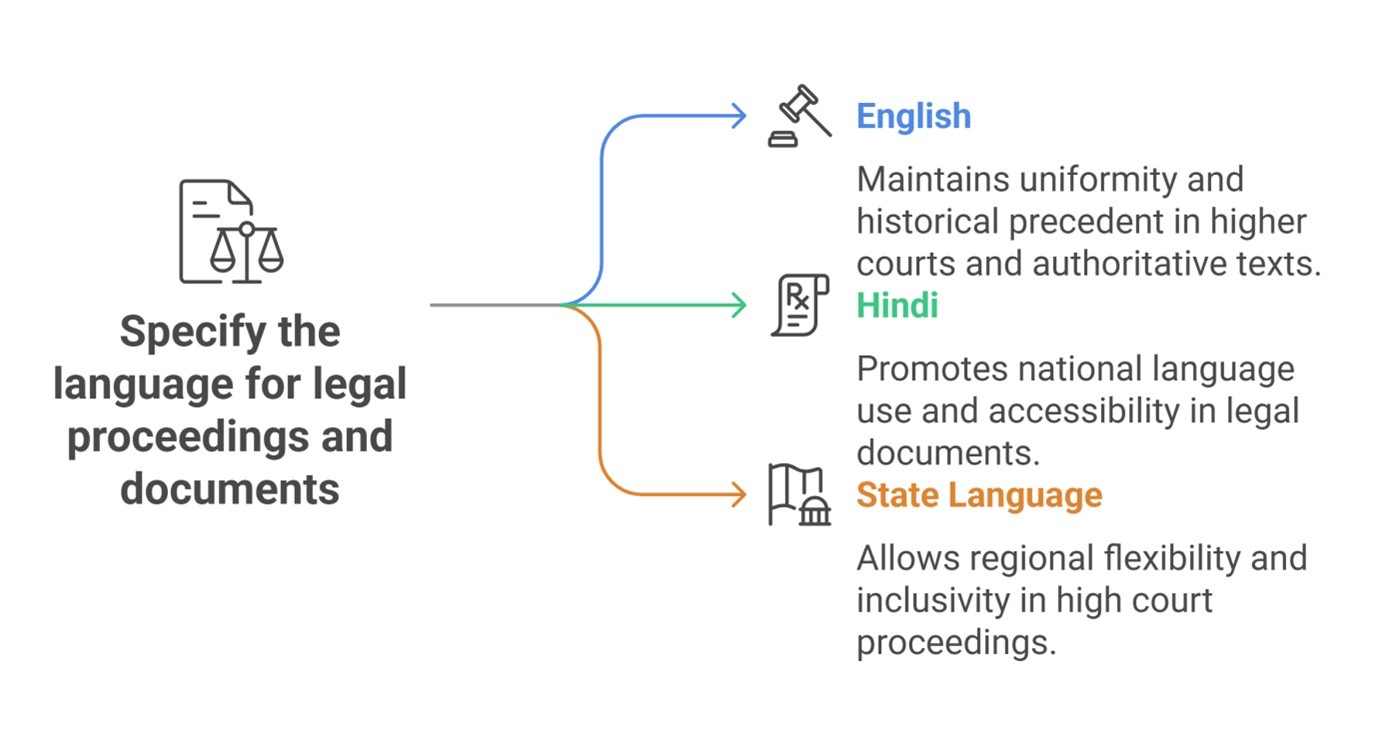
1. Until Parliament specifies otherwise, the following will be conducted in the English language only:
(a) All proceedings in the Supreme Court and every high court.
(b) The authoritative texts of all bills, acts, ordinances, orders, rules, regulations, and bye-laws at the Central and state levels.
2. However, the governor of a state, with prior approval from the president, can permit the utilization of Hindi or any other official language of the state, in the proceedings at the high court of the state; however, this does not apply to the judgements, decrees, and orders issued by it. In other words, the judgements, decrees, and orders of the high court must remain in English only (until Parliament provides otherwise).
3. Similarly, a state legislature can dictate the use of any language (excluding English) concerning bills, acts, ordinances, orders, rules, regulations, or bye-laws, but an English translation must be published. The Official Languages Act of 1963 states that Hindi translations of acts, ordinances, orders, regulations, and bye-laws published under the authority of the president are regarded as authoritative texts. Furthermore, each bill introduced in Parliament must be accompanied by a Hindi translation. Likewise, there shall be a Hindi translation of state acts or ordinances in specific cases.
The act further allows the governor of a state, with prior consent from the president, to authorize the use of Hindi or any other official language of the state for judgements, decrees, and orders issued by the high court of the state, but these must be accompanied by an English translation. For instance, Hindi is utilized in Uttar Pradesh, Madhya Pradesh, Bihar, and Rajasthan for this purpose.
However, Parliament has not established any provision for the use of Hindi in the Supreme Court. Therefore, the Supreme Court only hears those who petition or appeal in English. In 1971, a petitioner insisted on presenting a habeas corpus petition in Hindi in the Supreme Court. However, the Court dismissed his petition on the grounds that the language of the Court is English and permitting Hindi would be unconstitutional.
The Authorised Translations (Central Laws) Act of 1973 states that a translation in any regional language mentioned in the Eighth Schedule to the Constitution (excluding Hindi) of any central act, ordinance, order, rule, regulation, and bye-law published under the authority of the President in the Official Gazette is considered to be the authoritative texts in such language.
SPECIAL DIRECTIVES
The Constitution encompasses specific directives aimed at safeguarding the interests of linguistic minorities and promoting the advancement of the Hindi language. These include:
Protection of Linguistic Minorities
In this regard, the Constitution establishes the following provisions:
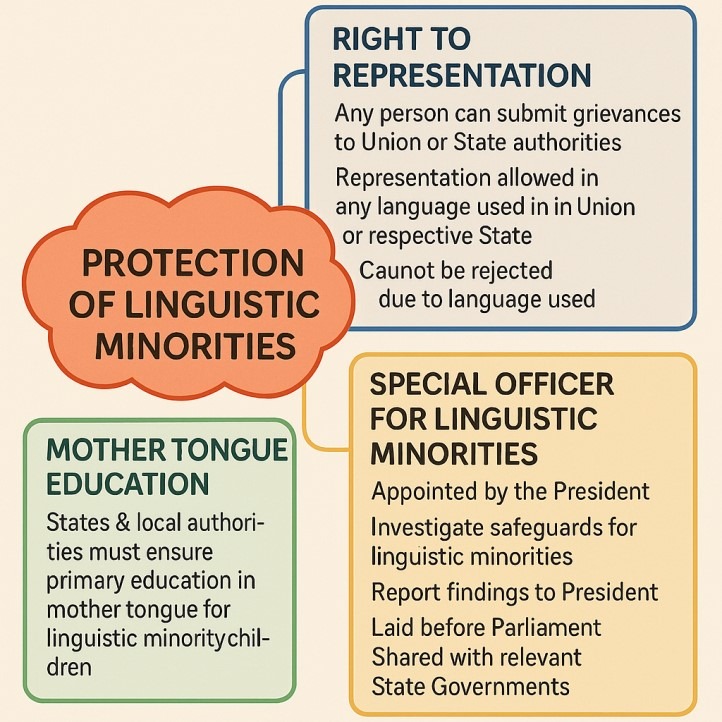
1. Every individual with grievances has the right to present a representation for redress to any officer or authority of the Union or a state in any of the languages used in the Union or in the state, as applicable. This implies that a representation cannot be dismissed on the basis that it is not written in the official language.
2. Every state and local authority within the state must provide adequate facilities for instruction in the mother tongue at the primary stage of education to children belonging to linguistic minority groups. The president can issue necessary directives for this purpose.
3. The president must appoint a special officer for linguistic minorities to investigate all matters concerning the constitutional safeguards for linguistic minorities and to report back to him. The president will present all such reports to the Parliament and communicate with the concerned state government.
Development of Hindi Language
The Constitution mandates the Centre to foster the growth and dissemination of the Hindi language so that it may serve as the lingua franca of India’s diverse culture. Furthermore, the Centre is directed to enrich Hindi by incorporating forms, styles, and expressions utilized in Hindustani and other languages specified in the Eighth Schedule, drawing its vocabulary mainly from Sanskrit and secondarily from other languages.
As of now (2019), the Eighth Schedule of the Constitution identifies 22 languages (initially 14 languages). These are: Assamese, Bengali, Bodo, Dogri (Dongri), Gujarati, Hindi, Kannada, Kashmiri, Konkani, Maithili, Malayalam, Manipuri, Marathi, Nepali, Odia, Punjabi, Sanskrit, Santhali, Sindhi, Tamil, Telugu, and Urdu. Sindhi was included by the 21st Amendment Act of 1967; Konkani, Manipuri, and Nepali were added by the 71st Amendment Act of 1992; and Bodo, Dongri, Maithili, and Santhali were added by the 92nd Amendment Act of 2003.
In light of the constitutional provisions, there are two objectives behind the specification of the above regional languages in the Eighth Schedule:
(a) Members of these languages are to be represented in the Official Language Commission; and
(b) the forms, style, and expressions of these languages are to be utilized for enriching the Hindi language.
COMMITTEE OF PARLIAMENT ON OFFICIAL LANGUAGE
The Official Languages Act (1963) mandated the formation of a Committee of Parliament on Official Language to evaluate the advancements made in the utilization of Hindi for the official purposes of the Union. Following the Act, this Committee was to be formed ten years after its enactment (i.e.,26th January, 1965). Consequently, this Committee was established in 1976. It comprises 30 members of Parliament, 20 from the Lok Sabha and 10 from the Rajya Sabha.
The Act outlines the following provisions concerning the composition and role of the committee:
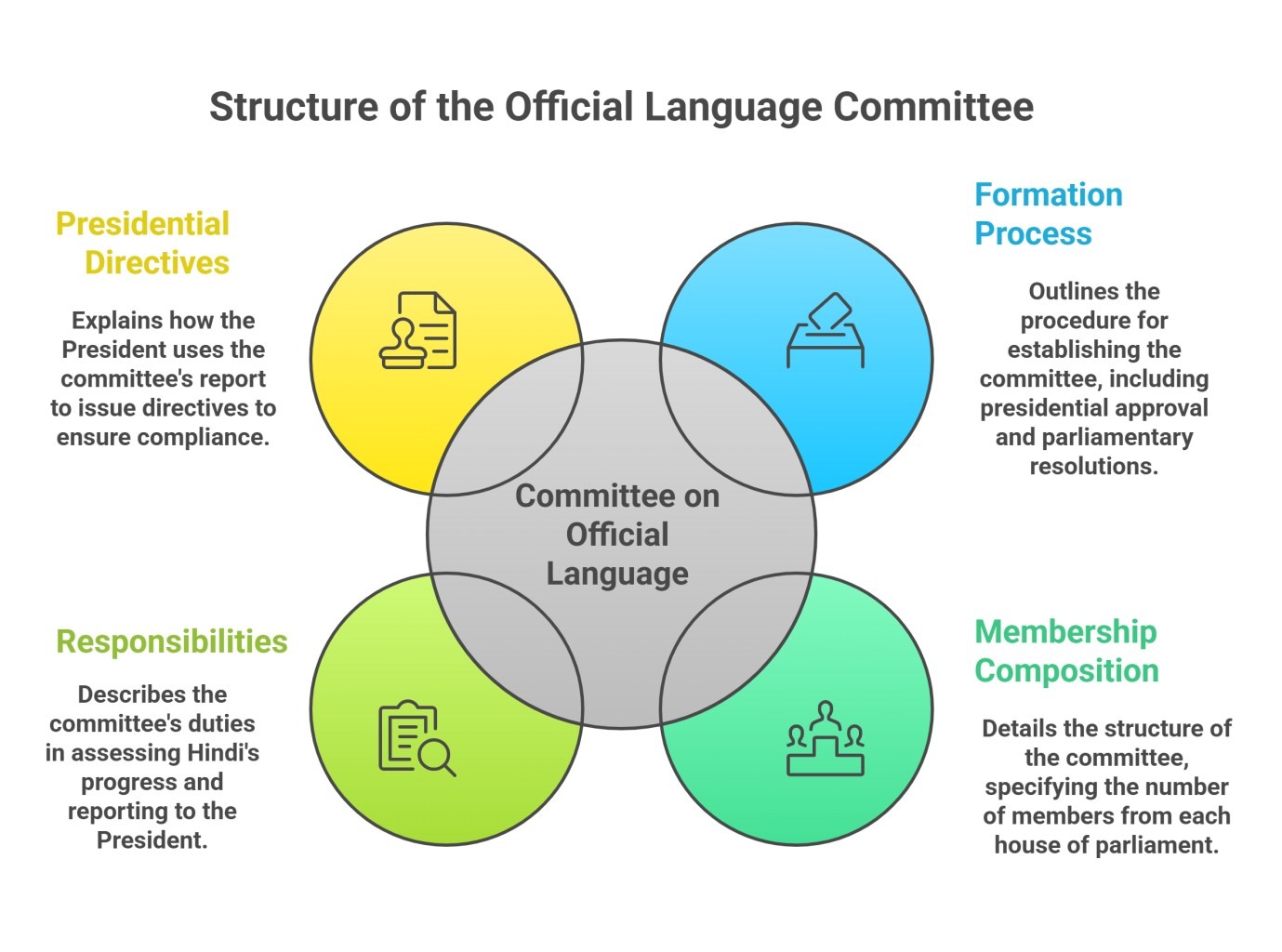
1. After ten years from the date on which the Act takes effect, a Committee on Official Language shall be formed upon a resolution to that effect being proposed in either House of Parliament with the prior approval of the President and passed by both Houses.
2. The Committee shall consist of thirty members, of whom twenty shall be members of the House of the People and ten shall be members of the Council of States, elected respectively by the members of the House of the People and the members of the Council of States in accordance with the proportional representation system using the single transferable vote.
3. It shall be the responsibility of the Committee to assess the progress achieved in the use of Hindi for official purposes of the Union and submit a report to the President containing recommendations, which the President shall ensure is presented to each House of Parliament and communicated to all State Governments.
4. The President may, after reviewing the report and the views expressed by the State Governments, issue directives in accordance with all or any portions of the report.
The Chairman of the Committee is elected by the committee members. Traditionally, the Union Home Minister has been elected as the Chairman of the Committee periodically. The Committee is required to present its report along with its recommendations to the President after evaluating the status of Hindi usage in Central Government Offices based on its observations.
In addition to other methods for gauging the actual situation, the Committee resolved to inspect certain Central Government offices across diverse fields of work to encourage maximum use of Hindi, thereby achieving the objectives of the Constitution and the Official Languages Act provisions. To this end, the Committee established three sub-Committees, and for the purpose of inspection, various Ministries/Departments were divided into three distinct groups.
Moreover, to evaluate the application of the Official Language for various purposes and connected matters, it was also decided to invite distinguished individuals from different fields such as education, judiciary, voluntary organizations, and the Secretaries of the Ministries/Departments for oral testimonies.
The progressive incorporation of Hindi in Central Government offices is being reviewed by the Committee within the context of the provisions regarding Official Language as stipulated by the Constitution; the Official Languages Act, 1963; and the rules formed under it. The Committee also takes into account the circulars/instructions, etc., issued by the Government in this regard over time. Given the comprehensive scope of the Committee’s terms of reference, it has also been examining other pertinent aspects such as the medium of instruction in schools, colleges, and universities; methods of recruitment for Central Government services; and the medium of departmental examinations, among others. Aware of the scale of various aspects of the Official Language policy and considering current conditions, the Committee decided in its meetings held in June 1985 and August 1986 to present its report to the President in parts, with each part addressing a specific aspect of the Official Language policy.
The Secretariat of the Committee is led by the Secretary of the Committee, who is supported by officers at the level of Under Secretary and other officials. These officials provide essential assistance in conducting the various activities of the Committee. For administrative purposes, this office operates as a subordinate office of the Department of Official Language, Ministry of Home Affairs.