
National Human Rights Commission
The National Commission for Scheduled Castes (SCs) operates under Article 338 of the Constitution, while the National Commission for Scheduled Tribes (STs) operates under Article 338-A. The National Commission for Human Rights (NCHR) is a similar body that focuses on protecting and promoting human rights in India. Below is an overview of its establishment, composition, functions, and role.Establishment of the Commission
-
- The National Human Rights Commission (NHRC) was established under the Protection of Human Rights Act, 1993. It serves as the watchdog for human rights in India.
- Its creation stemmed from the recognition of the need for an institutional framework to monitor human rights violations and provide a mechanism for redress.

Key Objectives of the Commission
1. Addressing Human Rights Issues:-
- To strengthen the institutional arrangements for addressing human rights issues comprehensively.
-
- To independently investigate allegations of excesses or violations of human rights and affirm the government’s commitment to protecting these rights.
-
- To complement and enhance existing efforts aimed at the protection and promotion of human rights.
Composition of the Commission
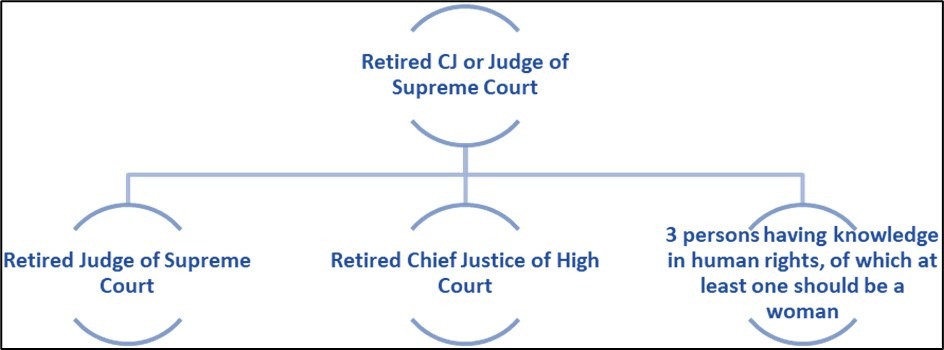
The NHRC is a multi-member body comprising:
1. Chairperson:
- Usually a retired Chief Justice of India or a judge of the Supreme Court.
2. Members:
- The Commission consists of four other members, including:
- A serving or retired judge of the Supreme Court.
- A serving or retired Chief Justice of a High Court.
- Three persons with practical experience in the field of human rights, where at least one must be a woman.
- The Commission consists of four other members, including:
3. Ex-Officio Members:
- The Commission includes ex-officio members comprising the chairpersons of various national commissions (e.g., National Commission for Minorities, Scheduled Castes, and Scheduled Tribes) and the Chief Commissioner for Persons with Disabilities.
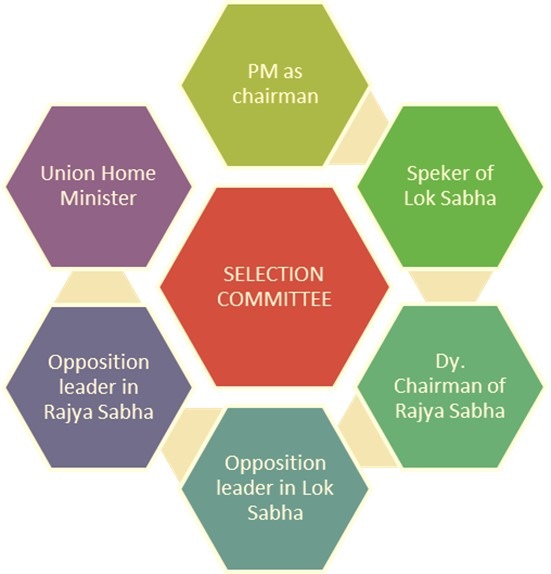
The chairperson and members are appointed by the President based on recommendations from a committee led by the Prime Minister.
Term & Tenure:
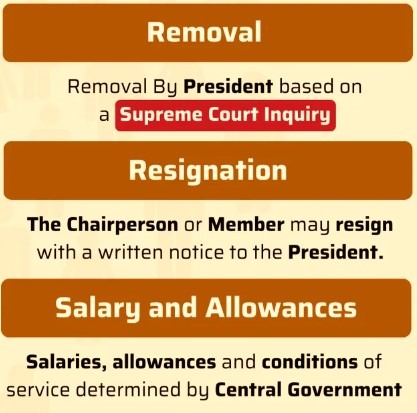
- The chairman and members hold office for a term of three years or till the age of seventy years, whichever is earlier.
- After their tenure, they are not eligible for reappointment or further employment under the Central or a state government.
- The salaries, allowances and other conditions of service of the chairman or a member are determined by the Central government.
- Commission has five Specialized Divisions i.e. Law Division, Investigation Division, Policy Research & Programmes Division, Training Division and Administration Division. The commission has its own nucleus of investigating staff.
Removal:
The president can remove the chairman or any member from the office:
- If he is adjudged an insolvent
- If he engages in any paid employment outside the duties of his office
- If he is unfit to continue in office by reason of infirmity of mind or body
- If he is of unsound mind and stand so declared by a competent court
- If he is convicted and sentenced to imprisonment for an offence.
In addition to these, the president can also remove the chairman or any member on the ground of proved misbehavior or incapacity.
- However, in these cases, the president has to refer the matter to the Supreme Court for an inquiry.
- If the Supreme Court, after the inquiry, upholds the cause of removal and advises so, then the president can remove the chairman or a member.
Issues with NHRC:
Neutrality of selection committee:-
- The Speaker and Deputy speaker, who form part of the selection committee, are usually members of the ruling party. Hence, along with the Prime Minister and Home Minister, the committee is tilted in favor of the ruling party.
- The ‘expert members’ criteria have not been clearly defined. Hence, the appointments are often those of retired bureaucrats, thereby raising the allegation that it is a post-retirement post for bureaucrats.
- Also, there is no judicial representation in the committee.
-
- The selection process is ambiguous as the criteria to assess candidates is not specified. Very often, the government does not publicize vacancies in the Commission or details regarding the selection process.
-
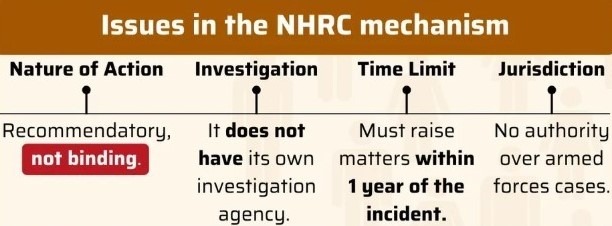
- The commission can only look into a matter within one year of its occurrence. A genuine grievance that exists in the earlier time period is thus ignored.
- The commission has limited role, powers and jurisdiction with respect to human right violations by the armed forces. It can only seek a report from the Central government and make its recommendations.
-
- It has no power to punish the violators of human rights, nor to award any relief including monetary relief to the victim. Its recommendations are not binding on the concerned government or authority.
-
- From a total of 96,267 complaints registered in the 2016, the figure fell to 75,064 in 2020, recording a sharp decline of 32.78%. Also, the number of Suo motu cases taken up by the Commission has almost halved between 2012-16 and 2016-20.
-
- As of September 2021, the Commission recorded a pendency of 20,806 cases. A decrease in registration with a subsequent increase in pendency questions the efficiency of the complaint handling mechanism of the commission.
-
- In 2020 alone, a total of 68,130 cases have been disposed of, where disposal would not necessarily mean deciding on merit. Most complaints were dismissed on procedural grounds and before being afforded a preliminary hearing on merits.
-
- Until recently, the NHRC was without a chairman. Also, most of the seats in the state human rights commissions’ posts remain vacant.
- Also, the NHRC relies on staff on deputation from other Government departments, who often lacks sensitivity and expertise in human rights issues. This is a major hinderance in the investigation of cases, especially those committed by agencies such as the police forces.
-
- The NHRC enjoys full functional autonomy but not financial autonomy. It gets its financial allocation from the Consolidated Fund of India. The paucity of funds has led to limited expenditure on spreading human rights literacy and awareness and poor infrastructural support for investigative purposes.
-
- There has been an unjustifiable delay in the tabling of NHRC reports in the Parliament and state legislatures. Only those reports that have been tabled before the Parliament are made public. This limits accountability of the Executive and efficacy of the NHRC.
-
- India is yet to ratify and sign several key conventions that will strengthen the human rights regime. These include the Convention Against Torture (signed in 1997, not ratified), Convention on the Protection of Rights of All Migrant Workers (not signed) and Convention for the Protection of All Persons from Enforced Disappearance (signed in 2007, not ratified)
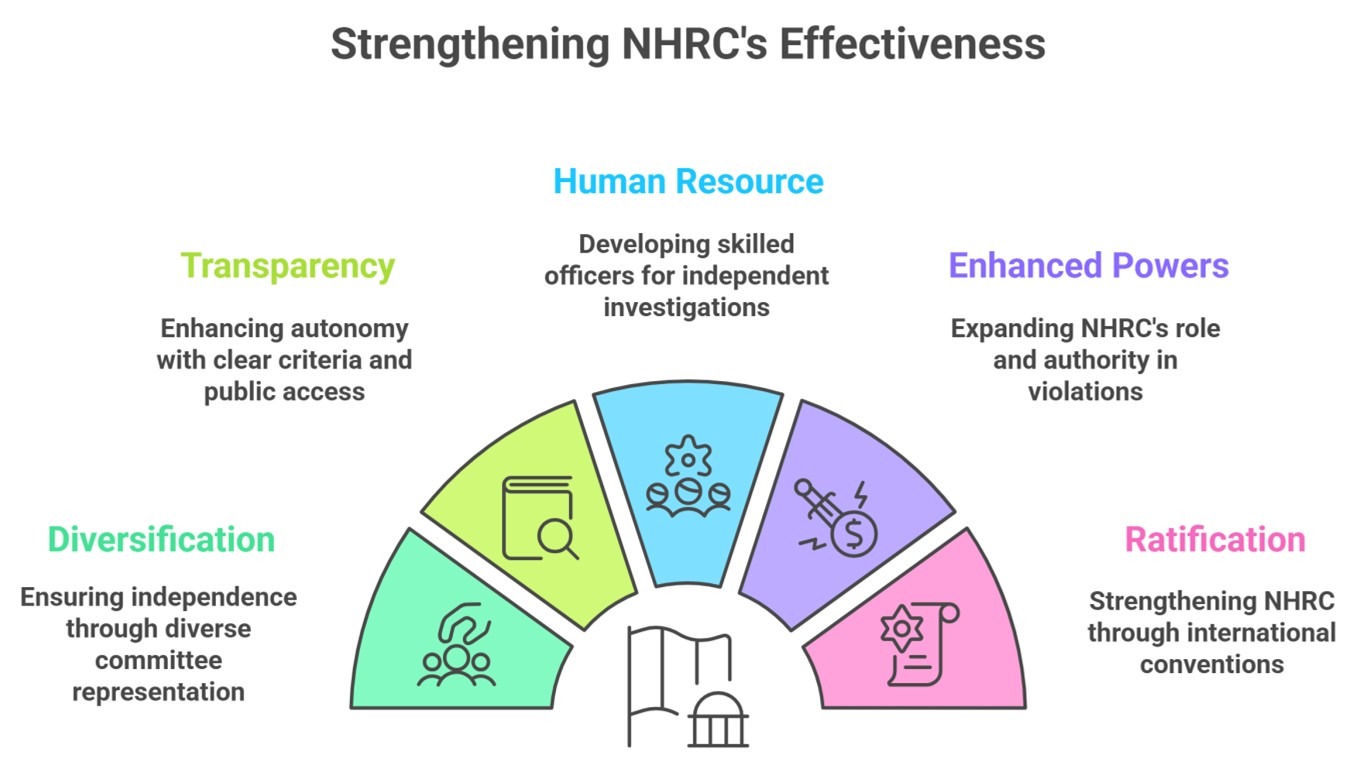
Remedies:
Diversification in selection committee:
- Political representatives should be limited in their engagement with NHRC so as to ensure independence. Also, judicial members and civil society members with proven track record in human rights should be included in the committee.
Bing greater transparency:
- The ‘expert members’ criteria should have clear definition and well-defined benchmarks so as to ensure its status as an autonomous agency rather than an extension of the bureaucracy. Also, details regarding the selection process should be given wide publicity.
Develop human resource:
- The NHRC should develop a dedicated cadre of officers who ae adept in human rights issues to carry out independent investigations. The government should supplement these efforts with funds, functionaries and infrastructure.
Enhance powers:
- There is a need for a greater role of NHRC in alleged human rights violations by the armed forces.
- There should be mechanisms to ensure that the recommendations of the commission are adhered by the government. In this regard, granting contempt powers to the commission can be looked into.
Ratification of major conventions and enactment of enabling laws will help strengthen NHRCs powers.
The definition of human rights changes with transformations in society and polity through time. Today, the challenges to human rights are numerous including those of refugees fleeing from persecution (E.g.: Rohingya), gender violence as well as environmental refugees.
It is thus crucial that the NHRC function properly so as to secure the rights to life, liberty, equality and dignity of the individual guaranteed by the Constitution, so that each human can enjoy the opportunity to grow and realize their maximum potential.