
TOne Academy

Municipalities

Home / Polity / Municipalities

Municipalities

    Urban Local Government (ULG) in India has evolved significantly over time, culminating in a structured system established by the 74th Constitutional Amendment Act in 1992. Here’s an overview of key aspects related to urban local governments, their evolution, and historical context:

Types of Urban Local Governments

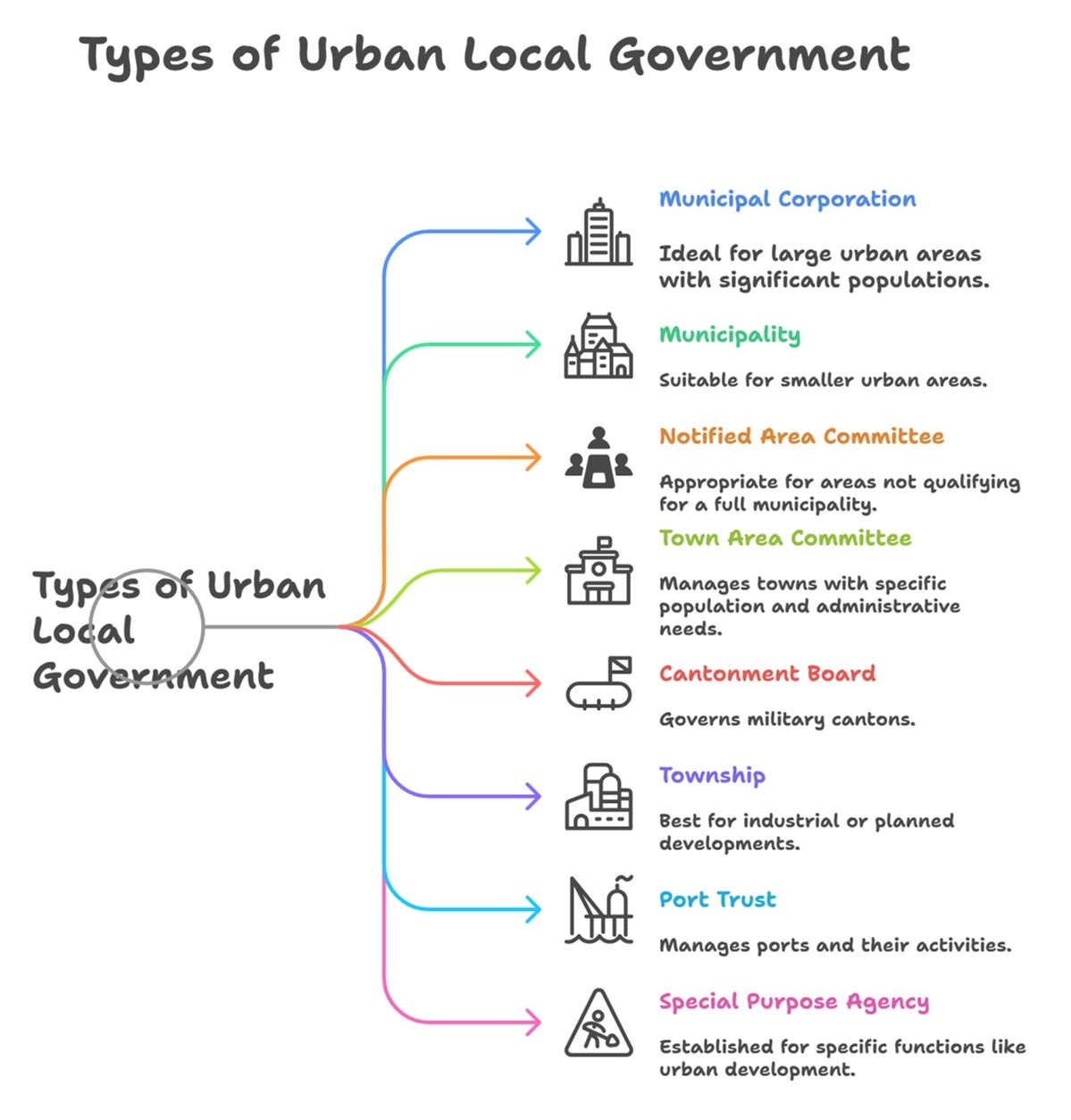
In India, there are eight recognized types of urban local governments:

    1. Municipal Corporation: Governs large urban areas with more significant populations.

2. Municipality: Governs smaller urban areas.

3. Notified Area Committee: Created for areas that may not qualify for a full municipality.

4. Town Area Committee: Manages towns with a specific population and administrative requirements.

5. Cantonment Board: Governs military cantons.

6. Township: Industrial or planned developments with administrative powers.

7. Port Trust: Manages ports and their activities.

8. Special Purpose Agency: Established for specific areas or functions, such as urban development or infrastructure improvement.


Historical Perspective

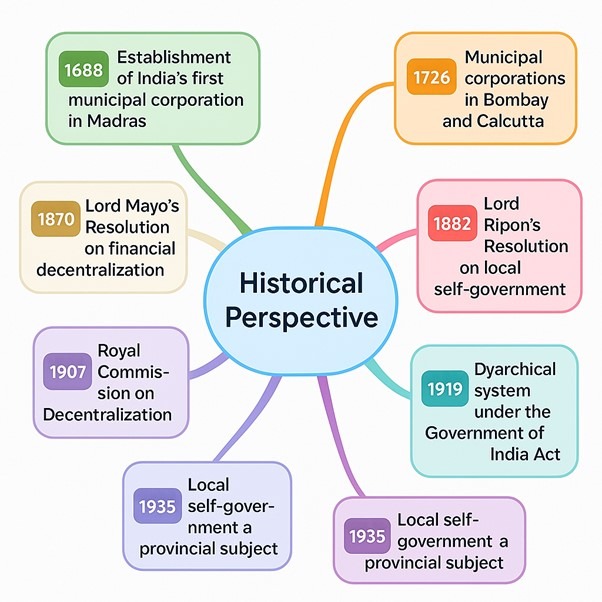
The development of urban local government in India has its roots in British colonial rule, with several key milestones:

    • 1688: Establishment of India’s first municipal corporation in Madras (now Chennai).
    • 1726: Formation of municipal corporations in Bombay (Mumbai) and Calcutta (Kolkata).
    • 1870: Lord Mayo’s Resolution advocated for financial decentralization to foster local government.
    • 1882: Lord Ripon’s Resolution is recognized as the “Magna Carta” of local self-government, emphasizing the importance of local governance.
    • 1907: The Royal Commission on Decentralization proposed reforms, leading to the introduction of local self-government institutions.
    • 1919: The Government of India Act introduced a dyarchical system, making local self-governance a transferred subject.
    • 1935: Under the Government of India Act, local self-government was made a provincial subject.

Committees and Commissions

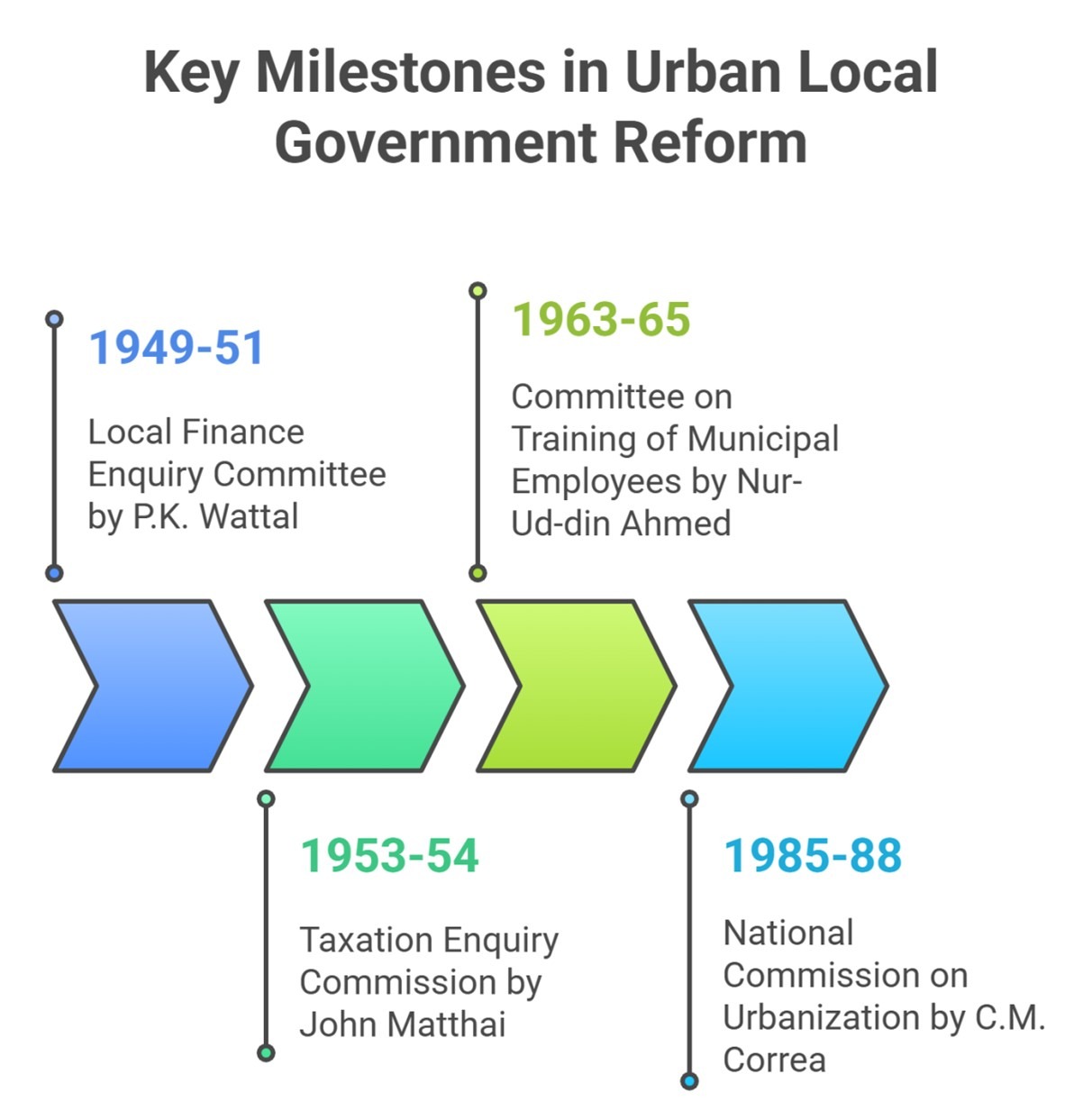
Numerous committees and commissions have been appointed over the years to assess and improve urban local government functioning. Some notable ones include:

    1. Local Finance Enquiry Committee (1949-51)– P.K. Wattal
    2. Taxation Enquiry Commission (1953-54)– John Matthai
    3. Committee on the Training of Municipal Employees (1963-65)– Nur-Ud-din Ahmed
    4. National Commission on Urbanization (1985-88)– C.M. Correa
Constitutionalisation

    The push for constitutional recognition began with the 65th Constitutional Amendment Bill (Nagarpalika Bill) introduced in 1989, which sought to grant municipal bodies constitutional status. Although it passed in the Lok Sabha, it was ultimately defeated in the Rajya Sabha.

    • In September 1990, a revised version of the Nagarpalika Bill was proposed but lapsed due to the dissolution of the Lok Sabha.
    • The P.V. Narasimha Rao Government introduced a modified Municipalities Bill in September 1991, which ultimately led to the passage of the 74th Constitutional Amendment Act in 1992, enacted in 1993.

Key Features of the 74th Amendment

    • It aimed to enhance the democratic process at the urban local government level.
    • Established a constitutional framework for urban local bodies, ensuring elections and delineating powers and responsibilities.
    • Provided for the establishment of State Finance Commissions for devolution of financial resources.


The evolution of urban local governments in India reflects a gradual transition towards more organized and empowered local governance, ultimately seeking to enhance local autonomy and improve service delivery in urban areas.


      he 74th Amendment Act of 1992 is a significant milestone in the constitutional framework of urban local governance in India. It added Part IX-A, titled “The Municipalities,” to the Indian Constitution, providing a solid basis for the governance of urban areas. Below is an overview of its key features and provisions:

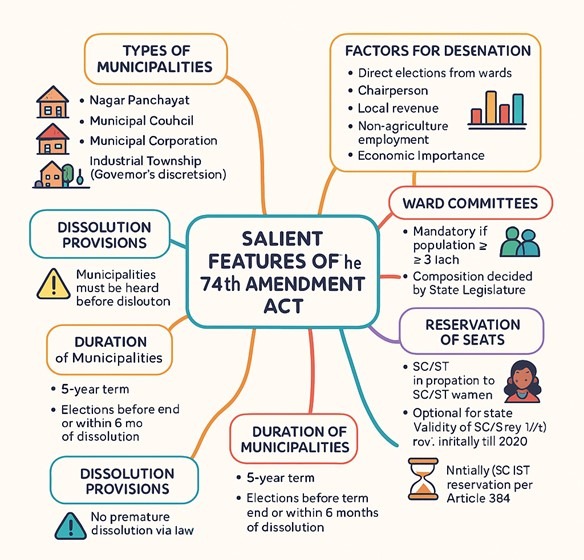
Salient Features of the 74th Amendment Act

1. Types of Municipalities:

    • The Act prescribes three types of municipalities:
        • Nagar Panchayat: For transitional areas.
        • Municipal Council: For smaller urban areas.
        • Municipal Corporation: For larger urban areas.
    • There is a provision for the governor to designate certain areas as industrial townships if municipal services are provided by an industrial establishment, thereby exempting them from the municipality classification.

2. Factors for Designation:

    • The governor must consider several factors while designating a transitional area, smaller urban area, or larger urban area:
        • Density of population.
        • Revenue generated for local administration.
        • Employment percentage in non-agricultural sectors.
        • Economic importance.
        • Any other relevant factors.

3. Composition and Elections:

    • Members of the municipality are directly elected by the people from designated wards.
    • State legislatures can dictate the manner of electing the chairperson and provide for representation of:
        • Experts in municipal administration without voting rights.
        • Members of the Lok Sabha and state legislative assemblies representing the municipal area.
        • Members of the Rajya Sabha and state legislative councils registered as voters in the area.
        • Chairpersons of committees (excluding ward committees).

4. Wards Committees:

    • For municipalities with a population of three lakh or more, ward committees must be established.
    • The state legislature can define the composition and operational framework of these committees.

5. Other Committees:

    • States can form additional committees, with chairpersons being eligible for membership in the municipality.

6. Reservation of Seats:

    • The Act mandates the reservation of seats for Scheduled Castes (SCs) and Scheduled Tribes (STs) in proportion to their population in the municipality.
    • A minimum of one-third of total seats must be reserved for women, including women from SCs and STs.
    • States can also reserve seats for backward classes.
    • Reservations for SC/ST seats will expire after the period defined in Article 334, which is currently set until 2020 (this may need further amendments as this period has passed).

7. Duration of Municipalities:

    • Each municipality has a five-year term. However, it can be dissolved earlier.
    • Elections must be conducted before the term expires or within six months of dissolution, unless the remaining term is less than six months.
    • Newly constituted municipalities following dissolution serve the remaining duration of the previous body.

8. Dissolution Provisions:

    • Municipalities must be given a reasonable opportunity to represent their case before being dissolved.
    • No amendment of existing laws can lead to the dissolution of a municipality before the end of its five-year term.
Impact of the 74th Amendment

      The 74th Amendment has provided constitutional recognition and strengthened the framework of urban local governance, ensuring that municipalities function effectively as democratic units of local self-government. It aims to enhance local autonomy, improve service delivery, and facilitate better governance in urban areas through elected representatives.

    The 74th Amendment Act of 1992 established a comprehensive framework for urban local governance in India, aimed at strengthening municipalities by providing them constitutional status. Below is a detailed overview of its provisions concerning disqualifications, elections, powers, finances, planning committees, and the Twelfth Schedule.

Disqualifications

    • Individuals are disqualified from being elected to or serving as members of a municipality if:
        • They are disqualified under any law pertaining to state legislature elections.
        • They are disqualified under any state law enacted by the state legislature.
    • However, the age requirement states that no one shall be disqualified on the basis of being under 25 years of age if they are at least 21 years old.
    • Questions regarding disqualifications are referred to the authority determined by the state legislature.

State Election Commission

    • The State Election Commission is responsible for overseeing the preparation of electoral rolls and conducting all elections to the municipalities.
    • The state legislature may provide regulations concerning municipal elections.

Powers and Functions

    • The state legislature can confer powers to municipalities to function as self-governing institutions. This includes:
        • Developing plans for economic development and social justice.
        • Implementing schemes related to the eighteen functional items listed in the Twelfth Schedule.

Finances

    • The state legislature may authorize municipalities to:
        • Levy, collect, and allocate taxes, duties, tolls, and fees.
        • Receive grants-in-aid from the state’s consolidated fund.
        • Establish funds for preparing budgets and handling finances.

Finance Commission

    • A Finance Commission, constituted for the panchayats, will review municipalities’ financial positions every five years and recommend to the governor on:
        1. Distribution of state taxes, duties, tolls, and fees among municipalities.
        2. Determining taxes assigned to municipalities.
        3. Grants-in-aid from the state fund.
        4. Measures to enhance the financial stability of municipalities.
    • The central Finance Commission will also make recommendations to augment the resources of municipalities based on the finance commission of the state.

Audit of Accounts

    • Provisions for maintaining and auditing municipal accounts can be set by the state legislature.

Application to Union Territories

    • The provisions of the 74th Amendment also apply to Union territories, with the President allowed to modify these provisions as necessary.

Exempted Areas

    • Scheduled and tribal areas in states are not governed by the provisions of this Act, although the Parliament may extend them with modifications.

District Planning Committee

    • Each state must form a District Planning Committee to consolidate plans from panchayats and municipalities.
    • Four-fifths of its members must be elected from district panchayat and municipality members, and representation should reflect the rural-urban population ratio.
    • The committee will prepare and forward the development plan for the district.

Metropolitan Planning Committee

    • Every metropolitan area is required to have a Metropolitan Planning Committee to create a draft development plan.
    • Two-thirds of its members should be elected from municipalities and panchayats in the metropolitan area.

Continuance of Existing Laws

    • Existing state laws on municipalities remain valid until one year after the 74th Amendment’s commencement. Municipalities operating before this act will remain until their terms end, barring any earlier dissolution by the legislature.

Bar to Interference by Courts

    • The Act prohibits courts from interfering in electoral matters of municipalities and establishes that the validity of laws governing constituency delimitation cannot be questioned in court.

Twelfth Schedule

The Twelfth Schedule lists 18 functional items under the purview of municipalities, which includes:

    1. Urban planning and town planning.
    2. Regulation of land use and building construction.
    3. Economic and social development planning.
    4. Roads and bridges.
    5. Water supply for various uses.
    6. Public health, sanitation, and solid waste management.
    7. Fire services.
    8. Urban forestry and environmental protection.
    9. Protection of weaker sections of society.
    10. Slum improvement and upgradation.
    11. Urban poverty alleviation.
    12. Provision of urban amenities (parks, gardens, etc.).
    13. Promotion of cultural and educational aspects.
    14. Burials, cremations, and cemetery management.
    15. Cattle ponds and animal welfare.
    16. Vital statistics and registrations.
    17. Public amenities (lighting, parking, etc.).
    18. Regulation of slaughterhouses and tanneries.


These provisions collectively aim to empower urban local bodies, enhance governance in urban areas, and facilitate effective service delivery to citizens.

      In India, urban local governance is structured through various types of urban local bodies, each designed to manage different urban areas and functions. Below is a detailed overview of the eight types of urban governments, along with municipal personnel systems.

Types of Urban Governments

1. Municipal Corporation:

    • Established for large cities such as Delhi, Mumbai, Kolkata, and Bangalore.
    • Governed by state acts or acts of Parliament in the case of union territories.
    • Comprises three authorities:
        • Council: The legislative body consisting of elected councillors and nominated experts, led by a Mayor.
        • Standing Committees: Focus on specific issues such as health and finance.
        • Municipal Commissioner: The chief executive, responsible for implementing council decisions, usually an IAS officer.

 

2. Municipality:

    • Created for smaller towns and cities, known by various names (e.g., municipal council).
    • Similar structure to municipal corporations, with a council, standing committees, and a chief executive officer.
    • The council is headed by a president or chairperson who has significant executive powers.
 

3. Notified Area Committee:

    • Formed for rapidly developing areas or towns that do not meet full municipal criteria but are deemed important.
    • Established via a notification in the government gazette and operates under the State Municipal Act.
    • Composed entirely of nominated members appointed by the state government.
 

4. Town Area Committee:

    • Established for small towns with limited civic functions such as drainage and street lighting.
    • Its governance and composition are defined by specific state legislation and can be wholly elected, wholly nominated, or a mix of both.

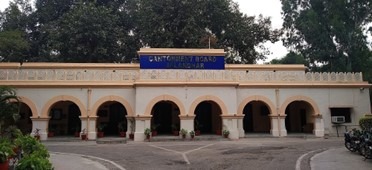
5. Cantonment Board:

    • Administers civilian areas in cantonments under the Cantonments Act of 2006, managed by the Central government.
    • Consists of elected and nominated members, with a military officer serving as the ex-officio president.
    • Functions similarly to municipalities with obligatory and discretionary responsibilities.
 

6. Township:

    • Established by large public enterprises to provide civic amenities for employees living in housing colonies.
    • Operates under a town administrator appointed by the enterprise with no elected members, being an extension of the organization’s bureaucratic structure.

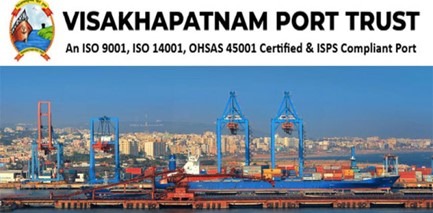
7. Port Trust:

    • Created to manage ports and provide civic amenities in port areas such as Mumbai and Chennai.
    • Governed by an act of Parliament, includes both elected and nominated members, with an official serving as the chairman.
 

8. Special Purpose Agency:

    • These are functional bodies created to address specific urban needs that fall under municipal responsibilities, such as urban development authorities and housing boards.
    • They operate independently of traditional municipal governments and are established by acts of state legislatures or executive resolutions.

Municipal Personnel Systems

There are three types of municipal personnel systems in India, reflecting different levels of control and autonomy:

1. Separate Personnel System:

    • Each local body independently hires, administers, and controls its personnel.
    • Promotes local autonomy and loyalty but limits the flexibility of personnel transfer across bodies.

2. Unified Personnel System:

    • The state government oversees the appointment and administration of municipal personnel.
    • Creates state-wide services where personnel can be transferred among various local bodies, prevalent in states like Andhra Pradesh and Tamil Nadu.

3. Integrated Personnel System:

    • Combines municipal personnel with state government personnel into a single service structure.
    • Members can be transferred not only within local bodies but also to state government departments, blending local and state civil services. This is observed in states like Odisha and Bihar.

Training Institutions for Municipal Personnel

To enhance the competencies of municipal employees, several training institutions exist, including:

    1. All-India Institute of Local Self Government (Mumbai)– Established in 1927.
    2. Centre for Urban and Environmental Studies (New Delhi)– Set up in 1967.
    3. Regional Centres for Urban and Environmental Studies– Operational in multiple cities since 1968.
    4. National Institute of Urban Affairs– Established in 1976.
    5. Human Settlement Management Institute– Established in 1985.


These training programs focus on developing skills essential for effective urban governance and administration across the various urban local bodies in India.

    Urban local bodies in India rely on various revenue sources to fund their operations and developmental projects. Here’s a detailed overview of municipal revenue sources followed by an outline of the Central Council of Local Government and relevant articles pertaining to municipalities.

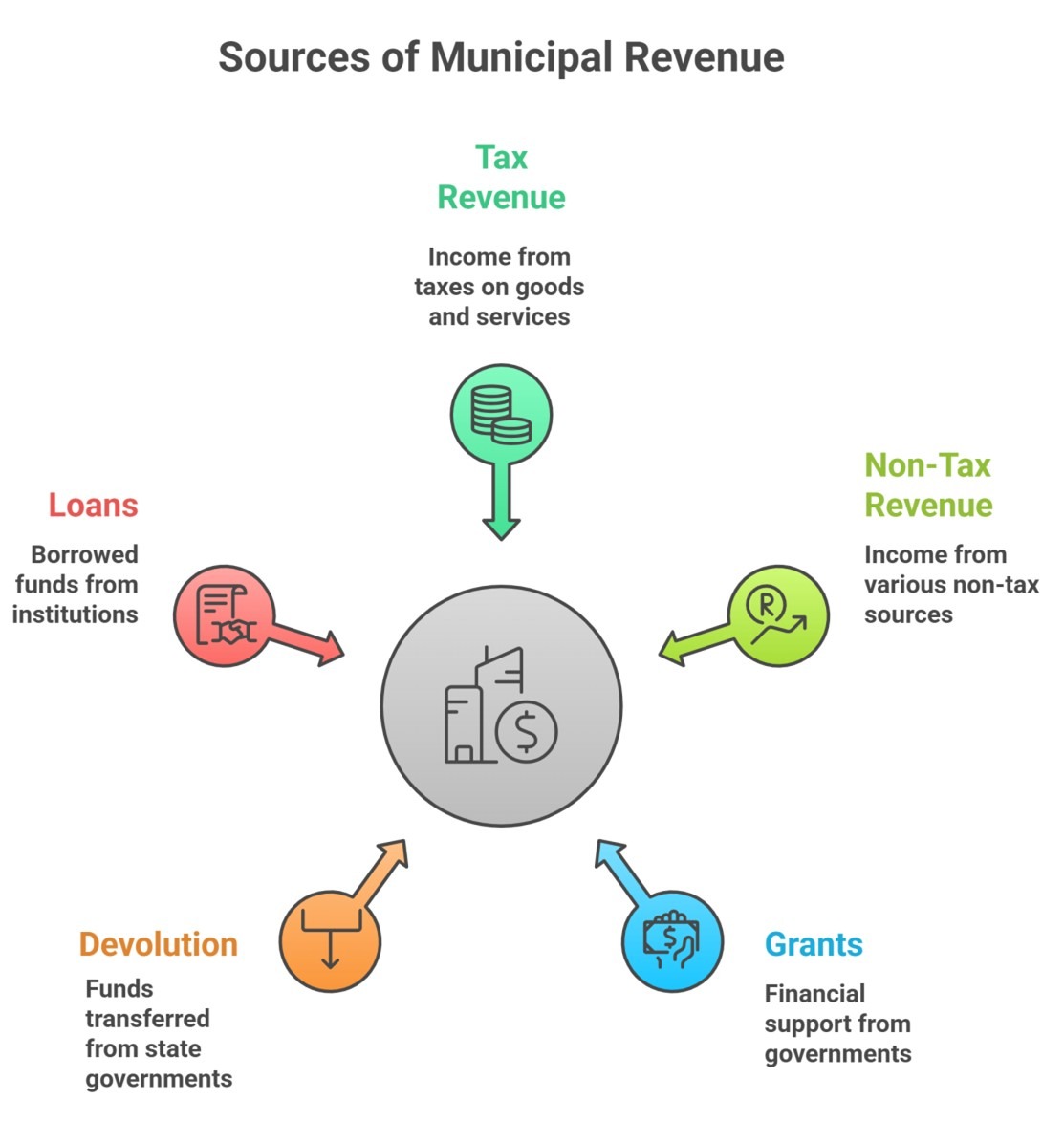
Sources of Municipal Revenue

1. Tax Revenue:

    • Urban local bodies generate income through various local taxes, including:
        • Property Tax: The most significant source of revenue.
        • Entertainment Tax: Collected on entertainment events and activities.
        • Taxes on Advertisements: Charged for advertisements placed in public areas.
        • Professional Tax: Levied on professionals and businesses.
        • Water Tax, Lighting Tax: Charges for public utilities.
        • Octroi: Tax on goods entering a local area (mostly abolished in many states).
    • Other specific cesses may include library cess, education cess, and beggary cess.

2. Non-Tax Revenue:

    • This includes various income sources such as:
        • Rent on Municipal Properties: Income from properties owned by the municipality.
        • Fees and Fines: Charges imposed for services and penalties for violations.
        • User Charges: Fees collected for utilities like water supply and sanitation.
        • Royalties and Profits: Earnings from municipal enterprises.

3. Grants:

    • Financial support from the Central and State Governments for development programs, infrastructure, and urban reform initiatives.

4. Devolution:

    • Funds transferred to urban local bodies from state governments based on recommendations made by the State Finance Commission.

5. Loans:

    • Urban local bodies may borrow from state governments and financial institutions, typically requiring state approval.
Central Council of Local Government

     The Central Council of Local Government was established in 1954 under Article 263 of the Constitution of India. Initially named the Central Council of Local Self-Government, it focuses solely on urban local governance following its reconfiguration in the 1980s.

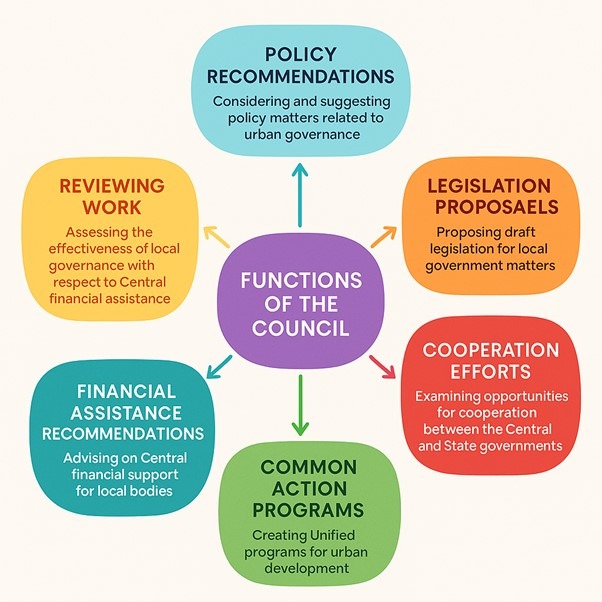
Functions of the Council:

    • Policy Recommendations: Considering and suggesting policy matters related to urban governance.
    • Legislation Proposals: Proposing draft legislation for local government matters.
    • Cooperation Efforts: Examining opportunities for cooperation between the Central and State governments.
    • Common Action Programs: Creating unified programs for urban development.
    • Financial Assistance Recommendations: Advising on Central financial support for local bodies.
    • Reviewing Work: Assessing the effectiveness of local governance with respect to Central financial assistance.
 

Articles Related to Municipalities

The 74th Amendment Act defines key aspects of urban local governance in various articles. Below is a summary:

Article No.

Subject-matter

243P

Definitions

243Q

Constitution of municipalities

243R

Composition of municipalities

243S

Constitution and composition of wards committees

243T

Reservation of seats

243U

Duration of municipalities

243V

Disqualifications for membership

243W

Powers, authority, and responsibilities of municipalities

243X

Powers to impose taxes by municipalities

243Y

Finance Commission

243Z

Audit of accounts of municipalities

243ZA

Elections to the municipalities

243ZB

Application to Union Territories

243ZC

Part not to apply to certain areas

243ZD

Committee for district planning

243ZE

Committee for metropolitan planning

243ZF

Continuance of existing laws and municipalities

243ZG

Bar to interference by courts in electoral matters

Name of Urban Local Bodies in Various States (2019)

State

Urban Local Bodies

Andhra Pradesh

Municipal Corporations, Municipalities, Nagar Panchayats

Arunachal Pradesh

(ULBs do not exist)

Assam

Municipal Corporations, Municipalities, Town Panchayats

Bihar

Municipal Corporations, Municipal Councils, Nagar Panchayats

Chhattisgarh

Municipal Corporations, Municipalities, Town Panchayats

Goa

Municipal Corporations, Municipal Councils

Gujarat

Municipal Corporations, Municipalities, Notified Area Councils

Haryana

Municipal Corporations, Municipal Councils, Municipal Committees

Himachal Pradesh

Municipal Corporations, Municipal Councils, Nagar Panchayats

Jharkhand

Municipal Corporations, Municipalities, Town Panchayats

Karnataka

Municipal/City Corporations, Municipal/City Councils, Town Panchay