
Lokpal and Lokayuktas
Global Perspective
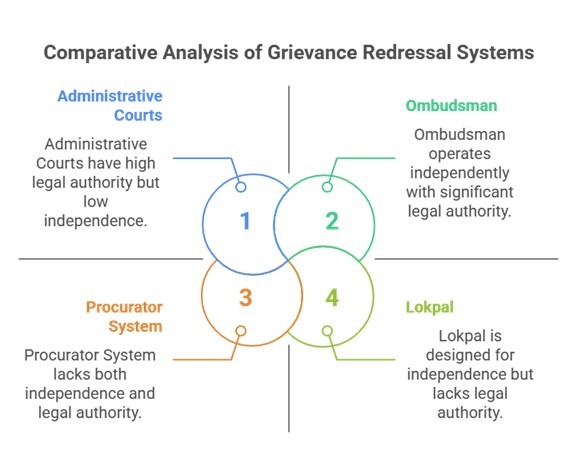
- Role of Government: Modern democracies prioritize citizens’ welfare, increasing bureaucratic power, which can lead to issues like corruption and maladministration.
- Institutional Mechanisms: Various systems have been established for grievance redressal, including:
- Ombudsman: Originating in Sweden in 1809, this institution handles complaints about unfair administrative actions. It operates independently, investigates grievances like maladministration, nepotism, and corruption, but cannot impose penalties.
- Administrative Courts: A French system adopted by several countries, providing legal mechanisms for citizens to challenge administrative decisions.
- Procurator System: Found in socialist countries, it typically oversees state actions and protects citizens’ rights.
Indian Context
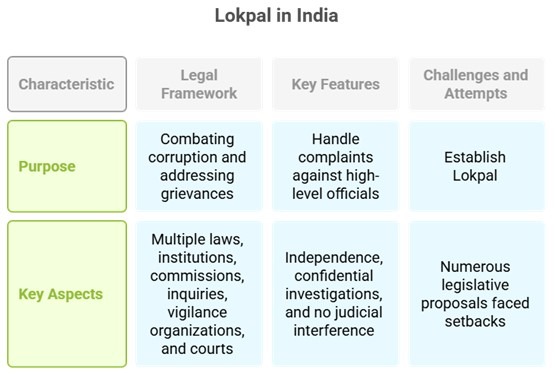
- Legal Framework: India has multiple laws and institutions aimed at combating corruption and addressing grievances:
- Key Acts: Public Servants (Enquiries) Act, Prevention of Corruption Act, and the Lokpal and Lokayukta.
- Various commissions and inquiries exist, along with vigilance organizations and courts.
- Lokpal: Recommended by the Administrative Reforms Commission in 1966-70, its establishment aimed to mirror the Ombudsman concept to handle complaints against high-level officials. Despite multiple legislative attempts since then, effective implementation has faced challenges.
- Legal Framework: India has multiple laws and institutions aimed at combating corruption and addressing grievances:
Key Features of Lokpal
- Independence: Designed to operate without political interference.
- Confidential Investigations: Conducted in an informal manner for accessibility.
- No Judicial Interference: Their proceedings are kept separate from judicial review, enhancing their authority.
Challenges and Attempts
- Numerous legislative proposals to establish Lokpal have been introduced but faced setbacks due to political changes and lapsing of bills.
National Lokpal and Lokayuktas Act (2013) and State Level Mechanisms
The Lokpal and Lokayuktas Act, 2013 was enacted to address corruption at both the national and state levels through the establishment of the Lokpal at the Centre and Lokayuktas in states. Below, we discuss their establishment, features, and related mechanisms.
Establishment of Lokpal and Lokayuktas
- The Lokpal serves as an ombudsman for the nation, while Lokayuktas perform a similar role at the state level. The framework aims to ensure transparency and enforce accountability among public servants.
Key Features of the Lokpal and Lokayuktas Act (2013)
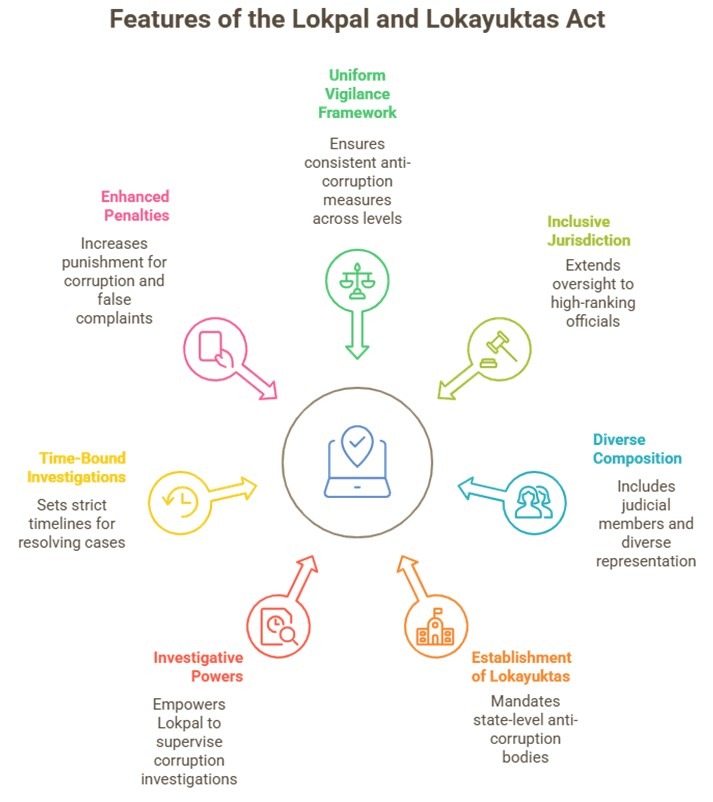
1. Uniform Vigilance Framework:
- The Act intends to provide a uniform mechanism for vigilance and anti-corruption measures at both the Centre and State levels.
2. Inclusiveness in Jurisdiction:
- The Lokpal’s jurisdiction extends to the Prime Minister, Ministers, Members of Parliament, and various public servants across different ranks.
3. Composition of Lokpal:
- The Lokpal consists of a Chairperson and a maximum of eight members, with at least fifty percent being judicial members and a similar representation from SCs, STs, OBCs, minorities, and women.
4. Establishment of Lokayuktas:
- The Act mandates the establishment of Lokayuktas in states within 365 days of the law’s commencement, allowing each state to define its Lokayukta’s framework.
5. Powers of Investigation:
- The Lokpal is endowed with powers to supervise investigations by agencies such as the Central Bureau of Investigation (CBI) regarding corruption cases.
6. Time-Bound Investigations:
- The Act lays down strict timelines for preliminary inquiries, investigations, and trials to expedite the resolution of corruption-related cases.
7. Enhanced Penalties:
- The maximum punishment under the prevention of corruption is increased, along with provisions for handling false complaints.
Lokayuktas Establishment in States
Historically, many states have established Lokayuktas to address corruption and uphold accountability among public servants:
- First Lokayukta Established: Maharashtra was the first state to establish the institution of Lokayukta in 1971, followed by many others.
Features of Lokayuktas
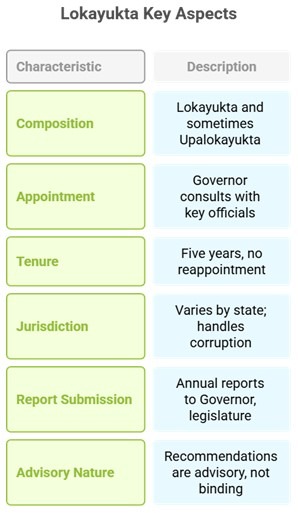
1. Composition:
- Lokayuktas generally consist of a Lokayukta and sometimes an Upalokayukta. The qualifications and appointment process can vary by state.
2. Appointment:
- Lokayuktas are appointed by the Governor of the state, often after consulting with the Chief Justice of the High Court and the Leader of the Opposition.
3. Tenure:
- Most Lokayuktas serve a term of five years, with no provision for reappointment.
4. Jurisdiction:
- The jurisdiction of Lokayuktas can vary:
- In some states, they can investigate complaints against the Chief Minister and members of the legislature, while in others, they may focus only on government officials.
- They often handle grievances and corruption allegations.
- The jurisdiction of Lokayuktas can vary:
5. Report Submission:
- Lokayuktas submit annual reports to the state governor, who presents them to the state legislature.
6. Advisory Nature:
- The recommendations of Lokayuktas are generally advisory and not binding on the government, though they carry significant moral authority.
Criticism and Challenges
Despite the establishment of Lokpal and Lokayuktas, challenges persist:
1. Limited Effectiveness: Critics argue that the Lokpal and Lokayuktas face limitations in enforcing their recommendations and lack independence from the political establishment.
2. Public Perception of Efficacy: There are concerns about whether these institutions are strong enough to effectively combat corruption in a meaningful way.
3. Potential for Bureaucratic Redundancy: Some detractors view the Lokpal and Lokayuktas as redundant bureaucracies that complicate governance without providing substantive oversight.
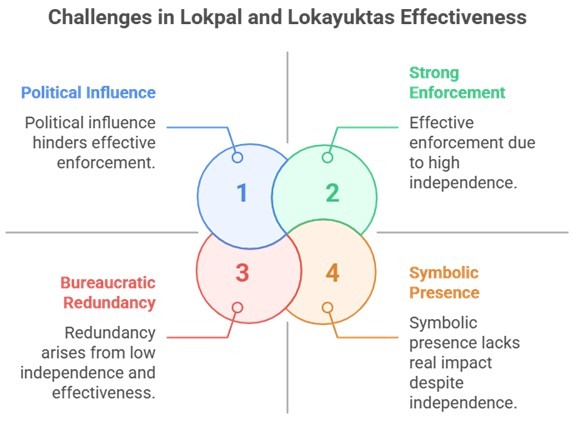
The Lokpal and Lokayuktas Act (2013) represents a significant step towards establishing a structured approach to combating corruption in India. While these mechanisms aim to enhance transparency and accountability, the challenges in their implementation and effectiveness highlight the need for ongoing reforms and support to strengthen these institutions in the fight against corruption. The transition from the Planning Commission’s model to more socially inclusive bodies like NITI Aayog underscores the adaptive nature of governance in India, seeking to improve public trust and societal welfare.