
Electoral Reforms
Committees Related to Electoral Reforms
India’s electoral system has been subject to numerous reviews and recommendations aimed at improving the electoral process, enhancing transparency, and ensuring fair representation. Various committees and commissions have examined the electoral process and suggested reforms.
Here are some of the notable committees related to electoral reforms:
- Joint Parliamentary Committee on Amendments to Election Laws (1971–72)
- Tarkunde Committee (1974): Appointed by Jaya Prakash Narayan during the “Total Revolution” movement. Submitted its report in 1975.
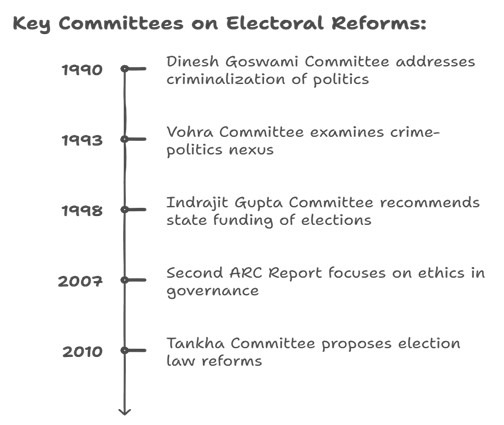
- Dinesh Goswami Committee on Electoral Reforms (1990)
- Vohra Committee on the Nexus between Crime and Politics (1993)
- Election Commission of India Recommendations on Electoral Reforms (1998)
- Indrajit Gupta Committee on State Funding of Elections (1998)
- Law Commission of India 170th Report on Reform of the Electoral Laws (1999)
- National Commission to Review the Working of the Constitution (2000–2002): Headed by M.N. Venkatachaliah.
- Election Commission of India Report on Proposed Electoral Reforms (2004)
- Second Administrative Reforms Commission of India Report on Ethics in Governance (2007): Headed by Veerappa Moily.
- Tankha Committee (Core Committee) (2010): Looked into the entire range of election laws and electoral reforms.
- S. Verma Committee Report on Amendments to Criminal Law (2013)
- Law Commission of India 244th Report on Electoral Disqualifications (2014)
- Law Commission of India 255th Report on Electoral Reforms (2015)
Based on recommendations from these committees, several reforms have been introduced in India’s electoral framework, categorized as follows:
Electoral Reforms Before 1996
Key Changes Prior to 1996
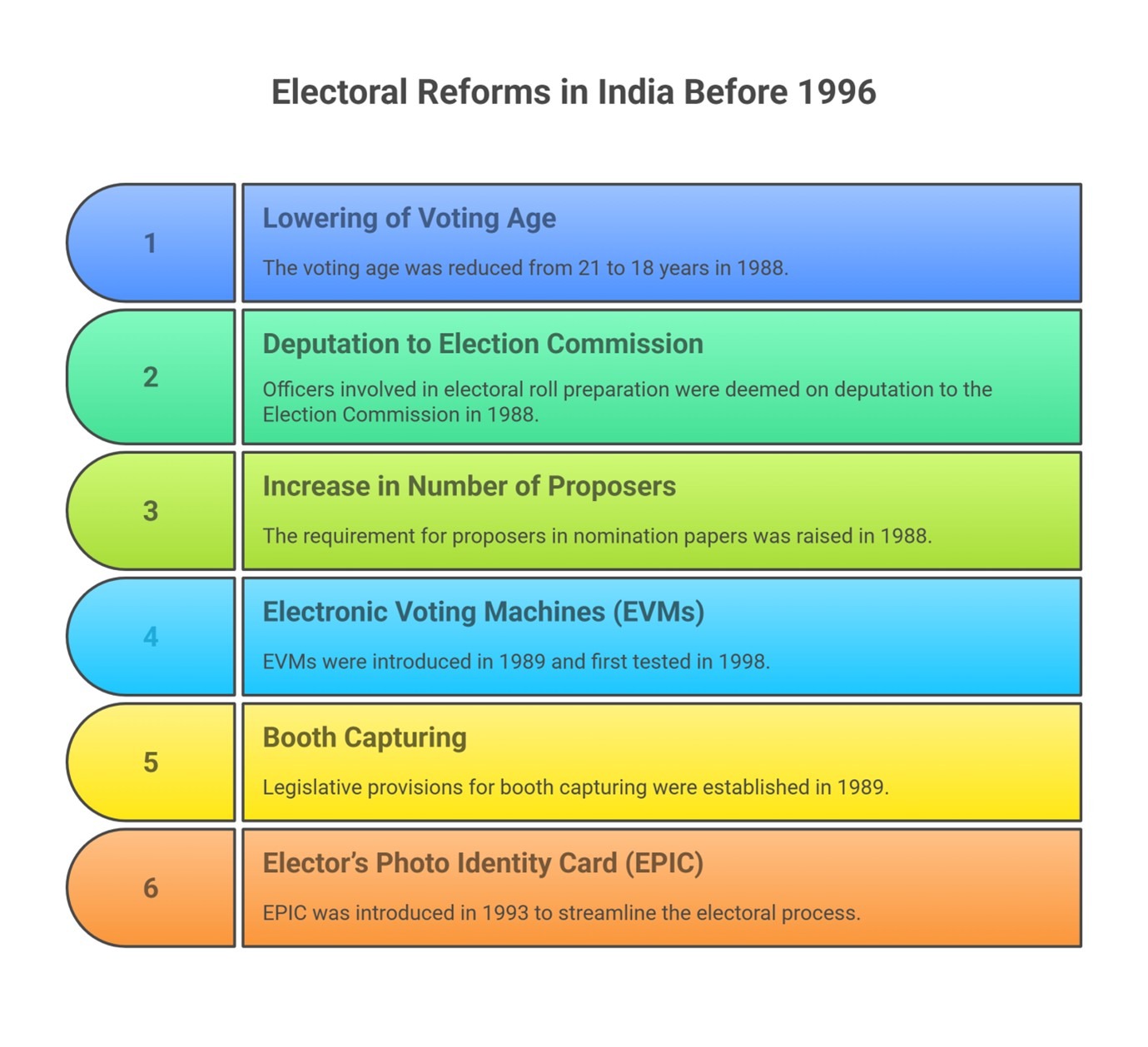
1. Lowering of Voting Age:
- The 61st Constitutional Amendment Act of 1988reduced the voting age from 21 to 18 years, enabling youth participation in the electoral process.
2. Deputation to Election Commission:
- A provision was introduced in 1988to deem officers involved in the preparation and revision of electoral rolls as on deputation to the Election Commission, ensuring their neutrality during elections.
3. Increase in Number of Proposers:
- In 1988, the requirement for proposers in nomination papers for Rajya Sabha and state legislative council elections was raised to 10%of the electorate or ten electors, whichever is less, to mitigate frivolous candidacies.
4. Electronic Voting Machines (EVMs):
- The 1989provision facilitated the use of EVMs, which were first tested in state assembly elections in 1998 and subsequently in Goa’s general elections in 1999.
5. Booth Capturing:
- Legislative provisions for the adjournment of polls or countermanding elections in instances of booth capturing were established in 1989, defining what constitutes booth capturing and the necessary accountability measures.
6. Elector’s Photo Identity Card (EPIC):
- The Election Commission introduced the EPIC in 1993to streamline the electoral process and curb voter impersonation, enhancing the integrity of the voting system.
The 73rd Amendment Act of 1992 and subsequent electoral reforms represent significant milestones in India’s journey towards strengthening democracy and ensuring fair electoral practices. The introduction of comprehensive electoral regulations, support for local self-governance through Panchayati Raj institutions, and the establishment of various committees to address electoral challenges highlight the ongoing commitment to refine and enhance the electoral process in India.
Electoral Reforms of 1996
The Dinesh Goswami Committee was appointed in 1990 to examine the electoral system in India and address its shortcomings. Based on its recommendations, several significant reforms were implemented in 1996 to enhance the electoral process. Below are the key reforms introduced:
Key Reforms Implemented
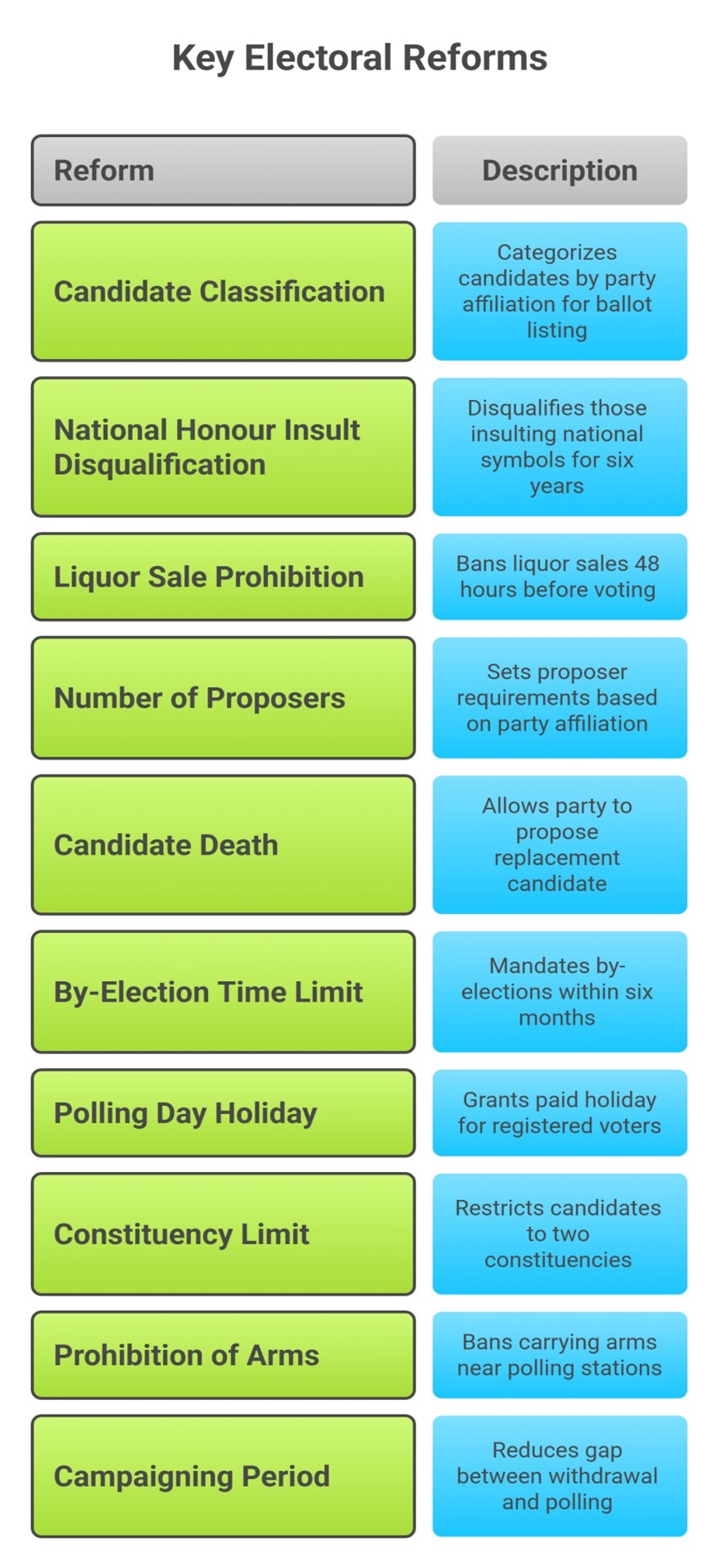
1. Classification of Candidates:
- Candidates contesting elections are categorized into three groups for listing their names:
- Candidates from recognized political parties.
- Candidates from registered but unrecognized political parties.
- Independent candidates.
- Names are to be listed in separate categories on ballot papers and arranged in alphabetical order within each category.
- Candidates contesting elections are categorized into three groups for listing their names:
2. Disqualification for Insulting National Honour:
- Individuals convicted under the Prevention of Insults to National Honour Act, 1971for offenses such as insulting the National Flag, Constitution, or preventing the singing of the National Anthem are disqualified from contesting elections for six years.
3. Prohibition on Sale of Liquor:
- The sale or distribution of liquor or intoxicants is banned in polling areas 48 hoursbefore the conclusion of voting. Violations can lead to imprisonment for up to six months or a fine of up to ₹2,000.
4. Number of Proposers:
- Candidates not sponsored by recognized political parties must be nominated by 10 registered electorsfrom their constituency. Recognized party candidates require only one proposer. This measure aims to deter non-serious candidates.
5. Death of a Candidate:
- Previously, if a contesting candidate died before polling, the election would be countermanded. Now, elections will not be canceled upon a candidate’s death. If the deceased was affiliated with a recognized political party, that party can propose another candidate within seven days.
6. Time Limit for By-Elections:
- By-elections for vacancies in Parliament or state legislatures must be held within six monthsof the vacancy unless:
- The remaining term is less than one year.
- The Election Commission certifies the difficulty in conducting by-elections.
- By-elections for vacancies in Parliament or state legislatures must be held within six monthsof the vacancy unless:
7. Holiday on Polling Day:
- Registered voters employed in any trade or establishment are entitled to a paid holidayon polling day, including daily wagers. Employers violating this provision face fines up to ₹500. Exceptions apply to those whose absence would pose significant risks to employment.
8. Contestants Restricted to Two Constituencies:
- Candidates may not contest from more than two Parliamentary or Assembly constituenciesduring general or by-elections, including biennial elections and Rajya Sabha/state legislative council by-elections.
9. Prohibition of Arms:
- Carrying arms near polling stations is a cognizable offense punishable with up to two yearsin prison or fines. Confiscation of arms and cancellation of licenses will also occur. This does not apply to officials maintaining peace at polling stations.
10. Reduced Campaigning Period:
- The minimum gap between the last date for withdrawal of candidature and the polling date has been reduced from 20 days to 14 days, allowing for a more streamlined electoral process.
The electoral reforms enacted following the Dinesh Goswami Committee’s recommendations in 1996 represented a significant modernization of the Indian electoral system. These reforms aimed to enhance transparency, reduce electoral malpractices, and ensure broader participation in the democratic process. By addressing various issues—from candidate classification and campaigning to voter rights and election management—the reforms sought to strengthen the foundations of democracy in India.
Electoral Reforms After 1996
Following the earlier electoral reforms, several significant changes were introduced in India’s electoral framework to enhance transparency, accountability, and accessibility within the electoral process. Below are the key reforms enacted after 1996:
Key Electoral Reforms
1. Presidential and Vice Presidential Elections (1997):
- The number of electors required as proposers and seconders for contesting the presidential elections increased from 10 to 50, and for vice-presidential elections from 5 to 20.
- The security deposit for contesting these elections was raised from ₹2,500 to ₹15,000to deter frivolous candidates.
2. Requisitioning of Staff for Election Duty (1998):
- The provision was established to allow the requisitioning of staff from local authorities, nationalized banks, and other government-aided institutions to assist with election duties.
3. Voting through Postal Ballot (1999):
- A provision was introduced enabling certain classes of persons to vote via postal ballot, with the Election Commission empowered to notify eligible classes of voters.
4. Voting by Proxy (2003):
- Service voters in the Armed Forces were given the option to vote through a proxy, allowing them to appoint a designated person to vote on their behalf.
5. Declaration of Criminal Antecedents, Assets, etc. (2003):
- Candidates seeking election must disclose their criminal record, assets, and liabilities, including any pending cases involving offenses punishable by imprisonment of two years or more.
- Furnishing false information in the affidavit is treated as an electoral offense, punishable by imprisonment of up to six months or fines.
6. Changes in Rajya Sabha Elections (2003):
- Removal of the domicile requirement for candidates contesting Rajya Sabha elections, allowing candidates to be electors in any parliamentary constituency.
- Introduction of an open ballot systemto reduce cross-voting and increase accountability during elections.
7. Exemption of Travelling Expenditure (2003):
- Campaigning leaders’ traveling expenses are not counted as part of a candidate’s election expenses, thereby alleviating the financial burden on candidates.
8. Free Supply of Electoral Rolls (2003):
- The government is mandated to provide free copies of electoral rolls and related materials to candidates from recognized political parties.
9. Political Party Contributions (2003):
- Political parties may accept contributions from any person or non-government company, with any contribution exceeding ₹20,000needing to be reported to the Election Commission for tax claims.
10. Allocation of Time on Electronic Media (2003):
- The Election Commission is tasked with equitable sharing of time on electronic media for political parties to address the public during elections.
11. Introduction of Braille Signage Features in EVMs (2004-2009):
- Following requests from visually impaired individuals, the Election Commission began trialing Braille signage features on Electronic Voting Machines (EVMs) to facilitate blind voters in casting their votes independently. This feature was rolled out during various state and national elections.
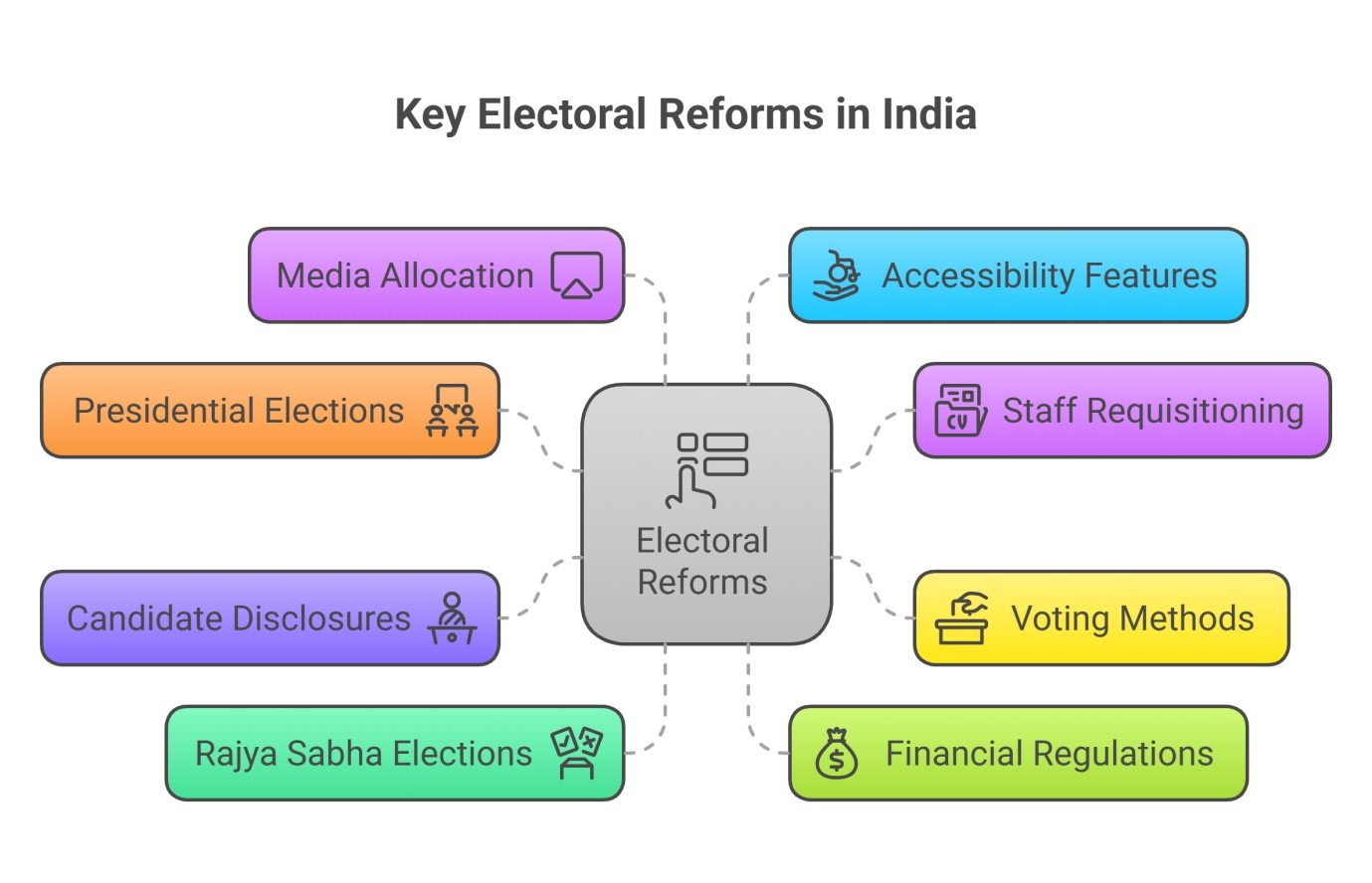
The electoral reforms implemented after 1996 reflect India’s commitment to enhancing the electoral process, ensuring greater participation, and improving the overall integrity of elections. These reforms address various aspects of the electoral machinery—from candidacy and voting mechanisms to financial regulations for political parties—aiming towards a more democratic and inclusive electoral environment.