Elections
Electoral System in India
The electoral system in India is primarily governed by Articles 324 to 329 of the Constitution, which establish the framework for conducting free and fair elections. The provisions outlined in these articles are crucial for the functioning of democracy in India.
Key Provisions of the Electoral System
1. Independent Election Commission:
- Article 324establishes the Election Commission of India (ECI) as an independent body tasked with the superintendence, direction, and conduct of elections for the Parliament, state legislatures, and offices of the President and Vice-President.
- The Commission currently consists of a Chief Election Commissioneralong with two Election Commissioners.
2. General Electoral Roll:
- The Constitution mandates a single general electoral roll for every territorial constituency for elections to the Parliament and state legislatures, thereby abolishing the previous systems of communal representation and separate electorates.
3. Inclusion in Electoral Roll:
- No individual can be excluded from the electoral roll based solely on religion, race, caste, sex, or similar factors.
- Citizens cannot claim inclusion in a special electoral roll based on these grounds, ensuring equality in electoral franchise.
4. Adult Franchise:
- Elections to the Lok Sabha and state assemblies are conducted based on adult franchise. Every citizen aged 18 years or olderis eligible to vote, provided they are not disqualified for reasons such as non-residence, unsound mind, crime, or engaging in corrupt practices.
5. Parliamentary Authority:
- Parliament has the authority to legislate on all election-related matters, including the preparation of electoral rolls and delimitation of constituencies.
- State legislatures can also legislate on election matters for state assemblies, but only regarding areas not covered by parliamentary law.
6. Delimitation and Seat Allocation:
- The Constitution states that the validity of laws concerning the delimitation of constituencies or seat allocation cannot be challenged in any court. Orders by the Delimitation Commissionare final and binding.
7. Election Petitions:
- The Constitution specifies that no election to the Parliament or state legislature can be questioned except through an election petition. These petitions can only be presented to the designated authority as outlined by the appropriate legislature.
- Since 1966, election petitions are triable exclusively by High Courts, with appeals falling under the jurisdiction of the Supreme Court.
8. Election Tribunals:
- Article 323Bempowers the appropriate legislature to establish a tribunal for adjudicating election disputes, with the provision to exclude the jurisdiction of all courts except for the Supreme Court’s special leave jurisdiction.
- However, this provision was declared unconstitutional by the Supreme Courtin the Chandra Kumar case (1997), which means any future election tribunal’s decision would be appealable to the High Court.

The electoral system outlined in the Indian Constitution is designed to ensure a fair, transparent, and inclusive electoral process. The establishment of the Election Commission as an independent authority is vital for maintaining the integrity of elections and protecting the democratic framework of the nation. With provisions for adult franchise and comprehensive electoral rolls, the Constitution aims to uphold the principle of equality in voting while providing a mechanism to address electoral disputes efficiently.
Structure of Election Machinery in India
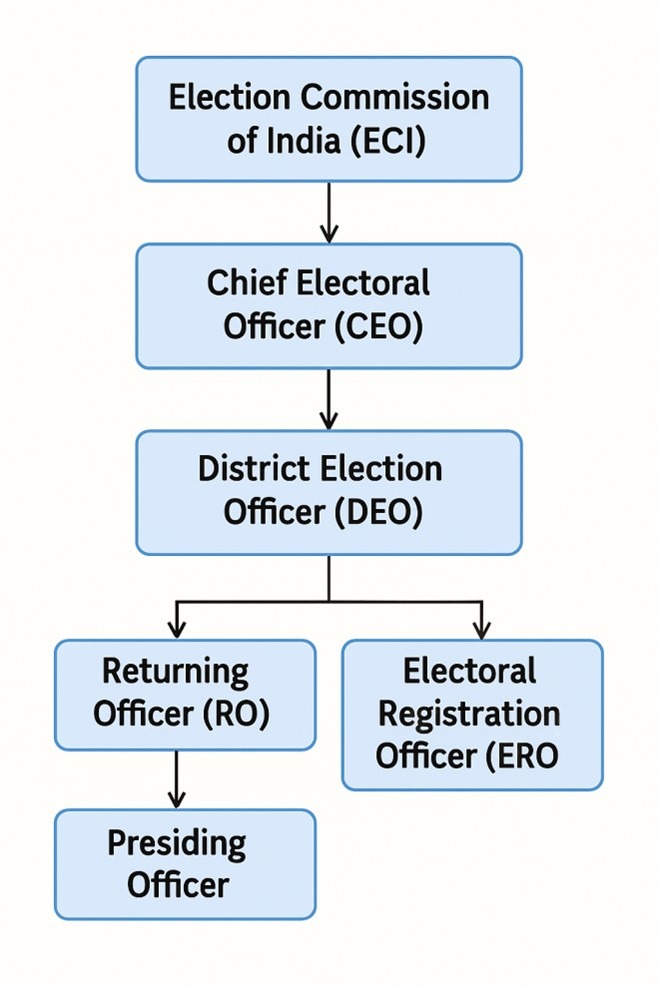
The structure of the Election Commission of India, which administers elections at the national and state levels, is outlined below:
1. Election Commission of India (ECI)
- Authority: The ECI is responsible for the superintendence, direction, and control of elections to the Lok Sabha, Rajya Sabha, and State Legislative Assemblies, as well as the offices of the President and Vice-President.
- Composition: The ECI consists of a Chief Election Commissioner (CEC) and two Election Commissioners.
2. Chief Electoral Officer (CEO)
- Role: The CEO supervises election activities within a state or Union Territory under the ECI’s overall direction.
- Appointment: Nominated or designated by the ECI from state government officials in consultation with the state government.
3. District Election Officer (DEO)
- Function: The DEO manages electoral processes at the district level and reports to the CEO.
- Appointment: Designated by the ECI from among state government officers.
4. Returning Officer (RO)
- Responsibilities: The RO conducts elections within their respective Parliamentary or Assembly constituencies.
- Appointment: Nominated or designated by the ECI, usually from the local government or staff.
5. Electoral Registration Officer (ERO)
- Duties: Responsible for the preparation and maintenance of electoral rolls for respective constituencies.
- Appointment: Appointed by the ECI in consultation with the state government.
6. Presiding Officer
- Duties: Conducts polling at polling stations with the assistance of polling officers.
- Appointment: Appointed by the District Election Officer.
7. Observers
The ECI appoints various types of observers to ensure free and fair elections:
- General Observers: Monitor overall electoral processes and ensure compliance with election rules.
- Expenditure Observers: Track candidate spending during elections to prevent inducement of voters.
- Police Observers: Oversee law and order during elections, ensuring coordination between civil and police authorities.
- Awareness Observers: Promote voter awareness and participation, particularly in underrepresented areas.
- Micro Observers: Send to critically sensitive polling stations to monitor the polling process in detail.
- Assistant Expenditure Observers: Assist in monitoring the compliance of campaign spending rules during elections.
The framework established by the Election Commission of India ensures that elections are conducted in a transparent and accountable manner, fostering public confidence in the democratic process. Each component of the electoral machinery, from the Chief Election Commissioner to local election officers, plays an essential role in upholding the integrity of elections in India. The various types of observers further enhance the robustness of this framework by monitoring compliance with electoral laws and procedures, contributing to the overall goal of free and fair elections.
Election Process in India
The electoral process in India is a well-structured mechanism governed by the Election Commission of India (ECI), ensuring free and fair elections for the Lok Sabha and State Legislative Assemblies. Below are the key components detailing the election process, from scheduling elections to handling election petitions.
Time of Elections
- Frequency: Elections for the Lok Sabha and state assemblies are scheduled every five years, unless a government loses its confidence earlier, prompting the President to dissolve the Lok Sabha.
- Timelines: The Constitution mandates that elections must be held within six months following the dissolution of the Lok Sabha.
Schedule of Elections
- The Election Commission announces the election schedule in a press conference, activating the election machinery.
- Upon the announcement, the Model Code of Conduct comes into effect for all political parties and candidates.
Election Procedure
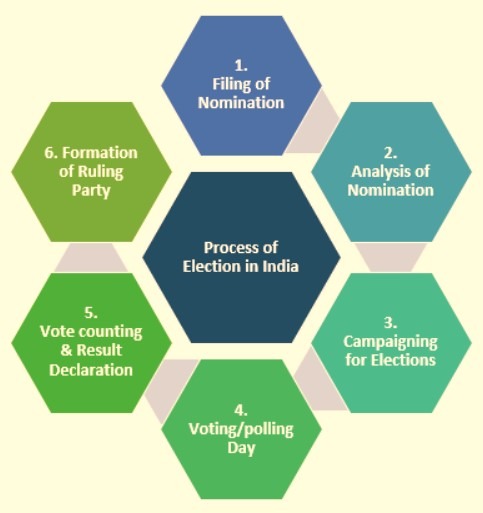
1. Notification:
- Notification is issued calling upon the electorate to choose Members of the House. Candidates can start filing nominations upon this notification.
2. Nomination Process:
- Candidates file their nomination papers, which are scrutinized by the Returning Officer. Validly nominated candidates may withdraw their nomination within a specified period after scrutiny.
3. Campaign Period:
- Official campaigning lasts for at least two weeksbefore the polling date, allowing candidates to promote their platforms.
4. Polling:
- Polling occurs over multiple days across various constituencies to ensure security and law-and-order management.
- Ballot papers are printed with candidates’ names and symbols, and voting is conducted through Electronic Voting Machines (EVMs), which enhance the voting process’s efficiency and security.
5. Voting Procedure:
- Voters mark their choices in a confidential manner at polling stations, typically located in public institutions.
- Polling stations are usually set up within two kilometers of each voter. Each station is open for at least eight hours on polling day.
6. Counting of Votes:
- After polling, the counting of votes is conducted under the supervision of Returning Officers and Observers appointed by the Election Commission.
- The winner is declared based on the first-past-the-postsystem, with the candidate receiving the most votes being elected.
7. Election Petitions:
- Any elector or candidate may file an election petition if they suspect malpractice during the election process. These petitions are treated as legal contests involving the entire constituency and are adjudicated by the High Court of the state.