
TOne Academy

Directive Principles of State Policy

Home / Polity / Directive Principles of State Policy

Directive Principles of State Policy

      The Directive Principles of State Policy are outlined in Part IV of the Indian Constitution, specifically from Articles 36 to 51. The framers of the Constitution drew inspiration for these principles from the Irish Constitution of 1937, which itself had adapted them from the Spanish Constitution. Dr. B.R. Ambedkar referred to these principles as “novel features” of the Indian Constitution, highlighting their significance. Together with Fundamental Rights, the Directive Principles embody the philosophy of the Constitution and are considered its soul. Granville Austin has described these principles and Fundamental Rights as the “Conscience of the Constitution.”

Features of the Directive Principles

1. Purpose and Meaning:

    The term “Directive Principles of State Policy” signifies the ideals that the State should consider when formulating policies and enacting laws. They serve as constitutional directives or recommendations for the State in legislative, executive, and administrative matters. According to Article 36, the term “State” in Part IV has the same meaning as in Part III, which encompasses the legislative and executive branches of the central and state governments, as well as all local authorities and public authorities in the country.

2. Comparison to Previous Instruments:

      The Directive Principles are similar to the “Instrument of Instructions” outlined in the Government of India Act of 1935. Dr. B.R. Ambedkar likened the Directive Principles to these instruments that provided guidance to the Governor-General and provincial governors under British rule. The key distinction is that the Directive Principles serve as instructions directed at the legislature and executive.

3. Comprehensive Program:

     The Directive Principles provide a thorough economic, social, and political framework for a modern democratic state. Their objectives align with the high ideals of justice, liberty, equality, and fraternity as expressed in the Preamble of the Constitution. They promote the vision of a “welfare state,” in contrast to the “police state” that existed under colonial rule, aiming to foster economic and social democracy in India.

4. Non-justiciability:

    These principles are non-justiciable, meaning they are not legally enforceable by the courts. Consequently, governments (central, state, and local) cannot be compelled to implement them. Nevertheless, Article 37 of the Constitution asserts that these principles are fundamental to the governance of the country and states that it is the duty of the State to apply them when creating laws.

5. Judicial Relevance:

     Although Directive Principles are non-justiciable, they assist the courts in analyzing and determining the constitutional validity of laws. The Supreme Court has ruled that if a law seeks to implement a Directive Principle, it may be deemed “reasonable” in relation to Article 14 (equality before law) or Article 19 (freedoms), thus protecting the law from being declared unconstitutional.

       These features underscore the importance of Directive Principles as guiding standards for policy-making and governance, while also reflecting the broader objectives of justice, equality, and democracy within the Indian constitutional framework.

Classification of the Directive Principles

While the Indian Constitution does not formally classify the Directive Principles of State Policy, they can be categorized into three broad groups based on their content and objectives: socialistic, Gandhian, and liberal-intellectual.
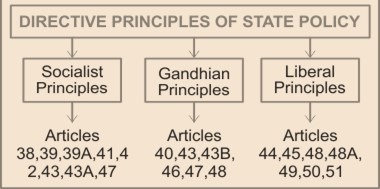
1. Socialistic Principles

These principles are rooted in the ideology of socialism and lay out the framework for a democratic socialist state aimed at achieving social and economic justice while working towards a welfare state. They direct the state to:
    1. Promote the welfare of the people by ensuring a social order infused with justice—social, economic, and political—and to minimize inequalities in income, status, facilities, and opportunities (Article 38).
    2. Secure:

(a) The right to adequate means of livelihood for all citizens.

(b) Equitable distribution of community resources for the common good.

(c) Prevention of wealth concentration and control over production.

(d) Equal pay for equal work regardless of gender.

(e) Protection of the health and well-being of workers and children from exploitation.

(f) Opportunities for healthy development for children (Article 39).

3. Promote equal justice and ensure free legal aid for the poor (Article 39A).

4. Secure the right to work, education, and public assistance in cases of unemployment, old age, sickness, and disability (Article 41).

5. Provide just and humane working conditions and maternity relief (Article 42).

6. Ensure a living wage, a decent standard of living, and social and cultural opportunities for all workers (Article 43).

7. Facilitate workers’ participation in industry management (Article 43A).

8. Enhance nutrition levels and improve public health (Article 47).

2. Gandhian Principles

These principles reflect Gandhian philosophy and embody the vision for societal reconstruction that Gandhi articulated during India’s national movement. They require the State to:
    1. Organize village panchayats and empower them to function as units of self-governance (Article 40).
    2. Encourage cottage industries on an individual or cooperative basis in rural areas (Article 43).
    3. Foster the voluntary creation, autonomy, democratic governance, and professional management of cooperative societies (Article 43B).
    4. Advance the educational and economic interests of Scheduled Castes, Scheduled Tribes, and other marginalized groups, while protecting them from social injustice and exploitation (Article 46).
    5. Prohibit the consumption of intoxicating substances that are harmful to health (Article 47).
    6. Prevent the slaughter of cows, calves, and other milch and draft animals, along with efforts to improve their breeds (Article 48).

3. Liberal-Intellectual Principles

This category embodies the principles of liberalism, directing the state to:
    1. Ensure a uniform civil code for all citizens across the country (Article 44).
    2. Provide early childhood care and education for all children until the age of six (Article 45).
    3. Organize agriculture and animal husbandry using modern scientific methods (Article 48).
    4. Safeguard the environment, including the protection of forests and wildlife (Article 48A).
    5. Protect monuments and sites of artistic or historic significance, declared of national importance (Article 49).
    6. Separate the judiciary from the executive within state public services (Article 50).
    7. Promote international peace and security, maintain just relations among nations, respect international law and treaty obligations, and encourage the resolution of international disputes through arbitration (Article 51).
These classifications illuminate the diverse objectives embedded within the Directive Principles, which collectively aim to foster a just and equitable society in India.

New Directive Principles

The 42nd Amendment Act of 1976 introduced four new Directive Principles to the Indian Constitution, emphasizing the role of the State in achieving various social and economic goals. These principles require the State to:
    1. Secure Opportunities for Healthy Development of Children: This is outlined in Article 39, focusing on the well-being and development of children.
    2. Promote Equal Justice and Free Legal Aid: Article 39A mandates that the State ensure equal justice and provide free legal assistance to the underprivileged.
    3. Involve Workers in Industry Management: Article 43A emphasizes the need for the participation of workers in the management of industries.
    4. Protect and Improve the Environment: Article 48A calls for the preservation and improvement of the natural environment, including forests and wildlife.
The 44th Amendment Act of 1978 added another important Directive Principle that mandates the State to minimize inequalities in income, status, facilities, and opportunities (Article 38). The 86th Amendment Act of 2002 redefined Article 45 to make elementary education a Fundamental Right under Article 21A, requiring the State to provide early childhood care and education for all children until they reach the age of six. The 97th Amendment Act of 2011 introduced a new Directive Principle related to cooperative societies, instructing the State to promote the voluntary formation, autonomous functioning, democratic control, and professional management of cooperatives (Article 43B).

Sanction Behind Directive Principles

Sir B.N. Rau, the Constitutional Advisor to the Constituent Assembly, proposed that individual rights should be divided into two categories: justiciable and non-justiciable. This was accepted by the Drafting Committee, resulting in Fundamental Rights, which are justiciable and found in Part III, and Directive Principles, which are non-justiciable and found in Part IV of the Constitution. While Directive Principles are not legally enforceable, Article 37 makes clear that these principles are fundamental in governance and that it is the State’s duty to apply them when making laws. This creates a moral obligation for state authorities, with public opinion serving as the real force behind their implementation. As Alladi Krishna Swamy Ayyar noted, a government accountable to the public cannot afford to overlook the provisions in Part IV of the Constitution. Dr. B.R. Ambedkar also pointed out that a government reliant on popular support must consider Directive Principles when shaping policies, as neglecting them would require justification to the electorate. The framers of the Constitution chose to make Directive Principles non-justiciable and legally unenforceable for several reasons:
    1. Insufficient financial resources available for implementation.
    2. The country’s vast diversity and socio-economic disparities would hinder practical application.
    3. The newly independent state confronted multiple priorities and needed to decide the order and methods for fulfilling these principles.
Consequently, the Constitution-makers adopted a pragmatic approach, believing that public awareness and opinion would be more effective for the realization of these principles than legal enforcement mechanisms.

Criticism of the Directive Principles

     The Directive Principles of State Policy have faced criticism from several members of the Constituent Assembly and various constitutional experts for the following reasons:

1. Lack of Legal Force:

        The non-justiciable nature of the Directive Principles has been a primary point of criticism. K.T. Shah referred to them as “pious superfluities,” likening them to “a cheque on a bank, payable only when the resources permit.” Similarly, Nasiruddin criticized them as being “no better than New Year’s resolutions, broken shortly after being made.” T.T. Krishnamachari described them as “a veritable dustbin of sentiments,” while K.C. Wheare considered them a “manifesto of aims and aspirations,” viewing them as mere “moral homily.” Ivor Jennings regarded them as “pious aspirations.”

      These criticisms highlight concerns regarding the effectiveness and real-world applicability of the Directive Principles in promoting social justice and welfare in India.

Criticism of Directive Principles

The Directive Principles of State Policy, while significant, have faced criticism from various members of the Constituent Assembly and constitutional experts on several grounds:

    1. Illogically Arranged: Critics argue that the Directive Principles are not organized in a logical manner, lacking a consistent philosophy. N. Srinivasan noted that the directives mix less important issues with vital economic and social concerns, combining modern ideas with outdated sentiments and prejudices.
    2. Conservative Nature: Sir Ivor Jennings criticized the principles for being based on 19th-century English political philosophy, suggesting that they reflect Fabian Socialism without embodying true socialist values. He expressed doubts about their relevance in the 21st century, questioning their suitability for modern governance.
    3. Constitutional Conflict: K. Santhanam indicated that the Directive Principles could lead to conflicts within the Constitution, including tensions between the Centre and the states, the President and the Prime Minister, and between governors and chief ministers. For instance, the Centre can direct states to implement these principles, and failure to comply may result in state government dismissal.

Utility of Directive Principles

Despite the criticisms, Directive Principles are considered essential to the Constitution for several reasons:

    1. Moral Duty: They serve as moral guidelines for state authorities, reminding them of the fundamental principles necessary for establishing a new social and economic order in India.
    2. Guidance for Judicial Review: The principles have proven useful to the judiciary, aiding courts in exercising judicial review and assessing the constitutional validity of laws.
    3. Framework for State Action: They provide a foundational context for all state actions—both legislative and executive—and serve as a reference point for court judgments in some cases.
    4. Amplification of the Preamble: The Directive Principles enhance the Preamble’s commitment to securing justice, liberty, equality, and fraternity for all citizens.


Additionally, Directive Principles contribute to governance in various ways:

    1. Stability in Policies: They help maintain continuity in domestic and foreign policies, regardless of changes in the ruling party.
    2. Supplement to Fundamental Rights: They complement the Fundamental Rights in Part III by addressing social and economic rights, filling gaps in citizen protections.
    3. Positive Environment for Rights: Their implementation fosters a favorable atmosphere for citizens to fully enjoy their fundamental rights, asserting the importance of economic democracy alongside political democracy.
    4. Influence of Opposition: The principles enable opposition parties to hold the government accountable by pointing out any actions that contradict these directives.
    5. Performance Measurement: They act as a benchmark for evaluating government performance, allowing citizens to assess governmental policies and programs against these constitutional commitments.
    6. Political Manifesto: They serve as common guiding principles for all political parties, regardless of their ideologies, underscoring that these directives should influence legislative and executive actions.


In summary, while the Directive Principles face criticism, their importance in establishing accountability, guiding governance, and promoting social justice remains widely recognized.

Conflict Between Fundamental Rights and Directive Principles

     The differing nature of Fundamental Rights, which are justiciable, versus Directive Principles, which are non-justiciable, has led to a longstanding conflict since the Constitution came into effect. While Fundamental Rights can be enforced through the judiciary, Directive Principles are moral obligations for the state to implement, as stated in Article 37.

      In the landmark Champakam Dorairajan case (1951), the Supreme Court ruled that in the event of a conflict between Fundamental Rights and Directive Principles, Fundamental Rights will take precedence. The Court declared that Directive Principles must conform to the Fundamental Rights and serve as subordinate to them. However, the Court acknowledged that Fundamental Rights could be amended by Parliament through constitutional amendments. This led to the enactment of the First Amendment Act (1951), the Fourth Amendment Act (1955), and the Seventeenth Amendment Act (1964) to enable the implementation of some Directive Principles.

   A significant shift occurred with the Supreme Court’s ruling in the Golaknath case (1967). The Court determined that Parliament cannot abolish or reduce any Fundamental Rights, deeming them “sacrosanct.” This decision indicated that Fundamental Rights could not be amended to facilitate the implementation of Directive Principles.

    In response to the Golaknath judgement, Parliament enacted the 24th Amendment Act (1971), which asserted that it had the authority to abridge or eliminate any Fundamental Rights through constitutional amendments. The 25th Amendment Act (1971) introduced a new Article 31C, which contained two key provisions:

    1. No law aimed at implementing the socialistic Directive Principles specified in Article 39(b) (equitable distribution of resources) and 39(c) (prevention of wealth concentration) would be void on the grounds of violating Fundamental Rights provided by Article 14 (equality before law and equal protection), Article 19 (protection of six freedoms), or Article 31 (right to property).
    2. Any law with a declaration for giving effect to such policies could not be challenged in any court for failing to fulfill these objectives.


However, in the Kesavananda Bharati case (1973), the Supreme Court ruled the second provision of Article 31C as unconstitutional and invalid, affirming that judicial review is a basic feature of the Constitution and cannot be removed. Conversely, the first provision of Article 31C was upheld as constitutional and valid.

     This interplay between Fundamental Rights and Directive Principles demonstrates the ongoing legal and constitutional tensions regarding individual rights and state mandates in India’s governance.

Distinction Between Fundamental Rights and Directive Principles

        Fundamental Rights

              Directive Principles

1. These rights are negative, as they restrict the State from taking certain actions.

1. These principles are positive, as they mandate the State to take specific actions.

2. They are justiciable, meaning they can be legally enforced by courts in the event of violations.

2. They are non-justiciable, indicating that they are not legally enforceable by courts for violations.

3. Their primary aim is to establish political democracy in the country.

3. Their goal is to establish social and economic democracy in the country.

4. Fundamental Rights carry legal sanctions, ensuring their enforceability through the judiciary.

4. Directive Principles carry moral and political sanctions, which do not provide for legal enforcement.

5. They focus on the welfare of the individual, making them personal and individualistic in nature.

5. They emphasize the welfare of the community, rendering them societal and socialistic.

6. They do not require specific legislation for their enforcement; they are automatically recognized.

6. They necessitate legislation for implementation, and their enforcement is not automatic.

7. Courts are obligated to declare any law violating Fundamental Rights as unconstitutional and invalid.

7. Courts cannot declare laws violating Directive Principles as unconstitutional; however, they can uphold the validity of laws enacted to implement these principles.


This distinction highlights the different roles that Fundamental Rights and Directive Principles play within the constitutional framework of India, showcasing their unique contributions to governance and the protection of individual and societal interests.

Relationship Between Fundamental Rights and Directive Principles

     The 42nd Amendment Act of 1976 expanded the first provision of Article 31C, extending its protection to include any law enacted to implement any of the Directive Principles, rather than limiting it to those specified in Article 39(b) and (c). This amendment effectively granted legal primacy and supremacy to the Directive Principles over Fundamental Rights established in Articles 14, 19, and 31.

       However, this extension was later declared unconstitutional and invalid by the Supreme Court in the Minerva Mills case (1980). As a result, Directive Principles were reaffirmed as subordinate to Fundamental Rights. Nevertheless, the court held that while Article 14 (equality before law) and Article 19 (protection of certain freedoms) were viewed as subordinate to the Directive Principles outlined in Article 39(b) and (c), Article 31 (right to property) was abolished by the 44th Amendment Act (1978).

     In the Minerva Mills case, the Supreme Court articulated that “the Indian Constitution is founded on the bedrock of the balance between Fundamental Rights and Directive Principles.” The court emphasized that both elements are critical to the commitment to social revolution, likening them to “two wheels of a chariot” that must maintain harmony. The court warned that granting absolute dominance to one over the other would disrupt the Constitution’s balance, with both being integral to realizing the goals laid out in the Directive Principles without negating the means provided by Fundamental Rights.

CONFLICT BETWEEN DPSP AND FUNDAMENTAL RIGHTS

Champakam Dorairajan case (1951)

    • Fundamental right > DPSP
    • Can be amended by the Parliament

Golaknath case (1967)

    • Fundamental Right: Sacrosanct nature
    • Cannot be amended by the Parliament
    • Article 368: Gives only Procedure to amend but not the power to amend.

Kesavananda Bharati case (1973)

    • Upheld provision which made Article 39 (b), 39 (c) > Article 14, 19 and 31.
    • Judicial review: Part of Basic structure of the constitution.

42nd amendment

    • Made all DPSP > Article 14, 19 and 31

Minerva Mills case (1980)

    • All DPSP > Article 14, 19 and 31 held unconstitutional
    • Balance between FR and DPSP (Basic structure of the constitution)
    • Article 39 (b) and (c) > Article 14 and 19 (present status)


Currently, it stands that Fundamental Rights hold supremacy over Directive Principles. However, this does not imply that Directive Principles cannot be implemented. Parliament has the authority to amend Fundamental Rights to facilitate the implementation of Directive Principles, provided such amendments do not compromise or undermine the Constitution’s basic structure.

Implementation of Directive Principles

       Since 1950, successive governments at both the Centre and the state levels have enacted various laws and developed numerous programs aimed at implementing the Directive Principles of State Policy. Key initiatives include:

1. Planning Commission:

      Established in 1950, the Planning Commission focused on the planned development of the country. Its successive Five-Year Plans aimed to secure social and economic justice while reducing inequalities in income, status, and opportunities. In 2015, the Planning Commission was replaced by NITI Aayog (National Institution for Transforming India).


2. Land Reform Laws:

      Nearly all states have enacted land reform legislation to transform the agrarian landscape and improve the living conditions of rural populations. These measures include:

(a) Abolition of intermediaries such as zamindars, jagirdars, and inamdars.

(b) Tenancy reforms that provide security of tenure and fair rent.

(c) Imposition of ceilings on land holdings.

(d) Distribution of surplus land to landless laborers.

(e) Promotion of cooperative farming.


3. Labor Protection Laws:

Various laws have been enacted to safeguard the rights and interests of workers, including:

    • The Minimum Wages Act (1948)
    • The Payment of Wages Act (1936)
    • The Payment of Bonus Act (1965)
    • The Contract Labour Regulation and Abolition Act (1970)
    • The Child Labour Prohibition and Regulation Act (1986)
    • The Bonded Labour System Abolition Act (1976)
    • The Trade Unions Act (1926)
    • The Factories Act (1948)
    • The Mines Act (1952)
    • The Industrial Disputes Act (1947)
    • The Workmen’s Compensation Act (1923)


In 2006, the government banned child labor, and in 2016, the Child Labour Prohibition and Regulation Act (1986) was renamed the Child and Adolescent Labour Prohibition and Regulation Act.


4. Women’s Rights:

        The Maternity Benefit Act (1961) and the Equal Remuneration Act (1976) were enacted to protect the rights and interests of women workers.


5. Utilization of Financial Resources:

Various steps have been taken to utilize financial resources for public welfare, including:

    • Nationalization of life insurance (1956)
    • Nationalization of fourteen major commercial banks (1969)
    • Nationalization of general insurance (1971)
    • Abolition of Privy Purses (1971)


6. Legal Aid:

      The Legal Services Authorities Act (1987) established a nationwide network to provide free and competent legal aid to the poor and organized lok adalats for promoting equal justice. Lok adalats serve as statutory forums for resolving legal disputes amicably, carrying the status of civil courts. Their awards are enforceable, binding the parties involved, with no right to appeal.


7. Promotion of Cottage Industries:

     Various boards and commissions, such as the Khadi and Village Industries Board, Khadi and Village Industries Commission, Small-Scale Industries Board, National Small Industries Corporation, Handloom Board, Handicrafts Board, Coir Board, and Silk Board, have been established to foster the development of cottage industries in rural areas.

    These initiatives illustrate the commitment of the Indian government to implement the Directive Principles of State Policy, aiming to create a welfare state that promotes social and economic equity across the nation.

Efforts for Development and Protection

The Government of India has launched various programs and enacted laws aimed at improving the standard of living, safeguarding the environment, and promoting social justice. Here are some key initiatives and acts:

1. Community Development Initiatives:

    • Community Development Programme (1952): Aimed at holistic rural development.
    • Hill Area Development Programme (1960): Focused on the development of hilly regions.
    • Drought-Prone Area Programme (1973): Addressed issues faced by drought-affected regions.
    • Minimum Needs Programme (1974): Aimed at meeting the essential needs of rural communities.
    • Integrated Rural Development Programme (1978): Aimed at providing self-employment and improving living standards.
    • Jawahar Rozgar Yojana (1989): Created job opportunities in rural areas.
    • Swarnajayanti Gram Swarozgar Yojana (1999): Promoted self-employment through self-help groups.
    • Sampoorna Grameena Rozgar Yojana (2001): Focused on generating employment for the rural poor.
    • National Rural Employment Guarantee Programme (2006): Guaranteed 100 days of wage employment in a year to every rural household.

2. Environmental Protection Laws:

    • Wildlife (Protection) Act, 1972: Enacted to protect wildlife.
    • Forest (Conservation) Act, 1980: Aimed at conserving forest resources.
    • Water and Air Acts: Established Central and State Pollution Control Boards to protect and improve environmental quality.
    • National Forest Policy (1988): Focused on the protection, conservation, and development of forests.

3. Agricultural Advancement:

    • Initiatives to modernize agriculture included providing improved inputs, seeds, fertilizers, and irrigation facilities, alongside organizing animal husbandry on scientific lines.

4. Panchayati Raj System:

    • A three-tier system (village, taluka, and zila) was introduced to fulfill Mahatma Gandhi’s vision of village self-governance. The 73rd Amendment Act (1992) provided constitutional status and protection to these institutions.

5. Reservation for Weaker Sections:

    • Provisions were made for reservation of seats for Scheduled Castes (SCs), Scheduled Tribes (STs), and other disadvantaged groups in educational institutions, government services, and legislative bodies. Key legislations include:
    • The Untouchability (Offences) Act, 1955(renamed as the Protection of Civil Rights Act in 1976).
    • Scheduled Castes and Scheduled Tribes (Prevention of Atrocities) Act, 1989: Protects SCs and STs from social injustice.
    • Establishment of the National Commission for Scheduled Castes and Scheduled Tribes through the 65th Constitutional Amendment Act of 1990, later split into two separate commissions by the 89th Constitutional Amendment Act of 2003.

6. National Commissions:

Various national-level commissions have been formed to advocate for the social, educational, and economic interests of weaker sections, including:

    • National Commission for Backward Classes (1993).
    • National Commission for Minorities (1993).
    • National Commission for Women (1992).
    • National Commission for Protection of Child Rights (2007).
    • The 102nd Amendment Act of 2018granted constitutional status to the National Commission for Backward Classes.

7. Reservations for Economically Weaker Sections (EWSs):

    • In 2019, the central government mandated 10% reservation in educational institutions and civil services for EWSs not included in existing reservation categories. This was implemented through the 103rd Amendment Act of 2019.

8. Separation of Judiciary and Executive:

    • The Criminal Procedure Code (1973) established the separation of judicial powers from executive authorities, transferring these judicial powers to district judicial magistrates under the control of state high courts.

9. Protection of Cultural Heritage:

    • The Ancient and Historical Monuments and Archaeological Sites and Remains Act (1951) was enacted to protect monuments, places, and objects of national importance.


These measures reflect India’s commitment to social justice, development, and the protection of its cultural and natural resources.

Implementation of Directive Principles

Healthcare Initiatives:

    • Primary health centers and hospitals have been established across the country to enhance public health. Additionally, special programs have been launched to combat widespread diseases such as malaria, tuberculosis (TB), leprosy, AIDS, cancer, filaria, kala-azar, guinea worm disease, yaws, and Japanese encephalitis.


Animal Welfare Legislation:

    • Some states have enacted laws prohibiting the slaughter of cows, calves, and bullocks, reflecting a commitment to animal welfare and cultural values.


Old Age Pension Schemes:

    • Various states have introduced pension schemes for individuals aged 65 and above to support their financial security in old age.


Foreign Policy:

    • India has embraced a policy of non-alignment and the principles of Panchsheel to foster international peace and security, positioning itself as a neutral entity in global affairs.


Despite these efforts by both the Central and state governments, the full and effective implementation of Directive Principles has faced challenges. Key obstacles include inadequate financial resources, unfavorable socio-economic conditions, population growth, and strained Centre-state relations.

Directives Outside Part IV

In addition to the Directive Principles outlined in Part IV of the Constitution, there are several other directives included in different parts of the Constitution. These are:

    1. Claims of Scheduled Castes (SCs) and Scheduled Tribes (STs) to Services: Article 335, located in Part XVI, states that the claims of members of Scheduled Castes and Scheduled Tribes shall be considered in making appointments to services and posts connected with the affairs of the Union or a State, provided that such consideration does not compromise the efficiency of administration.
    2. Instruction in Mother Tongue: Article 350-A, found in Part XVII, stipulates that every state and local authority should strive to provide adequate facilities for instruction in the mother tongue at the primary level of education for children belonging to linguistic minority groups.
    3. Development of the Hindi Language: Article 351, also in Part XVII, outlines the duty of the Union to promote the spread of the Hindi language and to develop it as a medium of expression that reflects the diverse elements of India’s composite culture.


These directives are non-justiciable, meaning they cannot be enforced through the courts. Nevertheless, they are regarded with equal importance and attentiveness by the judiciary, underlining the notion that all parts of the Constitution should be considered collectively.

DPSPS OUTSIDE PART IV

    • Article 335: Claims of SCs & STs to services
    • Article 350A: Instruction in mother tongue
    • Article 351: Development of Hindi language


[WpProQuiz 1]

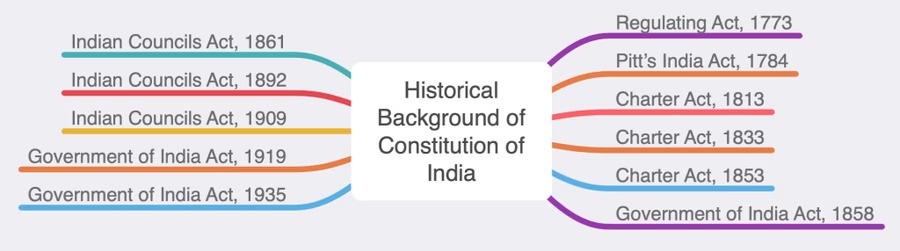
Historical Background

1. Regulating Act , 1973

2. Pitts India Act , 1984