Central Bureau of Investigation
Establishment of CBI

The Central Bureau of Investigation (CBI) was established in 1963 by a resolution of the Ministry of Home Affairs. Its origins lie in the Special Police Establishment (SPE) created in 1941 by the Government of India. The SPE’s functions initially pertained to investigating bribery and corruption during World War II. Later, the Delhi Special Police Establishment Act of 1946 brought the SPE under the Department of Home, expanding its mandate to cover specified offences beyond those related to the war. The CBI replaced the SPE, inheriting its personnel and functions. While the CBI derives its powers to investigate from the DSPE Act, it is not a statutory body.
Motto, Mission and Vision of CBI
The motto of the CBI is “Industry, Impartiality, Integrity”. Its mission includes investigating corruption, economic offences, and other serious crimes, contributing to maintaining law and order, and ensuring public trust through proactive and effective policing. The vision of the CBI is to be an internationally respected premier investigating agency committed to the rule of law and the pursuit of justice.
Organisation of CBI
The CBI is headed by a director. For administrative purposes, it is divided into various branches and specialised units to handle different types of crimes and investigations. These include divisions focusing on anti-corruption, economic offences, special crimes, and policy and coordination.
Originally (1963), the CBI was set up with the following six divisions:
(i) Investigation and Anti-Corruption Division (Delhi Special Police Establishment)
(ii) Technical Division
(iii) Crime Records and Statistics Division
(iv) Research Division
(v) Legal and General Division
(vi) Administration Division
At present (2019), the CBI has the following seven divisions:
- Anti-Corruption Division
- Economic Offences Division
- Special Crimes Division
- Policy and Coordination Division
- Administration Division
- Directorate of Prosecution
- Central Forensic Science Laboratory
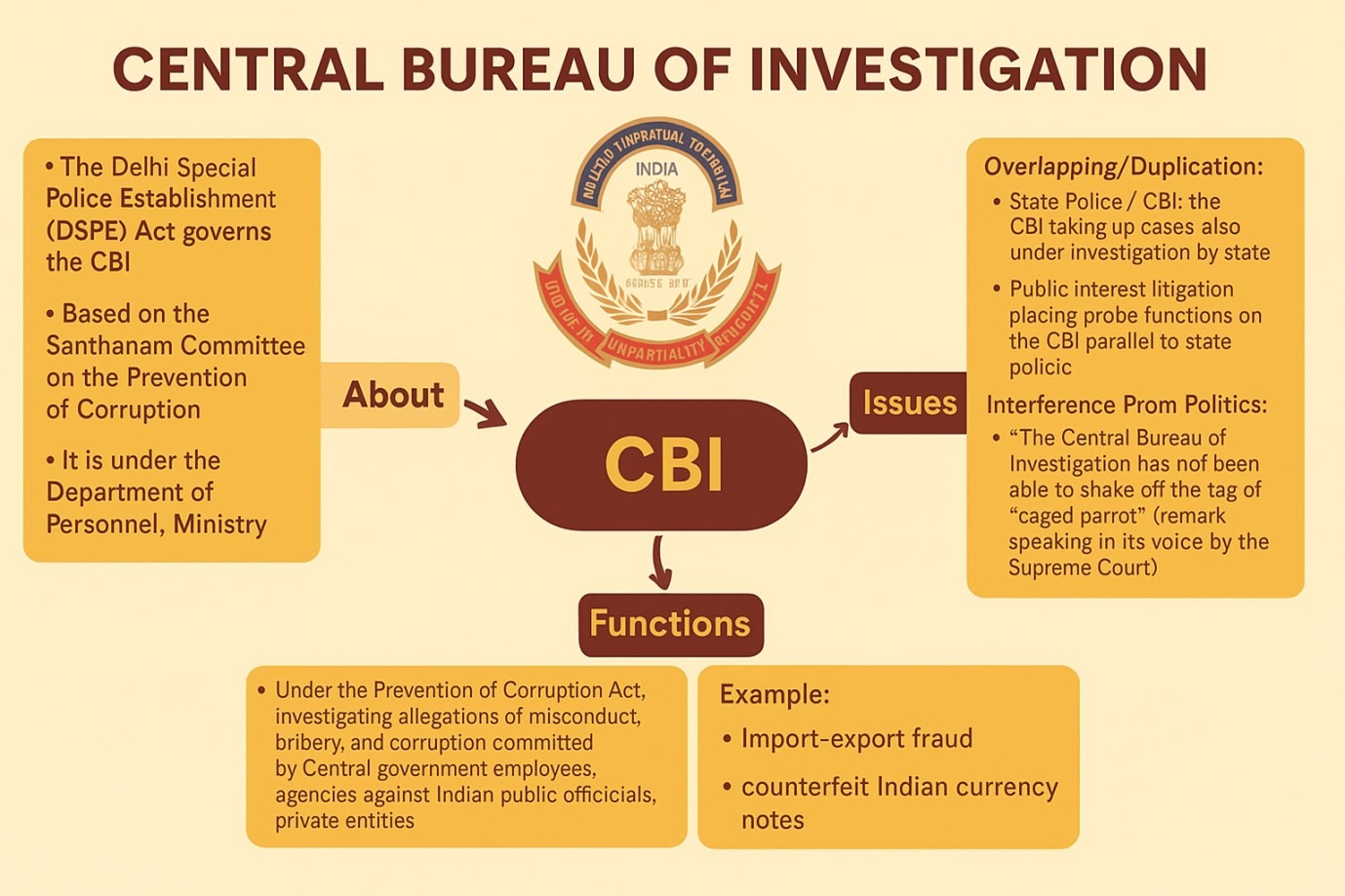
Composition of CBI
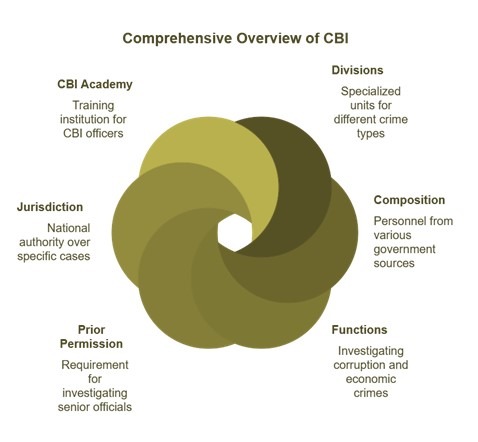
The CBI comprises police officers and other personnel drawn from various sources, including the Indian Police Service and other government departments. It has its own cadre of investigators and specialists in fields such as forensic science and law. The composition is structured to facilitate effective investigation and prosecution of complex cases.
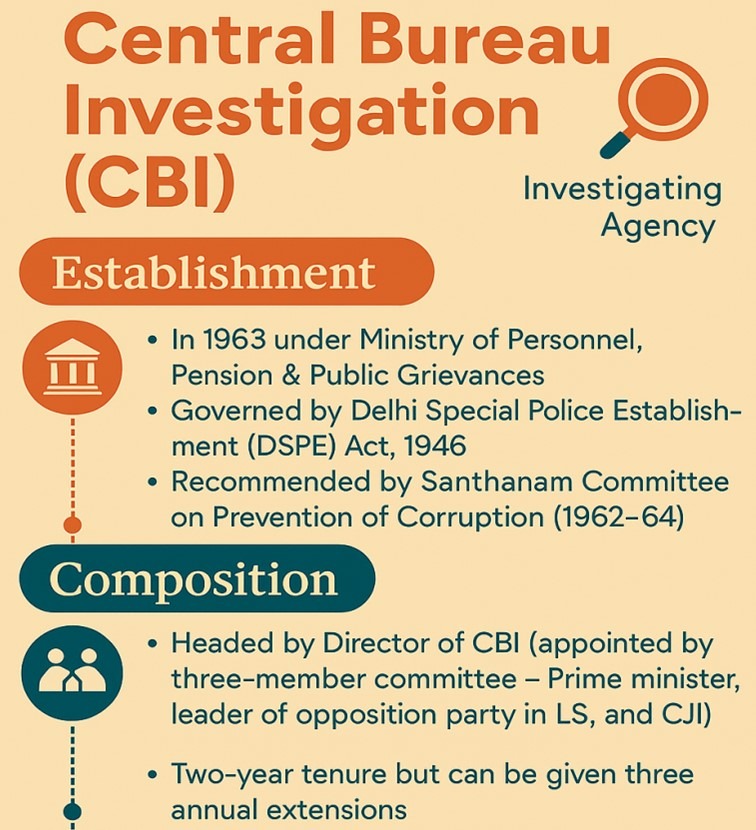
1. Appointment of CBI Director
- Before the Lokpal Act was legislated, the CBI director was appointed by the DSPE Act.
- Now, the Lokpal Act governs the appointment of the CBI director.
- The Centre appoints the director based on the recommendation of a search committee comprising:
- Prime Minister as the chairperson
- CJI (or SC judge) and
- Leader of the Opposition.
2. Tenure
- The director of CBI has been provided security of two-year tenure by the CVC Act, 2003.
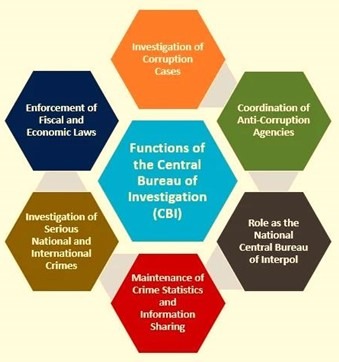
Functions of CBI
The primary functions of the CBI include investigating cases of bribery, corruption in public services, economic crimes (like bank fraud and financial irregularities), and serious and organised crimes. It also handles special crime cases assigned by the Central Government, High Courts, or the Supreme Court. Furthermore, the CBI plays a role in coordinating with other law enforcement agencies.
CBI Structure
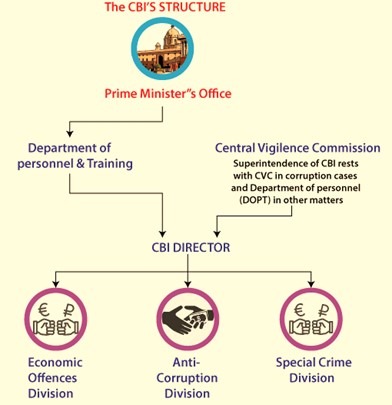
Provision of Prior Permission
According to a Supreme Court ruling, prior approval from the Central Government is necessary for investigating officers of the level of Joint Secretary and above in the Government of India in cases of alleged offences under the Prevention of Corruption Act. This provision aims to protect senior public officials from frivolous or malicious investigations.
CBI vs. State Police
The CBI’s jurisdiction generally extends across the country for the cases it is authorised to investigate, unlike state police forces which primarily operate within their respective state boundaries. The CBI typically handles cases with inter-state ramifications, high public interest, or those specifically referred to it by higher authorities, whereas state police deal with a broader range of law and order issues at the state level.
CBI Academy
The CBI has its own training academy. The CBI Academy is located in Ghaziabad and serves as the primary training institution for CBI officers and also conducts specialised courses for officers from other police forces and government organisations. It focuses on enhancing investigative skills, legal knowledge, and professional conduct.
General Consent Principle for CBI
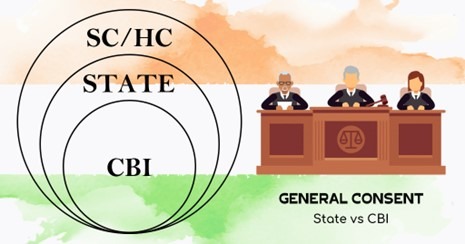
The provisions of the Delhi Special Police Establishment Act, 1946 do not enable the CBI to exercise its powers and jurisdiction in any area in a State (not being a railway area) without the consent of the Government of that State.
In other words, the jurisdiction of the CBI can be extended to the States only with the consent of the State Government concerned.
The consent of the state government to CBI can be of two types:
General Consent of State
- The “General Consent” of a state to the CBI refers to a broad authorization given by a state government to investigate all cases within its borders, without needing to seek specific permission for each individual case.
- In other words, it means consent for investing in a case by default.
- This consent is typically granted under Section 6 of the Delhi Special Police Establishment (DSPE) Act, 1946.
- The General Consent of a state allows the CBI to carry out a seamless investigation.
Case-Specific Consent of State
If any state has not given General Consent to the CBI, the CBI has to obtain permission from the state government for each specific case it intends to investigate within that state’s jurisdiction.
Supreme Court Judgments on Central Bureau of Investigation (CBI)
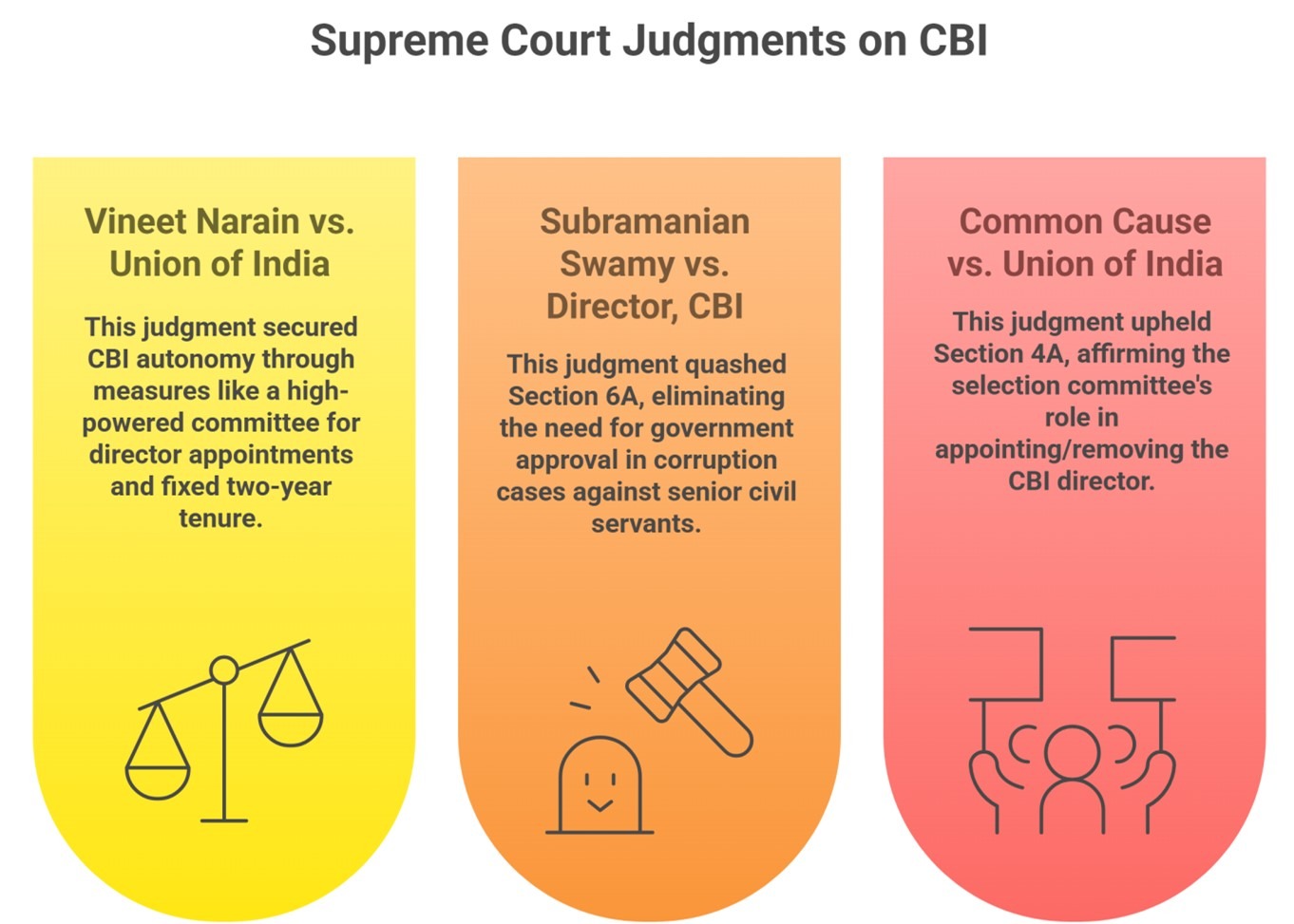
The Supreme Court has delivered several landmark judgments to protect the CBI from external interference and to enhance its professionalism and transparency. Some of these judgments are:
- Vineet Narain vs. Union of India (1997) – In this judgment, the Supreme Court has laid down several steps to secure the autonomy of the CBI, such as the appointment of the CBI director by a high-powered committee, and the fixed tenure of two years for the CBI director.
-
- Subramanian Swamy vs. Director, CBI (2014) – In this judgment, the Supreme Court quashed Section 6A of the Delhi Special Police Establishment Act, 1946, which required prior approval of the Central Government for inquiry or investigation into corruption cases against senior civil servants. The Supreme Court held that this provision was unconstitutional and violated Article 14 (equality before law) of the Constitution.
-
- Common Cause vs. Union of India (2018) – In this judgment, the Supreme Court upheld the validity of Section 4A of the Delhi Special Police Establishment Act, 1946, which provided for a selection committee comprising the Prime Minister, the Leader of the Opposition, and the Chief Justice of India or his nominee to appoint or remove the CBI director. The Supreme Court also directed that any transfer or change in the CBI director’s duties should be done only with the prior consent of this committee.
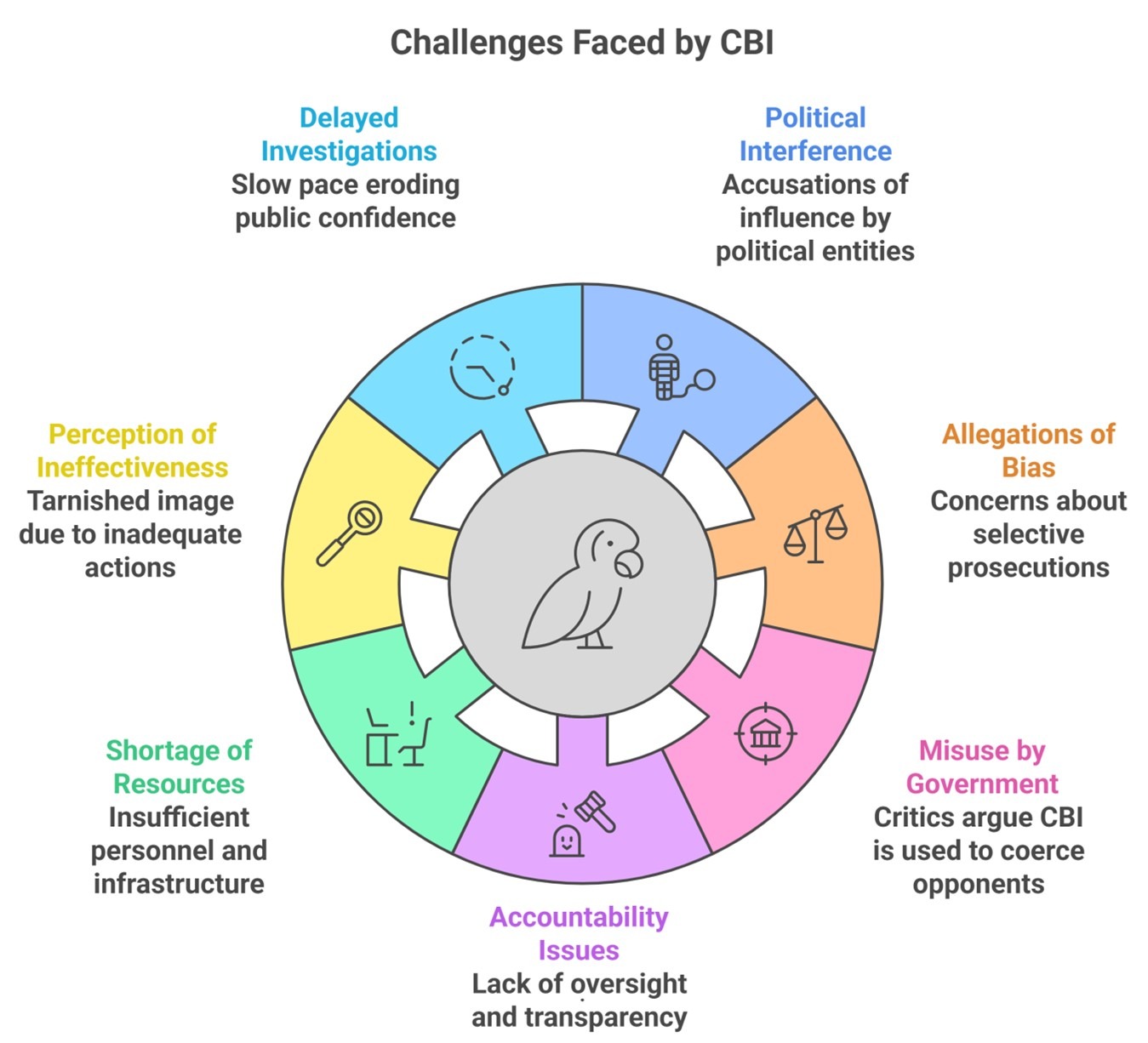
Challenges faced by Central Bureau of Investigation (CBI)
The challenges faced by the Central Bureau of Investigation (CBI) are:
Political Interference – Time and again, the CBI has been accused of being influenced by the political establishment and lacking true independence in its investigations.
- Excessive political interference in its functioning has made the Supreme Court call the CBI a “caged parrot speaking in its master’s voice”.
Allegations of Bias – There have been allegations of the CBI being biased in its investigations, favoring certain political parties or individuals.
- There have been concerns about the selective nature of some of the CBI’s prosecutions.
Misuse by the Central Government – Critics argue that successive Central Governments have used the CBI to haunt political opponents and coerce state governments to fall in line.
Accountability Issues – Questions have been raised about the CBI’s accountability mechanisms, with concerns about the lack of proper oversight and transparency in its functioning.
Shortage of Manpower and Resources – The agency has been plagued by a shortage of personnel, infrastructure, and financial resources, hampering its investigative capabilities.
- This has led to challenges in handling the increasing workload and complexity of cases.
Perception of Ineffectiveness – The CBI’s image has at times been tarnished by perceptions of ineffectiveness, particularly in high-profile cases or when its actions have been perceived as inadequate.
- This has led to a loss of public trust in the agency’s ability to deliver justice.
Delayed Investigations – The CBI has been criticized for the slow pace of its investigations, leading to delays in justice and eroding public confidence.
- Factors such as lack of resources, manpower, and procedural complexities have contributed to these delays.