
Categorisation and Examples
Cabinet Committees can be broadly categorised into standing committees, which possess a more permanent structure and address ongoing areas of governance, and ad hoc committees, which are formed to tackle specific, often time-bound, issues. While the provided sources do not list specific committees, common examples of standing committees in the Indian context often include those focused on Political Affairs, Economic Affairs, Security, Appointments, and Parliamentary Affairs.
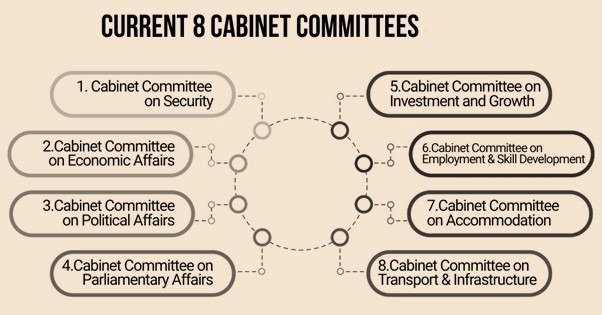
At present (2019), the following 8 Cabinet Committees are functional:
- Cabinet Committee on Political Affairs
- Cabinet Committee on Economic Affairs
- Appointments Committee of the Cabinet
- Cabinet Committee on Security
- Cabinet Committee on Parliamentary Affairs
- Cabinet Committee on Accommodation
- Cabinet Committee on Investment and Growth
- Cabinet Committee on Employment and Skill Development
Functions and Significance
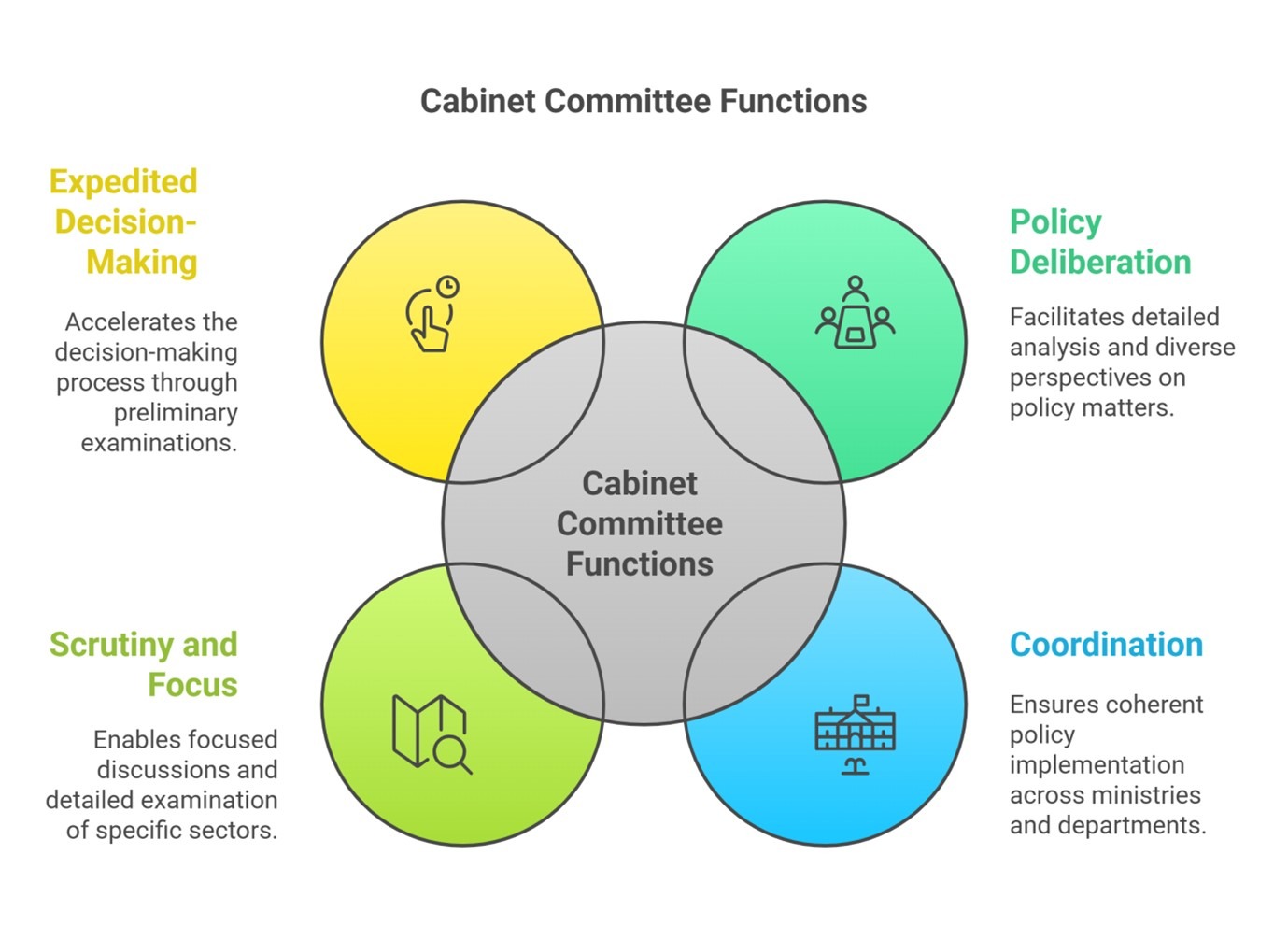
The functions performed by Cabinet Committees are pivotal to the efficient functioning of the central government. They play a crucial role in the deliberation of policy matters, offering a platform for detailed analysis and the consideration of diverse ministerial perspectives before recommendations are presented to the Cabinet for final endorsement [based on general knowledge]. Moreover, these committees are instrumental in fostering coordination across different ministries and government departments, ensuring a coherent and integrated approach to policy implementation and governance By concentrating on specific sectors, they facilitate a level of scrutiny and focused discussion that is often challenging to achieve within the larger setting of the full Cabinet [based on general knowledge]. Consequently, Cabinet Committees contribute significantly to expediting the decision-making process by undertaking preliminary examinations of issues and resolving potential inter-ministerial disagreements.
Groups of Ministers (GoMs)
These ministerial groupings, while sharing similarities with Cabinet Committees in their focused approach to specific issues, may differ in their composition and the scope of their authority [based on general knowledge]. GoMs can include ministers of state, and their mandates can range from making definitive decisions to primarily serving as deliberative bodies that formulate recommendations for the Cabinet [based on general knowledge]. The inclusion of GoMs in the likely suggests a comprehensive exploration of the various mechanisms employed by the Indian government to enhance efficiency and coordination beyond the plenary Council of Ministers.