
TOne Academy

Banking

Home / Indian Economy / Banking

BANKING

      Banking is an essential pillar of any modern economy, offering a broad spectrum of financial services to individuals, businesses, and governments. As financial intermediaries, banks accept deposits from the public and channel these funds into loans, investments, and other financial instruments. They play a vital role in the efficient allocation of credit, the functioning of the payment system, and the provision of liquidity, thereby supporting economic stability and growth.

Evolution of Banking in India

Pre-Independence Era:

    Before India gained independence in 1947, the banking sector was predominantly controlled by foreign banks, primarily established by British interests. The first bank in India, the Bank of Hindustan, was founded in 1770 by European merchants, marking the beginning of formal banking in the country. This was followed by the establishment of presidency banks such as the Bank of Bengal (1806), the Bank of Bombay (1840), and the Bank of Madras (1843), which primarily served the interests of British traders and colonial administration.


     In response to the growing need for indigenous financial institutions, Indian entrepreneurs began establishing their own banks in the late 19th century. A notable example is the founding of Punjab National Bank in 1894, which aimed to promote self-reliance among Indians and serve the local population. However, these early Indian banks struggled with limited access to capital, inadequate regulatory support, and stiff competition from the well-established foreign banks, making their operations challenging in the colonial economic environment.

Post-Independence Era (1947–1991):

    Following independence, the Indian government undertook significant steps to bring the banking sector under national control. One of the landmark moves was the nationalization of key foreign and Indian banks, including the transformation of the Imperial Bank of India into the State Bank of India (SBI) in 1955. This was aimed at extending banking facilities to rural and underbanked regions and aligning the banking system with national development goals.

To further support economic planning, the government established specialized financial institutions such as the Industrial Development Bank of India (IDBI) in 1964 and the National Bank for Agriculture and Rural Development (NABARD) in 1982. These institutions played pivotal roles in financing industrial growth and rural development, respectively.


     A major shift occurred in 1969 and again in 1980, when the government nationalized a total of 20 commercial banks. These moves were intended to ensure that banking services were accessible to all sections of society, especially the poor and marginalized.


     However, during this period, the banking sector remained highly regulated. Interest rates, lending practices, and branch expansion were tightly controlled by the government and the Reserve Bank of India (RBI). While these policies aimed to promote financial inclusion and social equity, they also stifled competition and innovation, leading to inefficiencies in credit allocation and limited customer-centric development in banking services.

Post-Liberalization Era (Since 1991):

    With the onset of economic liberalization in 1991, the Indian government initiated comprehensive reforms in the banking sector as part of a broader agenda to modernize and open up the economy. These reforms aimed to reduce state control, enhance efficiency, and foster greater private sector participation in the financial system.


      The liberalization process led to the entry of new private banks such as HDFC Bank, ICICI Bank, and Axis Bank, alongside the continued presence of public sector banks and foreign banks. The Reserve Bank of India (RBI) retained its regulatory authority but gradually allowed banks greater operational autonomy, including in setting interest rates, determining lending practices, and managing risk.


     As a result, the banking sector experienced increased competition, innovation, and improved customer service. Technological advancements, such as online and mobile banking, revolutionized the delivery of financial services. These developments significantly improved financial access and efficiency.


      To further promote financial inclusion, the government launched several landmark initiatives, the most notable being the Pradhan Mantri Jan Dhan Yojana (PMJDY) in 2014. This scheme aimed to provide every household with access to a bank account, insurance, and pension services, bringing millions of previously unbanked individuals into the formal financial system.

Banks: Definition and Functions

Definition:

      A bank is a financial institution that accepts deposits from individuals and organizations and provides loans, credit, and a range of financial services to its customers. Banks serve as financial intermediaries, playing a pivotal role in the economy by facilitating financial transactions, mobilizing savings, allocating credit, and promoting overall economic growth.

Primary Functions of Banks:

1. Accepting Deposits: One of the fundamental functions of a bank is to accept deposits from the public. These deposits can be:


    • Demand deposits (e.g., savings accounts, current accounts), which are withdrawable at any time.
    • Time deposits (e.g., fixed deposits, recurring deposits), which are held for a specific period and usually carry higher interest rates. By accepting deposits, banks mobilize household savings and make them available for productive uses in the economy.


2. Providing Loans and Advances: Banks lend money to individuals, businesses, and institutions in the form of:


    • Personal loans, home loans, vehicle loans, education loans, etc.
    • Business loans, working capital finance, and trade credit. Lending promotes capital formation, supports business activities, and helps meet personal financial needs, thereby contributing to economic development.

Secondary Functions of Banks:

1. Providing Financial Advice:

    • Banks offer financial consultancy and investment advisory services. Qualified financial advisors help customers make informed decisions about savings, investments, insurance, and retirement planning.


2. Issuing Credit and Debit Cards:

    • Banks issue credit cards and debit cards that facilitate convenient and secure cashless transactions for goods and services, both online and offline.


3. Providing Safe Deposit Lockers:

    • Banks offer safe deposit boxes or lockers to customers for storing valuables such as jewelry, legal documents, and other important items in a secure environment.


4. Foreign Exchange Services:

    • Banks provide foreign exchange (forex) services, including currency exchange, travel cards, and remittances. This is particularly useful for individuals and businesses engaged in international travel or trade.

Classification of Banks in India

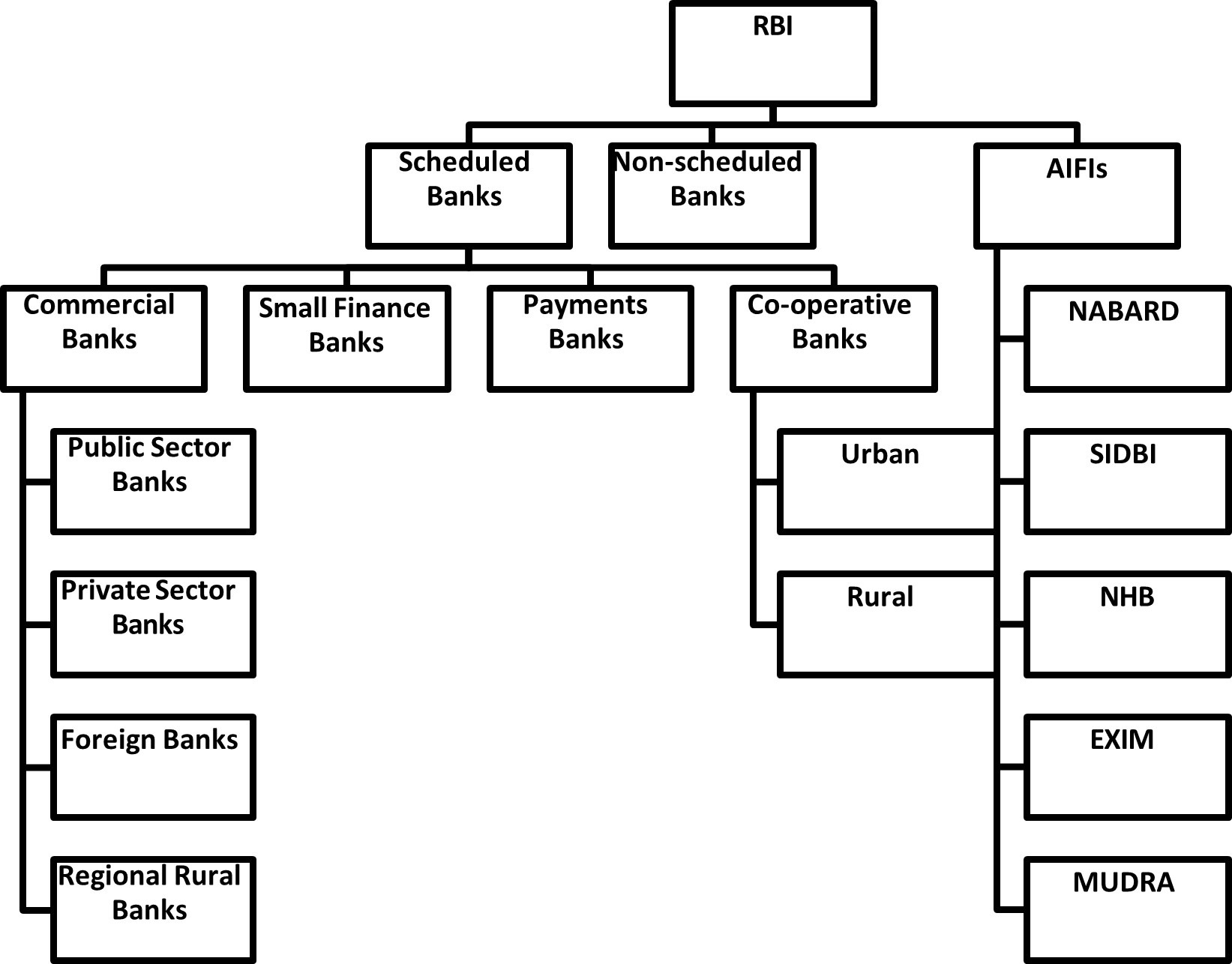
     Banks in India can be classified based on ownership, function, and target customers. Below is a detailed classification:

1. Based on Ownership

1. Public Sector Banks (PSBs):

    • Majority (more than 50%) stake held by the Government of India.
    • Examples: State Bank of India (SBI), Punjab National Bank (PNB), Bank of Baroda.
    • Known for wide reach and government-backed services.


2. Private Sector Banks:

    • Majority stake held by private individuals or corporations.
    • Examples: HDFC Bank, ICICI Bank, Axis Bank.
    • Known for better customer service and use of technology.


3. Foreign Banks:

    • Headquartered in a foreign country but operating in India through branches.
    • Examples: Citibank, HSBC, Standard Chartered.
    • Cater mostly to corporate clients and high-net-worth individuals.


4. Regional Rural Banks (RRBs):

    • Jointly owned by the Central Government (50%), State Government (15%), and a sponsor bank (35%).
    • Established to provide credit and banking facilities in rural areas.
    • Example: Prathama UP Gramin Bank.


5. Co-operative Banks:

    • Operate on a co-operative basis and are owned by their members.
    • Serve both rural and urban areas, mainly small borrowers.
    • Examples: Saraswat Co-operative Bank, Urban Co-operative Banks.

2. Based on Function

1. Commercial Banks:

    • Provide banking services to the general public and businesses.
    • Include both public and private sector banks.
    • Offer services like deposits, loans, credit cards, etc.


2. Development Banks:

    • Provide long-term capital for industrial and infrastructure development.
    • Examples: Industrial Development Bank of India (IDBI), Small Industries Development Bank of India (SIDBI), National Bank for Agriculture and Rural Development (NABARD).


3. Investment Banks:

    • Specialize in large financial transactions such as mergers, acquisitions, and issuing securities.
    • More relevant in advanced economies; limited presence in India.


4. Central Bank:

    • The apex monetary authority that regulates the entire banking system.
    • In India, the Reserve Bank of India (RBI) performs this role.

3. Based on Area of Operation

1. Scheduled Banks:

    • Listed under the Second Schedule of the RBI Act, 1934.
    • Fulfill criteria laid down by the RBI, such as minimum paid-up capital and reserves.
    • Enjoy privileges like access to RBI refinancing facilities.


2. Non-Scheduled Banks:

    • Not listed in the Second Schedule of the RBI Act.
    • Smaller in size and do not enjoy benefits available to scheduled banks.
 

Reserve Bank of India (RBI)

     The Reserve Bank of India (RBI) serves as the central banking institution of India, playing a crucial role in the country’s monetary policy formulation, financial system regulation, and overall economic governance.

Key Details about RBI

1. Establishment:

    • The RBI was established on April 1, 1935, under the Reserve Bank of India Act, 1934, following the recommendations of the Hilton Young Commission Report of 1926.


2. Headquarters:

    • The RBI’s Central Office was initially located in Kolkata but was permanently relocated to Mumbai in 1937. Mumbai serves as the headquarters where the Governor oversees operations and policy formulation.


3. Ownership:

    • Initially, the RBI was a privately owned institution; however, following its nationalization in 1949, it became fully government-owned. This shift emphasized the RBI’s role in serving the public interest and the Indian economy.


4. Governors:

    • The first Governor of the RBI was Sir Osborne Smith, who served until 1937. He was succeeded by Sir James Braid Taylor as the second Governor, and then C. D. Deshmukh took on the role as the third Governor. The position of the Governor is critical, as this individual leads the central bank and influences monetary policy decisions.

Key Acts Governing the Reserve Bank of India and Financial Regulation

    The Reserve Bank of India (RBI) operates under several key legislative frameworks that govern its functions, powers, and the broader financial landscape in India. Below are important acts that play significant roles in regulating various aspects of banking, finance, and economic management:
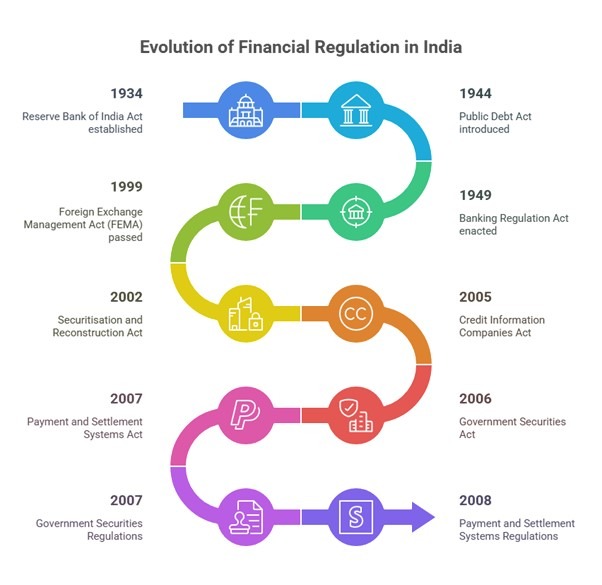


1. Reserve Bank of India Act, 1934:

    • This foundational act established the RBI and outlines its objectives, powers, structure, and functions, including monetary policy formulation and currency issuance.


2. Banking Regulation Act, 1949:

    • Provides a comprehensive framework for regulating and supervising commercial banks in India, ensuring stability and soundness within the banking sector.


3. Public Debt Act, 1944 / Government Securities Act, 2006:

    • This act allows the government to borrow money through the issuance of government securities, facilitating public debt management.


4. Government Securities Regulations, 2007:

    • These regulations govern the issuance and trading of government securities, ensuring orderly functioning in the government securities market.


5. Foreign Exchange Management Act (FEMA), 1999:

    • Regulates foreign exchange markets in India, facilitating external trade and payments while promoting the orderly development of the foreign exchange market.


6. Securitisation and Reconstruction of Financial Assets and Enforcement of Security Interest Act, 2002:

    • This act allows financial institutions to securitize their assets, providing a legal framework for the reconstruction of financial assets and the enforcement of security interests.


7. Credit Information Companies (Regulation) Act, 2005:

    • Regulates credit information companies (CICs) to enhance the accuracy of credit information, thereby facilitating responsible lending practices and protecting borrowers’ rights.


8. Payment and Settlement Systems Act, 2007:

    • This act provides a regulatory framework for payment systems in India to ensure safe, secure, and efficient payment transactions.


9. Payment and Settlement Systems Act, 2007 (As Amended up to 2019):

    • Refers to amendments made to the original legislation that may address emerging payment trends, technologies, and regulatory needs.


10. Payment and Settlement Systems Regulations, 2008 (As Amended up to 2022):

    • These regulations set forth specific requirements and guidelines for the operation of various payment systems, ensuring compliance with legislative frameworks.

Structure of the Reserve Bank of India (RBI)

    The Reserve Bank of India (RBI) has a well-defined organizational structure that facilitates its functions and operations. Below are the key components of the RBI’s structure:

1. Central Board of Directors

    • Headed by Governor: The central board of directors is the top management body of the RBI, headed by the Governor of the Reserve Bank.


    • Composition:
        • Four Deputy Governors: Assisting the Governor in managing various functions of the RBI.
        • Four Directors from Local Boards: These directors are elected representatives that bring regional perspectives to the board.
        • Ten Directors Nominated by the Government: Appointed by the Government of India, these directors include individuals with expertise in various fields such as finance, economics, and banking.
  •  
    • Appointment Duration: Directors are appointed or nominated for a period of four years, as stipulated by the Reserve Bank of India Act.

2. Local Boards

    • Regional Representation: The RBI has established local boards in four regions—East, West, North, and South. This regional representation ensures that the interests and issues specific to different geographical areas of India are considered in decision-making.


    • Responsibilities:
        • Advisory Role: The local boards advise the central board on regional economic and financial issues, ensuring that the RBI’s policies accommodate local needs.


        • Representation of Local Interests: Local boards represent the interests of the regional population and provide insights that may differ from national perspectives.

Functions of the Reserve Bank of India (RBI)

     The Reserve Bank of India (RBI) plays a pivotal role in the Indian economy by performing several key functions that contribute to monetary stability, financial integrity, and economic development. Below is a comprehensive overview of these functions:
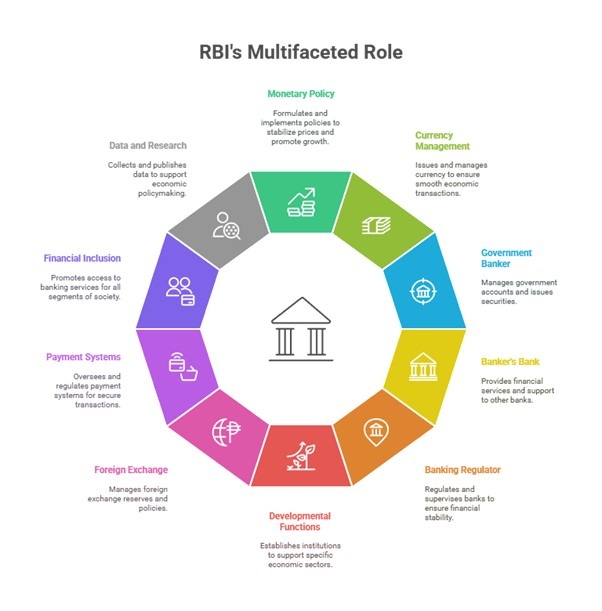


1. Monetary Policy Formulation and Implementation:

    • The RBI is responsible for formulating and implementing monetary policy to achieve price stability and promote economic growth.
    • Tools Used:
        • Repo Rates: The interest rate at which the RBI lends money to commercial banks, influencing overall borrowing costs in the economy.
        • Reverse Repo Rates: The rate at which banks can deposit excess funds with the RBI, affecting liquidity in the banking system.
        • Open Market Operations: The buying and selling of government securities to manage the money supply and liquidity in the economy.


2. Currency Issuance and Management:

    • The RBI holds the exclusive authority to issue currency notes in India, excluding the one-rupee coin.
    • It manages the supply of currency and credit to ensure currency stability, facilitating economic transactions smoothly within the market.


3. Banker to the Government:

    • The RBI acts as the banker and financial advisor to the Government of India, managing its accounts and handling the issuance of government securities.
    • It conducts all banking transactions for the government, ensuring efficient financial management.


4. Banker’s Bank and Lender of Last Resort:

    • The RBI serves as the banker to other banks, maintaining their banking accounts and providing necessary financial services.
    • As a lender of last resort, it provides emergency financial support to banks experiencing liquidity crises, thereby maintaining stability in the banking sector.


5. Regulator and Supervisor of the Banking System:

    • The RBI regulates and supervises commercial banks and financial institutions to ensure the stability and integrity of the financial system.
    • It issues banking licenses, establishes regulatory frameworks, and monitors compliance among financial entities to promote sound banking practices.


6. Developmental Functions:

    • The RBI undertakes various developmental roles to foster a robust financial system, such as establishing institutions like the National Housing Bank (NHB) and the National Bank for Agriculture and Rural Development (NABARD) to support specific sectors of the economy.


7. Foreign Exchange Management:

    • The RBI manages the country’s foreign exchange reserves, formulating policies to facilitate external trade, payments, and overall financial stability related to foreign currencies.


8. Payment and Settlement Systems:

    • The RBI oversees and regulates payment and settlement systems in the country, ensuring that they are efficient, secure, and reliable for economic transactions, contributing to the broader financial infrastructure.


9. Financial Inclusion:

    • The RBI promotes financial inclusion by developing policies and initiatives aimed at expanding banking services to unbanked and underprivileged segments of society, enhancing access to financial resources.


10. Data Collection and Research:

    • The RBI compiles and publishes data on various economic indicators and conducts research to support economic policymaking. This research aids in informed decision-making for both the RBI and the government.

RBI’s Sources of Income

      The Reserve Bank of India (RBI) generates revenue through various methods. These income sources are vital for its operations and contribute to its ability to manage monetary policy, regulate the banking sector, and provide financial stability. Here are the key sources of income for the RBI:
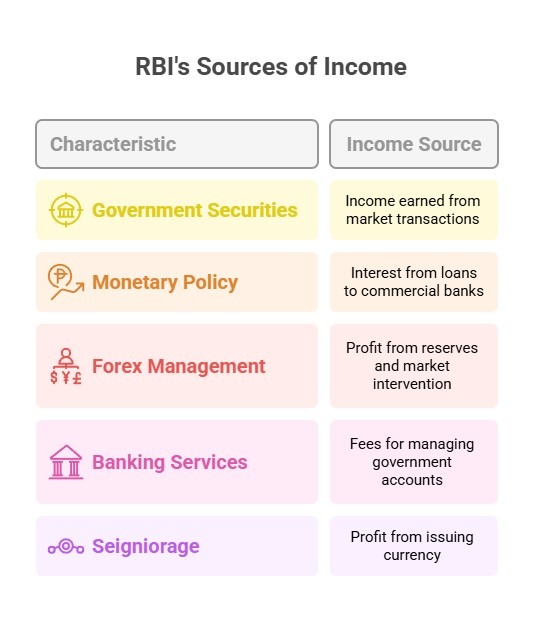


1. Purchase and Sale of Government Securities:

    • The RBI earns income by buying and selling government securities in the open market. These transactions influence liquidity in the economy and are part of the RBI’s monetary policy operations.


2. Monetary Policy Operations:

    • Through mechanisms like the repo market, the RBI provides short-term loans to commercial banks. The interest earned on these loans is a significant source of revenue for the RBI.


3. Foreign Exchange Reserves Management:

    • The RBI manages the country’s foreign exchange reserves, which include foreign currencies, gold, and other reserve assets. It generates profit from the appreciation of these assets’ values. Additionally, the RBI earns revenue from its interventions in the foreign exchange market.


4. Banking Services to the Government:

    • Acting as the banker to both central and state governments, the RBI charges fees for various services. This includes managing government accounts, handling cash flows, and facilitating the issuance and redemption of government bonds.


5. Seigniorage:

    • Seigniorage refers to the profit made by the central bank from issuing currency. It is the difference between the face value of the currency and the cost of producing and distributing it. Seigniorage represents an important source of revenue for the RBI.
  •  
    • After covering its operational expenses and maintaining adequate reserves, the RBI transfers surplus profits, including seigniorage, to the government, contributing to the government’s revenue.

Relationship Between RBI and the Government of India

   The relationship between the Reserve Bank of India (RBI) and the Government of India is characterized by a collaboration that balances the central bank’s autonomy with the government’s policy directives. Below are the key aspects of this relationship:
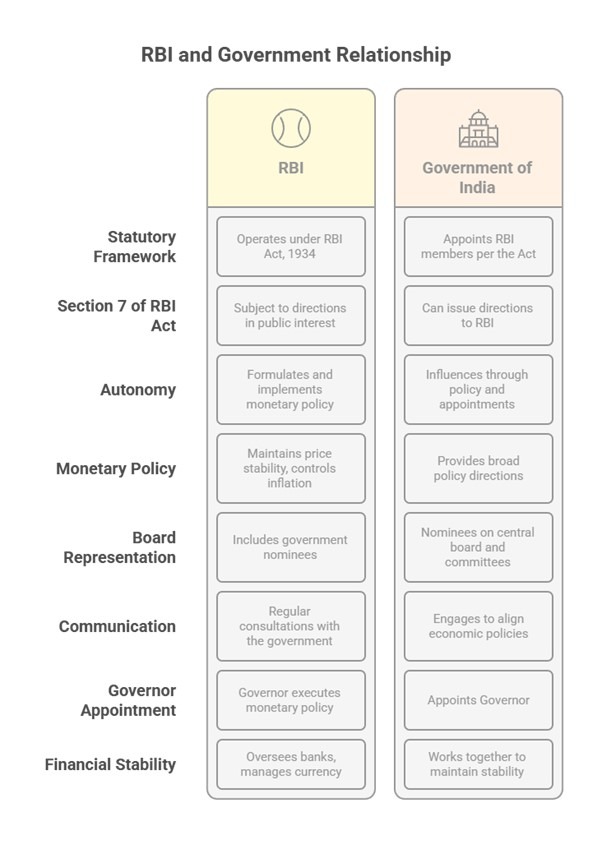


1. Statutory Framework:

    • The RBI operates under the framework established by the Reserve Bank of India Act, 1934. This legislation outlines the central bank’s functions, powers, and specifies the relationship between the RBI and the government, including the appointment of RBI members by the government.


2. Section 7 of the Reserve Bank of India Act:

    • Section 7 allows the Central Government to issue directions to the RBI after consulting the Governor, as deemed necessary in the public interest.
    • Section 7(2) provides the government with the power to entrust operations of the RBI to its board of directors, emphasizing the oversight role the government plays.


3. Autonomy of the Reserve Bank of India:

    • The RBI is granted autonomy to formulate and implement monetary policy, which is essential for maintaining price stability and controlling inflation.
    • While the central bank operates independently, it is not entirely free from government influence, thus requiring a delicate balance.


4. Monetary Policy Framework:

    • The RBI and the government collaborate to establish the monetary policy framework for the country. The RBI’s primary objective is to maintain price stability while also considering economic growth.
    • While the government can provide broad policy directions, the RBI has the authority to make specific decisions regarding interest rates, money supply, and other monetary tools.


5. Government Representation on RBI’s Boards:

    • The government plays a role in the governance of the RBI through representation on the bank’s central board and committees.
    • The central board includes government nominees, thereby allowing for input from the government perspective.


6. Consultations and Communication:

    • Regular consultations and communication occur between the government and the RBI to address economic conditions and policy priorities.
    • The Finance Ministry engages with the RBI to ensure alignment of economic policies and coordinate responses to emerging challenges.


7. Appointment of the RBI Governor:

    • The appointment of the RBI Governor is made by the government, specifically by the Prime Minister in consultation with the Finance Minister.
    • The Governor plays a critical role in both formulating and executing monetary policy, making this appointment significant in the context of monetary governance.


8. Coordination on Financial Stability:

    • The RBI and the government work together to maintain financial stability in the economy. This includes overseeing banks, managing the currency, and ensuring the overall stability of the financial system.
    • Collaborative efforts help in addressing systemic risks and facilitating a resilient financial environment.

Economic Capital Framework of the RBI

      The Economic Capital Framework of the Reserve Bank of India (RBI) establishes guidelines and methodologies for determining the appropriate amount of capital the central bank must hold to ensure financial stability and effectively manage various risks. This framework is addressed under Section 47 of the Reserve Bank of India Act, 1934.

Key Aspects of the Economic Capital Framework:

1. Purpose of Economic Capital:

    • The primary purpose of economic capital is to act as a buffer against potential losses that may arise from the RBI’s operations and exposures. This capital helps ensure that the central bank can continue to function effectively in fulfilling its mandate.


2. Profit Distribution:

    • According to Section 47, the RBI is mandated to pay a portion of its profits to the central government after accounting for various provisions, including:
        • Provisions for bad and doubtful debts.
        • Depreciation in assets.
        • Contributions to staff-related expenses.
    • This ensures that the central government receives a share of the RBI’s profits while maintaining the necessary capital reserves for operational stability.


3. Development of the Framework:

    • The previous Economic Capital Framework was developed in 2014-15 and was operationalized in 2015-16. This framework aimed to strengthen the capital base of the RBI in response to evolving financial landscapes and risks.
    • The RBI, in collaboration with the government, constituted a committee tasked with reviewing and recommending modifications to the economic capital framework to better align with contemporary needs.


4. Guidelines and Methodology:

    • The framework includes detailed guidelines for calculating the appropriate level of economic capital, which may encompass:
        • Assessments of various risks, including credit risk, market risk, operational risk, and liquidity risk.
        • Regular evaluations to adjust the capital requirements based on changing financial conditions and potential liabilities.


5. Implications for Financial Stability:

    • By maintaining an adequate level of economic capital, the RBI enhances its ability to withstand adverse financial conditions, thereby contributing to the overall stability of the financial system in India.
    • This framework also supports the credibility and independence of the RBI as a central monetary authority, assuring market participants and stakeholders of its financial resilience.

Bimal Jalan Committee’s Recommendations on RBI’s Economic Capital Framework

      The Bimal Jalan Committee, constituted by the Reserve Bank of India (RBI) in 2018, conducted a comprehensive review of the Economic Capital Framework (ECF) and provided several key recommendations aimed at enhancing the framework. Here are the notable recommendations:


1. Distinguish Realized Equity and Revaluation Balances:

    • The committee proposed separating realized equity (accumulated profits) from revaluation balances (which represent fluctuations in the value of assets). This distinction is intended to improve transparency and provide a clearer reflection of the RBI’s true financial position.


2. Modify Capital Adequacy Ratio (CAR) Range:

    • It was recommended to adjust the target range for total economic capital from the existing 20.8% – 25.4% to a narrower range of 20% – 24.5%. This change aims to ensure adequate capital levels while allowing the RBI greater flexibility in managing its financial operations.


3. Reduce Contingency Risk Buffer (CRB):

    • The committee suggested lowering the Contingency Risk Buffer from the current range of 5.5% – 6.5% to a new range of 4.5% – 5.5%. This would free up more capital for the RBI to achieve its objectives, while still maintaining sufficient buffers against unforeseen risks.


4. Enhance Transparency and Reporting:

    • The committee emphasized the need for improved disclosure and reporting regarding the ECF. This includes clear explanations of risk assessments, the methodologies employed, and the rationale behind capital adequacy decisions.

Shadow Banking

      Definition: Shadow banking refers to financial entities and activities that resemble traditional banking functions but operate outside the purview of more stringent banking regulations. Although not illegal, shadow banking operates in a “regulatory twilight zone,” where it faces fewer capital requirements and less rigorous liquidity checks compared to conventional banks.

Players in Shadow Banking

    • Housing Finance Companies (HFCs): Provide loans specifically for housing and real estate purchases.
    • Retail Non-Banking Financial Companies (NBFCs): Offer various financial services, including loans and credit.
    • Liquid Debt Mutual Funds (LDMFs): Invest in short-term debt instruments and provide liquidity to investors.

The Double-Edged Sword of Shadow Banking

While shadow banking can stimulate economic growth and improve access to credit for underserved sectors, it also poses inherent risks:


1. Leverage:

    • Shadow banks often operate with high levels of debt, making them vulnerable to financial shocks, which can trigger systemic effects within the economy.


2. Illiquidity:

    • The assets held by shadow banks can be challenging to sell quickly, causing liquidity crises if investors demand withdrawals all at once.


3. Bank Runs:

    • The absence of explicit deposit insurance exposes shadow banks to risks of bank runs. Investors may rush to withdraw funds in fear of insolvency, leading to further financial instability.

Regulatory Spotlight

In light of the risks associated with shadow banking, regulators globally are tightening oversight of this sector. Measures include:

    • Increased Capital Requirements: Mandating higher capital reserves to improve resilience against shocks.
    • Liquidity Regulations: Implementing rules to ensure sufficient liquidity management.
    • Closer Supervision: Enhanced monitoring of shadow banking activities to mitigate potential disruptions.

Way Forward

     The ongoing evolution of shadow banking necessitates careful monitoring and balanced regulation. Finding the right balance between fostering innovation and ensuring financial stability is crucial. A well-regulated shadow banking system can complement traditional banks and promote financial inclusion, but insufficient regulation could introduce significant risks to the overall financial ecosystem.