TOne Academy

Vijayanagara and Bahmani Kingdoms

Home / Indian History / Vijayanagara and Bahmani Kingdoms

Vijayanagara and Bahmani Kingdoms

     The Vijayanagar Empire emerged in 1336 CE when the brothers Harihara I and Bukka I, former commanders in Muhammad bin Tughlaq’s army, broke away from the Delhi Sultanate. Guided by the sage Vidyaranya, they established a new capital—Vijayanagar (modern Hampi)—on the southern bank of the Tungabhadra River. The city’s location provided natural fortification and easy access to fertile hinterlands, allowing the founders to consolidate a realm that drew together the diverse cultural zones of Kannada, Telugu, and Tamil India.

The empire would eventually be ruled by four dynasties:

Dynasty

Dates

Notable Features

Sangama

1336 – 1485

Founders of the empire; laid administrative and military foundations

Saluva

1485 – 1503

Transitional house that restored stability after a brief crisis

Tuluva

1503 – c.1570

Age of Krishnadevaraya; zenith of territorial and cultural expansion

Aravidu

c.1570 – 1670s

Continued resistance after the Battle of Talikota; gradual decentralisation


Contemporary travellers—including Niccolò Conti, Domingo Paes, Fernao Nuniz, Duarte Barbosa, and the Persian envoy Abdur Razzak—left glowing accounts of Vijayanagar’s monumental architecture, bustling markets, and cosmopolitan court.
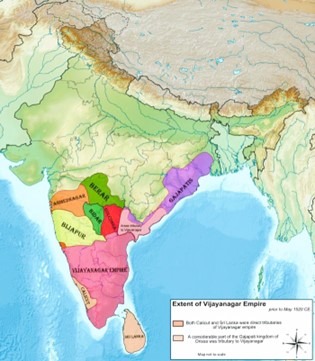
 

Sangama Dynasty (1336 – 1485)

Harihara I (1336 – 1356) & Bukka I (1356 – 1377)

    • Co‑founders of the empire, reputedly from a family of five brothers once allied with the Kakatiyas of Warangal and later ministers in the Kampili kingdom.
    • After imprisonment and brief conversion during Muhammad bin Tughlaq’s campaign against Kampili, they reconverted to Hinduism at Vidyaranya’s behest and proclaimed independence.
    • Named their capital Vidyanagar/Vijayanagar—“City of Victory”—as a tribute to their spiritual mentor.
    • Absorbed the weakened Hoysala territories by 1346, creating what has been called a “co‑operative commonwealth,” with other brothers administering newly conquered regions.
    • Bukka I destroyed the Madurai Sultanate, extending the empire deep into Tamil country.

Harihara II (1379 – 1404)

    • Pivoted expansion toward the eastern seaboard, battling the Reddis of Kondavidu and the Velamas to secure the coast from Nellore to Kalinga.
    • Withstood a Bahmani–Warangal alliance, yet captured Belgaum and Goa, securing western trade arteries.
    • Strengthened the frontier forts that guarded the Krishna–Tungabhadra doab.

Deva Raya I (1406 – 1422)

    • Addressed the capital’s water scarcity by building dams on the Tungabhadra and Haridra rivers, feeding a web of canals.
    • Fought recurring wars with Kondavidu, Warangal, Bahmani Gulbarga, and the Gajapatis of Kalinga.
    • After an initial setback and an enforced marriage alliance with Bahmani Sultan FirozShah, Deva Raya I reversed fortunes, crushing the Bahmanis at Pangal (1420 – 1422) and annexing territory up to the Krishna.
    • Modernised the army—importing Arabian and Persian horses, recruiting 10 000 Muslim cavalrymen, and appointing Turkish archers—reflecting a pragmatic, de facto secular approach.
    • Patronised architecture (the HazaraRama Temple) and Kannada letters; poet Madhura flourished at court.
    • Welcomed visitors such as Italian merchant NiccolòConti and Russian traveller AfanasiyNikitin, who praised the city’s splendour.

Deva Raya II (1423 – 1446)

    • Widely deemed the greatest Sangama ruler—soldier, scholar, and statesman.
    • Earned the title Gajabetekara (“Hunter of Elephants”) for decisive victories across the Deccan.
    • Expanded imperial sway from Ceylon to Gulbarga and Malabar to Orissa, extracting tribute from Ceylon, Quilon, Pegu, and Pulicat (Niccolò Conti).
    • Championed a golden age of culture, hosting luminaries such as Kannada poets Chamarasa (Prabhulingaleele) and KumaraVyasa (KarnataBharataKathamanjari); Telugu maestro Srinatha; and Sanskrit savant GundaDimdima.
    • Authored works in both Kannada (SobaginaSone, Amaruka) and Sanskrit (MahanatakaSudhanidhi) and penned a commentary on the BrahmaSutras.
    • South Indian mathematician–astronomer Parameshvara (Kerala school) pursued research under his patronage.


These early Sangama monarchs laid the administrative and cultural foundations that later enabled Tuluva emperor Krishnadevaraya to preside over what many regard as the apex of medieval South Indian civilisation.

Saluva Dynasty (c. 1485–1505 CE)

      The Saluva Dynasty marked a brief but significant chapter in the history of the Vijayanagara Empire. This dynasty was founded by Saluva Narasimha Deva Raya, a prominent general and minister under the preceding Sangama rulers. His rise to power was an attempt to rescue the weakening empire from internal strife and external threats.


    • The Gorantla inscription offers valuable insights into the foundation and lineage of the Saluva rulers.
    • Saluva Narasimha Deva Raya reigned from around 1486 to 1491 CE. Although his rule was short-lived, he made efforts to stabilise the declining empire.
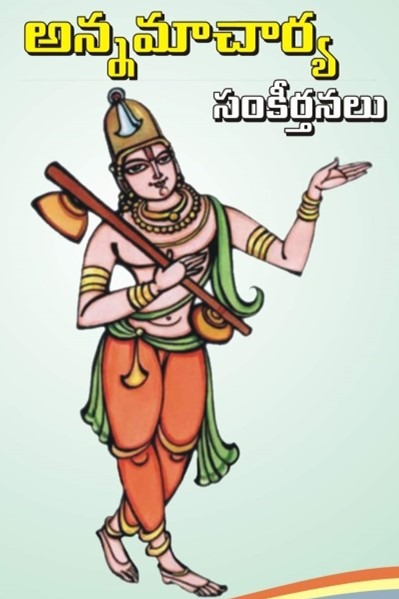
    • During his reign, the famous saint and Carnatic music composer Annamacharya (Annamayya) flourished, composing devotional hymns in praise of Lord Venkateswara.


    • After Narasimha’s death, his minor son Thimma Bhupala briefly ascended the throne, but due to his inability to govern, the empire fell into the hands of the powerful military commander Tuluva Narasa Nayaka, father of the future emperor Krishna Deva Raya.
    • Eventually, Narasimha Raya II, the last of the Saluva rulers, was dethroned by Vira Narasimha of the Tuluva lineage, bringing the Saluva dynasty to an end.

Tuluva Dynasty (c. 1505–1570 CE)

     The Tuluva Dynasty, one of the most prominent in the history of Vijayanagara, came to power following a phase of political instability. Vira Narasimha, a capable military leader, deposed the last Saluva ruler and laid the foundation of this new lineage. His reign set the stage for one of South India’s greatest rulers—Krishna Deva Raya.

Krishna Deva Raya (1509–1529 CE)

     Krishna Deva Raya is universally acknowledged as the greatest ruler of the Vijayanagara Empire and one of the most illustrious monarchs in Indian history. His reign marked the peak of the empire’s power, prestige, and cultural brilliance.
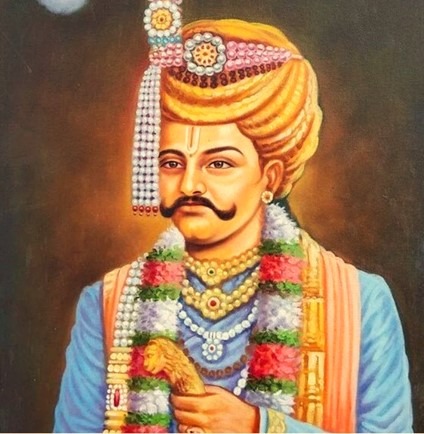


Political and Military Achievements:

    • He successfully restored law and order, bringing internal stability after years of unrest.
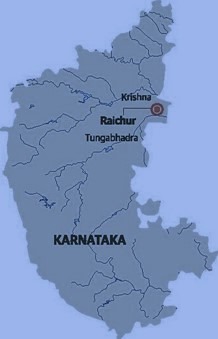
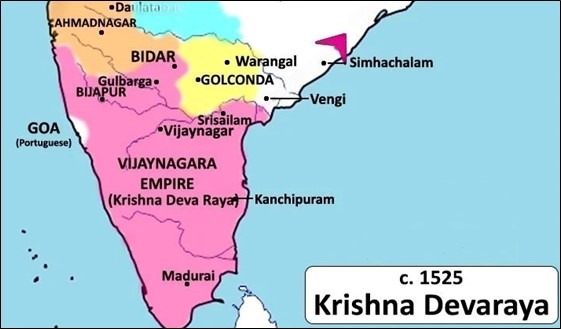
    • He launched successful military campaigns against the successor states of the Bahmani Sultanate, especially Bijapur, securing the Raichur Doab (the fertile land between the Krishna and Tungabhadra rivers).


    • He subdued the Gajapatis of Orissa, forcing them to retreat beyond the Krishna River and reclaiming territories for Vijayanagara.
    • Krishna Deva Raya maintained diplomatic and trade relations with the Portuguese, who were establishing themselves on the western coast. Ambassadors like Albuquerque visited his court, and a monopoly on the import of horses from the Portuguese was established.


Religious Policies and Temple Patronage:

    • Though a devout Vaishnavite, Krishna Deva Raya was known for his religious tolerance and patronage of multiple faiths.
    • He built monumental temples such as the Vittalaswamy Temple and Hazara Ramaswamy Temple in Hampi.
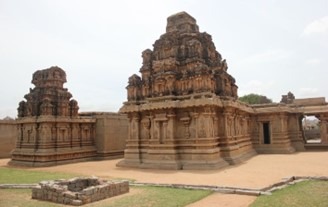


    • He also enhanced the grandeur of many existing temples in South India by constructing tall gopurams (gateway towers).
    • A new township named Nagalapuram, in honour of his mother, was established near Vijayanagara.
    • He invested in public infrastructure, including the construction of large irrigation tanks.

Art and Literature:

    • Krishna Deva Raya earned titles such as Andhra Bhoja and Andhra Pitamaha for his profound contributions to art and literature.
    • Telugu literature flourished under his reign, with the emergence of the legendary Ashta Diggajas—the eight literary luminaries of his court:


Poet

Title / Recognition

Notable Works

Allasani Peddana

Andhra Kavita Pitamaha

Manucharitam, Harikathasaram

Tenali Ramakrishna

Vikata kavi

Panduranga Mahatmyam

Pingali Suranna

Renowned Literary Figure

Garuda Puranam, Prabhavatee Pradyumnamu, Raghava Pandaveeyam, Kalapurnodayam

Nandi Thimmana

Court Poet of Krishnadevaraya

Parijatapaharanam


Dhurjati, Madayyagari Mallana, Ayyalaraju Ramabhadra Kavi, and Ramaraja Bhushana also contributed richly.


Krishna Deva Raya himself was a multilingual scholar, authoring the Telugu classic Amuktamalyada and Sanskrit works like Jambavati Kalyanam and Ushaparinayam.

Foreign Accounts:

    • Domingo Paes, a Portuguese traveller who visited his court, described Krishna Deva Raya as a charismatic and disciplined ruler. Paes was impressed by his regal routine, which included a rigorous morning workout, wrestling, horse riding, prayer, and then court duties.

Achyuta Deva Raya (1529–1542 CE)

    • Achyuta Deva Raya, the younger brother of Krishna Deva Raya, was handpicked as his successor. Though not as illustrious as his brother, his rule was marked by relative stability.
    • He patronised notable scholars such as Rajanatha Dindima II, Kannada poet Chatu Vittalanatha, and Purandaradasa, the revered composer regarded as the father of Carnatic music.
    • The Tiruvengalanatha temple, now known as the Achyutaraya Temple, was constructed during his reign.
    • Fernão Nunes, a Portuguese chronicler, visited Vijayanagara during this period and documented the cultural vibrancy of the empire.

Venkata I (1542 CE)

    • Following Achyuta Deva Raya’s demise, his son Venkata I ascended the throne amidst succession disputes. However, his rule lasted a mere six months, ending with his death.
    • This paved the way for Sadasiva Raya, the child-son of Krishna Deva Raya, to be placed on the throne under the regency of the influential Aliya Rama Raya.

Sadasiva Raya (1543–1576 CE)

    • Sadasiva Raya was the nominal ruler, while real power rested in the hands of Aliya Rama Raya, Krishna Deva Raya’s son-in-law and a shrewd statesman.
    • Rama Raya sought to consolidate power by removing old nobility and installing loyalists.
    • His diplomatic strategy involved balancing the rival Deccan Sultanates by pitting them against each other, but this ultimately backfired.
    • His political manipulations led to the formation of a formidable coalition of the Deccan Sultanates—Bijapur, Ahmadnagar, Golkonda, and Bidar (except Berar).
    • In 1565 CE, the Battle of Talikota (also known as the Battle of Rakshasa-Tangadi) was fought. The combined forces of the Deccan Sultanates decisively defeated the Vijayanagara army.
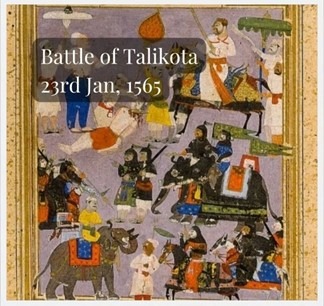


    • Rama Raya was captured and executed, and the magnificent capital city of Vijayanagara was looted and destroyed. This battle is widely regarded as the beginning of the end of the Vijayanagara Empire, though it continued under the Aravidu dynasty for some time in a diminished form.

Aravidu Dynasty (1570-1646)

      The Vijayanagar empire existed under the Aravidu dynasty, which ruled from Penukonda and later from Chandragiri (near Tirupati) for about another century. Sri Ranga, Thirumala, and Venkata II were the important rulers of this dynasty. Sri Ranga III (1642– 1646) was the last ruler of the Vijayanagar kingdom.

Administration of the Vijayanagara Kingdom

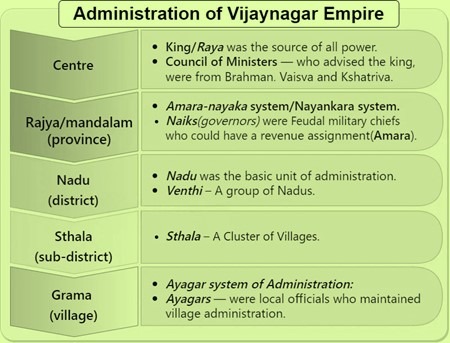
      The Vijayanagara Empire, one of the most remarkable South Indian kingdoms in medieval India, was known for its highly efficient and well-structured administrative system. The administration was monarchical in nature, with the Raya (king) at its helm, exercising absolute authority in all spheres of governance—executive, legislative, and judicial.

Central Administration

     The king was the supreme authority in the empire and was regarded as the fountainhead of justice and the ultimate lawmaker. His decisions were final in all civil and criminal matters, and he acted as the highest court of appeal. In matters of justice, the punishments prescribed were often severe and harsh, reflecting the need for deterrence in a large and complex empire. These punishments included mutilation, public flogging, and execution by trampling under elephants, which were meant to instill fear and maintain strict law and order.


     The succession to the throne was generally based on hereditary principles, following the dynastic traditions. However, instances of usurpation were not uncommon, particularly during periods of political instability. For example, Saluva Narasimha Deva Raya seized the throne by overthrowing the declining Sangama dynasty, marking the beginning of the Saluva line.


     To aid in governance, the king was assisted by a council of ministers known as Amatyas. These ministers were usually chosen from among the nobility and the loyal aristocracy, and they played a critical role in advising the monarch on administrative, military, and financial matters. While the king retained the final say, the council’s input was important in day-to-day functioning.
 

Provincial Administration

    The Vijayanagara Empire was divided into a well-organised hierarchy of administrative divisions to ensure effective control over its vast territories. The major units of administration were as follows:

    • Mandalams (Provinces)
    • Nadus (Districts)
    • Sthalas (Sub-districts)
    • Gramas (Villages)


Each Mandalam (province) was governed by a Mandaleswara or Nayaka, who was usually a noble, a loyal vassal, or a member of the royal family. In the early phase of the empire, these positions were often held by royal princes. However, over time, they were increasingly assigned to powerful nobles and military commanders, many of whom became hereditary governors, leading to the rise of Nayakship as an important feature of regional governance.


     The Nayakas (feudatories) enjoyed considerable autonomy in their respective territories. They had the power to maintain their own armies, collect taxes, conduct judicial proceedings, and even issue minor coinage. In return, they were obligated to pay annual tributes or a fixed revenue to the central treasury and to provide military assistance to the emperor during times of war.


    The duration of a Nayaka’s rule was not fixed by tenure but rather determined by his personal strength, administrative capacity, and loyalty to the king. The strong and influential Nayakas often behaved like semi-independent rulers, making the empire resemble a confederacy rather than a strictly centralised political system.

Local Administration and Village Governance

   At the grassroots level, village administration continued to function with a degree of autonomy. However, compared to the highly developed system of village self-governance under the Cholas, the Vijayanagara rulers curtailed some of the earlier independence of local institutions. The traditional village assemblies (sabhas and ur) lost much of their previous authority due to the rise of hereditary Nayakships and the growing centralisation of military power in the hands of provincial chiefs.


    Nevertheless, the local revenue officials, such as karanams (record keepers) and reddis (village heads), continued to function in coordination with the central administration, ensuring the collection of taxes and maintenance of local order.

Revenue System

    The primary source of revenue for the Vijayanagara state was land tax, which was meticulously assessed and collected. The standard rate of land revenue was typically one-sixth of the total agricultural produce, though this could vary depending on fertility, crop type, and local conditions. The land was surveyed and classified based on productivity, and cultivators were required to pay in kind or cash.

Apart from land revenue, the state also earned income through:

    • Tributes and gifts from subordinate chieftains and feudatories.
    • Customs duties and port taxes, especially at busy trading ports like Goa, Honnavar, and Machilipatnam.
    • Taxes on professions and occupations, including levies on artisans, merchants, and guilds.
    • Mining and forest products, such as precious stones, salt, sandalwood, and spices.


The empire also derived wealth from conquests, war booty, and strategic control of trade routes, which allowed it to levy tolls and import/export duties.

Judicial System

     Justice was administered by the king and his officials at various levels. While the king was the chief justice, judicial powers were also delegated to governors, Nayakas, and village elders. The legal system was a blend of Hindu customary law, Dharmashastra traditions, and royal decrees.


      Severe punishments were often awarded for theft, rebellion, or treason, reflecting the empire’s intent to maintain firm authority. Appeals could be made to higher officials, and ultimately to the king himself, who was considered the final arbiter of justice.


   The administrative framework of the Vijayanagara Empire was both expansive and adaptable, enabling the rulers to maintain control over a vast and culturally diverse territory for over two centuries. While the centralised monarchy held theoretical authority, the practical administration often functioned as a feudal confederation, relying heavily on the loyalty and efficiency of regional governors and local chieftains. The empire’s success in governance lay in its ability to balance royal authority with regional autonomy, making Vijayanagara one of the most enduring empires in Indian history.


Key Term

Concept

Meaning

Pradhani

Prime Minister

Chief advisor and executive head under the king

Raysani

Royal Decree

Recorded oral orders or commands issued by the king

Karnikam

Accountant

Responsible for maintaining financial and revenue records

Kadamal, Irai, Vrai

Types of Taxes

Different kinds of taxes levied in the empire

Athavane

Land Revenue Department

Office in charge of assessing and collecting land revenue

Mahanayakachara

Administrative Link

Acted as a mediator or liaison between king and villages

Padikaval

Policing Rights

Practice of selling the rights to maintain law and order

Talara

Watchman

Local village-level security personnel or guard

Vijayanagar Society

     The society of the Vijayanagar Empire was vibrant, diverse, and deeply rooted in tradition, hierarchy, and religion, yet showed remarkable signs of tolerance and cultural assimilation. It reflected a complex social structure that coexisted with grandeur, artistic flourishing, and inter-religious harmony.

Caste System and Social Structure

According to the renowned Telugu poet Allasani Peddanna, in his celebrated work Manucharitam, the Vijayanagar society was divided along the lines of the traditional varna system, comprising Brahmins, Kshatriyas, Vaishyas, and Sudras. This four-tiered caste structure remained an integral part of the social organization, shaping occupations, lifestyles, religious functions, and social interactions.


    • Brahmins occupied the highest position and were engaged in scholarly pursuits, religious rites, temple activities, and administration.
    • Kshatriyas, the warrior class, formed the ruling and military elite.
    • Vaishyas were engaged in agriculture, trade, commerce, and banking.
    • Sudras were primarily laborers, artisans, and service providers.


Despite the rigidity of the caste system, social mobility existed to some extent, especially within the growing mercantile class and among those who served the royal court or excelled in cultural and artistic fields.

Accounts by Foreign Travellers

Several foreign travelers and chroniclers who visited Vijayanagar have provided vivid descriptions of its societal life, material wealth, and urban splendour.


    • Domingo Paes, a Portuguese traveler, spoke at length about the grandeur of noble residences, describing the richly decorated mansions of the aristocracy, their multitudes of domestic servants, and the overall prosperity of the capital city.
    • Niccolò de’ Conti, an Italian merchant and explorer, mentioned the prevalence of slavery, which was a common practice in many parts of the world during that era. Slaves were employed in both domestic and public roles.


Foreign Traveller

Origin

Period of Visit

Key Details

Nicolo de Conti

Italy

1420 (Reign of Deva Raya I: 1404–1422 CE)

Italian trader; documented Vijayanagara’s grandeur and administration

Abdur Razzaq

Persia (Iran)

Reign of Deva Raya II (1425–1446 CE)

Persian ambassador; gave a vivid account of the court and prosperity

Afanasii Nikitin

Russia

15th century

Russian merchant; recorded socio-economic aspects of the empire

Duarte Barbosa

Portugal

Reign of Krishna Deva Raya (1509–1529)

Portuguese traveller; noted trade practices and administrative setup

Domingo Paes

Portugal

Around 1520 (Reign of Krishna Deva Raya)

Trader; provided detailed descriptions of the king’s lifestyle and military

Fernao Nuniz

Portugal

Reign of Achyuta Deva Raya (1529–1542)

Horse trader; chronicled political life and city architecture


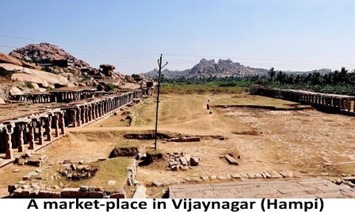
The capital city, Vijayanagar, was described as a cosmopolitan and prosperous urban centre, teeming with palaces, temples, gardens, markets, and wide roads. Silk and cotton garments were commonly worn, and brightly coloured fabrics were favored by both men and women.

Cultural Life and Entertainment

The people of Vijayanagar enjoyed a wide range of leisure and recreational activities. Entertainment included:


    • Dancing and Music: These were integral to temple rituals and royal festivities.
    • Gambling and cockfighting were popular pastimes, especially among the commoners.
    • Wrestling and athletic games were practiced and often witnessed by large audiences during festivals and royal events.


Religious festivals were celebrated with great zeal, often involving elaborate processions, theatrical performances, and temple rituals. Public participation in these celebrations added vibrancy to civic life.

Religion and Tolerance

     Religion played a central role in shaping social and political life in the Vijayanagar Empire. The Sangama dynasty, the first ruling house of the empire, was primarily Shaivaite in orientation and Virupaksha, a form of Shiva, was their dynastic deity. However, subsequent dynasties such as the Saluva, Tuluva, and Aravidu were inclined toward Vaishnavism, particularly Srivaishnavism, a sect popularized by the saint Ramanujacharya.


Despite these sectarian affiliations, the Vijayanagara rulers practiced remarkable religious tolerance:


    • Muslims were employed in administrative and military roles.
    • Under Deva Raya II, Muslim soldiers were recruited and given jagirs (land grants), and a mosque was constructed within the capital for their worship.
    • Jainism, though declining, was still present in parts of Karnataka and continued to receive support.
    • The construction of grand temples during this period — such as Hazara Rama, Vittalaswamy, and Virupaksha Temple — demonstrates both religious devotion and artistic excellence.


The temple complexes often functioned not just as spiritual centres but also as economic and social institutions. They controlled large endowments, engaged in internal and overseas trade, and served as centres for education, culture, and welfare.
 

Status of Women

The position of women in Vijayanagar society remained largely subordinate, reflecting broader patriarchal norms prevalent across medieval India. While women of the royal family and upper classes had access to education, property, and cultural activities, their societal status was still circumscribed by tradition.


    • The practice of Sati (Sahagamana) — where widows immolated themselves on the funeral pyre of their husbands — was not only prevalent but was often honoured as an act of devotion.
    • The Devadasi system, which involved dedicating young girls to temple service through dance and ritual performance, was flourishing during this time. Domingo Paes noted the presence of a large number of devadasis in temples, especially in Vijayanagara city.
    • Many women were employed as dancers, singers, domestic attendants, and palanquin bearers in royal households and temple complexes.
    • The poetesses Hannamma and Thirumalamma were among the few known women scholars of this era, indicating limited but notable female literary activity.
    • Polygamy was common among the royalty and nobility, further reinforcing the gendered structure of power.


Despite these limitations, women did participate in cultural life and religious functions, often as patrons, artists, and devotees.


       The society of the Vijayanagar Empire was a fascinating mix of rigid tradition and evolving cultural dynamism. Rooted in the classical Indian social order, it also embraced religious pluralism, artistic refinement, and economic prosperity. The city of Vijayanagar stood as a shining example of urban sophistication, drawing admiration from travellers and chroniclers around the world. Although social inequalities, especially regarding caste and gender, persisted, the society also provided space for intellectual, religious, and artistic expression, making it one of the richest civilisations in medieval Indian history.

Economy of the Vijayanagar Empire

    The Vijayanagar Empire, one of the most powerful and wealthiest kingdoms of medieval India, was renowned for its prosperous economy, diverse industries, and thriving international trade. Accounts by contemporary foreign travellers such as Domingo Paes, Abdur Razzaq, and Niccolò de’ Conti consistently highlight the empire’s extraordinary affluence, rich markets, and economic vibrancy.

Agriculture and Irrigation

      Agriculture formed the backbone of the economy, engaging the majority of the population. The rulers of Vijayanagar, recognizing the importance of agricultural productivity, took deliberate steps to improve irrigation infrastructure. They constructed massive tanks, canals, and dams across rivers such as the Tungabhadra to ensure a stable water supply for cultivation. These projects allowed for the growth of both food grains and commercial crops, securing food surplus and revenue stability.

Industrial Development and Artisanship

     The empire also witnessed the growth of several industries and craft guilds. Metalwork, carpentry, textiles, sculpture, and jewelry making were major industrial activities. Artisans were well-respected and often organized into guilds, which regulated trade, standards of production, and prices.

The regions of Kurnool and Anantapur were particularly famous for their diamond mines, which added immensely to the empire’s wealth and international reputation.

Trade and Commerce

    Vijayanagar was a major hub for inland, coastal, and overseas trade. Its strategic location, strong navy, and efficient administrative setup helped establish trade routes across land and sea. Important port cities such as Cannanore on the Malabar Coast facilitated maritime commerce.

Foreign Trade:

    • Western Trade Partners: Arabia, Persia, South Africa, and Portugal
    • Eastern Trade Partners: Burma (Myanmar), the Malay Peninsula, and China

Exported Goods:

    • Cotton and silk textiles
    • Spices (pepper, cardamom)
    • Sugar, rice, iron, and saltpetre

Imported Goods:

    • Horses (especially from Arabia and Central Asia)
    • Pearls, coral, mercury
    • Copper, velvet, and high-quality China silk


The Varaha, a gold coin, served as the primary currency. However, weights and measures varied regionally, reflecting the semi-autonomous nature of various provinces.


     The art of shipbuilding was also well-developed, facilitating international trade and naval defense. The economic prosperity of the Vijayanagar Empire was a result of its robust agrarian base, flourishing crafts, and far-reaching trade connections, making it one of the most affluent empires of its time.

Cultural Contributions of the Vijayanagar Empire

     The Vijayanagar rulers were not only patrons of power and prosperity but also great connoisseurs of art, culture, literature, and religion. Their reign is marked by a cultural renaissance that left an indelible impact on the Indian subcontinent.

Temple Architecture and Sculpture

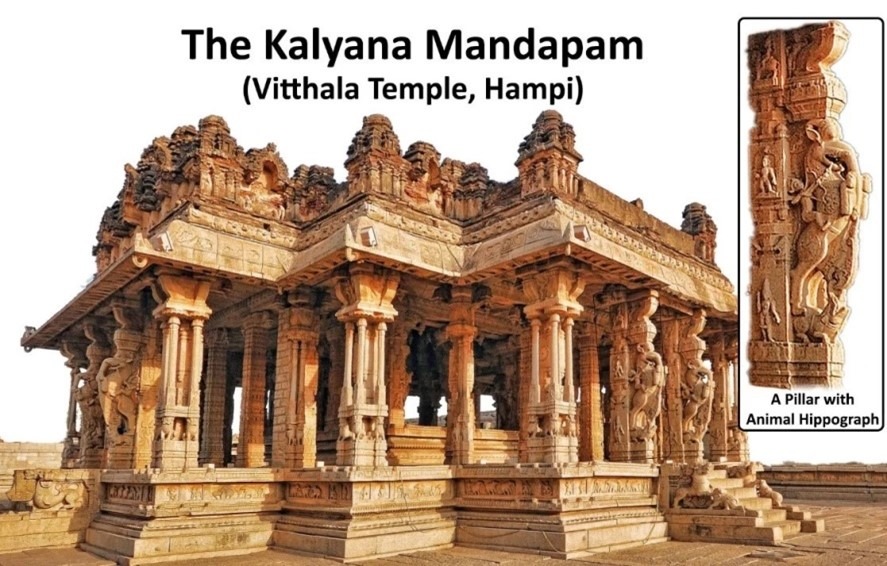
    The most striking cultural legacy of the Vijayanagar Empire lies in its temple architecture. A revival and transformation of earlier South Indian styles, Vijayanagar architecture is distinguished by its tall, ornate gopurams (gateway towers) and intricately sculpted Kalyanamandapams (marriage halls) within temple complexes.


    • Pillared Mandapams: These large open halls with hundred or even thousand pillars were used for festivals, rituals, and public gatherings. Each pillar was carved with elaborate motifs, especially horses, warriors, and deities, symbolizing the vitality of the empire.


    • Amman shrines and sub-temples were added to existing temple complexes, reflecting a deepening of religious inclusivity and worship practices.


Important temples that represent this style include:

    • Vittalaswamy Temple and Hazara Ramaswamy Temple at Hampi
    • Varadharaja Perumal and Ekamparanatha Temples at Kanchipuram
    • Raya Gopurams at Chidambaram and Thiruvannamalai
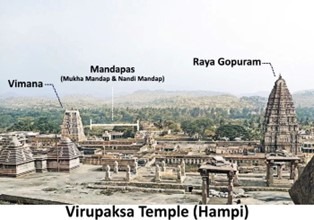


These structures reflect both religious devotion and architectural genius. The metal images of Krishna Deva Raya and his queens at Tirupati exemplify the high standards of metal casting and iconography of the time.

Music and Performing Arts

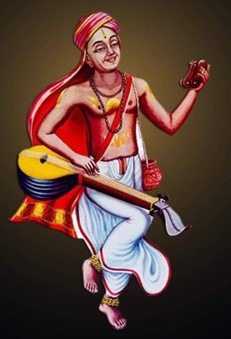
     Music and dance flourished under royal patronage. Classical music evolved, and instruments such as the veena, mridangam, and tambura were widely used. The Bhakti movement and temple rituals further nurtured devotional music.


     The famous composer Purandaradasa, known as the Father of Carnatic Music, lived during this era and laid the foundations for the structured teaching of music.
 

Literary Achievements

      The Vijayanagar period witnessed unparalleled literary activity, especially under Krishna Deva Raya, who was not only a patron but also an accomplished poet himself.


    • Languages Patronised: Sanskrit, Telugu, Tamil, and Kannada
    • Peak of Telugu Literature: The Ashtadiggajas (eight literary gems) of Krishna Deva Raya’s court, including Allasani Peddanna, Tenali Ramakrishna, and Pingali Suranna, elevated Telugu literature to new heights.

Krishna Deva Raya’s own compositions include:

    • Amuktamalyada (in Telugu), a lyrical work blending devotion and polity
    • Jambavati Kalyanam and Ushaparinayam (in Sanskrit), demonstrating his literary finesse


The cultural legacy of the Vijayanagar Empire is thus defined by an unparalleled integration of religion, art, language, and architecture, leaving behind a tradition that continued to inspire even after the empire’s decline.

Architecture of the Vijayanagar Empire

    The architecture of the Vijayanagar Empire represents a fusion of Dravidian traditions with Islamic and local influences, creating a distinctive style that left a lasting impression on South Indian temple architecture.

Structural Features

Vijayanagar architecture is characterized by:

    • Massive granite structures due to the availability of hard rock in the Deccan and the military needs of the empire.
    • Raya Gopurams, or towering gateway structures, adorned with life-sized figures of deities and mythical beings.
    • Ornate pillared mandapams, often square or rectangular in shape, used for religious and ceremonial purposes.
    • Monolithic sculptures, such as the massive Narasimha and Ganesha statues in Hampi.
    • Water structures, such as step wells and royal baths, demonstrating engineering skill.

Material and Design Innovations

    • While granite was preferred for its durability and local availability, soapstone was also used for detailed sculptures in certain regions, drawing from Hoysala and Western Chalukya
    • The secular architecture, including royal palaces and administrative buildings, shows Islamic elements such as arches, domes, and vaults, a result of cultural exchange and the employment of Persian and Turkic architects.

Architectural Heritage

Some of the finest examples of Vijayanagar architecture can be seen in:


    • Hampi: The capital city, now a UNESCO World Heritage Site, is home to dozens of temples, markets, and royal enclosures.
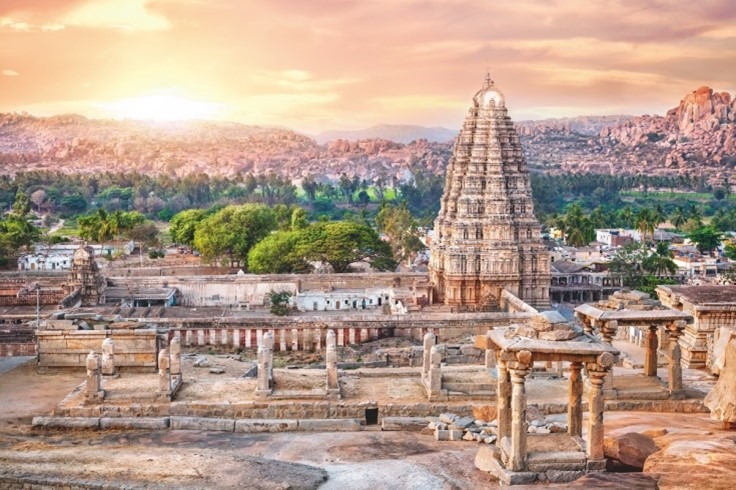


    • Chidambaram, Thiruvannamalai, and Kanchipuram: Sites where Raya gopurams were added to existing temples, amplifying their grandeur.
    • Nayak successors of Vijayanagar continued and expanded this architectural tradition in Madurai, Tanjore, and Rameswaram.


The Vijayanagar Empire stands as a monument of cultural resilience, economic prosperity, and artistic brilliance in the history of India. From the fertile fields of the Tungabhadra valley to the monumental temples of Hampi and beyond, the legacy of its economic strength, architectural innovation, and literary brilliance continues to inspire historians, artists, and travelers alike.

Conflict Between the Vijayanagar Empire and the Bahmani Sultanate

      The Vijayanagar Empire and the Bahmani Sultanate were two of the most prominent political powers in the Deccan during the late medieval period. Their relations were marked by recurring military conflicts, largely stemming from territorial ambitions and economic interests, rather than purely religious motivations, as often misrepresented.

Raichur Doab – The Epicentre of Rivalry

      At the heart of their prolonged rivalry was the Raichur Doab, the fertile and resource-rich tract of land situated between the Krishna and Tungabhadra rivers. This region, with its agricultural wealth, mineral resources, and strategic position, held immense economic and political significance for both kingdoms. Furthermore, the Golconda diamond mines, located in the eastern part of this doab, added further value to this contested territory.


     The geography of both kingdoms made expansion most feasible across the Tungabhadra River, intensifying their territorial ambitions. However, despite multiple wars fought over this region, the conflicts rarely produced decisive victories. At times, Vijayanagar emerged dominant; on other occasions, Bahmani forces gained the upper hand. Yet, neither side could achieve a lasting solution, leading to a continued state of hostility and border instability.

Other Regions of Conflict

Beyond Raichur Doab, other regions also became flashpoints of conflict:


    • Marathwada region, especially the Konkan coast, was agriculturally fertile and home to critical trading ports, including Goa—a gateway for maritime commerce.
    • The Krishna-Godavari delta, with its lush fields and access to international sea routes, was another highly prized area.


These regions were vital for controlling foreign trade, especially the import of horses from Iran and Iraq, which were crucial for the cavalry-dependent armies of both states.

Economic and Strategic Motivations

      While the confrontations between the Vijayanagar Empire and the Bahmani Sultanate have often been simplistically interpreted as Hindu-Muslim conflicts, a deeper examination reveals that the core causes were economic and territorial in nature. Control over fertile agricultural land, trade-rich coastal ports, and mineral resources was central to their struggle for regional supremacy.

Consequences of Prolonged Conflict

The frequent warfare between these two powers had several consequences:

    • It drained economic and military resources on both sides, weakening their ability to resist external threats.
    • The prolonged distraction allowed European powers, especially the Portuguese, to gain a foothold along the western coast of South India, particularly in Goa and other port towns.
    • It fostered a climate of militarisation that strained agricultural productivity and internal administration.

Instances of Cooperation and Cultural Exchange

Despite the frequent wars, there were moments of diplomatic interaction and mutual support. For instance:


    • The celebrated Vijayanagar ruler Krishna Deva Raya supported certain claimants to the Bahmani throne, even adopting the title “Establisher of the Yavana Kingdom”, referring to the Muslim-ruled territories.
    • Conversely, the Sultan of Bijapur intervened to help resolve succession disputes in Vijayanagar after Krishna Deva Raya’s death.


This dynamic also led to cultural cross-pollination. Influences from the Persian and Deccani world shaped Vijayanagar’s court culture, especially in the areas of architecture, literature, art, and music. Architectural elements such as arches and domes began to appear in secular buildings, and Persian-inspired court customs were selectively adopted.


    The conflicts between the Vijayanagar Empire and the Bahmani Sultanate were driven more by geopolitical strategy and economic competition than by religious hostility. While military rivalries were fierce and prolonged, they coexisted with periods of diplomatic cooperation and cultural exchange, reflecting the complex and interconnected political landscape of the Deccan in medieval India.

Bahamani Kingdom

    The Deccan region, once an integral part of the provincial administration of the Delhi Sultanate, witnessed a gradual shift towards autonomy in the 14th century. This transformation began under the rule of Muhammad bin Tughlaq, who appointed an officer titled Amir-i-Sada or Sada Amir to oversee stable governance in the Deccan. The Sada Amir was an administrative head responsible for overseeing one hundred villages, reflecting a structured rural administration.


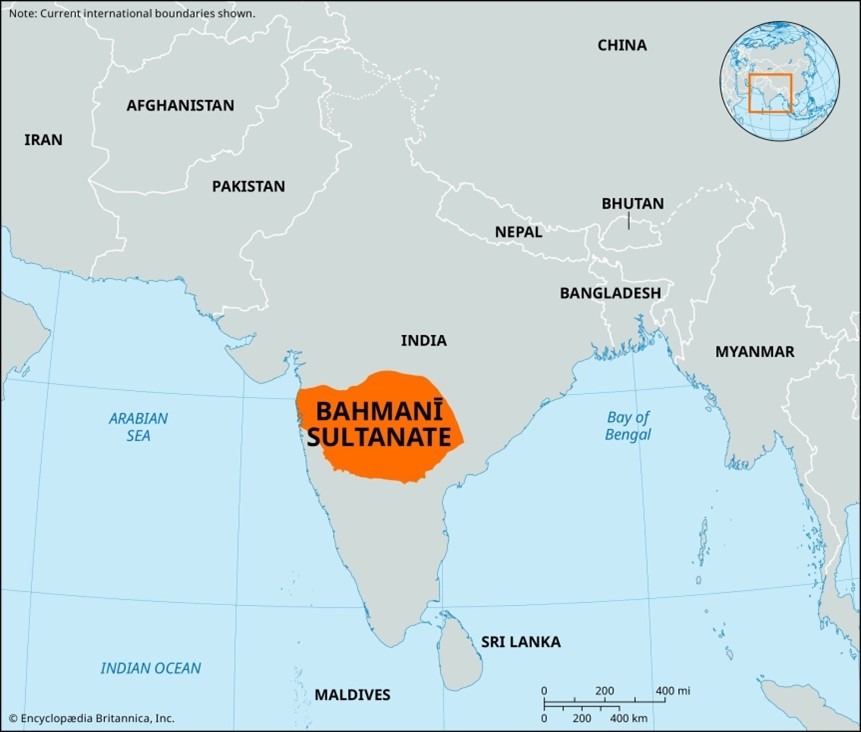
     However, starting around 1337 CE, tensions escalated between the officers of the Delhi Sultanate and the regional powers in the Deccan. This growing discontent culminated in the establishment of an independent Deccan kingdom in 1347 CE, with Gulbarga (in present-day Karnataka) as its capital. The founder of this kingdom was Haran Kangu, who assumed the royal title of Alauddin Hasan Bahman Shah, thereby laying the foundation of the Bahmani Sultanate, one of the earliest and most powerful Islamic kingdoms in the southern part of the Indian subcontinent.


The Bahmani Sultanate was divided into four major administrative divisions or provinces, known as Tarafs. These included:

    • Gulbarga (the initial capital)
    • Daulatabad
    • Bidar
    • Berar


Each Taraf was overseen by a governor (Tarafdar), who held significant autonomy and influence within his territory.
 

Key Rulers and Political Developments

Alauddin Hasan Bahman Shah (1347–1358 CE)

     As the founding monarch of the Bahmani Sultanate, Alauddin Hasan Bahman Shah was originally an Afghan adventurer and a military commander under Muhammad bin Tughlaq. He successfully led a rebellion against the weakening Delhi Sultanate and declared independence. His early reign was marked by continuous warfare with the Vijayanagar Empire and the Warangal state.


    In 1350 CE, he launched his first major campaign against Warangal, compelling its ruler, Kapaya Nayaka, to cede the fort of Kaulas. By the end of his reign, the Bahmani kingdom stretched impressively — from the Wenganga River in the north to the Krishna River in the south and from Bhongir in the east to Daulatabad in the west.

Tajuddin Firoz Shah (1397–1422 CE)

      Tajuddin Firoz Shah is widely considered one of the most remarkable rulers of the Bahmani dynasty. He expanded the kingdom into Berar by defeating Narsing Rai, the Gond Raja of Kherla, and led two victorious campaigns against Vijayanagar in 1398 and 1408 CE. However, he was ultimately defeated by Deva Raya I in 1420 CE.


      Firoz Shah was a polymath with deep knowledge of religious jurisprudence and secular sciences such as botany, geometry, and logic. A talented calligrapher and poet, he was fluent in multiple languages including Persian, Arabic, Turkish, Telugu, Kannada, and Marathi. His reign was marked by notable religious tolerance, including the inclusion of Hindus in administrative roles.

Ahmad Shah I Wali (1422–1436 CE)

      After defeating Firoz Shah in 1420 CE, his brother Ahmad Shah ascended the throne. Renowned for his association with the Sufi saint Gesu Daraz, he earned the title of ‘Wali’ (saint). He continued military campaigns to assert Bahmani control over the southeastern seaboard, and decisively defeated Warangal (1424–25 CE), annexing most of its territory.


     Ahmad Shah also shifted the capital from Gulbarga to Bidar, symbolising a new political and cultural chapter in the Sultanate’s history. His reign also included expeditions against Malwa, Gondwana, and the Konkan region.

Mahmud Gawan (1461–1481 CE) – The Great Vizier

     The Bahmani Sultanate reached the height of its power under the stewardship of Mahmud Gawan, a Persian scholar, merchant, and administrator. He came to India at the age of 42 and quickly rose through the ranks to become the Wazir (Prime Minister) under Humayun Shah. He was honored with the title ‘Malik-ul-Tujjar’ (Chief of the Merchants) and later ‘Khwaju-i-Jahan’ (Minister of the World).


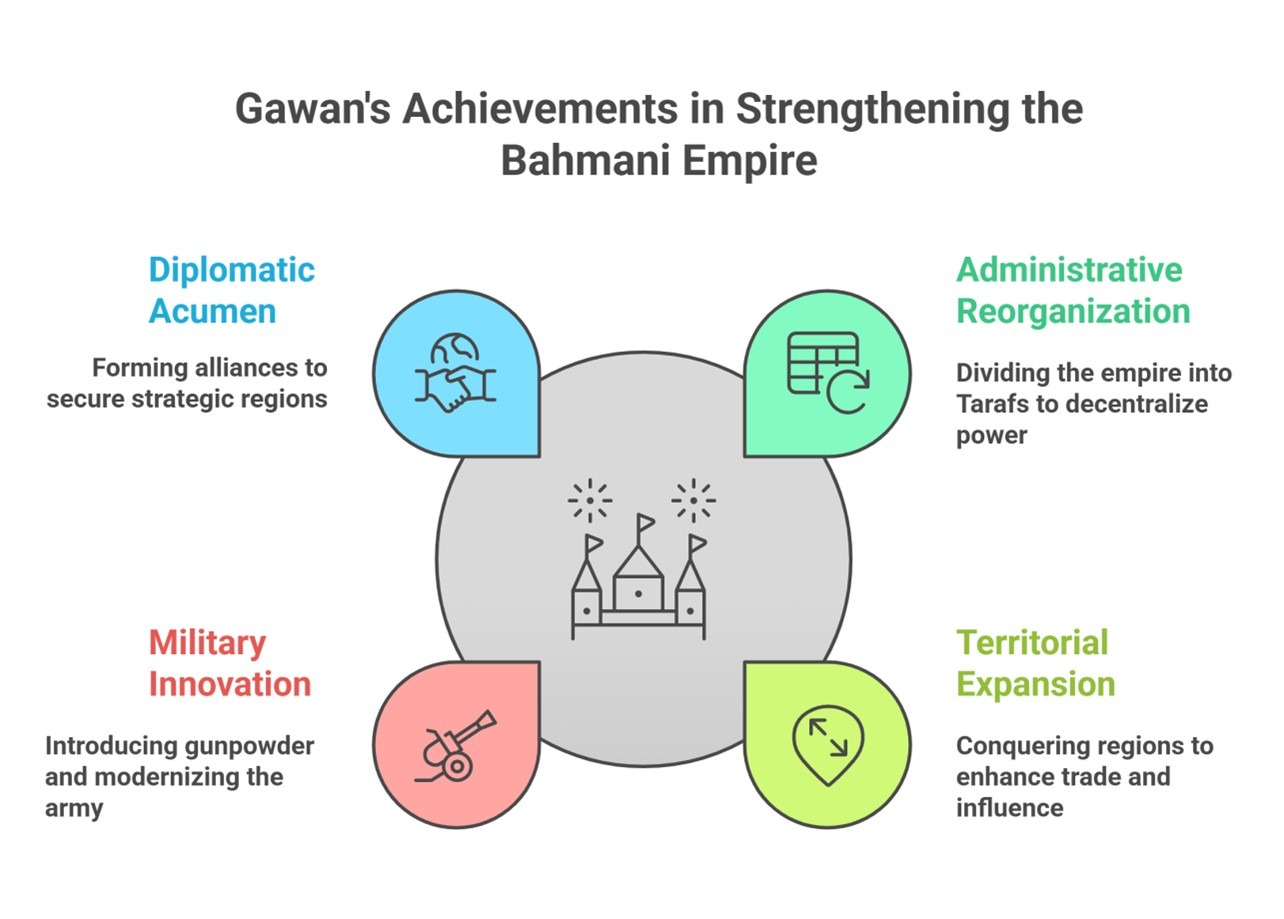
Gawan’s political and military achievements included:

    • Reorganization of administration: He divided the empire into eight Tarafs to decentralize administration while curbing the excessive powers of provincial governors. Each Tarafdar was allowed control over only one fort to prevent rebellions.
    • Territorial expansion: He conquered regions up to Kanchipuram in the south and extended Bahmani influence over Goa and Dabhol on the western coast, enhancing trade links with Iran and Iraq.
    • Military innovation: He introduced the use of gunpowder in warfare and invited Persian chemists to train the Bahmani army in its application, significantly modernizing their military capabilities.
    • Diplomatic acumen: He defeated Mahmud Khalji of Malwa with the support of the Gujarat Sultanate, thereby securing the strategic region of Berar.


Tragically, internal court politics led to his downfall. A faction of jealous Deccani nobles falsely accused Gawan of treason, resulting in his execution in 1482 CE. His death was deeply regretted by the Sultan, who later honored him with a dignified burial. Gawan remains one of the most revered figures in Deccan administrative history for his vision, reform, and statesmanship.

Legacy of the Bahmani Sultanate

    The Bahmani Sultanate played a pivotal role in shaping the political, cultural, and administrative landscape of medieval South India. It acted as a bridge between the northern Islamic traditions and southern Indian socio-cultural systems. Despite its eventual decline, the Bahmani kingdom laid the foundation for the Deccan Sultanates that emerged later, including Bijapur, Golconda, Ahmadnagar, Berar, and Bidar.


    Its architectural innovations, administrative reforms, and pluralistic society left a lasting imprint on the history of the Indian subcontinent.

Deccan Sultanates: Successor States of the Bahmani Kingdom

      Following the execution of the capable minister Mahmud Gawan in 1481, the Bahmani Sultanate began a gradual decline marked by internal discord, noble rivalries, and weakened central authority. As the kingdom disintegrated, various provincial governors and military commanders declared independence, leading to the emergence of several regional powers. Ultimately, by 1518 CE, the Bahmani Sultanate splintered into five independent states—collectively known as the Deccan Sultanates—which ruled over significant parts of the Deccan Plateau and played a crucial role in shaping South Indian politics during the 16th and 17th centuries.
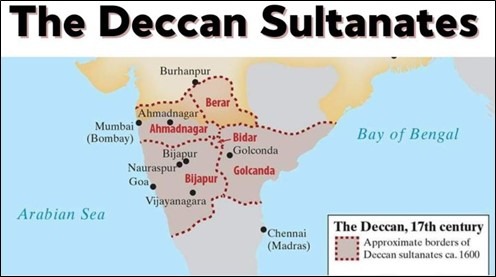
 

1. Nizam Shahis of Ahmadnagar (1490–1633 CE)

     The Nizam Shahi dynasty was founded by Malik Ahmad Bahri, a former noble of the Bahmani court, who declared independence in 1490 after decisively defeating the Bahmani forces under General Jahangir Khan. Initially, Junnar was chosen as the capital, but in 1494, Malik Ahmad laid the foundation of a new capital—Ahmadnagar.


    • In 1499, after persistent efforts, he succeeded in capturing the formidable Daulatabad Fort, which further strengthened his control.
    • The Nizam Shahis expanded their influence by annexing Berar in 1574 under Murtaza Shah.
    • Ultimately, the dynasty fell to the Mughals in 1633, when Emperor Shah Jahan annexed Ahmadnagar into the Mughal Empire after a protracted military campaign led by his son, Aurangzeb, then the Viceroy of the Deccan.

2. Adil Shahis of Bijapur (1490–1686 CE)

      The Adil Shahi dynasty was established by Yusuf Adil Shah, another former Bahmani governor who declared his independence in Bijapur in 1490. Under the Adil Shahis, Bijapur emerged as a powerful and culturally rich kingdom in southern India.

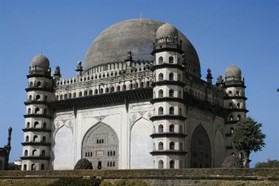
    • Muhammad Adil Shah, one of the prominent rulers, constructed the iconic Gol Gumbaz, renowned for having the world’s second-largest dome and its celebrated “whispering gallery.”


    • Ibrahim Adil Shah II, a poet and patron of the arts, composed the musical treatise “Kitab-i-Navras” in Dakhani Urdu, blending Islamic and Hindu cultural elements.
    • The Adil Shahis played a pivotal role in the Battle of Talikota (1565), forming a confederacy with the other Deccan Sultanates to defeat the Vijayanagara Empire.
    • The dynasty eventually collapsed when Aurangzeb conquered Bijapur in 1686, incorporating it into the Mughal Empire after several years of military engagement.

3. Imad Shahis of Berar (1490–1574 CE)

     The Imad Shahi dynasty was founded by Fathullah Khan Imad-ul-Mulk, the former Bahmani governor of Berar, who declared independence in 1490 and established his capital at Achalpur (Ellichpur).


    • He reinforced the military infrastructure by fortifying the important forts of Gavilgad and Narnala.
    • His successor Ala-ud-Din sought the assistance of Bahadur Shah of Gujarat to resist Ahmadnagar’s aggression.
    • Darya Imad Shah, the next ruler, attempted to forge an alliance with Bijapur but failed.
    • The dynasty came to an end in 1574 when Tufal Khan, a usurper, deposed Burhan Imad Shah, and the region was annexed by Murtaza Nizam Shah I of Ahmadnagar, marking the end of the Imad Shahi rule.

4. Qutb Shahis of Golconda (1518–1687 CE)

The Qutb Shahi dynasty was established by Sultan Quli Qutb-ul-Mulk, who declared his independence in 1518 and made Golconda his capital after building the renowned Golconda Fort.
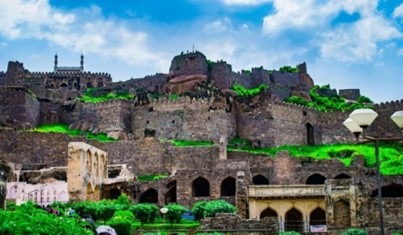


    • The most celebrated ruler of the dynasty was Muhammad Quli Qutb Shah, a visionary leader, poet, and city builder.
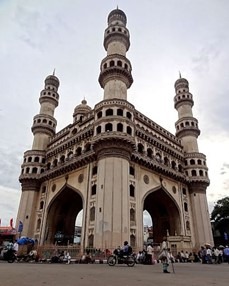
        • He founded the city of Hyderabad and constructed the Charminar, which became a lasting symbol of Indo-Islamic architecture.


        • He authored the Kulliyat-i-Muhammad Quli Qutb Shah, a collection of poetry in Dakhani Urdu, showcasing his literary prowess.
    • The Qutb Shahis were Shia Muslims of Turkmen origin, and their court culture reflected a blend of Persian and local Deccan traditions.
    • Their rule came to an end in 1687 when Aurangzeb’s Mughal forces besieged and conquered Golconda, thus integrating it into the Mughal Empire.

5. Barid Shahis of Bidar (1528–1619 CE)

The Barid Shahi dynasty was founded by Qasim Barid, who began his political career as Sar-Naubat (commander) under the Bahmani Sultanate and later rose to the position of Mir-Jumla (chief minister).


    • In 1492, sensing the decline of the Bahmani rule, Qasim Barid declared independence and established the Barid Shahi dynasty with Bidar as its capital.
    • The Barid Shahis ruled the smallest of the Deccan Sultanates and maintained a tenuous hold on power through diplomacy and military engagements.
    • The last ruler, Amir Barid Shah III, was defeated and overthrown in 1619, when Bijapur annexed Bidar, bringing the Barid Shahi rule to an end.

Legacy of the Deccan Sultanates

   The Deccan Sultanates contributed immensely to the political, architectural, literary, and cultural development of medieval South India. Their combined efforts reshaped the balance of power in the peninsula, especially after the fall of the Vijayanagara Empire. The legacy of these states endures through their monumental architecture, refined court cultures, and lasting contributions to Indo-Persian art and literature. Despite frequent conflicts among them, these sultanates fostered a unique syncretic culture that blended local Indian traditions with Persian and Central Asian influences, leaving behind a rich and enduring historical heritage.

Administration of the Bahmani Sultanate

    The administrative system of the Bahmani Sultanate was both elaborate and well-structured, drawing from earlier Delhi Sultanate traditions but adapted to Deccan needs. Initially, the kingdom was divided into four major provinces or ‘tarafs’ — namely Daulatabad, Bidar, Berar, and Gulbarga. These served as important administrative and military centres. However, under the wise and reform-oriented leadership of Mahmud Gawan, this system was refined and expanded to eight provinces, thereby improving administrative efficiency and central control.


    Each taraf was governed by a Tarafdar, who wielded considerable autonomy in civil, military, and financial matters. However, to curb the potential rise of rebellious provincial lords, Mahmud Gawan introduced regulations limiting their power. Notably, he directed that only one fort in each province could remain under the direct control of the Tarafdar, while the rest were to be garrisoned and managed by royal officers loyal to the Sultan.


      To ensure accountability and streamline governance, the salaries and obligations of the nobles and amirs were clearly defined. They were expected to maintain a fixed quota of troops, and in cases of non-compliance, they had to compensate the state treasury. Nobles were either paid in cash or granted jagirs (land assignments), the revenue from which was used to meet their administrative and military obligations.


    The Bahmani Sultanate also prioritized military preparedness and adopted advanced weaponry and training practices. The rulers actively employed Turkish and Portuguese military experts, especially in artillery and firearms, marking a significant shift in Indian warfare techniques. The central government maintained a standing army, while provincial governors were also expected to raise and command their own forces during times of conflict.

Art and Architecture of the Bahmani Sultanate

    The Bahmani period witnessed the flourishing of a distinct style of Indo-Islamic architecture that blended Persian aesthetics with local construction traditions. This unique architectural synthesis was characterized by the use of indigenous materials, elegant calligraphy, strong arches, large domes, slender minarets, and prominent crescent motifs crowning the structures.


Some of the most remarkable examples of Bahmani architecture can be found in Gulbarga and Bidar, the two successive capitals of the kingdom.

    • At Gulbarga, the earliest capital, monumental structures such as the Jama Masjid, Haft Gumbaz (Seven Domes), and Shah Bazaar Mosque reflect the grandeur of early Bahmani ambitions.
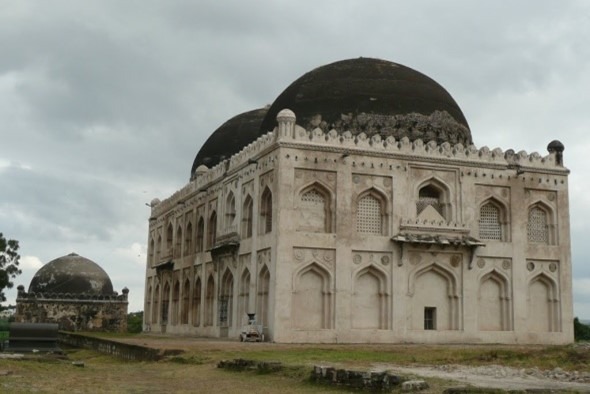
    •  


Haft Gumbaz (Seven Domes)

Shah Bazaar Mosque

    • Bidar, which rose to prominence under Ahmad Shah I, became a hub of artistic innovation. The city is home to the famed Mahmud Gawan Madrasa, a center of Islamic learning and Persianate scholarship, notable for its Persian tiles and impressive minarets. Other architectural gems include the Sola Khamba Mosque, Rangeen Mahal, Jannat Mahal, and Tarkash Mahal.


Literature also flourished during this period, particularly in Persian, Arabic, and the evolving Dakani Urdu dialect. Mahmud Gawan, a Persian himself, was a distinguished scholar and poet who authored works like Riyaz-ul-Insha and Manazir-ul-Insha. Meanwhile, Khwaja Bande Nawaz Gesu Daraz, the revered Sufi saint of Gulbarga, contributed significantly to the development of Dakani prose, laying the groundwork for the future evolution of Urdu literature in the Deccan.


    The Bahmani rulers also supported scholars, poets, and theologians from across the Islamic world, transforming their courts into centers of intellectual exchange and cultural fusion.


      The Bahmani Sultanate, which ruled large parts of the Deccan for nearly 180 years, left an indelible mark on the political, cultural, and architectural landscape of South India. It emerged in 1347 as a challenge to the Delhi Sultanate’s weakening control over the Deccan, and under rulers like Alauddin Hasan Bahman Shah, Firuz Shah Bahmani, Ahmad Shah Wali, and especially Mahmud Gawan, it achieved significant territorial expansion and cultural consolidation.


   Despite its accomplishments, the Bahmani kingdom was plagued by factional conflicts, especially between Deccani nobles (local Muslim elites) and Afaqis (foreign-born nobles), which weakened its internal cohesion. The unjust execution of Mahmud Gawan in 1481, who had tried to suppress these divisions, accelerated the decline of central authority.


     By the late 15th century, the kingdom began to fragment into five independent Deccan Sultanates: Bijapur, Ahmadnagar, Berar, Bidar, and Golconda. Though politically independent, these states continued to rival one another and often found unity only in opposition to the Hindu kingdom of Vijayanagar.


       This rare unity was displayed in 1565 at the Battle of Talikota, when four of the five Deccan Sultanates (except Berar) formed a confederacy and decisively defeated the powerful Vijayanagar Empire, leading to the sacking of its capital. This event marked a watershed in South Indian history and demonstrated the lingering strategic importance of the Bahmani legacy.


In the decades that followed:

    • Berar was annexed by Ahmadnagar in 1574,
    • Bidar was absorbed by Bijapur between 1618–1619,
    • The Mughals under Akbar and Shah Jahan gradually conquered Ahmednagar,
    • And finally, Aurangzeb annexed Bijapur and Golconda in the late 17th century, completing the Mughal conquest of the Deccan.


Despite its fall, the Bahmani Sultanate’s contribution to Deccan polity, culture, architecture, and literature remained significant, laying the foundation for the uniquely syncretic and cosmopolitan character of the region for centuries to come.

Bahmani Officials

Officer

Role

Vakil-us-Sultana

Equivalent to Naib Sultan of the Delhi Sultanate (Deputy to the Sultan)

Peshwa

Assistant or subordinate to the Vakil

Wazir-i-Kul

Prime Minister; Supervised all other ministries

Amir-i-Jumla

Head of the Finance Department

Wazir

Deputy Chief of the Finance Department

Wazir Ashraf

Head of Foreign Affairs and the Royal Court

Sadr-i-Jahan

Head of the Judiciary and Charitable Endowments

Kotwal

Head of Police; Responsible for law and order in towns

Tarafdar

Provincial Governor