The Revolt of 1857
The Revolt of 1857, often referred to as the First War of Indian Independence, began as a mutiny by the sepoys (Indian soldiers employed in the British East India Company’s army) but soon escalated into a widespread rebellion. It engulfed vast regions of northern and central India and involved various segments of society including peasants, artisans, rulers, religious leaders, and ordinary citizens. For more than a year, millions rose against British rule, posing the most formidable threat to the East India Company’s authority in India.
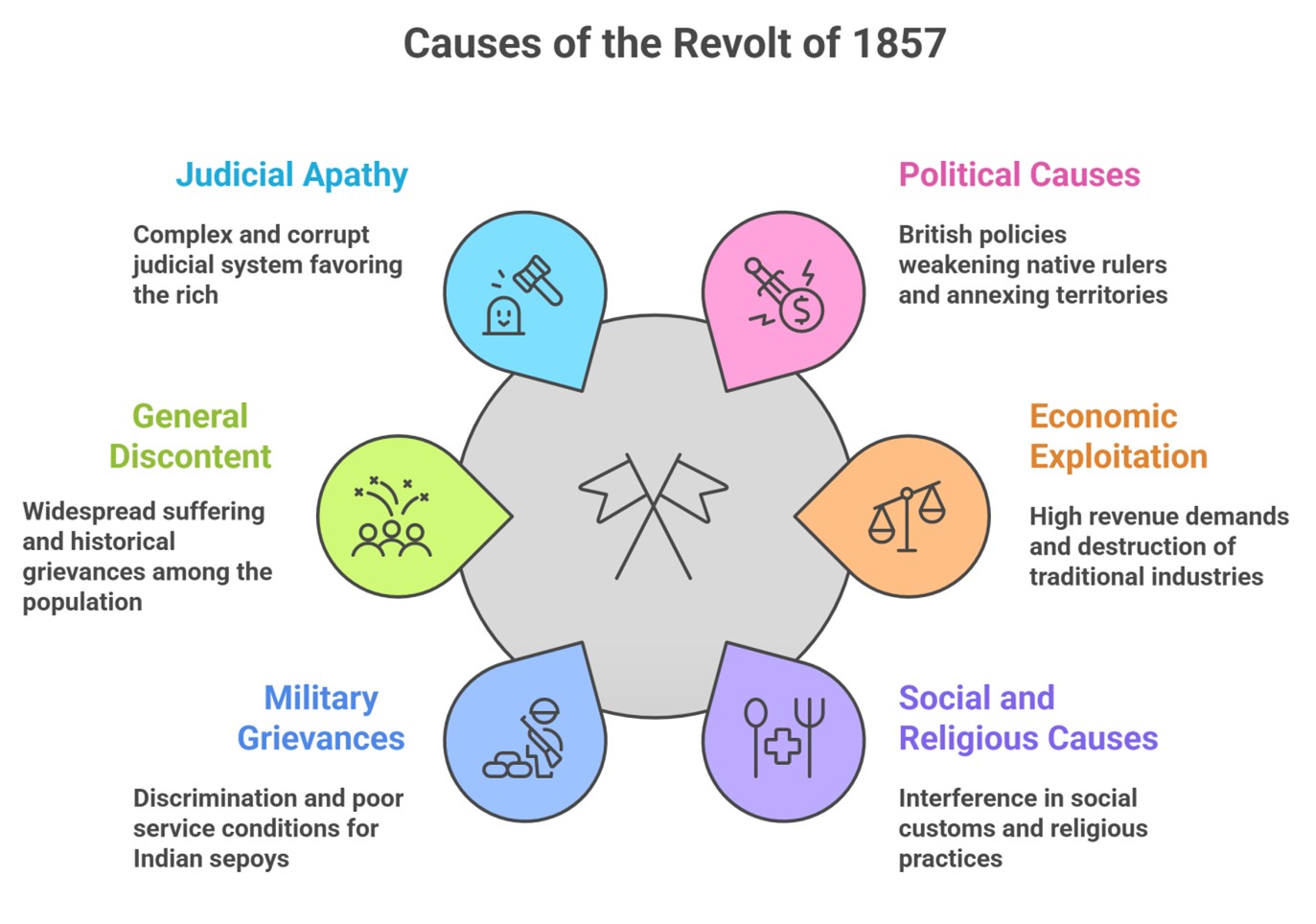
While the sepoy mutiny served as the immediate trigger, the revolt had much deeper socio-economic and political roots. The uprising was a culmination of decades of resentment and discontent brewed by British policies that undermined traditional institutions, disrupted the agrarian economy, eroded the power of local rulers, and interfered with social and religious customs. Over a century of British expansion and exploitation had alienated almost every section of Indian society.
Major Causes of the Revolt
1. Political and Administrative Causes
Displacement of Native Rulers: Since the mid-18th century, the British used various policies to systematically weaken and annex native princely states. Rulers were reduced to titular heads, their forces disbanded, and territories annexed through direct conquest or the infamous Doctrine of Lapse.
- Doctrine of Lapse: Introduced by Lord Dalhousie, this policy denied adopted heirs the right to inherit princely states. This led to widespread resentment among ruling families.
- Nana Saheb (adopted son of Baji Rao II) was denied the pension of his father, causing deep dissatisfaction.
- Rani Lakshmibai of Jhansi was denied her adopted son’s right to succession and her kingdom was annexed.
- Awadh (Oudh) was annexed under the pretext of misrule, despite its loyalty to the Company. The deposition of Nawab Wajid Ali Shah created anger among the nobility and the masses.
- Mughal Emperor Bahadur Shah Zafar was informed in 1856 that he would be the last emperor and his descendants would no longer live in the Red Fort, further provoking Delhi’s elite.
2. Economic Exploitation
- Land Revenue System: High revenue demands, rigid collection procedures, and land alienation impoverished the peasantry. In Awadh, the confiscation of taluqdari estates alienated powerful landholders.
- Destruction of Traditional Economy: Indian handicrafts and industries suffered due to the British policy of one-way free trade. Artisans lost their traditional patronage as Indian rulers were dethroned, and British goods flooded Indian markets.
- Peasant and Zamindar Alienation: The Permanent Settlement and Ryotwari system made peasants vulnerable to dispossession. Many lost their land to moneylenders due to inability to pay taxes.
3. Social and Religious Causes
- Interference in Social Customs: The British introduced reforms such as the abolition of sati (1829), widow remarriage, and the promotion of Western education. Though progressive, they were seen as a threat to traditional practices.
- Christian Missionary Activities: The aggressive missionary efforts and legal provisions such as the 1850 law allowing converted Christians to inherit ancestral property created fear of religious conversion.
- General Service Enlistment Act (1856): Made overseas service compulsory for new recruits. Crossing the sea (Kala Pani) was believed to cause loss of caste, deeply offending Hindu religious sentiments.
4. Military Grievances
- Discrimination and Poor Service Conditions: Indian sepoys faced racial discrimination in terms of pay, promotions, and treatment. They were paid less than British soldiers and barred from rising beyond the rank of subedar.
- Reduction in Batta (Foreign Service Allowance): Sepoys deployed in Sindh and Punjab were denied allowances, aggravating resentment.
- Religious Interference: Caste-based practices like wearing turbans and sectarian marks were restricted. Military regulations disregarded religious sensitivities.
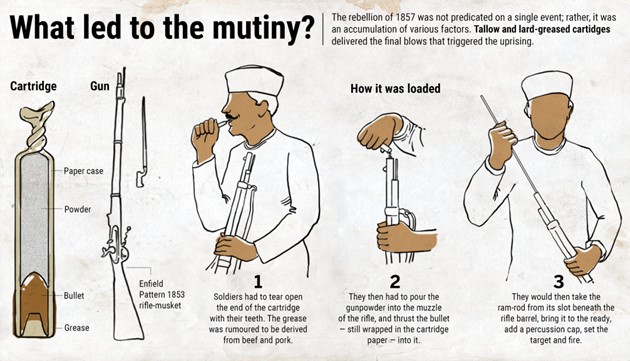
- Greased Cartridge Controversy: The final spark was the introduction of the new Enfield rifle cartridges rumored to be greased with cow and pig fat. This deeply offended both Hindus and Muslims and confirmed their worst fears of forced conversion.
5. General Discontent and Historical Grievances
- Sepoys were drawn from peasant backgrounds and shared in the wider population’s suffering. This made the sepoy anger reflective of general societal unrest.
- Prior Mutinies indicated a long-standing pattern of military disaffection:
- 1764: Early sepoy mutiny in Bengal.
- 1806: Vellore Mutiny against religious interference (e.g., leather cockades, ban on traditional dress).
- 1824: 47th Regiment at Barrackpore refused to travel to Burma by sea and was brutally punished.
- 1844: Revolts over salary and batta in seven battalions.
6. Judicial and Administrative Apathy
- The judicial system was complex and tilted in favor of the rich. Corruption was rampant at the lower levels of administration.
- The introduction of British laws eroded traditional village and community-based dispute resolution systems.
Foreign Nature of the British Rule
The British rule in India was characterized by its distinctly foreign and alien nature. Unlike earlier Indian dynasties, which often integrated themselves into local societies, the British rulers remained distant and aloof. They never made any genuine attempts to assimilate into Indian culture or society. Socially, they isolated themselves even from the upper strata of Indian society, maintaining an air of racial superiority. Their behavior was often marked by arrogance and contempt towards Indians, which bred deep resentment among the native population.
This continued aloofness and contempt reinforced the growing belief among Indians that British rule was inherently alien and oppressive. The alien nature of the regime bred widespread suspicion and mistrust. Over time, a simmering sense of anti-British sentiment grew stronger, periodically finding expression in regional and localized uprisings long before the major Revolt of 1857 erupted.
Annexation of Awadh:
The annexation of Awadh stands out as one of the most resented acts of British imperialism. Initially brought under British influence in 1801 through the imposition of the Subsidiary Alliance, the Nawab of Awadh was compelled to dismantle his military forces, station British troops within his territory, and operate under the guidance of the British Resident. This erosion of sovereignty left the Nawab powerless and increasingly dependent on the British for maintaining order.
In 1856, Governor-General Lord Dalhousie formally annexed Awadh on the pretext of maladministration. Nawab Wajid Ali Shah was dethroned and exiled to Calcutta. Contrary to British assumptions that he was unpopular, the Nawab was deeply loved by his people. His departure from Lucknow was mourned by masses who accompanied him, singing elegies that symbolized their sorrow.
The annexation dismantled the Awadh court’s rich cultural and administrative fabric, leaving thousands—musicians, poets, dancers, artisans, court officials, and retainers—unemployed. The sudden disintegration of their socio-economic world fostered a climate of bitterness and betrayal.
Network of Grievances in Awadh: Princes, Taluqdars, Peasants, and Sepoys
The revolt in Awadh in 1857 was intense and enduring, primarily because multiple social groups felt the sting of British policies. The Nawab’s removal deeply unsettled the royal court, while taluqdars (landed aristocrats) found their estates seized. These taluqdars, who had long commanded local loyalty and wielded considerable autonomy under the Nawabi regime, were disarmed and their forts razed following the annexation. The British implemented a Summary Settlement that labeled them as mere usurpers of land, reducing their control over villages from 67% to 38%.
Peasants, previously under the patronage of the taluqdars, were now directly subjected to the harsh demands of British tax officials. They were exposed to inflated revenue assessments and rigid collection practices without the customary leniency provided by the taluqdars during hard times. The social bond that had loosely connected landlords and tenants collapsed under the impersonal colonial system.
Meanwhile, sepoys from Awadh and nearby regions where the bulk of the Bengal Army was recruited—were especially angered. Many of them saw the annexation as a personal affront, not only because of the political insult to their homeland but also due to increased taxation on their family lands. Though they had aided the British in subduing other parts of India, they were now disillusioned and resentful about the occupation of their home territory.
Fear among Other Rulers
The annexation of Awadh, along with other aggressive acts under Dalhousie’s Doctrine of Lapse, sent waves of fear across princely states. Even rulers known for their loyalty to the British were not spared. It became clear that no amount of submission could ensure survival, as the British were driven by a relentless appetite for territorial expansion.
Immediate Cause: Greased Cartridges and Religious Sentiment
The immediate spark that ignited the Revolt of 1857 was the introduction of the new Enfield rifle, which required sepoys to bite off greased cartridges allegedly coated with cow and pig fat. This incited widespread outrage among both Hindu and Muslim soldiers, as it violated their religious beliefs. The refusal to use these cartridges led to disciplinary action, fueling mutiny.
Simultaneously, rumors emerged that cow and pig bone dust was being mixed into flour (atta), furthering fears of a deliberate plan to defile Indian religions and force conversions to Christianity. In the volatile atmosphere of rising discontent, these rumors were seen not just as plausible, but as proof of a broader colonial conspiracy.
Why Rumors Resonated So Strongly
Rumors gain traction when they align with people’s anxieties. From the 1820s onwards, the British undertook a series of reforms that included banning sati, permitting widow remarriage, introducing English education, and replacing Indian customs with European laws. Christian missionaries openly criticized Hinduism and Islam, seeking converts.
To the average Indian, this translated into a systematic dismantling of their world. Their kings were dethroned, their customs undermined, their sacred laws replaced. In such a climate of fear and loss, rumors and prophecies gained extraordinary credibility and became instruments of mass mobilization.
Role of Prophecies in the Revolt
Religious leaders and astrologers predicted the fall of British rule. One notable prophecy suggested that British rule would end exactly 100 years after the Battle of Plassey, on 23 June 1857. Leaders like Ahmadullah Shah, a maulvi from Faizabad, echoed such messages, reinforcing public conviction that a change was imminent.
Why Sepoys Revolted Despite Prestigious Employment
In a time when a government job ensured social respect and stability, sepoys chose rebellion. This underlines the depth of their anger. Despite decent pay, religion and caste norms took precedence over economic gain. After returning from campaigns like the Second Afghan War, many sepoys found themselves outcast by their communities for violating religious taboos. This ostracization added another layer of humiliation.
Newfound Confidence in Defeating British Rule
Popular confidence in overthrowing the British stemmed from a series of British military failures in the preceding decades:
1. The First Anglo-Afghan War (1838–42) ended disastrously for the British.
2. The Punjab Wars (1845–49) exposed British vulnerability against Sikh forces.
3. The Crimean War (1854–56) weakened British prestige.
4. The Santhal Rebellion (1855–56) showed that even poorly armed tribes could temporarily defeat colonial forces.
Though Britain eventually prevailed in all these conflicts, the initial setbacks created a perception that the colonial power was not invincible. This emboldened both sepoys and civilians to believe that armed resistance could succeed. However, in retrospect, the rebels miscalculated British strength and organization—an error that proved costly.
Legitimacy to the Revolt
That same night, the sepoys marched towards Delhi, reaching the capital in the early hours of 11 May. As word of the revolt spread, sepoys in Delhi also joined the insurrection. British officers were attacked, arms and ammunition were seized, and government buildings were torched.
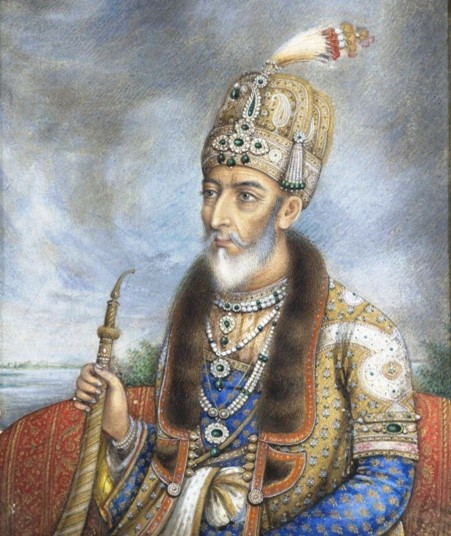
At the Red Fort, the rebels gathered around the aged Mughal emperor Bahadur Shah Zafar and urged him to lead the uprising. Initially reluctant, the emperor eventually yielded to their pressure. His symbolic endorsement gave the revolt a sense of legitimacy, transforming it from a military mutiny into a broader national rebellion. The rebels proclaimed him “Shahenshah-e-Hindustan” (Emperor of India).
Sepoys from various parts of India turned toward Delhi, seeking leadership and unity under the Mughal banner. Rulers of many princely states and feudal lords, who saw British expansion as a threat to their power, rallied behind the Mughal emperor in the hope of restoring their own authority.
Definitions:
- Mutiny: Collective disobedience within the armed forces.
- Revolt: A mass uprising by people against established authority.
- In this context, mutiny refers to the actions of sepoys, while revolt indicates the broader civilian participation.
Major Storm Centres
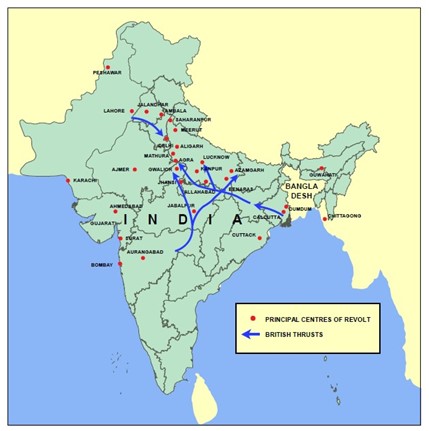
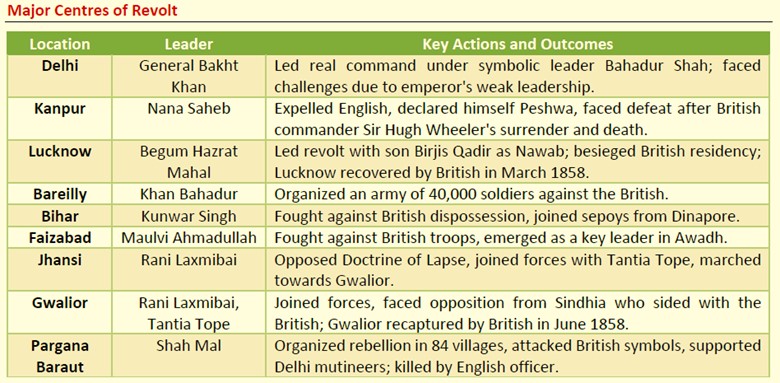
1. Delhi: Bahadur Shah Zafar was the symbolic head, but real power rested with the Court of Soldiers, led by General Bakht Khan, who brought rebel troops from Bareilly. Even after Delhi’s recapture in September 1857, Bakht Khan continued resistance from Lucknow until his death in May 1859.
2. Kanpur: Nana Sahib, adopted son of Baji Rao II, led the revolt. He declared himself Peshwa and acknowledged Bahadur Shah as Emperor. He was assisted by:
- Tantia Tope: His military commander who led fierce battles.
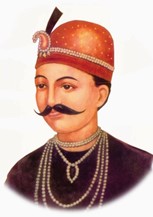
- Azimullah Khan: Political adviser and strategist.
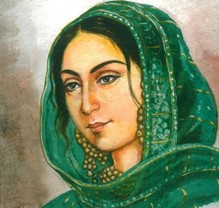
3. Lucknow: Begum Hazrat Mahal led the revolt and declared her son, Birjis Qadir, Nawab of Awadh. With support from sepoys and local zamindars, she mounted a major resistance.
4. Jhansi: Rani Lakshmibai became the face of resistance in Jhansi. Along with Tantia Tope, she captured Gwalior. Despite the Maharaja of Gwalior’s loyalty to the British, his forces joined the Rani. She died in battle in June 1858.
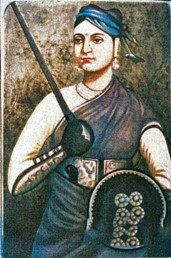
5. Madhya Pradesh: Rani Avantibai Lodhi of Ramgarh led an army of 4,000 against the British. When surrounded on 20 March 1858, she chose death over capture.
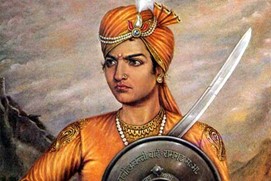
6. Bareilly: Khan Bahadur Khan, descendant of Hafiz Rahmat Khan, led the revolt, formed a government, and resisted the British.
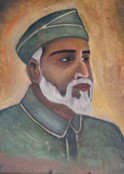
7. Bihar: Kunwar Singh, an elderly zamindar from Jagdishpur, emerged as one of the most capable military leaders. Despite his age, he led campaigns in Bihar, Awadh, and Central India. He died of wounds in April 1858.
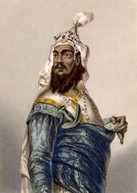
Local Leaders and Popular Resistance
- Ahmadullah Shah: A maulvi from Faizabad, preached jihad and fought in the Battle of Chinhat, where British forces under Henry Lawrence were defeated by Barkat Ahmad.
- Shah Mal: A peasant leader from Baraut (Meerut), led 84 villages in rebellion. He disrupted British communications and established a local justice system.
Repression and Aftermath
The British, shocked by the scale of the uprising, brought reinforcements from England and enacted repressive laws. Their counterattack began with the recapture of Delhi on 20 September 1857. Bahadur Shah was captured, tried, and exiled to Rangoon, where he died in 1862. The Mughal dynasty was extinguished.
Though Delhi fell, the rebellion continued in various regions for two more years. Major leaders were defeated one by one:
- Rani Lakshmibai: Killed in June 1858.
- Kunwar Singh: Died of battle wounds in April 1858.
- Tantia Tope: Fought guerrilla warfare before being captured and hanged in April 1859.
- Begum Hazrat Mahal: Fled to Nepal.
- Nana Sahib: Escaped to Nepal after defeat.
British Strategy to Break Unity
To undermine resistance, the British offered rewards to loyal landowners. Many taluqdars of Awadh were promised restoration of their estates if they submitted. This strategy fragmented the united front of peasants and landlords.
Key British Military Commanders
- John Lawrence
- Sir James Outram
- John Nicholson
- Sir Henry Havelock
- Neil
- Sir Colin Campbell
- Sir Hugh Rose
Battle Events:
- Kanpur: Sir Hugh Wheeler surrendered on 27 June 1857. Colin Campbell defeated Tantia Tope in December 1857.
- Lucknow: Henry Lawrence died during the siege. Colin Campbell recaptured the city in March 1858.
- Jhansi: Hugh Rose besieged Jhansi in March 1858. Rani Lakshmibai fled to Gwalior, where she joined Rao Sahib and Tantia Tope.
The Revolt of 1857, though ultimately unsuccessful, remains a landmark in Indian history. It marked the first major attempt to overthrow colonial rule and inspired future generations of freedom fighters.
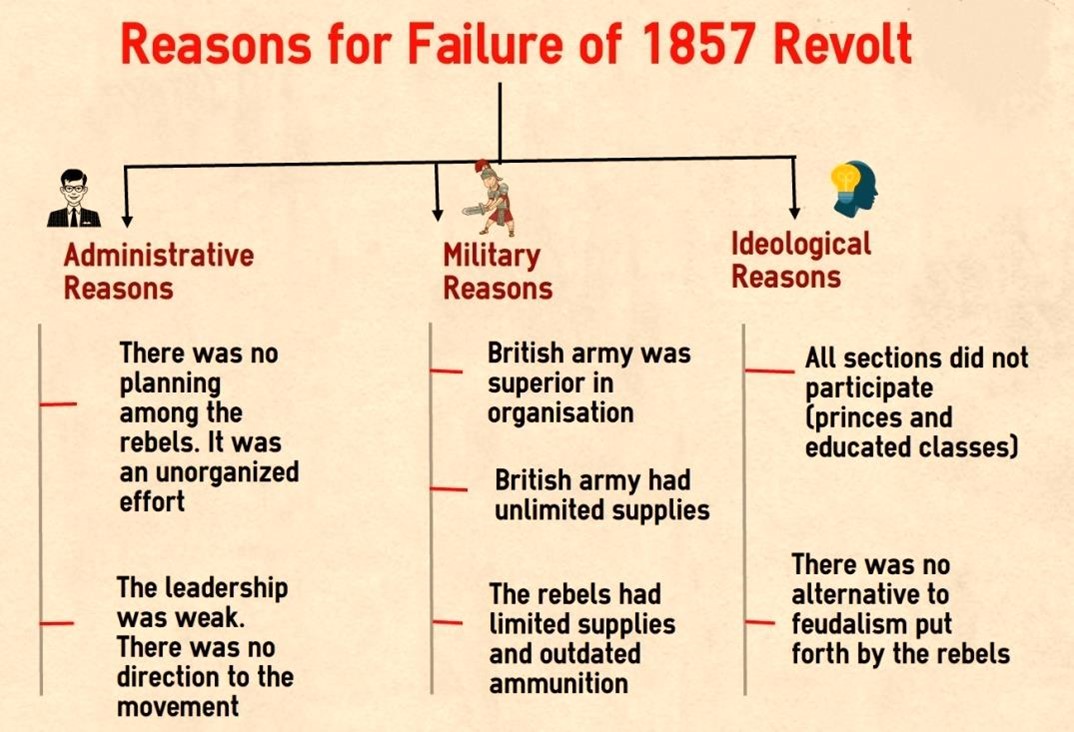
Reasons for the Failure of the Revolt of 1857
Disunity among Indians
One of the primary reasons for the failure of the Revolt of 1857 was the absence of unity across the vast and diverse sections of Indian society. The uprising did not encompass the entire Indian subcontinent, nor did it receive support from all classes and groups. Many regional rulers, large zamindars, wealthy merchants, influential moneylenders, the educated elite (intelligentsia), and sections of the middle and upper classes chose to remain neutral or even sided with the British. It is notable that nearly half of the Indian soldiers continued to fight on behalf of the British, further weakening the prospects of the rebellion.
Rulers of Regional States
Most regional rulers, apprehensive about British power, refrained from supporting the rebellion. In fact, less than one percent of Indian princely chiefs took part in the revolt. Key figures such as the Sindhia of Gwalior, the Holkar of Indore, the Nizam of Hyderabad, the Nawab of Bhopal, the Maharaja of Kashmir, the Ranas of Nepal, and numerous other ruling elites actively supported the British. Their aid was instrumental in suppressing the rebellion. Had these rulers extended their military and logistical support to the sepoys, the rebels could have mounted a more formidable resistance. Later, Lord Canning acknowledged that these rulers acted as “breakwaters to the storm” that could have engulfed British rule entirely.
Taluqdars
Even the taluqdars of Awadh, many of whom had initially joined the rebellion due to grievances against British land policies, deserted the cause when the government promised to restore their estates. This withdrawal of support made it nearly impossible for the peasants and rebel soldiers of Awadh to continue a sustained guerrilla resistance.
Moneylenders and Big Merchants
The rebellion saw widespread attacks on moneylenders, who were often perceived by villagers as symbols of exploitation. Consequently, these groups naturally opposed the uprising. Similarly, big merchants in metropolitan centers like Bombay, Calcutta, and Madras supported the British. Their economic prosperity was intertwined with colonial trade policies and connections with British commercial enterprises.
Educated Indians
Educated Indians, including many members of the intelligentsia, did not rally behind the revolt. They were alienated by the rebels’ appeals to superstition and their opposition to progressive social reforms such as the abolition of sati and widow remarriage. Many among the educated elite mistakenly believed that British rule could modernize India and uplift its backward social structure. However, this outlook changed in the following decades, when it became evident that foreign rule was more exploitative than reformative, prompting the rise of a robust national movement.
Inevitability of Disunity
In the mid-19th century, the idea of Indian nationalism was still in its infancy. Patriotism during this period was limited to loyalty towards one’s locality, caste, region, or princely state. A pan-Indian consciousness had not yet developed, which made disunity inevitable. The concept of a collective Indian identity transcending caste, religion, and region emerged only in the later decades of anti-colonial struggle.
Weak Leadership of Bahadur Shah Zafar
The leadership at the epicenter of the revolt—Delhi—was severely hampered by the frailty and indecisiveness of Bahadur Shah Zafar. Several factors contributed to his weak leadership:
- He was uncertain about the intentions and loyalty of the sepoys and doubted his own role as a leader.
- Torn between asserting imperial leadership and ensuring his personal safety, he vacillated between action and inaction.
- His influence was undermined by internal palace politics, especially by Queen Zeenat Mahal and his sons, who engaged in intrigues with the British.
- His old age, physical frailty, and lack of dynamic leadership qualities further hindered effective coordination.
Poor Organisation and Planning
The revolt lacked centralized planning and coordination. There was no common blueprint or authoritative leadership across regions. Each center of revolt functioned independently, with no synchronised movement. The absence of unified command severely curtailed the chances of success.
Lack of a Forward-Looking Programme
Although the rebels were united by their opposition to British rule, they had no clear vision of what kind of political order they wanted to establish after ousting the British. This ideological vacuum allowed feudal princes and zamindars to take control in many areas. These elements, having failed to protect their independence previously, were unlikely to lay the foundation for a new, progressive Indian state.
Weak Leadership in General
Apart from notable figures like Rani Lakshmibai, Kunwar Singh, and Maulvi Ahmadullah Shah, most rebel leaders failed to appreciate the historical importance of the revolt. Many displayed hesitation and lacked strategic foresight, which contributed to the collapse of the movement.
Inadequate Military Capability
The rebel forces were poorly equipped in comparison to the British. They lacked modern weaponry, trained military personnel, ammunition supplies, and effective logistics. Most rebels relied on outdated arms such as swords, spears, and pikes, while the British possessed superior rifles, artillery, and naval support.