
THE MAURYAN EMPIRE
The Mauryan Empire was one of the most powerful and geographically vast empires in ancient Indian history. It flourished during the Iron Age and was ruled by the Mauryan dynasty from 321 BCE to 185 BCE.
Originating from the kingdom of Magadha, located in the fertile Indo-Gangetic plains—which includes parts of present-day Bihar, eastern Uttar Pradesh, and Bengal—the Mauryan Empire quickly expanded to encompass much of the Indian subcontinent.
The administrative and political centre of the empire was the grand city of Pataliputra (modern-day Patna), which served as its capital. Under the leadership of Emperor Ashoka, the Mauryan Empire reached its greatest extent and influence, becoming the largest empire ever to exist on the Indian subcontinent.
Ashoka’s reign marked the zenith of Mauryan power, known not only for territorial expansion but also for the promotion of Buddhism, administrative reforms, and a commitment to non-violence and moral governance.
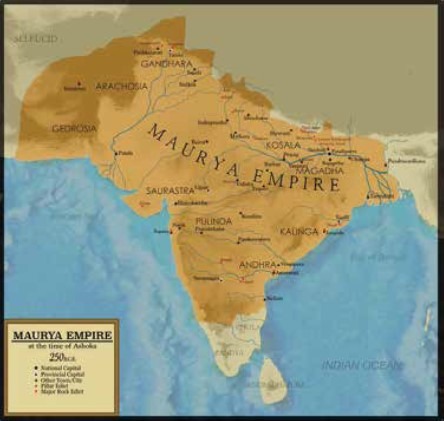
Sources of the Mauryan Empire: Literary and Archaeological
The Mauryan Empire, one of the most powerful and centrally governed empires in ancient Indian history, is known to us through a rich array of literary texts and archaeological sources. These sources offer comprehensive insights into the political, economic, military, administrative, and social dimensions of the Mauryan period. Among them, the works of Kautilya, Megasthenes, and Visakadatta hold immense historical value. Additionally, Ashokan inscriptions, Buddhist chronicles, and Jain texts serve as critical evidence for reconstructing the history of this vast empire.
1. Kautilya’s Arthashastra
One of the most celebrated texts from ancient India, the Arthashastra is a Sanskrit treatise attributed to Kautilya (also known as Chanakya or Vishnugupta), the chief advisor and strategist of Chandragupta Maurya, the founder of the Mauryan Empire. The Arthashastra is not only a cornerstone of Indian political thought but also a comprehensive manual on governance, statecraft, military strategy, and economics.
The text covers a wide range of topics vital to state administration, including:
- Duties and responsibilities of a king and his ministers
- Law, justice, civil and criminal procedures
- Taxation, trade, commerce, and market regulation
- Espionage, diplomacy, and warfare
- Administration of provinces, fortifications, and military organisation
- Ethical and practical governance strategies
Structure:
- The Arthashastra is divided into 15 books (Adhikaranas) and 180 chapters, broadly categorised into three sections:
- Internal administration and governance
- Civil and criminal law
- Foreign policy and military strategies
Social insights:
- The text sheds light on the status of slaves, stating that individuals could become slaves due to war or indebtedness. However, in a progressive note for its time, it mentions that a female slave who bore a child with her master would be freed, and the child would be legally recognised as the master’s son, enjoying inheritance rights.
Rediscovery:
- Though ancient sources referred to the Arthashastra, no manuscript was found until 1905, when a palm-leaf manuscript was donated to a library in Thanjavur (Tamil Nadu). The eminent scholar R. Shamasastry, then librarian at the Oriental Research Institute, Mysore, identified and published the text, revealing it to be the long-lost Arthashastra of Kautilya. Some scholars argue that the existing version may have been compiled over several centuries.
2. Megasthenes’ Indica

The Indica, authored by Megasthenes, the Greek ambassador sent by Seleucus I Nicator to the court of Chandragupta Maurya, serves as a valuable foreign account of the Mauryan Empire. Though the original manuscript has been lost, fragments survive in the works of later classical authors such as Diodorus Siculus, Strabo, Pliny the Elder, and Arrian.
Content:
- The Indica provides a vivid description of the capital city of Pataliputra, the military strength, and the administrative machinery of the empire. It also gives glimpses of contemporary social practices, the caste system, economy, and daily life.
Caution in interpretation:
- Despite its importance, Indica must be read critically, as many of the preserved fragments contain inconsistencies, exaggerations, and mythological elements. The classical authors often misunderstood Indian customs or added their own interpretations.
Compilation:
- In 1846, German scholar E.A. Schwanbeck compiled surviving fragments from various classical sources. This compilation was later translated into English by J.W. McCrindle in 1877, under the title “Ancient India as Described by Megasthenes and Arrian.”
3. Visakadatta’s Mudrarakshasa

Another important literary source is Mudrarakshasa, a political drama written by Visakadatta during the Gupta period, although it narrates events from the earlier Mauryan era.
- Plot: The drama revolves around the overthrow of the Nanda dynasty by Chandragupta Maurya, with the strategic guidance of Chanakya. It narrates the political intrigues and clever diplomacy that led to the Mauryan conquest.
- While being a dramatic work, Mudrarakshasa is invaluable for understanding the socio-economic conditions and political environment during the establishment of the Mauryan Empire.
Chandragupta Maurya (321–297 BCE)
Chandragupta Maurya was the illustrious founder of the Mauryan Empire, the first historically recorded empire that unified large parts of the Indian subcontinent under a single centralised administration. His reign marks the beginning of a new political era in Indian history, characterised by expansive territorial conquests, administrative reforms, and the emergence of a powerful centralised state.

Early Life and Rise to Power
Although details about his early life remain uncertain, Chandragupta is believed to have been born in Pataliputra (modern-day Patna). Orphaned or abandoned at a young age, he was raised among forest-dwellers, herdsmen, and hunters. His potential was recognised by the brilliant scholar and strategist Chanakya (also known as Kautilya or Vishnugupta), who took him under his guidance.
Chanakya trained Chandragupta at Takshashila University, equipping him with deep knowledge in administration, warfare, diplomacy, and statecraft. Inspired by a vision to liberate India from foreign domination and internal tyranny, Chanakya and Chandragupta launched a campaign to overthrow the corrupt Nanda dynasty and expel Greek satraps from northwestern India.
Military Conquests and Expansion of the Empire
With the help of smaller kingdoms in Punjab and Sindh, Chandragupta successfully defeated the Greek forces left behind after Alexander’s invasion and secured control over the northwest, including areas like Punjab, Sindh, and parts of modern-day Afghanistan.
He then turned eastward and laid siege to Pataliputra, the capital of Magadha, defeating the last Nanda ruler and establishing himself as the sovereign of a unified Indian realm around 321 BCE.
His vast military might is described by the Greek ambassador Megasthenes, who recorded that Chandragupta commanded:
- 600,000 infantry
- 50,000 cavalry
- 10,000 elephants
- 7,000 chariots
Chandragupta’s empire stretched from Kabul and Kandahar in the northwest, across Bihar, Bengal, and Uttar Pradesh, down to the Narmada River in the south, encompassing regions such as Herat, Baluchistan, Gujarat, and Kathiawar.
Treaty with Seleucus I
In 305 BCE, Chandragupta confronted Seleucus I Nicator, one of Alexander’s successors. Following initial conflict, both parties negotiated a treaty that was highly favourable to Chandragupta. He received control over vast territories in Afghanistan and Baluchistan, while Seleucus secured a matrimonial alliance and diplomatic relations with the Mauryan court. This treaty is a remarkable instance of early Indo-Greek diplomacy and is frequently cited in Greek and Roman historical records.
Governance and Administration
Chandragupta is widely considered the first national ruler of India, having established a highly centralised bureaucratic state. His administration was autocratic in nature but well-structured and supported by a council of ministers. With the guidance of Chanakya, he created a vast and efficient administrative system that included:
- A network of provincial governors and local officials
- A systematic taxation mechanism
- Regulation of trade and industry
- Oversight of urban development, including markets, temples, and public institutions
- A well-organised espionage network for internal and external intelligence
- Departments for managing foreigners, prostitutes, vital statistics, and civic infrastructure
The capital Pataliputra became a bustling cosmopolitan city under his reign, requiring a dedicated municipal administration and special judicial bodies to manage its growing needs.
Later Life and Jain Influence
Towards the end of his life, Chandragupta embraced Jainism under the influence of the Jain monk Bhadrabahu. According to Jain traditions, he renounced his throne in favour of his son Bindusara and migrated south to Shravanabelagola (in present-day Karnataka). There, he lived the life of an ascetic in the Chandragiri Hills, eventually undertaking Sallekhana Vrata—a Jain ritual of voluntary fasting unto death. He is believed to have died around 297 BCE, at the age of 45.
Bindusara (296–273 BCE): The Consolidator of the Mauryan Empire
Bindusara, the son of Chandragupta Maurya, ascended the Mauryan throne around 296 BCE, following his father’s abdication. While Chandragupta had laid the foundation of the vast Mauryan Empire, it was Bindusara who consolidated and expanded its territories, ensuring the continued strength and stability of the dynasty.

Expansion of the Empire
Bindusara is credited with extending the boundaries of the Mauryan Empire further south. According to historical sources, he expanded the empire’s reach up to the region of present-day Mysore (Karnataka), bringing most of the Indian subcontinent—except for Kalinga and the Tamil regions—under Mauryan control. This expansion further strengthened the empire’s political dominance and reinforced its status as one of the largest empires in ancient Indian history.
An Able Administrator
Known for his wisdom, diplomacy, and military prowess, Bindusara successfully maintained the vast and diverse empire he inherited. He continued to use the highly centralised administrative structure developed by his father, with assistance from his ministers and regional governors. One of his most capable administrators was his own son, Ashoka, who served as the governor of Ujjain, a key provincial capital.
Governance and Revolts
During his reign, Bindusara had to contend with two significant revolts in Taxila, a prominent city in the northwest. These uprisings were swiftly and efficiently suppressed, though they indicated possible tensions in the frontier regions. His eldest son, Susima, who had been appointed as the governor of Taxila, reportedly failed to manage the unrest effectively, which eventually led Bindusara to lose confidence in Susima’s leadership.
Family and Succession
According to Buddhist sources, Bindusara was married to sixteen queens and is said to have fathered more than 100 sons. His eldest son Susima was initially declared the crown prince, while his second son, Ashoka, was entrusted with the governance of Ujjain. However, following Susima’s failure in suppressing the revolts in Taxila, Bindusara is believed to have favoured Ashoka for the throne.
Despite Bindusara’s preference, Ashoka did not ascend the throne immediately after his father’s death in 273 BCE. Instead, there appears to have been a four-year interregnum during which Ashoka’s accession was delayed—possibly due to opposition from rival claimants, including Susima. These four years remain largely undocumented in Mauryan records, adding an element of mystery to this period of transition.
Legacy
Though not as widely celebrated as his father or son, Bindusara played a pivotal role in the Mauryan dynasty’s history. By maintaining internal stability, expanding territorial boundaries, and effectively managing administration, he preserved the empire’s integrity and laid the groundwork for Ashoka’s legendary rule.
Bindusara’s reign represents a period of consolidation and continuity, bridging the founding of the Mauryan Empire and its golden age under Ashoka.
Ashoka the Great (269–232 BCE): The Monarch Who Transformed the Meaning of Power
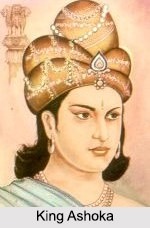
Ashoka, the son of Bindusara and the grandson of Chandragupta Maurya, stands tall among the greatest rulers not just of Indian history, but of world civilization. His reign, lasting nearly four decades, marks a unique chapter where imperial power was merged with moral and spiritual responsibility.
Ashoka was the third emperor of the Mauryan dynasty, ascending the throne in 269 BCE, although some sources suggest he consolidated full control by circa 265 BCE after a brief power struggle following his father’s death. What set him apart was not just his political success, but the moral transformation he underwent during his reign—a transformation that altered the trajectory of Indian governance and religious history.
The Kalinga War and Ashoka’s Transformation
The Kalinga War, fought in 265 BCE, marked a significant turning point in the life and reign of Emperor Ashoka. Kalinga, strategically located in present-day Odisha, was a prosperous region commanding crucial land and maritime trade routes to South India. Despite fierce resistance, Ashoka succeeded in conquering Kalinga, but at a tremendous cost—widespread bloodshed, destruction, and the death of over 100,000 people.
Deeply disturbed by the horrors of war and the human suffering it caused, Ashoka experienced a profound change of heart. This pivotal event led him to embrace Buddhism and abandon his expansionist ambitions. Renouncing violence, Ashoka redirected his energy towards the promotion of peace, compassion, and moral values, thus laying the foundation for his unique policy of governance.

Key Sites of Ashokan Inscriptions
Dhauli Inscriptions (Odisha)

Located on the banks of the Daya River, Dhauli is believed to be the site of the Kalinga War. The Ashokan rock edicts here include Rock Edicts I–X, XIV, and the two Separate Kalinga Edicts. A rock-cut elephant figure, symbolizing the Buddha and Dhamma, is also found here—carved alongside Ashoka’s inscriptions. This site vividly demonstrates Ashoka’s remorse and his transformation into a righteous ruler.
Junagadh Inscription (Girnar Hills, Gujarat)

The Girnar Rock contains inscriptions from three different periods:
1. Ashokan Edicts (14 Major Rock Edicts)
2. Rudradaman I’s Sanskrit inscription (c. 150 CE), which praises his conquests and recounts his repairs to a Mauryan-era lake and embankments.
3. Skandagupta’s inscription (c. 455 CE), recording another repair to the same lake.
These inscriptions reveal not only Ashoka’s messages but also the continuity of governance and public works across dynasties.
Cave Edicts (Barabar Hills, Bihar)
Ashoka donated rock-cut caves in the Barabar Hills to the Ajivika sect, a rival ascetic movement to Buddhism. These caves, inscribed with edicts, show Ashoka’s religious tolerance and his patronage of diverse sects. The edicts emphasize respect for all faiths and promote non-violence and compassion.
Kanaganahalli Buddhist Site (Karnataka)
Excavations at Kanaganahalli—on the banks of the Bhima River in Karnataka—revealed one of the most significant archaeological finds related to Ashoka:
- A grand Maha Stupa, referred to in inscriptions as Adholoka Maha Chaitya (The Great Stupa of the Netherworlds), built in three phases from 3rd century BCE to 3rd century CE.
- The site yielded stone portraits of Ashoka surrounded by queens and attendants. One inscription refers to him as “Ranyo Asoka”—literally, “King Ashoka”—marking the only known inscribed portrait of the emperor to date.

Minor Rock Edicts of Ashoka
Emperor Ashoka’s Minor Rock Edicts form a vital part of his epigraphic legacy. Unlike the Major Rock and Pillar Edicts that focus broadly on governance and Dhamma, the Minor Rock Edicts are more personal, often introspective, and detail Ashoka’s gradual transformation into a devout Buddhist.
Distribution and Location
There are three types of Minor Rock Edicts, found at fifteen different sites across the Indian subcontinent. Typically issued in pairs, with some rare instances containing all three edicts, these inscriptions are located in various states, including:
- Delhi: Bahapur (near Srinivaspuri in Kalkaji)
- Rajasthan: Bairat (Bhabru)
- Madhya Pradesh: Gujarra
- Bihar: Sasaram
- Uttar Pradesh: Ahraura
- Karnataka: Maski, Gavimath, Palkigundu, Jatinga Rameshwar, Siddapur, Brahmagiri, Nittur, Udegolam
- Andhra Pradesh: Rajula Mandagiri, Yerragudi

Themes and Content
In Minor Rock Edict I, Ashoka refers to himself as an Upāsaka (lay follower of Buddhism). He confesses that his commitment to the Buddhist Sangha was not instantaneous but evolved gradually over time. This personal reflection provides a rare glimpse into the emperor’s spiritual transformation.
These edicts emphasize:
- His personal dedication to Dhamma
- Respect for the Sangha (Buddhist community)
- Moral conduct and ethical values over ritualism
Minor Rock Edicts of Ashoka
Emperor Ashoka’s Minor Rock Edicts form a vital part of his epigraphic legacy. Unlike the Major Rock and Pillar Edicts that focus broadly on governance and Dhamma, the Minor Rock Edicts are more personal, often introspective, and detail Ashoka’s gradual transformation into a devout Buddhist.
Distribution and Location
There are three types of Minor Rock Edicts, found at fifteen different sites across the Indian subcontinent. Typically issued in pairs, with some rare instances containing all three edicts, these inscriptions are located in various states, including:
- Delhi: Bahapur (near Srinivaspuri in Kalkaji)
- Rajasthan: Bairat (Bhabru)
- Madhya Pradesh: Gujarra
- Bihar: Sasaram
- Uttar Pradesh: Ahraura
- Karnataka: Maski, Gavimath, Palkigundu, Jatinga Rameshwar, Siddapur, Brahmagiri, Nittur, Udegolam
- Andhra Pradesh: Rajula Mandagiri, Yerragudi
Themes and Content
In Minor Rock Edict I, Ashoka refers to himself as an Upāsaka (lay follower of Buddhism). He confesses that his commitment to the Buddhist Sangha was not instantaneous but evolved gradually over time. This personal reflection provides a rare glimpse into the emperor’s spiritual transformation.
These edicts emphasize:
- His personal dedication to Dhamma
- Respect for the Sangha (Buddhist community)
- Moral conduct and ethical values over ritualism
Ashoka’s Major Pillar Edicts
The Major Pillar Edicts of Ashoka were primarily erected in the northern part of India and represent one of the finest expressions of Mauryan royal craftsmanship and moral governance.
Locations and Significance
These edicts are found at six major sites:
1. Allahabad (Kausambi)
2. Topra-Delhi (Badi Lata) – Originally from Haryana, later shifted to Delhi by Feroz Shah Tughlaq in the 14th century.
3. Meerut-Delhi (Chhoti Lata) – Also relocated to Delhi by Feroz Shah Tughlaq.
4. Lauriya Araraj (Bihar)
- Lauriya Nandangarh (Bihar)
- Rampurva (Champaran, Bihar)
Each of these pillars usually contains Edicts I–VI, with the Topra-Delhi pillar uniquely bearing Edict VII.
Special Pillar Inscriptions
The Schism Edict (Kaushambi Pillar)
This edict directly addresses the Buddhist Sangha, warning against sectarian divisions and urging monastic unity. It outlines punitive measures for monks and nuns who cause schisms within the religious order, reflecting Ashoka’s strong commitment to the harmony and purity of the Sangha.
Allahabad Pillar Inscriptions
The Allahabad Pillar is notable for bearing inscriptions from three distinct historical periods, making it an important palimpsest of Indian history:
1. Ashoka – Major Pillar Edicts I–VI, the Schism Edict, and the Queen’s Gifts Edict, which mentions donations made by Ashoka’s queens.
2. Samudragupta – A eulogy (Prashasti) composed by Harishena, the Gupta emperor’s court poet.
3. Jahangir – A later Mughal inscription showcasing the continued reverence of ancient Mauryan relics.

Tarai Region Edicts (Nepal)
Nigali Sagar Inscription
- Located near Lumbini, in Nigalihawa, Nepal.
- The inscription records Ashoka’s visit and enlargement of the Kanakamuni Buddha’s stupa in his 14th regnal year.
- In his 20th year, Ashoka visited the site again, paid reverence, and erected a commemorative stone pillar.
This site was described by Chinese pilgrims Faxian and Xuanzang, providing corroborative evidence for Ashoka’s pilgrimage.
Rummindei (Lumbini) Pillar Inscription
- Located at Lumbini, the birthplace of Gautama Buddha.
- Composed in Prakrit and inscribed in the Brahmi script.
- Ashoka records his personal pilgrimage in the 20th year of his reign.
- He exempts the village of Lumbini from Bali (tribute) and reduces the Bhaga (royal share of produce) to one-eighth—a rare example of royal tax concession for religious reasons.

Name/Title of Ashoka | Source/Inscription | Location |
Ashoka | Maski Minor Rock Edict | Maski (Karnataka) |
Devanampiya Ashoka Rāja | Gujarra Minor Rock Edict | Gujarra (Madhya Pradesh) |
Rāja Ashoka | Nittur Minor Rock Edict | Nittur (Karnataka) |
Rāja Ashoka Devanampiya | Udegolam Minor Rock Edict | Udegolam (Karnataka) |
Piyadassi Rāja Magadh | Bhabru-Bairat Minor Rock Edict | Bairat (Rajasthan) |
Piyadassi | Barabar Cave Inscription | Barabar Hills (Bihar) |
Piyadassi | Kandahar Major Rock Edicts | Kandahar (Afghanistan) |
Ashoka Maurya | Mentioned by Rudradaman in Junagadh Rock Edict | Junagadh (Gujarat) |
Ashoka Vardhan | Mentioned in the Puranas | Various Puranic texts |
Mauryan Administration
The Mauryan Empire (321–185 BCE) was one of the most vast and efficiently governed empires in ancient Indian history. Its remarkable administrative structure enabled it to unify and manage a vast and diverse subcontinent. The central government was primarily responsible for tax collection and justice delivery, operating through a meticulously organized bureaucratic network that extended from the emperor down to toll collectors, market supervisors, and field recorders. Every level of this intricate system was regularly monitored by a corps of inspectors, with undercover informants acting as an additional layer of surveillance—ensuring transparency, accountability, and loyalty. All officials, whether high-ranking or grassroots, were appointed directly or indirectly by the emperor and had direct access to him when necessary.
A key theoretical foundation of the Mauryan administration was the Saptanga Theory, articulated by Kautilya in the Arthashastra. This concept described the state as composed of seven interdependent elements: the Swami (king), Amatya (ministers and officials), Janapada (territory and people), Durga (fortified capital), Kosa (treasury), Bala (army), and Mitra (allies). Kautilya likened the king to one wheel of a chariot and the other six elements to the second wheel—both indispensable for governance.


The empire was divided into large provinces, each governed from key administrative capitals such as Taxila, Ujjain, Tosali, Suvarnagiri, and Pataliputra. These provinces were further subdivided into districts called vishyas or aharas, which in turn encompassed groups of villages. Each village was managed by a headman known as the gramika, while the district administration was supported by various officers and was subject to royal oversight.

The King and His Council
At the helm of this sophisticated structure stood the emperor, the supreme authority and symbol of the state’s unity. However, Mauryan kings were not autocrats in the absolute sense. They governed with the assistance of two levels of ministers—Mantri Parishad (cabinet ministers) and Mantrigan (senior advisors). Key figures in this council included the Yuvaraja (heir apparent), Mahamantri (chief minister), Purohita (chief priest), and Senapati (commander-in-chief). All ministers were carefully selected for their expertise and integrity, often after passing rigorous examinations.
Bureaucratic Machinery and Departments
A robust and hierarchical bureaucracy underpinned the Mauryan state. Officials, called Amatyas, were entrusted with administering different government departments. Each department was headed by an Adhyaksha, responsible for areas such as agriculture, taxation, commerce, industry, and infrastructure. Other officials included:
- Sannidhata (chief treasurer)
- Samaharta (chief tax collector)
- Dandapala (chief of police)
- Rajukas (land surveyors)
- Pradeshikas (revenue and police officers)
- Gramika (village head)
- Gopa (supervisor of several villages)
- Nagrika (head of a city)
- Antamahamatras (officers for frontier provinces)
- Dharmamahamatras (guardians of moral conduct)

These officials ensured meticulous tax collection, public works, law enforcement, and welfare initiatives across the empire.
Revenue and Economy
The Mauryan state maintained a well-organized and efficient taxation system. The primary source of revenue was land tax, constituting about one-fourth of agricultural produce. Additional revenues came from tolls, forest produce, mining, salt, customs duties on trade, and judicial fines. The state’s financial health was robust, ensuring resources for governance, public welfare, and military maintenance.
Industries and trade flourished under the Mauryas. Artisans worked in metalcraft, pottery, dyeing, textiles, and medicinal products. The government actively supported public and private enterprises, built infrastructure such as roads and irrigation systems, and maintained rivers and canals. Sudarshana Lake in Gujarat stands as a testament to their water management.
Espionage and Internal Security
A remarkable feature of the Mauryan administration was its extensive and effective espionage system, vital to internal security and political stability. The Gudhapurushas (secret agents) operated under two types: Samsthah (stationary spies like monks, merchants, and ascetics) and Sancharah (wandering spies like emissaries and poisoners). Women played a crucial role in espionage under various disguises, including Parivarjikas, Bhikshukis, and Veshyas (courtesans). Espionage was used not only to detect corruption and treason but also to inform foreign policy and diplomatic maneuvering.
Military Organization
The Mauryan military was one of the most formidable in the ancient world. Chandragupta’s army reportedly had over 600,000 infantry, 30,000 cavalry, 9,000 elephants, and thousands of chariots. The military was overseen by a war office composed of 30 commissioners, divided into six specialized boards handling navy, infantry, cavalry, chariots, elephants, and logistics. The Senapati had supreme command and operated with remarkable autonomy. The state paid soldiers in cash and supported training camps, supply chains, and medical units—demonstrating a high level of professionalism and foresight in military affairs.
Judicial and Legal System
Justice was administered at various levels under royal supervision. The king, regarded as the Dharmapravartaka (upholder of Dharma), sat in judgment when necessary. Ashoka appointed Dharmamahamatras, who combined judicial and moral responsibilities. The legal system had two branches: Dharmasthiya (civil law) and Kantakashodhana (criminal law), both applied through tribunals in urban and rural areas. Judges known as Vyavaharika Mahamatras and Rajukas ensured law and order with fairness and equity.
Provincial and Local Administration
Provinces were ruled by royal princes or governors (Kumaras), and the core region was administered directly by the emperor. Semi-autonomous regions like Kamboja and Saurashtra retained certain privileges under Mauryan suzerainty. At the village level, local administration was strong and efficient. The Gramabhritaka (royal servant) and Gramika ensured daily functioning, supported by Gopa (overseer of villages) and Sthanika (district officer). Villagers received protection and were encouraged to cultivate land and contribute to the economy.

Sarnath Lion Capital: National Emblem of India
The Sarnath Lion Capital is a masterpiece of Mauryan sculpture. It features four lions seated back-to-back atop a circular abacus, which in turn rests on an inverted bell-shaped lotus. The abacus is intricately carved with figures of a lion, bull, elephant, and horse separated by Dharmachakras. This capital symbolizes the Dhammachakrapravartana—the Buddha’s first sermon—and has been adopted as the national emblem of India (excluding the lotus base).

The Rampurva Bull
A strikingly polished sculpture of a bull found in Rampurva, Bihar, formed the capital of a Mauryan pillar and is now housed in the Rashtrapati Bhavan. The naturalistic rendering and smooth polish make it an excellent example of Mauryan realism and finesse.

Stupas: Sacred Mounds of Spiritual Legacy
Stupas are dome-shaped structures that contain relics and are venerated by Buddhists. The tradition of stupa building predates Buddhism, but Emperor Ashoka gave it a new dimension by constructing numerous stupas to enshrine the relics of the Buddha, as mentioned in the Buddhist text Ashokavadana.
Key Stupas from the Mauryan and Post-Mauryan Era:
- Sanchi (Madhya Pradesh)
- Bharhut (Madhya Pradesh)
- Sarnath (Uttar Pradesh)
Components of a Stupa:
- Anda: The hemispherical dome that covers the relic casket.
- Harmika: A square railing on top of the dome symbolizing the abode of the gods.
- Yashti: A vertical pole or mast rising from the harmika, representing the cosmic axis.
- Chhatri: Umbrella-like structures on top of the yashti, representing the Three Jewels of Buddhism—Buddha, Dhamma, and Sangha.
- Medhi: An elevated platform used as a circumambulatory path.
- Vedika: The outer railing that separates the sacred from the secular space.
- Torana: Ornate gateways situated at cardinal points providing entry into the pradakshina patha.

Evolution of the Stupa
Initially conceived as simple earthen mounds, stupas underwent significant transformations:
- Incorporation of stone railings
- Addition of sculptured toranas
- Ornamentation with narratives from Buddha’s life and Jataka tales
Sanchi Stupa Evolution:
- Mauryan Period: Original brick stupa built by Ashoka
- Sunga Period: Enlarged and encased in stone; added harmika, yashti, and toranas
- Satavahana Period: Decorative enhancements
- Gupta Period: Construction of four shrines at cardinal points
Sculptures at Sanchi
Buddhist Themes:
- Vessantara Jataka: Tale of a generous prince
- Symbols: Empty throne (meditation), wheel (first sermon), stupa (parinirvana)
Popular Traditions and Motifs:
- Shalabhanjika: Fertility symbol, tree goddess figure
- Animal Motifs: Elephants (wisdom), horses, monkeys, cattle
- Gajalakshmi: Depictions of prosperity and divine grace
- Serpent Motifs: Derived from folk and tribal beliefs
Interpretation and Influence of Literature
Early art historians like James Fergusson misinterpreted Sanchi as a centre of tree and serpent worship due to a lack of understanding of Buddhist texts. The study of Buddhist literature and hagiographies eventually helped scholars accurately interpret the iconography and religious symbolism of these artworks.
Evidence of Patronage
Votive inscriptions provide key insights into the socio-religious life of the time. They record donations made to stupas and monastic complexes by individuals and groups:
- Donors included kings, traders, guilds, monks (Bhikkhus), and nuns (Bhikkhunis)
- Ivory carvers, for instance, helped fund parts of Sanchi’s gateways
Rock-Cut Caves: Shelters for Monks
- The Mauryan era also pioneered the practice of carving rock-cut caves for ascetics. These were simple yet artistically refined dwellings.
Notable Rock-Cut Caves:
- Lomas Rishi Cave (Barabar Hills, Bihar): Donated by Ashoka to the Ajivika sect; features the earliest chaitya arch motif
- Dhauli Hills (Odisha): Contains Ashokan inscriptions and rock-cut elephants
Yaksha and Yakshini Sculptures
The worship of Yakshas (male nature spirits) and Yakshinis (female counterparts) was a prevalent tradition, predating Buddhism and Jainism but later assimilated into them.
- Found in Patna, Mathura, and Vidisha
- Characterized by polished surfaces and detailed physiognomy
- Didarganj Yakshini (Patna): An iconic statue exemplifying grace and craftsmanship.

The Mauryan period marked the genesis of monumental Indian art and architecture. With their refined aesthetics, technical precision, and profound symbolism, Mauryan creations laid the cultural bedrock for subsequent artistic developments in Indian history. Whether in the form of solemn stupas, expressive sculptures, or awe-inspiring pillars, the Mauryan legacy continues to inspire and inform the cultural narrative of the subcontinent.