
The Marathas
In the first half of the 17th century, the Deccan region of India witnessed the rise of the Nizamshahi of Ahmadnagar and the Adilshahi of Bijapur. These sultanates held sway over much of Maharashtra, and several notable Maratha sardars (chieftains) served in their courts. These sardars held jagirs (land grants) in the remote and rugged Sahyadri mountain ranges, where they gradually built regional influence.
One such notable sardar was Shahaji Raje Bhosale, a prominent figure in the Nizamshahi kingdom. After its decline, he joined the Adilshahi court as a Mansabdar. Shahaji Raje was among the earliest visionaries of a sovereign Maratha state—an idea that was eventually realised and institutionalised by his son, Chhatrapati Shivaji Maharaj, who founded the concept of Swarajya (self-rule) in the Mawal region of Maharashtra.
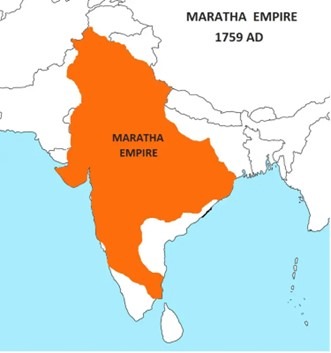
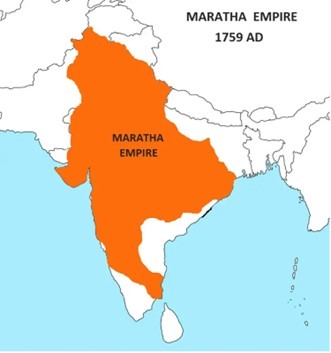
Rise of Regional Politics and States
The emergence of regional powers in India during the decline of the Mughal Empire created a new political landscape, and among the most formidable of these regional powers were the Marathas. The Marathas had long held influential administrative and military positions in the Deccan Sultanates of Bijapur and Ahmadnagar, which provided them with firsthand experience in governance and warfare. This foundation enabled them to later establish a powerful and organised state of their own.
The spread of the Bhakti movement in Maharashtra, led by saints such as Tukaram, Ramdas, Vaman Pandit, and Eknath, fostered a strong sense of social unity and spiritual awakening among the Marathas. However, it was Shahaji Bhonsle and his son Shivaji Maharaj who provided the much-needed political unity that galvanized the Maratha people. Capitalizing on the fragmentation of the Mughal Empire, the Marathas launched a northward expansion, eventually conquering large parts of Malwa, Gujarat, and Bundelkhand, and posing a formidable challenge to Mughal supremacy.
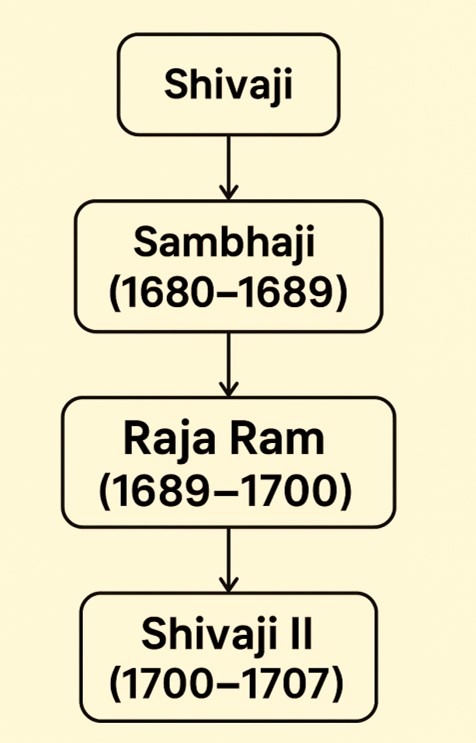
Chhatrapati Shivaji Maharaj (1630–1680)
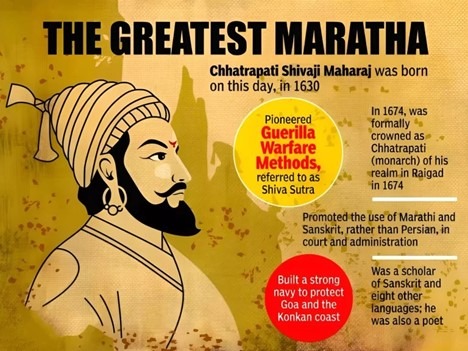
Chhatrapati Shivaji Maharaj stands as one of the most revered figures in Indian history. He was the founder of the Maratha Empire and a pioneer in establishing an independent and sovereign state in Maharashtra, grounded in justice, administrative efficiency, and religious tolerance. His concept of Swaraj (self-rule) laid a new foundation for modern Indian politics, eventually evolving into an all-India movement for self-governance.
Born on 19 February 1630 at Shivneri Fort near Junnar in Pune district, Shivaji was the son of Shahaji Bhonsle, a prominent Maratha sardar in the Deccan, and Jijabai, daughter of Lakhuji Jadhavrao. At the time, Maharashtra was divided under the control of the Nizamshahis of Ahmednagar and the Adilshahis of Bijapur.
Shivaji vs. Afzal Khan (1659)
In 1659, the Sultan of Bijapur dispatched Afzal Khan, a powerful general, with an army of 20,000 men to subdue Shivaji. Using a clever strategy, Shivaji lured Afzal Khan into the treacherous terrain of the Sahyadri hills. Pretending to negotiate peace, Shivaji met him at Pratapgad Fort, where he killed Afzal Khan in self-defence during a supposed peace meeting. His pre-positioned troops then launched a surprise attack and routed the Bijapuri army, instantly elevating Shivaji’s stature as a formidable military leader.
Conflict with Siddi Jauhar
Following Afzal Khan’s defeat, Bijapur sent Siddi Jauhar to contain Shivaji. Siddi Jauhar besieged the Fort of Panhala, cutting off escape routes. Shiva Kashid, a devoted servant of Swarajya, disguised himself as Shivaji and sacrificed his life, enabling the real Shivaji to escape. Baji Prabhu Deshpande, a loyal commander, held off Siddi’s forces at Ghodkhind, ensuring Shivaji’s safe arrival at Vishalgad, before sacrificing his life.
Clashes with the Mughals
To counter Shivaji’s growing influence, Emperor Aurangzeb sent Shaista Khan, his maternal uncle, to the Deccan. In a daring midnight raid, Shivaji stormed the Lal Mahal in Pune, injured Shaista Khan and killed his son, compelling the Mughals to retreat. In 1664, he plundered the port city of Surat, a key Mughal trade centre.
Angered, Aurangzeb sent his best general, Mirza Raja Jai Singh, with an army of over 120,000 men. Shivaji, assessing the situation wisely, signed the Treaty of Purandar (1665), agreeing to:
- Surrender 23 forts out of 35.
- Pay an annual tribute of one lakh huns.
- Secure a mansab of 5000 for his son Sambhaji.
Agra Incident and Dramatic Escape (1666)
As part of the treaty, Shivaji and his son travelled to Aurangzeb’s court in Agra. There, they were placed under house arrest. Using his wit, Shivaji feigned illness and began sending out large baskets of sweets to distribute among the poor. On 17 August 1666, he and Sambhaji escaped in the baskets, one of the most daring escapes in Indian history. Upon his return, Shivaji swiftly recaptured lost forts, restructured his administration, and revived Maratha power.
Naval Innovations and Religious Tolerance
Shivaji was the first Indian ruler to build a strong naval fleet, using sea power for both trade and defence. He was deeply religious but respected all faiths, including Muslims and Christians, and ensured the protection of their places of worship. His army included Muslim officers, and he allowed forcibly converted Hindus to return to their faith, breaking with prevailing norms.
Coronation and Later Years
In 1674, Shivaji was formally coronated as Chhatrapati at Raigad Fort, establishing a sovereign Hindu kingdom. He ruled for six years through the Ashta Pradhan Mandal (Council of Eight Ministers). His notable southern campaign formed alliances with the Deccan Sultanates to prevent further Mughal expansion.
Despite domestic strife and the defection of his elder son Sambhaji to the Mughals for a brief time, Shivaji continued to defend his kingdom with vigour. He died after a brief illness on April 3, 1680, in Rajgad, the stronghold he had fortified as his capital.
Legacy
Chhatrapati Shivaji Maharaj is remembered not only as a brilliant warrior and strategist but also as a visionary leader who revived the fortunes of the Maratha people. In an age marred by religious oppression, he stood out as a beacon of religious tolerance, efficient governance, and cultural pride. His creation of a self-reliant Maratha state reshaped the political landscape of India and sowed the seeds of national consciousness that inspired future freedom movements.
Battle | Year | Location | Parties Involved |
Battle of Pratapgad | 1659 | Fort Pratapgad, near Satara, Maharashtra | Shivaji Maharaj vs. Afzal Khan (Adilshahi General) |
Battle of Pavan Khind | 1660 | Near Fort Vishalgad, Kolhapur, Maharashtra | Baji Prabhu Deshpande (Maratha) vs. Siddi Masud (Adilshahi) |
Sacking of Surat | 1664 | Surat, Gujarat | Shivaji Maharaj vs. Inayat Khan (Mughal captain) |
Battle of Purandar | 1665 | Fort Purandar, Maharashtra | Maratha Empire vs. Mughal Empire |
Battle of Sinhagad | 1670 | Fort Sinhagad, near Pune, Maharashtra | Tanaji Malusare (Maratha) vs. Udaybhan Rathod (Mughal, under Jai Singh I) |
Battle of Sangamner | 1679 | Sangamner, Maharashtra | Maratha Empire vs. Mughal Empire (Last battle fought by Shivaji Maharaj) |
Battle of Kalyan | 1682–83 | Kalyan, Maharashtra | Bahadur Khan (Mughal) defeated the Maratha Army |
Shivaji’s Revenue Administration
Shivaji’s revenue system was primarily inspired by the models of the Mughals and the Ahmadnagar Sultanate’s Malik Ambar. Key features included:
- Land measured using ‘lathi’ (measuring rod).
- Classification of land: Paddy fields, garden lands, and hilly tracts.
- Shivaji curtailed the powers of Deshmukhs and Kulkarnis and appointed his own loyal revenue officers called Karkuns.
- Revenue farming was discouraged, and fair assessment was promoted.
- Revenue records were maintained in a special script known as Modi script.
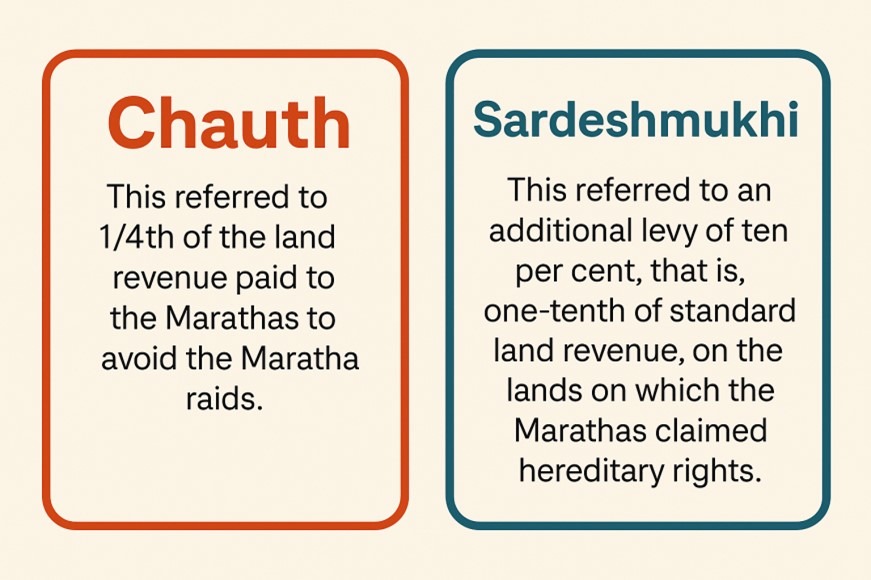
Two significant sources of revenue were:
- Chauth – One-fourth of the revenue collected from territories outside Maratha control.
- Sardeshmukhi – An additional 10% levy, claimed in the name of the Sardeshmukh, or chief headman of the region.
Major Military Campaigns and Resistance
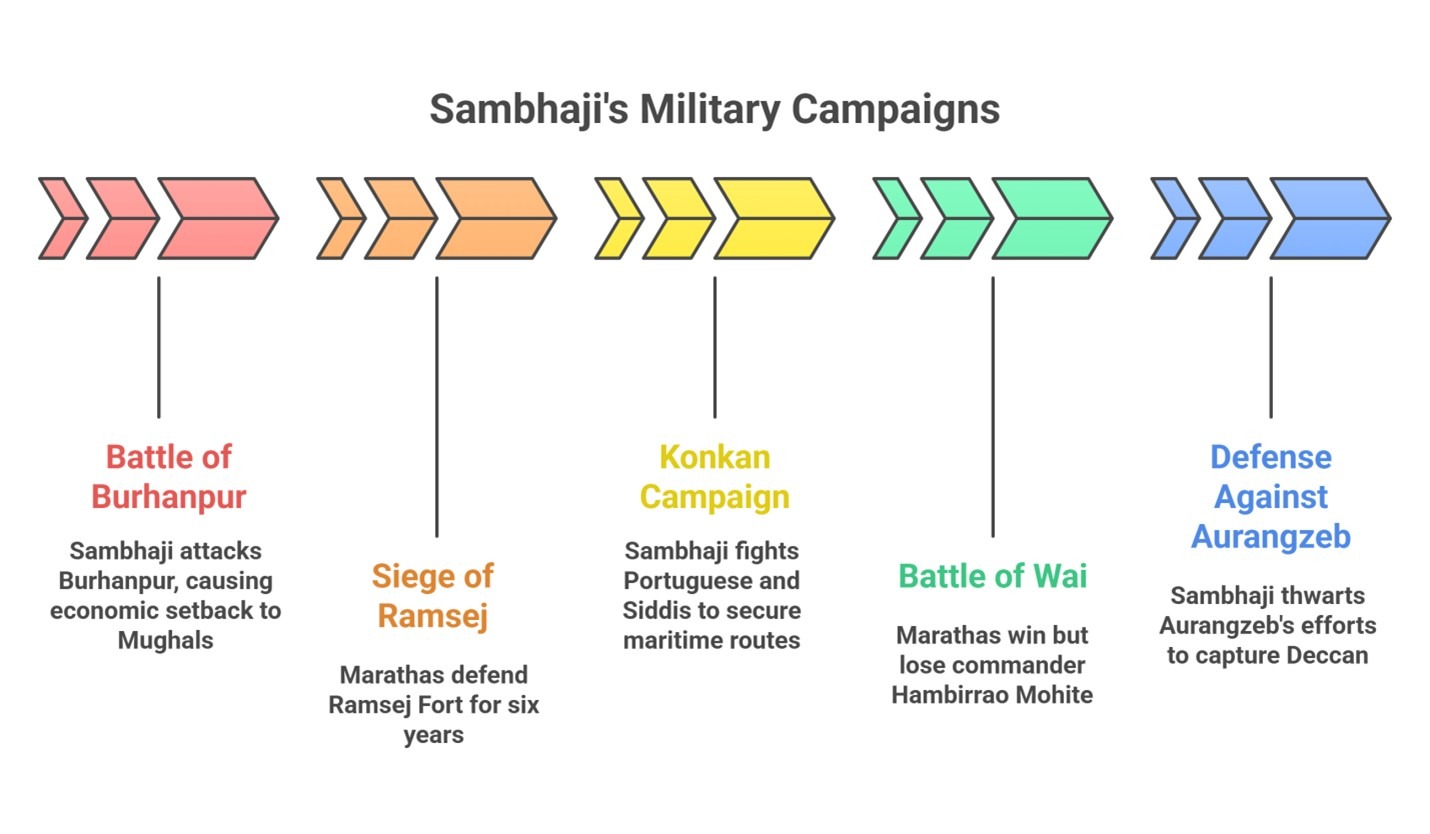
Battle of Burhanpur (1681)
Soon after his coronation, Sambhaji led a daring and strategic attack on the Mughal trade city of Burhanpur, inflicting a major economic setback on the Mughal Empire.
Siege of Ramsej (1682–1688)
One of the most notable episodes of his reign, the six-year-long defense of Ramsej Fort exemplified Maratha resilience and their unmatched commitment to resistance. Despite repeated attacks, the Marathas successfully held off the Mughals.
Konkan Campaign (1683–1684)
Sambhaji turned his attention to the western coastal belt. In this campaign, he fought against both the Portuguese and the Siddis of Janjira, aiming to secure strategic maritime routes and ports, thereby strengthening the Maratha naval power.
Battle of Wai (1687)
Though the Maratha forces secured a victory, they suffered a grave loss when their esteemed commander, Hambirrao Mohite, was killed in action—a major blow to the military leadership.
Defense Against Aurangzeb
Throughout his reign, Sambhaji consistently thwarted the Mughal emperor Aurangzeb’s efforts to capture the Deccan. His military campaigns successfully prevented Mughal reoccupation of large swathes of North India through the southern front.
The Peshwas
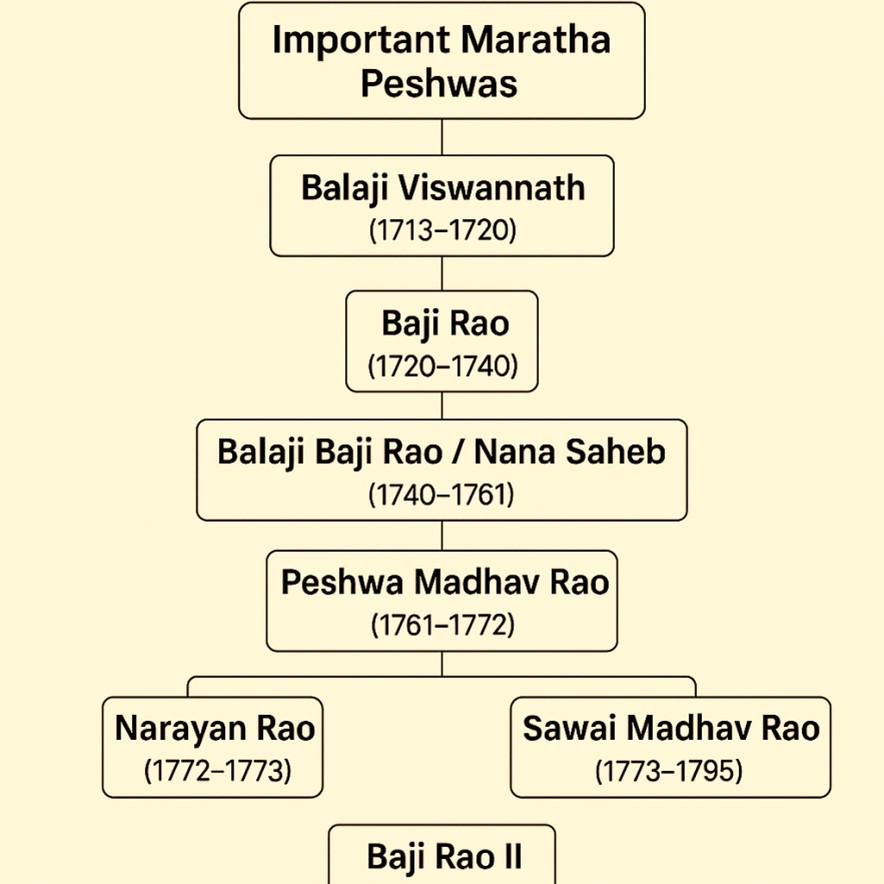
The era of the Peshwas marked a transformative chapter in the history of the Maratha Empire, during which the post of Peshwa (originally a chief ministerial role under the king) evolved into the supreme position of power, making the Peshwas the real rulers while the Chhatrapati became a ceremonial head. This period witnessed the Maratha Empire reaching the zenith of its territorial expansion and influence, followed by a gradual decline due to internal dissent and external challenges.
The Rise of Shahu Maharaj and the Beginnings of Peshwa Supremacy
Shahu Maharaj, the grandson of Chhatrapati Shivaji Maharaj, had been held prisoner by Aurangzeb since 1689. Following the Mughal emperor’s death in 1707, Shahu was released. His return to the Deccan sparked a succession conflict with his aunt Tarabai, who was ruling Kolhapur in the name of her son, Shivaji II.
Balaji Vishwanath, a talented diplomat and administrator, played a decisive role in securing the support of powerful Maratha sardars for Shahu. Owing to his loyalty and competence, Shahu appointed him Peshwa in 1713, thereby laying the groundwork for Peshwa supremacy in Maratha politics.
The Maratha Confederacy (1720–1818)
The Maratha Confederacy was a dynamic and powerful military-political alliance that arose in the early 18th century following the decline of central authority under the Chhatrapati. As the Peshwas assumed real power from their base in Poona (Pune), the Maratha Empire evolved into a confederate structure. This era witnessed both the apex of Maratha imperial ambitions and their eventual downfall at the hands of the British East India Company.
Key Components of the Maratha Confederacy
1. Peshwas of Poona (Pune)
The Peshwas, initially appointed as chief ministers under the Chhatrapati, eventually became the de facto rulers of the Maratha state. Operating from Poona, they directed imperial expansion, foreign diplomacy, and major military campaigns. The Peshwa era marked a significant shift from monarchic to bureaucratic dominance within the Maratha polity.
2. Gaikwads of Baroda
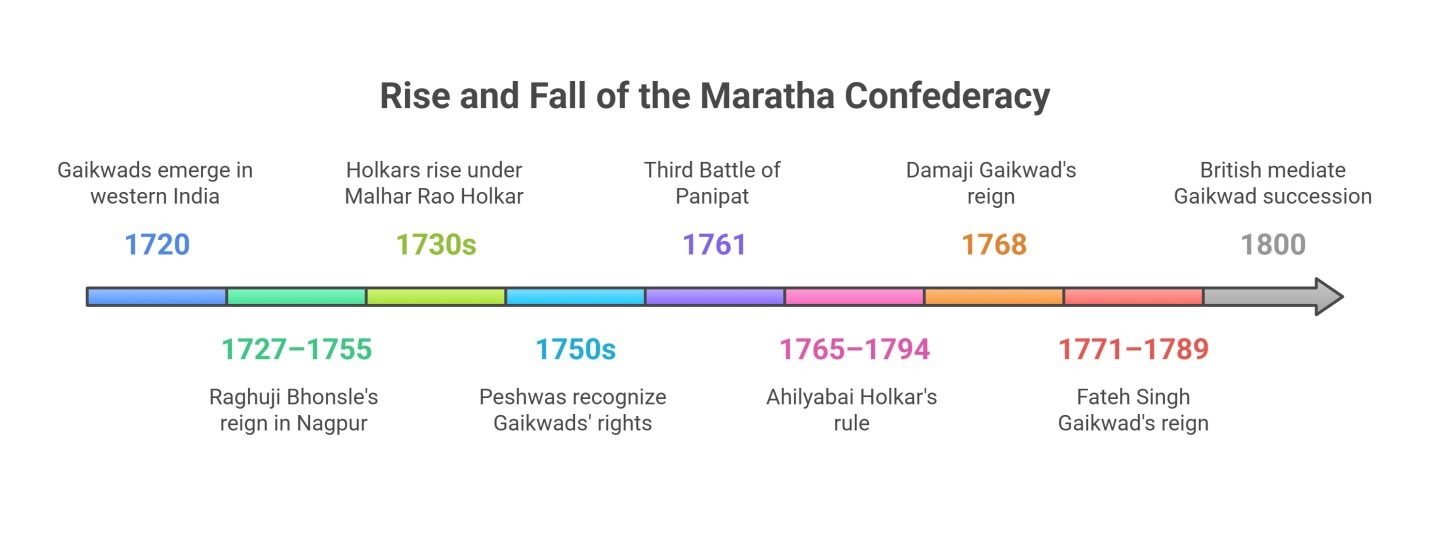
The Gaikwads emerged as influential players in western India around 1720, initially subordinate to the Bhonsles and the powerful Dabhade family.
- Their political standing improved significantly after the death of Shahu, coinciding with the rise of Peshwa authority.
- By the 1750s, the Peshwas recognized the Gaikwads’ rights to a major portion of Gujarat’s revenues, following which they established their capital at Baroda.
- Notable rulers: Damaji Gaikwad (1768) and Fateh Singh Gaikwad (1771–89).
- Fateh Singh’s decision to negotiate with the British East India Company marked the beginning of British interference in Gaikwad affairs.
- By 1800, the British, not the Peshwas, mediated succession disputes, reducing the Gaikwads to subordinate allies of the colonial power.
3. Holkars of Indore
Originally of modest political influence, the Holkars rose swiftly under the leadership of Malhar Rao Holkar by the 1730s.
- Malhar Rao obtained significant shares in the Chauth collections from Malwa, Khandesh, and eastern Gujarat.
- He consolidated power around Indore and controlled key commercial hubs like Burhanpur.
- His daughter-in-law, Ahilyabai Holkar, governed from 1765 to 1794, and is remembered for her administrative excellence and cultural patronage, which elevated the Holkar principality to new heights.
4. Bhonsles of Nagpur
The Bhonsles remained nominally subordinate to the Satara Chhatrapati but exercised considerable autonomy.
- Raghuji Bhonsle (1727–1755) was the most prominent ruler of this line.
- He spearheaded Maratha incursions into Bengal and Bihar and successfully occupied Orissa after defeating Nawab Alivardi Khan.
- The Bhonsles expanded Maratha influence deep into eastern India, establishing a significant power base at Nagpur.
5. Scindias of Gwalior
Following the Third Battle of Panipat in 1761, the Scindias emerged as a dominant force in northern India.
- Initially headquartered at Ujjain, they later shifted their capital to Gwalior.
- Under Mahadji Scindia (1761–94):
- Created a modern European-style army with both Hindu and Muslim soldiers.
- Employed a number of French officers and gunners.
- Established ordnance factories near Agra.
- Exercised control over Delhi and Agra on behalf of the Marathas.
- Secured the post of Naib-i-Munaib (Deputy to the Mughal Emperor).
- Relations with Nana Phadnavis and the Holkars were strained, limiting unified action.
- His successor, Daulat Rao Scindia, lacked Mahadji’s leadership and suffered defeats against the British, ceding large tracts of territory.
Anglo-Maratha Wars (1775–1818)
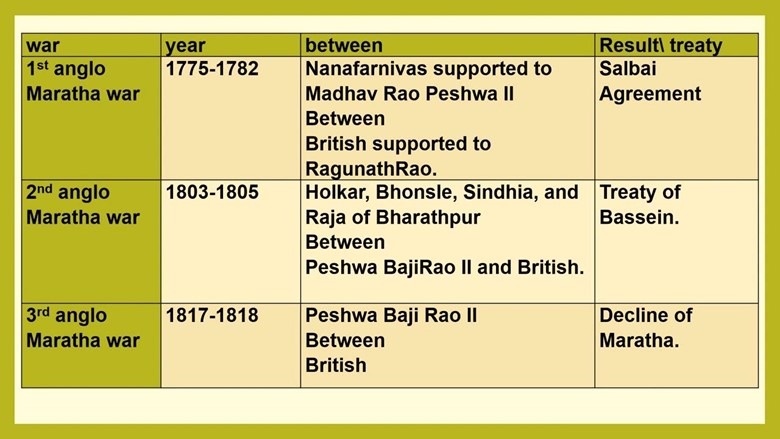
The Anglo-Maratha Wars were a series of three significant military confrontations between the British East India Company and the Maratha Confederacy, ultimately leading to the collapse of Maratha sovereignty.
First Anglo-Maratha War (1775–1782)
- Initiated by British support for Raghunath Rao, a claimant to the Peshwa throne.
- Treaty of Surat (1775): Recognized Raghunath Rao’s claims but was rejected by the Calcutta Council.
- Nana Phadnavis retaliated by granting the French a port, provoking British aggression.
- At Wadgaon (1779), British forces were defeated and surrendered.
- Treaty of Wadgaon: Returned territories to the Marathas.
- Treaty of Salbai (1782): Concluded hostilities and restored the status quo.
Second Anglo-Maratha War (1803–1805)
- Triggered by the Treaty of Bassein (1802) signed by Peshwa Baji Rao II after his defeat by the Holkars.
- Scindias and Bhonsles opposed the treaty and challenged British interference.
- British victories led to the signing of:
- Treaty of Deogaon (1803)
- Treaty of Surji-Anjangaon (1803)
- Treaty of Rajghat (1805)
- These treaties stripped the Marathas of vast territories, eroding their military strength.
Third Anglo-Maratha War (1817–1818)
Causes:
- Growing Maratha resentment against British control.
- British military operations against Pindari raiders within Maratha-held territories.
- The desire to reclaim lost prestige and sovereignty.
Outcomes:
- Crushing defeat of the Marathas.
- Annexation of remaining Maratha territories by the British.
- Complete dismantling of the Maratha Confederacy.
- India came fully under the British East India Company’s rule.
Decline of the Marathas
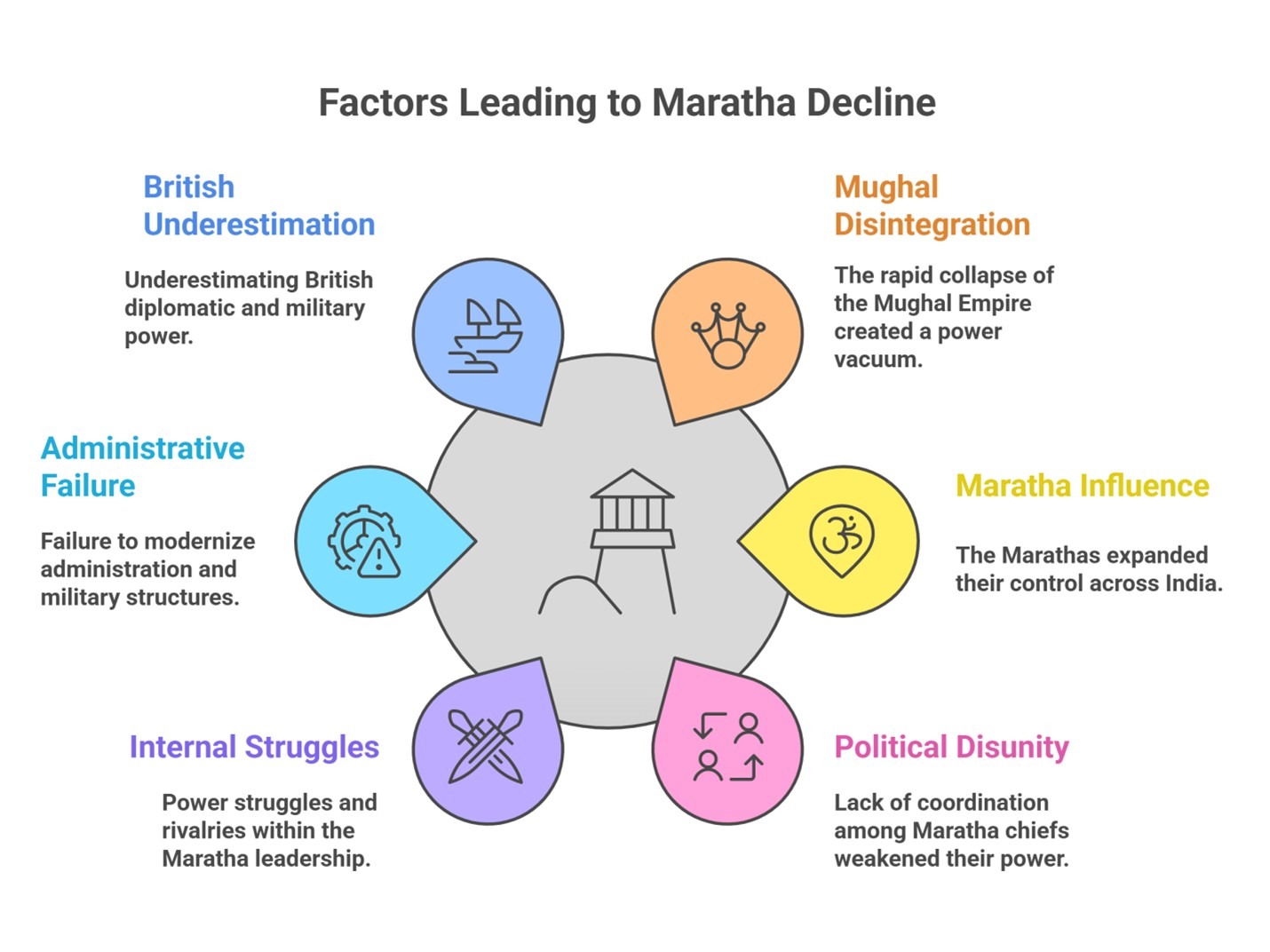
- Post-Aurangzeb, the Mughal Empire disintegrated rapidly, allowing the Marathas to rise as the most dominant regional force in India.
- Their influence extended from Punjab in the north to Cape Comorin in the south, and from Gujarat to Bengal.
- The Mughal Emperor became a pensioner of the Marathas, illustrating their dominance.
- Yet, they failed to establish a centralized pan-Indian empire.
- Reasons for decline:
- Lack of political unity and coordination among Maratha chiefs.
- Internal power struggles and regional rivalries.
- Failure to modernize administration and military structure.
- Underestimation of British diplomatic and military power.
- Ultimately, it was not the Mughals but the Marathas from whom the British inherited control over India.
The Marathas were on the verge of establishing an all-India empire in the aftermath of the Mughal decline. With visionary leadership, military innovation, and territorial expansion, they became one of the most formidable indigenous powers in Indian history. However, internal discord, lack of cohesive governance, and military setbacks in the Anglo-Maratha Wars culminated in their collapse.
The Third Anglo-Maratha War (1817–18) was the final blow that ended Maratha political supremacy and heralded the onset of British colonial dominance in India. Yet, their legacy endures as a symbol of indigenous resistance and administrative ingenuity in the face of foreign rule.
End of Maratha Rule
The downfall of the Maratha Empire was marked by British diplomatic cunning and military superiority, especially during the Second (1803–1805) and Third Anglo-Maratha Wars (1817–1819). The British systematically divided the Maratha sardars, defeating them one by one in isolated conflicts.
While several Maratha princely states were allowed to exist as subsidiary allies under British suzerainty, the House of the Peshwas was formally abolished. With this, the long-cherished Maratha ambition to succeed the Mughals and establish a pan-Indian empire ultimately ended in failure.