The 6th century BCE marks a watershed moment in Indian history—an era of deep philosophical inquiry and transformative social change. This period witnessed the rise of two of the most influential thinkers in Indian and global history: Mahavira and Gautama Buddha. Their teachings laid the foundations for Jainism and Buddhism, two religious and philosophical systems that responded directly to the rapidly changing socio-political and economic environment of the time.
Unlike the hierarchical and ritualistic ideologies that had begun to dominate society, Jainism and Buddhism presented an alternative worldview—one rooted in equality, non-violence, and the pursuit of inner truth. They offered a new ethical and social framework, challenging the dominance of the Brahmanical order and envisioning a more just and compassionate world.
The political landscape during this period was diverse and evolving. Two primary forms of governance coexisted:
These gana-sanghas were organized along kinship lines, where power was exercised collectively by the clan. However, the increasing centralization of authority and militarization of state systems, especially in kingdoms like Magadha, led to the gradual collapse of the gana-sanghas. As monarchies expanded territorially, the communal systems of governance were unable to withstand the pressures of political consolidation.
The Buddhist texts vividly document this transformation. Under King Bimbisara, Magadha undertook aggressive expansion and administrative organization. A shift from a tribal, pastoral economy to a settled agrarian economy enabled the support of a standing army and a more intricate state machinery—key indicators of early state formation.
By the time of the Buddha, smaller gana-sanghas such as the Sakyas and Mallas had already been absorbed by powerful kingdoms. This was not just a political defeat but the demise of a way of life based on communal land ownership and collective decision-making.
The consolidation of power by monarchies like Magadha reshaped the structure of society. Kings wielded absolute and often arbitrary power, unchecked by any institutional constraints. The law became personalized and inconsistently applied. Earlier tribal institutions that once represented collective will had vanished, leaving a vacuum that was filled by autocratic rule.
In this context, Buddhism’s political philosophy emerged as a counterpoint—emphasizing ethical governance, moral responsibility, and the renunciation of desire as the root of suffering.
This era saw profound economic changes fueled by the growth of iron technology, which enabled large-scale deforestation and agricultural expansion. The introduction of rice transplantation led to a demographic boom, with texts referencing numerous new settlements and cultivated lands.
The rise of a money economy is evidenced by the widespread use of coins and the emergence of trade routes. Craft production flourished, supported by commercial organizations called srenis (guilds). Urbanization gained momentum—so much so that this period is known as India’s Second Urbanisation.
At the heart of this agrarian economy were the Gahapatis—wealthy landholding householders who played a pivotal role in agricultural production. They became the primary taxpayers and were integral to the functioning of the monarchy.
As the economy evolved, society became increasingly stratified. A new class of labourers emerged, including:
These terms reflect a growing class of individuals who were economically dependent and socially unfree. Poverty, previously less visible in ancient texts, became a significant theme. The word dalidda (Pali for daridra, meaning extreme poverty) appears for the first time.
Meanwhile, Brahmanas asserted their dominance based on birth and ritual purity, though their claims were increasingly contested. High-status families enjoyed land and privileges, while others were marginalized—a clear indication of widening social and economic inequalities.
Amidst these sweeping changes, new spiritual movements arose as a reaction to societal upheaval. At the center of this intellectual revolution were the Samanas, or wandering ascetics, including Mahavira and Buddha.
These renunciants rejected the Brahmanical tradition of elaborate rituals and animal sacrifices. Instead, they embraced simplicity, non-violence, and introspection. Traveling across the subcontinent, they debated, taught, and gathered disciples. Their way of life—free from worldly attachments—captivated the masses disillusioned with rigid caste norms and oppressive rulers.
The Samanas opposed both the religious orthodoxy and the social privileges of the Brahmanas. Their philosophies addressed alienation, moral decay, and the loss of community—a fallout of the breakdown of earlier clan-based societies.
The 6th century BCE was an age of profound transformation. Political power was becoming centralized, economies were shifting toward agrarian and urban models, and social hierarchies were hardening. Yet it was also a time of intellectual awakening and spiritual questioning.
In response to a world marked by inequality, coercion, and materialism, Jainism and Buddhism emerged as powerful, alternative ideologies. They not only challenged the status quo but also offered practical, ethical, and compassionate pathways for personal and societal reform.
As we explore the teachings of Mahavira and Buddha in greater depth, we see how their philosophies remain relevant even today—centuries after their inception—in advocating justice, non-violence, and the quest for inner peace.
Jainism is one of the most ancient spiritual traditions of India, with its doctrinal roots believed to be older than even Buddhism. While both Mahavira (the 24th Tirthankara of Jainism) and Gautama Buddha were contemporaries in the 6th century BCE, the origins of Jainism trace back even further through a long line of enlightened teachers known as Tirthankaras.
Both Jainism and Buddhism arose as reformist movements that challenged the prevailing Brahmanical orthodoxy. They shared several philosophical features—such as rejection of Vedic authority, belief in a non-theistic universe, emphasis on renunciation, and recognition of human effort as the key to liberation. Both traditions also established monastic orders for men and women, creating structured communities for disciplined spiritual practice.
Yet, despite these similarities, the two philosophies differ significantly in metaphysical outlook and ethical emphasis. Jainism, for instance, gives primacy to non-violence (Ahimsa) to an unparalleled degree and maintains a dualistic view of soul and matter, unlike Buddhism’s anatta (non-self) doctrine.
The word Jaina means a follower of a Jina—a spiritual victor. A Jina is one who has conquered inner passions and attained infinite knowledge (Kevala Jnana), thereby achieving moksha, or liberation from the cycle of birth and death. Another term often used for a Jina is Tirthankara, meaning “ford-maker”—one who creates a spiritual path (a “ford”) across the ocean of worldly suffering to guide others toward salvation.
According to Jain tradition, there are 24 Tirthankaras, each of whom appears in every cosmic cycle to teach the eternal truth. These enlightened beings are not gods but humans who, through intense spiritual discipline, transcend worldly existence and attain omniscience. They serve as ideal role models rather than objects of worship in the traditional sense.
Jain cosmology presents a unique understanding of time, which is seen as eternal and cyclical, not linear. Time moves through infinite cycles, each divided into two equal halves:
Each half-cycle is further divided into six stages (kalas), representing gradual changes in moral and material conditions. The current era is said to be in the fifth stage of Avasarpini, marked by decay in values and increasing suffering.
Jainism holds that its truths have been revealed repeatedly by 24 Tirthankaras in every time cycle. Among them:
In Jainism, the Jina or Tirthankara is a fully liberated soul who has eradicated all karmic bonds and attained a state of perfect knowledge, perception, conduct, and bliss. Though born as human beings, they are believed to possess certain extraordinary signs from birth, symbolizing their future greatness.
Jinas do not claim divine status; instead, they emphasize self-effort and ethical living as the path to liberation. The teachings of all Tirthankaras are considered identical in essence, highlighting the permanence and universality of Jain philosophy.
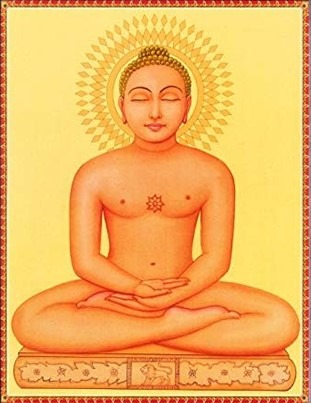
Vardhamana, who would later be known as Mahavira, was born around 599 BCE in Kundagrama, near Vaishali, the capital of the ancient kingdom of Videha (in present-day Bihar). Like the Buddha, he was born into an aristocratic Kshatriya family. His father, Siddhartha, was the chief of the Jnatrika clan, and his mother, Trishala, was the sister of the king of Videha.
Mahavira was deeply revered and came to be known by many names—Mahavira (Great Hero), Jitendriya (one who has conquered the senses), and Arihant (the worthy one). He was believed to possess Avadhijnana, or superhuman insight and perception.
Initially, Mahavira lived the life of a householder. He married Yashoda and had a daughter named Priyadarshana. However, in pursuit of spiritual truth, he renounced worldly life at the age of 30 and chose the path of asceticism. For the next 12 years, he wandered through forests and villages, practicing intense meditation, severe austerities, and fasting.
At the age of 42, Mahavira attained Kevalajnana (infinite knowledge or omniscience) on the banks of the Rijupalika River, near Jrimbhikagrama, in the fields of a householder named Samaga. With this supreme knowledge, he became a Kevalin (enlightened one), capable of guiding others toward liberation. He spent the remainder of his life preaching his philosophy and ultimately achieved moksha (liberation) at the age of 72 in 527 BCE, at Pavapuri near Patna in Bihar. After his death, he was considered a Siddha, a fully liberated soul free from the cycle of birth and death.
The core objective of Jainism is the liberation of the soul from the cycle of birth and death. To attain this, Mahavira emphasized following the Triratna or Three Jewels of Jaina ethics:
1. Right Faith (Samyag Darshana) This is not blind belief but refers to perceiving reality clearly—through seeing, hearing, and understanding—while avoiding superstitions and misconceptions.
2. Right Knowledge (Samyag Jnana) This involves an accurate understanding of the universe, including the fundamental substances and truths that constitute existence, gained with a balanced and rational mindset.
3. Right Conduct (Samyag Charitra) This means living ethically, following Jain principles, avoiding harm to any living being, and freeing oneself from attachments, passions, and impure thoughts.
To support the practice of these principles, Mahavira outlined the Pancha Mahavratas or Five Great Vows, which form the ethical foundation of Jain life:
Over time, Jainism spread widely across India. Like Buddhists, Jain monks and scholars contributed significantly to Indian literature, producing a vast corpus in Prakrit, Sanskrit, and Tamil. Unlike the Brahmanical tradition that favored Sanskrit, early Jain teachers embraced Prakrit, the language of the common people. This strategic choice made Jain teachings accessible to a broader audience.
Jainism found particular strength in western India, where Vedic and Brahmanical traditions were less dominant. The religion also gained royal patronage—most notably from Chandragupta Maurya, who eventually embraced Jainism and lived his final years as a Jaina monk in Karnataka.
A major turning point came with a famine in Magadha, roughly 200 years after Mahavira’s death. To survive the harsh conditions, many Jain monks migrated south under the leadership of Bhadrabahu, a prominent Jain acharya. This migration played a crucial role in the spread of Jainism to southern India, where it continued to thrive and evolve.
Jainism, one of the oldest religions of India, gradually evolved into two major sects: the Shvetambaras and the Digambaras. This division, while rooted in philosophical and doctrinal differences, was also influenced by historical circumstances, particularly a severe famine in the region of Magadha around 298 BCE.
During the famine, a group of Jain monks led by Bhadrabahu and Chandragupta Maurya migrated to South India, settling in Shravanabelagola (present-day Karnataka). This group strictly adhered to the original monastic codes, including complete renunciation of clothing. Meanwhile, the monks who stayed back in Magadha under the leadership of Sthulabhadra adopted less austere practices, including wearing white robes.
Over time, these divergent practices and interpretations of monastic discipline gave rise to the two main sects:
Further divisions occurred within both sects, leading to the formation of various sub-sects, some of which eventually rejected idol worship altogether.
The term Shvetambara literally means “white-clad,” referring to the white garments worn by the monks and nuns of this sect. The Shvetambaras emphasize that clothing is not a hindrance to spiritual liberation; rather, attachment is. They maintain that a true monk’s path lies in practicing non-attachment, self-discipline, and spiritual knowledge, regardless of external appearance.
The Shvetambaras believe that women are capable of attaining salvation and allow them to join the monastic order. They also preserve a substantial portion of Jain scriptures, known as the Agamas, which include the Angas and Anga-bahyas.
1. Sthanakavasi
2. Murtipujaka (Deravasi)
3. Terapanthi
The term Digambara translates to “sky-clad,” reflecting the practice of Digambara monks who do not wear clothes, symbolizing their complete detachment from worldly possessions. According to their belief, liberation cannot be achieved without absolute renunciation, including giving up clothing.
Digambaras do not accept women into the monastic order, arguing that women must be reborn as men to attain liberation. They also believe that the original canonical scriptures have been lost over time, and rely on later texts written by acharyas like Kundakunda.
1. Mula Sangh
2. Bisapantha
3. Terapantha (Digambara)
4. Taranapantha (Samaiyapantha)
5. Gumanapantha and Totapantha
The division between Shvetambaras and Digambaras reflects the diverse interpretations of spiritual discipline and liberation within Jainism. Despite their differences, both sects share a commitment to the core principles of non-violence (Ahimsa), truth (Satya), non-stealing (Asteya), celibacy (Brahmacharya), and non-attachment (Aparigraha). Their philosophical depth, ethical rigor, and spiritual focus continue to influence millions of followers and contribute richly to India’s religious and cultural heritage.
Aspect | Digambara School | Shvetambara School |
Scriptural Basis | Follows the teachings of Mahavira and all five restraints: Satya, Ahimsa, Asteya, Aparigraha, and Brahmacharya. | Follows the teachings of Parshvanatha and four restraints (except Brahmacharya). |
Key Exponent | Bhadrabahu was an exponent of this sect. | Sthulabhadra was an exponent of this school. |
View on Women | Believe that women cannot become Tirthankaras. | Believe that both men and women can become Tirthankaras. |
Monastic Rules | Rules are more rigid and austere. | Rules are less rigid than those of the Digambaras. |
Clothing (Monks) | Monks do not wear any clothes (practice complete nudity). | Monks wear simple white robes. |
Clothing (Nuns) | Digambara tradition does not permit nuns to attain liberation. | Nuns wear unstitched, plain white sarees and can attain liberation. |
1. First Council was held at Pataliputra by Sthulabahu in the beginning of the third century BC and resulted in the compilation of 12 Angas to replace the lost 14 Purvas.
2. Second Council was held at Valabhi in the 5th century AD under the leadership of Devaradhi Kshamasramana and resulted in the final compilation of 12 Angas and 12 Upangas.
Jainism represents a unique spiritual and philosophical tradition that firmly rejects the authority of the Vedas and associated rituals. Unlike other orthodox schools of Indian thought, Jainism does not accept the existence of a supreme creator God. Instead, it upholds the belief that the universe is eternal — not created or governed by any divine being, but regulated by an impersonal universal law.
Central to Jain philosophy is the doctrine of karma and the transmigration of the soul. The religion emphasizes self-effort to attain liberation, advocating non-violence (Ahimsa) as the highest virtue. Jainism promotes ethical living and spiritual discipline as the path to ultimate liberation or Kaivalya.
Jainism lays great emphasis on ethical conduct. The core ethical principles, often referred to as the Five Great Vows (Mahavratas), are:

These vows form the moral foundation of Jain life and are strictly observed by monks and nuns, while lay followers practice them with moderation.
Jainism prescribes a simplified version of these vows for householders:
Historically, the first four principles were taught by Parshvanatha, the 23rd Tirthankara. Lord Mahavira, the 24th Tirthankara, added Brahmacharya as the fifth vow.
To attain Kaivalya (liberation or perfect knowledge), Jainism advocates the path of Three Jewels:
These three are interdependent and must be pursued together for spiritual liberation.
In its earliest stages, Jaina literature was preserved through oral transmission. The teachings of the Tirthankaras, especially those of Lord Mahavira, were passed down from acharyas (spiritual teachers) to their disciples. Strict adherence to the vow of non-possession meant that early monks refrained from recording even sacred texts in written form. However, over time, as the body of teachings grew and the accuracy of oral transmission declined due to memory lapses, interpolations, and loss of content, there arose a pressing need to compile the teachings.
Recognizing this, a significant council was convened around 300 BCE at Pataliputra, under the leadership of Sthulabhadra, where the 12 Angas (primary texts) of Jainism were compiled. Later, a second council was held at Vallabhi (Gujarat) in 512 CE, where the Svetambara monks recompiled these texts to preserve their authenticity.
The Svetambara sect of Jainism recognizes a vast body of scripture collectively known as the Agamas, written in Ardhamagadhi Prakrit. These texts are believed to have been compiled by the Ganadharas, the immediate disciples of Lord Mahavira, and represent his teachings.
The Agamic literature is divided into two major categories:
The twelve Angas form the core of Svetambara scriptures. These include:
These are Acharanga-Sutra, Sutrakritang, Sthananga, Samavayanga, Vyakhya Pragnapti (Bhagavati Sutra), Jnatrdharmakatha, Upasakadasah, Antakrddasah, Anuttaraupapatikadasah, Prasnavyakarana, Vipaksruta and Dristivada.
The Drishtivada, the twelfth Anga, included the fourteen Purvas, considered the oldest and most sacred Jain scriptures. Over time, these Purvas were lost, and today only eleven Angas are extant.
The Purvas were revered texts known to all Tirthankaras. Monks who mastered at least ten of these were called Shrutakevalis. Acharya Bhadrabahu is regarded as the last known Shrutakevali. According to Jain tradition, the knowledge of the Purvas gradually declined within two centuries of Mahavira’s Nirvana, leading to their eventual disappearance.
The Svetambaras believe that the original intent of Mahavira’s teachings was preserved and accurately documented at the council of Vallabhi. In contrast, the Digambaras reject this belief and hold that the Agamas were lost entirely, and the surviving Svetambara scriptures do not reflect the true words of Mahavira.
These are explanatory and supplementary texts to the Angas. They cover various themes and are composed in different regional languages such as Prakrit, Apabhramsa, Sanskrit, and Maharashtri. Their classification includes:
The Digambara sect considers all Anga and non-Anga texts to have been lost over time and therefore does not accept any part of the Svetambara canon.
The Digambaras believe that both the 14 Purvas and the original 11 Agamas were lost around 200 years after Mahavira’s Nirvana. As a result, they do not recognize the Agamas accepted by the Svetambaras. In the Digambara tradition, there is no rigid division between canonical and non-canonical texts. However, two texts are highly revered:
1. Satkhandagama (Scripture of Six Parts) – authored by Acharyas Puspadanta and Bhutabali
2. Kasayapahuda (Kasaya-Prabhrta) – composed by Gunadharacharya
Alongside these foundational texts, the Digambaras rely on a set of four Anuyogas (expository categories), which were composed between the 2nd and 11th centuries CE in Sauraseni Prakrit and Sanskrit:
Composed in the 9th century CE by Acharya Jinasena and Gunabhadra, this monumental work is divided into two parts:
Jaina literature, though divided along sectarian lines, reflects a rich, ancient intellectual and spiritual heritage. Whether preserved orally or written down centuries later, these texts form the philosophical foundation of Jainism and continue to guide millions in their ethical, spiritual, and monastic lives. The contrast in how the Svetambaras and Digambaras view the preservation of scriptures highlights both the diversity and depth of Jain traditions. Together, these texts represent one of the most enduring literary and philosophical legacies of India.
Jainism shares many commonalities in terms of beliefs and values with Hinduism and Buddhism. But Jainism has its own spiritual leaders and teachers. Jains honor 24 Jinas, or Tirthankaras, the following list gives all the 24 Tirthankaras along with their symbols.
No. | Name | Symbols |
1 | Rishabha | Bull |
2 | Ajitnath | Elephant |
3 | Sambharnath | Horse |
4 | Abhiaandam Swamy | Monkey |
5 | Sumathinath | Curlew |
6 | Padamprabhu | Red Lotus |
7 | Suparshvanath | Swastik |
8 | Chandraji prabhu | Moon |
9 | Suvidhinath | Crocodile |
10 | Shitalnath | Srivastava |
11 | Shreyansnath | Rhinoceros |
12 | Vasupujya | Buffalo |
13 | Vimalnath | Boar |
14 | Anantnath | Falcon |
15 | Dharamnath | Vajra |
16 | Shantinath | Deer |
17 | Kunthunath | He-Goat |
18 | Arnath | Fish |
19 | Mallinath | Water pot |
20 | Muniswasth | Tortoise |
21 | Naminath | Blue Lotus |
22 | Neminath | Conch Shell |
23 | Parswanath | Serpent |
24 | Mahavir | Lion |
Jainism, with its roots in ancient India, has contributed immensely to the country’s cultural and architectural heritage. From intricately carved temples to awe-inspiring monolithic statues and cave complexes, Jain architecture spans centuries and showcases a deep commitment to spiritual ideals, craftsmanship, and artistic excellence. These sites serve not only as places of worship but also as living museums that reflect the rich history and philosophical depth of Jainism.
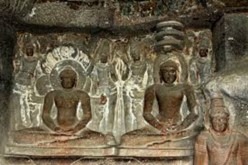
Cave architecture in Jainism flourished alongside Buddhist and Hindu rock-cut traditions. These monastic retreats, carved into hillsides and rock faces, served as places for meditation and religious instruction. Some of the most famous Jain cave complexes in India include:


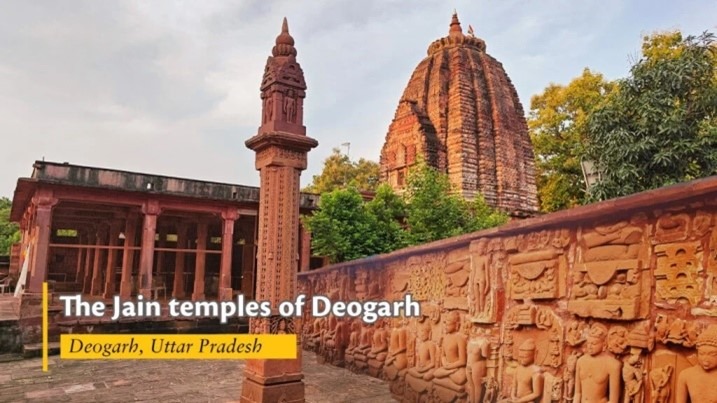
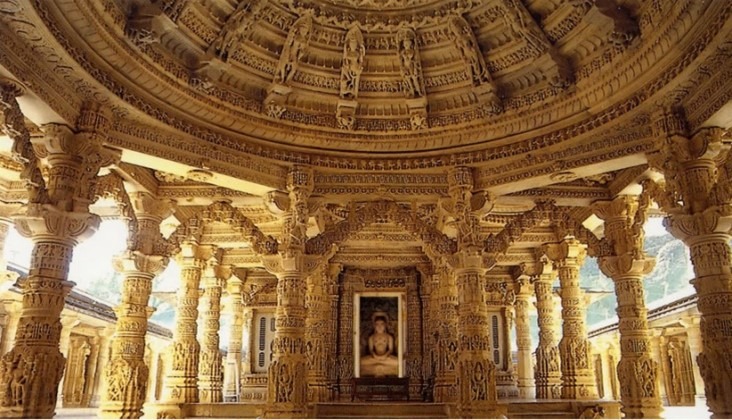
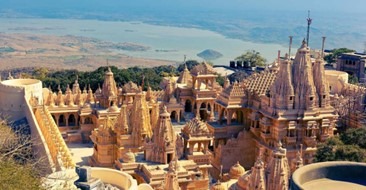
Jain temple architecture evolved into a unique style marked by symmetry, elegance, and intricately carved marble. Many Jain temples stand as architectural marvels across India:


Jainism also fostered a vibrant tradition of bronze image-making, especially of the Tirthankaras, which were used for both worship and ceremonial purposes. These bronzes are found across various regions and are celebrated for their refined detailing and spiritual symbolism.
Significant sites where hoards of Jain bronze sculptures have been discovered include:
These images typically depict Mahavira, Parshvanatha, and Adinatha, and are often adorned with stylized features like elongated ears, meditative postures, and parasol motifs signifying spiritual eminence.
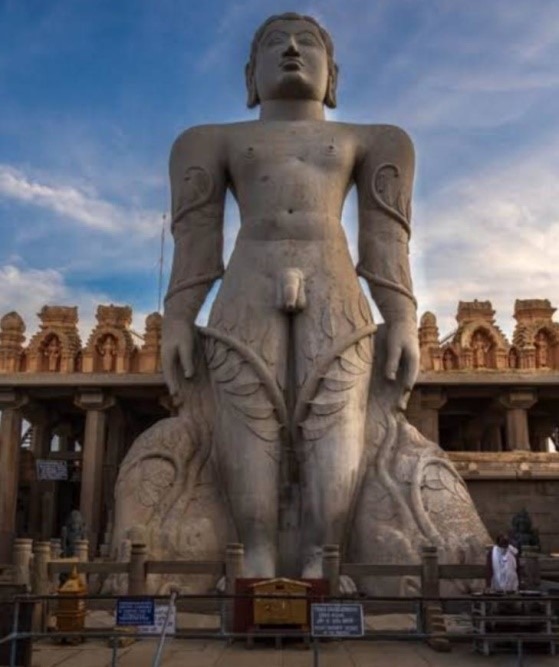
One of the most iconic symbols of Jain architecture is the monolithic statue of Bahubali, also known as Gommateshwara, located in Shravanabelagola, Karnataka.

The architectural and artistic legacy of Jainism is a testament to its spiritual depth, ethical rigor, and aesthetic refinement. From rock-cut sanctuaries and temple complexes to awe-inspiring statues and bronze artistry, Jain heritage sites continue to inspire wonder and reverence. They not only reflect the religious devotion of centuries past but also serve as a vital link between India’s ancient philosophies and its living cultural traditions.
Jainism, one of the most ancient spiritual traditions of India, has played a pivotal role in shaping the cultural, linguistic, economic, and intellectual life of the subcontinent. Beyond its religious and philosophical teachings, Jainism has significantly influenced literature, trade practices, societal reforms, and artistic heritage—leaving a legacy that continues to enrich Indian civilization.
Jainism’s role in the development and preservation of Indian languages and literary traditions is both profound and enduring. Jain monks and scholars, committed to spreading their teachings among the masses, adopted and elevated several regional and vernacular languages as literary mediums.
Jainism, with its strong emphasis on non-violence (Ahimsa), discouraged followers from engaging in professions that involved harm to living beings, including warfare and even agriculture, as it could lead to the destruction of life beneath the soil.
Jainism’s contributions are not limited to religion, language, and commerce. The tradition also made significant efforts toward social reform and cultural development.
The contributions of Jainism to Indian civilization are multi-faceted and enduring. From shaping the linguistic evolution of the subcontinent and enriching its literary and artistic traditions, to fostering economic prosperity through ethical commerce and promoting non-violent social reform, Jainism has played a transformative role in India’s cultural journey.
The community’s steadfast commitment to non-violence, truth, discipline, and learning has not only preserved an ancient tradition but also continuously contributed to India’s diverse, pluralistic identity.