
The Four Sights and the Great Renunciation (Mahabhinishkramana)
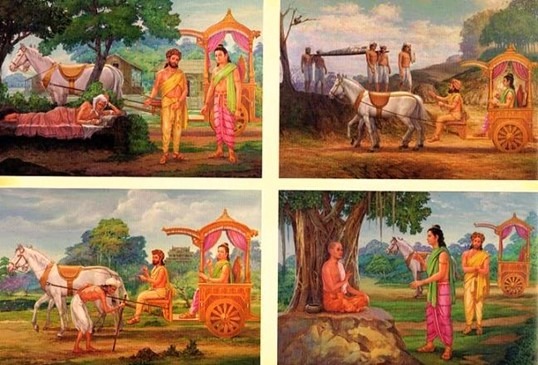
At the age of 29, Siddhartha ventured outside the palace walls and witnessed four sights that changed the course of his life: an old man, a sick man, a dead body, and an ascetic. These scenes exposed him to the inevitability of suffering and mortality, prompting him to seek a path beyond the cycles of birth, death, and rebirth.
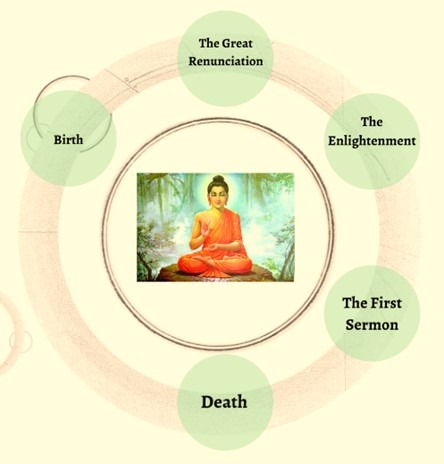
One night, accompanied by his loyal charioteer Chhandaka and riding his horse Kanthaka, Siddhartha left his palace silently. This act of leaving his home in search of spiritual truth is known as the Mahabhinishkramana or Great Departure. It marks the beginning of his journey as a seeker of ultimate knowledge.
Search for Enlightenment and Teachers
For the next six years, Siddhartha led the life of a wandering ascetic, experimenting with rigorous disciplines, self-mortification, and meditation. During this time, he studied under two prominent teachers:
- Alara Kalama, who taught him a meditative state called the sphere of nothingness.
- Udraka Ramaputra, from whom he learned the sphere of neither perception nor non-perception.
Despite mastering these techniques, Siddhartha found them insufficient to achieve liberation. Rejecting extremes of self-indulgence and self-denial, he adopted the Middle Path, a balanced approach to spiritual practice.
Enlightenment under the Bodhi Tree
At the age of 35, Siddhartha began deep meditation under a Peepal tree at Bodh Gaya, in present-day Bihar. After 49 days of intense meditation, he attained Enlightenment (Nirvana). With this supreme knowledge, he became the Buddha, meaning “The Awakened One” or “The Enlightened One.”
First Sermon and the Spread of the Dhamma
Following his Enlightenment, the Buddha traveled to Sarnath, near Varanasi, where he delivered his first sermon to five ascetics. This event is known as Dhammachakkapavattana or “Setting in Motion the Wheel of Dharma.” His five disciples—Kaundinya, Bhardika, Vashpa, Mahanama, and Ashvajit—became the first members of the Buddhist monastic community or Sangha.
Among them, Kaundinya, a Brahmin who had once predicted Siddhartha’s spiritual destiny, became the first Arahant, achieving Nirvana after hearing the Buddha’s teachings.
Forty-Five Years of Preaching and Travels
Over the next 45 years, Gautama Buddha traveled extensively on foot across the Gangetic plains, teaching the principles of Dhamma (the righteous path) and establishing monastic communities. His teachings cut across caste, class, and gender boundaries, and he welcomed all into the fold of Buddhism.
Prominent places he visited included:
- Vaishali (Vajji)
- Rajgir, Bodh Gaya, and Pataliputra (Magadha)
- Sarnath (Kashi)
- Kushinagar (Malla)
- Kausambi (Vatsa)
- Shravasti and Ayodhya (Kosala)
- Mathura (Shurasena)

Monks, including the Buddha himself, wandered for eight months each year, accepting alms and living a life of detachment. During the monsoon season, they stayed in shelters or caves to avoid harming crops and insects, reflecting the Buddha’s deep concern for Ahimsa (non-violence).
Teachings of Gautama Buddha
The teachings of Gautama Buddha, the founder of Buddhism, form the cornerstone of one of the most influential spiritual traditions in the world. Focused on ethical conduct, personal responsibility, and spiritual insight, the Buddha’s message was practical, compassionate, and revolutionary for its time. Rooted in human experience rather than divine revelation, his philosophy continues to inspire millions.
1. Foundations of the Buddha’s Teachings
Unlike the religious leaders of his time, Buddha did not claim divinity, nor did he appeal to supernatural authority. He rejected the idea of an eternal soul (atman) and a creator god. According to the Buddha, the social world was human-made, not divinely ordained. He challenged the authority of the Vedas, criticized the varna (caste) system, and opposed ritual sacrifices and elaborate ceremonies that defined the Brahmanical tradition.
The essence of his teachings can be found in the Sutta Pitaka, a collection of discourses attributed to him, preserved in the Pali Canon.
2. The Four Noble Truths (Arya Satya)
At the heart of Buddha’s teaching lies the understanding of human suffering and its cessation, encapsulated in the Four Noble Truths, which are:
1. Dukkha (Suffering): Life is inherently unsatisfactory and marked by suffering.
2. Samudaya (Origin of Suffering): The cause of suffering is desire, attachment, and craving (tanha).
3. Nirodha (Cessation of Suffering): Suffering can end when desire is extinguished.
4. Magga (The Path): There is a path that leads to the end of suffering, known as the Eightfold Path.
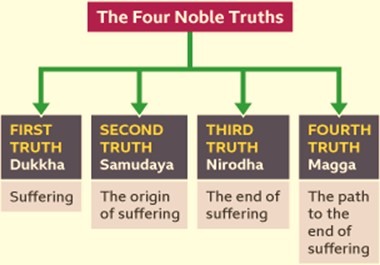
These truths highlight a realistic and introspective approach to life, focusing on overcoming suffering through inner transformation rather than divine intervention.
3. The Eightfold Path (Ashtangika Marga)
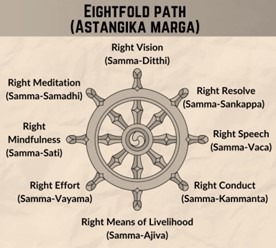
The Eightfold Path is the practical guide laid down by the Buddha for achieving liberation from suffering. It is a middle way that avoids both indulgence and extreme asceticism. It consists of:
- Right View – Understanding the Four Noble Truths.
- Right Intention – Commitment to ethical and mental self-improvement.
- Right Speech – Speaking truthfully, avoiding lies and harmful words.
- Right Action – Ethical conduct and non-violence.
- Right Livelihood – Earning a living without harming others.
- Right Effort – Developing and sustaining wholesome thoughts.
- Right Mindfulness – Awareness of body, feelings, and thoughts.
- Right Concentration – Practicing deep meditation.
4. Panchasheel: The Code of Conduct
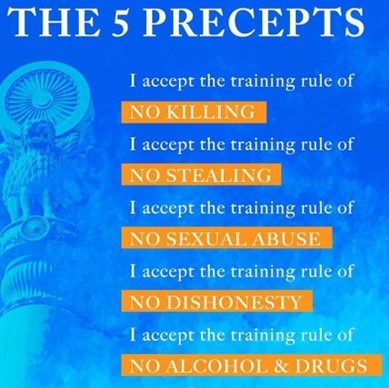
Buddha laid down five ethical precepts known as the Panchasheel, which serve as a moral foundation for lay followers:
- Refrain from killing any living being – Promote non-violence.
- Refrain from stealing – Respect others’ property.
- Refrain from sexual misconduct – Maintain purity.
- Refrain from false speech – Uphold truthfulness.
- Refrain from intoxicants – Maintain clarity of mind.
These precepts cultivate a life of compassion, integrity, and mindfulness.
5. Emphasis on Individual Action and Rational Thought
Buddha taught that salvation is achieved through personal effort, not by relying on priests, sacrifices, or rituals. He encouraged self-inquiry and critical thinking, stating that his followers should not accept teachings blindly—even his own—but test them through experience and reason.
Buddha discouraged speculation about metaphysical concepts such as the existence of the soul, God, or life after death. These were referred to as Avyakata (the unanswered questions) because they did not lead to liberation.
6. Concepts of Karma, Nibbana, and the Middle Path
- Karma (Action): Every intentional action has consequences. Good actions result in favorable outcomes, while bad actions lead to suffering. The law of karma governs both this life and future rebirths.
- Nibbana (Nirvana): The ultimate goal in Buddhism is the liberation from the cycle of birth and death (samsara). It is a state of freedom from desire, ego, and suffering. Nibbana literally means the extinguishing of the flame—symbolizing the extinction of greed, hatred, and delusion.
- Middle Path: Buddha advocated the Middle Path, which avoids the extremes of luxury and self-mortification. It promotes a balanced and mindful approach to life.
7. Compassion and Social Inclusion
- Karuna (Compassion): Buddha emphasized compassion for all living beings, urging rulers and householders to be just, generous, and humane.
- Ahimsa (Non-violence): Although not as stringent as in Jainism, non-violence was a key value in Buddhism. It extended to all forms of life.
- Equality: Buddha welcomed people from all castes, genders, and backgrounds. His spiritual community included kings, merchants, courtesans, and slaves.
8. The Sangha: Buddhist Monastic Community
Buddha established a monastic order known as the Sangha, comprising bhikkhus (monks) and later bhikkhunis (nuns). These individuals renounced worldly life to pursue the path of Dhamma.
- Entry into the Sangha was open to all, regardless of caste or status, though permission was required from family or authorities for dependents, servants, and officials.
- Ananda, Buddha’s disciple, persuaded him to admit women into the Sangha. Mahapajapati Gotami, his foster mother, became the first nun.
- Members followed a strict code of conduct, recorded in the Vinaya Pitaka, and lived by begging, meditating, and teaching.
The Sangha operated democratically, often using consensus or voting, and served as a vehicle to preserve and propagate the Buddha’s teachings.
9. The Arhat Ideal
In early Buddhism, the goal was to become an Arhat—a person who attains enlightenment and is liberated from samsara. Arhats lived in peace and solitude, free from desire. The concept evolved in different Buddhist schools, with some later Mahayana traditions considering Bodhisattvas to be spiritually superior to arhats.
10. The Viharas: Monastic Residences
As monks and nuns wandered for most of the year, during the monsoon season, they took refuge in temporary shelters or caves. Eventually, permanent monasteries known as viharas were constructed. These served as centers for:
- Study and teaching of Dhamma
- Meditation and community living
- Cultural and literary activity
Viharas were often built through the patronage of kings, wealthy merchants, and local communities. Many were carved from rock, especially in western India.
11. Language and Accessibility
- Buddha taught in Prakrit, the language of the common people, to ensure that his teachings could be understood by all, regardless of education or caste.
12. Prominent Disciples of Buddha
Buddha had two types of followers:
- Monastic disciples (bhikkhus and bhikkhunis), such as:
- Ananda – The Buddha’s closest attendant and “Treasurer of the Dhamma”
- Sariputta and Moggallana – His two chief disciples
- Lay followers (Upasakas and Upasikas) who practiced the Dhamma while living household lives.
The teachings of Gautama Buddha represent a pragmatic, ethical, and introspective approach to life. Centered on the elimination of suffering through self-awareness, compassion, and disciplined living, Buddhism offered a spiritual path that was inclusive, rational, and transformative. Its rejection of hierarchy and ritualism, combined with a deep emphasis on personal responsibility and inner peace, continues to resonate across cultures and eras.
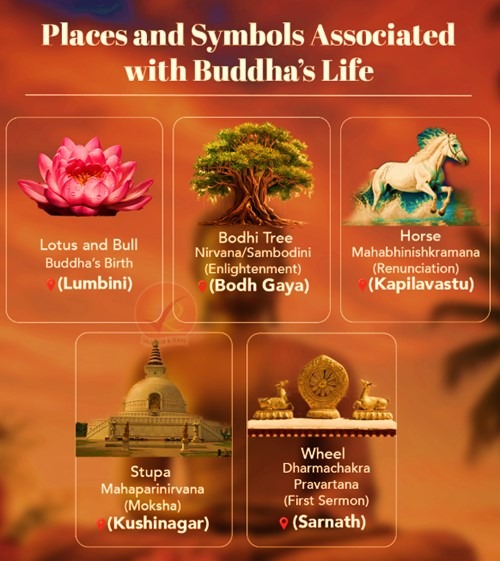
Place | Event Associated with Buddha’s Life |
Lumbini | Place of Birth |
Bodh Gaya | Place of Enlightenment |
Sarnath | Place of First Sermon |
Kushinagar | Place of Death and Cremation |
Symbols of 5 Great Events of Buddha’s Life
Buddhist Texts
Buddhism, a spiritual tradition founded by Gautama Buddha in the 6th century BCE, developed a rich body of literature that has been preserved and revered by followers over centuries. The sacred texts of Buddhism not only preserve the teachings of the Buddha but also provide insight into the philosophy, monastic rules, historical developments, and cultural evolution of Buddhism as it spread across Asia.
Tripitaka (Tipitaka) – The Three Baskets
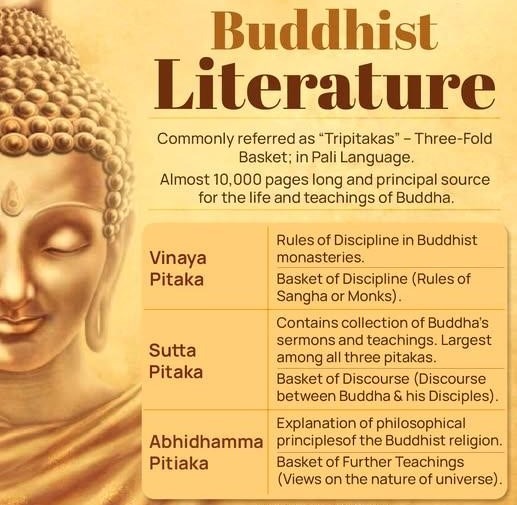
The Tripitaka, also known as the Tipitaka in Pali, is the earliest and most authoritative collection of Buddhist scriptures. It is divided into three “baskets” or sections:
1. Sutta Pitaka – The Basket of Discourses
- Contains the sermons and teachings of the Buddha delivered through dialogues, parables, and analogies.
- Compiled during the First Buddhist Council at Rajgir in 483 BCE, under the guidance of Ananda, a close disciple of the Buddha.
- Divided into five Nikayas (collections):
- Digha Nikaya (Long Discourses)
- Majjhima Nikaya (Middle-Length Discourses)
- Samyutta Nikaya (Connected Discourses)
- Anguttara Nikaya (Numerical Discourses)
- Khuddaka Nikaya (Minor Collection)
2. Vinaya Pitaka – The Basket of Discipline
- Encompasses rules and regulations for monks and nuns of the Buddhist Sangha (monastic community).
- Also compiled at the First Council at Rajgir, led by Upali.
- It outlines the monastic code (Patimokkha), disciplinary procedures, and daily conduct.
3. Abhidhamma Pitaka – The Basket of Higher Doctrine
- Contains philosophical and psychological analysis of Buddhist teachings.
- Composed in the form of structured questions and answers.
- Compiled during the Third Buddhist Council at Pataliputra (modern Patna) in 250 BCE, under the leadership of Moggaliputta Tissa.
- Consists of seven books: Dhammasangani, Vibhanga, Dhatukatha, Puggalapannatti, Kathavatthu, Yamaka, and Patthana.
Oral Tradition and Language
Buddha’s teachings were initially transmitted orally, through discussions and debates among his disciples. They were not written down during his lifetime. The first compilations occurred shortly after his death at the First Council, forming the basis of the Tripitaka, which was composed in the Pali language.
While early Buddhist texts are primarily in Pali, later compositions—especially in Northern and Mahayana traditions—appeared in Sanskrit, Tibetan, and Chinese.
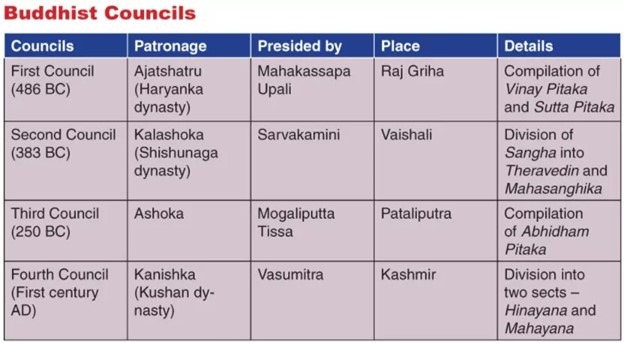
Buddhist Councils
Mahayana Buddhism: The Great Vehicle of Compassion
Mahayana Buddhism, one of the major branches of the Buddhist tradition, emerged as a powerful spiritual movement that reshaped Buddhist beliefs and practices. Unlike the earlier schools that emphasized personal liberation through self-discipline, Mahayana introduced the ideal of the Bodhisattva—a being who postpones their own nirvana in order to help others attain enlightenment. This shift marked a profound transformation in the philosophical, devotional, and artistic expressions of Buddhism.
Evolution from Early Buddhism to Mahayana
In early Buddhist teachings, as preserved in the Theravada (Hinayana) tradition, the focus was primarily on the individual’s personal effort (self-effort) to achieve nibbana (nirvana). The Buddha was regarded as a human teacher, a seeker who attained enlightenment through his own perseverance and insight. Followers were encouraged to emulate him and become arhats—individuals who attain liberation from the cycle of rebirth through rigorous spiritual discipline.
However, by the first century CE, significant changes began to emerge in Buddhist thought and practice. A growing body of literature and followers began to envision Buddha not just as a teacher, but as a savior-like figure who could be revered and worshipped. This led to the gradual development of image worship and the concept of divine compassion, eventually giving birth to Mahayana Buddhism, meaning the “Great Vehicle.”
Birth and Rise of Mahayana Buddhism
Although the ideological roots of Mahayana Buddhism trace back to about the first century BCE, particularly in the Andhra region of South India, it was initially met with resistance from orthodox Buddhist schools. The movement gained momentum under the influence of Nagarjuna, one of Mahayana’s greatest philosophers, whose teachings on Shunyata (emptiness) and the Middle Way laid the intellectual foundation of this tradition.
The formal establishment of Mahayana Buddhism is attributed to the Fourth Buddhist Council, held under the patronage of Kushan Emperor Kanishka in the first century CE at Kundalvana (Kashmir). Kanishka is widely credited with institutionalizing the Mahayana school and promoting it through royal patronage and the commissioning of Buddhist art and literature.
Key Characteristics of Mahayana Buddhism
Mahayana Buddhism introduced several distinct philosophical and devotional features that differentiated it from earlier schools.
1. The Ideal of the Bodhisattva
- At the heart of Mahayana thought is the Bodhisattva ideal—a compassionate being who has attained enlightenment but chooses to remain in the world to help others achieve liberation.
- Bodhisattvas embody universal compassion and are committed to alleviating the suffering of all sentient beings, unlike the Arhat, who seeks personal salvation.
- Prominent Bodhisattvas in Mahayana include:
- Avalokiteshvara (Bodhisattva of Compassion)
- Manjushri (Bodhisattva of Wisdom)
- Maitreya (the future Buddha)
- Gautama Buddha himself was believed to have gone through several lifetimes as a Bodhisattva, perfecting his virtues before his final birth.
2. Image Worship and Devotional Practices
- Early Buddhism avoided anthropomorphic representations of the Buddha, symbolizing his presence through icons like the bodhi tree, wheel (Dharma Chakra), or footprints.
- Mahayana Buddhism introduced the worship of Buddha images and statues of Bodhisattvas as a central part of religious life.
- Temples, stupas, and caves were adorned with magnificent sculptures and paintings to inspire devotion and visualize the divine.
Doctrinal Shift: From Arhat to Bodhisattva
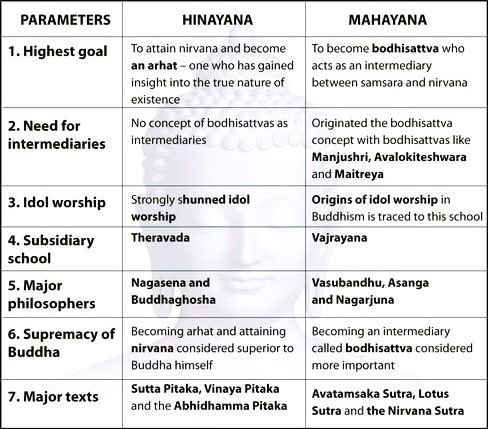
Mahayana Buddhists criticized the Arhat ideal, viewing it as self-centered and limited in its scope. They believed that true enlightenment involves helping others attain liberation, not merely seeking one’s own.
- Arhatship is seen as a lower goal, while Bodhisattvahood is regarded as the highest aspiration.
- Followers are encouraged to cultivate the six paramitas (perfections) on the Bodhisattva path:
- Generosity (Dana)
- Morality (Shila)
- Patience (Kshanti)
- Energy (Virya)
- Meditation (Dhyana)
- Wisdom (Prajna)
Hinayana vs. Mahayana: A Clarification
- The term Hinayana (literally, “lesser vehicle”) was used by Mahayana followers to refer to those who did not adopt the Bodhisattva ideal.
- However, those associated with this older tradition call themselves Theravadins, or followers of the “Teaching of the Elders.”
- According to many scholars, Theravada Buddhism is a sub-school of what Mahayana called “Hinayana”, but Hinayana as a distinct sect no longer exists.
- Today, Theravada Buddhism is a thriving tradition, primarily practiced in Sri Lanka, Myanmar, Thailand, Laos, and Cambodia.
Geographical Spread and Cultural Impact
Mahayana Buddhism found fertile ground in:
- China, Korea, Japan, and Vietnam – where it evolved into schools like Zen, Pure Land, and Nichiren.
- Central Asia and Tibet – where it fused with local practices, leading to the rise of Vajrayana Buddhism (also known as Tantric or Esoteric Buddhism).
Its emphasis on compassion, community service, universal salvation, and religious art allowed it to adapt to diverse cultures and flourish across a wide range of societies.
Mahayana Buddhism represents a profound shift in the ethos and practice of the Buddhist tradition. By embracing the ideal of compassionate service, venerating the Buddha and Bodhisattvas, and expanding the goals of spiritual practice to include the liberation of all beings, Mahayana redefined the meaning of enlightenment itself.
Whether expressed through philosophy, ritual, art, or community work, Mahayana Buddhism remains a living path of wisdom and compassion, offering a broader, more inclusive vehicle for human liberation.
Spread of Buddhism
Buddhism, one of the most influential spiritual traditions in the world, witnessed a remarkable spread both during the lifetime of its founder, Gautama Buddha, and after his death. What began as a modest path to spiritual liberation in northern India soon evolved into a global religious movement, thanks to its inclusive philosophy, effective organization, and the patronage it received from rulers and commoners alike.
1. Spread During the Buddha’s Lifetime
During the lifetime of Gautama Buddha (6th–5th century BCE), Buddhism attracted a wide range of followers. It expanded swiftly, gaining acceptance among both monarchies and republics across the Indian subcontinent.
- Prominent Monarchies: Kingdoms like Magadha, Koshala, and Kausambi played a major role in adopting and propagating the new faith.
- Republics: Republican states such as the Sakyas, Vajjis, and Mallas, known for their liberal socio-political systems, embraced the teachings of the Buddha.
- Royal Patrons: Influential rulers such as Bimbisara and Ajatashatru of Magadha, Chanda Pradyota of Avanti, Udayana of Vatsa, and Prasenjit of Kosala became prominent disciples, providing political and moral legitimacy to the religion.
2. Spread After Buddha’s Death
After the passing of the Buddha in 483 BCE, Buddhism continued to flourish under the patronage of powerful monarchs and through the efforts of devoted disciples.
- King Ashoka the Great (3rd century BCE): After converting to Buddhism following the Kalinga War, Ashoka became a passionate supporter. He sent missionaries across Asia, including his son Mahendra and daughter Sanghamitra to Sri Lanka. His efforts led to the firm establishment of Theravada Buddhism in regions like Sri Lanka, Myanmar, Thailand, Laos, and parts of Indonesia.
- Emperor Kanishka (1st–2nd century CE): Under Kanishka of the Kushan dynasty, Mahayana Buddhism received imperial support. He organized the Fourth Buddhist Council and facilitated the religion’s spread to Central Asia, China, Korea, and Japan.
3. Global Expansion of Buddhism
Over time, Buddhism transcended the boundaries of India and reached distant lands:
Region | Form of Buddhism | Key Contributor |
Sri Lanka, Myanmar, Thailand | Theravada | Ashoka |
Indonesia | Theravada | Ashoka |
Central Asia, China, Korea, Japan | Mahayana | Kanishka |
Although Buddhism gradually declined in India due to various socio-political factors, it remained deeply rooted and vibrant in many parts of Asia and beyond.
4. Reasons Behind the Rapid Spread of Buddhism
The widespread appeal of Buddhism can be attributed to a combination of ideological, linguistic, organizational, and political factors:
A. Charismatic Personality of the Buddha
- Gautama Buddha’s calm demeanor, compassionate nature, and non-violent approach won the hearts of the people. He practiced what he preached — responding to hatred with love and to slander with silence. His humility and integrity inspired people from all walks of life to follow him.
B. Practical and Ethical Teachings
- Buddha’s teachings focused on practical morality, offering simple solutions to life’s suffering. Unlike the complex rituals and philosophical abstractions of Brahmanism, Buddhism taught the Noble Eightfold Path, which was easily understood and applicable to daily life. The emphasis on metta (loving-kindness) and karuna (compassion) resonated deeply with the masses.
C. Rejection of the Varna (Caste) System
- Buddhism openly challenged the rigid caste system. It welcomed people from all social backgrounds — including merchants like Anathapindika, and courtesans like Amrapali — offering them dignity and respect. The inclusion of women in the Sangha (monastic community) was also revolutionary, giving them spiritual equality at a time when it was denied elsewhere.
D. Use of the Pali Language
- Unlike Brahmanical Hinduism, which used Sanskrit, a language limited to the educated elite, Buddhism adopted Pali, the language of the common people. This made the teachings accessible to a much wider audience and helped in the grassroots spread of the religion.
E. Royal Patronage and State Support
- Kings and emperors who adopted Buddhism contributed significantly to its expansion. Their patronage helped build monasteries, sponsor missionary work, and hold councils that codified teachings and practices. The support of Ashoka and Kanishka was particularly crucial in transforming Buddhism into a pan-Asian faith.
F. The Role of the Sangha (Monastic Order)
- The well-organized and disciplined monastic order, or Sangha, played a pivotal role in institutionalizing and spreading Buddhism. Monks and nuns lived simple, disciplined lives and travelled widely to preach, teach, and serve. The Sangha became the backbone of the religion’s growth, providing a stable framework for religious life and learning.

The rise and spread of Buddhism are remarkable not only for their historical significance but also for their enduring legacy. Through compassion, simplicity, inclusiveness, and organized outreach, Buddhism transcended barriers of language, caste, and geography to become one of the world’s major religions. Its influence continues to shape spiritual, cultural, and ethical thought across continents even today.
Mudras of Buddha
Mudras of Buddha are basically sacred and symbolic gestures and non-verbal mode of communication and self-expression in Buddhism which consist of hand gestures and finger-postures.
Bhumisparsha Mudra
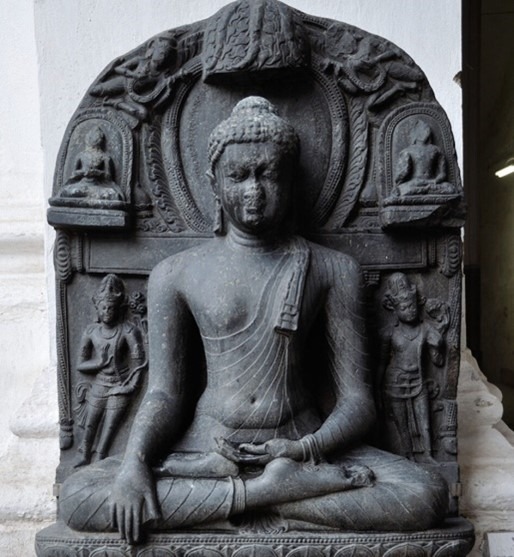
- The Bhumisparsha Mudra, or “Earth-Touching Gesture,” is one of the most iconic and frequently depicted hand gestures in Buddha statues.
- In this mudra, the Buddha is shown seated in deep meditation, with his left hand resting palm-up in his lap and his right hand extended downward to touch the earth.
- This gesture is closely linked with the blue Buddha Akshobya, symbolizing unwavering resolve.
- Significance: It represents the pivotal moment when the Buddha attained enlightenment under the Bodhi tree, calling the Earth to witness his victory over temptation and ignorance. This act affirmed the truth of his spiritual awakening.
Dhyana Mudra
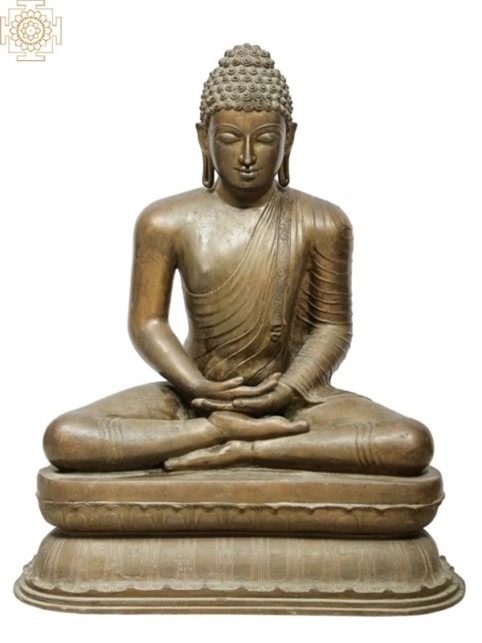
- The Dhyana Mudra, also known as the ‘Samadhi’ or ‘Yoga’ Mudra, symbolizes deep meditation, concentration, and inner peace.
- In this gesture, the Buddha is depicted with both hands resting in the lap, the right hand placed over the left, palms facing upward, and fingers fully extended. In many representations, the thumbs of both hands touch at the tips, forming a mystic triangle—a symbol of spiritual unity and enlightenment.
- This mudra signifies the attainment of spiritual perfection and inner tranquility.
- It is most closely associated with the Buddha’s final meditation under the Bodhi tree, leading to his enlightenment.
Vitarka Mudra

- The Vitarka Mudra represents teaching, intellectual discussion, and the transmission of Buddhist wisdom.
- In this gesture, the thumb and index finger touch at their tips, forming a circle, while the right hand is held at shoulder level and the left hand rests in the lap at hip level, with the palm facing upward.
- This mudra symbolizes the phase of teaching and reasoning in the life of the Buddha, particularly when he delivered sermons and engaged in philosophical dialogue.
- The circle formed by the thumb and index finger signifies the unbroken flow of energy and knowledge, embodying perfection, continuity, and completeness in the act of teaching.
Abhaya Mudra
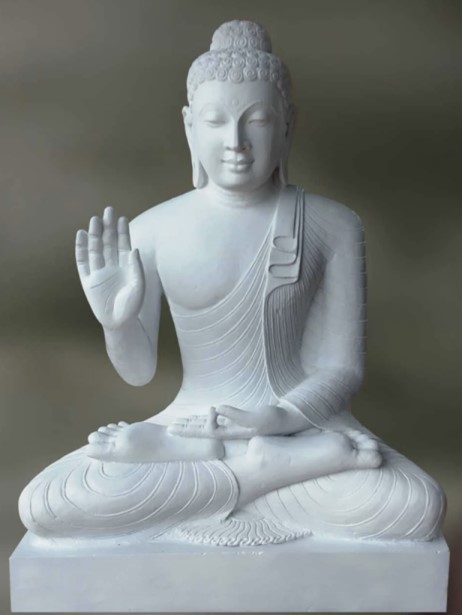
- The Abhaya Mudra symbolizes fearlessness, protection, and reassurance, reflecting inner strength and spiritual power.
- In this gesture, the right hand is raised to shoulder height, with the arm bent, palm facing outward, and fingers extended and joined together, while the left hand hangs naturally at the side.
- This mudra conveys a message of peace and the dispelling of fear, offering comfort and safety to followers.
- It is believed that the Buddha adopted this gesture immediately after attaining enlightenment, signifying his resolve to guide others on the path to liberation without fear.
Dharmachakra Mudra
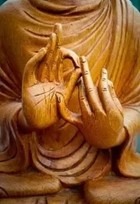
- The Dharmachakra Mudra represents the “Turning of the Wheel of Dharma,” symbolizing the Buddha’s first sermon and the beginning of his teaching journey.
- This gesture involves both hands positioned at chest level.
- The right hand faces outward, with the thumb and index finger touching to form a circle, while the left hand faces inward, with its thumb and index finger also forming a circle and touching the corresponding fingers of the right hand.
- The interlocking circles symbolize the unbroken flow of wisdom and teaching.
- This mudra was famously demonstrated by the Buddha during his first sermon at the Deer Park in Sarnath, after attaining enlightenment.
Anjali Mudra
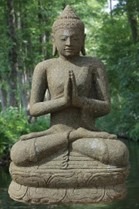
- The Anjali Mudra symbolizes greeting, reverence, devotion, and adoration.
- It is performed by bringing both hands together in front of the chest, with palms and fingers pressed together in a vertical position.
- This gesture is widely recognized as the traditional Indian salutation “Namaste,” expressing respect, humility, and acknowledgment of the divine in others.
- It signifies honouring a superior or showing deep respect and is often used during prayers and devotional practices.
- In Buddhist tradition, it is believed that enlightened Buddhas do not perform this gesture. Instead, the Anjali Mudra is typically associated with Bodhisattvas, symbolizing their humility, devotion, and aspiration toward full enlightenment.
Uttarabodhi Mudra
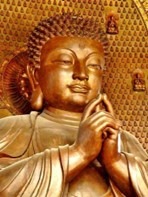
- The Uttarabodhi Mudra represents supreme enlightenment and the realization of ultimate truth.
- It is performed by interlocking all fingers of both hands, except for the index fingers, which are extended straight upward and touch each other, held at chest level.
- This gesture is believed to channel powerful energy and is often associated with a state of spiritual awakening and inner perfection.
- It conveys the idea of oneness with the universal energy and symbolizes the culmination of the spiritual journey.
- This mudra is famously depicted in representations of Shakyamuni Buddha, particularly in his role as the liberator of Nagas, highlighting its deep spiritual and symbolic significance.
Varada Mudra
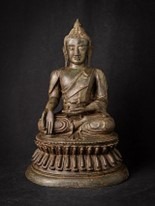
- This gesture symbolizes charity, compassion, and the granting of wishes.
- The right arm is naturally extended downward, with the palm facing outward toward the observer. When standing, the arm is held slightly forward. It can also be performed with the left hand.
- The five outstretched fingers represent the five virtues: Generosity, Morality, Patience, Effort, and Meditative Concentration.
Karana Mudra
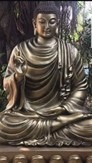
- This mudra represents the act of warding off evil.
- The hand is extended either horizontally or vertically with the palm facing forward. The thumb presses down the two folded middle fingers, while the index and little fingers are raised straight upward.
- It symbolizes the expulsion of demons and negative energy, generating a powerful force that helps eliminate obstacles like illness and harmful
Vajra Mudra
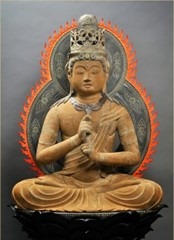
- This mudra symbolizes knowledge and wisdom.
- It is especially well-known in Korea and Japan.
- In this gesture, the upright forefinger of the left hand is enclosed within the fist of the right hand. It is also seen in a mirror-inverted form.
- The mudra highlights the significance of knowledge—represented by the extended forefinger—while the right hand’s fist signifies protection of this supreme wisdom.