
Prehistoric Period
- It refers to the time in human history before the advent of written records.
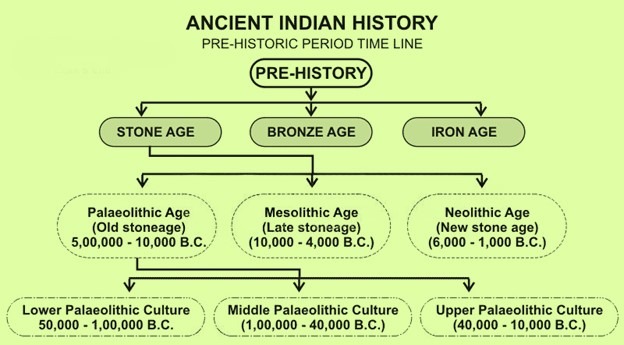
- The Prehistory of India is divided into three phases.
The first one is the age of Stone Age, the second is the Bronze Age and the third is the Iron Age. The prehistoric age in India dates back to the start of the Stone Age. The Stone Age is further divided into three phases, Palaeolithic, Mesolithic and Neolithic.

Palaeolithic Period
The Palaeolithic Age is the earliest period of the Stone Age, which developed in the Pleistocene or Ice Age. It was spread in practically all parts of India except the alluvial plains of the Indus and Ganga.
The Palaeolithic man of India is said to have belonged to the Negrito race and lived in caves and rock shelters. They were food-gathering people who lived on hunting and gathering wild fruits and vegetables. They had no knowledge of agriculture, house building, pottery, or any metal. It was only in later stages that they attained the knowledge of fire.
During this period, man used tools of unpolished, undressed rough stones — mainly hand axes, cleavers, choppers, blades, burin, and scrapers. Since the stone tools were made of a hard rock called ‘quartzite’, Palaeolithic men are therefore also called ‘Quartzite men’ in India. Following are the features of this period.
Art & Cult:
- In the Palaeolithic age, art was dependent on the Ostrich Egg Beads and people used to worship the Mother Goddess.
Life Style:
- The People depended on a reciprocity system. They were living in the band society in which around 50-60 people were living. Their settlement was not permanent. The children and old people were not working as the hunting and gathering process required active participation.
Food Resources:
- They were dependent on hunting gathering, fruits and the eggs of ostrich. The major differences between the different phases of the Palaeolithic period are the types and quality of tools used by people.
Lower Palaeolithic Age (5,00,000- 1,00,000 B.C.):
- It covers the greater part of the Ice Age. The people were wanderers. They did not know how to grow food. They used to eat fruits, birds and raw animal flesh, etc. The tools were usually made of hard rock, ‘Quartzite’ and therefore the man of the Palaeolithic age is called ‘Quartzite Man’. For hunting they used hand-axe, cleavers, flaxes and choppers of irregular shapes. A fossil of “Homo Erectus”, from Hathnaura (Narmada basin), of this age has been found. This age is represented by Sohan culture (Now in Pakistan). Sohan Valley (Punjab), Belan Valley (Mirzapur), Narmada Valley (Madhya Pradesh), Didwani (Rajasthan), and Bhimbetka (M.P.), Singrauli basin (U.P), Chhotanagpur (Jharkhand), Assam, Andhra Pradesh, Karnataka and in whole India except Sind and Kerala.
Middle Palaeolithic Age (1,00,000 – 40,000 B. C.):
- It was an age of flakes. A bit of change in the shape of tools made of stones or bones is remarked. Now they started using blades, points and scrappers made of flakes. Still, they had no house to live in. They lived under the rocks in caves and hollow tree trunks. They were afraid of wild creatures.
Neanderthal man dominated this stage of human evolution. Important Sites are Bankura and Purulia (West Bengal), Nevasa, Nodur Madhmeshwar, Suregaon and Nevasa (Maharastra), Malprabha and Ghatprabha basin (Karnataka). Narmada Valley, etc. In Bhimbetka (M.P) 200 rock shelters, caves and thousands of paintings have been traced which are of the middle Palaeolithic age, i.e. scrapper and borer culture.
Upper Palaeolithic Age (40,000 – 10,000 B.C.):
- In this period, humans lived as nomadic huntergatherers.
The traces of Homo sapiens have been discovered. Rock paintings and carvings have been found in Bhimbetka that reflect the art and rituals of this period. The animals depicted in these are mostly bison, elephants, tigers, bears, rhinoceros, etc. The upper Palaeolithic art is characterised by red and green colours. Important Sites are Andhra Pradesh, Karnataka, Maharastra, Bhopal (Bhimbetka) and Chhotanagpur (Jharkhand).

Mesolithic Period
The Mesolithic Age, often referred to as the Middle Stone Age, marks a significant transitional phase in the evolution of prehistoric human society. Positioned chronologically between the Paleolithic and Neolithic periods, the Mesolithic era is considered a bridge between the older hunter-gatherer lifestyle and the onset of agricultural and settled life. This phase is broadly dated to the Holocene epoch, which succeeded the Pleistocene epoch approximately 10,000 years ago.
During the Mesolithic period, humans primarily sustained themselves through hunting, fishing, and gathering of wild food. However, by the later stages of this age, they began to exhibit early signs of animal domestication, laying the groundwork for future agricultural societies.
Tools and Technological Advancements
One of the most defining features of the Mesolithic Age was the development of microliths — small, finely-crafted stone tools usually made from crypto-crystalline materials such as chalcedony, chert, or silica. These microliths were not only distinctive due to their miniature size and precision but also for their geometrical and non-geometrical shapes. Unlike the larger and cruder tools of the Paleolithic Age, Mesolithic microliths demonstrated technological sophistication.
These tools were often hafted onto wooden or bone handles, transforming them into composite tools like sickles, arrowheads, spear tips, and other hunting or processing implements. This innovation significantly enhanced the efficiency of hunting and gathering activities, as well as laid the foundation for future advancements in tool-making during the Neolithic period.
Cultural Aspects: Art, Religion, and Lifestyle
The Mesolithic people, though primarily nomadic, left behind remarkable evidence of their artistic and religious sensibilities. One of the most notable contributions of this period is the emergence of prehistoric rock art. In 1867, the first Indian rock paintings were discovered at Sohagighat in the Kaimur Hills of Uttar Pradesh. Since then, over 150 rock art sites belonging to the Mesolithic period have been identified across India.
Among these, the Bhimbetka Caves in Madhya Pradesh stand out as a UNESCO World Heritage Site, offering a wealth of pictorial narratives. Other important rock art locations include Kharwar, Jaora, and Kathotia (Madhya Pradesh), Sundargarh and Sambalpur (Odisha), and Ezhuthu Guha (Kerala).
These paintings predominantly feature animals, reflecting the close association of Mesolithic people with nature and their reliance on fauna for survival. Interestingly, snakes are notably absent from these depictions, which has puzzled archaeologists and historians alike. The presence of burials and symbolic imagery in these sites suggests the beginnings of religious rituals and possibly early concepts of the afterlife. Furthermore, the division of labor — often inferred through art and skeletal analysis — hints at an early form of gender-based role differentiation in Mesolithic communities.
Absence and Introduction of Pottery and Agriculture
Pottery, which becomes a hallmark of the Neolithic Age, is generally absent in most Mesolithic sites. However, a few exceptions exist, such as Langhnaj in Gujarat and parts of the Kaimur region in Mirzapur (Uttar Pradesh), where early evidence of pottery has been found. These findings indicate a gradual cultural shift toward a more sedentary lifestyle.
In the later Mesolithic phase, humans began the initial stages of plant cultivation, which, although rudimentary, marked a turning point in human history. This slow but steady shift from a foraging economy to a food-producing one eventually paved the way for full-fledged agriculture in the Neolithic period.
Major Mesolithic Sites in India
India is home to several important Mesolithic archaeological sites, spread across various regions:
- Rajasthan: The state hosts Bagor, which is the largest Mesolithic site in India. Other significant sites include Tilwara, the Pachpadra basin, and the Sojat area.
- Gujarat: Prominent Mesolithic settlements have been discovered along the Sabarmati River, including Langhnaj, Akhaj, Valsana, and Hirpur.
- Uttar Pradesh: Major sites include Sarai Nahar Rai, Morhana Pahar, and Lekkahia, all of which provide evidence of early habitation, tool usage, and subsistence patterns.
- Madhya Pradesh: Aside from Bhimbetka, Chaturbhujnath Nala and Adamgarh are well-known for their rock shelters and microlithic tools.
- Jharkhand: The Chhota Nagpur Plateau is a notable area rich in Mesolithic findings.
- Odisha: Key sites include Mayurbhanj, Keonjhar, and Sundargarh, where tools and habitation sites reveal significant Mesolithic activity.
- South India: Mesolithic cultural remnants have also been found in parts of Karnataka, Tamil Nadu, and Andhra Pradesh, indicating the widespread distribution of Mesolithic communities across the subcontinent.
The Mesolithic Age in India was a dynamic and transformative period in the subcontinent’s prehistoric journey. With advancements in tool-making, the beginnings of domestication and agriculture, and the emergence of artistic and religious expressions, it laid a crucial foundation for the settled societies of the Neolithic period. Its widespread archaeological footprint across India underscores the diversity and richness of human adaptation during this intermediate era.

Major Neolithic Sites in India and Their Unique Features
India has a rich archaeological record of Neolithic sites, each contributing uniquely to our understanding of early human settlements:
1. Northern India
- Burzahom (Jammu and Kashmir): Known for unique rectangular stone choppers and the burial of domestic dogs with humans, indicating a special relationship with animals.
- Gufkral (Jammu and Kashmir): Famous for pit dwellings, stone tools, and household graveyards, offering insights into social and ritual practices.
2. Southern India
- Maski, Brahmagiri, Piklihal (Karnataka): Evidence of cattle herding, suggesting early pastoralism.
- Budihal (Karnataka): Noted for communal food preparation and feasting, reflecting social bonding.
- Tekkalakota (Karnataka): An important site indicating mixed farming and permanent settlement.
- Paiyampalli (Tamil Nadu) and Utnur (Andhra Pradesh): Important for understanding Neolithic cultural expansion in South India.
3. Eastern India
- Chirand (Bihar): Known for extensive use of bone tools, particularly antler-based implements.
- Garo Hills (Meghalaya): Represents one of the major Neolithic zones in the North-Eastern region.
4. Central and Indo-Gangetic Region
- Belan Valley (Uttar Pradesh): Crucial for understanding continuity across Paleolithic, Mesolithic, and Neolithic phases.
- Chopani Mando (Uttar Pradesh): Provides the earliest evidence of pottery use.
- Koldihwa and Mahagara (Uttar Pradesh): Reveal strata of circular huts and early rice cultivation, including the world’s earliest evidence of domesticated rice.
- Koldihwa also shows overlapping Neolithic, Chalcolithic, and Iron Age layers, showcasing long-term occupation.
5. North-Western Region (Now in Pakistan)
- Mehrgarh (Baluchistan): Considered the earliest Neolithic site in the Indian subcontinent, often referred to as the “Breadbasket of Baluchistan.” It demonstrates early forms of agriculture, animal domestication, and settlement planning.
- Saraikhola (Potwar Plateau, near Taxila), Amri, and Kot Diji: Offer significant insight into the proto-urban phase and cultural interactions with the Indus Valley Civilization.

The Neolithic Age in India was a foundational period that transformed human existence from a nomadic, subsistence-based lifestyle to a more organized, agrarian one. The development of agriculture, domestication of animals, innovation in tools, pottery, textile production, and the formation of permanent settlements marked the beginning of civilization on the Indian subcontinent.
The diverse and regionally varied Neolithic sites across India not only reflect the adaptability of early human societies but also showcase the deep-rooted cultural traditions that would later shape India’s historical trajectory.
Chalcolithic Period
This age is marked by the use of copper as copper was the first metal used by man of this age. The economy was based on subsistence agriculture, stock-raising, hunting and fishing. The dead were buried in the North-South position in Maharashtra but in South India, it was in the East-West direction.
The chalcolithic people slaughtered animals for food. Some perforated stone discs are found which were used for jhum-cultivation. The supply of copper was limited. People did not know the art of mixing tin with copper. The decline in rainfall from about 1200 B.C. led to the decay of this culture. Due to the agitation of epidemics, the culture of chalcolithic people came to an end. The transitional stage between the Stone Age and humans started living a settled life.
Important sites:
Probably, this culture was extended from the Chhotanagpur plateau to the upper Gangetic basin. Some sites are found at Brahmagiri near Mysore and Navada Toli on the Narmada. Copper hoards have been found in a wide area from West Bengal, Orissa, Haryana, Andhra Pradesh and Uttar Pradesh. From Gungeria (M.P) we have found 424 copper tools and weapons and 102 thin sheets of silver objects. Stone tools have also been found in excavations. Mostly the copper hoards were supplemented by stone tools that paved the way of a settled life in a good portion of the Ganga – Yamuna doab. Besides these, the two types of pottery, i.e., O.C.P. (Ochre Coloured Pottery) and B.R.W. (Black and Red Ware), showing Harappan influence, have been excavated from various sites.

Some Important Features of the Chalcolithic Age:Both Kharif and Rabi crops were cultivated. Barley was the main crop. A highly specialised store blade industry of siliceous store is found. Cotton was produced for the first time in this period. First village communities in Peninsular India were found. Jhum cultivation was practised. First-time fortified settlements were built, e.g., sites of Daimabad, Inamgao, Nagada, etc.
Burial Practices of the Megalithic Culture in India
The Megalithic Culture of ancient India, characterized by large stone constructions associated with burials, offers profound insights into the social, economic, and cultural lives of its people. These burial practices not only reflect regional variations but also highlight social stratification, craftsmanship, and belief systems—particularly the concept of an afterlife.
Below is an overview of key megalithic burial sites and their significance:
1. Brahmagiri (Karnataka)
- Types of Burials: Cairns, stone circles, and dolmens.
- Social Implications: The size and complexity of burial monuments vary significantly, indicating a hierarchical society. More elaborate constructions likely belonged to individuals of higher status.
- Key Discoveries: Excavations revealed grave goods such as pottery, beads, iron tools, and even gold ornaments—strong indicators of wealth, status, and belief in life after death.
2. Adichanallur (Tamil Nadu)
- Types of Burials: Urn burials and pit burials.
- Social Implications: The diversity of burial goods—ranging from iron weapons and bronze artifacts to finely crafted pottery—points to clearly defined social classes.
- Key Discoveries: A remarkably rich assemblage of objects offers a window into the material culture and socio-economic organization of the time.
3. Porkalam (Kerala)
- Types of Burials: Dolmens, cists, and stone circles.
- Social Implications: Burial diversity, along with the presence of personal ornaments and utilitarian tools, reflects the existence of social stratification and specialized roles.
- Key Discoveries: The presence of iron weapons and tools suggests not only a high level of metallurgical skill but also a probable warrior class within the society.
4. Junapani (Maharashtra)
- Types of Burials: Cairn circles and cists.
- Social Implications: Variations in burial size and the richness of grave goods indicate disparities in wealth and status.
- Key Discoveries: With a large number of megalithic structures, Junapani stands out as a significant site for understanding burial customs and the broader social fabric of megalithic communities.

The burial practices of the Megalithic Culture serve as archaeological testimonies to an organized society with complex belief systems, economic structures, and clear social hierarchies. The diversity across regions—reflected in burial styles and grave goods—underscores the cultural richness and technological advancement of early Indian civilizations.
Major Impacts of Iron in Ancient India
1. Forest Clearance and Agricultural Expansion
The arrival of iron axes, hoes, and ploughshares dramatically transformed the agricultural landscape. These tools enabled the large-scale clearing of dense forests, especially in the eastern Gangetic plains, where older tools made of stone or copper were ineffective against the thick vegetation.
With iron implements, communities could cultivate heavier and more fertile alluvial soils, previously inaccessible. This led to a surge in agricultural productivity, allowing for larger, more permanent settlements and a growing population. Crops like rice, wheat, barley, and pulses could be grown more efficiently, laying the foundation for rural prosperity.
2. Urbanization and the “Second Urbanization” (600 BCE onwards)
The enhanced agricultural output resulting from iron use contributed to the rise of urban centers. As food surpluses grew, trade, commerce, and craft specialization developed, giving rise to the Second Urbanization—a period marked by the emergence of cities after the Harappan Civilization.
Major cities such as:
- Pataliputra (a political and administrative hub)
- Varanasi (a center of culture and learning)
- Ujjain (an important trading and religious site) emerged during this time.
- These cities became cosmopolitan centers, featuring structured markets, public institutions, and artisan quarters. Urban life also fostered new socio-political ideologies and religious movements, reflecting the changing societal framework.

3. Emergence of State Systems and Administrative Institutions
With increased food production came surplus resources, which allowed rulers to extract taxes, tribute, or produce from their subjects. This economic base led to the consolidation of centralized political structures or early states.
The king, or raja, became a powerful figure, responsible for:
- Land distribution
- Tax collection
- Law enforcement
- Organizing military campaigns
This period witnessed the rise of the Mahajanapadas—large territorial states across northern India—each with its own administrative machinery and military strength.
4. Transformation of Social Hierarchies and the Varna System
The social structure during the Iron Age evolved in response to changing economic and political dynamics. The traditional varna system gained complexity and rigidity:
- Kshatriyas (warrior class) gained political prominence due to their military role in defending and expanding territory.
- Brahmins, while still respected for their religious authority, saw their dominance challenged in some regions by the rising political clout of kings and warriors.
- Vaishyas (merchants and agriculturists) gained importance through trade and production.
- Shudras, traditionally the working class, played crucial roles in supporting the agrarian and urban economies.
The division of labor became more institutionalized, reflecting a stratified and hierarchical society.
5. Iron Craftsmanship: Tools, Weapons, and Utility
The growth of iron metallurgy led to the production of a wide range of strong, durable, and versatile tools. These included:
- Agricultural tools: ploughs, sickles, and hoes
- Construction tools: chisels, nails, and hammers
- Weapons: swords, spears, arrowheads, and daggers
Such developments were not only vital for agriculture and warfare, but also promoted specialized craft production. Blacksmiths, toolmakers, and warriors formed distinct professional classes, and certain regions became known for their iron goods, fostering regional trade and skill transmission.
6. Trade, Market Economy, and Long-Distance Exchange
The economic surplus enabled by iron tools and urban growth spurred internal and external trade. Agricultural goods, crafted items, iron tools, ornaments, and other commodities began circulating in more organized markets.
- Caravan routes and riverine trade supported regional exchange.
- India established early trading contacts with Persia, Central Asia, and Southeast Asia, as seen in archaeological evidence and literary records.
Coins, weights, and seals from this period also point to the rise of a monetized economy, encouraging commercial transactions and standardization of value.
7. Influence on Religion and Cultural Shifts
The social transformations driven by iron usage also reshaped cultural and religious life. A growing urban population, economic inequalities, and caste-based restrictions led many to question Vedic orthodoxy and Brahmanical authority.
This climate of change facilitated the emergence of heterodox philosophies, notably:
- Buddhism, which advocated for non-violence, renunciation, and equality
- Jainism, which emphasized asceticism and self-discipline
These movements, rooted in the urban centers of the Gangetic plains, attracted support from traders, artisans, and lower social groups who sought alternatives to the rigid Brahmanical social order.
The Iron Age in India was not merely a technological period defined by metal tools—it was a revolutionary era that laid the groundwork for state formation, economic prosperity, urban development, social change, and cultural evolution. Its legacy is visible in the rise of organized kingdoms, dynamic trade networks, religious pluralism, and a stratified but vibrant society.
The mastery over iron not only empowered ancient Indian societies to manipulate their environment more effectively, but also enabled them to build enduring institutions that would shape the subcontinent for centuries to come.