
Factors Responsible for the Transition
The post-World War I period created a perfect storm of economic hardship, political disillusionment, and ideological awakening, making India fertile ground for mass mobilisation.
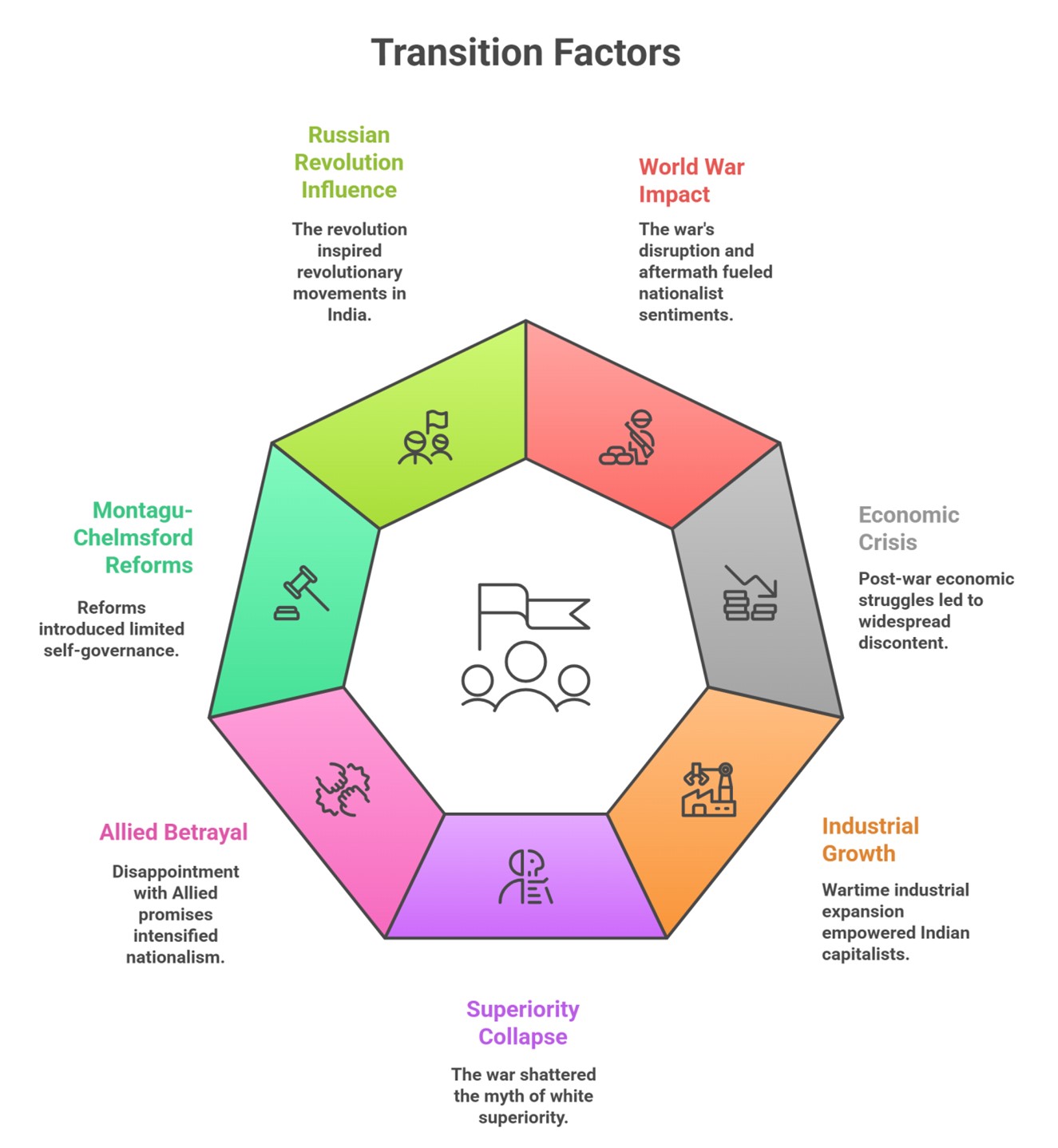
1. Impact of the First World War (1914–1918):
The First World War had a profound impact on the psyche of colonised nations, especially in Asia and Africa.
- The war exposed the hypocrisy of imperialist powers who, while preaching liberty and democracy, engaged in brutal warfare to protect and expand their empires.
- Indian nationalists had supported the British war effort, hoping for political concessions in return. However, this expectation was betrayed, as rewards for loyalty turned out to be minimal and superficial.
- The promises of democracy, freedom, and self-determination proved hollow, as the victors divided the colonies of defeated powers among themselves, continuing the cycle of exploitation.
✦ The war broke the myth of imperial benevolence and contributed to widespread nationalist anger.
2. Post-War Economic Crisis:
The economic aftermath of the war proved devastating for India:
- Prices of essential goods skyrocketed, placing a huge burden on both urban and rural populations.
- Heavy taxation, including war loans and income tax, drained the savings of the middle class and peasants alike.
- Unemployment soared, especially among educated youth, as the wartime economic boom collapsed.
- Peasants were crushed under rising revenue demands, debt, and declining agricultural productivity.
- Industrial workers suffered from job cuts, stagnant wages, and unbearable cost of living.
Interestingly, the business class, which had prospered during the war due to decreased imports, now began facing renewed competition from British goods. This led to growing support from industrialists for the nationalist movement, hoping to secure tariff protection and pro-industry policies.
✦ For the first time, economic grievances unified a wide spectrum of society—from industrialists to landless peasants—into the nationalist fold.
3. Wartime Industrial Growth and Rise of Indian Capitalists
The war had temporarily disrupted European imports, allowing Indian industries like textiles, jute, and steel to flourish.
- A new class of Indian industrialists emerged, who began to support nationalist activities, particularly those led by Gandhi and the Congress.
- Their interests now aligned with the political demand for self-rule, as it could ensure economic autonomy and freedom from colonial economic constraints.
This class, including industrial magnates like G.D. Birla and Jamnalal Bajaj, would later become key financial supporters of the national movement.
4. Collapse of the “White Man’s Superiority”
For decades, British imperialism was justified by the “White Man’s Burden”—the belief in European cultural and racial superiority.
- However, the brutality, destruction, and moral bankruptcy displayed by European nations during the war deeply undermined this myth.
- The colonial atrocities committed during and after the war, combined with racist treatment of Indian soldiers, caused a crisis of legitimacy for the British regime.
✦ The discrediting of Western moral superiority gave a psychological boost to Indian nationalists and increased confidence in self-governance.
5. Betrayal by the Allied Powers:
During the war, Britain and its allies solicited Indian support by promising constitutional reforms and greater self-governance.
- However, the Montagu-Chelmsford Reforms of 1919—formulated post-war—offered limited self-governance, retaining British control over key areas like finance and law and order.
- At the same time, these powers were recolonising former German and Ottoman territories, making a mockery of their commitment to freedom and democracy.
✦ This sense of betrayal radicalised nationalist sentiment, especially among the youth, students, and urban middle class.
6. The Montagu-Chelmsford Reforms (Government of India Act 1919):
- Introduced a system of diarchy in the provinces, separating subjects into reserved and transferred lists.
- However, real authority remained with British officials, and Indian ministers were given only minor portfolios.
The reforms were widely criticised as a “fraud on the nation”, falling far short of expectations for self-government.
✦ Rather than appease Indian aspirations, the reforms served to intensify nationalist anger.
7. Influence of the Russian Revolution (1917):
The success of the Bolshevik Revolution in overthrowing the Czarist autocracy in Russia had a profound ideological impact on the colonised world.
- The emergence of the world’s first socialist republic inspired Indian revolutionaries, showing that even a powerful empire could be dismantled through mass uprising.
- The revolution emboldened leaders like M.N. Roy, Abani Mukherjee, and S.A. Dange, who founded early communist groups in India.
- Even moderate nationalists began to recognise the transformative power of mass movements.
✦ The Russian example provided a new vocabulary of revolution, class struggle, and egalitarianism, which began influencing Indian political discourse.
By the end of 1918, the Indian freedom struggle entered a decisive and transformative phase. The leadership of Mahatma Gandhi marked a clear departure from earlier elite-led constitutional agitation to a mass-based national movement, rooted in the lived experiences of ordinary Indians.
The merging of political discontent with economic hardship, social unrest, and the inspiration from global revolutionary ideologies catalysed a new wave of nationalism. Gandhi’s ability to transcend barriers of caste, class, religion, and region made the movement more inclusive and powerful than ever before.
Furthermore, the moral decline of British imperialism, the betrayal of war-time promises, and the limitations of half-hearted reforms exposed the hollow core of colonial governance. These factors created an environment ripe for mass mobilisation, setting the stage for upcoming movements like Non-Cooperation, Civil Disobedience, and Quit India.
Thus, this period laid the foundation for the final and most intense phase of the Indian National Movement—characterised by widespread participation, nonviolent resistance, and a collective determination to achieve complete independence.
Response of the British Government: Reforms and Repression (1917–1919)
As the Indian nationalist movement surged in strength during and after the First World War, the British colonial administration adopted a dual approach—commonly described as the policy of ‘carrot and stick’. This strategy reflected both appeasement and authoritarianism: while limited constitutional concessions were dangled before Indian leaders, repressive laws and coercive measures were used to suppress the intensifying nationalistic fervor.
On one side, the Montagu-Chelmsford Reforms were portrayed as a symbol of British liberalism and goodwill. On the other hand, the passing of the Rowlatt Act in 1919 served as a grim reminder of the British Empire’s commitment to preserving its hold on India through repression and surveillance.
Montagu-Chelmsford Reforms (1918)
By 1916, it had become increasingly clear that the existing colonial administrative structure was becoming obsolete and incapable of managing a politically awakened Indian populace. The contribution of India to Britain’s war efforts—through the supply of manpower, financial resources, and critical raw materials—had raised Indian expectations for greater political autonomy and recognition.
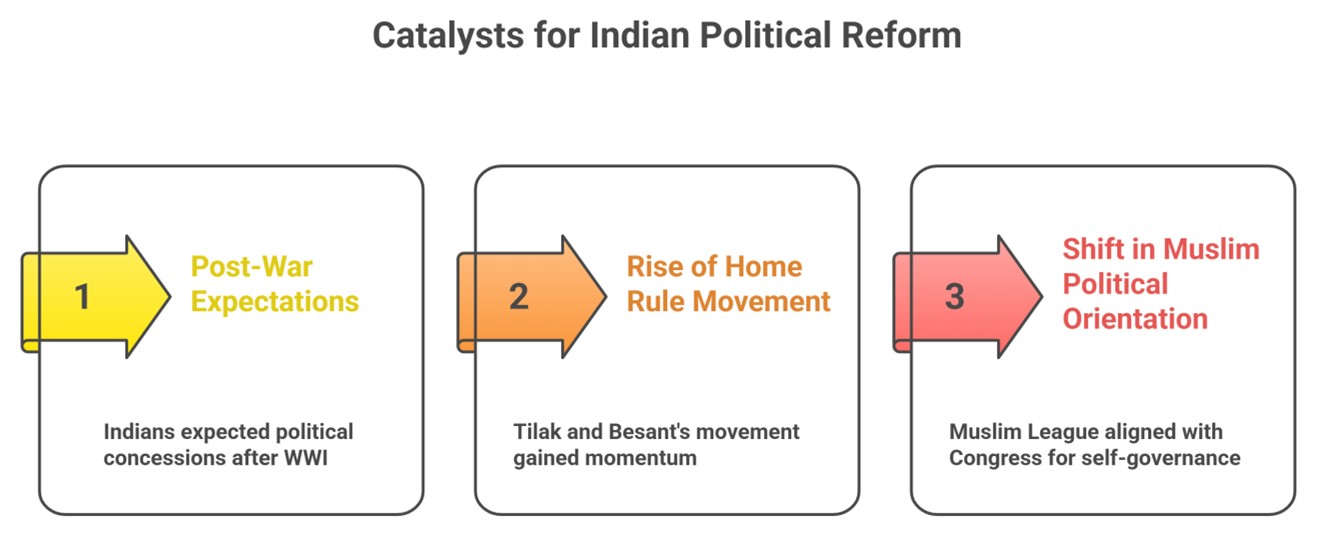
Three major developments catalyzed the push for reform:
1. Post-War Expectations of Indians
India had played a vital role in the British war machinery during the First World War. Nearly 1.3 million Indian soldiers served in various theatres of war, and vast sums of Indian revenue and raw materials had supported the British campaign.
In return, there was a widespread expectation across the country that Britain would honor Indian aspirations for self-government with concrete political concessions.
2. Rise of the Home Rule Movement
The emergence of Home Rule Leagues under Bal Gangadhar Tilak and Annie Besant had already stirred public consciousness and built massive momentum for self-rule. Their mass outreach campaigns, petitions, and propaganda had turned constitutional reform into a mainstream demand.
This movement created unprecedented political pressure on the British authorities, making reform no longer a choice but a compulsion.
3. Shift in Muslim Political Orientation
Despite the Morley-Minto Reforms of 1909, many Muslims remained disillusioned with British promises. The Muslim League, influenced by leaders such as Muhammad Ali and Shaukat Ali, began aligning more closely with the Indian National Congress in a united call for self-governance.
The landmark Lucknow Pact of 1916 cemented this cooperation, forging a united front between Moderates and Extremists, and between Hindus and Muslims, to demand meaningful constitutional change.
Montagu Declaration (20 August 1917)
To retain Indian loyalty during the war and address growing unrest, Edwin Montagu, the then Secretary of State for India, made a historic statement in the British Parliament:
“The policy of His Majesty’s Government is the gradual development of self-governing institutions in India with a view to the progressive realisation of responsible government.”
This was the first official acknowledgment from the British Government promising eventual responsible government in India. However, it was vague and non-committal, offering no fixed timeline or guaranteed roadmap.
Montagu-Chelmsford Report (1918)
Following Montagu’s visit to India in November 1917, a detailed report—commonly referred to as the Montford Report—was prepared in collaboration with Lord Chelmsford, the Viceroy of India. This report served as the blueprint for the Government of India Act of 1919.
Government of India Act, 1919:
The Government of India Act of 1919, also known as the Montagu-Chelmsford Reforms, was enacted as a response to increasing Indian demands for self-governance following World War I. Though presented as a progressive reform by the British government, it was in reality a calculated attempt to retain imperial control while creating a façade of democratic advancement. Despite its structural limitations and strategic flaws, the Act marked a critical, albeit cautious, step in India’s constitutional evolution.
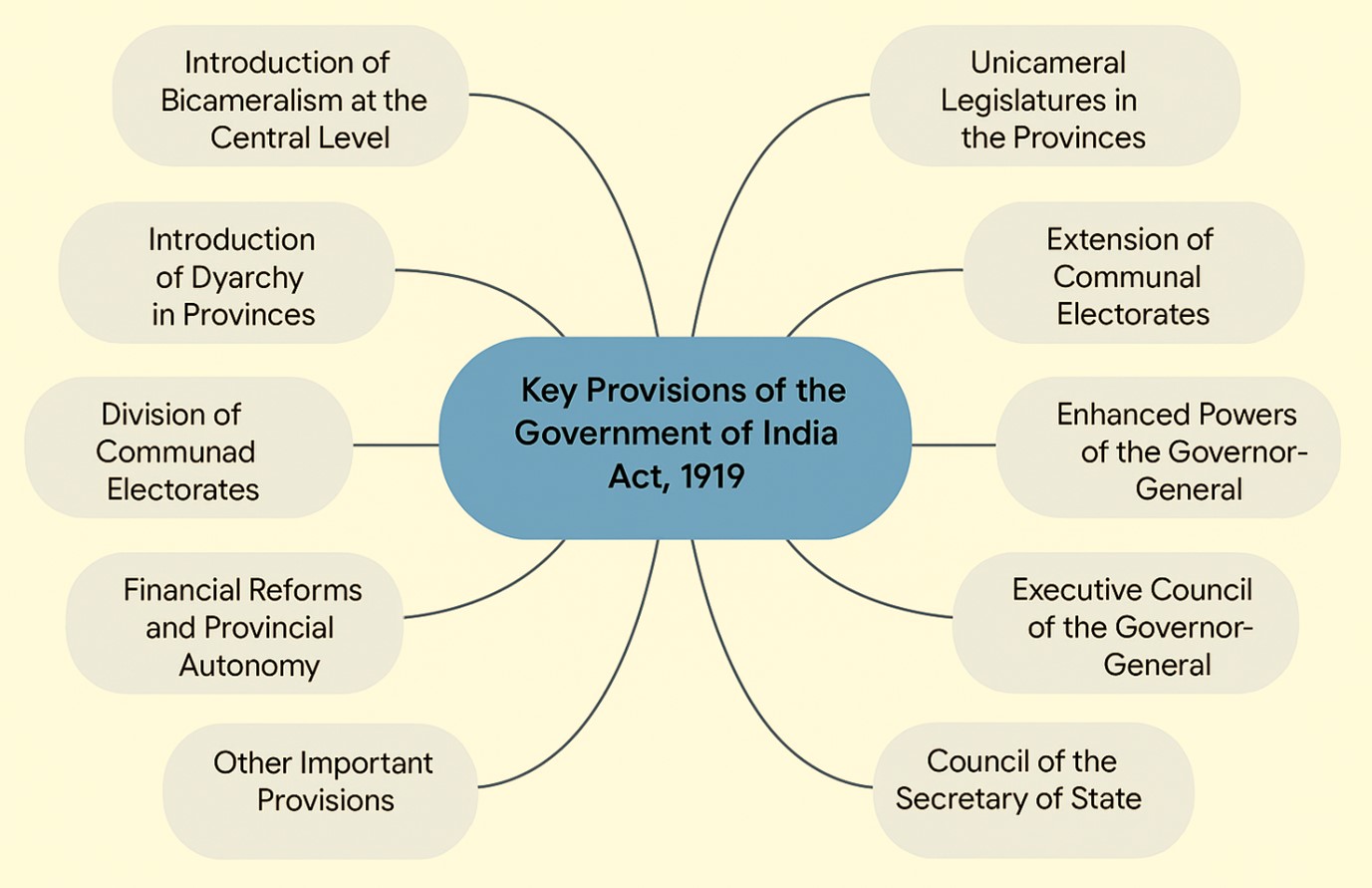
Key Provisions of the Government of India Act, 1919
1. Introduction of Bicameralism at the Central Level
For the first time in Indian constitutional history, the Act introduced a bicameral legislature at the central level:
- Legislative Assembly (Lower House): Consisted of 145 members—104 elected and 41 nominated; tenure of 3 years.
- Council of State (Upper House): Comprised 60 members—34 elected and 26 nominated; tenure of 5 years.
Direct elections were introduced, but the franchise was highly restricted, limited to those with specific property, income, and educational qualifications. Universal adult suffrage remained absent, thereby excluding the vast majority of the Indian population.
2. Unicameral Legislatures in the Provinces
The Act applied initially to eight provinces and was later extended to Burma and the North-West Frontier Province (NWFP).
- Each province had a unicameral Legislative Council, with at least 70% of members elected through direct voting.
- However, the electorate was limited, with stringent eligibility criteria.
- Women’s suffrage was allowed at the discretion of provincial governments, but its application was minimal.
This structure ensured that political representation remained confined to a privileged few, failing to democratise governance at the grassroots level.
3. Introduction of Dyarchy in Provinces
The most notable and controversial innovation of the Act was the system of Dyarchy—a dual form of government in provinces:
- Reserved Subjects: Included police, justice, land revenue, irrigation, printing presses, and factories. These remained under the absolute control of the Governor and his Executive Council, who were not answerable to the legislature.
- Transferred Subjects: Included education, public health, agriculture, local self-government, and public works. These were administered by Indian ministers who were accountable to the elected provincial legislatures.
In practice, Indian ministers lacked authority, as financial and administrative control remained with the British-appointed officials in the reserved domain. Dyarchy thus proved dysfunctional and disempowering.
4. Extension of Communal Electorates
The Act expanded communal representation beyond Muslims, extending separate electorates to:
- Sikhs
- Indian Christians
- Anglo-Indians
- Europeans
This policy intensified religious and communal divisions, reinforcing the British strategy of “divide and rule” and undermining the concept of a unified Indian nationalism.
5. Division of Central and Provincial Subjects
A clear functional distinction was established between subjects:
- Central List: Included subjects like foreign affairs, defence, currency, customs, and communications.
- Provincial List: Included areas such as education, sanitation, agriculture, local self-government, and public health.
However, residuary powers remained with the Governor-General, ensuring that the British still retained the final authority on all legislative matters.
6. Enhanced Powers of the Governor-General
Despite the introduction of elected bodies, the Governor-General retained overriding executive authority, including:
- Vetoing legislative bills passed by elected assemblies.
- Certifying laws without legislative consent.
- Absolute control over key portfolios like defence, external affairs, and princely state relations.
- Power to overrule decisions of the Executive Council.
This made the entire legislative process largely symbolic, as real power remained with the colonial executive.
7. Executive Council of the Governor-General
- The Governor-General’s Executive Council comprised six members, three of whom were Indians.
- However, Indian members were assigned only non-political portfolios, such as education, labour, law, and health.
- They were not accountable to the legislature, but reported directly to the Governor-General and the Secretary of State in Britain.
This setup offered limited participation to Indians and reinforced the imperial structure of governance.
8. Council of the Secretary of State
- The Council of the Secretary of State in London consisted of 8 to 12 members, including three Indians.
- While consultation with the Council was mandatory on key issues, the Secretary of State still held overriding powers.
For the first time, the cost of the Secretary’s salary was to be borne by the British exchequer, not Indian revenues—a minor but symbolic concession.
9. Financial Reforms and Provincial Autonomy
- Provincial budgets were formally separated from the central budget, allowing for limited fiscal autonomy.
- However, key revenue-generating departments remained in the “reserved” list, thus financial starvation of transferred subjects
- Indian ministers could not implement their policies effectively due to lack of control over funds.
10. Other Important Provisions
- Partial relaxation of British Parliamentary oversight on Indian affairs.
- Establishment of the Office of the High Commissioner for India in London, to represent Indian interests abroad.
- Provision for setting up a Statutory Commission after ten years to review the Act’s implementation—this led to the Simon Commission (1927).
Limitations and Criticism of the 1919 Act
Despite being presented as a liberal reform, the Government of India Act, 1919 was heavily criticised for its inadequate and regressive structure:
Major Shortcomings
- No responsible government at the central level; real executive authority remained with British officials.
- Dyarchy proved a failure, causing administrative confusion, inefficiency, and resentment.
- The Governor’s overriding powers nullified the role of elected legislatures.
- Communal electorates fragmented Indian society, promoting sectarianism over national unity.
- Provincial autonomy was superficial, as the central government retained the power to override provincial decisions.
Positive Contributions
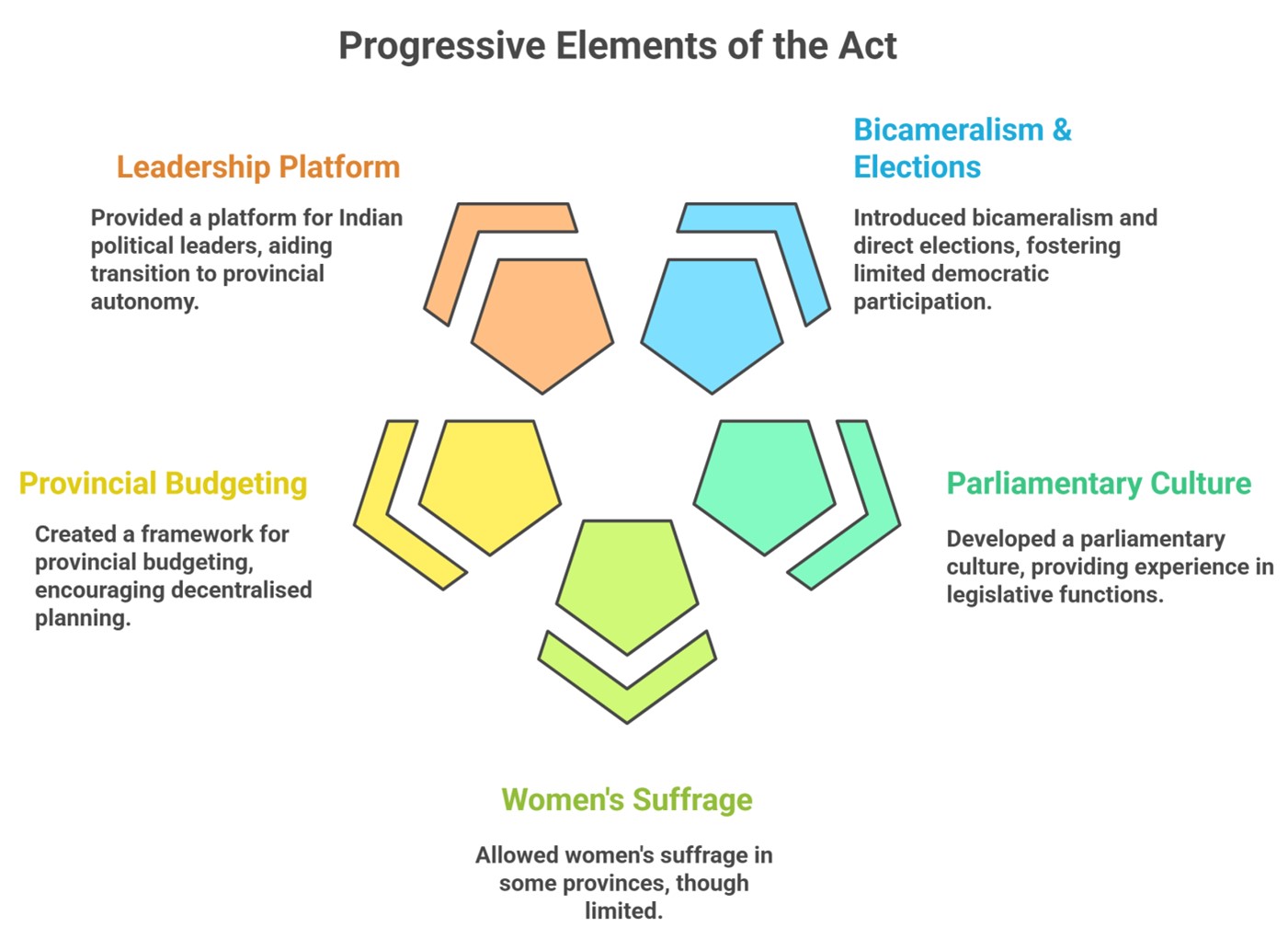
Despite its numerous flaws, the Act had certain progressive elements:
- Introduced bicameralism and direct elections, allowing limited democratic participation.
- Helped develop a parliamentary culture, providing Indian leaders with first-hand experience in legislative functions.
- Allowed women’s suffrage in some provinces, although in a limited capacity.
- Created the framework for provincial budgeting, encouraging decentralised financial planning.
- Provided an initial platform for Indian political leaders to participate in governance, which later helped in the transition to provincial autonomy under the Government of India Act, 1935.
Indian National Congress’s Stand
The Indian National Congress rejected the Act outright, viewing it as an insufficient and deceptive measure.
- In its Special Session at Bombay (August 1918) under Hasan Imam, the Congress declared the reforms unsatisfactory and disappointing.
- The INC demanded complete self-government and rejected the piecemeal delegation of limited powers.
Under the leadership of Mahatma Gandhi, the Congress boycotted the first elections held under the Act in 1920, aligning with the Non-Cooperation Movement
Rowlatt Act (1919):
In the immediate aftermath of World War I, the British colonial administration in India found itself facing an intensified nationalist movement. The rising political consciousness, combined with widespread socio-economic hardship, led to an atmosphere of unrest. To counter this and suppress growing dissent, the government opted for a repressive legal framework rather than democratic concessions.
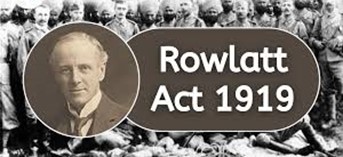
Sedition Committee and the Rowlatt Bills
To study and recommend measures against “revolutionary crimes”, the Government of India appointed a Sedition Committee in 1917, chaired by Justice Sydney Rowlatt.
- Based on the Committee’s recommendations, two bills were introduced in the Imperial Legislative Council on 6 February 1919.
- These bills aimed to extend the wartime defence restrictions into peacetime and were seen as a betrayal of the promised political reforms under the Montagu Declaration of 1917.
Key Repressive Provisions of the Rowlatt Act
- No right of appeal: Special tribunals of three High Court judges were set up whose decisions could not be appealed.
- Admissibility of secret evidence: Even inadmissible evidence (under the Indian Evidence Act) could be used.
- Arrest without warrant: Police were empowered to conduct searches and arrests without judicial sanction.
- Detention without trial: Individuals could be detained for up to two years without any formal charge or trial.
- Suspension of Habeas Corpus: The fundamental right to a fair trial was curtailed, violating basic civil liberties.
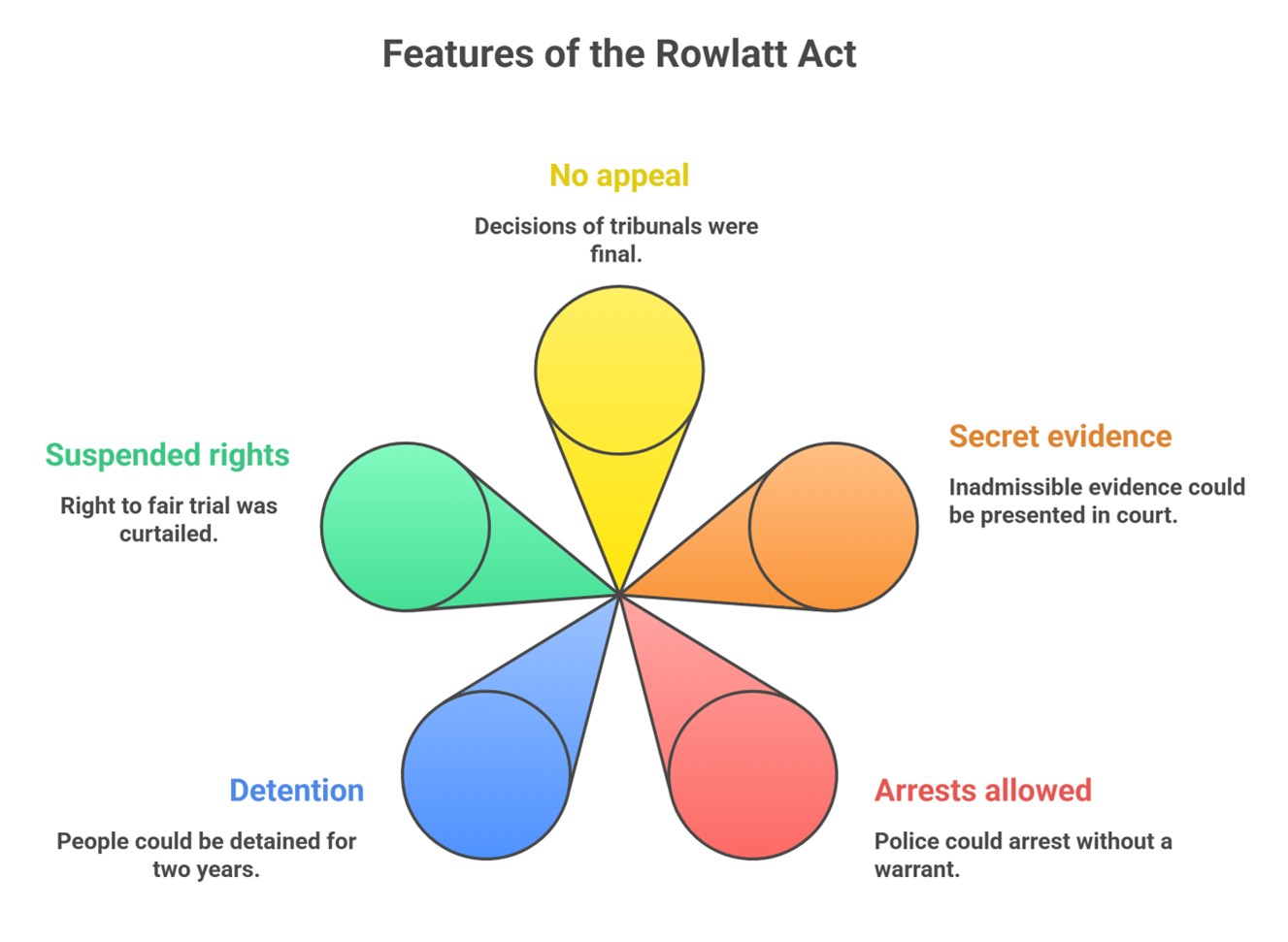
These provisions were seen as an outright attack on civil rights and personal freedom, earning the Act the popular label: “Black Act”.
Rowlatt Satyagraha: (1919)
Nationwide Condemnation
The Rowlatt Act received widespread opposition from across the political spectrum:
- Mahatma Gandhi denounced the Act as a “Black Law” and resolved to resist it through non-violent civil disobedience.
- A. Jinnah, then a member of the Imperial Legislative Council, opposed the bill vehemently, warning of dangerous consequences if the government proceeded.
Formation of the Satyagraha Sabha
- On 24 February 1919, Gandhi established the Satyagraha Sabha in Bombay.
- Members took a solemn pledge to oppose the Act through peaceful civil disobedience, even at the cost of imprisonment.
- The Sabha drew participation from young Home Rule Leaguers, Muslim League radicals, and Pan-Islamic leaders like Abdul Bari.
Modes of Protest
- The movement adopted hartals (mass strikes), peaceful picketing, distribution of banned literature, and civil disobedience.
- Four banned books, including Gandhi’s Hind Swaraj, were deliberately circulated as an act of defiance.
- The slogans of Hindu-Muslim unity reverberated throughout India, energising a united nationalist spirit.
Criticism of Gandhi’s Strategy
Despite its moral appeal, not all leaders supported Gandhi’s initiative:
- Moderate leaders like Sir D.E. Wacha, Surendranath Banerjee, B. Sapru, and Srinivasa Sastri believed the Satyagraha would derail political reforms.
- Annie Besant criticised the movement as ill-conceived, arguing there was nothing in the law to warrant civil disobedience and cautioned against blind law-breaking.
Legislative Outcome
- Due to intense opposition, one of the two bills was withdrawn, but the other was passed as the Anarchical and Revolutionary Crimes Act of 1919, commonly known as the Rowlatt Act.
- All Indian members of the Imperial Legislative Council opposed the Act. In protest, leaders such as Madan Mohan Malaviya, Muhammad Ali Jinnah, and Mazhar ul Haq resigned from the Council.
- The Act was perceived as a betrayal of wartime promises and a move towards autocratic governance.
Jallianwala Bagh Massacre (13 April 1919)
The events leading up to the Jallianwala Bagh massacre were deeply intertwined with the growing unrest following the implementation of the Rowlatt Act of 1919, which had triggered widespread resentment across India.
On 6 April 1919, Mahatma Gandhi called for a nationwide hartal (strike) against the draconian Rowlatt legislation, which empowered the British government to detain individuals without trial and curb civil liberties. The hartal witnessed unprecedented mass mobilisation in urban centres, and it quickly evolved from a symbolic protest into a potent expression of public anger.
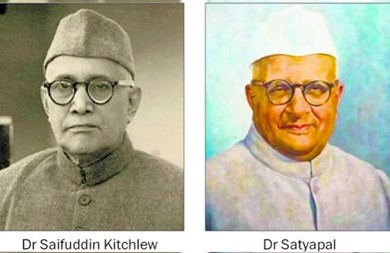
In Amritsar, the protest gained particular momentum. The arrest of two prominent leaders, Dr. Saifuddin Kitchlew and Dr. Satyapal, on 9 April 1919 added fuel to the fire. These leaders were widely respected and symbolised Hindu-Muslim unity, making their arrest a politically provocative act.
On 10 April, a large and peaceful procession marched to the residence of the Deputy Commissioner to demand their release. However, instead of engaging in dialogue, the British police opened fire on the unarmed crowd, resulting in several deaths and injuries. This incident marked a turning point, transforming local discontent into mass outrage.
General Dyer’s Military Clampdown: Prelude to a Massacre
In response to the civil administration’s inability to manage the situation, Brigadier-General Reginald Edward Harry Dyer was appointed to take charge of Amritsar under martial law. Dyer implemented an extremely rigid regime that turned the city into a military garrison.
The repressive measures imposed included:
- Curfews with minimal notice
- A complete ban on public gatherings
- Passes required for movement within the city
- Public floggings and humiliating punishments, including the infamous crawling order on the street where a British woman was allegedly assaulted
Dyer viewed his role not as a peacekeeper but as a disciplinarian. He intended to instill fear and “teach the natives a lesson”—a mindset that would culminate in the events of 13 April 1919.
The Massacre at Jallianwala Bagh:
On 13 April 1919, the festival of Baisakhi—one of the most important religious days for Sikhs—thousands of people, including men, women, and children, gathered at Jallianwala Bagh, a public garden surrounded by walls with a single narrow entrance and exit.
The gathering had two primary purposes:
- To celebrate the Baisakhi festival, which drew villagers from nearby areas.
- To peacefully protest the arrest of local leaders and the brutal killings of April 10.
Most of those assembled were unaware of the government’s ban on public meetings, as martial law orders had not been widely communicated in rural areas.
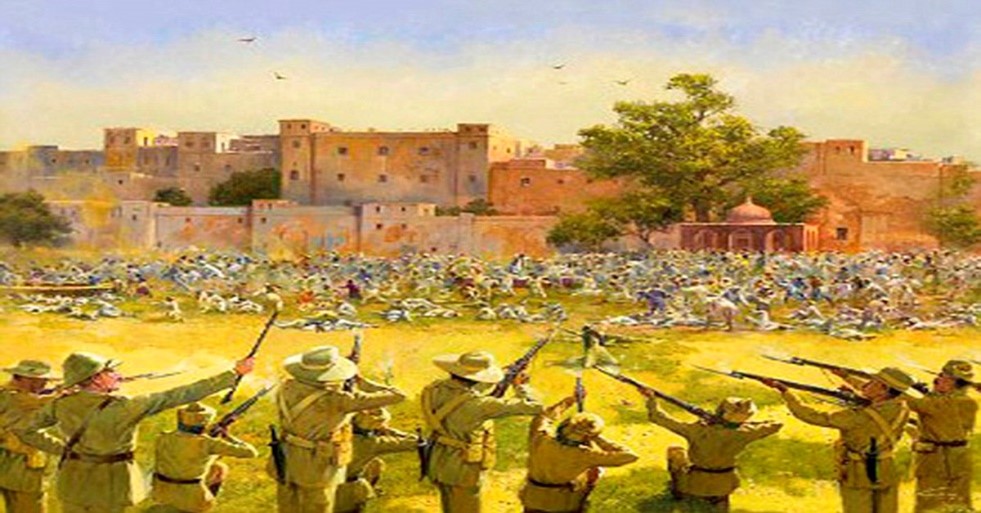
At approximately 4:30 PM, General Dyer arrived with a contingent of armed troops, blocked the sole entrance to the Bagh, and without any prior warning, ordered his troops to open fire on the unarmed crowd.
For 10 to 15 minutes, 1,650 rounds were fired directly into the densest sections of the crowd. Panic ensued as people scrambled to escape. With walls on all sides and no exit, many were trampled to death, while others jumped into a well inside the Bagh to avoid bullets, only to perish there.
Official British figures claimed 379 people were killed and over 1,200 injured, but unofficial estimates put the number of deaths at well over 1,000, with several hundred more injured.
🔹 General Dyer later testified that his objective was not merely to disperse the crowd but to “produce a moral effect” and “make a lasting impression” through punitive violence.
Nationwide Reaction and Consequences:
The Jallianwala Bagh massacre sent shockwaves throughout the country and marked a crucial turning point in India’s struggle for independence.
Key Repercussions:
- Rabindranath Tagore, Nobel laureate and respected cultural icon, renounced his knighthood as a symbolic act of protest, declaring that “the time has come when badges of honour make our shame glaring.”
- Mahatma Gandhi, who had led the Rowlatt Satyagraha, was deeply disturbed by the ensuing violence across the country and by the government’s brutal repression. He called off the movement on 18 April 1919, believing that the nation was not yet prepared for disciplined non-violent resistance.
- The massacre led to a severe breakdown of trust between Indians and the British. The idea that British rule was based on justice and fairness was irrevocably discredited.
Rowlatt Satyagraha: Assessment and Legacy
Limitations and Challenges
Despite its historic significance, the Rowlatt Satyagraha had several limitations:
- The Indian National Congress, at the organisational level, played a limited role in directing or sustaining the movement.
- The agitation remained largely urban-centric, with minimal impact in rural areas.
- The Satyagraha Sabha, formed to coordinate the movement, focused more on propaganda, meetings, and pledge collection than on structured political action.
- Gandhi later referred to the decision to launch mass civil disobedience without sufficient preparation as a “Himalayan blunder.”
Historical Significance
Yet, despite these shortcomings, the Rowlatt Satyagraha and the Jallianwala Bagh massacre were watershed moments in modern Indian history.
- It was India’s first all-India protest movement, involving diverse regions, languages, and communities.
- It marked Mahatma Gandhi’s emergence as the undisputed national leader, transcending regional, religious, and class boundaries.
- The movement reinvigorated Hindu-Muslim unity, a crucial element for future national campaigns.
- The brutal repression, symbolised by the massacre, radicalised Indian nationalism and exposed the violent core of colonial rule.
The Rowlatt Act and the Jallianwala Bagh massacre together shattered the illusion that the British Empire could reform itself into a benevolent ruler. While the former curtailed civil liberties in the name of law and order, the latter demonstrated the brutality of unchecked colonial power.
The massacre not only left a deep psychological scar on the Indian population but also galvanised political awakening across the nation. It became the catalyst for the Non-Cooperation Movement of the early 1920s and planted the seeds for future mass civil disobedience campaigns.
In the end, the events of 1919 taught Indians two important lessons:
- British promises of reform could not be trusted without pressure and resistance.
- The path to freedom would demand not just constitutional debate, but organised, sustained, and united mass action.
Aftermath of the Jallianwala Bagh Massacre (1919)
The Jallianwala Bagh massacre not only shocked the conscience of India but also had far-reaching political, institutional, and psychological consequences. In the wake of this brutal colonial repression, the Indian national movement shifted decisively from constitutional methods to mass mobilization. The massacre prompted widespread outrage, both in India and abroad, and led to organized political action through inquiries, resolutions, and reforms that sought to hold the perpetrators accountable and demand justice.
Amritsar Session of the Indian National Congress, 1919
To express solidarity with the people of Punjab and to register a formal protest against the massacre, the Indian National Congress (INC) convened its annual session in Amritsar in December 1919.
- Pandit Motilal Nehru presided over the session, which drew massive participation from across India.
- The session began with solemn mourning for the victims of the Jallianwala Bagh massacre and passed multiple resolutions condemning the atrocities.
Key Resolutions Passed at the Session:
- Demand for the immediate withdrawal of Viceroy Lord Chelmsford from his post.
- Accountability of Michael O’Dwyer (the then Lieutenant Governor of Punjab) and General Reginald Dyer for their roles in the massacre.
- Boycott of the Hunter Commission, citing its lack of credibility and biased composition.
- A resolution moved by Mahatma Gandhi expressing regret over the mob violence that erupted in Punjab and Gujarat in the wake of the Rowlatt Satyagraha.
Other Important Demands and Resolutions:
- Repeal of the Rowlatt Act of 1919 and the Press Act of 1910, both of which were seen as repressive tools to stifle dissent.
- Strong protest against the British government’s hostility towards the Khilafat issue, which had galvanized Muslim political opinion.
- Promotion of Swadeshi (self-reliance in goods) as an economic tool for political resistance.
- Support for the formation of Labour Unions, recognizing the importance of organized workers’ rights in the broader national struggle.
Interestingly, at this session, Mahatma Gandhi proposed a limited cooperation with the British in implementing the Montagu-Chelmsford reforms, despite their inadequacies. However, just months later, by September 1920, Gandhi would abandon this position and call for Non-Cooperation, launching one of the most significant mass movements in Indian history.
Hunter Commission (1919):
In response to the overwhelming domestic and international condemnation, the British government appointed an official inquiry to investigate the events in Punjab.
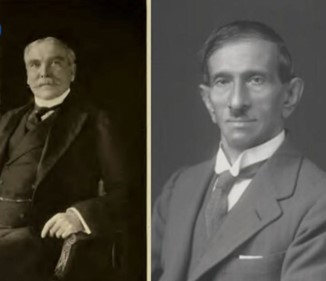
- On 14 October 1919, the Disorders Inquiry Committee—popularly known as the Hunter Commission—was constituted.
- The Commission comprised eight members, including three Indians:
- Sir Chimanlal Setalvad – Vice-Chancellor of Bombay University
- Sultan Ahmad Khan – Prominent lawyer
- Jagat Narayan – Public prosecutor and known legal expert.
Proceedings and Findings:
- Each member was permitted to cross-examine the accused officers, including General Dyer.
- The Indian members conducted intense and detailed questioning, bringing out the deliberate nature of the violence.
- The majority British members exonerated Dyer, limiting criticism to procedural misjudgment.
- In contrast, the Indian members dissented and submitted a minority report, condemning Dyer’s actions as unjustifiable and brutal.
Outcome:
- In 1920, the Hunter Commission formally censured General Dyer, but no legal or disciplinary action was taken.
- The Commission concluded that the massacre was one of the darkest episodes in British colonial rule, yet the punishment amounted to mere retirement.
- The Commander-in-Chief of India directed Dyer to resign, and he was informed he would not be re-employed in India, as confirmed in a letter by Edwin Montagu, the Secretary of State for India.
Lack of Universal Condemnation
While the Hunter Commission, Viceroy Chelmsford, and even members of the House of Commons condemned the massacre, the reaction in Britain was deeply divided.
- The House of Lords and influential figures like Rudyard Kipling hailed Dyer as a patriot and savior of the empire.
- The conservative British newspaper, The Morning Post, launched a fundraising campaign to support Dyer, raising over £28,000—a massive sum at the time.
- The campaign was endorsed by multiple British-Indian newspapers including the Calcutta Statesman, Rangoon Times and Press, and Madras Mail.
- In contrast, Winston Churchill, then Secretary of War, vehemently condemned the massacre, calling it a “monstrous event.”
🔹 However, many Indian princes, rajas, and Sikh elites, aiming to maintain their privileged positions under British patronage, either remained silent or publicly supported the British administration.
Congress Report on the Punjab Disorders (1920)
Given its lack of faith in a British-led inquiry, the Indian National Congress launched its own independent investigation into the atrocities committed in Punjab.
- A sub-committee was formed in 1919 and conducted extensive fieldwork and interviews.
- By 25 March 1920, the findings were compiled and published in a landmark document titled “The Congress Punjab Inquiry Report.”
Key Contributors:
- Mahatma Gandhi (primary drafter)
- R. Das, M.R. Jayakar, and Abbas Tyabji (co-signatories and investigators)
Highlights of the Report:
- It categorically refuted the official British claim of 379 deaths, estimating that over 1,200 were killed and more than 3,600 injured.
- It held General Dyer, Michael O’Dwyer, and Lord Chelmsford directly responsible for the massacre and the violent suppression that followed.
- The report provided a meticulous account of the brutality, backed by eyewitness testimonies, and was instrumental in mobilizing public opinion against British rule.
Later Developments and Long-Term Consequences
Surprising Honour to Dyer
In a controversial and politically loaded act, Arur Singh, the caretaker of the Golden Temple, presented General Dyer with a siropa (robe of honour) after the massacre.
- This act was widely criticized and triggered the Gurdwara Reform Movement, which aimed to wrest religious institutions from corrupt or colonial-aligned authorities.
Assassination of Michael O’Dwyer (1940)
On 13 March 1940, at Caxton Hall in London, Udham Singh, a revolutionary and survivor of the massacre, assassinated Michael O’Dwyer.
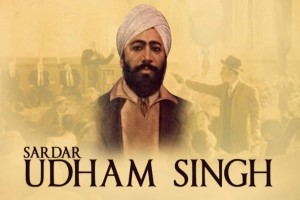
- O’Dwyer, as the Lieutenant Governor of Punjab during the massacre, was seen as the principal enabler of Dyer’s actions.
- Singh was arrested and hanged shortly after, but his act was widely hailed across India as retribution for the atrocities of 1919.
- However, Mahatma Gandhi publicly disapproved, calling the assassination “an act of insanity” and reaffirming his stance against personal revenge. Gandhi stated,
“We have no desire for revenge. We want to change the system which produced Dyer.”
A Turning Point in India’s Freedom Struggle
The Jallianwala Bagh massacre and its aftermath represented more than just a colonial atrocity—it became the defining moment when faith in British constitutionalism was finally shattered for many Indians. The lack of real accountability, the divided British response, and the Indian determination to uncover the truth laid the groundwork for radical changes in political strategy.
The Indian National Congress, under Gandhi’s leadership, evolved from demanding reforms to demanding full Swaraj (self-rule). The Non-Cooperation Movement of 1920–22, launched soon after these events, marked the beginning of mass civil resistance on an unprecedented scale.
The legacy of Jallianwala Bagh lives on as a symbol of colonial brutality, resistance, and the irrepressible spirit of a nation’s quest for freedom.
Khilafat and Non-Cooperation Movement (1919–1922)
The years 1920–21 marked a turning point in the Indian freedom struggle, ushering in a new phase of mass mobilisation and popular politics. This period witnessed the simultaneous rise of two important movements—the Khilafat Movement and the Non-Cooperation Movement. Though rooted in different grievances, both movements converged in their common programme of action: non-violent non-cooperation with the British government.
This alliance between Indian nationalists and Muslim leaders catalysed a pan-Indian movement that mobilised the masses like never before and made Mahatma Gandhi the undisputed leader of the national struggle.
Backgrounvd and Precipitating Factors
Several developments in the years immediately following the First World War (1914–1918) created widespread unrest and dissatisfaction across India, setting the stage for nationwide resistance:
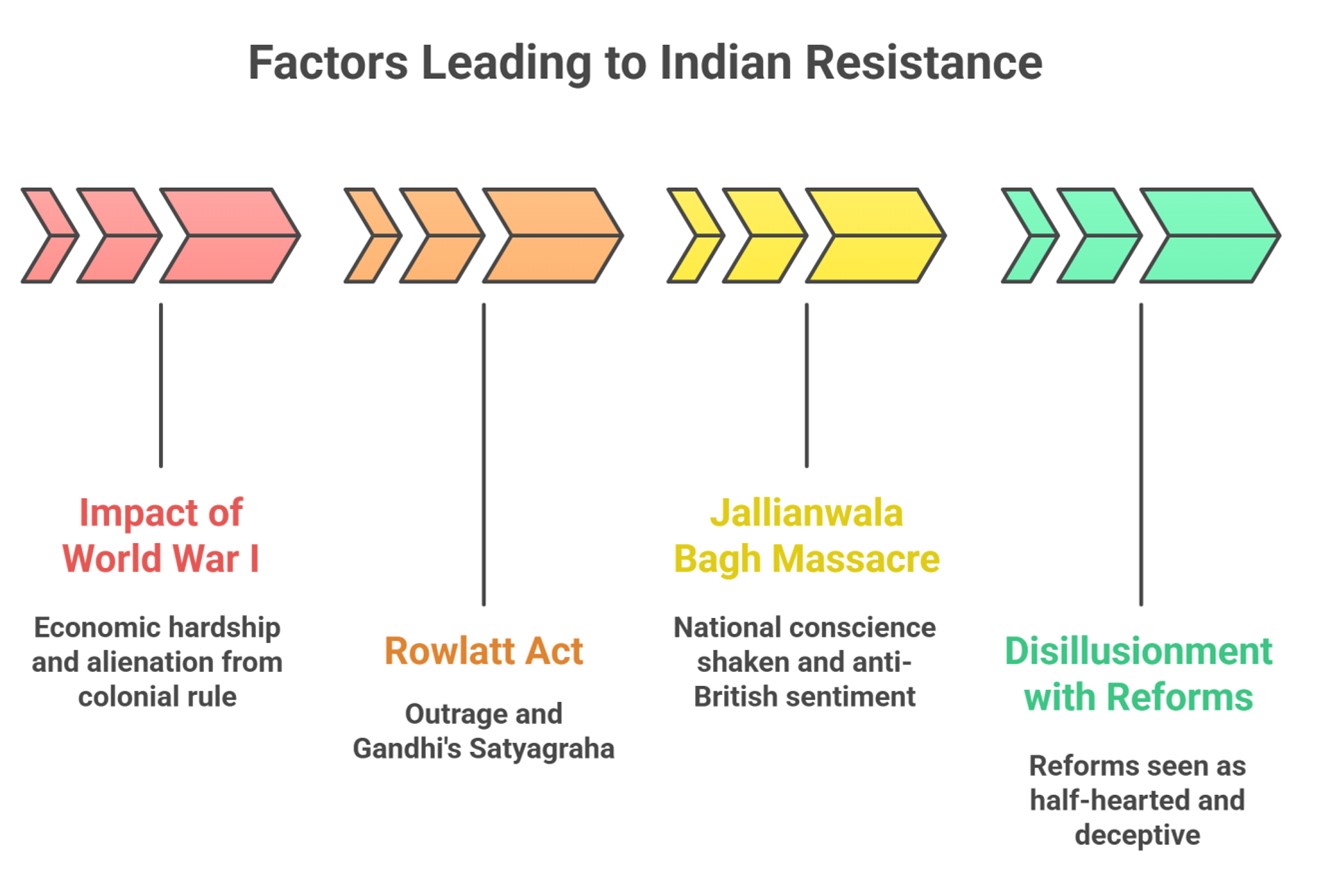
1. Impact of the First World War:
- The war caused widespread economic hardship, leading to inflation, food shortages, and unemployment.
- Heavy taxation and forced recruitment further alienated the masses from colonial rule.
2. The Rowlatt Act (1919):
- The draconian Rowlatt Act, which authorised detention without trial, sparked outrage across the country.
- Gandhi called it a “Black Law” and launched a nationwide Satyagraha in protest.
3. Jallianwala Bagh Massacre (1919):
- The brutal massacre of unarmed civilians at Amritsar deeply shook the national conscience.
- Rabindranath Tagore renounced his knighthood, and anti-British sentiment surged across India.
4. Disillusionment with the Montagu-Chelmsford Reforms (1919):
- The Government of India Act of 1919, which introduced dyarchy, was seen as a half-hearted and deceptive reform.
- It failed to meet the rising expectations of self-rule and further strengthened the resolve to intensify the national movement.
The Khilafat Issue: A Catalyst for Hindu-Muslim Unity
The Khilafat issue emerged as the immediate context for mass mobilisation:
- During the First World War, Turkey sided with Germany and Austria. The Sultan of Turkey, also regarded as the Caliph (Khalifa) by Indian Muslims, was removed from power after the war.
- The harsh terms of the Treaty of Sèvres (1920) further angered Muslims, who demanded:
- That the Caliph be retained as the religious head of Muslims.
- That Muslim sacred places remain under his control.
- That sufficient territory be left with him to safeguard Islamic interests.
In response, the Khilafat Committee was formed in Bombay in 1919, led by Shaukat Ali, Mohammad Ali, Maulana Azad, Hakim Ajmal Khan, and Hasrat Mohani.
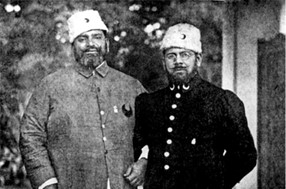
- The All India Khilafat Conference (Delhi, Nov 1919) decided to initiate non-cooperation if British demands were not met.
- Gandhiji saw the Khilafat agitation as a golden opportunity to forge Hindu-Muslim unity and bring the Muslim masses into the national struggle.
- He became the President of the All India Khilafat Committee and actively supported their demands.
Towards the Non-Cooperation Movement: 1920–1922
The period following the Jallianwala Bagh massacre and the Rowlatt Act represented a decisive turning point in India’s national movement. The combination of brutal repression in Punjab, continued colonial arrogance, and disrespect for global Islamic sentiments through the Treaty of Sèvres led to a profound sense of betrayal among Indians.
Against this backdrop, Mahatma Gandhi, once a cautious constitutionalist, came to believe that non-cooperation with the British Raj was the only morally viable and politically effective path forward.
All-Party Conference at Allahabad – June 1920
In June 1920, an All-Party Conference convened at Allahabad, bringing together representatives from multiple political and religious organizations. The conference proposed a comprehensive programme of boycotting British institutions, including government schools, law courts, and civil services.
This marked the first collective and formal call for nationwide non-cooperation, signifying a strategic shift from petitioning to resistance.
Gandhi’s Disillusionment and Call for Non-Cooperation
The final straw for Gandhi was twofold:
- The Hunter Committee’s whitewashing of the Punjab atrocities, particularly its failure to hold General Dyer truly accountable.
- The humiliating terms imposed on Turkey, the seat of the Caliphate, under the Treaty of Sèvres, which inflamed Muslim sentiments across India.
In response, Gandhi openly declared that non-cooperation was the only course left for Indians who wished to uphold self-respect, justice, and national dignity.
Launch of the Non-Cooperation Movement – 31 August 1920
On 31 August 1920, the Khilafat Committee, deeply aggrieved by British actions in Turkey, officially launched the Non-Cooperation Movement, with Gandhi as its first and most prominent participant.
As a mark of protest, Mahatma Gandhi renounced all British honours previously awarded to him:
- Kaisar-i-Hind Gold Medal – awarded for humanitarian service during plague relief.
- Boer War Medal – received for serving as a stretcher-bearer during the Boer War.
- Zulu War Medal – awarded for ambulance work in South Africa.
This symbolic act of moral renunciation deeply resonated with Indians and set the tone for the larger boycott strategy to follow.
Institutionalisation of the Movement: Congress Backs Non-Cooperation
Calcutta Special Session of Congress – September 1920
Presided over by Lala Lajpat Rai, the Calcutta Session of the Indian National Congress provided official approval to Gandhi’s plan of non-cooperation.
Key resolutions passed included:
- Boycott of British-run educational institutions, law courts, and legislative councils.
- Promotion of Swadeshi, including hand-spinning (charkha) and Khadi production.
- Surrender of government titles, awards, and honorary positions.
This session marked the beginning of the transformation of the Congress from an elite body to a mass-based political organisation.
Constructive Programme | Non-constructive Programme |
Establishment of national schools and colleges | Boycott of government educational institutions, law courts, and legislatures |
Promotion of indigenous goods | Boycott of foreign clothes |
Practising hand-spinning and hand-weaving | Surrender of official titles |
Popularisation of Charkha and Khadi |
Nagpur Session of Congress – December 1920
The Nagpur Session, presided over by C. Vijayaraghavachariar and guided strategically by C.R. Das, passed the Non-Cooperation Resolution, making it the Congress’s official strategy.
Key Organisational Reforms Introduced:
- Formation of the Congress Working Committee (CWC) – A powerful executive body with 15 members to guide the party’s daily functions.
- Creation of the All India Congress Committee (AICC) – Enlarged to 350 members, to ensure national representation.
- Provincial Congress Committees reorganised on linguistic basis, enhancing accessibility and local relevance.
- Mass Membership Introduced – Any Indian aged 21 or above could become a member by paying a nominal fee. This was later reduced, and the age limit lowered to 18 in 1921, further democratising the party structure.
These reforms converted the Congress into a genuine mass movement, capable of sustained mobilisation across classes, castes, and regions.
Widespread Participation and Popular Response
The call for non-cooperation met with enthusiastic and unprecedented response across India:
- Students left British-run institutions and joined nationalist schools and colleges, such as:
- Jamia Millia Islamia
- Bihar Vidyapith
- Gujarat Vidyapith
- Lawyers like Motilal Nehru, R. Das, and Rajendra Prasad gave up lucrative legal practices in support of the national movement.
- Women played a critical role by:
- Participating in picketing of liquor shops and foreign cloth stores.
- Discarding purdah and stepping into the public domain.
- Donating generously to the Tilak Swaraj Fund, a major funding initiative for the movement.
- Khadi and the charkha (spinning wheel) became powerful visual symbols of self-reliance, national dignity, and economic resistance.
Gandhi’s Personal Transformation and Mass Connect
On 22 September 1921, Gandhi renounced his usual Gujarati attire and began wearing a simple hand-spun dhoti, the dress of India’s rural poor.
This act was more than symbolic—it was a conscious embrace of simplicity and solidarity with the masses, which elevated Gandhi to the stature of a national icon and moral leader.
Peasant and Tribal Uprisings: The Rural Echo of Nationalism
The Non-Cooperation Movement (1920–22), though guided by Mahatma Gandhi’s philosophy of non-violence, found its resonance in rural India through intense agrarian and tribal uprisings. These revolts were not always non-violent; in fact, they often turned militant, reflecting the raw grievances of the countryside, where landlordism, colonial exploitation, and oppressive social structures had long wreaked havoc on the lives of peasants and tribal communities.
Though Gandhi’s appeal was spiritual and political, in the hinterlands of India, the freedom movement merged with local struggles for justice, land rights, and social dignity. Peasant and tribal resistance became an important dimension of the national movement, giving it a grassroots character.
Prominent Peasant and Tribal Movements During the Non-Cooperation Era
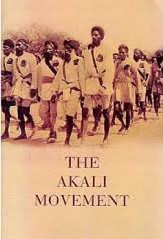
Punjab: The Akali Movement
- The Akali Movement emerged as a significant campaign in Punjab, primarily aimed at liberating Sikh gurdwaras from the control of corrupt mahants supported by the British.
- Though rooted in religious reform, the movement soon acquired nationalist overtones, as it challenged colonial interference in religious institutions.
- The Akali agitation mobilised thousands of Sikh peasants and added a religio-political dimension to the freedom struggle in northern India.
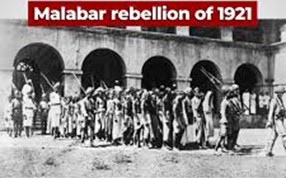
Malabar (Kerala): The Moplah Rebellion (1921)
- One of the most intense uprisings of the period, the Moplah (Mapilla) Rebellion was led by Muslim tenants against oppressive Hindu landlords and British colonial authorities.
- What began as a peasant struggle for land and dignity escalated into a violent anti-colonial insurrection, marked by mass killings, property destruction, and severe repression.
- Though controversial in its communal overtones, the Moplah uprising reflected the deep agrarian discontent simmering in southern India.
Assam: Labour Strikes in Tea Plantations
- In the tea gardens of Assam, workers—many of them tribal and migrant labourers—staged massive strikes demanding better wages and working conditions.
- These workers shouted slogans like “Gandhi Maharaj ki Jai,” linking their demands to the national movement.
- The strikes highlighted the harsh exploitation of plantation workers and brought labour struggles into the mainstream of anti-colonial resistance.
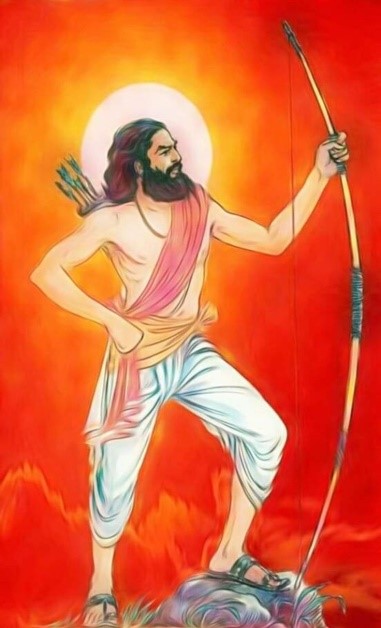
Andhra Pradesh: Forest Satyagrahas and Alluri Sitarama Raju
- In the Godavari hills of Andhra Pradesh, the tribal peasants launched a guerrilla-style rebellion under the leadership of Alluri Sitarama Raju.
- Raju, a charismatic leader, combined Gandhian ideals of swadeshi and non-cooperation with armed resistance against forest laws, police excesses, and British exploitation.
- Although Raju was eventually captured and executed in 1924, his movement left a lasting legacy of tribal assertion and sacrifice.
United Provinces & Bihar: The Kisan and Eka Movements
- In the United Provinces (modern-day Uttar Pradesh), Baba Ram Chandra, a sanyasi-turned-activist, led a powerful peasant movement demanding:
- Reduction in rent
- Abolition of begar (forced labour)
- Legal protection from eviction
- The movement spread widely among the lower-caste tenants and landless labourers, challenging both the zamindars and the colonial bureaucracy.
- The Eka Movement, spearheaded by Madari Pasi, also emerged around the same time, uniting small tenants and agricultural labourers in opposition to rent hikes, unfair taxes, and zamindari oppression.
- Though short-lived and brutally suppressed, these movements signalled a new phase of rural mobilisation in India’s nationalist journey.
These rural uprisings illustrated the fusion of local socio-economic grievances with the broader nationalistic goals, effectively turning the Non-Cooperation Movement into a truly pan-Indian campaign.
Gandhi’s Mythical Status in Rural India
As these movements gained momentum, Mahatma Gandhi’s image assumed almost mythical proportions, especially among the rural and semi-literate populations:
- In towns and villages across India, Gandhi was seen not just as a political leader, but as a divine figure.
- Many believed he had supernatural powers—capable of bringing rain, curing diseases, or even delivering justice by mere invocation of his name.
- His image as the “Mahatma” or the great soul deeply resonated with India’s spiritual and moral traditions, helping him mobilise millions with minimal infrastructure.
This emotional and spiritual connect made Gandhi the moral compass of the nation and the face of India’s collective conscience.
Moderate Leaders Break Away from the Movement
However, not everyone in the Indian political spectrum endorsed Gandhi’s strategy of non-cooperation:
- Prominent moderate leaders such as Annie Besant, M.A. Jinnah, G.S. Khaparde, and B.C. Pal were uncomfortable with mass agitation and believed in gradual, constitutional progress.
- They were wary of boycotting councils, disrupting administration, and escalating confrontations with the British.
- Consequently, many of them resigned from the Indian National Congress, signalling the final ideological split between Moderates and Gandhi-led mass nationalists.
The departure of the Moderates cleared the path for the Congress’s complete transformation into a mass-based movement, focused on grassroots participation, direct action, and non-violent resistance.
Chauri Chaura Incident (5 February 1922):
Just days after Gandhi’s ultimatum, a tragic incident occurred in Chauri Chaura, a small town in the Gorakhpur district of United Provinces (now Uttar Pradesh).
- A peaceful procession of approximately 3,000 villagers, protesting against British policies, was confronted by the police.
- The police opened fire on the crowd without adequate provocation.
- In retaliation, the angry protestors attacked the police station, set it on fire, and killed 22 policemen.
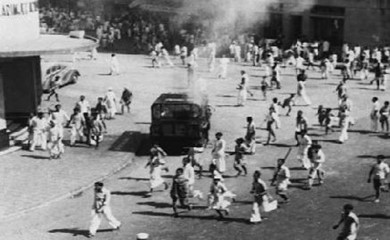
The incident sent shockwaves through the national leadership and became the defining moment in the trajectory of the Non-Cooperation Movement.
Gandhi’s Reaction and Moral Standpoint
The violent turn of events at Chauri Chaura left Gandhi deeply disturbed. A staunch believer in Ahimsa (non-violence), Gandhi believed that moral legitimacy was the soul of the nationalist movement.
Key Reasons for Gandhi’s Withdrawal:
- He felt that the masses were not yet trained in non-violent discipline and that continued agitation might spiral into mob violence and anarchy.
- Violence, in his view, would undermine the movement’s moral foundation and justify British repression.
- Gandhi emphasised that true freedom could not be built on the foundation of bloodshed.
Bardoli Resolution (12 February 1922): The Congress Working Committee (CWC) convened at Bardoli, Gujarat, and passed a landmark resolution officially suspending all civil disobedience movements.
Key Proposals of the Bardoli Resolution:
- Immediate suspension of all forms of law-breaking and civil disobedience.
- Strategic redirection towards constructive programmes, emphasizing long-term societal transformation.
Focus Areas of the Constructive Programme:
- Promotion of Khadi and revival of village industries.
- Eradication of untouchability and upliftment of marginalised communities.
- Strengthening Hindu-Muslim unity to reinforce national integration.
- Establishment of national educational institutions promoting indigenous values.
- Temperance campaigns aimed at reducing alcohol consumption.
🔹 Although this resolution marked a tactical pause in direct political confrontation, it strongly reinforced the Congress’s enduring commitment to grassroots reform, self-reliance, and inclusive nation-building.
Mixed Reactions among Nationalist Leaders
The sudden withdrawal of the movement shocked many Congress leaders and grassroots workers.
- Subhas Chandra Bose called the decision a “national calamity”.
- Jawaharlal Nehru expressed “consternation and amazement”, questioning the timing and strategic logic.
- Leaders like C.R. Das and Motilal Nehru felt the momentum should have been maintained to extract political concessions.
However, despite their disappointment, most leaders complied out of reverence for Gandhi, whose moral stature had become unassailable.
As an act of self-purification, Gandhi commenced a five-day fast on 12 February 1922, reinforcing his spiritual commitment to non-violence and national service.
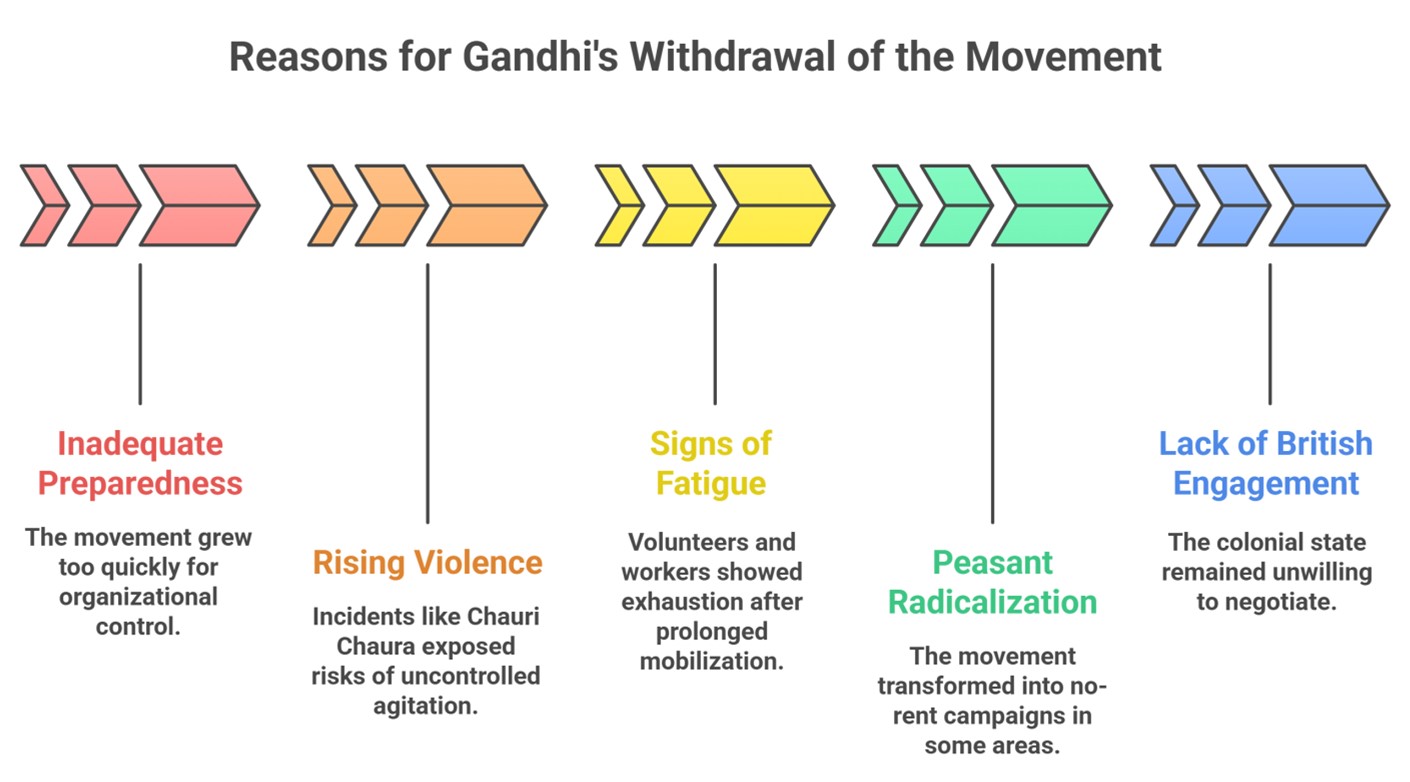
Reasons behind the Withdrawal of the Movement
Gandhi’s decision to withdraw was influenced by a combination of political, moral, and strategic factors:
- Inadequate preparedness: The movement had grown faster than the organisational capacity to control it.
- Rising instances of violence, like Chauri Chaura, exposed the risks of uncontrolled agitation.
- Signs of fatigue after prolonged mobilisation—many volunteers and workers were exhausted.
- Peasant radicalisation: In some areas, especially Bihar and Uttar Pradesh, the movement had transformed into no-rent campaigns, threatening social stability.
- Lack of British engagement: The colonial state remained unwilling to negotiate, choosing repression over reform.
Arrest and Trial of Mahatma Gandhi (1922): On 10 March 1922, Mahatma Gandhi was arrested by the British colonial government and charged with sedition under Section 124A of the Indian Penal Code for his leadership in the Non-Cooperation Movement. This arrest marked a crucial moment in India’s struggle for independence, highlighting Gandhi’s unwavering commitment to truth and non-violence.
The Trial
Gandhi’s trial became a landmark in colonial legal history. In a courtroom packed with observers, Gandhi delivered a powerful and memorable statement, declaring:
“Non-cooperation with evil is as much a duty as cooperation with good.”
- He pleaded guilty to the charges, accepting full moral responsibility for inciting civil disobedience against unjust laws.
- The British judge, while acknowledging Gandhi’s honesty, sentenced him to six years in prison.
- However, due to deteriorating health, Gandhi was released in 1924, after serving two years.
End of the Khilafat Movement:
With the suspension of the Non-Cooperation Movement following the Chauri Chaura incident, the Khilafat Movement also began to lose momentum and relevance.
Key Developments in Turkey
- In November 1922, Mustafa Kemal Pasha (later Atatürk) rose to power in Turkey, embarking on a bold programme of modernisation and secularisation.
- He abolished the political authority of the Caliph, separating state from religion.
- By 1924, the institution of the Caliphate was formally dismantled, ending the symbolic cause that had united Indian Muslims.
Broader Impact of the Khilafat Movement
Despite its eventual dissolution, the Khilafat Movement had a significant impact on the Indian nationalist landscape:
- It brought Indian Muslims into the mainstream of the national freedom struggle, many for the first time.
- It fostered a rare moment of Hindu-Muslim unity, with both communities rallying behind a shared political cause under Gandhi’s leadership.
- It nurtured a spirit of pan-Islamic solidarity and promoted anti-imperial resistance beyond India’s borders.
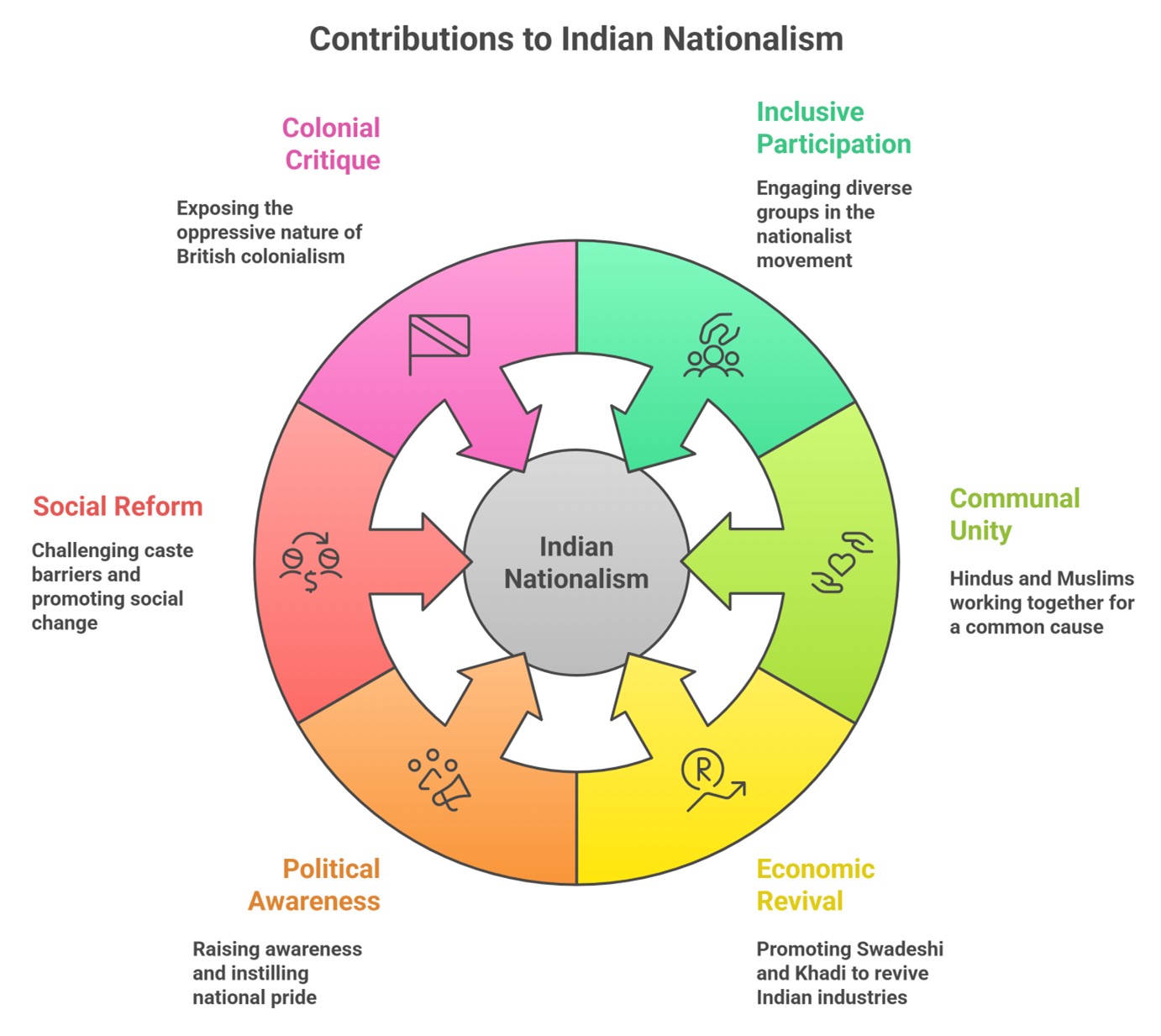
Contribution of the Khilafat and Non-Cooperation Movement
Despite its eventual suspension, the movement left an enduring legacy and produced far-reaching effects on Indian society and politics.
Key Contributions:
- Widened the base of Indian nationalism by including:
- Peasants, artisans, women, students, and the urban working class.
- Bridged communal divides:
- Hindus and Muslims worked together for a common political cause.
- Promoted Swadeshi and Khadi, weakening the British textile industry and reviving Indian handloom and cottage industries.
- Raised political awareness at the grassroots, instilling a sense of national pride and empowerment.
- Challenged caste barriers and gave a boost to social reform movements.
- Exposed the oppressive nature of British colonialism, weakening its moral legitimacy.
- Widened the base of Indian nationalism by including:
Transformation of the Indian National Congress
The movement also transformed the Indian National Congress from a closed, elite organisation into a broad-based mass movement.
- After the movement, Congress could no longer be dismissed as a “microscopic minority,” as previously described by British officials.
- Gandhi’s leadership brought the Congress closer to rural India, making it the true voice of the Indian people.
The Non-Cooperation and Khilafat Movement (1919–1922) represented India’s first major experiment in non-violent mass civil disobedience. Although it ended abruptly, the movement succeeded in:
- Unifying the nation like never before.
- Embedding non-violence, mass mobilisation, and social reform as essential elements of Indian nationalism.
- Establishing Mahatma Gandhi as the unchallenged leader of India’s freedom struggle.
It laid the conceptual and organisational groundwork for future mass movements—Civil Disobedience (1930) and Quit India (1942)—that would ultimately lead to India’s independence in 1947.