
Who Were the Moderates?
The early leadership of the Indian National Congress comprised individuals who were:
- Educated in British-style institutions, especially in English.
- Predominantly drawn from the urban, professional middle class, including lawyers, teachers, journalists, and doctors.
- Mainly from the Bombay, Bengal, and Madras Presidencies, where Western education had made the deepest impact.
- Frequently from upper-caste backgrounds, especially Brahmins, who had easier access to modern education and jobs under colonial rule.
These leaders were heavily influenced by liberal-democratic ideas from the West and sought to emulate British constitutionalism in their demands and methods.
Objectives of Moderate Nationalism
The Moderates did not initially seek complete independence. Instead, their goals were more modest and strategic. They aimed to:
- Create national political awareness among the masses.
- Unite Indians across caste, religion, and regional divides under a shared identity.
- Petition the British Crown and Parliament for administrative, legislative, and economic reforms.
- Train Indians in the art of politics, civic engagement, and constitutionalism.
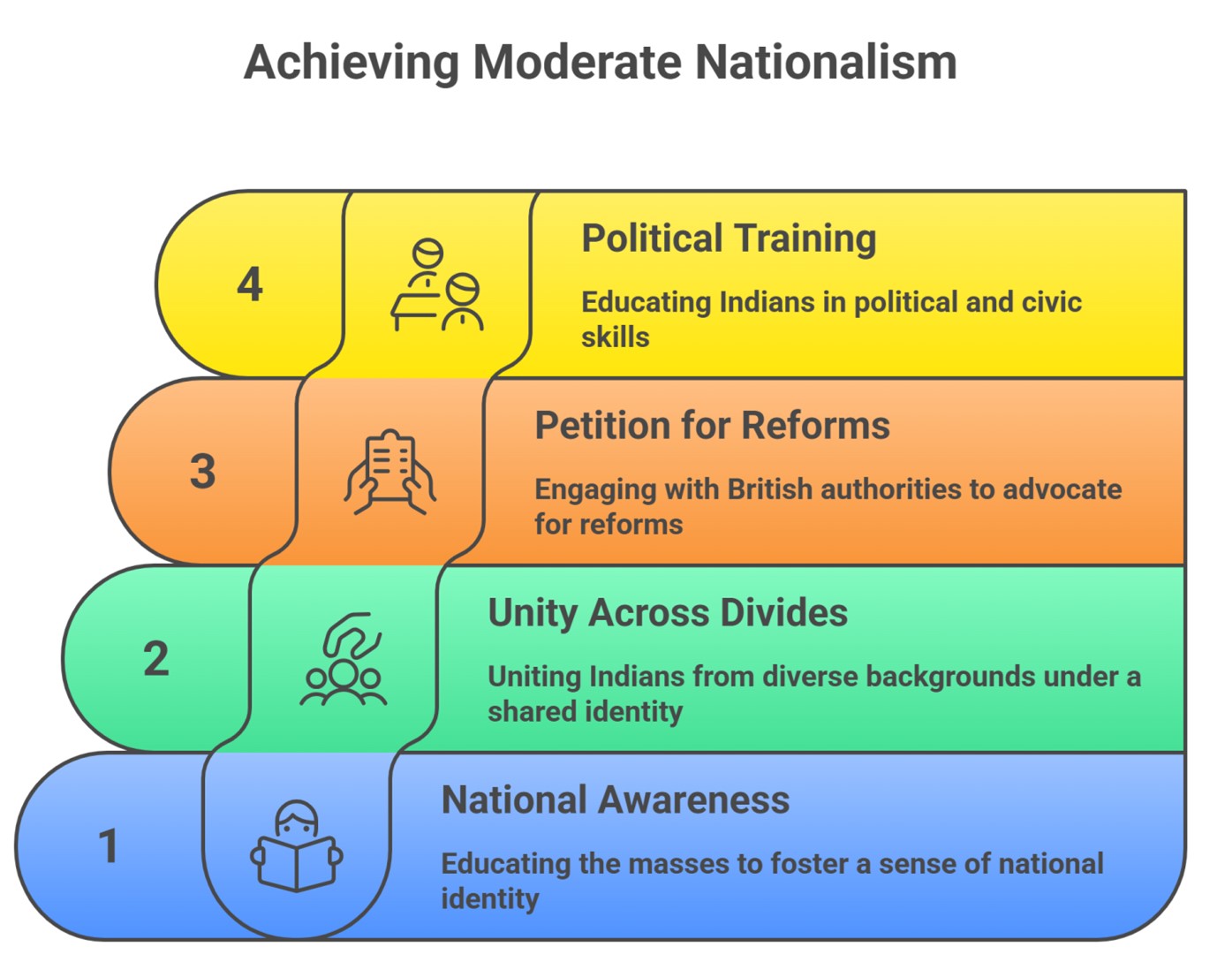
Their vision was based on the belief that India was undergoing a “nation-in-the-making” process and required political maturity through education and dialogue, not confrontation.
Key Demands and Programmes of the Moderates
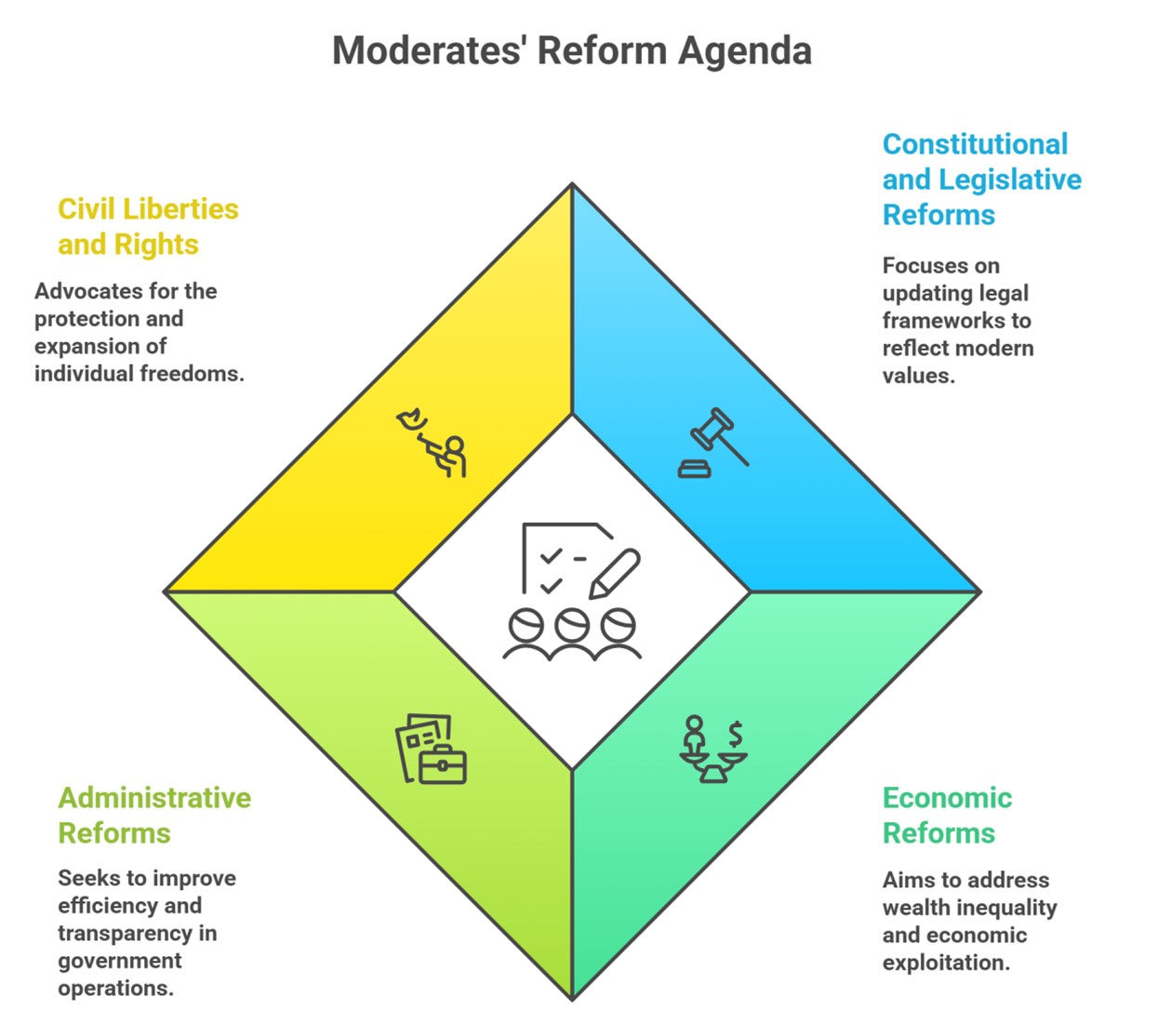
1. Constitutional and Legislative Reforms
The Moderates believed in expanding Indian participation in governance through:
- Enlargement of legislative councils at central and provincial levels.
- Increased representation of Indians in these councils, with real powers to discuss and influence policies.
- Freedom to debate budgetary allocations and administrative actions.
Their sustained advocacy led to the enactment of the Indian Councils Act of 1892, which:
- Increased the number of non-official members, including Indians.
- Allowed limited discussion of financial matters, without voting rights.
- Continued to maintain an official majority, thus limiting legislative autonomy.
Unsatisfied with these token reforms, the Moderates later demanded:
- A majority of elected Indians in the councils.
- Control over financial matters, encapsulated in the slogan: “No taxation without representation.”
- Swarajya (self-rule) on the model of self-governing British colonies such as Canada and Australia.
At the Banaras Session in 1905, Gopal Krishna Gokhale first raised the demand for self-government. Dadabhai Naoroji reinforced this idea at the 1906 Calcutta Session, making it part of the Congress’s official demands.
2. Economic Reforms: Exposing the Drain of Wealth
Moderates like Dadabhai Naoroji, R.C. Dutt, and G.V. Joshi laid the intellectual foundation of economic nationalism.
- Dadabhai Naoroji’s “Drain Theory”, in his seminal work Poverty and Un-British Rule in India, argued that India was being impoverished by British economic policies.
The ‘Drain’ of Indian wealth included:
- Salaries and pensions of British officials, paid out of Indian revenues.
- Profits and dividends of British enterprises remitted to England.
- The cost of maintaining British military forces in India and overseas.
As a result of their relentless efforts, the Welby Commission was constituted to examine India’s finances. Naoroji became the first Indian to serve on a British royal commission.
Key economic demands included:
- Reduction in land revenue and salt taxes, which burdened the poor.
- Cutting down military expenditure and spending more on welfare.
- Tariff protection and state aid for Indian industries.
- Promotion of Swadeshi goods and boycott of imported British products.
3. Administrative and Bureaucratic Reforms
Moderates believed that better governance could be ensured through:
- Indianisation of the civil services:
- Economically beneficial, as Indians would work for lower salaries.
- Politically empowering, allowing Indians to represent Indian interests.
- Morally justified, as it reduced racial discrimination in service appointments.
- Holding simultaneous Indian Civil Services (ICS) examinations in England and India to provide equal opportunity.
- Separation of judiciary from the executive to ensure impartiality in justice delivery.
- Expansion of primary, secondary, and technical education to build human capital.
- Strengthening of public health, irrigation, and infrastructure facilities.
- Establishment of agricultural banks to support farmers and reduce dependency on moneylenders.
- Legal protection for Indian labourers abroad, especially in British colonies.
- Repeal of the discriminatory Arms Act of 1878, which denied Indians the right to possess weapons.
4. Civil Liberties and Democratic Rights
The Moderates were staunch advocates of individual rights:
- Freedom of speech, freedom of the press, and freedom of association were core civil liberties they consistently defended.
- They opposed arbitrary laws like the Vernacular Press Act, and used petitions, memoranda, and public meetings to protest violations of civil rights.
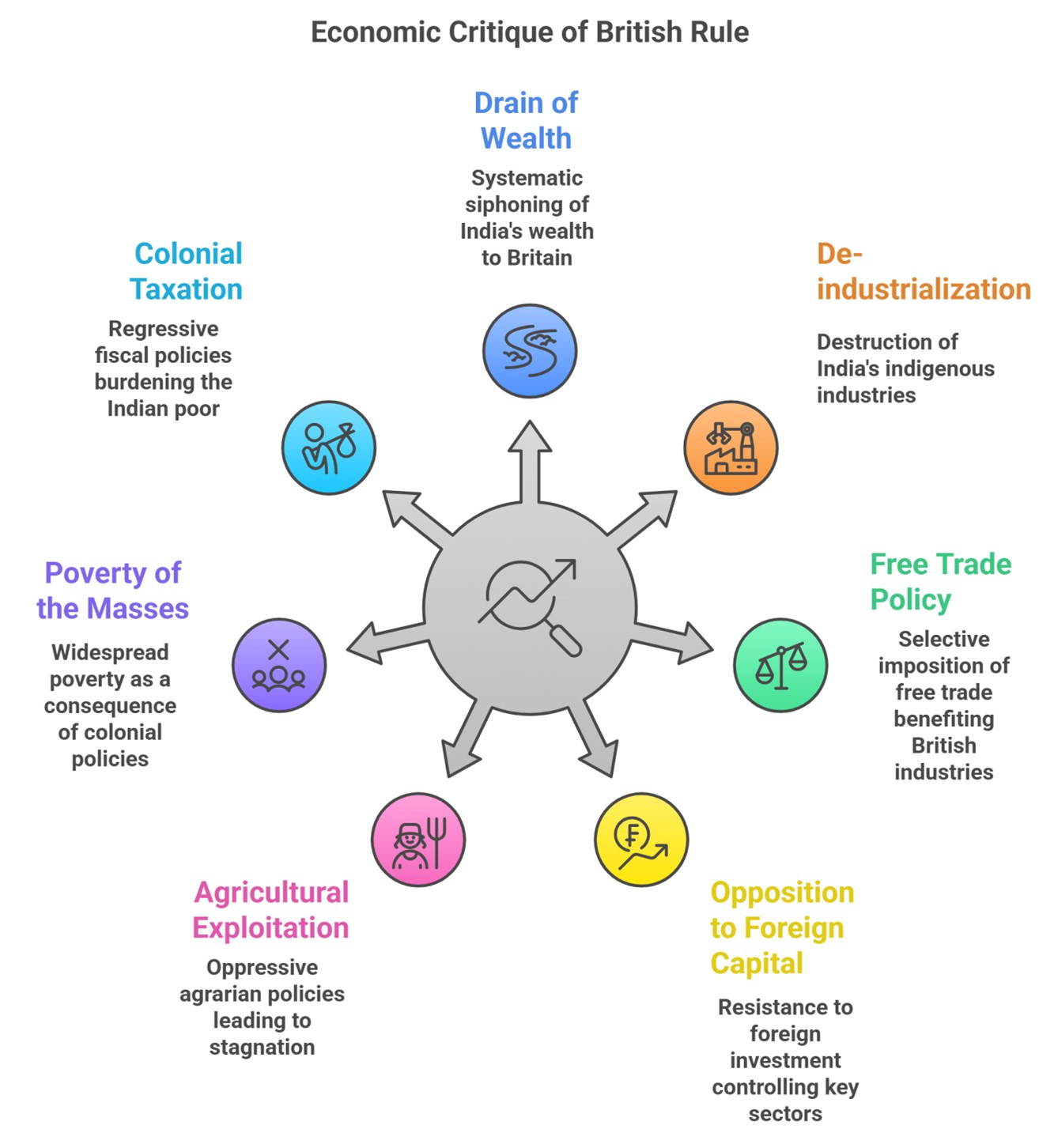
Major Themes of the Economic Critique of British Rule in India
The economic critique of British colonialism, developed by early Indian nationalists in the late 19th century, laid the foundation for modern Indian nationalism. This economic analysis exposed how colonial policies stifled India’s economic development and created chronic poverty and structural underdevelopment.
1. Drain of Wealth
The concept of the “Drain of Wealth” was one of the central pillars of the nationalist economic critique. It was popularised by Dadabhai Naoroji, often referred to as the Father of Indian Economic Nationalism, in his influential book “Poverty and Un-British Rule in India.”
He argued that India’s national wealth was being systematically siphoned off to Britain, with no corresponding benefit to the Indian people. The mechanisms of this drain included:
- Salaries and pensions of British civil and military officials paid from Indian revenues
- Remittances of savings by British personnel working in India
- Profits of British trading and investment companies, repatriated to Britain
- Payments for the upkeep of British troops stationed in India or abroad but paid for by India.
The Indian National Congress formally adopted the Drain Theory at its 1896 session in Calcutta, making it a foundational theme in nationalist discourse.
Key References:
- Prosperous British India by William Digby
- Economic History of India by R.C. Dutt
- Some Economic Aspects of British Rule in India by G.S. Iyer
2. De-industrialization
The nationalists strongly criticised the destruction of India’s indigenous industries, especially the traditional handicraft and artisan sectors, which had flourished before the advent of British rule.
- The unrestricted import of British factory-made goods into India led to a flood of cheap machine-made products, undermining local artisans.
- Indian craftsmen, unable to compete with the mass-produced goods of England, lost their livelihoods, leading to widespread unemployment and poverty.
- This phenomenon triggered a process of ruralisation, where displaced artisans were forced back into agriculture, which was already overcrowded and stagnating.
De-industrialisation was a key factor in India’s economic regression, as it led to job losses without adequate compensation through industrial development.
3. Policy of Free Trade
The British policy of free trade, under the guise of economic liberalism, was selectively imposed to benefit British industries at the expense of Indian economic interests.
- Indian products received no protection, while British goods enjoyed duty-free entry into Indian markets.
- This resulted in the crippling of Indian infant industries, which could not compete with the established industrial base of Britain.
The early nationalists called for:
- Protective tariffs to shield native industries
- State patronage for the development of Indian enterprises
- Promotion of Swadeshi goods and the boycott of British imports to restore economic autonomy
These demands culminated in the Swadeshi Movement that became central to later phases of the national movement.
4. Opposition to Foreign Capital
The nationalist leaders opposed British investment in Indian infrastructure like railways, plantations, and mines, not because they were against industrialisation per se, but because:
- Foreign capital led to external control over India’s key economic sectors
- It suppressed indigenous entrepreneurship, as Indian capitalists were unable to compete with British firms favoured by the colonial state
- The profits from these investments were repatriated to Britain, contributing further to the economic drain.
The nationalists emphasised that industrial development must be driven by Indian capital and enterprise to ensure real national progress and economic sovereignty.
5. Agricultural Exploitation and Land Revenue System
With nearly 80% of Indians dependent on agriculture, the oppressive agrarian policies of the British were a primary target of nationalist critique. Key issues included:
- Exorbitant and unpredictable land revenue assessments, often revised arbitrarily
- Harsh rent collection practices, which resulted in evictions, indebtedness, and peasant unrest
- Lack of security of tenure, which discouraged investment in land improvement.
The consequences of this exploitative system were:
- Stagnation of Indian agriculture
- Decline in land productivity
- Frequent famines and food insecurity
The nationalists demanded:
- Reduction in land revenue rates
- Introduction of a permanent and secure tenure system (not necessarily the Zamindari system), to encourage farmers to invest in the land and improve agricultural output
6. Poverty of the Indian Masses
The nationalists were deeply concerned about the widespread poverty that plagued India under colonial rule. This was clearly articulated by Dadabhai Naoroji in his work “The Poverty of India” (1876). He identified that poverty was not accidental or cultural, but rather the direct consequence of British exploitative policies that drained Indian wealth and stifled economic opportunities.
The persistent poverty, even after decades of British rule, was a compelling argument against the “benevolent imperialism” often claimed by the British.
7. Public Finance and Colonial Taxation
The fiscal policies of the British colonial state were highly regressive and inequitable, disproportionately burdening the Indian poor. Key issues included:
- Excessive taxation on essentials, particularly the infamous salt tax
- Military expenditure, which consumed a large share of Indian revenues and primarily served British imperial interests
- The rich and British residents in India largely escaped taxation, enjoying privileges and exemptions.
The nationalists demanded:
- Abolition of the salt tax
- Reduction in military spending
- Introduction of progressive taxation and land reforms to ensure a more equitable fiscal structure.
They argued that public revenues must be spent for the welfare of Indians, not to sustain foreign domination.
Early Intellectual Roots of Economic Nationalism
Even before the emergence of the moderate nationalists, several Indian intellectuals had laid the ideological foundations of economic nationalism by criticising colonial economic practices.
Raja Rammohan Roy
- Opposed the tribute payments to Britain that drained Indian wealth
- Advocated for fiscal accountability and justice
Maharashtrian Economists
- Thinkers like Bhaskar Pandurang Tarkhadkar, Govind Vitthal Kunte, and others condemned:
- The destruction of indigenous cottage industries
- Unfair trade practices, such as free trade favouring British goods
- Use of Indian revenue to fund British imperial wars, especially outside India
These early voices influenced the later moderate nationalists, providing intellectual depth and moral legitimacy to their economic critique.
Gopal Krishna Gokhale (1866–1915)
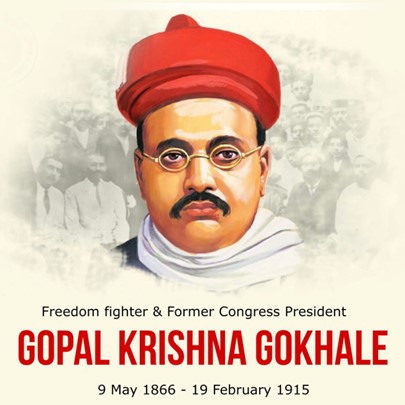
A moderate nationalist, political philosopher, and social reformer, Gopal Krishna Gokhale played a pivotal role in shaping the liberal and constitutionalist vision of the Indian freedom movement.
Influences and Early Life:
- Deeply influenced by Justice M.G. Ranade, a key figure in Indian social reform and moderate politics.
- Gokhale was educated at Elphinstone College and later taught at Fergusson College, Pune.
Legislative Contributions:
- Elected to the Bombay Legislative Council in 1899.
- Served in the Imperial Legislative Council from 1901, where he emerged as a respected voice of reason, known for his eloquent budget speeches and persistent advocacy for Indian rights.
- Strongly championed compulsory primary education and worked tirelessly to improve the conditions of Indian indentured labourers, particularly in South Africa.
Organisational Initiatives:
- Founded the Servants of India Society (1905): An organisation that trained young Indians to dedicate themselves to the service of the nation through social work and public service.
- Launched the journal “Hitavada” in 1911, to spread liberal democratic ideals and foster national awakening.
Political Philosophy:
- Believed in constitutional reform, gradualism, and collaboration with the British authorities.
- Opposed the extremist methods of direct action advocated by leaders like Bal Gangadhar Tilak.
- Served as mentor to Mahatma Gandhi, who referred to him with great reverence and wrote the book “Dharmatma Gokhale” in his honour.
- Gokhale believed that self-government must evolve step-by-step, as Indians became ready for it through education and institutional capacity-building.
Surendranath Banerjee (1848–1925)
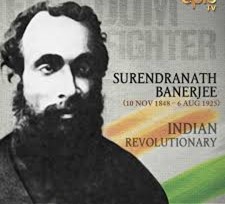
A prominent moderate leader, educator, and early nationalist journalist, Surendranath Banerjee was instrumental in popularising political consciousness among the Indian middle class.
- Passed the Indian Civil Services (ICS) examination in 1869, becoming one of the earliest Indians to do so. However, he was later disqualified on technical grounds related to his age, a move widely seen as discriminatory.
- This personal experience of injustice ignited his lifelong dedication to political reform and national awakening.
Organisational Leadership:
- Co-founded the Indian Association (1876) with Ananda Mohan Bose, to provide a broader political platform that aimed to unite Indians of all backgrounds on common political objectives. The Association merged with the INC in 1886.
Journalism and Public Mobilisation:
- Purchased and edited “The Bengalee” newspaper for over 40 years, using it as a platform to promote constitutional reform, education, and Indian rights.
- Became the first Indian journalist to be imprisoned in 1883 for writing against a colonial judge (Justice Norris), gaining national recognition.
Role in Congress and Beyond:
- Presided over the Indian National Congress in 1895 and 1902.
- After the Montagu–Chelmsford Reforms (1919), he supported them despite Congress opposition, leading to his resignation from the INC.
- Founded the Indian National Liberation Federation (1919), along with other moderate leaders.
- Accepted a knighthood in 1921, becoming one of the first Indian leaders to be officially honoured by the British.
Leader | Key Contributions |
G. Subramania Iyer | • Founded two prominent newspapers: – The Hindu (English) in 1878 – Swadesamitran (Tamil) in 1882 • Co-founded the Madras Mahajan Sabha in 1884 along with M. Veeraraghavachariar and P. Anandacharlu – one of the earliest regional political associations in South India. |
Badruddin Tyabji | • Co-founded the Bombay Presidency Association with Pherozeshah Mehta and K.T. Telang to promote constitutional reforms and Indian political rights. • Became the first Muslim President of the Indian National Congress, presiding over its Third Session in Madras (Chennai) in 1887. He was instrumental in promoting communal harmony and inclusive nationalism. |
Womesh Chandra Bonnerjee | • First President of the Indian National Congress, presiding over its inaugural session in Bombay in 1885. • Also presided over the Allahabad Session of the INC in 1892. • A renowned lawyer, he defended Surendranath Banerjee in the famous Contempt of Court case in 1883 in the Calcutta High Court. |
Sir Rash Behari Ghosh | • Served as President of the Indian National Congress during two important sessions: – Surat Session (1907) – which witnessed the ideological split between Moderates and Extremists. – Madras Session (1908). • A noted philanthropist and educationist. • Was knighted in 1915 for his public services under British rule. |