
Historiography of Modern India
Historiography refers to the study of how history is written and interpreted. It is not merely a record of events, but an intellectual exercise that helps us understand how historical narratives are shaped by political, ideological, social, and cultural contexts. Through historiography, one can critically evaluate the motivations, biases, and frameworks used by historians in different periods.
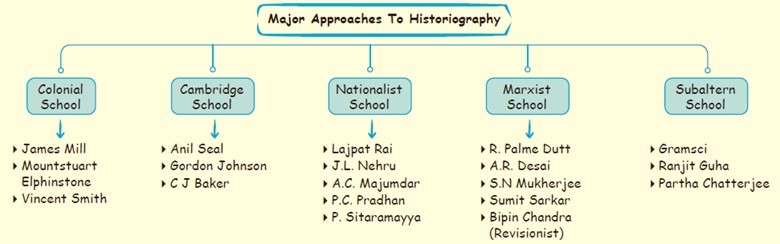
In the context of Modern Indian history, historiography can be broadly divided into four dominant schools: the Colonial, Nationalist, Marxist, and Subaltern approaches. Additionally, several other interpretations such as the Liberal, Communalist, Feminist, and the Cambridge School also offer important insights into how India’s past has been perceived and recorded.
1. Colonial School of Historiography
The Colonial School dominated the intellectual landscape of Indian history during the 19th and early 20th centuries. It was largely shaped by British administrators, officials, and scholars, who wrote history with the objective of justifying and glorifying colonial rule in India.
Key Features:
- Major Contributors: James Mill (History of British India), Vincent Smith, Mountstuart Elphinstone, and Valentine Chirol (Indian Unrest).
- Denial of Indian Nationhood: Colonial historians denied the existence of India as a unified nation before British rule. They emphasized religious, linguistic, and regional divisions to justify the “civilising mission” of the British.
For instance, Valentine Chirol described India as a “mere geographical expression”, claiming that even its geography was shaped by British rule.
- Glorification of British Rule: They portrayed the British as harbingers of modernity who introduced law, order, railways, Western education, and rational governance to a supposedly backward and fragmented Indian society.
- Depiction of Nationalist Movements: The anti-colonial struggle was often depicted as a collection of disconnected, reactionary, or violent uprisings, rather than a legitimate, organised mass movement.

2. Nationalist School of Historiography
Reacting against the colonial narrative, the Nationalist historians sought to reclaim India’s past with pride and offer a counter-narrative to British justifications of imperialism. Their goal was to highlight the unity, resilience, and achievements of Indian civilisation.
Key Features:
- Proponents: Lajpat Rai, Surendranath Banerjee, A.C. Mazumdar, R.G. Pradhan, B.R. Nanda, Pattabhi Sitaramayya, and later, Bipan Chandra and Bisheshwar Prasad.
- National Unity: Nationalist historians celebrated the “unity in diversity” of Indian civilisation and emphasised the continuity of India’s cultural and political identity, despite foreign invasions.
- Anti-Colonial Perspective: They exposed the exploitative nature of British colonialism and highlighted its damaging effects on India’s economy, culture, and social fabric.
Subhas Chandra Bose and Jawaharlal Nehru both insisted that Indian civilisation had a deep-rooted unity which British colonialism could not break.
- Limitation: However, this school sometimes tended to romanticise the past and overlook internal social divisions such as caste, gender, and class conflicts.
3. Marxist School of Historiography
The Marxist school, grounded in dialectical materialism, examined history through the lens of class struggle, economic exploitation, and production relations. It provided a structural and materialist analysis of Indian society under colonialism.
Key Features:
- Proponents: R.P. Dutt (India Today), A.R. Desai, Sumit Sarkar, Bipan Chandra, S.N. Mukherjee.
- Critique of Colonialism and Nationalism: Marxist historians criticised colonial historians for being Eurocentric and also critiqued nationalist historians for ignoring economic realities and focusing solely on cultural pride.
R.P. Dutt argued that the 1857 Revolt was a feudal reaction and that real nationalism only developed with the emergence of the bourgeois-led Indian National Congress.
- Class Analysis: Emphasized the role of the peasantry, working class, and bourgeoisie in shaping the Indian freedom struggle.
- Focus on Material Conditions: Marxist narratives delve into land relations, agrarian exploitation, capitalist development, and the economic drain theory.
4. Subaltern School of Historiography
Emerging in the 1980s, the Subaltern School was influenced by Gramsci’s theory of hegemony and focused on the “history from below”—the experiences and resistance of the marginalised.
Key Features:
- Proponents: Ranajit Guha, Partha Chatterjee, Gayatri Chakravorty Spivak, Dipesh Chakrabarty.
- Main Argument: The nationalist movement was largely an elite-driven project. Real resistance, according to them, came from peasants, tribals, workers, and other subaltern groups.
- Structural Dichotomy: A strong divide is observed between elite political discourse and popular resistance. They often rejected the notion of a unified national movement, arguing that elite nationalism failed to represent the masses.
- Criticism: While subaltern studies brought neglected voices into historical discourse, critics argue that it often romanticises local resistance and underestimates pan-Indian unity.