
Growth of Revolutionary Nationalism
Following the decline of the Swadeshi Movement, India’s national struggle entered a new and radical phase with the emergence of Revolutionary Nationalism. Between 1905 and 1918, the freedom movement experimented with multiple political strategies to counter British imperialism, each contributing significantly to the deepening of national consciousness. The revolutionary stream, in particular, synchronised with the waning mass participation in the Swadeshi movement. Later phases of political activism included the Ghadar Movement and the Home Rule Movement during the First World War.
Causes behind the Rise of Revolutionary Nationalism
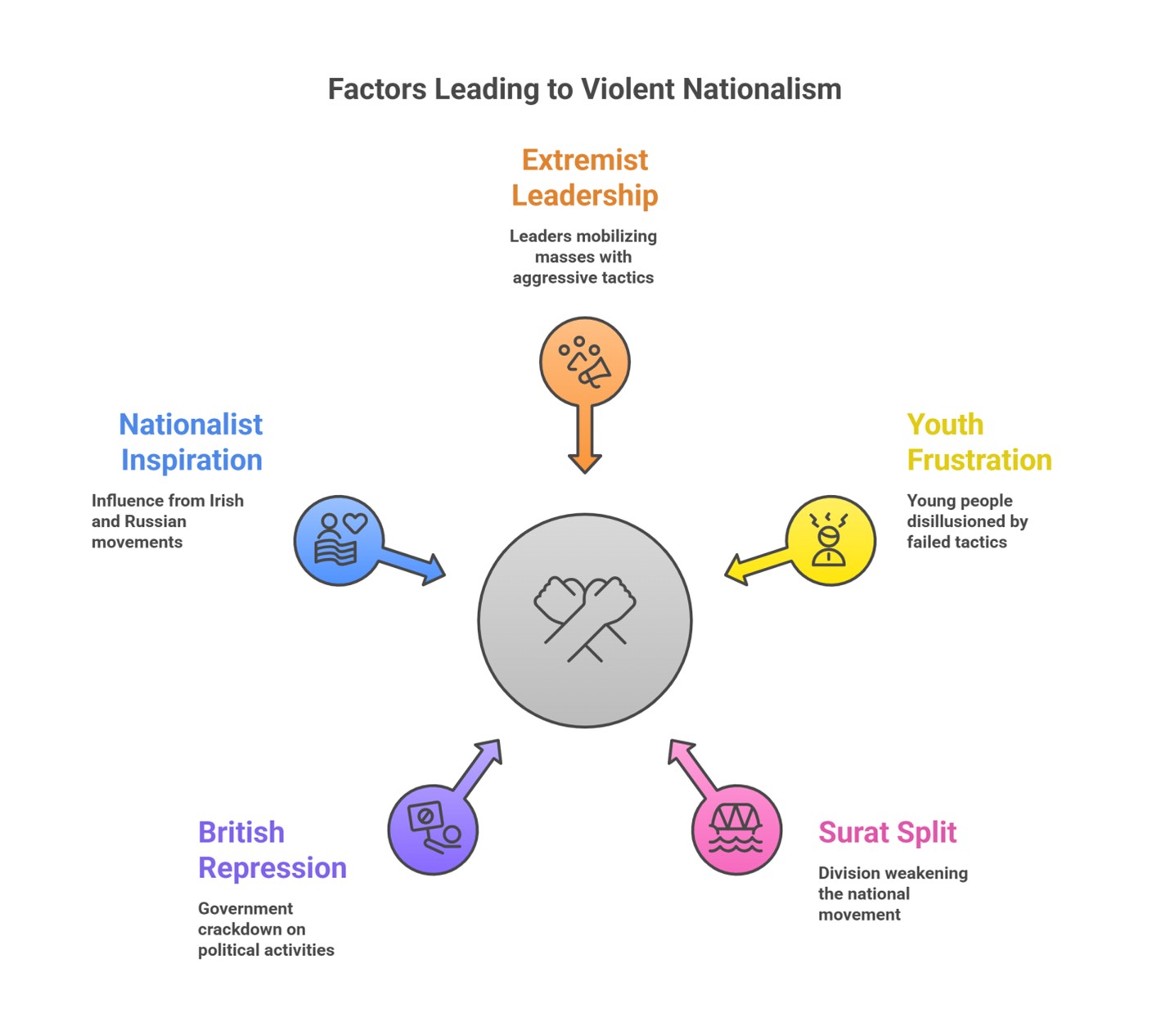
- The Extremist (Radical) leaders had successfully mobilised the masses, especially the youth, around aggressive methods like boycott, passive resistance, and direct confrontation with colonial rule. However, their failure to offer a structured roadmap for sustained mass action led to disillusionment among their followers.
- The younger generation in Bengal, who had been deeply involved in the Swadeshi movement, grew frustrated when these tactics failed to yield immediate results.
- The 1907 Surat Split further weakened the national movement’s united front, giving the British government an opportunity to unleash severe repression. The crackdown on extremist leaders and suppression of political activities closed off peaceful avenues of protest.
- The resultant frustration and anger pushed many youths toward violent nationalism. Inspired by the Irish nationalists and Russian Nihilists, they believed that the assassination of unpopular British officials and acts of armed rebellion would shake the foundations of colonial authority.
The revolutionary activities primarily took two forms:
- Individual heroic actions such as assassinations of British officials, informers, and loyalists.
- Swadeshi dacoities—robberies conducted to collect funds for revolutionary activities.
These actions aimed to:
- Strike fear in the minds of British administrators
- Eradicate the awe of British authority among Indians
- Ignite patriotic fervour and national consciousness across the country.
Several newspapers like Sandhya and Yugantar in Bengal and Kal in Maharashtra began promoting revolutionary ideals during this phase.
Extremists’ Views on Revolutionary Nationalism
Although Extremist leaders like Tilak and Bipin Chandra Pal did not endorse violent methods such as political assassinations, they expressed sympathy and admiration for the courage and patriotism of young revolutionaries. They considered these youths as victims of British repression, whose radical actions were born out of desperation and a lack of peaceful alternatives.
Revolutionary Activities in Maharashtra
Early Revolutionary Action by Vasudeo Balwant Phadke (1879)
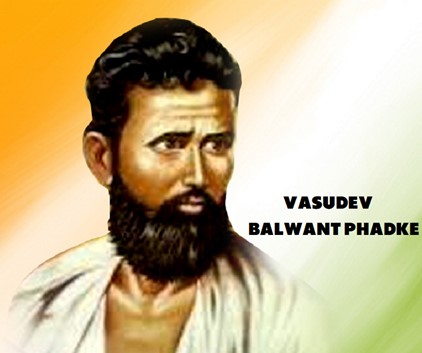
- Phadke, a government clerk, formed a band of Ramoshi tribal peasants and attempted an armed revolt against British rule in western India.
- The movement lacked planning and was quickly suppressed by colonial authorities.
Rand Assassination Case (1897)
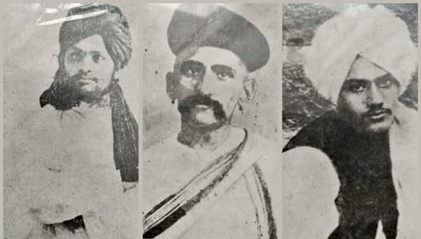
- During the bubonic plague outbreak in Pune, the British appointed W.C. Rand as the Plague Commissioner.
- His team carried out violent and humiliating inspections, violating the privacy and dignity of Indian households.
- In retaliation, Damodar and Balkrishna Chapekar, members of the Chapekar Club (followers of Tilak), assassinated Rand and his escort Lieutenant Ayerst during Queen Victoria’s Diamond Jubilee celebration.
- Vasudeo Chapekar and other associates later killed police informers. All three Chapekar brothers were hanged in 1899.
Abhinav Bharat Society (1904)
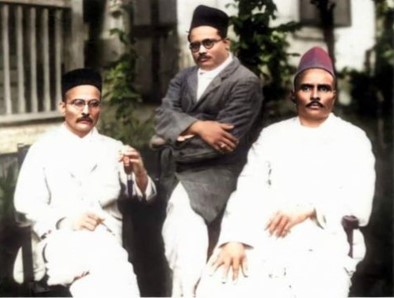
- Vinayak Damodar Savarkar and Ganesh Savarkar founded this secret organisation in Nashik, inspired by Mazzini’s Young Italy.
- It engaged in revolutionary propaganda and planned assassinations of colonial officials.
- It merged with Mitra Mela, an earlier secret group established in 1899.
Assossination of Jackson (1909)
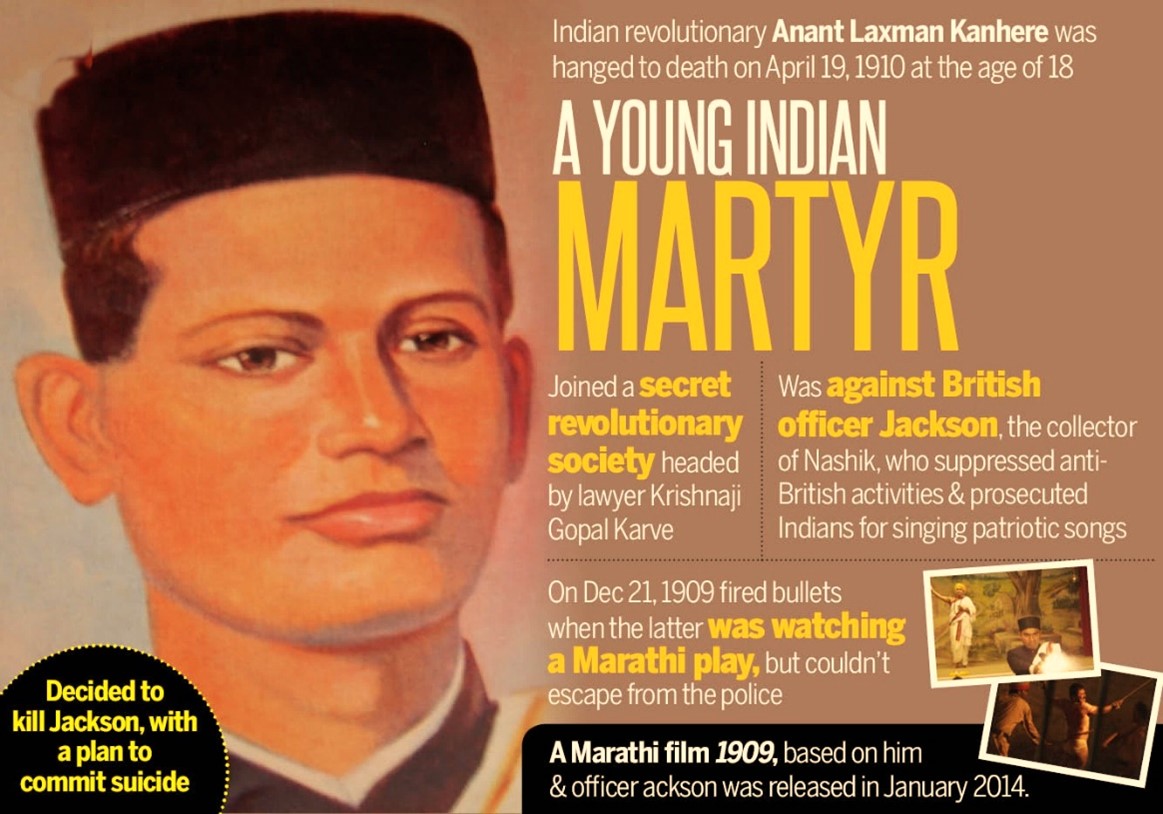
- A.M.T. Jackson, the District Magistrate of Nashik, was shot dead by Anant Laxman Kanhere, a 17-year-old revolutionary.
- The event exposed Abhinav Bharat’s role, leading to the arrest of the Savarkar brothers. V.D. Savarkar was sentenced to life imprisonment and sent to Cellular Jail in Andaman.
Revolutionary Activities in Bengal
Anushilan Samiti (1902)
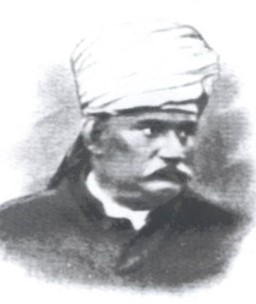
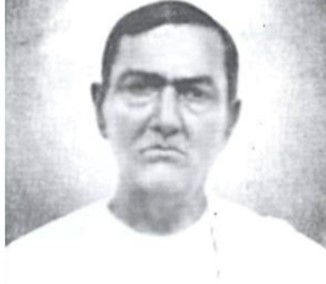
- A secret revolutionary group founded in Calcutta by Pran Nath Mitra and Satish Chandra Basu.
- Influenced by Bankimchandra’s play Anushilan-Tattva, it trained youth in physical culture and political action.
- Associated with nationalists like Aurobindo Ghosh, Bipin Chandra Pal, and Jatindranath Bannerjee.
Dhaka Anushilan Samiti (1906)
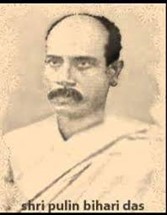
- Started by Pulin Behari Das, it rapidly gained popularity and overshadowed the Calcutta branch.
- Conducted bomb attacks, assassinations, and dacoities to fund revolutionary activities.
- The journal Yugantar Patrika, started in 1906 by Barindra Ghosh and others, spread revolutionary ideology.
Assassination Attempts (1907–08)
- In 1907, an attempt was made on Sir Fuller, the Lieutenant Governor of East Bengal.
- In 1907, Sir Andrew Fraser, another high-ranking official, narrowly escaped a train bombing.
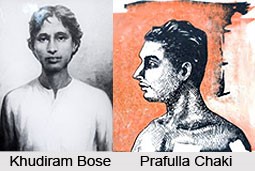
- In April 1908, Khudiram Bose and Prafulla Chaki attempted to assassinate Judge Kingsford by throwing a bomb. The attack mistakenly killed two British women. Chaki committed suicide; Bose was arrested and executed at age 18.
Alipore Bomb Case (1908–09)
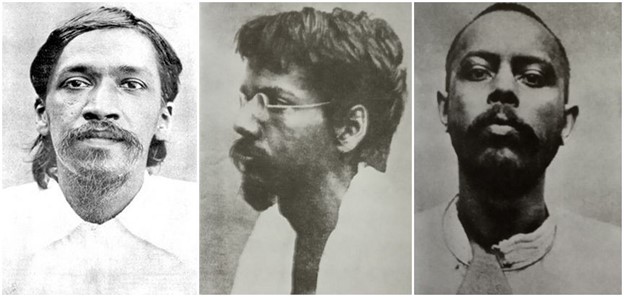
- This was a major conspiracy trial involving Aurobindo and Barindra Ghosh.
- Narendra Gosain, who turned approver, was murdered in jail by fellow accused.
- Aurobindo Ghosh was defended by C.R. Das and acquitted. He later withdrew from politics to pursue a spiritual life in Pondicherry.
- Barindra Ghosh and Ullaskar Dutt were sentenced to life imprisonment.
Delhi Conspiracy Case (1912)
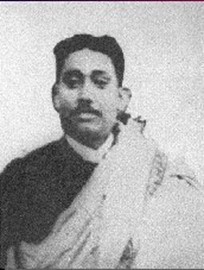
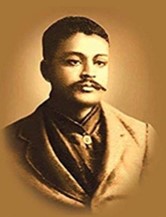
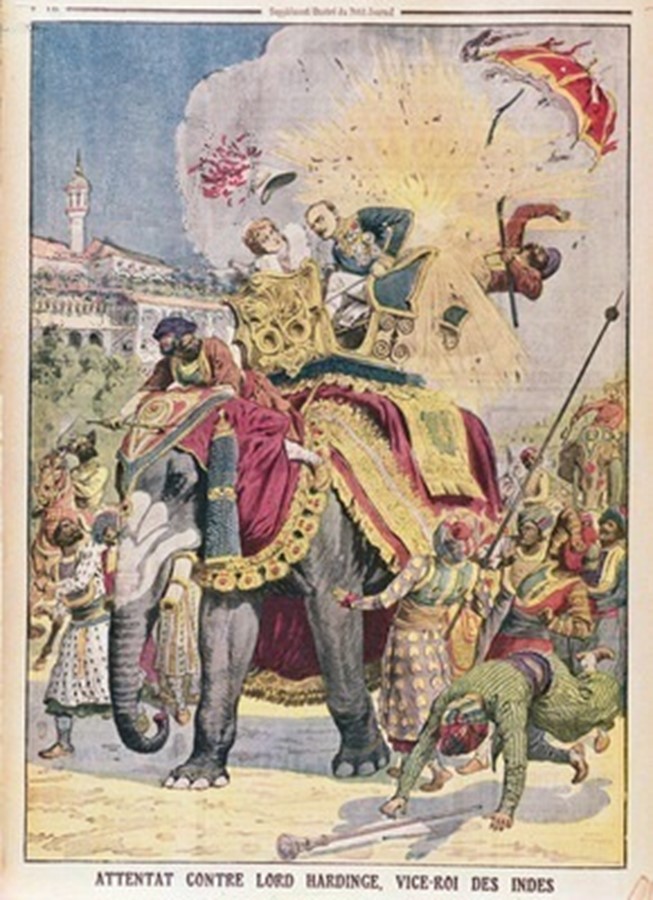
- A bomb was thrown at Viceroy Lord Hardinge during a ceremonial procession in Delhi. Though injured, he survived.
- Revolutionaries Rash Behari Bose and Sachin Sanyal masterminded the attack.
- After extensive investigations, Basant Kumar Biswas, Amir Chand, and Avadh Behari were hanged.
- Rash Behari Bose fled to Japan, where he continued revolutionary work until his death.
Jatin Mukherjee (Bagha Jatin) and the German Plot
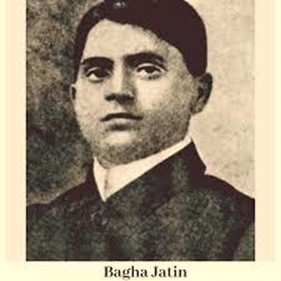
- Jatin Mukherjee, a key figure in the Jugantar group, envisioned an armed national insurrection.
- He collaborated with Indian revolutionaries abroad, especially the Ghadar Party, to import German arms via sea during World War I (Zimmerman Plan).
- Jatin and his comrades awaited the shipment in the Balasore jungles (1915), but the plan was leaked.
- In a 75-minute gunfight, Jatin was mortally wounded. He died later in hospital.
Revolutionary Activities in Madras
Bharatha Matha Sangam
In the Madras Presidency, revolutionary nationalism found expression through the formation of secret societies that aimed to challenge British authority through radical actions. One such group was the Bharatha Matha Sangam, which was formed by Nilakanta Bramhachari, Vanchinathan, Shankar Krishna Aiyar, and a few other dedicated revolutionaries. The Sangam plotted to assassinate influential British officials who were involved in suppressing Indian nationalist movements.
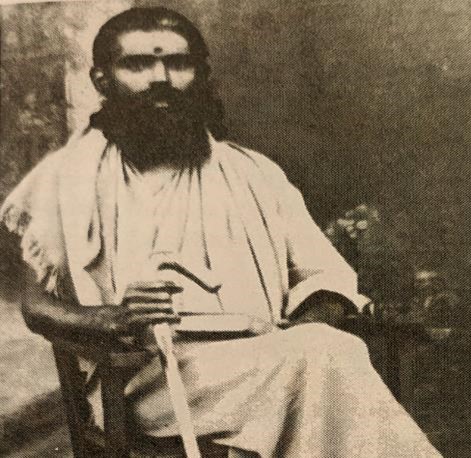
On 17 June 1911, Vanchinathan carried out the assassination of Robert Ashe, a British official notorious for his brutal suppression of protests. Ashe had ordered the firing on a crowd protesting the arrest of Chidambaram Pillai, an Extremist nationalist leader. Vanchinathan’s act was a symbolic expression of resistance against colonial repression in South India.
Revolutionary Activities Abroad
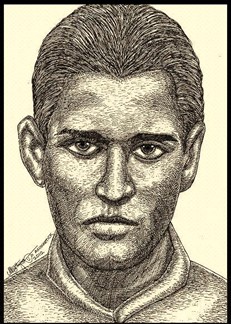
Revolutionary nationalism was not confined within Indian borders. Many Indian nationalists, unable to operate freely under colonial repression, shifted their base abroad and created influential hubs of resistance in London, Paris, and Berlin. These centres played a critical role in spreading anti-British sentiment and organizing revolutionary activities on a global scale.
London: India House and Shyamji Krishna Varma
In 1905, Shyamji Krishna Varma established three significant institutions in London:
- Indian Home Rule Society: Created to promote the cause of Home Rule and to educate Indians about their rights and the importance of national unity.
- India House: A hostel and meeting place for radical Indian students. It soon became a centre of revolutionary nationalist activities.
- The Indian Sociologist: A journal used to publish anti-colonial ideas and expose the exploitative nature of British rule.
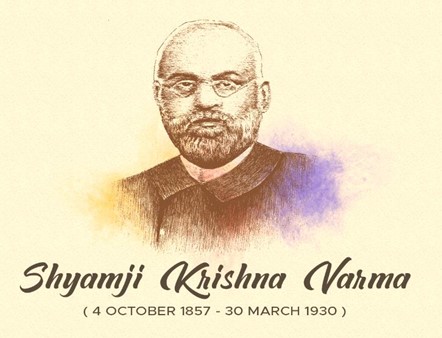
Prominent revolutionaries such as Vinayak Damodar Savarkar and Lala Har Dayal were associated with India House. After Varma was exiled to Paris in 1907, Savarkar assumed leadership of India House. However, following the assassination of Sir Curzon Wyllie by Madan Lal Dhingra, India House was shut down by British authorities in 1909.
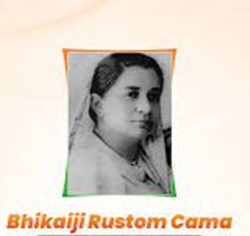
Paris: Madam Bhikaiji Cama and Paris Indian Society
In 1905, Madam Bhikaiji Cama, S.R. Rana, and Munchershah Burjorji Godrej established the Paris Indian Society, which served as a shelter for revolutionaries escaping from Britain.
Madam Cama’s contributions were remarkable:
- She refused to sign a declaration of loyalty to the British government, which barred her return to India.
- In 1907, at the Second Socialist Congress in Stuttgart, Germany, she unfurled the first Indian national flag designed by herself.
- She founded the nationalist journal Bande Mataram.
- Her efforts were instrumental in financing Virendranath Chattopadhyaya’s Berlin-based newspaper Talvar.
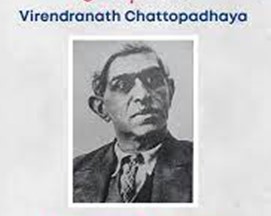
Virendranath Chattopadhyaya (Chatto)
Initially a student of law in London, Virendranath Chattopadhyaya soon became disillusioned with the colonial regime. He associated with Savarkar and became secretary of the journal Swaraj, edited by Savarkar. After fleeing to Paris in 1909, he became a leading voice of Indian nationalism in exile.
In 1915, Chattopadhyaya established the Berlin Committee for Indian Independence. He played a central role in coordinating revolutionary activities in Europe, receiving financial and logistical support from German authorities.
Germany: Berlin Committee and International Schemes
In April 1914, Chattopadhyaya moved to Germany. By September 1914, with help from fellow revolutionaries and German officials like Baron Oppenheim, the Indian Independence Committee was formed in Berlin. The Committee devised several plans to incite rebellion in India:
- Afghan Scheme: To rally Muslims in the North-West Frontier.
- Batavia Scheme: To mobilise Bengali revolutionaries.
- Bangkok Scheme: To energize returning Sikhs of the Ghadar Party.
Religious Underpinnings of Revolutionary Nationalism
The early 20th century witnessed a fusion of nationalism with religious fervour. Most revolutionaries were devout individuals who viewed the struggle for freedom as both a political duty and spiritual mission.
- In Maharashtra, Tilak and Savarkar infused nationalist ideas with spiritual symbolism from texts like the Bhagavad Gita, interpreting it as a call to selfless action.
- In Bengal, Bankim Chandra Chatterjee’s portrayal of the motherland as the divine goddess Durga, and Swami Vivekananda’s nationalistic messages, deeply influenced the youth.
- Secret societies often took oaths before goddess Kali, swearing to fight until India attained freedom.
However, this religious symbolism also alienated sections of the Muslim population, as the movement appeared to be largely Hindu in character. Still, the early revolutionaries remained focused on one goal: the armed liberation of India from colonial rule, with religion serving as a moral compass and motivational force.
Case / Organization (Year, Place) | Associated People & Description |
The Anushilan Samiti (1902, Bengal) | Founded by Promotha Mitter, Jatindranath Banerjee, Barindra Kumar Ghosh. Published Yugantar and Sandhya Prakash. Promoted Swadeshi dacoities, physical training, and moral education. |
Attempt on Sir Fuller’s Life (1907, Bengal) | Carried out by Yugantar. Targeted Sir Fuller (Lt. Governor of Eastern Bengal and Assam). Fuller resigned after the attempt. |
Muzaffarpur Case / Alipore Conspiracy / Manicktolla Bomb Case (1908, Bengal) | Prafulla Chaki and Khudiram Bose targeted Magistrate Kingsford. Khudiram was hanged; Prafulla died. Aurobindo Ghosh was acquitted; Barindra Kumar Ghosh sentenced to life. |
Barrah Dacoity (1908, Bengal) | Executed by Dacca Anushilan under Pulin Das to fund revolutionary work. |
Delhi Conspiracy Case (1912, Delhi) | Rash Behari Bose and Sachindra Sanyal attempted to assassinate Viceroy Hardinge with a bomb during a procession. |
German Plot / Zimmerman Plan (1916–17, Bengal) | Led by Jatindranath Mukherjee (Bagha Jatin) and Yugantar. Planned insurrection with German arms. Included Swadeshi and boat dacoities to raise funds. |
Ramosi Peasant Force (1879, Maharashtra) | Led by Vasudev Balwant Phadke for an armed revolt against British rule. |
Chapekar Brothers Case (1897, Maharashtra) | Damodar and Balkrishna Chapekar killed Plague Commissioner Rand and Lt. Ayerst in retaliation to oppressive plague measures. |
Mitra Mela (1899, Maharashtra) | Founded by V.D. Savarkar and brother; merged into Abhinav Bharat in 1904. Influenced by Mazzini’s Young Italy. |
Killing of A.M.T. Jackson (1909, Nashik) | Anant Laxman Kanhere (Abhinav Bharat) assassinated Jackson. Kanhere was executed; Savarkar imprisoned. |
Punjab Extremism (Punjab) | Initiated by Lala Lajpat Rai. Groups like Punjabee and Anjuman-i-Mohisban-i-Watan. Revolutionaries included Lala Hardayal, Bhai Parmanand, Syed Haider Raza. |
Assassination of Robert Ash (1911, Madras) | Vanchi Iyer assassinated District Collector Robert Ash (Tirunelveli). |
India House / Indian Home Rule Society (1905, London) | Founded by Shyamji Krishna Varma. Key figures: Savarkar, Hardayal. Published The Indian Sociologist. Inspired networks in Paris, Geneva, London. |
Assassination of Curzon-Wyllie (1909, London) | Madanlal Dhingra assassinated Curzon-Wyllie to protest British rule. |
Ghadar Party (1913, San Francisco) | Founded by Sohan Singh Bhakna, Lala Hardayal, Ramchandra, Kartar Singh Sarabha, Barkatullah, etc. Supported by Germany in WWI. Published revolutionary material; organized armed efforts. |
Berlin Committee (1915, Germany) | Led by Virendranath Chattopadhyaya, Bhupendranath Dutta, Lala Hardayal. Coordinated rebellion plans with German aid under Zimmerman Plan. |
Missions to Kabul, Persia, Turkey, Baghdad | Leaders: Raja Mahendra Pratap, Barkatullah, Obaidullah Sindhi. Tried to form a provisional Indian government in Kabul with Afghan support. |
Singapore Mutiny (Feb 15, 1915, Singapore) | Led by Jamadar Chisti Khan, Abdul Gani, Subedar Daud Khan. Involved 5th Light Infantry and 36th Sikh Battalion. Brutally suppressed; many executed or sentenced. |
All India Muslim League (AIML)
In pursuit of their ‘Divide and Rule’ policy, the British colonial authorities actively encouraged the aristocratic and conservative sections of the Muslim community to form a political organisation aimed at safeguarding their supposed communal interests. This was done with the implicit intent of creating divisions within Indian society and undermining the growing influence of the Indian National Congress.
- In 1906, under the leadership of Aga Khan (who became the first President of the League), along with prominent aristocrats such as the Nawab of Dacca, Khwaja Salimullah Bahadur, and Nawab Mohsin-ul-Mulk, the All India Muslim League (AIML) was formally established in Dhaka. Its founding members were mostly drawn from the ranks of educated Muslims, Nawabs, and landed elites.
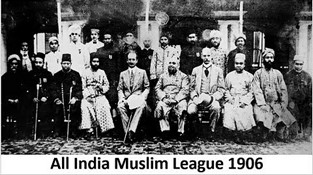
- The Muslim League was conceived as a loyalist, communal, and conservative political organisation. From its inception, it did not criticise British colonial rule. Instead, it directed its political energies against the Indian National Congress and Hindu political interests, thereby supporting the British strategy of political division.
- The AIML strongly supported the Partition of Bengal (1905), asserting that the creation of a Muslim-majority province served their communal interests. Furthermore, the League began demanding special safeguards for Muslims, particularly in government employment and representation.
Muslim League’s Paradox
- The Muslim League claimed to represent the interests of all Indian Muslims, but in practice, it focused on protecting the privileges of the Muslim elite. It failed to address the economic hardships and social challenges faced by the Muslim masses, many of whom were victims of the same colonial exploitation as their Hindu counterparts.
- Despite Muslims and Hindus alike suffering under British imperialism, the AIML’s political campaigns were largely directed against the Indian National Congress, rather than challenging British rule itself. This contradiction revealed the class and communal bias within the League’s early agenda.
Strained Relations between Muslims and the Government
Over time, especially after the Morley-Minto Reforms of 1909, Muslim disillusionment with British policies began to surface. Several developments led to increasing friction:
- Revocation of the Partition of Bengal (1911) angered many Muslims who had supported the division.
- The British refusal to grant university status to the Aligarh Muslim College in 1912 was viewed as a betrayal by the Muslim intelligentsia.
- Britain’s unsympathetic stance toward the Ottoman Empire during the Italian (1911–12) and Balkan Wars (1912–13) further alienated the Muslim population in India.
Gradually, under the leadership of dynamic and progressive leaders like Muhammad Ali, Shaukat Ali, Hasrat Mohani, and Fazlul Haq, the League began moving away from its purely communal orientation. It began to accept the goal of self-government for India and initiated talks with the Congress to explore a common political future.
Rise of Militant Muslim Nationalism
- The early weakness and elite bias of the League did not go unnoticed by patriotic Muslims, particularly the younger generation. Many educated young Muslims, drawn to the ideals of radical nationalism, began forming their own organisations that were more inclusive and nationalistic in character.
Ahrar Movement
- The Ahrar Movement emerged as a militant nationalist Muslim initiative led by those who rejected the pro-British Aligarh school. Key leaders included Maulana Mohammed Ali, Hakim Ajmal Khan, Hasan Imam, Maulana Zafar Ali Khan, and Mazhar-ul-Haq.
- These leaders were deeply influenced by modern democratic ideals and believed in active participation in the freedom movement, rejecting the loyalist stance of the big Nawabs and Zamindars.
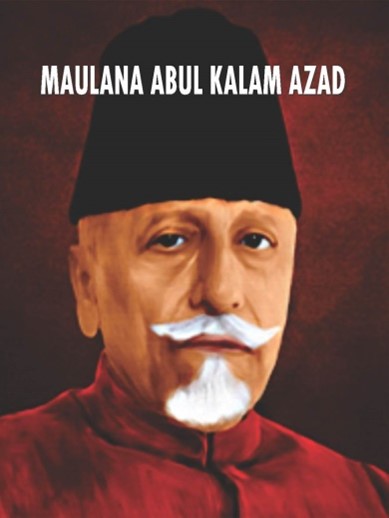
Al-Hilal and Maulana Abul Kalam Azad
- A section of traditional Muslim scholars, especially those associated with the Deoband school, began to embrace nationalism. Maulana Abul Kalam Azad, one of the most influential voices, propagated rationalist and nationalist ideals through his revolutionary newspaper Al-Hilal.
- Azad emphatically stated that there was no contradiction between Islam and Indian nationalism, thereby offering a powerful counter-narrative to communal politics.
Religious Lens on Political Issues
- During the early 20th century, many Islamic holy places were located in the Ottoman Empire, whose ruler, the Sultan of Turkey, was considered the Caliph or religious head of the global Muslim community.
- The Italian invasion of Libya (1911) and the Balkan Wars (1912–13) generated immense sympathy for Turkey among Indian Muslims. Britain’s perceived betrayal of the Turkish cause caused pro-Caliph and anti-British sentiments to grow within the Indian Muslim community.
- While this sentiment fostered anti-imperial consciousness, it also led to the habit of viewing political issues through a narrow religious framework, which in the long term hampered the development of a unified national outlook.
Syed Ameer Ali and the London Muslim League
- Syed Ameer Ali, a renowned jurist and intellectual, was one of the earliest advocates of a separate political platform for Muslims. In 1906, he was instrumental in the founding of the All India Muslim League.
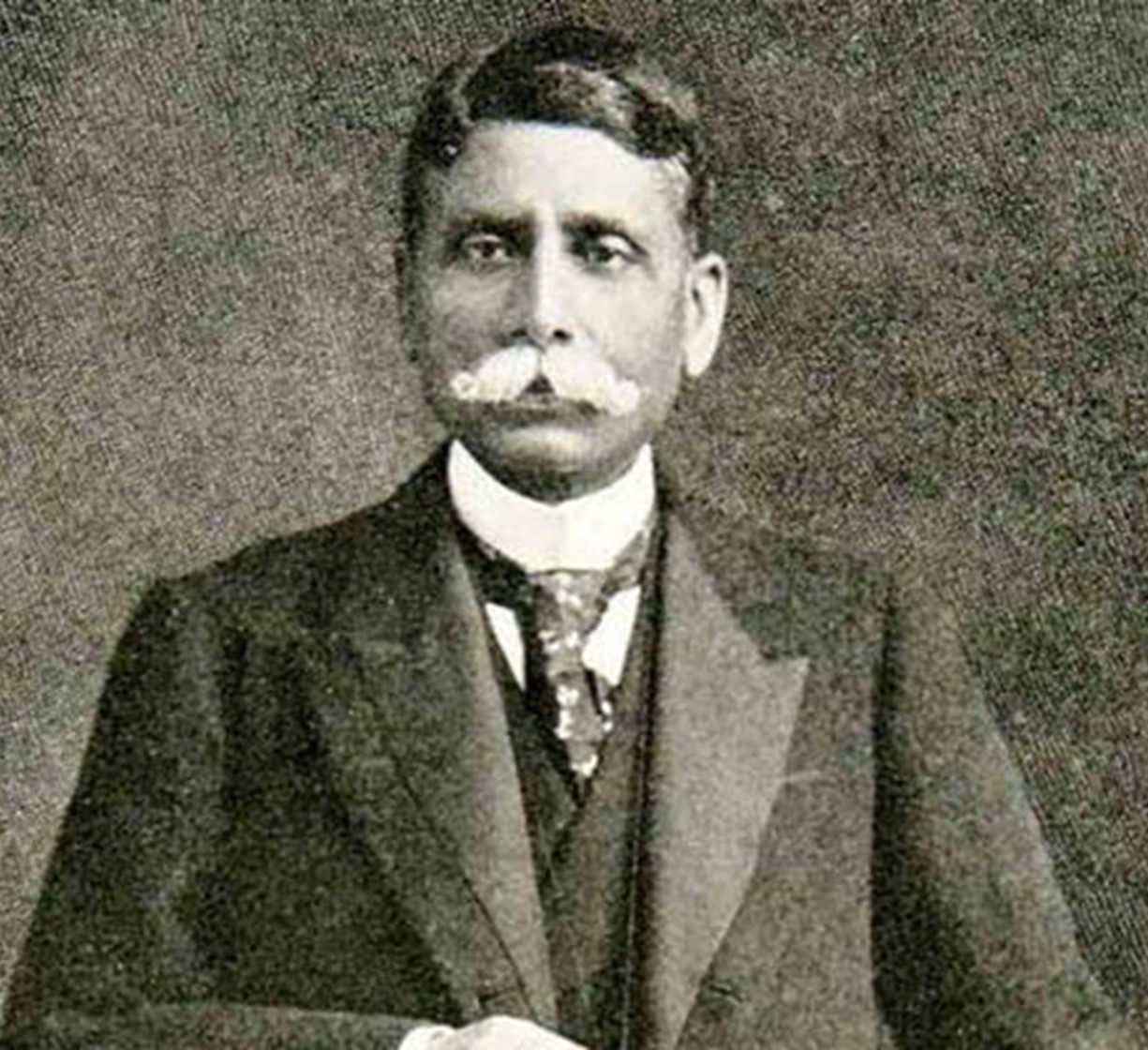
- He played a pivotal role in securing separate electorates for Muslims, which became a cornerstone of British-Indian constitutional reforms.
- In 1908, Syed Ameer Ali founded the London Muslim League, an independent body that represented Muslim interests in Britain. It was not a branch of the AIML but functioned autonomously to influence British policy.
- In 1909, Ameer Ali became the first Indian appointed to the Judicial Committee of the Privy Council, the highest court of appeal for the British colonies. He served on this body until his death in 1928.
- He also became the second Indian to serve as a law member of the Government of India, following the resignation of Satyendra P. Sinha in 1910.
The establishment of the All India Muslim League marked a significant turning point in Indian political history. Initially a tool of British political strategy, the League evolved over time under pressure from progressive Muslim leaders. Despite its communal origins, its transformation and eventual cooperation with the Congress laid the foundation for the complex trajectory of Muslim politics in India. However, the tendency to view political matters through a religious lens remained a challenge for developing an inclusive and cohesive national movement.
The Growth of Communalism in Colonial India
Definition and Origins of Communalism
- Communalism refers to an ideology where a religious community considers its social, cultural, economic, and political interests as distinct and even antagonistic to those of other communities.
- This divisive ideology posed one of the gravest threats to the unity of the Indian people and the growing national movement, especially as communalism and nationalism emerged simultaneously towards the end of the 19th century.
Factors Responsible for the Rise of Communalism
- The British Government’s policy of divide and rule
- Relative educational and economic backwardness of Muslims
- General economic underdevelopment and competition for jobs
- Militant nationalism with a religious hue
- Distorted historical narratives in colonial education systems.
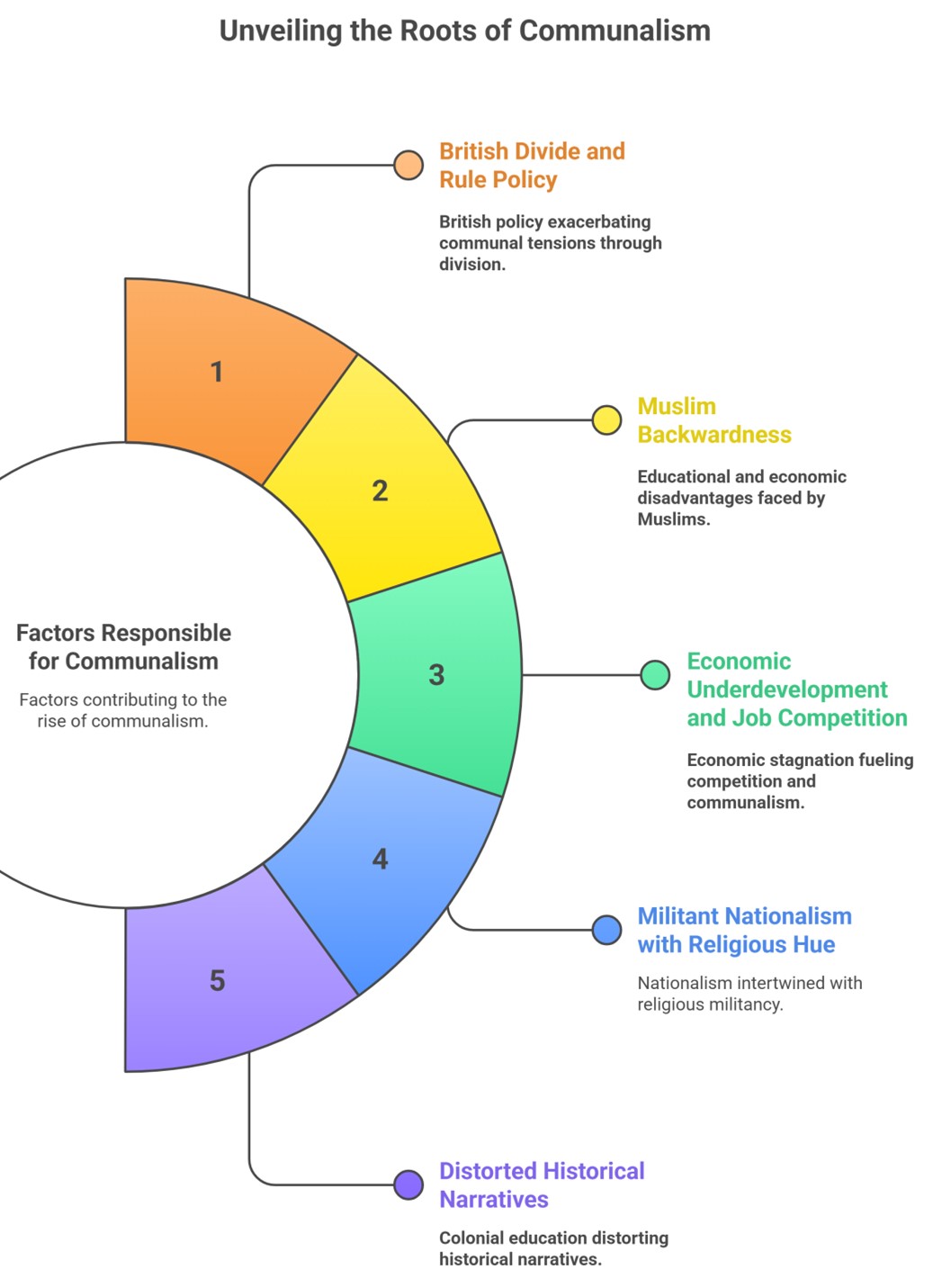
In many traditional societies, religion has often been exploited to evoke emotional unity. In India, however, this was frequently manipulated to foster division, thereby deepening communal sentiments.
1. The British Policy of Divide and Rule
- After the Revolt of 1857, where Hindus and Muslims united in armed resistance, the British became fearful of such unity and sought to strategically divide the communities.
- Initially, they punished Muslims harshly for their perceived lead role in the revolt. But by the 1870s, they shifted tactics, promoting Muslims as loyal allies to counterbalance the growing Hindu-majority nationalist movement.
- In provinces like P. and Bihar, the British incited linguistic and communal tensions—supporting Urdu for Muslims and Hindi for Hindus, thus deepening divisions.
2. Educational and Industrial Backwardness of Muslims
- Among Hindus, emerging modern intelligentsia and commercial classes gradually displaced traditional elites like landlords from leadership roles.
- In contrast, Muslim society remained under feudal influence, with a smaller proportion engaged in modern professions or education.
- This power vacuum allowed Muslim landlords and aristocrats, loyal to the British, to claim leadership and align with colonial policies that promoted separatism.
3. Limited Access to Modern Education
- In the early 19th century, many upper-class Muslims viewed Western education with suspicion, considering it anti-Islamic and a tool of Christian evangelism.
- This led to their isolation from modern political thought and nationalist currents that were influencing educated Hindus.
4. Economic Stagnation and Job Competition
- British colonialism failed to industrialise India significantly. Unemployment, particularly among the educated middle class, bred resentment and competition.
- The British manipulated job insecurity to promote communal divisions, offering Muslims token benefits in return for political loyalty, further fuelling suspicions.
5. Militant Nationalism and Religious Symbolism
Militant nationalism, while invigorating patriotic fervour, also unintentionally alienated Muslims by infusing Hindu symbolism into political movements. Examples:
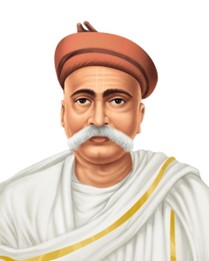
- Bal Gangadhar Tilak used Ganapati and Shivaji festivals to mobilise people.
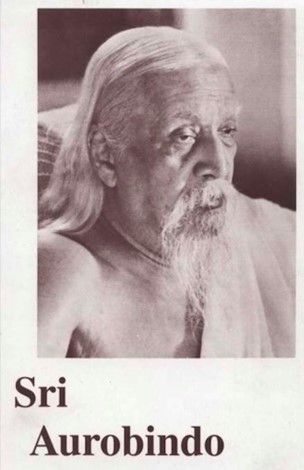
- Aurobindo Ghosh interpreted nationalism as a religion, with Bharat Mata as the deity.
- Revolutionary groups took oaths before Kali and began anti-partition campaigns with Ganga rituals.
- Such actions led to:
- Alienation of Muslim participants
- Strengthening of Muslim communal identity
- Opportunity for the British to paint nationalism as Hindu-dominated, thus deterring Muslim support.
However, most militant nationalists, including Tilak, sincerely desired Hindu-Muslim unity, and their cultural symbolism was meant more to mobilise people than exclude communities.
6. Colonial Education and Communal Narratives
British historians distorted Indian history by labelling the medieval era as the ‘Muslim period’, implying perpetual conflict between Hindus and Muslims.
This portrayal ignored the reality that rulers, regardless of religion, acted for power and wealth, not religious conquest.
The truth was:
- Both Hindu and Muslim peasants suffered exploitation.
- Nobles, zamindars, and kings, irrespective of religion, oppressed the masses.
- Gandhiji later criticised such education and argued that communal harmony could never be established unless textbooks were reformed to reflect historical truths.
Communalism as a Modern, Not Medieval, Phenomenon
- Contrary to popular belief, communalism was not a medieval remnant. While religious strife existed, there was no organised communal politics until the late 19th century.
- Communalism is a product of modern politics that relies on mass participation and identity mobilisation, making it susceptible to religious manipulation.
Communalism vs. Religious Diversity
- The mere presence of multiple religions in a society doesn’t lead to communalism.
Communalism arises only when religion is exploited for political gain.
- As Gandhiji said, “Religion is the personal affair of each individual. It must not be mixed up with politics or national affairs.”
Role of Syed Ahmad Khan in the Rise of Communalism
- Syed Ahmad Khan, though a visionary educationist and founder of Aligarh Movement, later became politically conservative.
- He began promoting the idea that Hindus and Muslims had different political interests.
- He advocated loyalty to the British, believing that this would secure jobs and privileges for Muslims, especially given their minority status.
His fears were based on the idea that, in a democratic setup, Hindus would dominate due to numbers—an argument not grounded in reality, as:
- Economic and political interests of both communities were shared.
- A Bengali Hindu and a Bengali Muslim had more in common than a Bengali Muslim and a Punjabi Muslim.
Role of the Indian National Congress (INC) in Mitigating Minority Fears
- The INC recognised early that minority apprehensions must be addressed to build a united national front.
- It reassured minorities that:
- Their religion and cultural identities would be respected.
- Religion would not influence political or economic policies.
- Dadabhai Naoroji, in his 1886 Congress Presidential Address, declared that the INC would avoid social and religious matters and focus only on national issues.
- A rule was passed at the 1888 Congress Session: No resolution would be adopted if it was opposed by the majority of either Hindu or Muslim delegates—a pioneering step for inclusivity.
British Officials’ Role in Spreading Communalism
Key British officials who fostered Hindu-Muslim division include:
- Lord Curzon: Divided Bengal in 1905 to weaken nationalist unity
- Lord Minto: Supported separate electorates under the 1909 Morley-Minto Reforms
- Sir Fuller and Sir Lancelot Hare: Fuelled tensions in Eastern Bengal and Assam
- Sir Andrew Fraser: Favoured Muslim appointments to marginalise Hindu leaders
These policies exacerbated communal divides, weakened the national movement, and laid the groundwork for the eventual two-nation theory.
Hindu Communalism: Origins and Evolution
From the 1870s onwards, a section of Hindu zamindars, money-lenders, and middle-class professionals began propagating an anti-Muslim narrative. These groups fully adopted the colonial interpretation of Indian history, portraying the medieval Muslim rule as tyrannical and oppressive. In their writings and public discourse, they credited the British with having “liberated” the Hindus from this so-called “Muslim oppression.” Importantly, their critique was not aimed at colonial rule but at Muslim communities, sowing seeds of religious division.
The rise of Muslim political consciousness, especially after the formation of the All-India Muslim League in 1906 and the British government’s introduction of separate electorates for Muslims in 1909, further intensified Hindu communal sentiments. In response, several Hindu Sabha organisations emerged across regions such as Punjab, the United Provinces, Bihar, and the Bombay Presidency, with the aim of safeguarding what they perceived as the endangered interests of the Hindu community.
Punjab Hindu Sabha (1909)
In 1909, Lal Chand and U.N. Mukerji founded the Punjab Hindu Sabha with the explicit objective of defending Hindu interests. Lal Chand famously asserted that every Hindu should consider themselves “a Hindu first and an Indian later.” The Sabha viewed the Indian National Congress (INC) with suspicion, accusing it of undermining Hindu identity by attempting to unify Indians across communal lines.
By 1913, the Punjab Hindu Sabha passed a resolution to establish a national-level umbrella organisation called the All-India Hindu Sabha, further institutionalising Hindu communalism.
All India Hindu Mahasabha (1915)
The All India Hindu Mahasabha was formally established in 1915 under the leadership of Madan Mohan Malaviya. It emerged as an umbrella organisation bringing together regional Hindu Sabhas. Its primary function was to act as a pressure group representing the interests of orthodox Hindus, particularly in relation to the British administration and even within the Indian National Congress.
Despite its ideological alignment with Hindu traditionalism, the Mahasabha remained a weak political force for many years. This was largely due to the influence of the modern secular intelligentsia and middle-class Hindus, who were more aligned with inclusive nationalism. Moreover, the British government, relying on Muslim communalism for support, offered little backing to Hindu communal elements during this period.
Although the Mahasabha did not overtly support British rule, it also did not actively participate in the Indian national movement. It boycotted the Civil Disobedience Movement of 1930 and the Quit India Movement of 1942, thereby maintaining a stance of political detachment.
Madan Mohan Malaviya (1861–1946):
Madan Mohan Malaviya, popularly known as ‘Mahamana’, was born on 25 December 1861 in Allahabad (Prayagraj). A distinguished journalist, social reformer, educationist, and lawyer, he became one of the most influential moderate leaders of the Indian National Congress. He firmly opposed the concept of separate electorates for Muslims, especially during the Lucknow Pact negotiations.
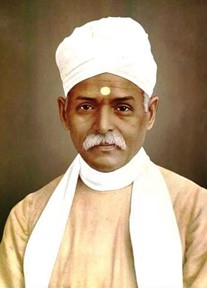
He served as the President of the Indian National Congress on four occasions — 1909, 1918, 1930, and 1932. During the 1933 session, owing to his arrest, Nellie Sengupta, a foreign woman, presided over the Congress session — the second foreign woman and third overall to do so.
Promotion of Hindi and Indian Culture
Malaviya was a staunch advocate of the Hindi language. During British rule, English and Persian dominated administrative and educational institutions. Malaviya sought to reverse this trend by promoting Hindi and Sanskrit culture, advocating for the use of Hindi in education and administration. He worked tirelessly to revive indigenous values and broaden access to Indian-language education.
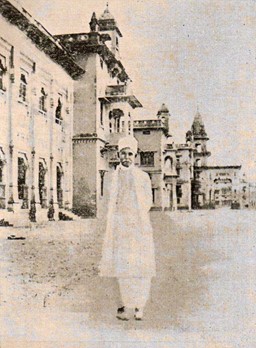
Banaras Hindu University (BHU), 1916
Recognising the colonial bias of existing educational institutions, Malaviya envisioned a university that would fuse Indian cultural heritage with modern scientific knowledge. This vision materialised with the founding of Banaras Hindu University (BHU) in Varanasi in 1916. BHU provided inclusive education to students from all communities and was a landmark in the history of Indian education. It offered courses in modern sciences, literature, and arts while remaining rooted in Indian civilisational ethos.
Contribution to Journalism
Malaviya made significant contributions to Indian journalism. He was the first editor of Hindustan, a newspaper started by Thakur Ramgopal Singh in 1885. His major journalistic initiatives included:
- Abhyudaya (Hindi weekly, 1907)
- Maryada (Hindi monthly)
- The Leader (English daily, 1909)
These publications became vehicles for disseminating nationalist thought, social reform, and anti-colonial ideas.
Peasant Mobilisation in Awadh
Malaviya was also invested in addressing the plight of Indian peasants. In February 1918, with his support, Gauri Shankar Mishra and Indra Narayan Dwivedi founded the United Provinces Kisan Sabha. This body played a pioneering role in organising peasants in Awadh, mobilising them against oppressive taxes (nazarana) and forced labour (begari). It marked one of the early organised peasant resistances in colonial India.
Recognition
In recognition of his lifelong service to the nation, Madan Mohan Malaviya was posthumously awarded the Bharat Ratna on 24 December 2014, India’s highest civilian honour.
The Nationalists and the First World War
Outbreak of the First World War (1914) In June 1914, the First World War broke out between two major alliances. On one side were Great Britain, France, Italy, Russia, Japan, and later the United States, and on the other were Germany, Austria-Hungary, and Turkey. The war had far-reaching implications for India, both politically and socially. It revived the Indian nationalist movement, which had experienced a lull following the Swadeshi movement.
Nationalist Response to the War Indian nationalist leaders, including Lokamanya Tilak, initially extended support to the British war effort, not from loyalty or sympathy but under the naive assumption that Britain would reward India with self-governance in return. This hope was soon shattered when it became evident that Britain and other colonial powers were only interested in safeguarding their own empires.
In contrast, revolutionaries, especially the Ghadar revolutionaries based in North America, and leaders like Annie Besant in India, saw the war as an opportunity to intensify the struggle for Indian independence. The Ghadarites sought violent rebellion against British rule, while the Home Rule Leaguers spearheaded mass mobilisations demanding Swaraj or Home Rule.
The Ghadar Movement:
Formation of the Ghadar Party (1913) The Ghadar Party, originally called the Hindi Association, was founded in Portland, Oregon in May 1913 by Indian revolutionaries residing in the United States and Canada, particularly among Punjabi Sikh peasants and ex-soldiers. These immigrants, who had faced severe racial discrimination, began to organise under the leadership of Lala Har Dayal, who had been lecturing at Stanford University on anarchism and syndicalism.
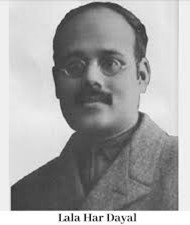
The founding members included:
- Lala Har Dayal (General Secretary)
- Baba Sohan Singh Bhakna (President)
- Pandit Kanshi Ram Maroli (Treasurer)
The party soon established its headquarters, Yugantar Ashram, in San Francisco, and began publishing a weekly paper titled Ghadar, launched on 1 November 1913 in Urdu and later in Gurmukhi.
Ideology and Objectives
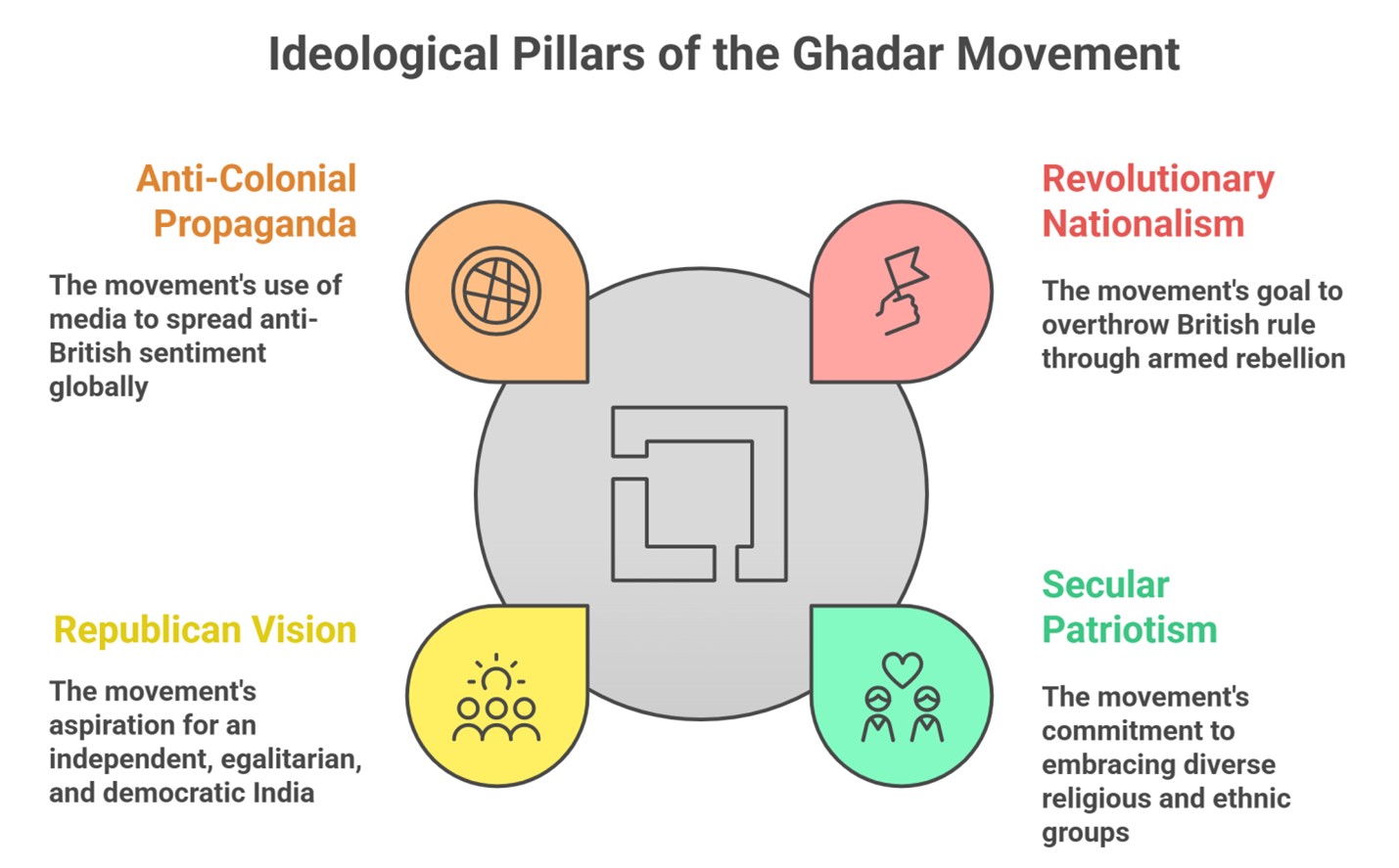
- Revolutionary Nationalism: To overthrow British rule in India through armed rebellion.
- Secular Patriotism: Despite a Sikh-majority base, the movement was secular, embracing Hindus, Muslims, and Bengalis.
- Republican Vision: The party envisioned an independent, egalitarian, and democratic republic in India.
- Anti-Colonial Propaganda: The Ghadar paper was an effective medium of anti-British sentiment, widely circulated among Indian immigrants globally, including Mexico, Japan, China, the Philippines, Malaya, Singapore, Thailand, and East and South Africa.
Significant Early Activities
- Tarak Nath Das published Free Hindustan, while G.D. Kumar launched Swadesh Sevak.
- The establishment of Swadesh Sewak Home in Vancouver and United India House in Seattle fostered activism.
- The arrival of Bhagwan Singh in Vancouver further radicalised the diaspora, promoting violent resistance.
Major Events Influencing the Ghadar Movement (1914-15)
1. Lala Har Dayal’s Arrest and Escape (1914)
- Arrested in March 1914 for anarchist activities; he jumped bail and fled to Switzerland, weakening central leadership.
2. Komagata Maru Incident (1914)
- Chartered by Gurdit Singh from Singapore, the ship carried 376 Indian immigrants to Vancouver.
- Canadian authorities denied them entry citing immigration laws.
- Upon return to India, the British authorities clashed with passengers at Budge Budge near Calcutta, killing 18, arresting 202, and causing a nationalist uproar.
3. Outbreak of the First World War
- The Ghadarites saw this as an ideal opportunity to ignite revolution in India. They issued the Ailan-e-Jung (Proclamation of War) and sent back volunteers and arms.
The Final Phase and Repression of the Ghadar Movement
Efforts to Spark a Revolt Thousands of Ghadarites returned to India, especially to Punjab, to incite rebellion. Notably:
- Kartar Singh Sarabha, a brilliant student and sub-editor of the Ghadar paper, played a vital role.
- Ghadarites toured villages, spread revolutionary literature, and tried to organise mutinies among Indian soldiers.
Despite their efforts:
- The November 1914 mutiny attempt failed.
- A second attempt was planned for 21 February 1915, led by Rash Behari Bose, but it was foiled due to British infiltration.
Severe Repression
- The government arrested and tried Ghadar leaders on a large scale.
- 42 were hanged, 114 transported for life, and 93 given long-term imprisonments.
- Many, after release, joined Kirti and Communist movements in Punjab.
Singapore Mutiny (1915)
- On 15 February 1915, inspired by Ghadar propaganda, 700 soldiers of the 5th Light Infantry revolted under Jamadar Chisti Khan and Subedar Dundey Khan.
- The mutiny was crushed; 37 were executed, and 41 transported for life.
Assessment of the Ghadar Movement
Achievements
- Popularised nationalist ideas among Indian immigrants and within India.
- Created a cadre of committed revolutionaries.
- Secular and democratic in nature.
- Rejected communalism and caste/regional divisions, stressing unity in patriotism.
- Introduced symbols like ‘Bande Mataram’ as secular nationalist rallying cries.
Weaknesses
- Overestimated mass readiness for revolution.
- Misjudged India’s political climate, expecting popular support that never materialised.
- Underestimated British intelligence and control.
Legacy Despite its failure in achieving immediate objectives, the Ghadar Movement significantly contributed to India’s freedom struggle by:
- Laying down the ideological foundation of secular revolutionary nationalism.
- Establishing a precedent for diaspora-led mobilisation.
Tilak’s Return and Shift in Outlook (1914) Upon returning from his imprisonment in Mandalay, Bal Gangadhar Tilak emerged as a transformed leader:
- Secular Approach: He avoided religious appeals and advocated Home Rule in purely political terms.
- Inclusivity and Vernacular Education: Emphasised the development of regional languages and inclusive policies.
- Opposition to Untouchability: Declared that even a god who accepted untouchability was unacceptable.
Reunion at the Lucknow Session (1916)
- The Surat Split (1907) had divided Congress into Moderates and Extremists.
- Post-Tilak’s return and Pherozeshah Mehta’s death in 1915, efforts were made to reunite both factions.
Efforts by Annie Besant and Tilak
- Both launched campaigns in 1915 through newspapers and public platforms.
- The 1915 Congress Session saw softening of opposition.
- At the Lucknow Session of Congress in 1916, presided by A.C. Mazumdar, Extremists were readmitted into the party.
- This session was also Gandhiji’s first attendance after returning from South Africa.
The Lucknow Pact (1916)
Agreement between Congress and Muslim League
- Congress and the All India Muslim League, under Jinnah and Tilak’s leadership, signed the Lucknow Pact.
- It was a joint demand for constitutional reforms and greater Indian participation in governance.
- Key provisions:
- Half of the executive councils to be Indians.
- Separate electorates for Muslims, a controversial compromise made to assure minority protection.
Significance
- The pact marked temporary Hindu-Muslim unity.
- However, it also legitimised communal electorates, which later strengthened communalism in Indian politics.
Legacy
- Though flawed, the Lucknow Pact laid the groundwork for future collaboration between different political communities and proved the value of nationalist unity against colonial rule.
- It showcased that joint efforts could extract concessions from the British, even if the unity was short-lived.
The period from 1913 to 1916 marked a critical phase in India’s struggle for independence. The Ghadar Movement represented the rise of diaspora-led revolutionary nationalism, while the Lucknow Pact symbolised political compromise and unity. Both events reflected the maturing of Indian political consciousness in the context of a global war, shaping the direction of the freedom movement for decades to come.
Indian Home Rule Movement (1916-1918)
The Indian Home Rule Movement (1916-1918) emerged during the First World War as a significant political response to the lack of meaningful reforms from the British colonial government. It was a concerted effort to demand self-government within the British Empire, inspired by the Irish Home Rule movement. The movement marked a revival of nationalist activity after the lull that followed the Swadeshi movement.
Background and Motivation
- The movement was born out of the belief that Britain would not grant political concessions to India without pressure from a broad-based public movement.
- As World War I intensified, many Indian leaders felt the time was ripe for demanding self-rule, and that mass agitation would be the key.
Formation of Home Rule Leagues
Two separate but coordinated Home Rule Leagues were established in 1916:
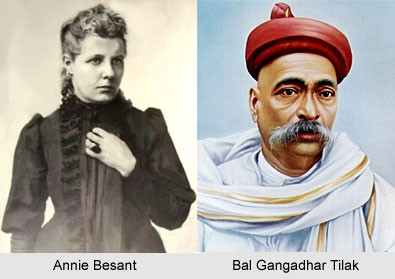
- Bal Gangadhar Tilak led one League, launched in April 1916 with Poona as its headquarters.
- Annie Besant and Subramaniya Iyer founded the other in September 1916, with its base at Adyar (Madras Presidency).
- Their objective was to secure Home Rule for India after the war, functioning within the framework of the British Commonwealth.
- Both Leagues demarcated areas of operation and worked cooperatively. They conducted extensive propaganda campaigns promoting the cause of self-governance.
Tilak’s Home Rule League (April 1916)
- Formally inaugurated at the Bombay Provincial Conference in Belgaum, Tilak’s League covered:
- Maharashtra (excluding Bombay city)
- Karnataka
- Central Provinces and Berar
- Tilak toured extensively, advocating vernacular education, development of regional culture, and Home Rule.
- His slogan: “Swarajya is my birthright and I shall have it” became iconic.
Legal Challenge and Political Impact
- The British government attempted to curb the movement by issuing a notice to Tilak, demanding surety for good behaviour and a bond of Rs. 60,000.
- Mohammed Ali Jinnah led the legal team defending Tilak.
- Though Tilak lost in the Magistrate’s Court, he won in the High Court. This episode galvanised public support, and by April 1917, his League had over 14,000 members.
Annie Besant’s Home Rule League (September 1916)
- Besant, a prominent Theosophist, had arrived in India in 1893. Her influence grew through her journals New India and Commonweal.
- In September 1916, she launched her League with George Arundale as the Organising Secretary.
- The League had 200 branches and covered all regions not included in Tilak’s League, including Bombay city.
- Prominent associates included P. Ramaswamy Aiyar, B.P. Wadia, and Jawaharlal Nehru.
- By March 1917, her League had around 7,000 members.
Joint Meeting and Activities
A joint meeting of both Leagues was held after the 1916 Lucknow Session of Congress, attended by over 1,000 delegates.
Activities included:
- Holding political classes and lectures
- Distributing pamphlets
- Setting up libraries and local branches
- Engaging with local self-governing bodies
- Mobilising funds and public opinion
Repression and National Response
In June 1917, the government arrested Annie Besant, B.P. Wadia, and George Arundale.
This triggered widespread protests:
- Sir S. Subramania Iyer renounced his knighthood
- Leaders like Jinnah, Surendranath Banerjee, and Madan Mohan Malaviya joined the agitation
- Tilak advocated civil disobedience
- Gandhiji supported collecting signatures to defy internment orders
British Response and Montagu Declaration
- To calm the unrest, the British Secretary of State Edwin Montagu issued a statement in August 1917, declaring:
- “The policy of His Majesty’s Government is the increasing association of Indians in every branch of the administration and the gradual development of self-governing institutions with a view to the progressive realization of responsible government in India.”
- This was a significant policy shift and made the demand for Home Rule legitimate and non-seditious.
- Annie Besant was released in September 1917, and was elected Congress President in December 1917, largely due to Tilak’s support.
Decline of the Home Rule Leagues (1918 Onwards)
The movement began to lose momentum due to:
- Moderate Withdrawal: Many moderates accepted Montagu’s reform promise and were disillusioned by talk of civil disobedience.
- Besant’s Ambivalence: She often wavered between supporting and rejecting passive resistance.
- Leadership Vacuum: Tilak’s decision to travel to England in late 1918 to pursue a libel suit left the movement without firm leadership.
Dissolution and Merger
- In 1920, Mahatma Gandhi joined the All India Home Rule League and renamed it “Swarajya Sabha”.
- Eventually, it merged with the Indian National Congress, setting the stage for Gandhi’s mass civil disobedience campaigns.
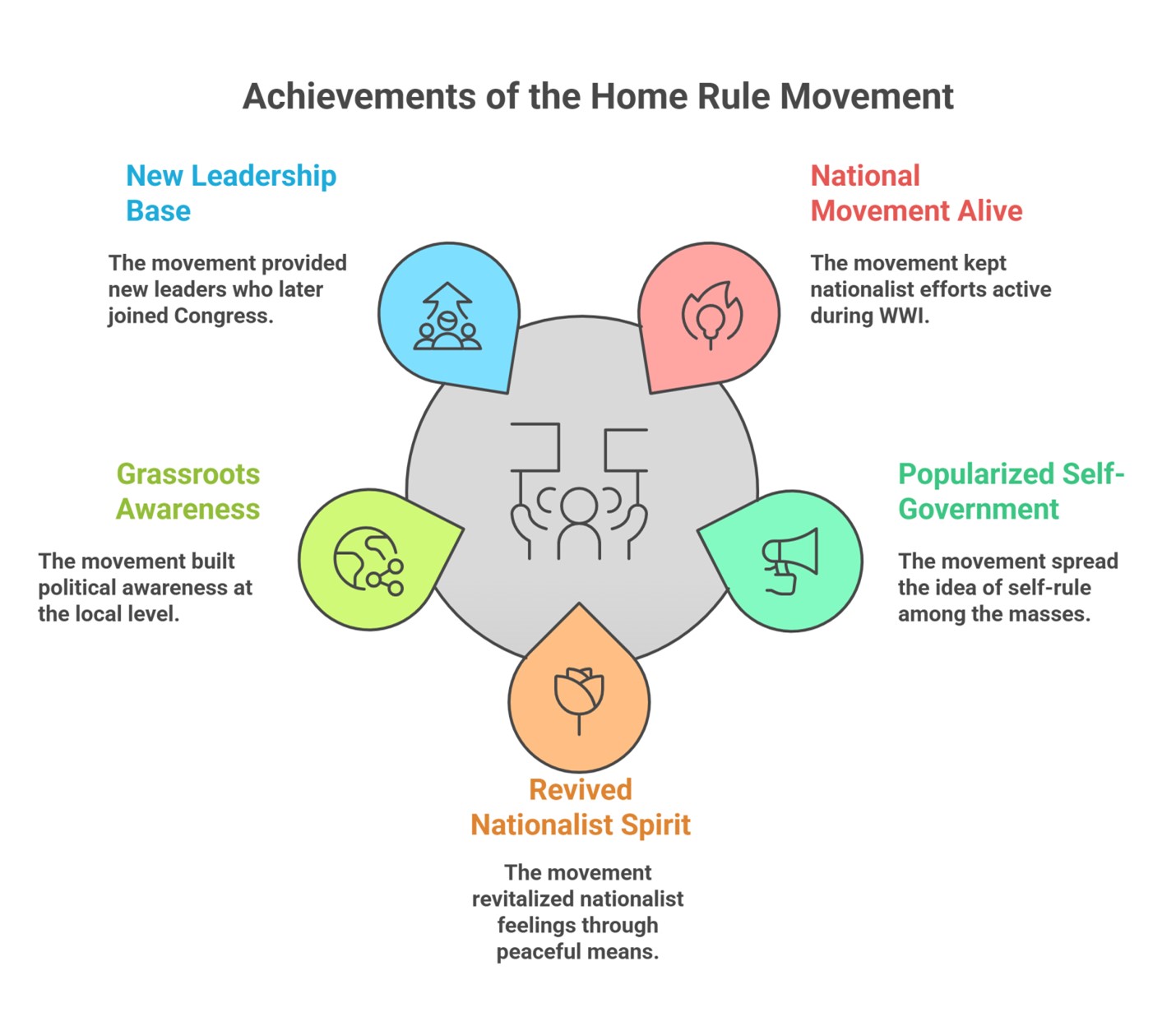
Achievements of the Home Rule Movement
✔ Kept the national movement alive during WWI.
✔ Popularised the concept of self-government among the Indian masses.
✔ Revived nationalist spirit through peaceful and constitutional means.
✔ Created grassroots political awareness, building networks that proved invaluable later.
✔ Provided a new leadership base—many Home Rule League workers later became Congress stalwarts.
✔ Laid the foundation for mass mobilisation under Gandhi’s leadership.
The Home Rule Movement was not merely a political campaign—it was a bridge between early moderate politics and Gandhian mass politics, transforming Indian nationalism into a more dynamic, inclusive force.
Great Personalities of Indian Nationalism
Lala Lajpat Rai (1865–1928)
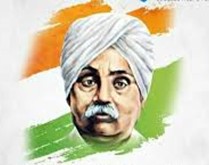
Lala Lajpat Rai, popularly known as ‘Punjab Kesari’ or the Lion of Punjab, was born on 28 January 1865 in the Ludhiana district of Punjab. He was one of the prominent extremist leaders of the Indian National Congress and part of the famed Lal-Bal-Pal trio (Lala Lajpat Rai, Bal Gangadhar Tilak, and Bipin Chandra Pal).
- A dedicated member of the Arya Samaj, Rai played an important role in social reform. In 1897, he founded the Hindu Relief Movement to aid famine-stricken people and to shield them from missionary influence.
- A staunch nationalist, Rai played an active role in the Swadeshi Movement after the Partition of Bengal in 1905. Due to his rising popularity and nationalist agitation, he was arrested in 1907 and imprisoned in Mandalay Fort.
Contributions to Education
- Rai was a passionate educationist. In 1886, he helped Mahatma Hansraj establish the Dayananda Anglo-Vedic (DAV) School in Lahore, laying the foundation for a nationalist education system.
Indian Home Rule League of America (1917)
- Prevented from returning to India during WWI, he stayed in the United States (1917–1920), where he founded the Indian Home Rule League of America, headquartered in Broadway, New York.
Labour and Political Involvement
- Deeply concerned about the working class, Rai served as President of the All India Trade Union Congress.
- In 1920, he presided over the Special Session of the Indian National Congress at Calcutta, where Gandhi’s Non-Cooperation Movement received formal approval.
Servants of the People Society (1921)
- In 1921, he established the Servants of the People Society, which worked tirelessly in fields such as education, rural reconstruction, social reform, and uplift of the depressed classes (Harijans).
Swaraj Party and Later Politics
- After his release from jail in 1921, Rai joined the Swaraj Party, formed by C.R. Das and Motilal Nehru in 1923 to enter legislative councils and disrupt British governance from within.
Literary Works and Intellectual Contributions
- Rai authored numerous biographies and political essays. His major works include:
- “The Story of My Deportation” (1908)
- “Arya Samaj” (1915)
- “England’s Debt to India” (1917)
- “Unhappy India” (1928) (a rebuttal to Katherine Mayo’s “Mother India”)
- Rai authored numerous biographies and political essays. His major works include:
Protest Against the Simon Commission
- Rai played a leading role in opposing the Simon Commission (1927), which was boycotted for its all-White composition. While leading a non-violent procession in Lahore on 30 October 1928, he was brutally assaulted by the police and succumbed to his injuries on 17 November 1928. He famously declared, “Every blow aimed at me is a nail in the coffin of British imperialism.”
Aurobindo Ghosh (1872–1950)
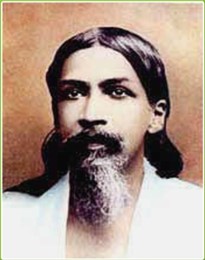
Aurobindo Ghosh was born on 15 August 1872 in Calcutta. He was a nationalist revolutionary, philosopher, poet, and later, a spiritual leader. His multifaceted life bridged political activism and profound spiritual transformation.
Education and Early Life
- Sent to England at the age of seven, Aurobindo completed his education at St. Paul’s School and King’s College, Cambridge. Although he passed the ICS written examination, he intentionally failed the horse-riding test to avoid serving the colonial regime.
- He returned to India in 1893 and worked at Baroda College until 1906.
Role in Indian Nationalism
- After the Partition of Bengal (1905), he joined the nationalist movement in Calcutta.
- Advocated for complete Swaraj, boycott, Swadeshi, and national education.
- Became the first principal of Bengal National College (1906).
- Faced sedition charges in 1907 and Alipore Bomb Case in 1908 but was acquitted.
Spiritual Transformation
- In 1910, he withdrew from active politics and settled in Pondicherry, where he pursued spiritual philosophy.
- Founded the Aurobindo Ashram in 1926 with Mirra Alfassa (The Mother).
- Key concepts of his spiritual teachings included Integral Yoga, Karma Yoga, and spiritual nationalism.
Major Literary Contributions
- Editor of nationalist journals like Jugantar, Bande Mataram, and Karmayogi.
- Wrote influential works such as:
- The Life Divine
- Essays on the Gita
- Savitri
- The Ideal of Human Unity
Renaissance of Hinduism
- Aurobindo was a champion of Neo-Vedanta and carried forward the Hindu renaissance initiated by Swami Vivekananda and Bankim Chandra Chattopadhyay.
- Interpreted the Bhagavad Gita in the context of national liberation, emphasising selfless action (Karma Yoga) and spiritual resistance.
Critique of British Rule and Moderate Politics
- Through his series “New Lamps for Old”, he severely criticised moderate politics, advocating for revolutionary action.
- Asserted that British rule was exploitative, and no amount of reforms could replace the need for Swaraj.
Tagore called Aurobindo the “Messiah of Indian Culture,” while C.R. Das hailed him as the “poet of patriotism, prophet of nationalism, and lover of humanity.”
Bipin Chandra Pal (1858–1932)
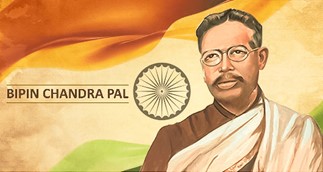
Bipin Chandra Pal, born in Sylhet (now in Bangladesh), was one of the most vocal and radical leaders of the extremist faction of the Congress and a key figure of the Lal-Bal-Pal trio.
Role in the National Movement
- Became prominent during the Swadeshi Movement (1905) following the Partition of Bengal.
- Advocated Purna Swaraj, Swadeshi, boycott of British goods, and national education.
- Refused to testify against Aurobindo Ghosh in the Bande Mataram sedition case, for which he was imprisoned for six months.
Philosophy and Religious Outlook
- Initially influenced by Brahmo Samaj and Keshub Chandra Sen, later adopted Vedanta and was influenced by Sri Chaitanya’s Vaishnavism.
Journalism and Literature
Started several newspapers:
- Paridarshak (1880)
- New India (1901)
- Bande Mataram (1906)
- Swaraj
- Hindu Review (1913)
Was also Assistant Editor of Bengal Public Opinion and The Tribune (Lahore).
Economic Views
- Authored “The New Economic Menace of India”, demanding better wages and working conditions for Indian labourers.
Political Evolution
- Initially inspired by Surendranath Banerjea, Pal later became aligned with Tilak, Aurobindo, and Lala Lajpat Rai in the militant nationalist camp.
Unsung Heroes of Indian Freedom Movement
Vasudev Balwant Phadke (1845–1883)
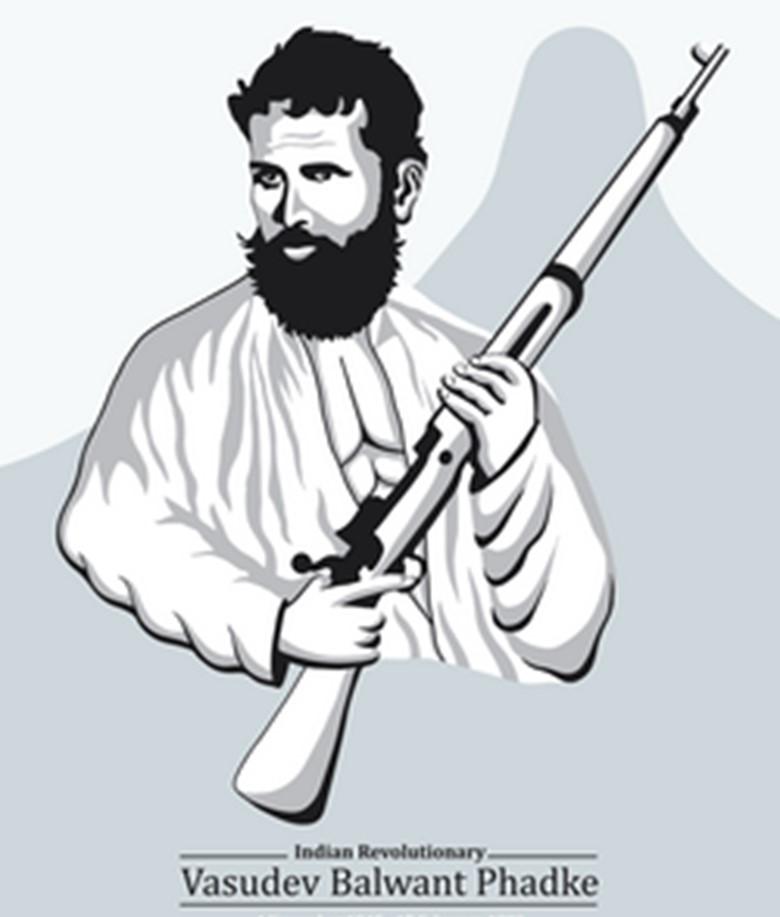
- Born in 1845 in the Kolaba district of Maharashtra, Vasudev Balwant Phadke was among the earliest revolutionaries who advocated for India’s independence through armed rebellion.
- A graduate of Bombay University (1862), Phadke served in several government offices before developing strong anti-British sentiments after he was denied leave to visit his ailing mother in 1869.
- Influenced by Poona Sarvajanik Sabha and G. Ranade, he became increasingly convinced that the British Raj was responsible for the economic misery of Indians, especially during the Deccan riots (1875) and famine of 1876-77.
- Founded the Aikya Vardhini Sabha and promoted the use of Khadi and Swadeshi goods.
- As support from educated elites was lacking, Phadke mobilised marginalised communities like the Ramoshis, Kolis, Bhils, and Dhangars.
- In 1879, he launched a series of raids on British treasuries to fund revolutionary efforts and help famine-affected farmers. He was eventually captured in Hyderabad and imprisoned at Aden, where he died in 1883 after a hunger strike.
Sister Nivedita (1867–1911)
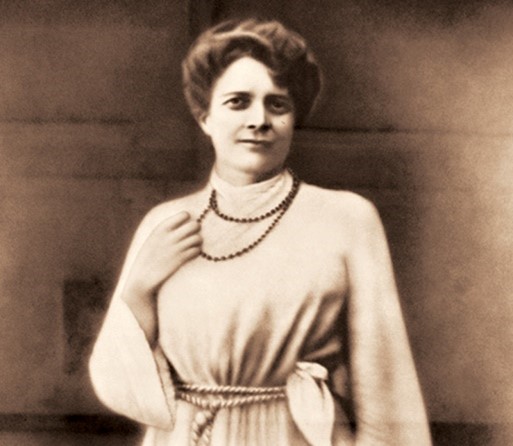
- Born as Margaret Elizabeth Noble in Ireland, she met Swami Vivekananda in 1895 and came to India in 1898, where she took the name “Nivedita” meaning “dedicated to God.”
- Opened a school in Bagbazar, Kolkata for girls and widows, integrating vocational training with conventional education.
- A strong supporter of the Swadeshi Movement, she motivated youth and women to take part in political activities.
- Designed a prototype national flag in 1904, featuring the Vajra symbol and the words “Bonde Matoram” embroidered in Bengali. It was displayed at a Congress exhibition in 1906.
Sakharam Ganesh Deuskar (1869–1912)
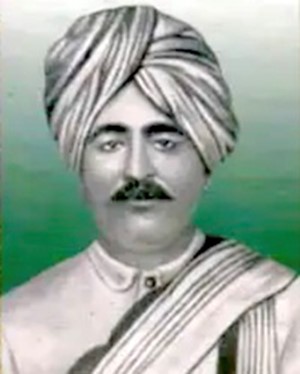
- Born on 17 December 1869 in Deoghar (now in Jharkhand), Pandit Sakharam Ganesh Deuskar was a nationalist writer and political activist.
- Considered Bal Gangadhar Tilak as his political mentor and promoted nationalism through journalism in Bengali revolutionary magazines.
- Introduced the term “Swaraj” to Bengal in 1902 during a Shivaji festival.
- His notable work, “Desher Katha” (1904), explained the economic impact of British colonialism in simple Bengali for the masses. It was later translated into Hindi as “Desh Ki Baat”.
- The book gained immense popularity during the anti-partition movement and was banned by the British in 1910 for inciting nationalist sentiments.
Sardar Ajit Singh (1881–1947)
Sardar Ajit Singh, a prominent revolutionary and the uncle of Shaheed Bhagat Singh, played a crucial role in sowing the seeds of nationalist agitation in Punjab during the early 20th century. He was deeply committed to resisting British colonial oppression and is remembered for his pivotal role in organising peasant protests.
- In 1906, Ajit Singh led a powerful agitation against three exploitative agrarian legislations passed by the colonial government:
- Punjab Land Alienation Act (1900)
- Punjab Land Colonisation Act (1906)
- Doab Bari Act
- These laws, rather than granting land ownership to farmers, effectively reduced them to the status of sharecroppers, leading to widespread resentment.
- Ajit Singh founded the Bharat Mata Society (Anjuman-i-Muhibban-i-Watan), a secret revolutionary organisation to promote patriotism and resist colonial policies.
- He played a key role in the Pagri Sambhal Movement, which forced the British government to repeal the oppressive acts in 1907.
- In 1906, Ajit Singh led a powerful agitation against three exploitative agrarian legislations passed by the colonial government:
As a result of his leadership, Ajit Singh was arrested and deported to Mandalay Jail in Myanmar in 1907
Rash Behari Bose (1886–1945)
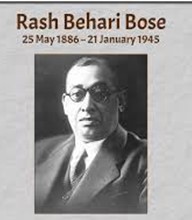
Rash Behari Bose, born on 25 May 1886 in Bengal, emerged as one of the earliest architects of the revolutionary nationalist movement in India and abroad.
- The Partition of Bengal in 1905 deeply influenced his political consciousness.
- While working at the Forest Research Institute in Dehradun, he mastered the art of bomb-making.
- In 1912, he planned and executed the bomb attack on Lord Hardinge, the then Viceroy, in Delhi.
- Bose was also one of the key organisers of the Ghadar Mutiny Conspiracy in 1915, which aimed to incite a military revolt.
- Escaping British pursuit, Bose fled to Japan in 1915, disguising himself as a relative of Rabindranath Tagore.
- He gained Japanese citizenship and established the Indian Club of Tokyo.
- In 1942, he founded the Indian Independence League in Tokyo.
- Bose later helped merge Mohan Singh’s Indian National Army (INA) with the Indian Independence League, serving as its chairman.
- In July 1943, he handed over leadership of the League and INA to Subhas Chandra Bose, paving the way for the INA’s major campaigns.
Satyendranath Bose (Revolutionary)
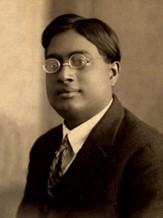
Not to be confused with the physicist of the same name, Satyendranath Bose was a brave revolutionary who made the ultimate sacrifice during the Alipore Bomb Case.
- In 1908, during the British trial against Aurobindo Ghosh and others, Naren Goswami, an arrested revolutionary, turned approver.
- To safeguard Aurobindo and others, Satyendranath Bose and Kanailal Dutta posed as potential approvers to gain access to Goswami.
- On 31 August 1908, they assassinated Goswami in jail.
- The assassination rendered Goswami’s testimony inadmissible in the Sessions Court, thereby saving Aurobindo from conviction.
- Bose and Kanailal were tried and executed shortly after, becoming martyrs in India’s revolutionary history.
Madan Lal Dhingra (1883–1909)
Madan Lal Dhingra, born in Amritsar in 1883, was a revolutionary nationalist who took the battle for freedom to British soil.
- He went to London in 1906 to pursue engineering.
- While there, he came under the influence of Veer Savarkar, whose fiery patriotism inspired him deeply.
- Dhingra realised that sacrifices, not words, would bring India’s liberation.
- On 1 July 1909, he assassinated Colonel William Curzon Wylie at the Imperial Institute in London.
- Wylie was seen as an architect of British oppression in India.
- Dhingra was immediately arrested, tried, and executed, becoming one of the earliest martyrs of India’s freedom struggle abroad.
Taraknath Das (1884–1958)
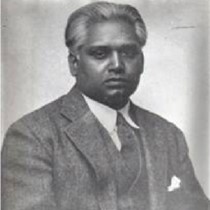
Taraknath Das was a Bengali revolutionary, scholar, and founder of several nationalist platforms abroad.
- A member of Anushilan Samiti, he fled to Japan and later moved to the USA to avoid British surveillance.
- The Bellingham riots in 1907 against Indian immigrants in the USA deeply affected him.
- He started the newspaper ‘Free Hindusthan’, which boldly condemned British policies and inspired unity among Indians.
- The paper became a critical voice against colonial repression.
- In 1913, he joined Har Dayal and the Ghadar Movement, further intensifying anti-British efforts overseas.
- Taraknath Das was not only a revolutionary but also a scholar who later taught at American universities, advocating India’s freedom diplomatically and intellectually.