
The Achaemenid Dynasty was an ancient Iranian royal house that founded and ruled the Achaemenid Empire—the first and largest global empire of antiquity—from 559 BCE to 330 BCE. This expansive dynasty was established by Cyrus II, more famously known as Cyrus the Great, in the 6th century BCE. Beginning as a regional ruler, Cyrus embarked on a series of remarkable military campaigns, eventually forging one of the greatest empires the ancient world had seen.
Spanning over 200 years, the Achaemenid Empire at its zenith stretched from the Indus Valley in the east to the Aegean Sea in the west, and from the Caucasus Mountains in the north to the Persian Gulf in the south.
During the 6th century BCE, the Indian subcontinent presented a complex political landscape:
Under Darius and his successors, Indian soldiers were employed in the imperial army. Notably, Xerxes I employed Indian troops in his prolonged war against the Greeks.
India remained a part of the Persian empire until it was overtaken by Alexander of Macedon in the late 4th century BCE.
The Persian rule over parts of northwestern India—which lasted for over two centuries—left a deep and lasting legacy in several areas:
Persian aesthetics played a significant role in shaping Mauryan art, especially during the time of Ashoka.
The Achaemenid Dynasty stands out not only for its imperial scale and efficient administration but also for its far-reaching influence on regions beyond Persia, including India. The Persian invasion of northwestern India marked the beginning of cross-cultural interactions that enriched Indian art, language, trade, and governance. These connections laid the groundwork for further historical developments, including the advent of Mauryan centralisation and the Hellenistic influence that followed Alexander’s incursion.
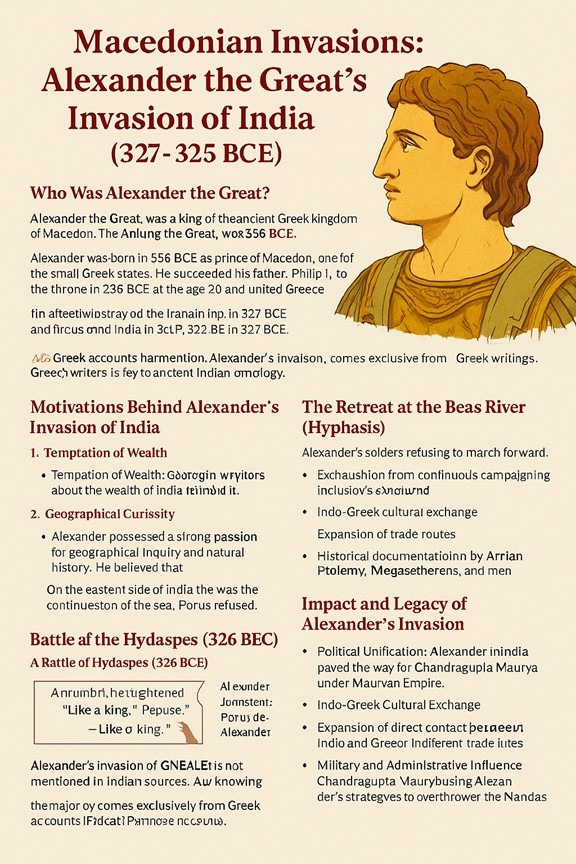
Alexander the Great, born in 356 BCE, was the legendary king of Macedon, a small kingdom in northern Greece. He ascended the throne at the age of 20 in 336 BCE following the assassination of his father, Philip II, and within a few years, he achieved what no Greek ruler had done before—the unification of all Greek states under a single authority.
By the fourth century BCE, the geopolitical rivalry between Greece and Persia (Iran) had escalated into a battle for global supremacy. In 330 BCE, Alexander dealt a decisive blow to the Achaemenid Empire by defeating Darius III at the Battle of Arbela. With Persia subdued, Alexander turned his eyes eastward—towards the fabled riches of India.
Alexander’s march into India in 327 BCE was driven by multiple motives:
1. Temptation of Wealth: Greek writers like Herodotus described India as a land of immense wealth, which intrigued Alexander and encouraged his pursuit.
2. Geographical Curiosity: Alexander was passionate about exploration and natural sciences. He believed that by conquering India, he could reach the eastern edge of the world, where the land met the sea.
3. Strategic Expansion: Conquering India would complete his domination of the known world and enhance his status as the supreme ruler of both East and West.
Note: Alexander’s invasion is not mentioned in Indian sources. Our understanding of the campaign comes exclusively from Greek accounts. These texts refer to “Sandrokottas,” who has been identified by historians as Chandragupta Maurya, aiding in the construction of Indian chronology.
Crossing into India
Political Landscape of the Time
Two prominent rulers at the time were:
Despite the looming threat, the two did not unite against Alexander. Ambhi submitted willingly, offering his support, troops, and resources. On the other hand, Porus chose resistance.
Alexander advanced from Taxila towards the River Hydaspes (modern Jhelum), where Porus awaited him. In the fierce Battle of Hydaspes, Alexander emerged victorious, although Porus’s defense was formidable and valiant.
After the battle, Alexander asked Porus how he wished to be treated. Porus famously replied, “Like a king.” Impressed by his courage and dignity, Alexander not only returned Porus’s kingdom but also made him an ally and satrap under Macedonian rule.
While kings like Ambhi capitulated, several tribal groups put up strong resistance:
Alexander’s army marched eastward, reaching the River Beas (known in Greek as Hyphasis and in Vedic texts as Vipasha). He desired to press forward into the Gangetic plains, but his soldiers refused.
Despite his unmatched military record, Alexander had to retreat—not due to enemy force, but due to the exhaustion of his own men.
In 325 BCE, Alexander began his return journey. Before leaving India:
Alexander reached Babylon, where he fell gravely ill and died in 323 BCE at the age of just 32.
Greek historians who accompanied Alexander—such as Arrian, Ptolemy, and Megasthenes—provided invaluable records of Indian society, economy, and geography. These accounts inform us of:
Alexander’s Indian expedition was a turning point in ancient history. Though brief, his campaign had far-reaching effects on Indian politics, trade, culture, and historical records. His invasion laid the groundwork for the Mauryan consolidation of India and forged links between the East and West that would continue for centu.
Year / Period | Event |
6th century BCE | Cyrus the Great founded the Achaemenid Persian Empire. |
6th century BCE | Smaller principalities and republics in northeast India gradually merged into the Magadhan Empire. |
6th century BCE | In northwest India, principalities like the Kambojas, Gandharas, and Madras engaged in conflicts, leading to political disunity. |
516 BCE | Darius I of Persia annexed Sindh and parts of Punjab west of the Indus River. |
330 BCE | Alexander the Great defeated Darius III, leading to the fall of the Achaemenid Empire. |
329–321 BCE | Reign of Dhana Nanda in Magadha. |
326 BCE | Alexander invaded India and fought the Battle of the Hydaspes against King Porus. |
325 BCE | Alexander left India, beginning his return journey to Babylon. |