
The decline of the Mauryan Empire began rapidly following the death of its most celebrated ruler, Emperor Ashoka. With his passing, the centralised control of the vast Mauryan state weakened considerably, leading to the disintegration of the empire. One of the first visible impacts was the assertion of independence by various provinces. For instance, Kalinga in present-day Odisha declared its independence under the leadership of King Kharavela. Simultaneously, the Satavahanas rose to power in regions of central and western India, establishing their rule and initiating a new political order.
In the northwestern parts of the subcontinent, the situation was further complicated by a succession of foreign invasions. A series of external groups—the Indo-Greeks, Shakas (Scythians), Pahlavas (Parthians), and Kushans (Yuezhi)—invaded and settled in different areas. These groups often coexisted in different regions simultaneously, contributing to a highly fragmented political landscape in the northwest. As a result, Mauryan authority remained largely restricted to the Gangetic plains and was eventually supplanted by the Shunga dynasty.
Despite political instability, India continued to enjoy substantial prosperity. The southern regions, in particular, experienced a major trade boom with the West, which helped sustain economic vitality. During this period, India is estimated to have contributed nearly one-third of the global economy, thanks to its rich resources, advanced crafts, and robust maritime trade networks.
Ashoka’s reign was marked by a policy of religious tolerance and a strong emphasis on nonviolence. Although he encouraged the people to respect all religious communities, including the Brahmanas, his promotion of Dhamma and the discouragement of animal sacrifices adversely affected the economic interests of the Brahmanical class. Brahmanas, who traditionally relied on gifts and offerings associated with Vedic sacrifices, experienced a decline in patronage.
In the aftermath of the Mauryan decline, several new kingdoms emerged that were led by rulers of Brahmana origin. These dynasties sought to reverse the trend of diminishing Brahmanical influence by reinstating Vedic traditions and rituals. The Shungas and Kanvas—immediate successors of the Mauryas in the Gangetic plains—were Brahmanas who played a pivotal role in reviving Brahmanism. Similarly, the Satavahanas, who ruled over parts of the western Deccan and Andhra regions, were also Brahmanas and actively supported Vedic rites.
These new rulers restored traditional practices that had been sidelined during Ashoka’s rule, thereby re-establishing the prominence of Brahmanical religion and culture in Indian society.
The Shunga dynasty was established around 185 BCE by Pushyamitra Shunga, who was originally the commander-in-chief under the last Mauryan ruler, Brihadratha. Pushyamitra assassinated Brihadratha and assumed power, marking the beginning of the Shunga reign in the Gangetic Valley.
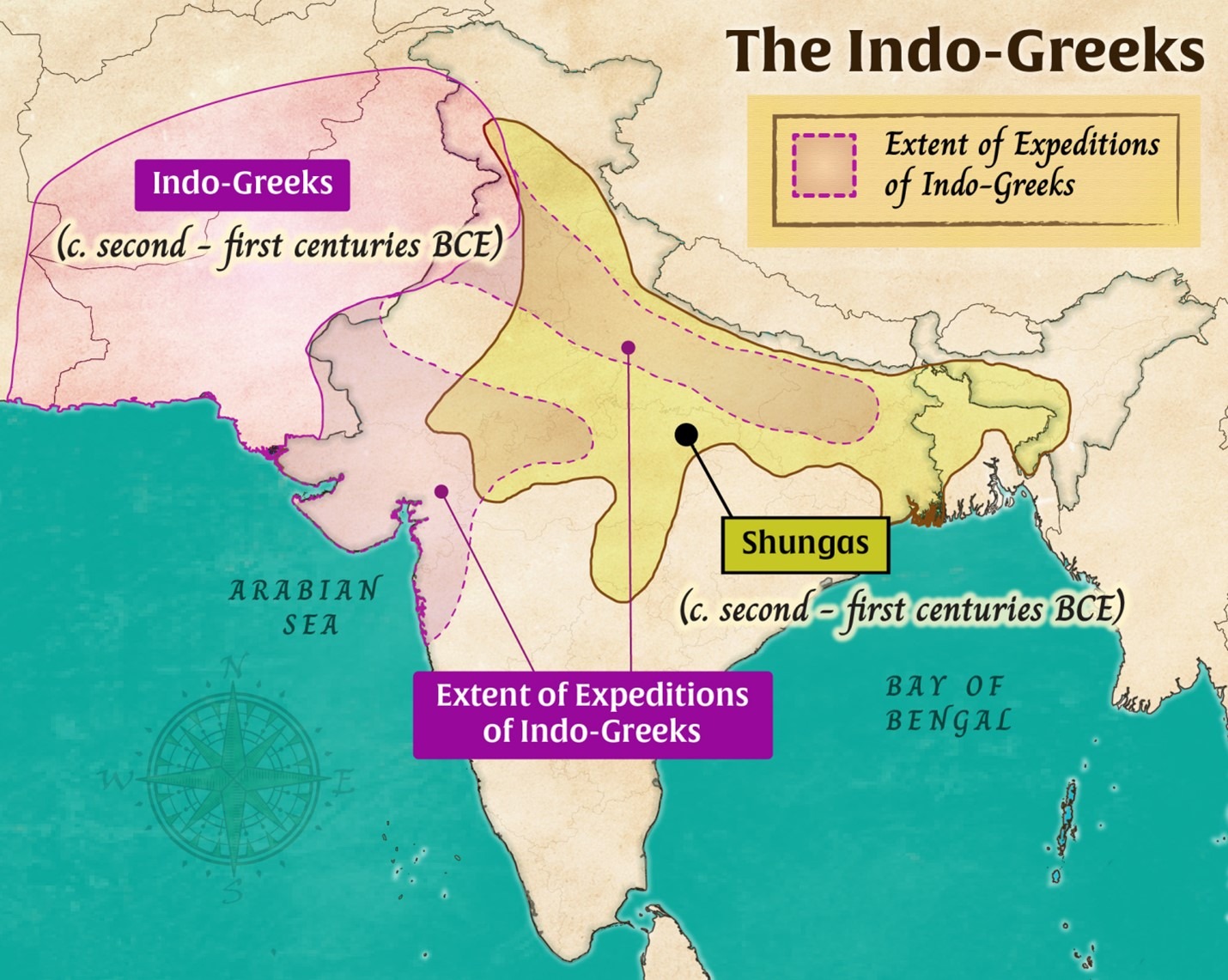
The Shungas were primarily engaged in defending their territories against multiple external and internal threats. One of their significant achievements was the successful resistance against the Bactrian Greek invasions from the northwest. The Greeks had advanced as far as Pataliputra and occupied it briefly. However, Pushyamitra managed to reclaim the capital and push back the invaders. In addition to foreign threats, the Shungas faced military challenges from the south, especially from the Deccan region, and also clashed with King Kharavela of Kalinga, who had launched invasions into northern India.
Pushyamitra was a staunch adherent of Brahmanism and is known to have performed two Ashvamedha yajnas (horse sacrifices), reinforcing his commitment to Vedic traditions. However, historical interpretations of the Shungas vary considerably. Literary sources present contrasting views: the Sanskrit play Malavikagnimitram by Kalidasa portrays the Shungas in a favourable light, while certain Buddhist texts like the Divyavadana accuse them of persecuting Buddhists and destroying monasteries. Despite such accusations, archaeological evidence suggests that Pushyamitra also patronised Buddhist art and architecture. Notably, the Buddhist monuments at Bharhut and Sanchi were renovated and expanded during the Shunga period.
Pushyamitra was succeeded by his son Agnimitra, and over the next century, ten Shunga rulers governed the kingdom. However, the dynasty gradually weakened and was eventually confined to the Magadhan region. The last Shunga king, Devabhuti, was assassinated by his Brahmana minister, Vasudeva Kanva, who then established the Kanva dynasty.
The Kanva dynasty ruled Magadha for approximately 45 years after overthrowing the Shungas. Like their predecessors, the Kanvas were also Brahmanas and continued the Brahmanical traditions. However, they failed to expand their territory significantly and remained largely restricted to central India.
Eventually, the Kanvas were displaced by the Mitras, a lesser-known dynasty based in Kosambi. The Mitras governed parts of the Gangetic plains until the fourth century CE, when they were finally subdued by the powerful Gupta emperor Samudragupta during his northern campaigns. The Guptas would go on to establish one of the most celebrated empires in Indian history.
This transitional period between the Mauryan and Gupta empires was marked by political fragmentation, foreign invasions, and religious realignment. Yet, it also witnessed the resilience of Indian society, with economic prosperity continuing in several regions and a dynamic interplay between various religious and cultural forces shaping the subcontinent’s historical trajectory.
The post-Mauryan history of Kalinga, a historically significant region corresponding to modern-day Odisha, remains somewhat obscure. The precise timeline of Kalinga’s resurgence as an independent polity following the fall of the Mauryan Empire is uncertain. However, it is widely accepted that Kharavela, a powerful monarch of the Chedi-Mahameghavahana dynasty, rose to prominence in the second century BCE and played a critical role in shaping the region’s political and cultural landscape.
Kharavela was a devout follower of Jainism and is renowned for his military exploits, administrative capabilities, and patronage of religion and the arts. Much of what we know about him is derived from the Hathigumpha (Elephant Cave) inscription located on the Udayagiri hill near Bhubaneswar. Although the inscription is partially damaged and lacks a definitive date, it serves as a crucial primary source of information. The 17-line Prakrit inscription provides a detailed account of Kharavela’s achievements and conquests. It mentions his military victories over the Satavahanas, the Indo-Greek ruler Demetrius, the kingdom of Magadha, and even distant Tamil regions.
One notable episode described in the inscription recounts the earlier conquest of Kalinga by the Magadhan ruler, who had carried off a sacred image of the Kalinga Jina (a Jain deity). Kharavela is said to have launched a retaliatory campaign against Magadha, decisively defeating its forces and triumphantly restoring the image to Kalinga. This act not only symbolized a military victory but also a spiritual and cultural restoration for the Jain community in the region.
Kharavela is also credited with the excavation of 117 caves, primarily intended as resting places for Jain monks. These architectural feats, particularly the Udayagiri and Khandagiri caves, underscore his deep commitment to Jainism and his contributions to religious infrastructure. The caves, adorned with inscriptions and carvings, stand as a testament to his rule and the flourishing of Jain culture under his patronage.
Another significant archaeological and historical site linked to ancient Kalinga is Sisupalgarh, located near modern Bhubaneswar. Believed to have been established between the 7th and 6th centuries BCE, Sisupalgarh served as the capital city of Kalinga and represents one of the most advanced examples of urban planning in early India.
Sisupalgarh is especially noteworthy for its sophisticated water management system and its fortification based on the Jala Durga (Water Fort) concept. This ingenious design involved surrounding the city with water bodies, which acted as natural defensive barriers against potential invasions. Such hydraulic engineering indicates a high level of strategic and civic planning.
The city is also unique for its eight fortified gateways, with two positioned on each side of its rectangular layout. These gateways not only provided controlled access to the city but also served administrative and security functions, reflecting the city’s importance as a political and economic hub. The extensive ruins of Sisupalgarh provide insight into the governance, architecture, and defense mechanisms of ancient Kalingan society.
Following the decline of centralized Mauryan authority, tribal and clan-based republics re-emerged in various parts of India, especially in the northwestern regions such as Punjab and Haryana. Among the most prominent of these were the Yaudheyas, a warrior republic that flourished around the first century CE.
The Yaudheyas, like many other tribal groups of the period, sought to legitimize their rule by asserting Kshatriya status, often claiming descent from heroic lineages mentioned in epic traditions. This alignment with the traditional varna system helped these republics integrate into the broader socio-political fabric of Indian society.
Archaeological evidence, particularly coinage, suggests that the Yaudheyas were economically active and politically organized. Thousands of copper coins issued by the Yaudheyas have been discovered, reflecting their involvement in regional trade and commerce. These coins often feature the image of Lord Kartikeya, a six-headed war deity, along with a peacock, symbolizing martial prowess and divine legitimacy. The Yaudheya example illustrates the resilience and adaptability of republican traditions in the post-Mauryan age.
During the Mauryan era, various regional chieftains such as the Rathikas and Bhojas in present-day Maharashtra functioned as feudatories of the empire. Among them was a noble named Satavahana, believed to be affiliated with the Rathika or Bhojaka lineage. His son, Simuka, would later emerge as the founder of the Satavahana dynasty, marking a significant shift in the political dynamics of the Deccan.
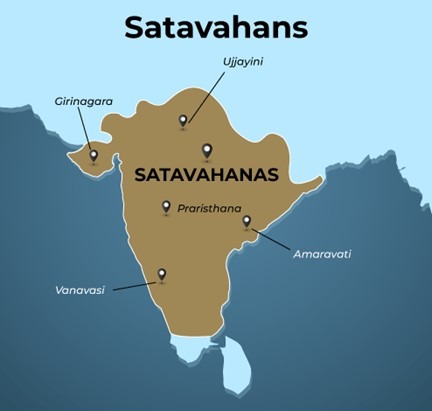
As the Mauryan Empire began to fragment, Simuka seized the opportunity to assert independence. Around the late second century BCE, he established the Satavahana dynasty, which would go on to dominate the Deccan region for nearly five centuries. The Satavahanas played a crucial role in unifying the Deccan, integrating its fragmented political units, and creating a stable and enduring polity.
The chronology of the Satavahana dynasty’s origin remains a subject of scholarly debate. While most historians place the beginning of their rule in the late second century BCE, some textual sources, such as the Puranas, hint at an earlier origin—possibly as early as the third century BCE. However, these early references are not corroborated by concrete archaeological evidence.
According to epigraphical sources, especially the Naneghat inscription dated to 70–60 BCE, Simuka was the father of the reigning king Satakarni. This inscription strongly supports the view that Simuka established his rule in the first century BCE, around a hundred years after the collapse of the Mauryan Empire. This dating aligns with most modern scholarly consensus and is considered more reliable than the Puranic chronology.
The Satavahana rule extended from the second century BCE to the second century CE, covering large parts of western and central India, including regions of modern Maharashtra, Andhra Pradesh, and Karnataka. During this period, they acted as a powerful counterforce to the Indo-Greeks, Shakas, and other foreign powers in the subcontinent.
Reconstructing the history of the Satavahanas involves careful interpretation of multiple sources. While Puranic texts refer to the dynasty as the “Andhras,” the term “Satavahana” is absent from these narratives. Conversely, Satavahana inscriptions do not use the term “Andhra” to describe themselves. This has led many scholars to conclude that the two names refer to the same dynasty, even though their usage differs by source.
Important inscriptions such as those at Nasik and Naneghat provide valuable insights into the reign of notable Satavahana rulers like Gautamiputra Satakarni and Vashishtaputra Satakarni. These inscriptions document political achievements, social conditions, and religious affiliations, contributing significantly to our understanding of the period. Additionally, the coins issued by the Satavahanas are rich in iconographic and linguistic detail, shedding light on their economy, governance, and cultural exchanges.
Before the rise of the Satavahanas, the Deccan was fragmented into numerous petty kingdoms, often embroiled in local conflicts. The Satavahanas were instrumental in unifying this politically divided landscape into a coherent and stable empire. They gave the Deccan a shared historical identity and laid the foundation for subsequent regional kingdoms. The term “Deccan”, derived from the Sanskrit word dakshina meaning “south,” in this context refers broadly to the areas encompassing present-day Maharashtra, Andhra Pradesh, and Karnataka.
The foundation of the Satavahana dynasty was laid by Simuka, a Brahmin ruler, who established his kingdom around Paithan in present-day Maharashtra. Following him, his brother Kanha succeeded to the throne and expanded the Satavahana dominion further west to Nasik. Simuka’s son, Sri Satakarni, emerged as the third ruler and played a key role in extending the empire’s influence into western Malwa and Berar. Under his leadership, the Satavahanas began to assert themselves as a significant power in peninsular India.
At the height of their reign, the Satavahanas ruled over a vast territory that encompassed Maharashtra, Andhra Pradesh, northern Karnataka, parts of Madhya Pradesh, and even extended into Saurashtra. This extensive domain was achieved through strategic conquests and effective governance.
One of the most significant rivalries during the Satavahana period was with the Western Kshatrapas or Shakas, who ruled over the upper Deccan and western India. These Indo-Scythian rulers were formidable adversaries and, for a period, even succeeded in wresting control of parts of Maharashtra and western India from the Satavahanas. However, this setback was later reversed by the efforts of a prominent Satavahana king—Gautamiputra Satakarni.
Gautamiputra Satakarni, also known as Gotami-putra Siri-Satakani, is celebrated as the most illustrious monarch of the Satavahana dynasty. His 24-year reign, from 106 to 130 CE, marked the first major revival of Satavahana power after significant setbacks. His military accomplishments and administrative achievements are recorded in the famous Nasik inscription, composed by his mother, Gautami Balashri.
He described himself as “eka Brahmana” or “the only Brahmana,” and claimed to have humbled the pride of the Kshatriyas. Under his rule, the empire expanded to include regions such as Malwa and Kathiawar, previously under Shaka control. His dominion stretched from Malwa in the north to Karnataka in the south, including a stronghold over Andhra Pradesh. Gautamiputra decisively defeated the Shaka ruler Nahapana, dismantled the Khakharata lineage, and re-established Satavahana supremacy over lost territories.
Gautamiputra Satakarni was succeeded by his son Vashishtaputra Pulumavi. He established his capital at Paithan on the banks of the Godavari in present-day Aurangabad, Maharashtra. The coins and inscriptions of his reign, which have been discovered across Andhra Pradesh, suggest that the eastern part of the Deccan had become fully integrated into the Satavahana empire by this time.
Vashishtaputra was notably the first Satavahana ruler to conquer and consolidate Andhra, as evidenced by the distribution of his coinage. However, his reign also witnessed renewed hostilities with the Shakas. The Shaka king Rudradaman I, who ruled over Saurashtra (Kathiawar), engaged in two major conflicts with Vashishtaputra. Although the Satavahanas were defeated on both occasions, Rudradaman refrained from completely annihilating them due to existing matrimonial alliances between the two royal families.
Yajna Sri Satakarni was the last significant ruler of the Satavahana dynasty and is credited with the second revival of Satavahana power. During his reign, he managed to recapture North Konkan and Malwa from the Shaka rulers, restoring some of the lost prestige of the dynasty.
His coins, discovered in regions such as Andhra Pradesh, Maharashtra, Madhya Pradesh, and Gujarat, depict maritime symbols such as ships, reflecting the importance he placed on overseas trade and naval strength. These symbols also suggest that the Satavahanas, under his rule, maintained a strong maritime presence and were actively engaged in commerce with distant lands.
Among the later Satavahana rulers, King Hala, the seventeenth monarch, holds a unique place due to his literary contributions. He is renowned for compiling the Gāthāsaptashatī (Sattasai), a celebrated anthology written in Maharashtri Prakrit.
The Gathasaptashati comprises 700 lyrical verses (gathas), mostly centered on themes of love and personal emotions. The poems often take the form of candid monologues by unmarried girls or married women, portraying a rich emotional tapestry of love, longing, humour, and sometimes sensuality. Though the work was likely revised in later centuries, its original compilation under Hala reflects the cultural refinement of the Satavahana court.
The decline of the Satavahana dynasty began shortly after the death of Yajna Sri Satakarni. The last known ruler, Pulumavi IV, reigned until around 220 CE. After his death, the once-powerful empire gradually disintegrated, and various successor states emerged in different regions of the Deccan and western India.
Several prominent dynasties rose from the remnants of the Satavahana empire:
Thus, while the Satavahanas played a vital role in consolidating the Deccan into a cohesive political and cultural entity, their eventual decline paved the way for the emergence of several regional powers that would continue to shape the history of peninsular India.
The Satavahanas, originally believed to be a tribal community from the Deccan region, underwent a significant process of Brahmanisation as they ascended to political power. Despite their tribal roots, they soon began to project themselves as upholders of Brahmanical social order. According to Brahmanical norms, kings were expected to be Kshatriyas; however, the Satavahanas—being Brahmanas by origin—reconciled this contradiction by asserting their role as guardians of the varna system. Gautamiputra Satakarni, one of the most celebrated Satavahana rulers, claimed to have eradicated social intermixing, restoring the integrity of the fourfold varna system.
Interestingly, while advocating Brahmanical ideals, the Satavahanas also engaged in matrimonial alliances with the Shakas—foreign rulers who were traditionally outside the varna fold. This helped integrate the Shakas into Indian society as Kshatriyas, revealing a pragmatic approach to social hierarchy and legitimacy.
The Satavahana society displayed matrilineal traits, as reflected in the practice of using metronymics in royal titles—names derived from the mother’s name, such as Gautamiputra (son of Gautami) and Vashishtiputra (son of Vashishti). This highlights the elevated status of women, particularly royal women, who were active in religious patronage and sometimes acted as regents. However, the dynasty followed a patriarchal political structure, with succession typically passing through the male line.
Marriage within the Satavahana elite often followed the practice of endogamy—marriage within the same kin group—rather than the exogamous unions recommended by Brahmanical texts. This practice reinforced clan solidarity and helped maintain political alliances.
The Satavahana administration was shaped by a blend of traditional Mauryan structures and regional adaptations. The rulers upheld the ideals prescribed in the Dharmashastras, portraying the king as the protector of dharma. Kings were often likened to mythological heroes such as Rama, Bhima, Arjuna, and Keshava, reinforcing their divine and heroic image in inscriptions.
The administrative setup retained some Ashokan features, such as the division of the empire into districts called ahara, and the appointment of officials like amatyas and mahamatras. However, the Satavahana state had pronounced military and feudal characteristics. The Senapati (military commander) also served as a provincial governor, maintaining control over tribal areas of the Deccan that were yet to be fully integrated. In the countryside, gaulmikas—local military officers—commanded regiments composed of chariots, elephants, cavalry, and infantry, playing a key role in ensuring law and order.
The frequent use of terms like kataka (military camp) and skandhavara (mobile headquarters) in inscriptions underscores the military nature of the Satavahana state. These camps often served as temporary administrative centers when the king was present, indicating a system that heavily relied on coercion and military authority.
The Satavahana polity also featured a three-tiered feudatory system:
1. Raja – The highest-ranking feudatory, often permitted to mint coins.
2. Mahabhoja – A middle-ranking local chief.
3. Senapati – A commander with semi-administrative powers in his region.
These feudatories exercised local authority and were granted land or privileges in return for military or political support.
The Satavahana period witnessed considerable economic prosperity, fueled by both internal trade and overseas commerce. The dynasty controlled strategic ports on both the eastern and western coasts—such as Kalyani (west), Gandakasela, and Ganjam (east)—that facilitated maritime trade with the Roman Empire and Southeast Asia.
Numerous Roman coins found in Satavahana territory suggest a robust Indo-Roman trade. Although the Satavahanas did not mint gold coins like the Kushanas, they possibly used gold from the Kolar mines for bullion. Their coinage predominantly consisted of lead, with supplementary issues in potin, copper, and bronze, especially in the Deccan region.
The rise in trade and handicrafts brought merchants and artisans into prominence. These groups often identified themselves with their native towns, indicating regional pride and a growing sense of urban identity.
A significant administrative development under the Satavahanas was the initiation of land grants to religious figures. The dynasty granted tax-free villages to Brahmanas and Buddhist monks. These beneficiaries were exempted from paying revenue to the state and were sometimes given the right to collect taxes from local inhabitants. Such grants helped secure the support of religious institutions and legitimized royal authority.
Brahmanas reinforced the varna-based social hierarchy, while Buddhist monks played a key role in acculturating tribal populations and promoting ethical conduct. Although the Satavahanas were Brahmanas and patrons of Vedic rituals like Ashvamedha and Vajapeya, they also extensively supported Buddhism.
Temples, chaityas, and viharas were constructed under their patronage. Vashishtaputra Pulamayi, for example, is credited with renovating the great stupa at Amaravati. The twin cities of Amaravati and Nagarjunakonda in Andhra Pradesh became flourishing centers of Buddhist activity.
Mahayana Buddhism gained widespread popularity during the Satavahana period, especially among artisans and merchant guilds. These social groups generously supported the construction of stupas and monastic complexes.
One notable donor class was the gandhikas (perfumers), frequently mentioned in inscriptions as contributors to Buddhist establishments. Over time, the term Gandhika came to refer broadly to shopkeepers and traders. The modern surname “Gandhi” is believed to be derived from this term.
For instance, ivory workers helped finance the ornate gateways of the Sanchi stupa, showcasing the deep integration of artisan guilds into the religious and cultural fabric of the time.
Dhanyakataka (modern-day Amaravati and Dharanikota) emerged as the capital of the later Satavahanas and developed into a major hub of Mahayana Buddhism. Even before the Mauryan period, this region had strong Buddhist roots. The famous Amaravati Mahachaitya (Great Stupa), dating to the Mauryan era, is associated with Emperor Ashoka and the spread of Buddhism in Andhra.
Under the Satavahanas and later the Ikshvakus, Dhanyakataka became a flourishing center for Buddhist art and learning. Numerous stupas, chaityas, and viharas were constructed across sites like Bhattiprolu, Goli, Jaggayyapeta, and Ghantasala, reflecting popular support for Buddhism beyond elite patronage.
The establishment of Dhanyakataka as the capital facilitated Roman trade, brought economic prosperity, and helped fund religious institutions. While royal patronage was significant, it was the collective support from ordinary people—artisans, merchants, and lay followers—that ensured Buddhism’s thriving presence in the region.
The Satavahanas officially used Prakrit, and their inscriptions were written in the Brahmi script. They made notable contributions to Prakrit literature. King Hala’s work, Gathasaptashati (or Sattasai), is a remarkable collection of 700 short lyrical poems composed in Maharashtri Prakrit. These verses, often written from the perspective of women, explore themes of love, longing, and domestic life with emotional depth and subtle humor.
The Satavahana period witnessed a major expansion in rock-cut and structural architecture. Two prominent architectural types flourished: chaityas (prayer halls) and viharas (monasteries). The Karle Chaitya Hall and the caves at Ajanta are exemplary Buddhist monuments from this period.
The Amaravati Mahachaitya, located on the banks of the Krishna River, represents the zenith of Satavahana architecture. Constructed in two distinct phases between the 3rd century BCE and the 3rd century CE, it featured intricately carved drum slabs and depicted scenes from the Buddha’s life in various postures—frontal, profile, semi-frontal—showing a high level of artistic sophistication.
In Nasik, three viharas bear inscriptions from Nahapana and Gautamiputra Satakarni, dating to the 1st–2nd centuries CE, highlighting the active role of Satavahana rulers in sponsoring Buddhist architecture.
The Vakataka dynasty emerged as a prominent political power in the Deccan following the decline of the Satavahanas. Their rule extended from the 3rd to the 5th century CE, covering a vast territory from present-day Gujarat in the north to the Tungabhadra River in the south. Contemporaneous with the Gupta Empire in northern India, the Vakatakas played a key role in shaping the political and cultural landscape of peninsular India.
The dynasty was founded by Vindhyashakti, a Brahmana by origin, who established a stronghold in the Deccan around the mid-3rd century CE. The Vakatakas are primarily known through numerous copper-plate land grant inscriptions, which record generous donations to Brahmanas, indicating the dynasty’s deep-rooted commitment to Brahmanical traditions.
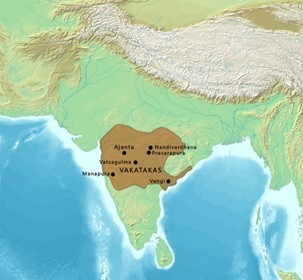
A significant political and cultural connection was established between the Vakatakas and the Guptas through the marriage alliance between Prabhavati Gupta, daughter of the Gupta emperor Chandragupta II (reigned c. 375–415 CE), and Rudrasena II of the Vakataka family. After Rudrasena’s sudden death, Prabhavati ruled as regent on behalf of her minor sons for nearly two decades. During her regency, she administered the kingdom with the guidance of her father, thereby reinforcing Gupta influence in the Deccan.
The Vakatakas were devout followers of the Brahmanical religion and actively promoted Vedic rituals and sacrifices. As Brahmanas themselves, they sought to uphold and disseminate orthodox Brahmanical values across the Deccan. Although their political relevance is more commonly associated with northern India due to their Gupta ties, culturally they served as a conduit for transmitting northern religious and social practices into the southern regions.
One of their most significant contributions to Indian heritage is their patronage of the Ajanta Caves, a UNESCO World Heritage Site. These rock-cut Buddhist monuments, renowned for their intricate murals and sculptures, were commissioned during the reign of the Vakatakas, illustrating the dynasty’s inclusive approach to religious patronage.
Following the weakening of the Satavahana Empire, the Ikshvaku dynasty—also referred to as the Andhra Ikshvakus—rose to prominence in the Krishna-Guntur region of Andhra Pradesh. Founded by Vashishtiputra Chamtamula, a former Satavahana feudatory, the Ikshvakus ruled from the early 3rd century to the early 4th century CE. They established their capital at Vijayapuri, now known as Nagarjunakonda, which developed into a major cultural and religious center of the time.
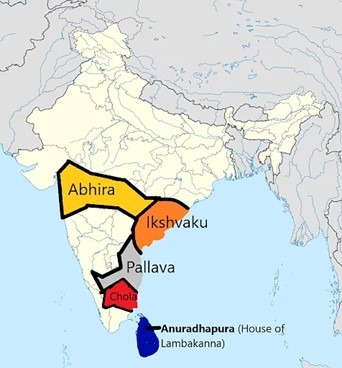
The Ikshvakus were a local clan who strategically adopted the illustrious lineage of the Suryavamsha or Solar Dynasty, claiming descent from the legendary King Ikshvaku, the forebear of Lord Rama. This mythological association not only elevated their dynastic prestige but also helped legitimize their rule in the eyes of the Brahmanical elites and the masses.
One of the notable administrative innovations introduced by the Ikshvakus was the systematic practice of land grants in the Krishna-Guntur region. These grants, recorded on copper plates, were often made to Brahmanas and Buddhist institutions, reflecting the dynasty’s dual religious engagement.
Religiously, the Ikshvakus presented a unique pattern of gendered patronage. The kings were staunch Shaivites, performing elaborate Vedic sacrifices to assert their religious authority. However, the royal women—queens and princesses—were enthusiastic supporters of Buddhism. They made substantial donations to the Buddhist Sangha and financed the construction of stupas, chaityas, and viharas, particularly in Nagarjunakonda and Amaravati. This dual patronage exemplifies the religious pluralism that characterized their rule.
Under the Ikshvakus, Nagarjunakonda flourished as a major seat of Buddhist learning and architecture. It hosted some of the earliest brick temples dedicated to Brahmanical deities alongside monumental Buddhist structures, underscoring the region’s syncretic cultural landscape. The city’s prosperity peaked during the 2nd and 3rd centuries CE, driven by royal patronage and a thriving mercantile community.
The cultural zenith of the Ikshvaku dynasty coincided with the life and work of Nagarjuna, one of the most influential philosophers in the history of Mahayana Buddhism. Believed to have lived in the 2nd century CE, Nagarjuna is traditionally associated with the Andhra region and the court of the Ikshvakus.
Nagarjuna is revered as the founder of the Madhyamaka (Middle Path) school of Buddhist philosophy. His most famous work, the Mulamadhyamakakarika (“Fundamental Verses on the Middle Way”), articulates the profound concept of shunyata (emptiness), asserting that all phenomena—including the Buddha and Nirvana—are devoid of inherent existence. This philosophical stance emphasizes the dependent origination of all things and aims to liberate the mind from fixed conceptions.
In addition to his philosophical treatises, Nagarjuna is closely associated with the Prajnaparamita Sutras (“Perfection of Wisdom”), which form the doctrinal bedrock of Mahayana Buddhism. His writings combined rigorous logical analysis with deep spiritual insight, earning him a place as a towering intellectual figure in the Buddhist world.
Recent archaeological discoveries at the Phanigiri Buddhist site in the Suryapet district of Telangana further affirm the vitality of Buddhist culture during the Ikshvaku era. Among the most significant finds is a pot containing 3,730 lead coins bearing symbols such as the elephant and Ujjain symbol, which are attributed to the Ikshvakus.
The Kadamba dynasty emerged as a significant regional power in southern India following the dissolution of Satavahana authority. Founded by Mayurasharman in the 4th century CE, the Kadambas established their capital at Banavasi, located in present-day Uttara Kannada district of Karnataka. Their realm extended across northern Karnataka and parts of the Konkan coast.
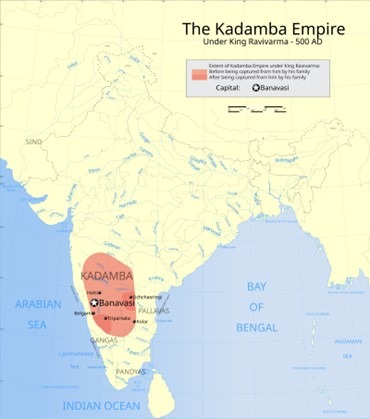
Claiming Brahmana lineage, the Kadambas were devout followers of Brahmanical traditions and generously patronized fellow Brahmanas. This strengthened their social base and legitimized their kingship in a period of political fragmentation.
One of the most notable aspects of Kadamba political history is that the Chalukyas of Badami, who would later become a dominant force in peninsular India, initially served as feudatories under the Kadambas. By the 6th century CE, the Chalukyas declared their independence, laying the foundation for a new imperial phase in Deccan history.