
The Bhakti Movement:
The Bhakti movement arose as a reaction against the rigid caste system, elaborate rituals, and the increasingly complex forms of worship within Brahmanical Hinduism. It emerged as a popular, devotional, and spiritual reform movement, emphasizing emotional union with the divine over ritualistic formalities.
Historical Origins:
- The movement began in South India around the 7th century CE, primarily in Tamil Nadu and Karnataka.
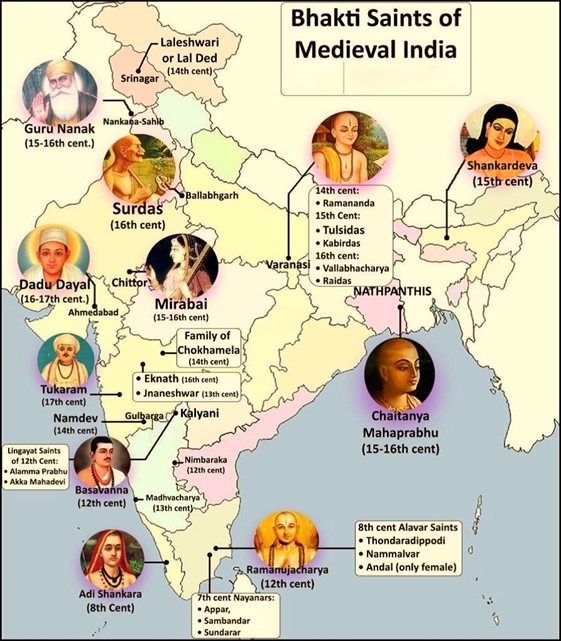
- Basavanna (1105–1168), a 12th-century philosopher and reformer, played a significant role in Karnataka. He initiated a powerful social reform movement known as Lingayatism, which openly challenged caste inequalities and Brahmanical authority.
- The early Bhakti saints included the Nayanars (Shaivite saints) and Alvars (Vaishnavite saints), who wrote passionate devotional hymns in Tamil. They viewed religion as a bond of love between the worshipper and the divine, not as a mechanical adherence to rituals.
Causes for the Rise and Growth of the Bhakti Movement
Indigenous Roots in Indian Tradition
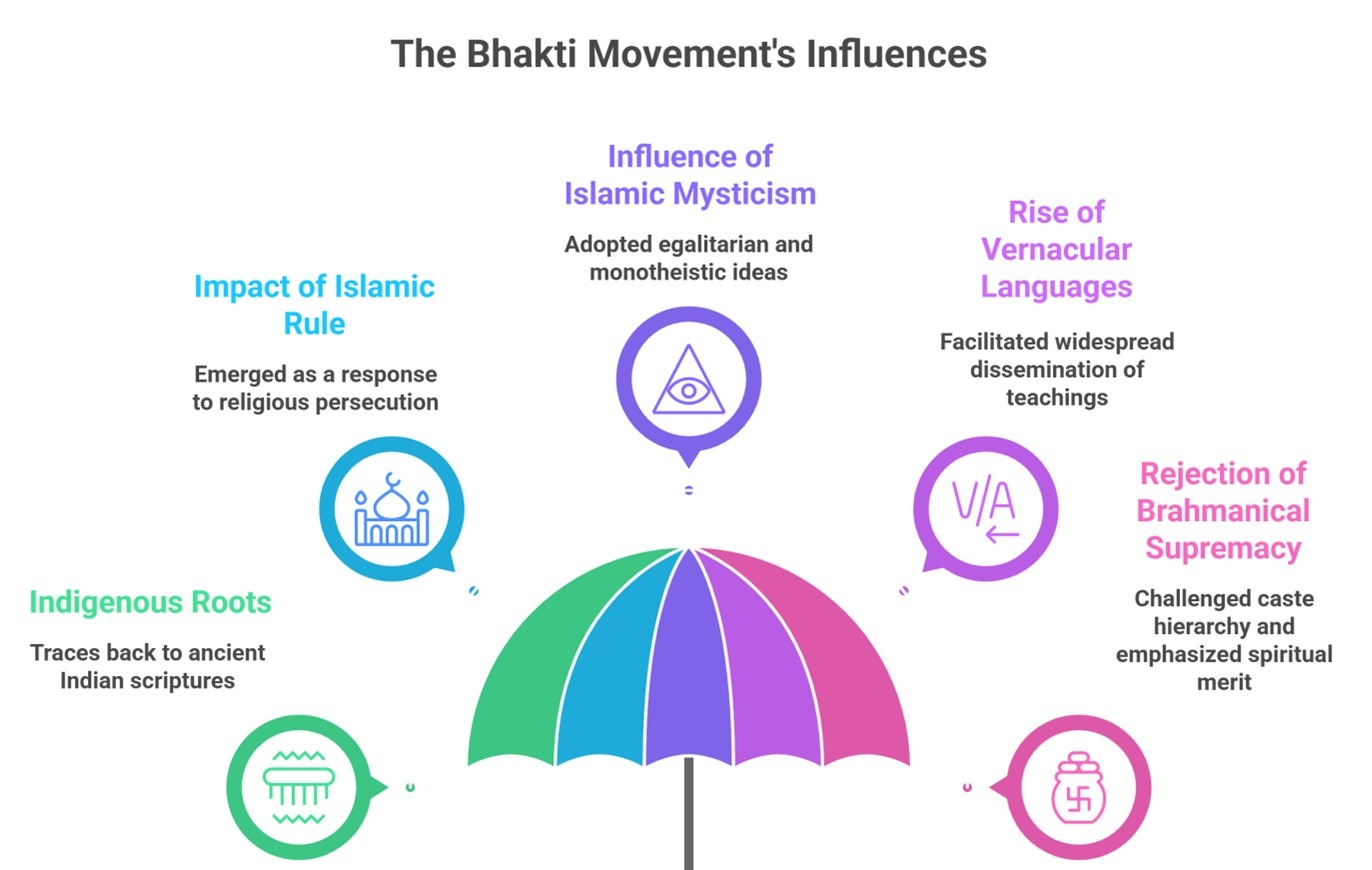
The Bhakti ethos was not an imported ideology; its origins lay deep within ancient Indian scriptures. Elements of Bhakti were already present in the Vedas, Upanishads, Bhagavad Gita, and Puranas. Thus, the Bhakti movement represented a revival and reformulation of long-standing Indian spiritual values.
Impact of Islamic Rule
The Islamic conquests and subsequent rule in various parts of India, particularly under certain fanatical rulers, led to destruction of temples and persecution of Hindus. This caused widespread anxiety and spiritual insecurity among the people.
In this context, the Bhakti movement emerged as a resilient spiritual alternative, offering hope, consolation, and inner strength to the masses. It acted as a defense mechanism for Hinduism, asserting its core values in the face of external pressures.
Influence of Islamic Mysticism and Egalitarianism
The egalitarian doctrines of Islam, particularly those of the Sufis, influenced Bhakti thought. Ideas such as monotheism, universal brotherhood, complete surrender to the divine, and rejection of religious orthodoxy found echoes in the Bhakti movement.
Rise of Vernacular Languages
The growth of regional languages was crucial to the spread of the Bhakti ideology. Saints and poets composed spiritual verses in the language of the people, allowing Bhakti teachings to transcend barriers of literacy, caste, and privilege.
Rejection of Brahmanical Supremacy and Caste Hierarchy
A major appeal of the Bhakti movement lay in its challenge to Brahmanical hegemony. It openly criticized the caste system and emphasized that spiritual merit, not birth, was the true measure of human worth.
Women were actively encouraged to participate, and many saints openly criticized social evils like female infanticide and untouchability. The Bhakti movement thus emerged as a force of social reform in addition to being a spiritual renaissance.
Bhakti Movement in South India
Between the 7th and 10th centuries CE, the Bhakti movement in South India laid the foundational ideals of devotional worship that would later influence northern India. The movement was spearheaded by the Vaishnava Alvar saints and Shaiva Nayanar saints, who devoted their lives to promoting the path of bhakti (devotion) as a means of attaining spiritual salvation. These saints transcended caste, gender, and social hierarchy, making spirituality accessible to all segments of society. Notably, many of these saints hailed from marginalized communities, and some were even women, symbolizing the inclusive nature of the movement.
Nayanars and Alvars
The two prominent groups of Bhakti saints in Tamil Nadu were:
- Nayanars – Devotees of Lord Shiva
- Alvars – Devotees of Lord Vishnu
These saints came from diverse backgrounds, including communities considered “untouchable” such as the Pulaiyar and Panars. They were fiercely critical of Buddhism and Jainism, and promoted intense emotional love and personal devotion to Shiva or Vishnu as the true path to moksha (liberation). Their poetry drew upon heroic and romantic imagery to illustrate their devotion.
Nayanars
The Nayanars were a group of 63 Shaivite saints active between the 6th and 8th centuries in Tamil Nadu. These saints came from all walks of life—potters, peasants, Brahmins, untouchables, hunters, soldiers, and even kings. Notable figures include:
- Sambandar
- Sundarar
- Appar
- Manikkavasagar
Their devotional hymns are preserved in a twelve-volume Tamil text called the Thirumurai, which continues to be revered in Tamil Shaivism.
Alvars
The Alvars were a group of 12 saints devoted to Vishnu, active mainly in Tamil Nadu. They composed devotional songs that praised Vishnu and his various avatars. Key Alvars include:
- Periyalvar
- Andal (his daughter and the only female Alvar)
- Tondaradippodi Alvar
- Nammalvar

Their hymns were compiled into the revered Nalayira Divya Prabandham, a collection of 4,000 Tamil verses, which is foundational to Sri Vaishnavism.
Important Saints of the Southern Bhakti Tradition
Adi Shankaracharya (8th–9th century)
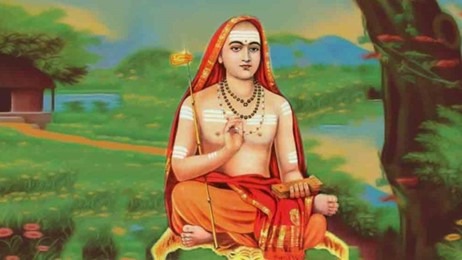
A towering figure in Indian philosophy, Adi Shankaracharya revitalized Hinduism by preaching Advaita Vedanta or non-dualism, which posits that the individual soul (Atman) and the universal soul (Brahman) are one. Key contributions include:
- Advocated Jnana Marga (path of knowledge)
- Established four mathas (monasteries) at Dwarka, Puri, Badrinath, and Sringeri
- Wrote important commentaries like Vivekachudamani
- His followers are known as Smarthas
Ramanujacharya (11th century)
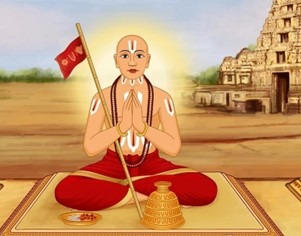
A spiritual reformer, Ramanuja preached Vishishtadvaita Vedanta (qualified non-dualism). He emphasized:
- Bhakti Marga (path of devotion) over dry intellectualism
- God is Saguna Brahman (with attributes)
- Prapatti Marga (total surrender to God)
- Opened Vaishnavism to Shudras and Dalits, thereby promoting social inclusivity
- Authored the philosophical treatise Sri Bhashya
Nimbarka
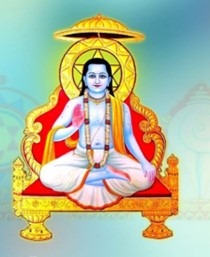
A Telugu Brahmin, Nimbarka spent most of his life in Vrindavan, where he preached the doctrine of Dvaitadvaita (dualistic non-dualism). He emphasized complete devotion to Radha and Krishna.
Madhvacharya (13th century)
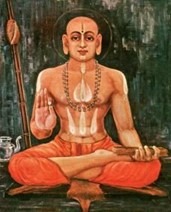
A prominent philosopher from Udupi, Madhvacharya advocated Dvaita Vedanta or dualism. According to him:
- God (Paramatma), Soul (Jivatma), and Matter are distinct and real
- The world is not an illusion but a tangible reality
- Composed the renowned Gita Bhashya
Basavanna (12th century)
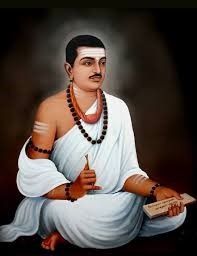
A pioneering social reformer from Karnataka, Basavanna founded the Veerashaiva or Lingayat movement, which worships Shiva in the form of a Linga. His followers rejected Brahminical authority and caste distinctions, advocating a highly egalitarian form of worship and community living.
These saints collectively transformed the spiritual landscape of South India, breaking religious orthodoxy, empowering marginalized communities, and laying the groundwork for a more inclusive and emotionally driven form of Hinduism.
Bhakti Movement in North India
The Bhakti Movement in North India witnessed a profound transformation in the religious, cultural, and social landscape of the region. It emerged as a major spiritual and social reform movement, challenging the rigidities of the caste system, orthodoxy, and meaningless ritualism. It stressed direct devotion to God, often expressed through poetry, music, and public gatherings, making religion more accessible and egalitarian.
Ramananda
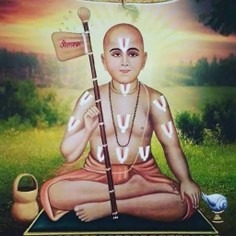
Ramananda was initially a disciple of Ramanuja, but eventually, he diverged from his teachings to establish his own sect. Operating primarily from Banaras (Varanasi) and Agra, he propagated devotion to Lord Rama as the supreme path to salvation. One of his significant contributions was the use of vernacular Hindi to communicate his ideas, thereby making spiritual teachings accessible to the common people.
He preached a simplified form of worship that rejected the orthodox caste hierarchies and religious formalism. He accepted disciples from all social strata, including so-called ‘lower castes’, emphasizing the universality of divine love and human equality. Prominent disciples included:
- Kabir (a weaver and poet)
- Raidas (a leather worker)
- Dhanna (a Jat and butcher)
- Peepa (a Kshatriya king)
- Sen (a barber)
- Ganga (a courtesan)
- Alongside several Brahmin disciples such as Brahmanand, Sukhanand, and Bhavananand.
Ramananda’s approach laid the foundation for a more inclusive religious ethos that profoundly influenced later Bhakti saints.
Vallabhacharya
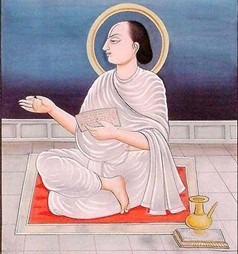
Vallabhacharya, a Telugu Brahmin, founded the Pushtimarg (Path of Grace), also known as the Vallabha Sampradaya. He advocated Krishna Bhakti, particularly in his child form (Baal Krishna). His teachings emphasized complete surrender to Krishna, devoid of asceticism or renunciation.
The sect gained immense popularity in Gujarat, and its legacy continues in the famous Vaishnava tradition there. Surdas, the celebrated Krishna devotee and poet, was among his most famous followers. The sect also produced the Ashtachap, a group of eight Krishna bhakti poets.
Surdas
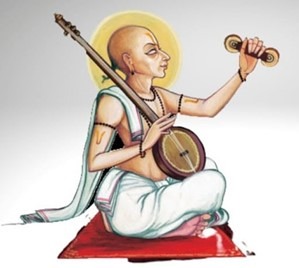
Surdas (1483–1563), a blind poet and disciple of Vallabhacharya, was one of the most influential devotional poets in North India. His works celebrated the life of Lord Krishna, particularly his childhood and youth, through tender and emotionally rich verse.
His most famous composition is the ‘Sur Sagar’, a poetic masterpiece recounting Krishna’s lilas (divine plays). Surdas’s work was infused with love, humility, and sweetness, earning him the title of the “Blind Bard of Agra.”
Mirabai

Mirabai (1503–1573), a Rajput princess and poet, expressed her intense devotion to Lord Krishna through soul-stirring bhajans and poems. Despite societal constraints, she defied patriarchal norms by embracing a life devoted to her ‘beloved Giridhar Nagar’ (Krishna).
Her spiritual marriage to Krishna, composed in vernacular Rajasthani and Hindi, continues to resonate with spiritual seekers. Her compositions had a significant influence on Mahatma Gandhi, and she remains a powerful symbol of devotion and resistance.
Tulsidas
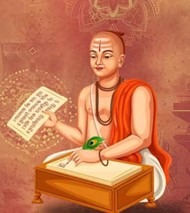
Tulsidas was an ardent devotee of Lord Rama. He authored the ‘Ramcharitmanas’, a revered Awadhi retelling of the Ramayana. His work made the epic accessible to the common man and infused it with deep spiritual and ethical teachings. Tulsidas’s writings reinforced Rama’s image as the ideal king, husband, and devotee.
Nathapanthis, Siddhas, and Yogis
These heterodox sects significantly shaped the Bhakti ethos. Nathpanthis, Siddhas, and Yogis emphasized self-discipline, yogic practices, and mystical union with the divine. Many came from marginalised castes such as Domas, Chamaras (tanners), washermen, and cobblers, challenging caste-based exclusion.
During the 13th and 14th centuries, their popularity surged with the decline of orthodox Brahmanical dominance under the newly established Turkish rule. Their inclusive practices laid the groundwork for later Bhakti saints like Kabir, who drew inspiration from such traditions.
The Vaishnavite Movement
The Vaishnavite Movement centered around the worship of Vishnu and his incarnations—especially Rama and Krishna—as personal deities. It became a powerful force for religious and social transformation during the Bhakti era.
Key Features:
- Devotion was expressed through songs, poetry, dance, and kirtans (devotional musical gatherings).
- It emphasized personal connection with a Saguna (embodied) form of God, contrasting with Nirguna (formless) worship advocated by saints like Kabir and Guru Nanak.
Major Contributors:
- Kabir, Namdev, and Guru Nanak promoted devotion to a formless (Nirguna) God, yet encouraged universal love and ethical living.
- Surdas, Mirabai, Tulsidas, and Chaitanya Mahaprabhu championed Saguna Bhakti, worshipping God in embodied form (Krishna or Rama).
Chaitanya Mahaprabhu (1484–1533):
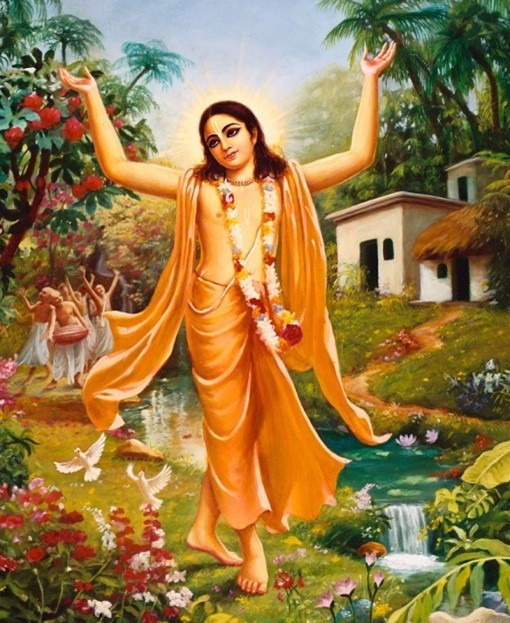
- A saint from Bengal who regarded Krishna as the Supreme Being, beyond just an avatar of Vishnu.
- Advocated ecstatic devotion through Sankirtans (collective hymn-singing).
- Encouraged communal worship, dissolving caste distinctions.
- Played a key role in spreading the Vaishnava movement across Bengal and eastern India.
Ramananda’s Influence:
- Revered Rama as the Supreme Deity.
- Encouraged women and outcasts to join the devotional fold, promoting social inclusivity.
The Vaishnavite Bhakti movement created a vibrant culture of devotional expression that appealed to all classes, fostering unity, spiritual egalitarianism, and resistance to orthodoxy.
Bhakti Movement in Bengal
The Bhakti movement in Bengal flourished under the profound spiritual influence of Chaitanya Mahaprabhu, a saint and social reformer of the 15th–16th century. He was instrumental in promoting the Krishna cult, emphasizing pure devotion (bhakti), love, and equality of all human beings irrespective of caste, creed, or gender. Chaitanya renounced worldly life and became an ascetic, travelling across India to preach his doctrine of universal brotherhood and spiritual unity. Through song and dance, he encouraged personal devotion as a means to experience divine presence. His teachings inspired the masses and his legacy continues to resonate in Bengal’s cultural and spiritual landscape even today.
Gaudiya Sampradaya
Gaudiya Vaishnavism, also known as Chaitanya Vaishnavism or the Hare Krishna movement, was founded by Sri Chaitanya in the 16th century. The word “Gaudiya” is derived from Gauda, an ancient name for the Bengal region, while “Vaishnavism” refers to the worship of Vishnu or his avatars. Chaitanya revived and spiritualized the culture of Krishna bhakti, drawing heavily from Bhagavad Gita, Bhagavata Purana, other Puranic texts, and Upanishads. His movement laid the foundation for the global Vaishnava revival witnessed today.
Jaydev
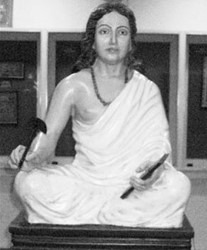
Another significant figure in Bengal’s devotional tradition was Jaydev, who composed the Gita Govinda, a classic Sanskrit lyrical poem celebrating the love between Krishna and the gopis, especially Radha. The text poetically narrates divine love, illustrating Radha’s supreme devotion, and includes Ashtapadis, or eight-verse compositions. The Gita Govinda inspired numerous classical dance forms, particularly Odissi, and became a spiritual and artistic cornerstone of the bhakti tradition.
Bhakti Movement in Maharashtra
Jnaneswar (1275–1296 AD)
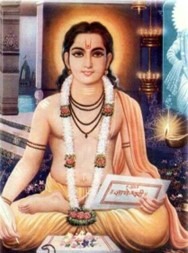
Regarded as the pioneer of the Bhakti movement in Maharashtra, Jnaneswar emphasized devotion over rituals and caste distinctions. His work Jnaneswari, a Marathi commentary on the Bhagavad Gita, is one of the earliest literary masterpieces in the region and laid the ideological groundwork for the bhakti tradition. His devotional compositions, called Abhangs, are still revered in Maharashtra.
Namadeva
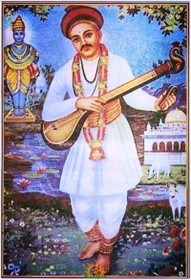
Namadeva, a tailor by profession, turned into a spiritual poet-saint. His Marathi poems overflow with divine love and are deeply personal in expression. He denounced idolatry, opposed Brahmanical domination, and is credited with initiating the Abhang devotional tradition. He also had spiritual exchanges with Sufi saints in Delhi, showcasing interfaith harmony.
Eknath
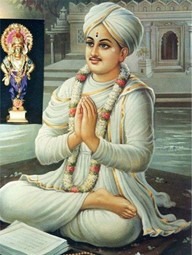
A prominent Warkari saint, Eknath was devoted to Lord Krishna. He actively promoted bhajans, kirtans, and religious processions. His devotional songs, deeply embedded in the Warkari sampradaya, continue to inspire followers who walk to the Vithoba temple in Pandharpur each year.
Tukaram (17th Century)
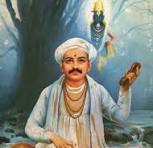
A towering figure in the Bhakti movement, Tukaram was contemporary to Chhatrapati Shivaji. Through his soul-stirring Abhangs and collective worship (kirtans), he championed social equality, spiritual liberation, and the worship of Vithoba (Vitthala). His teachings played a pivotal role in nurturing Maratha nationalism.
Bhakti Movement in Other Regions
- Kashmir: In the 14th century, Shaiva bhakti was popularized by Lal Ded, a revered mystic woman saint who composed devotional verses in the Kashmiri language.
- Gujarat: The Vallabha Sampradaya and the poet-saint Narsinh Mehta emerged as central devotional figures. Mehta is often referred to as Adi Kavi of Gujarati literature.
- Assam: Sankaradeva (1449–1568) led a major revival of Vaishnavism through his Eka-sarana Dharma. Despite resistance from orthodox Brahmins, he emphasized monotheism, use of common language, and introduced drama, dance, and music into devotional practices.
Kabir (1440–1518)
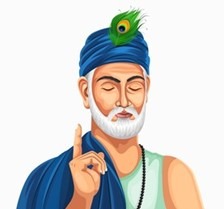
Among Ramananda’s disciples, Kabir stands out as a profound poet-philosopher. Born to a Muslim weaver family, he challenged religious dogma and promoted experiential devotion (bhakti). Kabir preached the oneness of God, addressing Him by names from both Hindu and Islamic traditions (Rama, Hari, Allah, Khuda, etc.).
Kabir’s teachings were captured in dohas (couplets) and pads (verses). He believed in spiritual simplicity, self-effort, and the futility of empty rituals. His message was universal: love and humility as the path to God. His verses were later compiled by Kabirpanthis in the Bijak, which remains their holy text. Kabir is revered across Hindus, Muslims, and Sikhs, with some of his verses even included in the Guru Granth Sahib.
Evolution of Sikhism
The medieval period in Indian history witnessed the emergence of Sikhism, a major religious movement that began as a small spiritual path and gradually evolved into a formidable socio-religious force. The Sikh religion was founded by Guru Nanak Dev Ji, whose teachings laid the foundation of a distinct and egalitarian spiritual philosophy. Over time, Sikhism developed into a well-structured faith with its own sacred texts, institutions, and identity. The religion was shaped and nurtured by ten successive Gurus, each contributing significantly to its evolution.
Guru Nanak Dev (1469–1539):
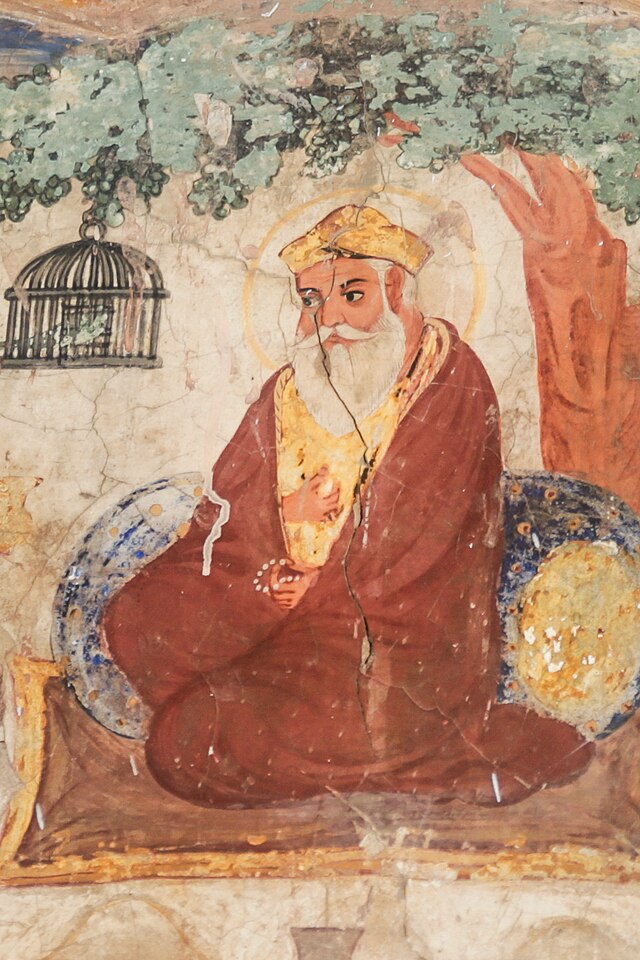
Born in Talwandi (modern-day Nankana Sahib in Pakistan), Guru Nanak showed early signs of spiritual inclination. He sought to challenge the corruption, ritualism, and divisive practices of the existing religious systems. Guru Nanak envisioned a just and egalitarian society based on universal love, truth, and service. His followers came to be known as Sikhs, meaning “disciples.”
- He preached against caste discrimination, idol worship, and religious orthodoxy.
- Guru Nanak emphasized three core principles:
- Naam Japna (Meditation on God’s name)
- Kirat Karni (Honest living)
- Vand Chakna (Sharing with others)
- He denounced the five vices – Ego, Anger, Greed, Attachment, and Lust, which he believed hindered spiritual growth.
- He advocated for gender equality, stating that women who give birth to kings should not be looked down upon.
- His hymns (known as bani) are compiled in the Guru Granth Sahib, the holy scripture of Sikhism.
- Guru Nanak emphasized universal brotherhood, harmony between Hindus and Muslims, and a life of righteousness amidst worldly challenges.
Successors of Guru Nanak and the Evolution of Sikhism
Following the passing of Guru Nanak Dev Ji, the spiritual foundation he laid was nurtured and expanded by nine successive Gurus, each of whom played a vital role in shaping Sikhism into a powerful religious, cultural, and social force. Their combined efforts transformed the Sikh community from a devotional fellowship into a unified and self-aware religious identity, with its own scripture, social structure, and ultimately, military tradition.
Guru Angad Dev (1539–1552)
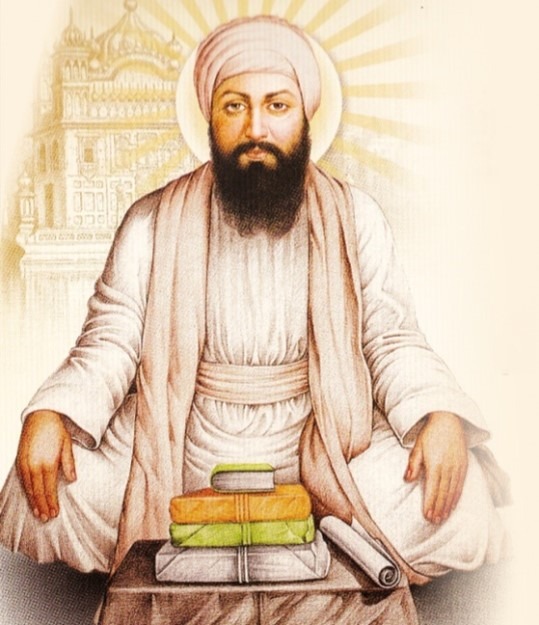
- Born as Bhai Lehna, Guru Angad was a devoted disciple of Guru Nanak and was chosen to be his spiritual successor.
- He is credited with popularising and standardising the Gurmukhi script, which later became the official script of the Punjabi language and the primary medium of Sikh scriptures.
- He expanded the institution of Guru ka Langar (community kitchen), reinforcing Sikhism’s message of equality and communal service.
- Guru Angad also promoted physical and spiritual discipline by setting up Mall Akharas (wrestling arenas), thereby encouraging Sikhs to stay fit and strong.
Guru Amar Das (1552–1574)
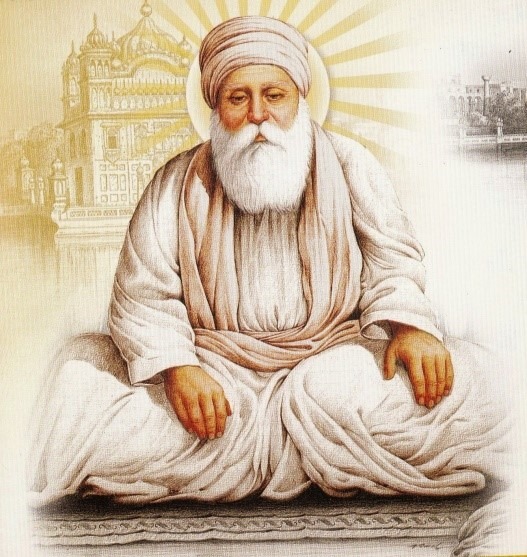
- Reformed and institutionalised the Langar system, making it a cornerstone of Sikh communal life and a symbol of social equality.
- Divided the Sikh spiritual empire into 22 administrative units called Manjis, each led by a spiritual representative to ensure efficient propagation of teachings.
- Took a progressive stand against social evils like Sati, caste discrimination, and the purdah system. He also promoted widow remarriage.
- He persuaded Emperor Akbar to remove the pilgrim tax imposed on non-Muslims, promoting religious tolerance.
Guru Ram Das (1574–1581)
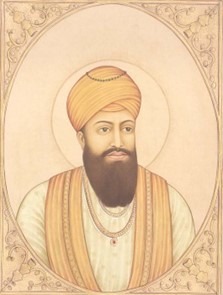
- Composed the “Anand Karaj”, the Sikh marriage hymn, establishing a distinct matrimonial tradition that replaced orthodox Hindu customs.
- Founded the sacred city of Amritsar (originally called Chak Ramdas) with the support of Akbar.
- Laid the foundation for the construction of the Harmandir Sahib (Golden Temple), which later became the most revered Sikh shrine.
- He denounced superstition, caste hierarchy, and pilgrimage rituals, aligning with the inclusive nature of Sikhism.
Guru Arjan Dev (1581–1606)
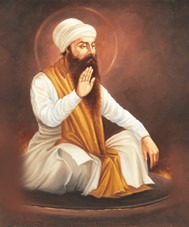
- Compiled the Adi Granth, the original version of the Guru Granth Sahib, incorporating not only the teachings of Sikh Gurus but also the works of Bhakti and Sufi saints, thereby promoting interfaith harmony.
- He completed the construction of Amritsar and established other key centres like Kartarpur and Tarn Taran.
- Executed on the orders of Emperor Jahangir for supporting Prince Khusrau in his rebellion, Guru Arjan Dev became the first Sikh martyr, revered as Shaheedan-de-Sartaj (Crown of Martyrs).
Guru Hargobind (1606–1644)
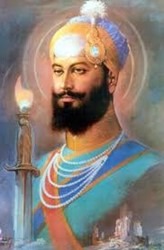
- Following the martyrdom of his father, Guru Arjan Dev, he introduced the concept of militant resistance to oppression and transformed the Sikhs into a martial community.
- He founded the Akal Takht (Throne of the Timeless), opposite the Golden Temple, symbolising the dual nature of spiritual and temporal authority.
- Introduced the doctrine of Miri and Piri, representing the union of spiritual and secular leadership, symbolised by two swords.
- Adopted the title “Sachcha Padshah” (True King) and successfully fought multiple battles against the Mughal forces.
- He fortified Amritsar and later shifted the headquarters to Kartarpur, strengthening Sikh political structure.
Guru Har Rai (1644–1661)
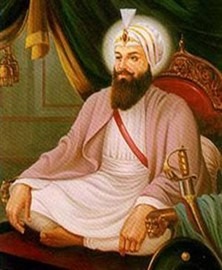
- Known for his peaceful and compassionate nature, Guru Har Rai continued the spiritual legacy of his predecessors.
- He came under Aurangzeb’s scrutiny for extending support to Dara Shikoh, the liberal-minded brother of the Mughal emperor.
- Aurangzeb accused him of blasphemy, leading to persecution of his followers and increased tensions with the Mughal state.
Guru Har Krishan (1661–1664)
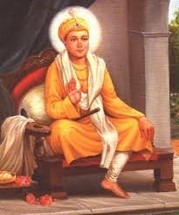
- Ascended the Guruship at a very young age and is remembered for his extraordinary humility and service.
- Summoned to Delhi by Aurangzeb on political grounds, he selflessly served the people during a smallpox epidemic in the capital.
- He succumbed to the disease and was venerated for his compassionate sacrifice, earning a revered place in Sikh history.
Guru Tegh Bahadur (1665–1675)
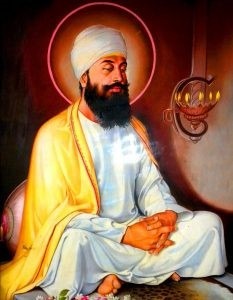
- Courageously stood up against Aurangzeb’s religious persecution, especially in defence of Kashmiri Pandits who were facing forced conversions.
- Beheaded publicly at Chandni Chowk, Delhi, for refusing to renounce his faith — his martyrdom is commemorated at the Sis Ganj Sahib Gurudwara.
- Expanded the Sikh faith into eastern India, including Bihar and Assam, thereby broadening its geographical influence.
- Appointed Banda Singh Bahadur as the military commander of the Sikh resistance.
Guru Gobind Singh (1675–1708)
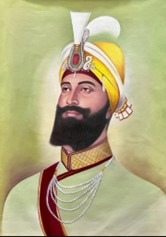
- The tenth and final Guru in human form, Guru Gobind Singh completed the formal transformation of Sikhism into a Khalsa Panth or warrior community in 1699.
- Initiated the Panj Pyare (Five Beloved Ones), who were the first members of the Khalsa, and in a powerful act of equality, received amrit (baptism) from them himself.
- Introduced the Five Ks as mandatory symbols for Sikhs:
- Kesh (uncut hair)
- Kangha (wooden comb)
- Kara (steel bracelet)
- Kirpan (sword)
- Kachera (short breeches)
- Instructed all Sikh men to adopt the name ‘Singh’ (Lion) and women to use ‘Kaur’ (Princess), symbolising courage and equality.
- Declared the Guru Granth Sahib as the eternal Guru, ensuring that no human Guru would follow him.
- Authored parts of the Dasam Granth, a supplementary religious text.
- Died from stab wounds inflicted by an assassin believed to be sent by Wazir Khan, a Mughal governor.
Sufism
Introduction to Sufism
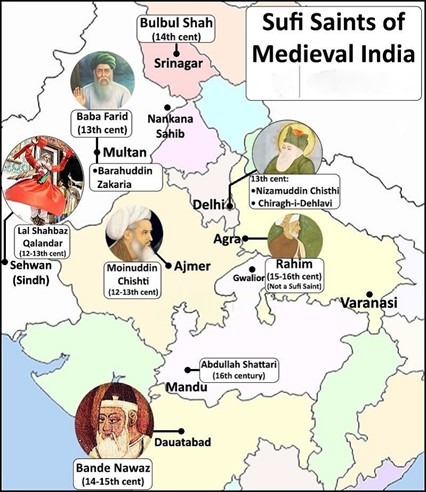
Sufism is a mystical and devotional movement within Islam that seeks to establish direct communion between the individual and God. Rooted in a personal experience of the divine, Sufism transcends ritualistic practices and emphasizes the inner spiritual journey toward God-realization. Unlike orthodox interpretations that focus predominantly on external conduct, Sufis emphasize inner purity, love, humility, and devotion.
This path can be traversed only under the guidance of a spiritual master — called a Murshid, Shaikh, or Pir — who has already experienced the mystical union with God. The disciple, known as the Murid, undergoes a series of spiritual stages (maqamat) and states (ahwal) through intense practices such as:
- Self-mortification (nafs ki tazkiyah),
- Remembrance of God’s name (dhikr),
- Meditation, and
- The practice of Sama, or spiritual musical recitation, designed to induce a state of divine ecstasy.
While such practices brought spiritual solace to many, they also attracted criticism from conservative Ulema, who often viewed them as deviations from Islamic orthodoxy.
Similarities between the Bhakti and Sufi Movements
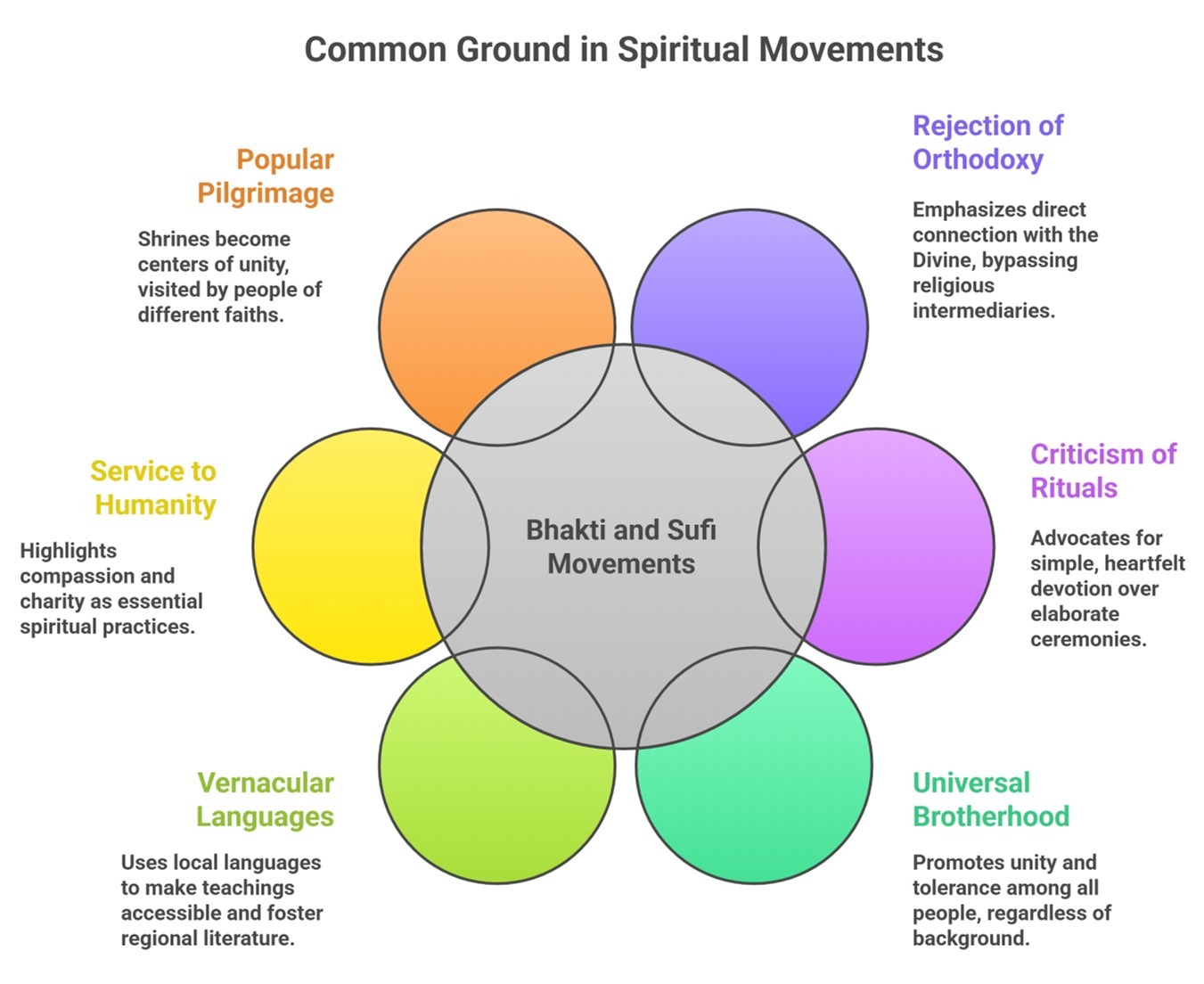
The Bhakti and Sufi movements emerged as powerful spiritual currents during medieval India, aiming to reform religious practices and promote a deeper, more personal connection with the Divine. Despite originating from different religious backgrounds—Hinduism and Islam—both movements shared striking similarities in their teachings, philosophy, and social impact.
Rejection of Religious Orthodoxy
Both the Bhakti saints and Sufi mystics emphasized that divine realization does not require intermediaries such as priests or ulemas. Instead, one could experience the presence of God through personal devotion, love, and guidance of a spiritual teacher (Guru or Pir). This belief challenged the authority of orthodox religious leaders and questioned the rigidity of institutionalized religion.
Criticism of Rituals and Formalism
Both movements denounced meaningless rituals, dogmas, and elaborate ceremonies that had become prevalent in society. They advocated for simple, heartfelt devotion (Bhakti or Ishq-e-Haqiqi) and inner purity as the true path to spiritual liberation.
Emphasis on Universal Brotherhood and Tolerance
A core message of both movements was the oneness of all human beings, regardless of caste, creed, or religion. They preached communal harmony, interfaith dialogue, and mutual respect, fostering an atmosphere of religious tolerance and social cohesion.
Promotion of Vernacular Languages
To connect with the masses, Bhakti and Sufi saints used local languages and dialects instead of Sanskrit or Arabic-Persian. This not only made their teachings accessible to common people but also stimulated the growth of regional languages and devotional literature, including poetry, songs, and prose.
Service to Humanity
Both traditions laid great emphasis on compassion, charity, and selfless service. Acts of helping the poor, feeding the hungry, and caring for the needy were considered as noble as any spiritual practice.
Popularity and Pilgrimage
Bhakti and Sufi saints became deeply revered figures among the people. Their shrines, samadhis, and dargahs became popular centres of pilgrimage, visited by both Hindus and Muslims, symbolizing their enduring legacy of unity and love.
Importance of Bhakti and Sufi Movements
The Bhakti and Sufi movements were not merely religious developments; they were transformative socio-cultural movements that redefined the spiritual and social landscape of medieval India. These movements emerged during a period when society was burdened by religious orthodoxy, social stagnation, caste-based discrimination, and ritualistic practices, offering instead a message of equality, love, and devotion.
Social Awakening and Reform
The Bhakti movement, as a socio-religious reformist movement, played a crucial role in challenging religious bigotry, caste rigidity, and moral decline. It revived faith in personal devotion and ethical conduct, focusing on character-building and spiritual integrity. At a time when Indian society had become rigid and hierarchical, Bhakti saints infused a fresh spirit of reform and inclusivity, redefining spiritual values and initiating a powerful dialogue on social justice.
Critique of Ritualism and Superstition
Both Bhakti and Sufi saints offered scathing critiques of ritualistic, dogmatic, and superstitious religious practices. They believed that true salvation (moksha or nijat) could only be attained through pure and unconditional devotion to God, not through empty rituals or priestly mediations. Their teachings significantly reformed and humanised religion, placing love, compassion, and humility at its core.
Promotion of Social Equality
Saints like Kabir, Guru Nanak, Ravidas, and others emphasized egalitarianism in both spiritual and social realms. They rejected the caste system, questioned Brahmanical dominance, and accepted disciples from all backgrounds, including women and oppressed castes. For instance, Ramananda’s disciples included a cobbler (Ravidas), a weaver (Kabir), and a woman (Padmavati). This inclusive approach gave the marginalized communities a voice and spiritual legitimacy.
Unity Between Hindus and Muslims
The movements became a bridge between Hindu and Islamic traditions, fostering communal harmony. Saints like Kabir were revered by both Hindus and Muslims, and their teachings promoted universal brotherhood and religious tolerance. This atmosphere of unity and mutual respect contributed significantly to the secularisation of society.
Legacy of Sikhism
Although Guru Nanak never intended to establish a new religion, the spiritual and ethical foundations he laid eventually led to the emergence of Sikhism. His teachings, compiled in the Guru Granth Sahib, gave rise to a community with a distinct religious identity, script (Gurmukhi), and doctrinal foundation. Over time, this community evolved into a powerful socio-political force, particularly under Maharaja Ranjit Singh, shaping the history of northern India.
Sufi Philosophy and Cultural Syncretism
The Sufi philosophy of Wahdat-al-Wujud (Unity of Being) closely resembled Hindu metaphysical ideas, particularly those found in the Upanishads. Sufi saints not only embraced local traditions but also adapted their language and symbolism to connect with Indian audiences. Notable poets like Malik Muhammad Jayasi composed spiritual works in Hindi, and commonly used Indian imagery such as Radha, Krishna, Ganga, and Yamuna. The fusion of religious thought was so profound that Mir Abdul Wahid felt compelled to write Haqaiq-i-Hindi, a treatise to explain the Islamic equivalents of these Hindu concepts.
Impact on Music and Literature
The Bhakti and Sufi movements gave rise to a renaissance in devotional music and literature. Kirtans, bhajans, abhangs, qawwalis, and other forms of group singing became a medium of mass spiritual awakening. Compositions of Mira Bai, Tulsidas, Kabir, and Surdas continue to be sung in religious gatherings even today, showing their timeless appeal and cultural significance.
Influence on Political Thought
The atmosphere of tolerance and pluralism cultivated by these movements influenced rulers like Emperor Akbar, whose liberal religious policies—such as abolition of jizya, interfaith dialogue, and patronage of different religious scholars—can be traced back to the cultural milieu shaped by Bhakti and Sufi teachings.

Legacy of a Composite Culture
The Bhakti and Sufi movements represent a remarkable chapter in India’s socio-cultural history, lasting for over 500 years. They originated independently but merged in purpose, traveling from South to North and North to South, influencing diverse regions over centuries. These movements gave birth to a composite culture, rooted in unity, mutual respect, and shared identity. Their impact went far beyond religion—they contributed to nation-building, linguistic development, and the cultural integration of India.
Even today, their messages of love, simplicity, tolerance, and devotion remain deeply relevant in a world seeking spiritual and social harmony.
Saint | Region | Chronology | Philosophy | Notable Works |
Adi Shankaracharya | Kerala | 788–820 | Advaita Vedanta (non-dualism) | Brahmasutra Bhashya, Upanishad Bhashyas, Vivekachudamani |
Ramanujacharya | Tamil Nadu | 1017–1137 | Vishishtadvaita (qualified non-dualism) | Sri Bhashya, Vedartha Sangraha, Gita Bhashya |
Gnyaneshwar | Maharashtra | 1275–1296 | Unity of God and individual soul | Dnyaneshwari, Amrutanubhav |
Namdev | Maharashtra | 1270–1350 | Devotion to Vithoba (Krishna) | Abhangas |
Baba Farid | Punjab | 1173–1266 | Inner purity, devotion to God, Chishti Order | – |
Khwaja Moinuddin Chishti | Ajmer, Rajasthan | 1141–1236 | Love, tolerance, openness, Chishti Order of Sufism | – |
Nizamuddin Auliya | Delhi | 1238–1325 | Love for God and all creation, charity, humility | Fawaid-ul-Fuad |
Amir Khusro | Delhi | 1253–1325 | Sufi mysticism combined with local culture | Tuhfat-us-Sighr, Khamsa |
Ramananda | North India | 1300–1380 | Worship of Rama and Vishnu, rejected caste distinctions | – |
Kabir | Varanasi, North India | 1440–1518 | Nirguna Bhakti, criticism of rituals and caste system | Kabir Bijak, Kabir Granthavali |
Ravidas | Varanasi, North India | 1450–1520 | Casteless society, devotion to a formless God | – |
Meera Bai | Rajasthan | 1498–1547 | Devotion to Lord Krishna, expressed love through poetry | Numerous Bhajans |
Surdas | North India | 1478–1583 | Devotion to Lord Krishna | Sursagar, Sur Saravali, Sahitya Lahari |
Tulsidas | North India | 1532–1623 | Devotion to Lord Rama, Bhakti emphasis | Ramcharitmanas, Hanuman Chalisa |
Chaitanya Mahaprabhu | Bengal and Odisha | 1486–1534 | Worship of Krishna, congregational chanting (sankirtan) | Siksastakam |
Eknath | Maharashtra | 1533–1599 | Unity of God, devotion, self-realization | Eknathi Bhagavata, Rukmini Swayamvara |
Sheikh Salim Chishti | Fatehpur Sikri, U.P. | 1478–1572 | Blessings, prophecies, Chishti Order | – |
Sheikh Ahmad Sirhindi | Punjab | 1564–1624 | Reformist Islam, opposed Akbar’s syncretism (Din-i-Ilahi) | Maktubat-e-Imam Rabbani |
Hazrat Shah Jalal | Sylhet, Bengal | 1271–1346 | Promoted Islam through teachings and simplicity | – |
Tukaram | Maharashtra | 1608–1649 | Devotion to Vithoba (Krishna), simplicity in devotion | Various Abhangas |
Guru Nanak | Punjab | 1469–1539 | Founded Sikhism, preached monotheism and human equality | Japji Sahib |
Shankaradeva | Assam | 1449–1568 | Devotion to Krishna, rejected caste distinctions | Kirtan Ghosa, Bhakti Ratnavali |
Ramprasad Sen | Bengal | 1718–1775 | Devotion to Goddess Kali through devotional songs | Shyama Sangeet |
Bulleh Shah | Punjab | 1680–1757 | Sufi philosophy, divine love, human equality | Kafi poetry |