
Advent of the Europeans in India
Geographical Exploration and European Colonisation
Early Indo-European Trade Relations
India maintained vibrant commercial ties with Europe from ancient times, especially during the Sangam Age (circa 300 BCE–300 CE). This is evidenced by the discovery of Roman gold coins, amphorae, and ceramics across peninsular India, indicating the flourishing Indo-Roman trade. Indian spices, fine cotton textiles, gems, ivory, and handicrafts were in great demand among the European aristocracy, particularly in the Roman Empire, which heavily relied on Indian imports.
Major Trade Routes Connecting India and Europe (Before Maritime Discoveries)
Before the emergence of maritime navigation, Indo-European trade was facilitated through three prominent routes:
1. Silk Route (Overland): This ancient trade route traversed Central Asia, moving through the Amu Darya River, the Caspian Sea, and the Black Sea, eventually linking to Europe. It was a part of a vast network that also connected China and Persia with the Mediterranean world.
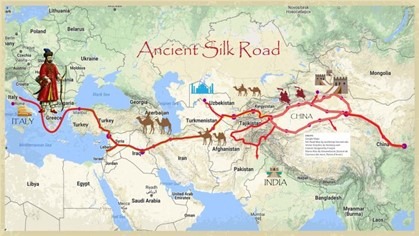
2. Arabian Route to the Mediterranean: Goods from India were shipped across the Arabian Sea to ports in Arabia, from where they were transported overland through Saudi Arabia and Syria, reaching Mediterranean ports such as Alexandria and Antioch.
3. Red Sea-Egyptian Route: Indian goods were carried via the Arabian Sea and Red Sea, then transported by land through Egypt and finally shipped across the Mediterranean Sea to Europe.
During this time, Italian city-states such as Venice and Genoa emerged as dominant trading powers. Their geographical proximity to the Mediterranean and control over critical sea lanes allowed Italian merchants to establish monopoly over luxury goods, including spices, silk, and perfumes. This monopoly gave Italy tremendous economic and political leverage in European affairs.
Key Factors behind the Age of European Exploration and Colonization
Several political, technological, economic, and religious factors combined to give rise to the Age of Discovery, which altered the course of global history.
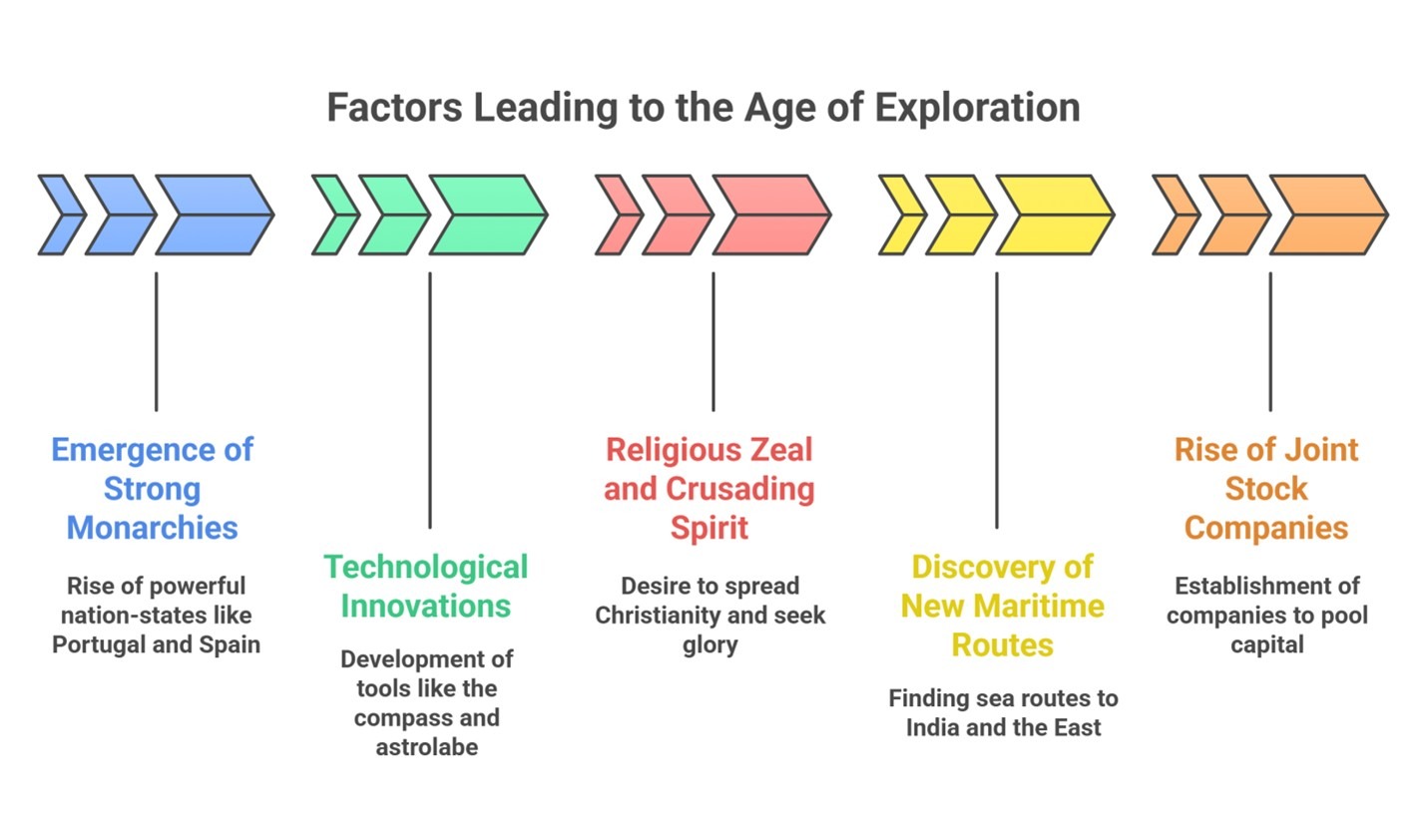
1. Emergence of Strong Centralized Monarchies
The rise of nation-states like Portugal and Spain, governed by powerful monarchs, played a crucial role. Kings such as Prince Henry the Navigator (Portugal) and Ferdinand and Isabella (Spain) actively sponsored exploratory missions with the ambition of acquiring new colonies, securing trade routes, and accumulating wealth through overseas conquests.
2. Technological Innovations in Navigation and Warfare
The 15th century witnessed a technological revolution that made long-distance sea voyages possible and more efficient:
- Magnetic Compass – Allowed accurate navigation and orientation during sea travel.
- Astrolabe – Helped sailors determine latitude by observing celestial bodies.
- Gunpowder – Strengthened naval power, enabling conquest and control of foreign ports.
- Cartography (Map-making) – Provided detailed and updated maps essential for sea voyages.
- Printing Press – Facilitated the widespread distribution of maps, travelogues, and maritime manuals.
These innovations significantly reduced the risks associated with sea exploration.
3. Religious Zeal, Crusading Spirit, and the Desire for Glory
Apart from economic motives, religious aspirations also played a crucial role. European explorers were driven by the zeal to spread Christianity among non-believers. This was often combined with the crusading spirit, as the voyages were seen as part of a larger civilising mission. Additionally, glory-seeking adventurers and noblemen were eager to gain titles, wealth, and fame through exploration.
4. Discovery of New Maritime Routes to the East
European maritime powers desperately sought a direct sea route to India, bypassing Islamic empires that controlled land routes.
- In 1487, Bartholomew Diaz, a Portuguese navigator, became the first European to round the southern tip of Africa, which was named the Cape of Good Hope, symbolising the promise of reaching the East by sea.
- In 1498, Vasco da Gama successfully landed in Calicut (Kerala), establishing direct sea access to India and marking the beginning of Portuguese colonial ambitions in Asia.
This achievement ushered in European dominance over Asian maritime trade for the next several centuries.
5. Rise of Joint Stock Companies: The New Economic Engines
The emergence of joint stock companies revolutionised the structure of global trade. These companies allowed:
- Pooling of capital from multiple investors, reducing individual risk.
- Business continuity, even after the death of individual shareholders.
- Ease of fundraising and movement of capital, which ensured expansion and profitability.
Pioneering companies like the British East India Company (1600) and the Dutch East India Company (VOC, 1602) were granted royal charters and exercised enormous political and military powers. They established fortified trading posts, signed treaties, and even waged wars, functioning like sovereign powers in Asia.
The Dawn of a Global Era
The Age of Geographical Exploration was fuelled by a combination of economic necessity, religious idealism, political ambition, and technological innovation. The discovery of sea routes to India and Asia not only broke the monopoly of Italian merchants and Middle Eastern empires but also ushered in European colonisation of vast parts of the East.
This epoch marked the beginning of a truly global economy, forever transforming the dynamics of international trade, cultural exchange, and colonial domination. The age of European imperialism had begun, with India at the heart of this grand maritime revolution.
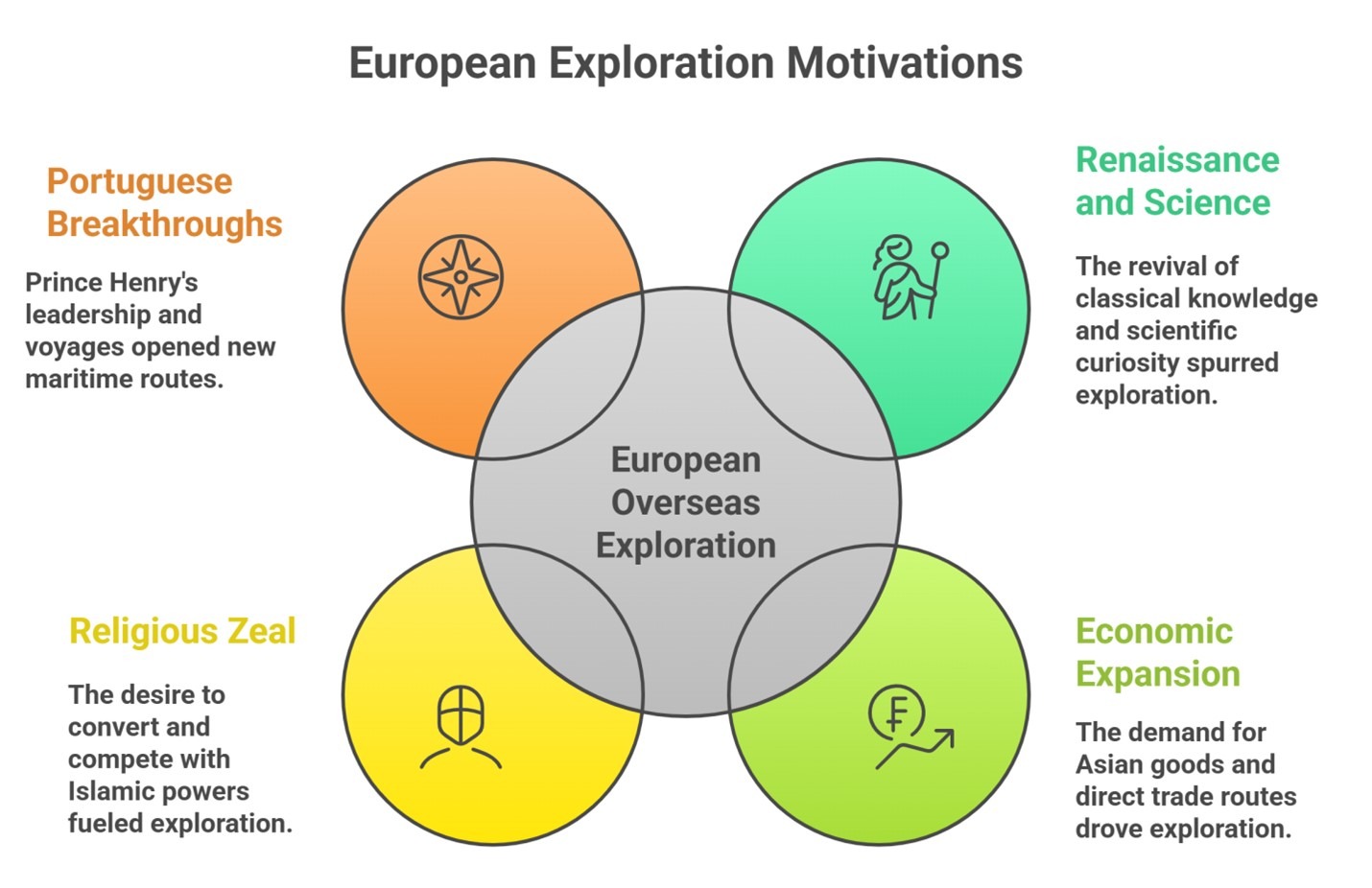
Portuguese Maritime Breakthroughs
Prince Henry the Navigator
Regarded as the father of modern navigation, Prince Henry of Portugal spearheaded early explorations along the African coast. He founded navigational academies, funded scientific inquiry, and envisioned a Christian naval route to India, circumventing the Islamic world.
Treaty of Tordesillas (1494)
To avoid conflict over newly discovered lands, Spain and Portugal signed the Treaty of Tordesillas, dividing the non-Christian world into spheres of influence. Portugal was permitted to explore eastward, laying the groundwork for its presence in India.
Bartholomew Dias (1487)
Dias’s historic voyage around the Cape of Good Hope proved the possibility of reaching India via the sea. This established the final navigational puzzle piece needed to access the Indian Ocean.
Vasco da Gama’s Voyage (1497–1498)
In a voyage of immense global significance, Vasco da Gama successfully reached Calicut (Kozhikode) in May 1498, establishing the first direct maritime link between Europe and the Indian subcontinent. This inaugurated an era of European colonisation and global trade.
Governor | Period of Office | Key Actions and Achievements |
Francisco De Almeida | 1505–1509 | • Appointed as the first Governor of Portuguese India. • Implemented the Blue Water Policy focused on naval supremacy. • Built fortresses at Anjadiva, Cochin, Cannanore, and Kilwa. • Defeated the combined Egyptian and Gujarat navies in the Battle of Diu (1508). • Aimed to establish Portuguese dominance over the Indian Ocean. |
Alfonso de Albuquerque | 1509–1515 | • Secured strategic control of key trade routes in the Indian Ocean. • Established strong Portuguese bases in East Africa, Ormuz, Malabar, and Malacca. • Introduced the permit (Cartaz) system for regulating maritime trade. • Captured Goa from the Sultan of Bijapur in 1510. • Abolished sati (widow burning). • Promoted intermarriage, urban development, and cultural integration in Goa. |
Nino da Cunha | 1529–1538 | • Transferred the Portuguese capital in India from Cochin to Goa. • Acquired the island of Bassein from Bahadur Shah of Gujarat. • Expanded Portuguese influence in Bengal, setting up Hooghly as a commercial base. • Played a role in the controversial killing of Bahadur Shah in 1537. |
Why Portugal Succeeded in India
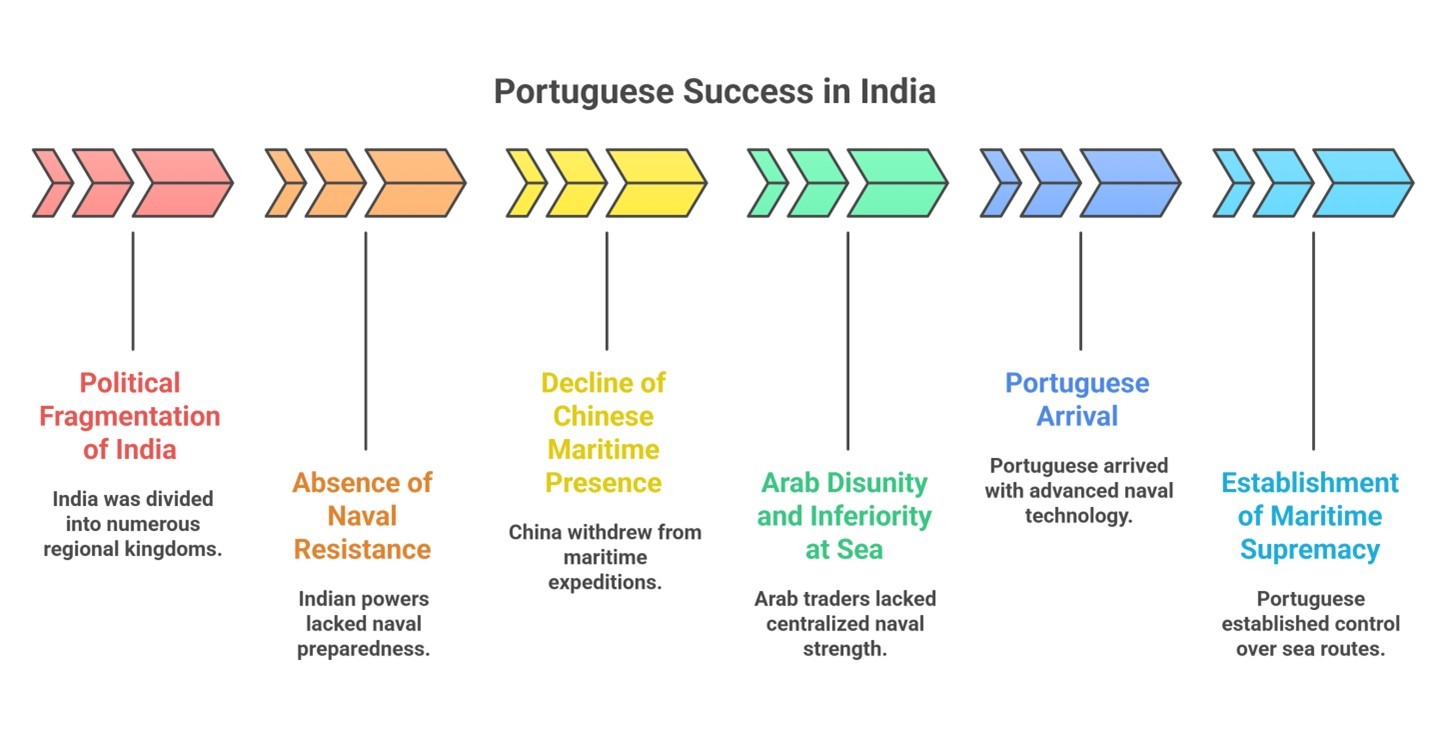
Political Fragmentation of India
When the Portuguese first arrived on the Indian subcontinent, India was deeply fragmented into numerous regional kingdoms. The Delhi Sultanate’s influence had significantly diminished, and the Bahmani Sultanate was in the process of disintegrating into smaller Deccan states like Bijapur, Ahmadnagar, and Golconda. This lack of political unity created a fertile ground for foreign powers to exploit regional rivalries and establish their dominance.
Absence of Naval Resistance
Indian powers, though strong on land, were militarily and strategically unprepared for naval warfare. The Portuguese possessed advanced naval technology, including caravels equipped with cannons and superior maritime training. Their domination of the sea lanes allowed them to control trade routes, outmaneuver coastal rulers, and establish fortified enclaves with little resistance.
Decline of Chinese Maritime Presence
During this period, China withdrew from international maritime expeditions due to a royal edict by the Ming Emperor. The famed Chinese admiral Zheng He’s voyages were terminated, removing a formidable naval competitor from the Indian Ocean. This power vacuum was swiftly filled by the Portuguese, who faced less competition for control over Indo-Asian sea routes.
Arab Disunity and Inferiority at Sea
Though Arab traders dominated Indian Ocean trade for centuries, they were loosely organized and lacked centralized naval strength. The Portuguese, arriving with well-armed warships and a coordinated strategy, quickly overpowered these fragmented trading networks and established maritime supremacy.
Decline of Portuguese Power in India
Entry of the English and Other Europeans
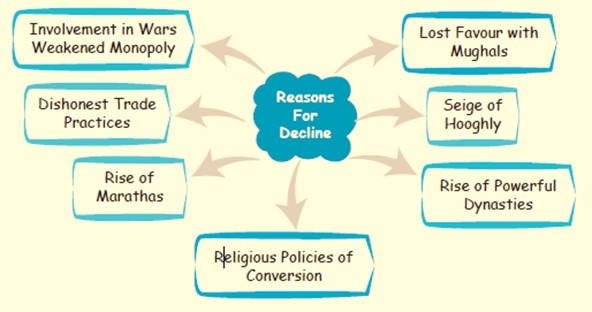
In 1608, Captain William Hawkins arrived in Surat seeking trade privileges from the Mughal emperor Jahangir, who granted him a mansab (official rank). The Portuguese failed to prevent the English entry, and the arrival of the British and Dutch East India Companies marked the beginning of Portuguese decline in Indian trade.
Fall of Hooghly (1632)
Portuguese abuses in slave trading, salt monopolies, and exploitation of locals prompted a Mughal offensive under Shah Jahan. Hooghly was besieged and captured, Portuguese inhabitants were imprisoned or fled, and their religious privileges were curtailed.
Broader Causes of Decline
- Rise of powerful Indian states like the Marathas, who resisted Portuguese intrusion.
- The Union of Portugal with Spain (1580–1640), which distracted the Portuguese from Asian affairs.
- Discovery of Brazil, which diverted attention and resources toward the New World.
- The superior naval capabilities of the English and Dutch, backed by wealthier Joint Stock Companies, eventually eclipsed Portuguese maritime dominance.
Lasting Contributions of the Portuguese in India
Military Advancements
The Portuguese introduced modern European firearms, naval artillery, and siege techniques, which significantly influenced Indian military strategies, especially those of the Mughals and Marathas.
Maritime Innovations
They brought advanced navigation methods, multi-decked ships, trained pilots, and scientific cartography, revolutionizing trade in the Indian Ocean.
Cultural and Architectural Legacy
Despite their religious intolerance, the Portuguese contributed to the rich cultural mosaic of India, particularly in Goa, where their legacy is evident in:
- Christian art and music
- Gothic and Baroque architecture
- Indo-European culinary traditions
- Iconic monuments like the Basilica of Bom Jesus, a UNESCO World Heritage Site.
The Portuguese were the first European colonial power to establish a stronghold in India, paving the way for future European empires. Their early naval success, strategic diplomacy, and technological superiority enabled them to dominate Indian coastal trade for over a century. Although their influence waned in the face of stronger competitors, their military, maritime, and cultural contributions profoundly shaped the trajectory of Indian history and continue to be visible in architecture, customs, and cuisine in regions like Goa. The legacy of Portuguese colonization, while complex and often controversial, is undeniably an integral part of India’s colonial past.
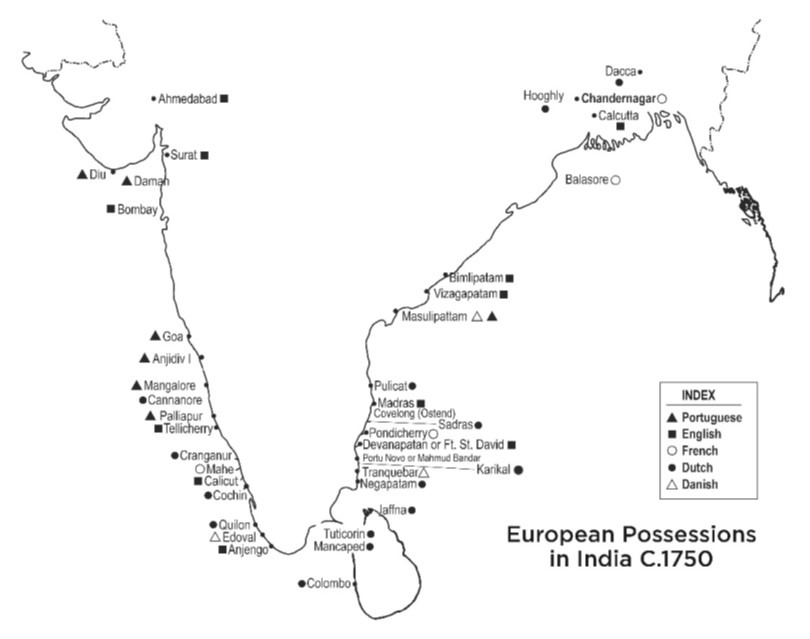
Dutch Factories in India
On the Coromandel Coast
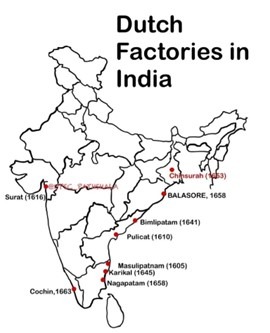
- Petapuli (1606): The VOC’s earliest settlement in India, located on the Coromandel Coast.
- Masulipatnam (1606): Another key port city in present-day Andhra Pradesh, where the VOC established a factory in the same year. It gained importance due to its strategic trade location.
- The head of this factory later held the title of President (from 1621), being second in command after the Dutch director at Pulicat.
- Pulicat (1610): Became the VOC’s principal headquarters in South India. It later became the seat of the Dutch directorate of Coromandel, overseeing all VOC factories in the region.
- The Dutch constructed Fort Geldria at Pulicat in 1613, one of their most important strongholds.
- Nagapattinam (1690): The administrative seat was eventually shifted from Pulicat to Nagapattinam, making it the VOC’s new base on the Southern Coromandel Coast.
In Gujarat and Bengal
- Surat (1618): The VOC received permission from Prince Khurram (later Shah Jahan) to establish a trading post at this key Mughal port city.
- Bengal (1665): The VOC factories in Bengal became independent of Coromandel’s control, forming their own directorate. The chief factory at Hooghly served as the headquarters of VOC operations in Bengal.
- VOC operations here were purely commercial, and military presence was minimal, unlike in the Coromandel region.
Year | Location |
1609 | Pulicat, north of Madras |
1616 | Surat |
1632 | Patna |
1641 | Bimlipatam |
1645 | Karaikal |
1653 | Chinsura |
1658 | Barangar, Kasimbazar, Balasore, Nagapatam |
1663 | Cochin |
The English in India
The English venture into Indian trade was formally initiated with the granting of a royal charter by Queen Elizabeth I on December 31, 1600, establishing the “Governor and Company of Merchants of London Trading into the East Indies.” This laid the foundation for the English East India Company (EIC), a joint-stock company that would go on to play a pivotal role in the colonization of India.
- The company emerged at a time of increased maritime interest in England following Francis Drake’s circumnavigation of the globe in 1580 and the defeat of the Spanish Armada in 1588, which established British naval dominance.
- Initially granted a 15-year monopoly, the charter was later extended indefinitely.
- With the Dutch controlling the spice-rich East Indies, the English turned their attention to India’s lucrative textile trade.
The French in India
The French were among the last European powers to arrive in India for the purpose of trade and colonization. Unlike the Portuguese, Dutch, and British, whose activities in India had commenced during the 16th and early 17th centuries, the French entry was delayed due to internal political developments in France and limited maritime presence during the early modern period.
Foundation of the French East India Company
In 1664, during the reign of Louis XIV, the powerful French statesman Jean-Baptiste Colbert initiated the formation of the Compagnie des Indes Orientales (French East India Company). This state-supported company was modeled after the British and Dutch trading companies and was granted:
- A monopoly for 50 years to conduct French trade across the Indian and Pacific Oceans.
- A perpetual concession over Madagascar, with a mandate to acquire more overseas territories.
This marked the formal entry of France into the Indian Ocean commercial theatre and their ambitions to secure a foothold in India, not merely for trade, but also as part of broader geopolitical competition with the British.
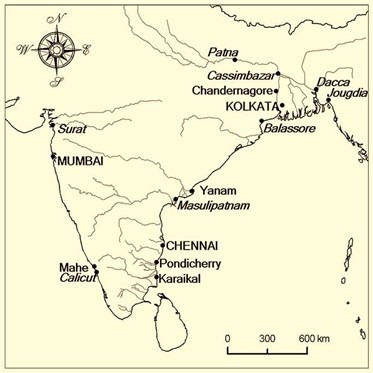
Major French Settlements and Trading Posts in India
After its establishment, the French East India Company embarked on creating trading settlements along the Indian coastline.
Surat (1667):
- Under the leadership of François Caron, the French established their first factory in Surat. This marked the initial French attempt to compete with British and Dutch traders in the western Indian Ocean region.
Masulipatnam (1669):
- The second French factory was set up in Masulipatnam (on the Coromandel Coast) by Mercara, a Persian associate of Caron. A trade license (patent) was secured from the Sultan of Golconda, indicating the French effort to build alliances with local rulers.
Chandernagore (1673):
- The French gained permission from Shaista Khan, the Mughal Subahdar (governor) of Bengal, to establish a settlement at Chandernagore, located near Calcutta. It later developed into a prominent French centre in eastern India.
Pondicherry (1674):
- The most important French possession in India, Pondicherry, was founded by François Martin after Sher Khan Lodi, the local governor of Valikondapuram, granted them land. Over time, Pondicherry became the headquarters of French power in India and the symbol of their colonial ambitions.
Other Settlements:
The French also established factories in:
- Mahe (on the Malabar Coast),
- Karaikal (near the Cauvery delta),
- Balasore (in Odisha), and
- Qasimbazar (in Bengal).
Dupleix as an Administrator
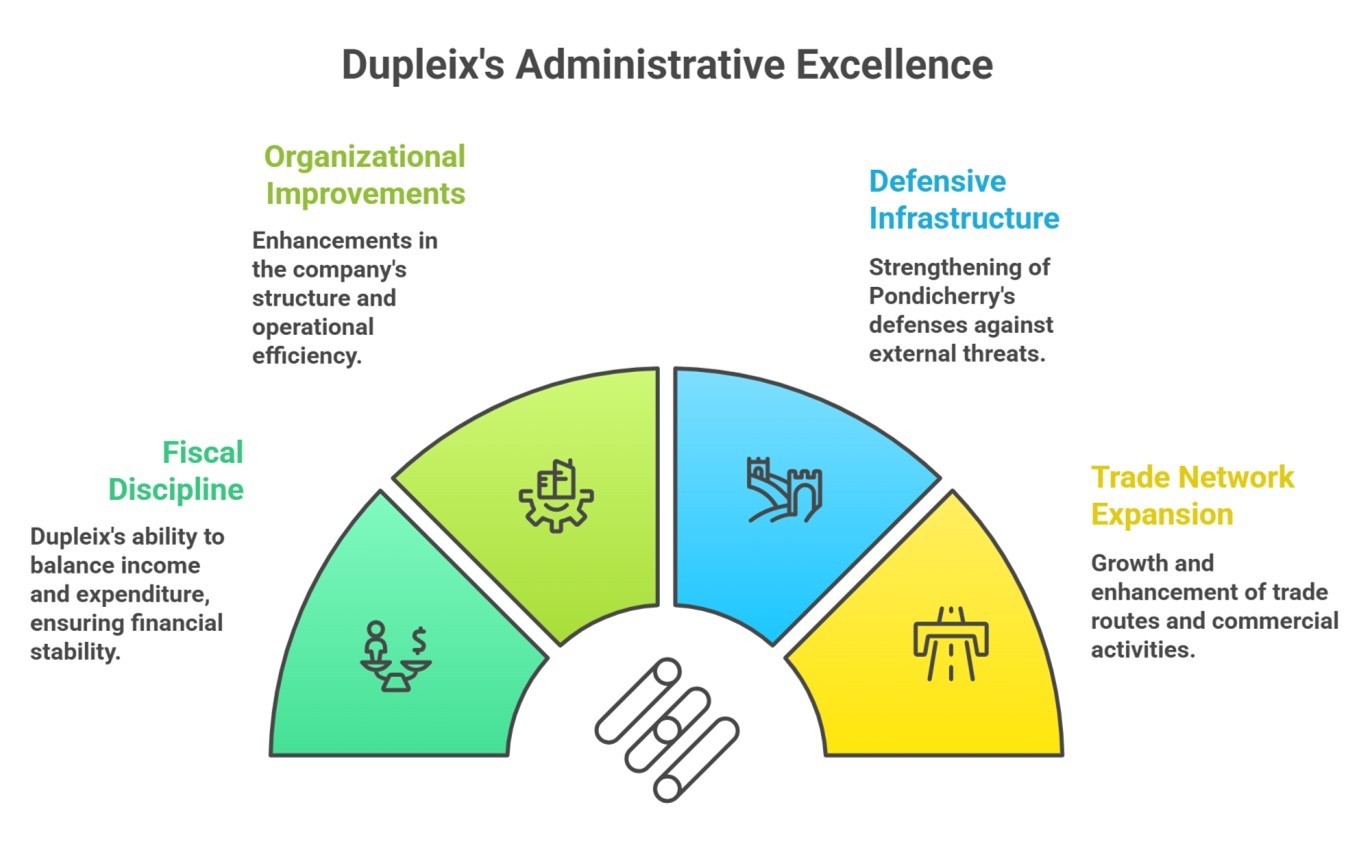
- Dupleix is remembered as a proficient administrator who brought fiscal discipline and organizational improvements to the French East India Company.
- He successfully balanced income and expenditure, a rare achievement for European trading companies operating in India at the time, which often suffered from mismanagement and corruption.
- Under his leadership, the defensive infrastructure of Pondicherry was considerably strengthened, ensuring greater protection from both rival European forces and native threats.
- His focus on expanding trade networks and enhancing commercial activity led to increased profitability for the Company.
- Dupleix’s sound administrative decisions and strategic planning earned him praise and admiration from the Directors of the French East India Company in Paris, who viewed him as a capable and visionary leader.
Causes for the Success of the English and the Failure of the French in India
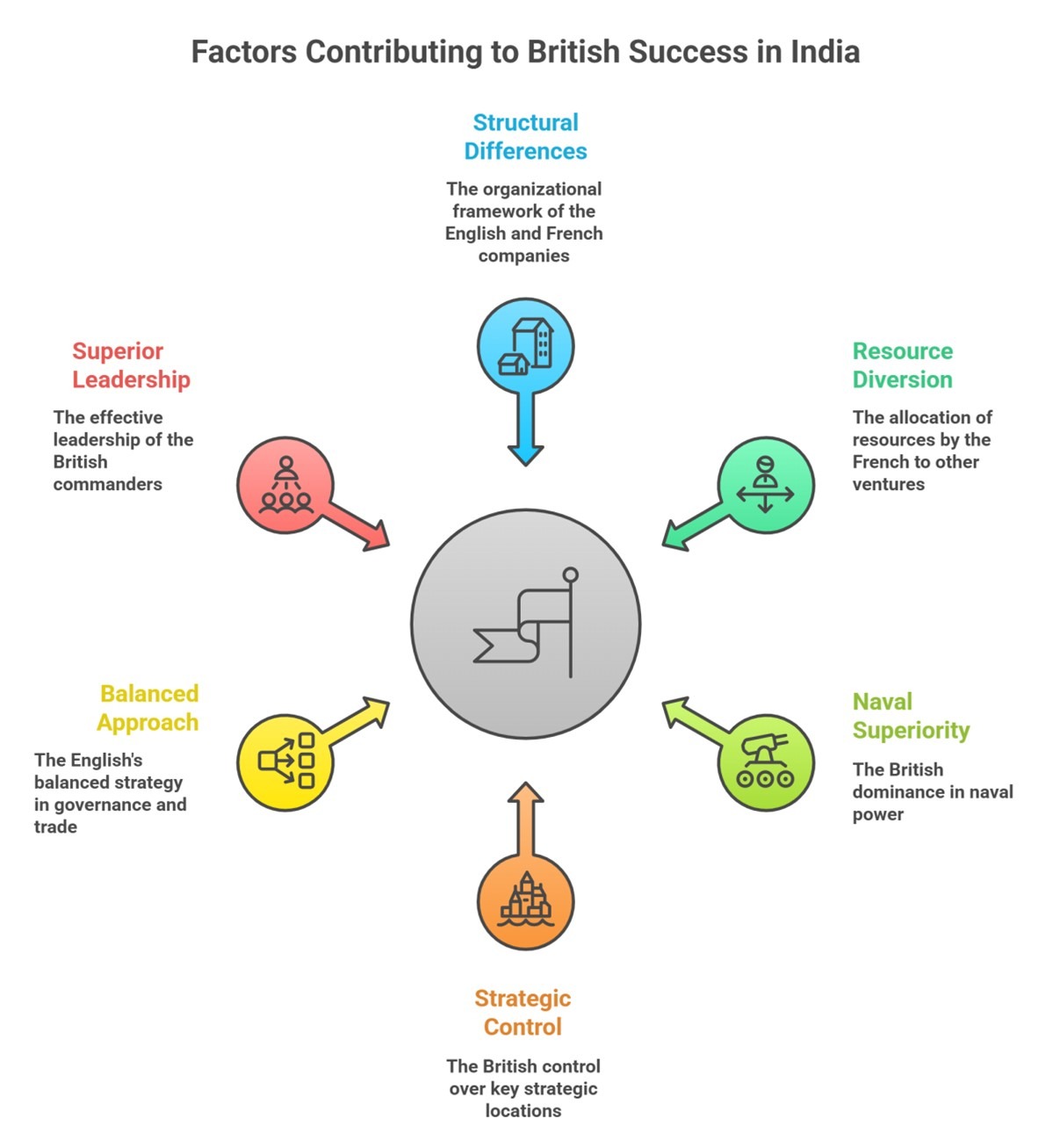
The ultimate triumph of the English over the French in India was the result of a combination of strategic, structural, and leadership advantages enjoyed by the English East India Company. Several key factors contributed to this outcome:
1. Structural Differences between the Two Companies
- The English East India Company operated as a private enterprise, fostering a spirit of initiative, enterprise, and self-confidence among its officials. This autonomy allowed it to take quick decisions without waiting for formal approval from the British government.
- In contrast, the French East India Company was state-controlled, burdened by bureaucratic delays and rigid government policies. This limited its ability to respond swiftly to changing political and commercial conditions in India.
2. Diversion of French Resources
- France was heavily involved in military conflicts in Europe, including wars against other European powers. This constant continental engagement forced them to divide their attention, energy, and resources, reducing their effectiveness in India.
- The British, however, were able to focus more consistently on expanding their influence in India.
3. Naval Superiority of the British
- The British Royal Navy was vastly superior to its French counterpart. This enabled the English to dominate sea routes, cut off reinforcements, and block essential supplies from reaching French settlements in India.
- The French, due to their weaker naval power, often found themselves isolated and vulnerable.
4. Strategic Control Over Key Locations
- The British controlled three major and strategically significant port cities: Calcutta, Bombay, and Madras. These cities not only boosted trade but also served as important military and administrative bases.
- The French, on the other hand, had only Pondicherry as a major base, which limited their influence and operations.
5. Balanced Approach of the English
- The English balanced their commercial interests with imperial ambitions, ensuring long-term financial sustainability. Their policies emphasized economic gain alongside territorial expansion.
- The French leadership, especially under Dupleix, prioritized territorial conquest at the expense of trade, which strained the company’s finances and weakened its foundation.
6. Superior British Leadership
- The English had dynamic and capable military leaders such as Robert Clive, Major Stringer Lawrence, and Sir Eyre Coote. Their strategic brilliance, military discipline, and political acumen played a critical role in British victories.
- The French relied mainly on Joseph François Dupleix, who, despite his talents, lacked consistent support and was ultimately recalled, leaving the French efforts weakened.
The English success in India was not merely a result of military victories but stemmed from a combination of institutional autonomy, superior naval power, strategic territorial control, effective leadership, and a balanced approach between trade and empire-building. The French failure, conversely, was due to bureaucratic constraints, overextension of resources, and a lack of cohesive long-term strategy.
The Danes
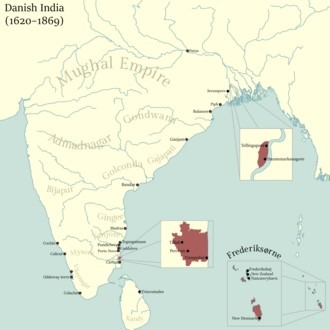
The Danish East India Company, established in 1616 during the reign of King Christian IV of Denmark, was among the earliest European trading enterprises formed to profit from the rich commerce of the East. However, Denmark’s colonial influence in India remained limited compared to its European rivals like the British, French, Portuguese, and Dutch.
- The Danes founded their first trading factory at Tranquebar (modern-day Tharangambadi), near Tanjore on the southeastern coast of India, in 1620. This settlement remained their primary base for over two centuries.
- Later, they established another key settlement at Serampore, near Calcutta (Kolkata) in Bengal. These establishments functioned more as commercial outposts rather than centers of political control or military expansion.
- Despite their early involvement, the Danish never posed a serious challenge to other colonial powers. Their commercial activities were limited in scale, and they lacked the naval and military strength needed to protect or expand their holdings.
- By 1845, recognizing the futility of maintaining their Indian ventures, Denmark sold all its possessions in India to the British. Notably, the Danes are remembered more for their missionary activities, particularly in the promotion of education and religious texts in local languages, than for any significant commercial or political influence.
Internal Challenges within British Companies
- The British East India Company faced domestic challenges as well. In 1635, a rival trading firm, the Courteen Association, emerged under a license from King Charles I. It was later renamed the Assada Company.
- By 1657, the two entities merged, only to face another competitor in 1698. The conflict was resolved in 1702, and by 1708, they formed the “United Company of Merchants of England Trading to the East Indies”, through arbitration by Earl of Godolphin. This unified company ruled over British interests in India until 1858, when the British Crown assumed direct control following the Revolt of 1857.
The Legacy of European Intervention in India
The arrival of European trading powers in India, beginning in the 16th century, marked a transformative era in the subcontinent’s history. While it introduced new ideas, commercial practices, technologies, and global connections, it also paved the way for economic exploitation, political domination, and cultural upheaval.
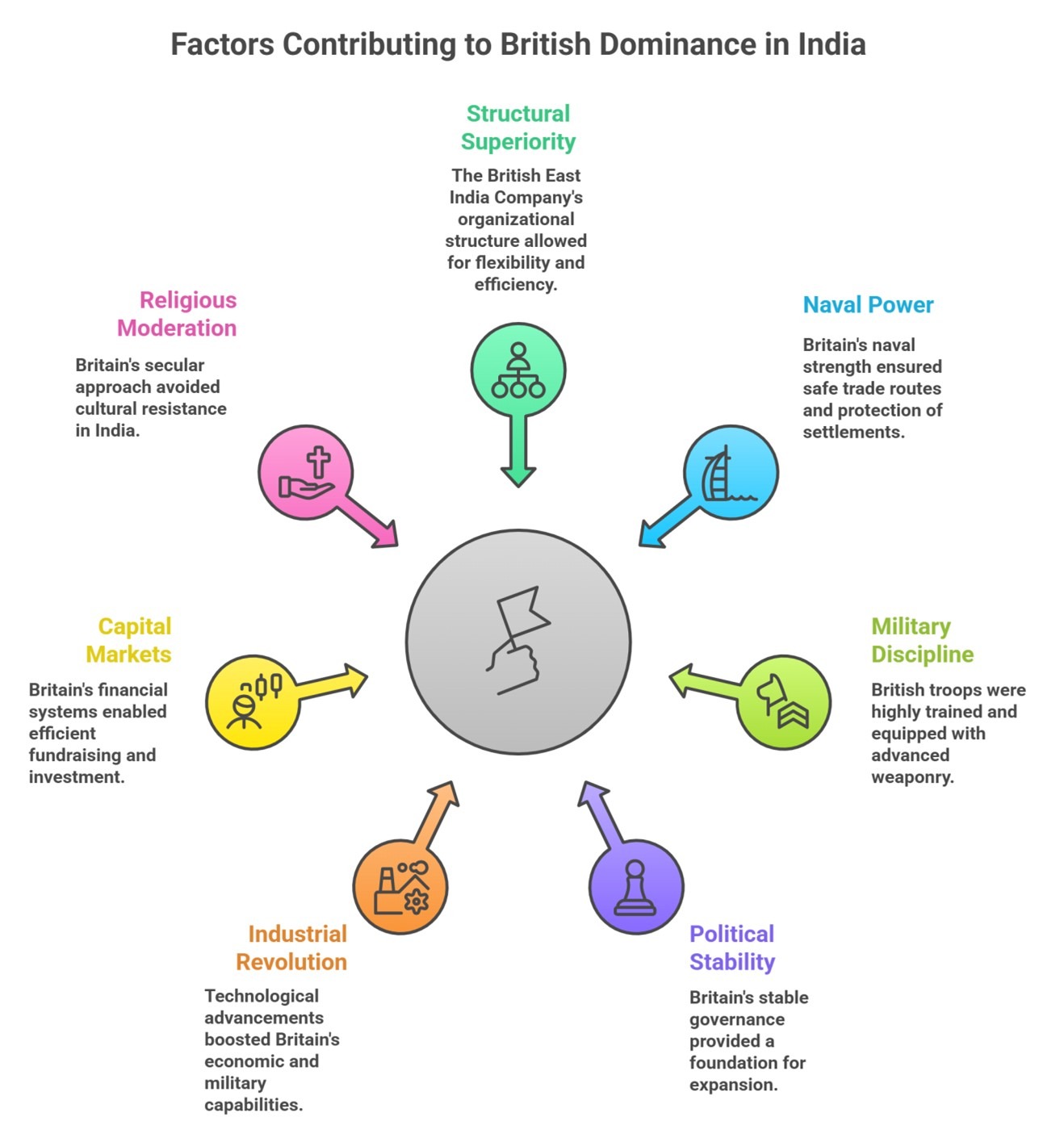
Among all European contenders, Britain emerged as the supreme colonial force, owing to a combination of naval power, military strategy, political stability, and industrial might. The failure of other European powers, including the Danes, can be attributed to limited ambition, weaker financial and administrative systems, and inability to adapt to changing geopolitical dynamics.
The European presence in India laid the groundwork for the British Empire, which would dominate the region for over two centuries. The impact of this colonial encounter continues to shape India’s political, economic, and cultural landscape even today, making it an essential area of study for understanding the complexities of modern Indian history and its global interactions.