
Queen’s Proclamation (1858) & Government of India Act, 1858
Following the Revolt of 1857, the British Parliament formally ended the rule of the East India Company and brought India directly under the British Crown. This monumental shift was institutionalised through the Government of India Act, 1858, which laid the foundation of British imperial governance in India for the next 90 years.
Government of India Act, 1858
Passed on August 2, 1858, this Act abolished the East India Company’s rule and transferred all powers of administration, legislation, and finance to the British Crown.
Major Provisions:
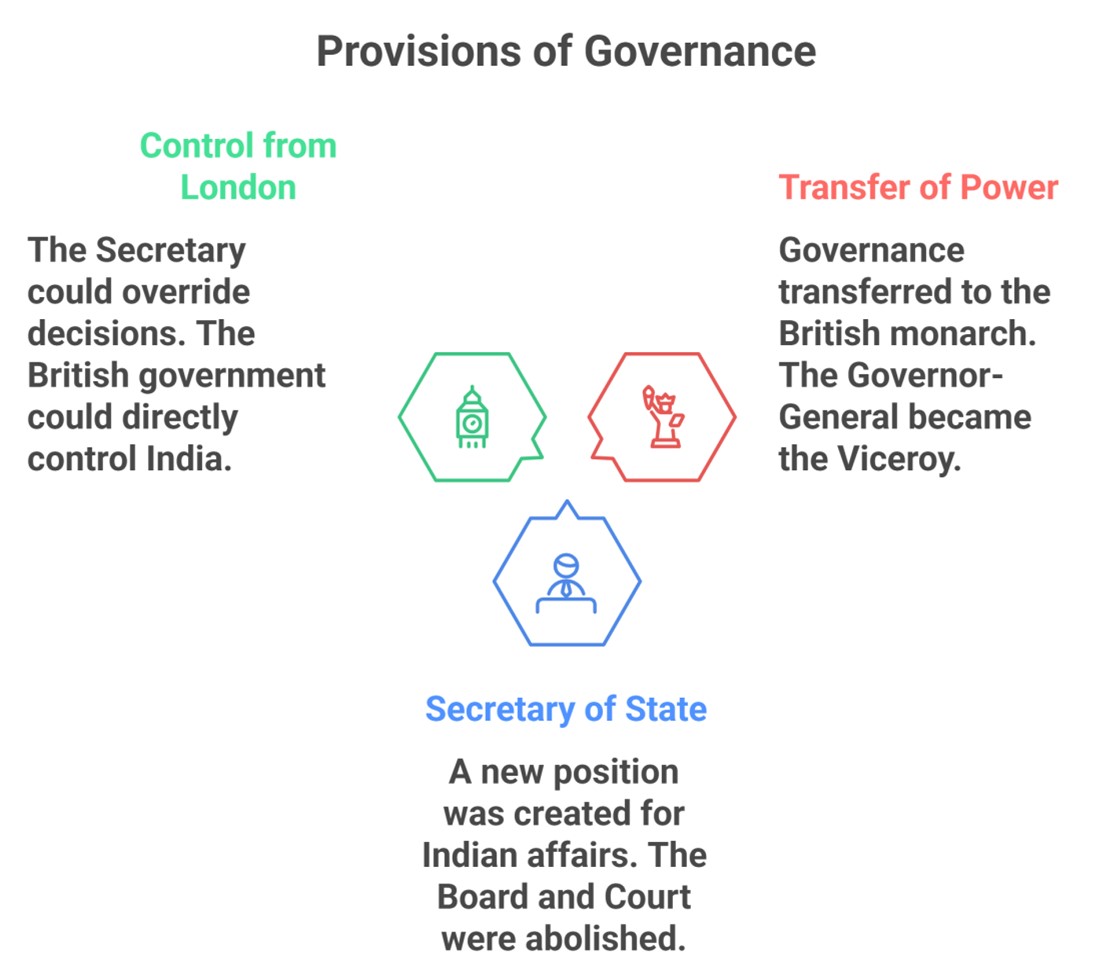
Transfer of Power to the Crown:
➤ The authority to govern India was transferred from the East India Company to the British monarch.
➤ The Governor-General of India was now also designated as the Viceroy, a representative of the British Crown.
➤ All the Company’s armed forces were brought under the control of the Crown.
Establishment of the Secretary of State for India:
➤ A new position—Secretary of State for India—was created. He was a member of the British Cabinet and held complete authority over Indian affairs.
➤ The Board of Control and Court of Directors of the Company were abolished.
➤ The Secretary of State was assisted by a 15-member Council of India, nine of whom had to have lived in India for at least ten years.
Control from London:
➤ The Secretary of State could override decisions of the Indian Council, particularly on urgent or secret matters.
➤ By 1870, with advancements like the opening of the Suez Canal (1869) and telegraph communication, the British government could directly control and intervene in Indian administration from London in real-time.
➤ Lord Stanley became the first Secretary of State for India.
Queen Victoria’s Proclamation – November 1, 1858
Announced in a grand durbar at Allahabad by Lord Canning, the proclamation declared Queen Victoria as the sovereign ruler of India and marked the beginning of direct Crown rule. It is often referred to as the “Magna Carta of the Indian people”.
Key Declarations of the Proclamation:
No More Annexations:
➤ The British government would no longer pursue a policy of annexation or interfere in the internal affairs of princely states.
Recognition of Indian Princes:
➤ The rights and dignity of native rulers were guaranteed, and they were allowed to adopt heirs.
Religious Tolerance:
➤ The Crown promised non-interference in religious beliefs, securing freedom of worship for all communities.
Equality Before Law:
➤ It pledged equal treatment for Indians and Europeans under British law.
Civil Services Open to All:
➤ In principle, Indians were declared eligible for government jobs based on merit and qualifications, although in practice, racial discrimination continued.
General Amnesty:
➤ Rebels who surrendered before January 1, 1859, were granted amnesty, excluding those directly involved in British killings.

Significance of the Act and the Proclamation
- Ended the era of Company rule and began a new chapter of British imperialism under Crown control.
- Established a centralised and tightly supervised colonial bureaucracy, controlled from London.
- Marked a shift in British attitude, from conquest and expansion to consolidation and exploitation.
- Set the stage for future nationalist movements by awakening political consciousness among Indians.
Indian Councils Act of 1861
In an attempt to rectify the complete exclusion of Indians from the legislative process and to enhance administrative participation, the Indian Councils Act of 1861 was introduced.
Key Features:
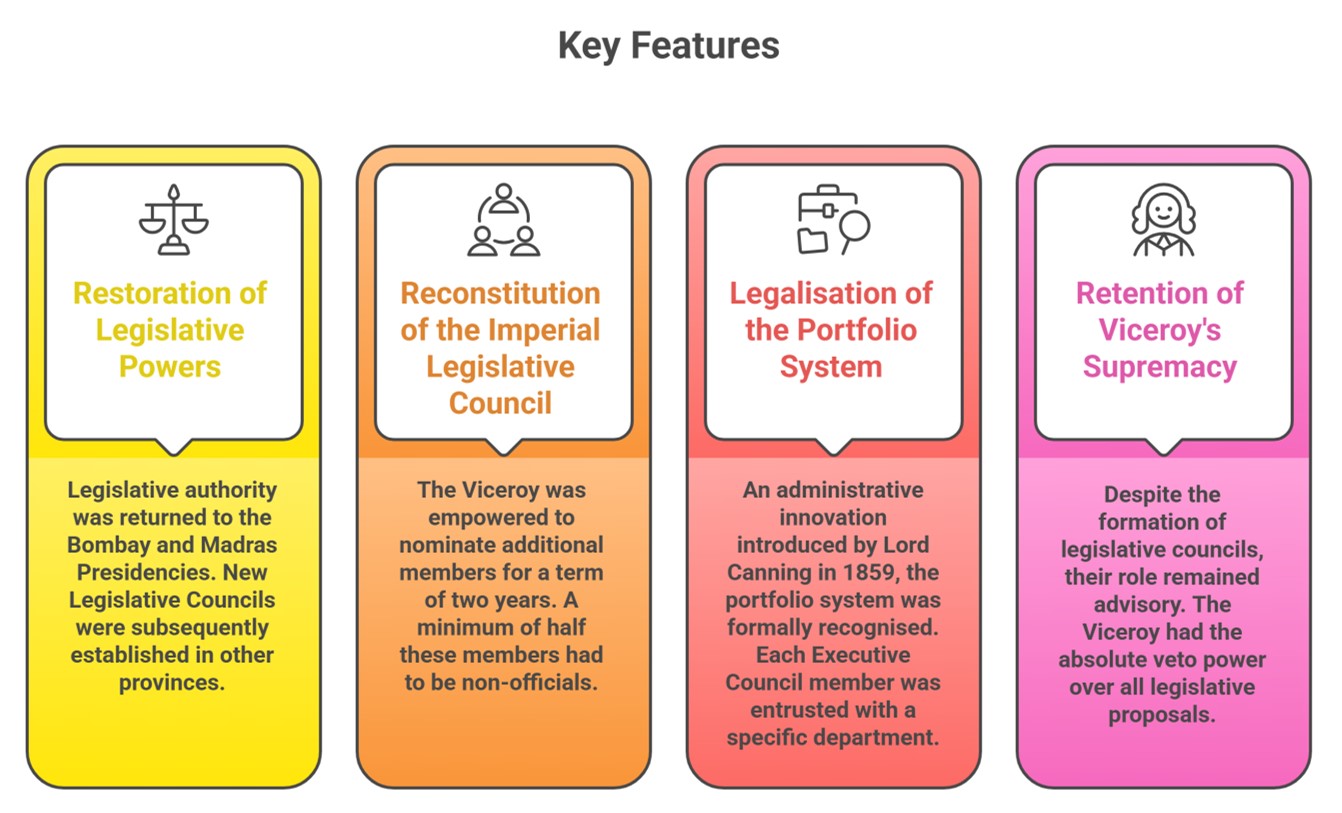
Restoration of Legislative Powers to Provinces:
- Legislative authority was returned to the Bombay and Madras Presidencies.
- New Legislative Councils were subsequently established in other provinces: Bengal (1862), North-Western Provinces (1886), and Punjab (1897).
Reconstitution of the Imperial Legislative Council:
- The Viceroy was empowered to nominate between 6 and 12 additional members for a term of two years.
- A minimum of half these members had to be non-officials, and some of them were Indians, albeit from elite backgrounds.
Legalisation of the Portfolio System:
- An administrative innovation introduced by Lord Canning in 1859, the portfolio system was formally recognised.
- Each Executive Council member was entrusted with a specific department, enhancing administrative efficiency.
Retention of Viceroy’s Supremacy:
- Despite the formation of legislative councils, their role remained advisory.
- The Viceroy had the absolute veto power over all legislative proposals, ensuring no real check on executive authority.
Limitations of the 1861 Act:
- The Legislative Council lacked real authority, functioning largely as a rubber-stamp body without control over finances or the executive.
- Indian representation was nominated, not elected, and usually included princes, landlords, or zamindars, offering no voice to the common populace.
- Indian members had no power to question, debate, or introduce legislation, making their presence largely symbolic.
Indian Councils Act of 1892
With the rise of nationalist sentiments and the growing influence of the Indian National Congress (established in 1885), modest reforms were introduced through the Indian Councils Act of 1892.
Major Provisions:
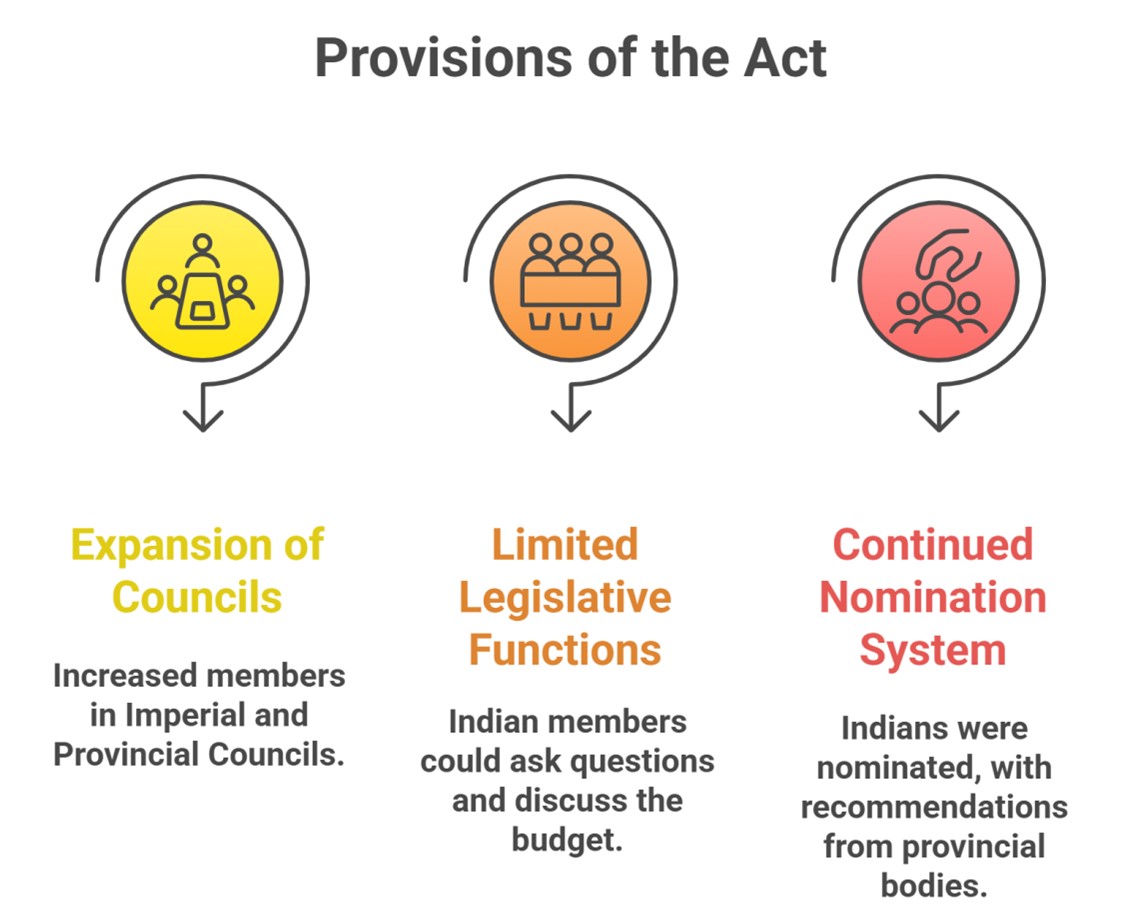
Expansion of Legislative Councils:
- The number of additional members in the Imperial and Provincial Legislative Councils was increased.
Introduction of Limited Legislative Functions:
- Indian members were given the right to ask questions on matters of public interest (though subject to constraints).
- Discussion of the annual budget was permitted, but without voting rights or power to amend proposals.
Continued Nomination System:
- Indians continued to be nominated rather than elected, although the process involved recommendations from provincial bodies, giving a semblance of representation.
Despite these measures, the Act fell short of real empowerment, and Indian voices remained peripheral in the decision-making process.
Indian Councils Act of 1909 (Morley–Minto Reforms)
Responding to growing political unrest and demands for greater Indian participation, the Indian Councils Act of 1909, commonly referred to as the Morley–Minto Reforms, was enacted. It marked the first attempt to introduce representative elements into Indian governance.
Salient Features:
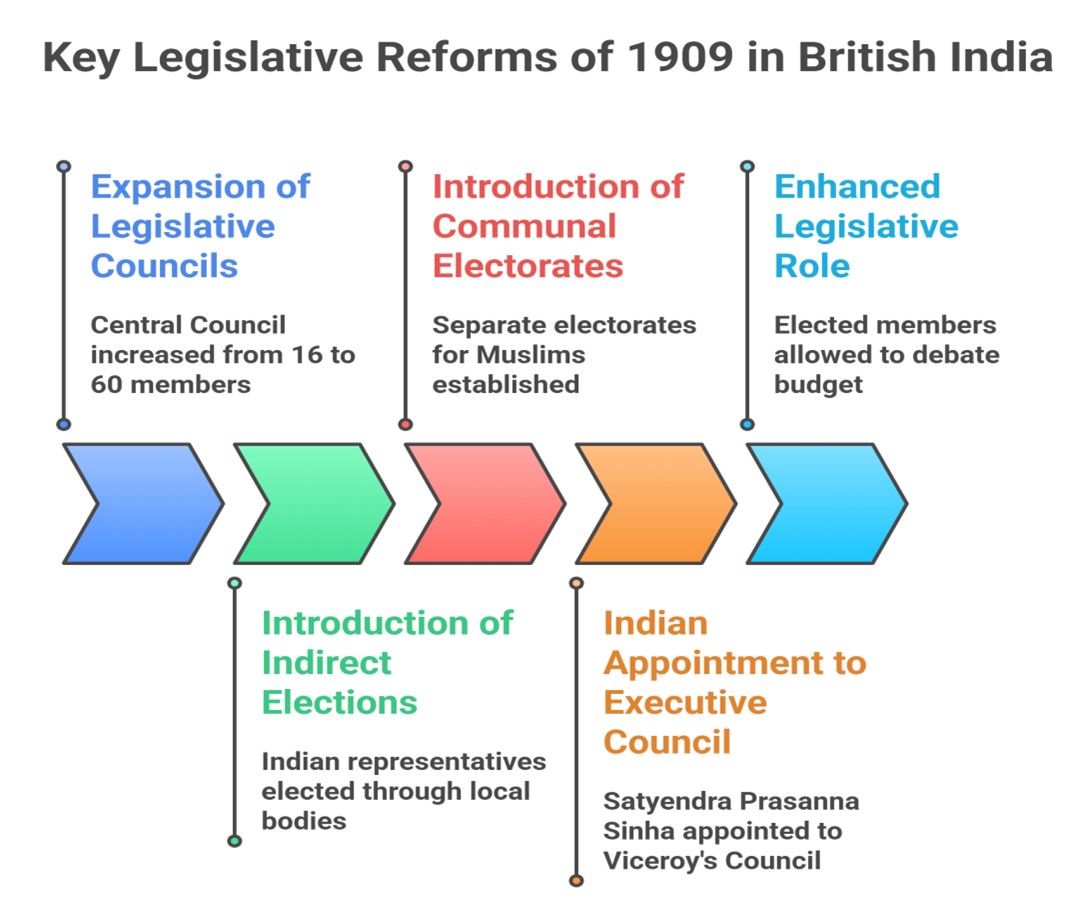
Expansion and Reformation of Legislative Councils:
- The Central Legislative Council was expanded from 16 to 60 members.
- Provincial Councils were similarly enlarged.
Introduction of Indirect Elections:
- For the first time, Indian representatives were indirectly elected through local bodies and organizations.
- Though not based on universal suffrage, this was a significant departure from previous purely nominated systems.
Introduction of Communal Electorates:
- The Act introduced separate electorates for Muslims, allowing them to elect their own representatives to the councils.
- This move institutionalised communal representation, setting a dangerous precedent that later contributed to the division of Indian society along religious lines.
Indian Appointment to Executive Council:
- For the first time, an Indian was appointed to the Viceroy’s Executive Council.
- Satyendra Prasanna Sinha became the first Indian member in 1909, holding the portfolio of Law.
Enhanced Legislative Role:
- Elected members were allowed to ask supplementary questions, move resolutions, and debate portions of the budget.
- However, their influence remained limited by the official majority retained by the British.
Significance and Criticism of the 1909 Act
Positive Outcomes:
- For the first time, Indians gained limited access to governance at both central and provincial levels.
- The introduction of electoral principles, though restricted, set a precedent for future constitutional developments.
Criticisms:
- Retained official dominance in all councils, effectively neutralizing the influence of Indian members.
- The policy of communal electorates laid the foundation for religious divisions in Indian politics, undermining the national unity envisioned by the freedom movement.
- The Act failed to meet the aspirations of moderate and extremist nationalists alike, as genuine political power remained elusive.
The period following the Government of India Act of 1858 marked the gradual evolution of British Indian administration, with the Crown assuming direct control. Through successive reforms—from the Indian Councils Act of 1861 to the 1909 Morley-Minto Reforms—the British attempted to appease growing Indian political consciousness without relinquishing real authority. These reforms, though limited in scope, laid the early foundation of representative governance in India, while simultaneously entrenching colonial control and communal divisions.
Government of India Act, 1919 (Montagu–Chelmsford Reforms)
The Government of India Act of 1919 represented a pivotal moment in India’s constitutional history. Enacted as a direct outcome of the Montagu Declaration of 1917, the Act aimed at initiating the “gradual development of self-governing institutions” in India. This marked the first official acknowledgment by the British that Indians should be progressively granted more control over their governance—although the actual power transferred was minimal.
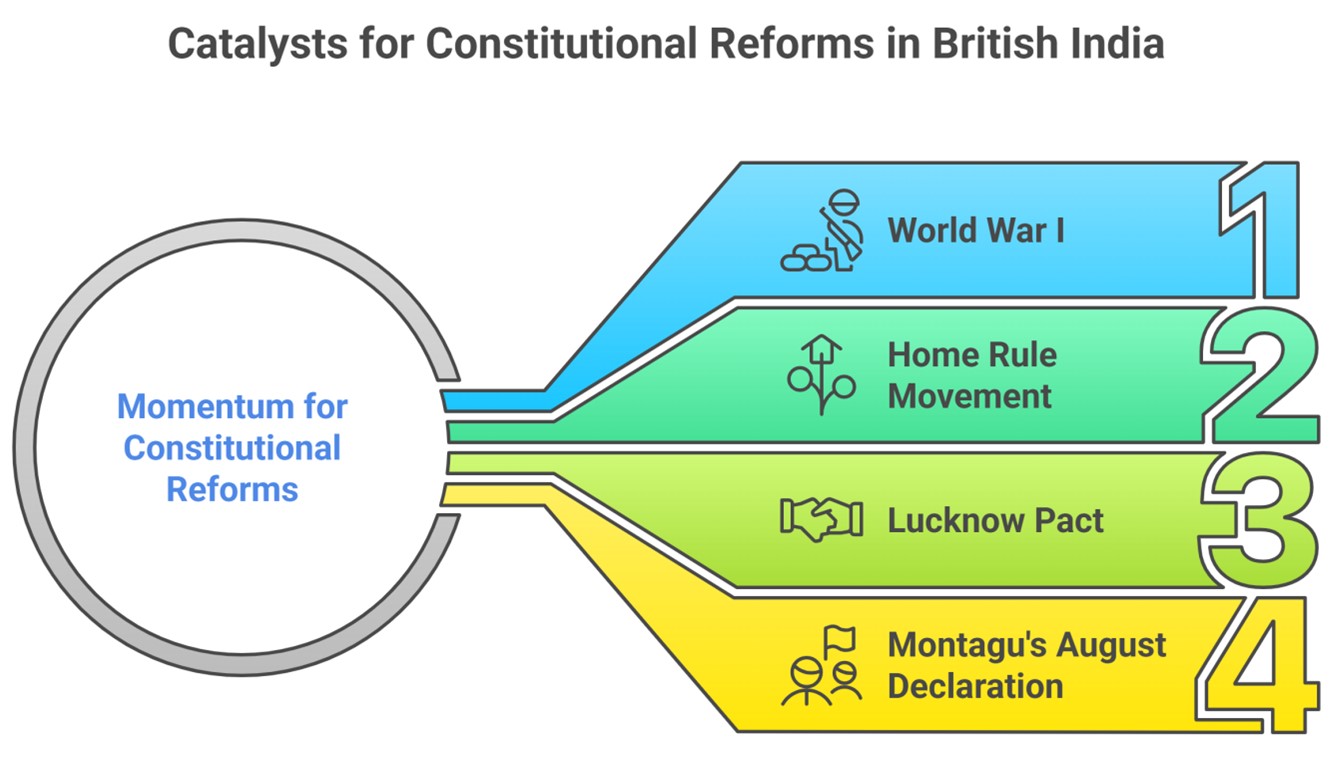
Several significant developments in the early 20th century created momentum for constitutional reforms in British India:
- World War I: India’s substantial contribution to the British war effort—both in manpower and resources—generated widespread expectations of political concessions in return. Over 1 million Indian soldiers served overseas, reinforcing the demand for a share in governance.
- Home Rule Movement: Spearheaded by Annie Besant and Bal Gangadhar Tilak, this movement raised a powerful demand for self-government within the British Empire, similar to dominion status enjoyed by countries like Canada or Australia.
- Congress–League Lucknow Pact (1916): This historic alliance between the Indian National Congress and the All-India Muslim League created a unified demand for constitutional reforms and greater Indian representation.
- Montagu’s August Declaration (1917): Announced in the British Parliament by Edwin Montagu, the Secretary of State for India, it promised the progressive realisation of responsible government in India, laying the foundation for the 1919 reforms.
Key Features of the Government of India Act, 1919
Introduction of Diarchy at the Provincial Level
The most notable administrative experiment introduced by the Act was diarchy, or dual government, in the provinces:
Provincial subjects were classified into two broad categories:
1. Reserved Subjects – Managed by the Governor and his Executive Council. These included key areas such as law and order, finance, police, and irrigation.
2. Transferred Subjects – Administered by Indian ministers who were responsible to the legislative councils. These included subjects like education, public health, agriculture, and local self-government.
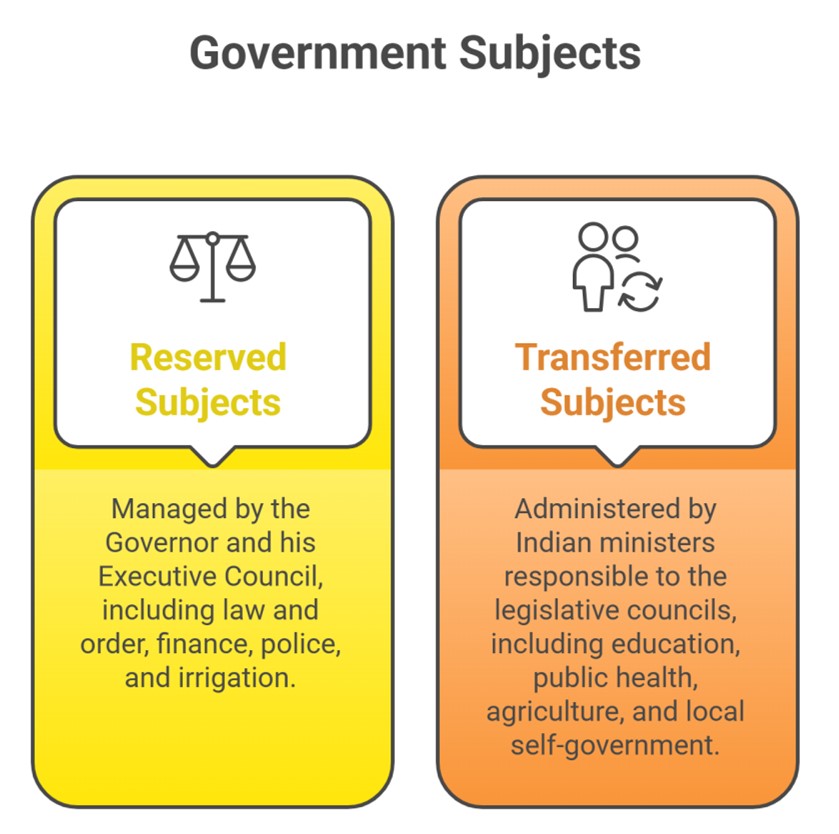
Although this division aimed to involve Indians in governance, transferred subjects were financially dependent on the reserved subjects, significantly limiting ministerial autonomy.
Establishment of a Bicameral Central Legislature
For the first time in Indian history, the central legislature became bicameral:
- Council of State: The Upper House, comprising a mix of nominated and indirectly elected members.
- Legislative Assembly: The Lower House, with a larger number of members and greater public representation.
While some members were elected, the executive remained wholly responsible to the British Parliament—not to the Indian legislature. This effectively preserved British supremacy in decision-making.
Extension of Communal Representation
The Act widened the scope of separate electorates, originally introduced for Muslims under the 1909 reforms:
- Separate electorates were now granted to Sikhs, Indian Christians, Anglo-Indians, and Europeans.
- This reinforced communal divisions in the political system and entrenched the British policy of “divide and rule”, creating long-term implications for national unity.
Indian Representation in the Executive
For the first time, three Indians were included in the Governor-General’s Executive Council, handling portfolios such as:
- Education
- Health
- Labour
- Law
However, these Indian members remained subordinate to the Governor-General, who exercised overriding authority and could overrule their decisions at will.
Powers of the Governor-General
Despite the reforms, the Governor-General retained absolute and overriding powers, which included:
- Vetoing any bill passed by the legislature.
- Overruling decisions made by Indian ministers, even on transferred subjects.
- Exercising complete control over critical departments like Defence, External Affairs, and Ecclesiastical matters.
Thus, the real authority remained concentrated in British hands, with the reforms offering limited practical power to Indians.
Limitations and Shortcomings of the 1919 Act
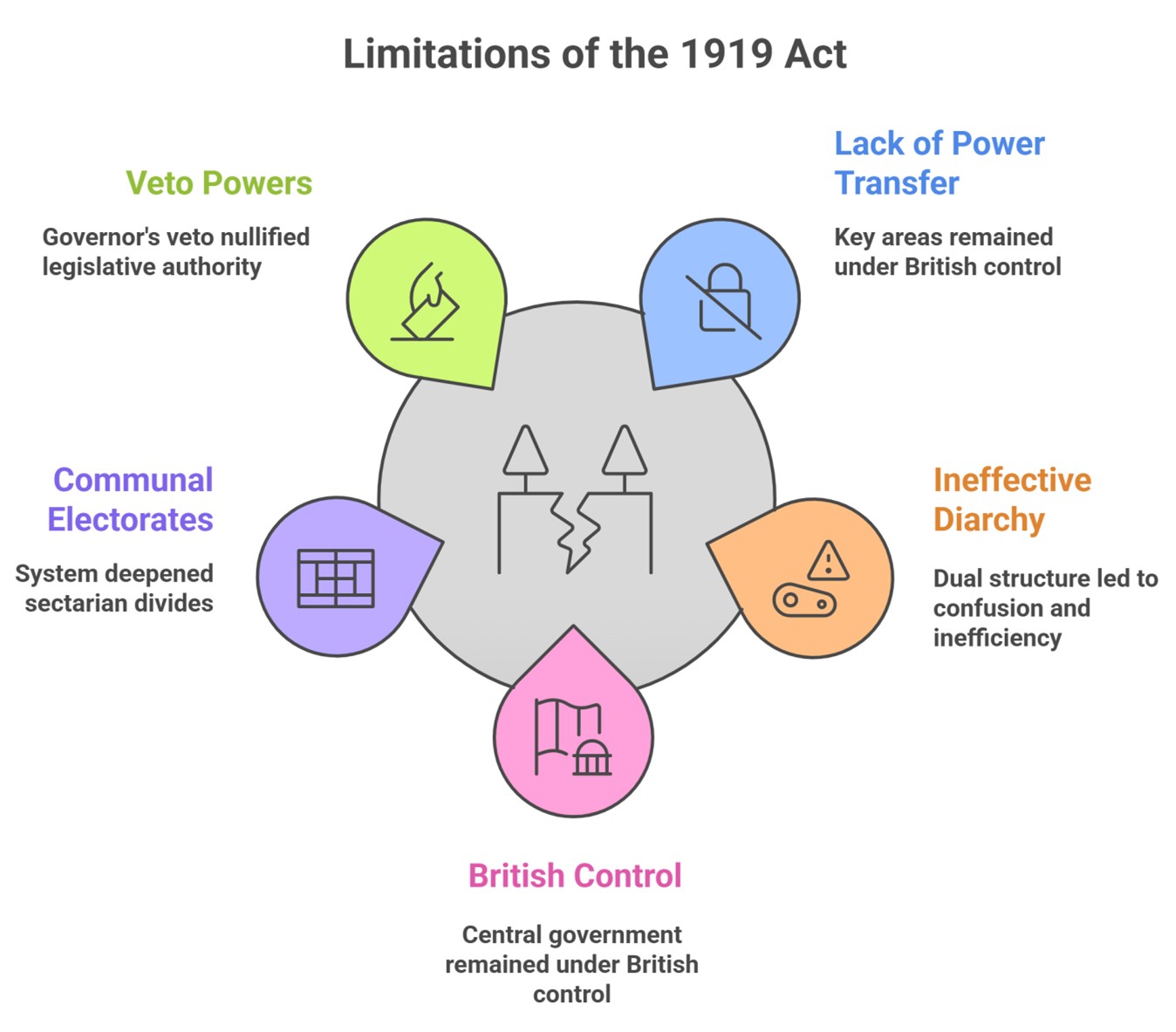
While it was portrayed as a step toward self-governance, the Act suffered from several structural and functional limitations:
- There was no genuine transfer of power; key areas such as finance, law and order, and foreign affairs were kept out of Indian reach.
- Diarchy proved ineffective—the dual structure led to confusion, inefficiency, and a lack of accountability.
- The central government remained under complete British control, with Indian legislators having no say in executive matters.
- The communal electorate system deepened sectarian divides, undermining national unity.
- The Governor and Governor-General’s veto powers nullified any real legislative authority Indians could exercise.
Positive Outcomes and Significance
Despite its flaws, the 1919 Act did lay the constitutional groundwork for future reforms and had some notable achievements:
- Introduced elected representatives into both provincial and central legislatures, enabling limited Indian participation in governance.
- Created a parliamentary environment, familiarising Indian leaders with legislative debates, question hours, and administrative processes.
- Acted as the first formal step toward a federal structure in India, later expanded under the Government of India Act, 1935.
- For the first time, some women were granted voting rights in select provinces, though in a restricted manner.
Indian National Congress Reaction and Political Impact
The Indian National Congress (INC) strongly rejected the 1919 reforms, branding them inadequate and deceptive.
- Under Mahatma Gandhi’s leadership, the INC launched a boycott of the 1920 elections held under the new Act, as part of the Non-Cooperation Movement.
- However, moderate leaders such as Annie Besant, Surendranath Banerjee, and Tej Bahadur Sapru supported the reforms. They broke away from the Congress and formed the Indian Liberal Federation, advocating constitutional methods and gradual reform.
Provincial Administration under British Rule
Structure of Provinces
British India was divided into two types of provinces:
1. Presidencies – The more autonomous regions such as Bombay, Madras, and Bengal, administered by Governors and Executive Councils.
2. Other Provinces – Governed by Lieutenant Governors or Chief Commissioners, these remained directly accountable to the Governor-General of India.
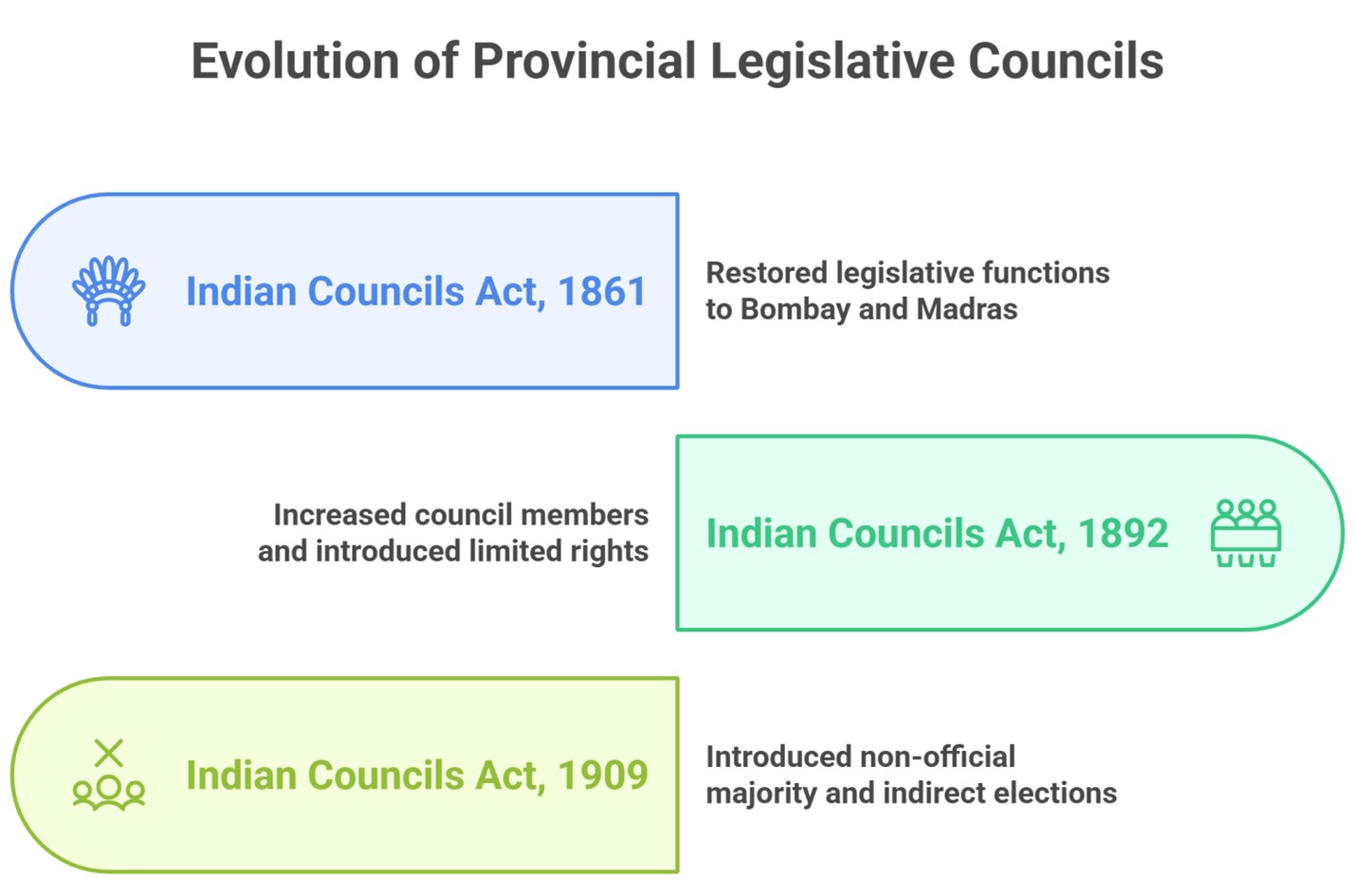
Evolution of Provincial Legislative Councils
Indian Councils Act, 1861:
- Restored legislative functions to Bombay and Madras.
- Enabled creation of legislative councils in other provinces.
Indian Councils Act, 1892:
- Increased the number of members in provincial councils.
- Introduced limited rights to ask questions and discuss the budget (though without voting rights).
Indian Councils Act, 1909:
- Introduced non-official majority in provincial legislative councils.
- Permitted indirect elections, bringing some level of representation to Indian leaders.
Diarchy in Provinces under the 1919 Act
- The system of diarchy was implemented only at the provincial level.
- Ministers chosen from the elected members were entrusted with transferred subjects.
- Reserved subjects such as revenue, law and order, and finance remained under the direct control of British-appointed officials.
Challenges and Failures of Provincial Diarchy
The system was marred by internal contradictions:
- Transferred departments lacked financial independence, being dependent on budgets controlled by the reserved departments.
- Governors retained overriding powers, often overruling Indian ministers.
- A bureaucratic elite, largely unaccountable, continued to dominate the administrative machinery.
As a result, diarchy failed to create an efficient or truly representative system at the provincial level.
Significance and Legacy
While the Government of India Act, 1919 fell short of nationalist expectations, it holds great historical importance:
- It was the first attempt to introduce ministerial responsibility, even if limited to transferred subjects.
- It exposed the inherent contradictions of British reform policies, fuelling further political mobilisation.
- It prepared Indian leaders for administrative responsibilities and laid the foundation for future developments under the Government of India Act of 1935 and ultimately, the Constitution of independent India.
Government of India Act, 1935:
The Government of India Act of 1935 stands as the most comprehensive and far-reaching constitutional reform introduced by the British in colonial India. Encompassing 321 sections and 10 schedules, it was the longest and most detailed piece of legislation ever enacted by the British Parliament for the governance of India. This Act laid the foundation of the federal structure and many administrative principles that would later be adopted in the Constitution of independent India (1950).
Background and Context
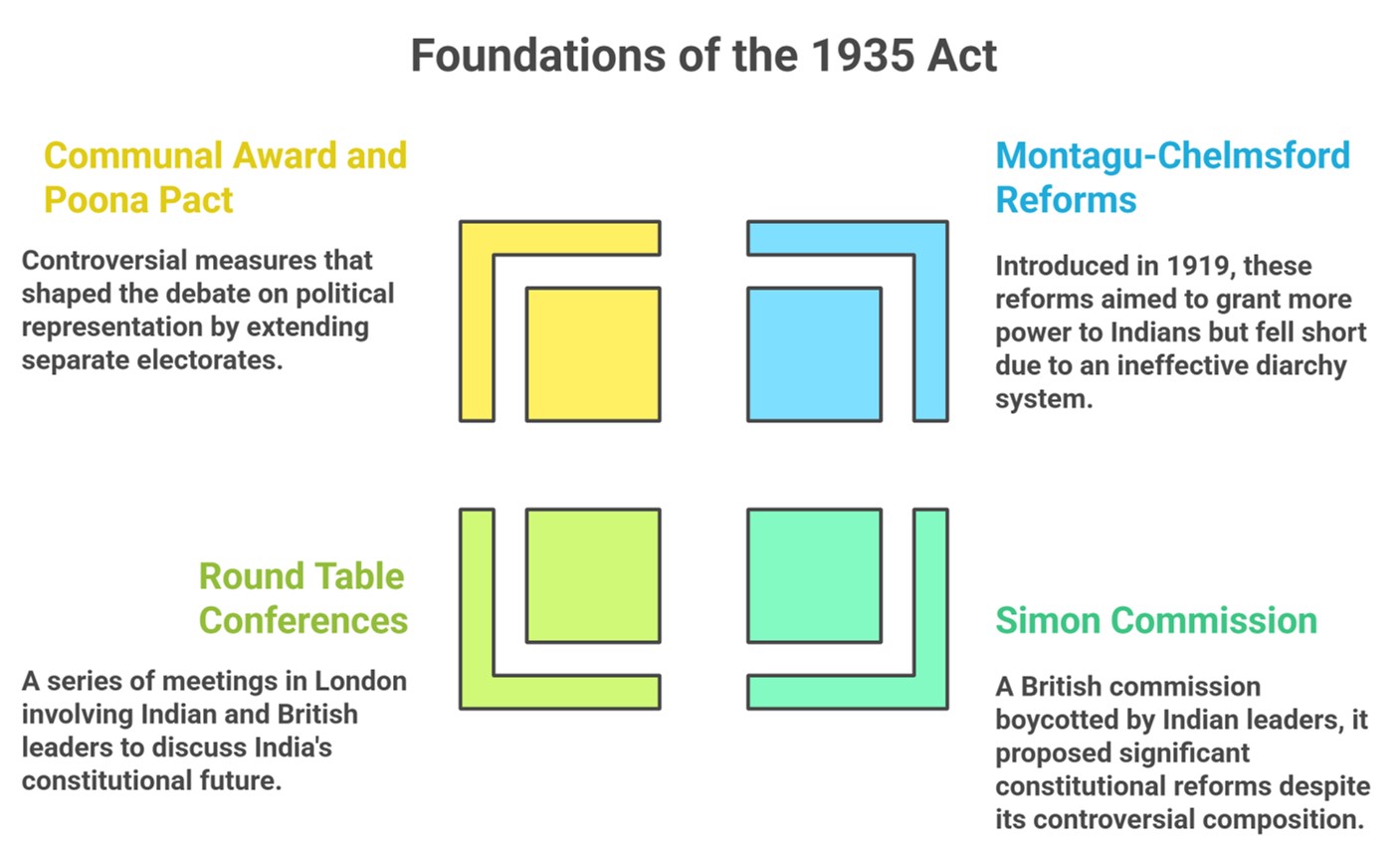
The emergence of the 1935 Act was the culmination of a series of political events, movements, and failed reforms:
- The Montagu–Chelmsford Reforms of 1919, introduced under the Government of India Act, 1919, had failed to deliver substantive power to Indians, particularly due to the ineffective diarchy system at the provincial level.
- The Simon Commission (1927), although boycotted by Indian leaders for its all-British composition, reviewed the functioning of the 1919 Act and proposed sweeping constitutional reforms.
- A series of Round Table Conferences (1930–1932) were convened in London, involving Indian political leaders, British officials, and representatives of princely states, to discuss India’s constitutional future.
- The controversial Communal Award (1932), which extended separate electorates to various communities, and the subsequent Poona Pact between Gandhi and Ambedkar, shaped the evolving debate on political representation.
- All these developments culminated in the formulation of the Government of India Act, 1935, which was the final major constitutional measure enacted before Indian independence.
Salient Features of the Government of India Act, 1935
Abolition of Diarchy in Provinces and Introduction of Provincial Autonomy
- The Act completely abolished the dual system (diarchy) in the provinces, which had proven unworkable under the 1919 Act.
- All administrative subjects were now placed under Indian ministers, who were made responsible to elected provincial legislatures.
- For the first time, provincial governments enjoyed autonomy in internal matters, albeit with certain limitations.
- However, the Governor retained special powers:
- He could veto legislation.
- Had control over key departments such as police and revenue in emergencies.
- Could dismiss ministries and reassert British authority when deemed necessary.
This marked the beginning of responsible government at the provincial level, although subject to the overriding powers of the Governor.
Proposal to Establish an All-India Federation (Never Implemented)
- The Act proposed the creation of an All-India Federation comprising:
- British Indian provinces, and
- Princely states (who could voluntarily join the federation).
- Each princely state was to nominate representatives to the federal legislature, unlike provinces which had elected representatives.
- However, since the princely states refused to join, the federation never came into existence.
- The Act proposed the creation of an All-India Federation comprising:
Division of Powers Using Three Legislative Lists
The Act introduced a structured division of legislative powers between the Centre and the Provinces through three separate lists:
- Federal List – Contained 59 subjects including defence, foreign affairs, currency, and communications.
- Provincial List – Included 54 subjects such as public health, police, education, and local government.
- Concurrent List – Consisted of 36 subjects, including criminal law, marriage, and succession, where both the Centre and Provinces could legislate.
- Residuary powers were vested in the Governor-General, further reinforcing British control.
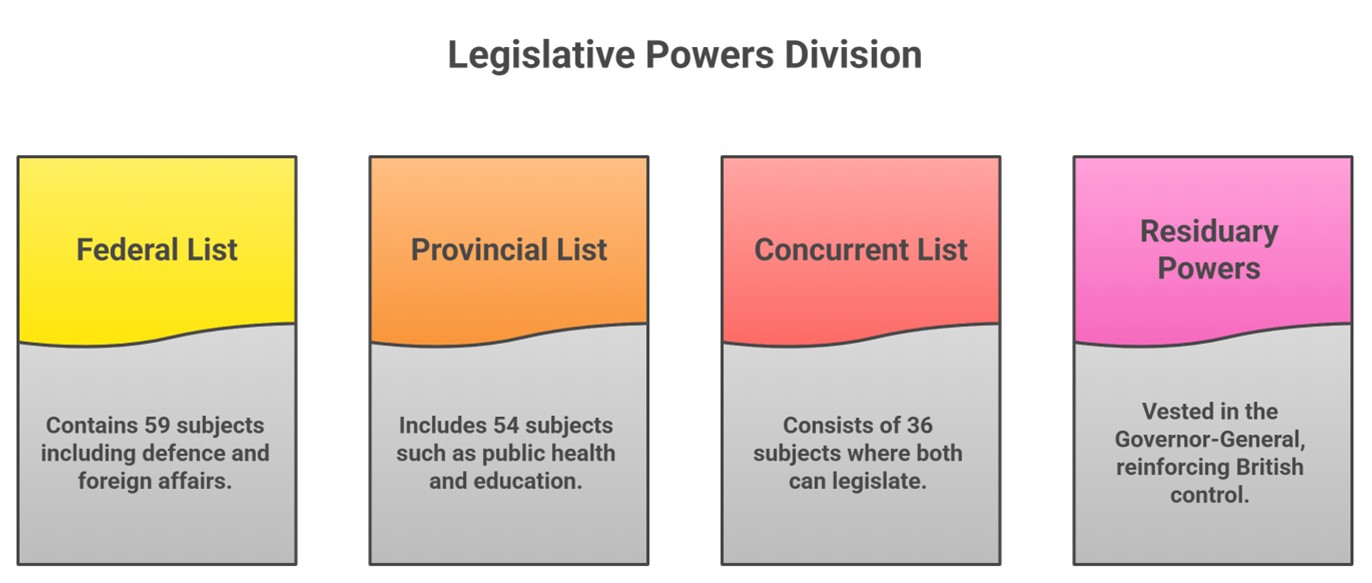
This three-tier distribution of powers inspired the structure of legislative powers later enshrined in the Indian Constitution.
Introduction of Dyarchy at the Centre (Never Implemented)
- Ironically, while diarchy was abolished in the provinces, it was introduced at the central level under this Act.
- Reserved Subjects (e.g., defence, foreign affairs) remained under the exclusive control of the Governor-General and his Executive Council.
- Transferred Subjects were to be handled by Indian ministers responsible to the federal legislature.
- However, since the federation was never established, this central-level diarchy was never implemented.
Creation of a Bicameral Federal Legislature
The Act provided for a bicameral legislature at the federal level:
- Council of State (Upper House) – Comprised of partly elected and partly nominated members.
- Federal Assembly (Lower House) – Members were indirectly elected by provincial legislatures and nominated by princely rulers.
- Despite the presence of elected bodies, the Governor-General retained overriding legislative powers, including:
- The power to veto bills.
- Authority to issue ordinances.
- The ability to certify bills as essential to British interests, thereby bypassing legislative procedures.
Indian Participation in the Executive
- The Act continued the earlier policy of including Indians in the Viceroy’s Executive Council.
- Three Indian members were appointed, but their roles remained ceremonial, and they functioned under the direct control of the Viceroy.
Establishment of the Reserve Bank of India (RBI)
- One of the significant financial provisions of the Act was the creation of the Reserve Bank of India to manage currency, credit, and monetary policy.
- The RBI came into existence on April 1, 1935, and functioned as the central bank of British India until it was nationalised after independence.
Creation of a Federal Court
- The Act provided for the establishment of a Federal Court to:
- Resolve disputes between provinces and the central government.
- Interpret constitutional provisions.
- The Federal Court was set up in 1937, with jurisdiction over constitutional, civil, and appellate matters. It eventually evolved into the Supreme Court of India after independence.
- The Act provided for the establishment of a Federal Court to:
Limitations and Criticisms of the Act
- Despite being the most extensive piece of constitutional legislation for India under British rule, the Act had several glaring weaknesses:
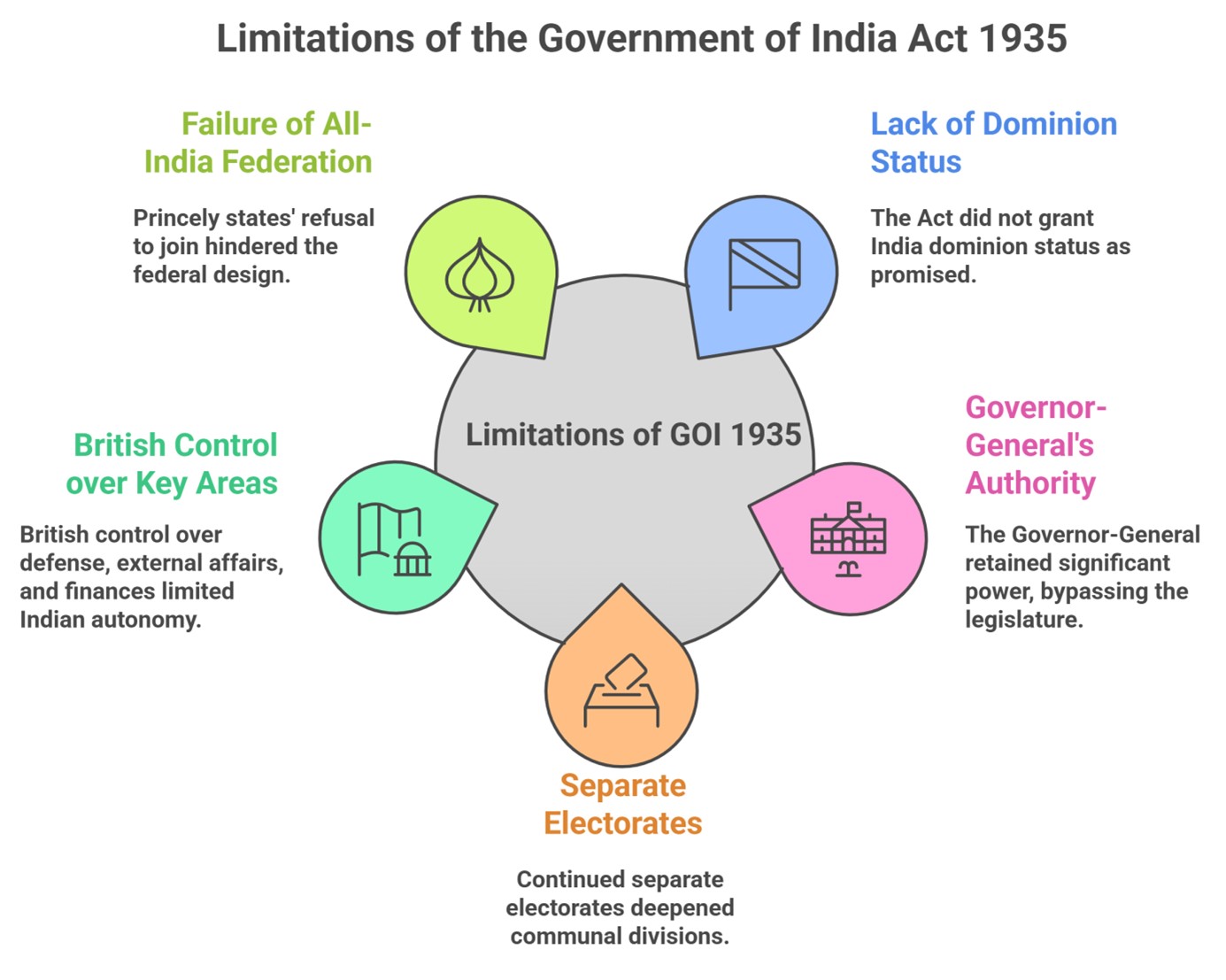
- There was no mention of “Dominion Status”, despite earlier British assurances in the Simon Commission Report and other declarations.
- The Governor-General retained overriding authority, and could bypass the legislature in both central and provincial affairs.
- The continuation of separate electorates deepened communal divisions, especially among Hindus, Muslims, Sikhs, Christians, and Anglo-Indians.
- Indian ministers had no control over defence, external affairs, or finances, which remained under exclusive British control.
- The British Parliament and Secretary of State retained ultimate control over Indian affairs, denying Indians full sovereignty.
- The All-India Federation failed to materialise as the princely states chose not to join, rendering the federal design incomplete.
Provincial Autonomy and the 1937 Elections
- Provincial autonomy, one of the core provisions of the Act, was implemented in 1937.
- Elections were held across British Indian provinces, and the Indian National Congress formed ministries in 7 out of 11 provinces.
- However, in 1939, these ministries resigned en masse to protest against the British decision to involve India in World War II without consulting Indian leaders.
This resignation marked a turning point, leading to the launch of more assertive phases of the freedom movement, including the Quit India Movement (1942).
Positive Contributions and Legacy
- Despite its colonial underpinnings, the Government of India Act, 1935 made several notable contributions:
- It provided a structured federal framework, which was later incorporated into independent India’s Constitution.
- Introduced autonomous provincial governance, allowing Indian ministers to administer departments under legislative control.
- Gave Indian leaders practical experience in administration, preparing them for future governance.
- The Act influenced key aspects of the Indian Constitution, including federalism, division of powers, and the bicameral legislature.
Final Evaluation
The Government of India Act, 1935 was the last major constitutional measure enacted by the British before India’s independence. Although criticised for retaining colonial control, it significantly reshaped Indian governance by introducing the concept of provincial autonomy, federal structure, and legislative responsibility. Many of its administrative and structural principles were adopted into the Constitution of India in 1950, making the 1935 Act a precursor to modern democratic governance in India.
Evolution of Local Self-Government in British India
The development of local self-government in colonial India was a slow and cautious process, primarily guided by British administrative expediency rather than genuine democratic intent. Although framed as steps toward decentralised governance, the reforms were often superficial, aimed more at easing the financial and administrative burden on the colonial state than empowering the Indian population. Nevertheless, over time, these local bodies evolved into important platforms for Indian political education and public administration, laying the foundation for grassroots democracy in post-independence India.
Early Initiatives and Colonial Motivations
In the early phases of British rule, local self-governing institutions were established with very limited authority. Their primary function was to support revenue collection and maintain basic civic amenities, such as sanitation, water supply, and street lighting. These local bodies were largely administrative in nature and offered little scope for public involvement.
- The first municipal corporation in India was established in Madras in 1688, followed by the creation of similar institutions in Bombay and Calcutta in 1726.
- As the British administration expanded and the cost of governance increased, colonial authorities began viewing local self-government as a practical means to shift financial responsibilities and routine governance to Indians, thereby reducing the burden on the imperial treasury.
Lord Mayo’s Resolution (1870):
The first significant formal initiative toward decentralisation came in the form of Lord Mayo’s Resolution of 1870, which laid the groundwork for financial and administrative decentralisation:
- It recognised the need for encouraging local financial responsibility, especially in the wake of rising administrative costs.
- The Resolution advocated for local self-government as a means to improve services such as education, policing, public health, roads, and sanitation.
- Provincial governments were directed to form municipal committees and district boards, although these bodies primarily comprised nominated members and remained under the tight supervision of British officials.
- While Mayo’s initiative was more fiscal in nature than democratic, it marked the beginning of institutional decentralisation in colonial India.
Lord Ripon’s Resolution (1882): The True Foundation of Local Self-Government
Often hailed as the “Magna Carta of Local Self-Government in India”, the Resolution of 1882 by Lord Ripon significantly advanced the cause of public participation in local governance:
Key Provisions of the 1882 Resolution:
- Majority of members in local bodies were to be non-officials, indicating a shift toward public representation.
- Among these non-officials, a provision was made for the election of members, thereby introducing an element of democracy into local institutions.
- Chairpersons of municipal bodies were to be chosen from among elected non-officials, rather than being nominated or appointed by the government.
- Though the scope of these reforms was modest, they marked a turning point in the evolution of Indian local self-governance.
Due to these progressive measures, Lord Ripon is often celebrated as the “Father of Local Self-Government in India”.
Limitations despite Reforms
Despite Ripon’s visionary reforms, the practical implementation of local self-government remained severely restricted:
- In many regions, the number of elected representatives remained in the minority, thereby undermining their decision-making authority.
- The franchise was highly restricted, with voting rights limited to landowners, merchants, and taxpayers, effectively excluding the vast majority of the Indian population.
- The real executive authority remained with the District Magistrate or British officials, who could override the decisions of local bodies.
- These institutions often functioned more like administrative extensions of the colonial government, rather than autonomous or democratic bodies.
Local Self-Government under the Government of India Acts
Government of India Act, 1919 (Montagu–Chelmsford Reforms)
- The Act classified Local Self-Government as a “Transferred Subject”, which meant that Indian ministers in the provinces were made responsible for its administration.
- However, the real impact was limited, as finance continued to be a “Reserved Subject”, thereby crippling local governance due to a lack of adequate funds.
- This financial dependence rendered local bodies largely ineffective and dependent on British administrators for support.
Government of India Act, 1935
This Act brought more significant reforms to local governance than any previous legislation:
- For the first time, the finance portfolio was placed under popularly elected ministries, which ensured better funding and support for local self-governing bodies.
- Provinces were empowered to pass their own Municipal Acts, granting greater administrative autonomy to municipal and district boards.
- The Act encouraged greater Indian participation in the functioning of local institutions and provided legislative backing for democratic decentralisation.
- Although the control of Governors over provincial matters still existed, local bodies gained considerable operational space to manage civic administration.
Significance and Legacy of Colonial Local Self-Government
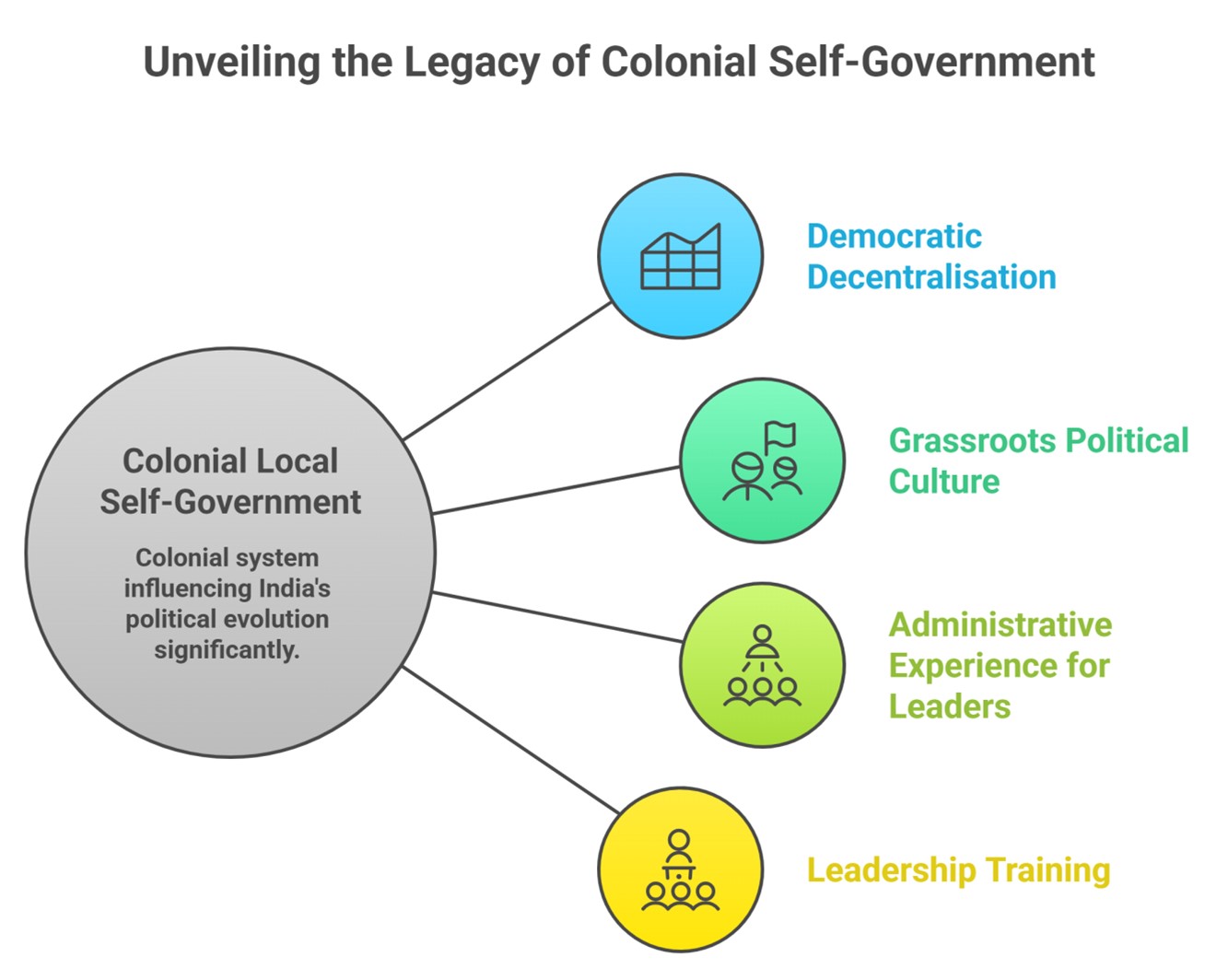
Despite its limited democratic character and colonial underpinnings, the local self-government system in British India produced a number of long-lasting effects that influenced India’s political evolution:
- It laid the groundwork for the concept of democratic decentralisation, which was later adopted and institutionalised in post-independence India.
- It nurtured a grassroots political culture, enabling ordinary citizens to engage with administrative systems and understand governance mechanisms.
- It provided a platform for Indian political leaders to gain administrative experience, many of whom later played significant roles in India’s national freedom movement and post-independence governance.
- These institutions became training grounds for leadership, political negotiation, and public accountability, elements vital to any functioning democracy.
While the British introduction of local self-government in India was largely motivated by economic and administrative self-interest, it unintentionally set the stage for political awakening and democratic engagement among Indians. Despite tight colonial controls, these local bodies sowed the seeds for decentralised governance, which would eventually evolve into India’s Panchayati Raj institutions and urban municipal systems after independence.
Today, the legacy of colonial local self-governance can be seen in the vibrant and diverse local government institutions across India, which continues to act as pillars of democratic participation and local accountability.
Administrative Organisation in British India After 1858
The year 1858 marked a watershed moment in the history of British India, as the Government of India Act of 1858 ended the rule of the East India Company and transferred power directly to the British Crown. Following this transfer, a series of critical changes were introduced in the administrative apparatus, including the Indian Civil Service, army, and police, to ensure tight British control and to prevent future uprisings like the Revolt of 1857. Although the British claimed to be preparing Indians for self-governance, in practice, they restructured the administration to systematically exclude Indians from real authority.
The Civil Service: Instrument of Colonial Control
Establishment of Crown Rule
- With the passage of the Government of India Act, 1858, India came directly under British Crown rule.
- Her Majesty gained the power to appoint officials to superior political positions, and the Civil Service Commission in London became responsible for conducting competitive examinations for recruitment.
Indian Civil Service Act, 1861
- The Indian Civil Service Act of 1861 reserved key administrative posts for members of the covenanted civil service, primarily manned by British officers.
- It allowed Indians or Europeans residing in India for at least seven years to be eligible for specified positions, provided they:
- Passed examinations in the vernacular language of the district they were assigned to.
- Cleared additional departmental tests and met other qualifications imposed by authorities.
However, the Act was rarely enforced and became a dead letter due to reluctance from British authorities and impractical conditions of recruitment.
Further Reforms and Restrictions in Civil Services
Act of 1870
- Amid growing demands from educated Indians to join the covenanted civil service, the British Parliament passed an Act in 1870 permitting Indians of merit and ability to be appointed to civil service positions, bypassing the restrictive provisions of the 1861 Act.
- Yet, implementation was half-hearted due to divisions in British opinion on whether to open all appointments to Indians or to maintain racial proportionality.
Statutory Civil Service (1879)
- Introduced by Lord Lytton, this service reserved one-sixth of covenanted posts for Indians nominated by provincial governments and approved by the Secretary of State.
- The system failed to deliver results and was ultimately abolished, reinforcing barriers to Indian participation.
Indian National Congress Demand and Aitchison Commission
INC Resolution (1885)
- At its first session in December 1885, the Indian National Congress passed a resolution demanding simultaneous civil service examinations in India and England.
- This placed additional pressure on the British to allow greater Indianisation of the civil service.
Aitchison Commission (1886)
Chaired by Sir Charles Aitchison, the Commission made significant recommendations:
- Abolish terms like covenanted and uncovenanted.
- Discontinue the Statutory Civil Service.
- Divide civil services into Imperial, Provincial, and Subordinate categories.
- Raise the age limit for entry to 23 years.
- Maintain recruitment examinations in England to uphold British administrative principles.
Post-Commission Outcomes:
- Statutory Civil Service and covenanted terms were scrapped.
- Civil services were classified into:
1. Imperial Civil Service – Controlled by the Secretary of State.
2. Provincial Civil Service – Managed by provincial governments.
3. Subordinate Services – Lower-tier roles with limited power.
Islington Commission (1912)
- Appointed under Lord Islington, then Governor of New Zealand, this Commission reviewed Indian representation in civil services.
- Key findings and proposals:
- Indians constituted only 5% of the higher civil services.
- Suggested dual recruitment channels: open to all in England, but limited to Indians in India.
- Proposed reserving 25% of senior posts for Indians, with gradual progression.
- Recommended categorisation of services into Class I and II.
Montagu–Chelmsford Reforms and Indianisation
Montagu Declaration (1917)
- Announced a policy of associating Indians more extensively in governance and civil administration.
Montford Reforms (1919)
- Recommended:
- Holding separate civil service examinations in India.
- Setting aside 33% of superior posts for Indians, with an annual increase of 1.5%.
- Recommended:
Government of India Act, 1919 and its Impact
- Envisaged the:
- Holding of competitive exams in India (though not simultaneously).
- Creation of a Public Service Commission in India.
- Envisaged the:
In 1922, the first civil service examination in India was conducted at Allahabad, and successful candidates were trained in England for two years.
Lee Commission (1923)
- A Royal Commission on Superior Civil Services, chaired by Lord Lee, made landmark recommendations:
Key Recommendations:
- Classification of services into:
- All India Services – e.g., ICS, IPS, Indian Medical, Forest, and Engineering Services.
- Central Services.
- Provincial Services.
- The Secretary of State was to control All India Services, while services in transferred subjects were to be provincialised.
- Advocated 50:50 parity between Europeans and Indians in ICS recruitment by 1939.
- Classification of services into:
Public Service Commission (1926)
- Established on 1 October 1926 with Sir Ross Barker as the first Chairman.
- Conducted its first civil service examination in 1927, on behalf of the Civil Service Commission in London.
Government of India Act, 1935
- Provided for:
- Federal, Provincial, and Joint Public Service Commissions.
- Continued existence of All India Services like ICS, IPS, and Indian Medical Service.
- Other services were provincialised as part of the provincial autonomy reforms.
- Provided for:
Reorganisation of the Indian Army
Significance of the Army
- The army was a central pillar of British control in India.
- Prior to 1857, 86% of the Company’s army comprised Indian soldiers.
Post-1857 Reforms
- Following the Revolt of 1857, the British restructured the army to prevent any future insurrections.
Key Measures Introduced:
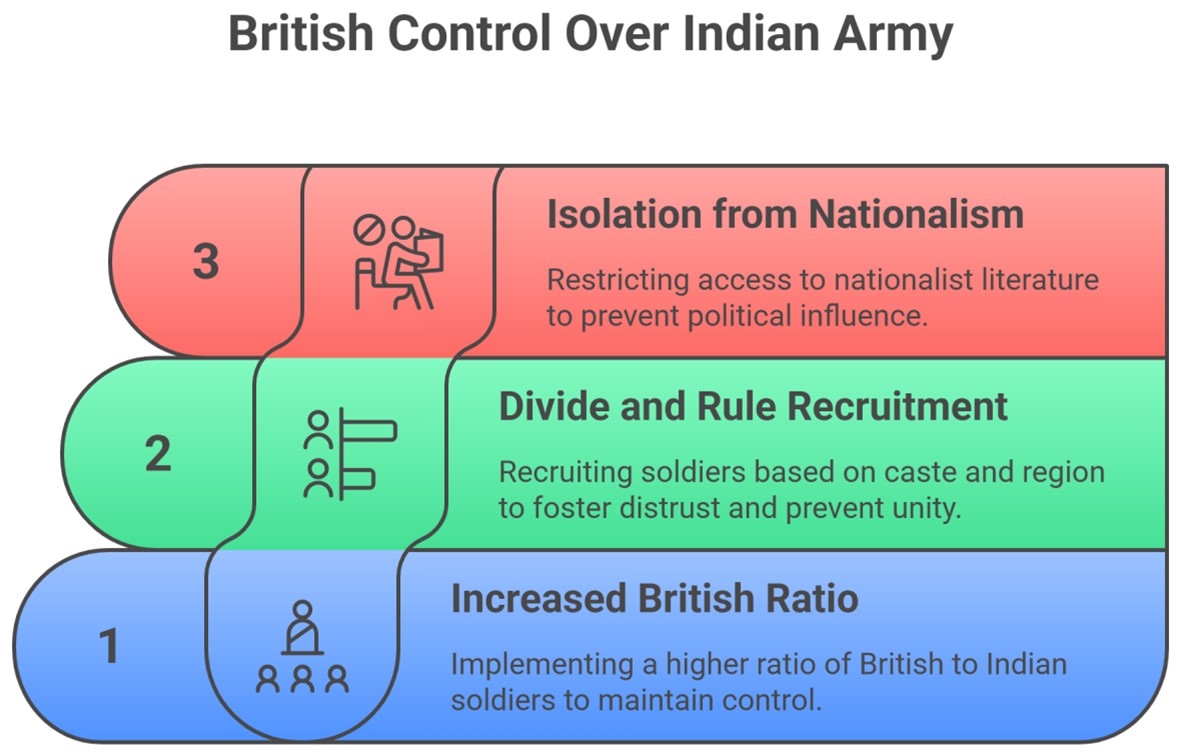
1. Increased British Ratio in the Army:
- The Royal Peel Commission (1859) recommended a ratio of 1 British to 2.5 Indian soldiers.
- European troops were stationed in strategic and sensitive areas, with key divisions like artillery placed exclusively under European command.
- Indians were systematically excluded from officer ranks.
2. Divide and Rule in Army Recruitment:
- Recruitment was based on caste, region, religion, and loyalty.
- Soldiers were recruited to ensure mutual distrust among regiments.
- The army was divided into “martial” and “non-martial” classes:
- Martial Races (e.g., Sikhs, Gurkhas, Pathans) were favoured.
- Regions associated with the 1857 Revolt (e.g., Awadh, Bihar, South India) were excluded.
3. Isolation from Nationalism:
- Indian soldiers were isolated from political influences.
- Access to nationalist literature, newspapers, and journals was banned in military areas.
The Police System in Colonial India
Establishment and Structure
- The Indian Police Act of 1861, based on Napier’s policing model, laid the foundation of the modern police system in India.
- The Act created a provincially controlled but centrally structured police force, headed by:
- Inspector General of Police – Head at provincial level.
- Deputy Inspector General – Head at range level.
- District Superintendent of Police (SP) – Head at district level.
The 1861 Act created a repressive, colonial policing system, focused more on control than public service.
Frazer Commission (1902–03)
- Appointed to evaluate and reform British India’s police force.
- Recommended:
- Establishing a Central Intelligence Bureau (CIB).
- Setting up a Crime Branch (CID) for each Presidency.
Legacy and Post-Independence Challenges
- Post-independence, the police system faced severe criticism:
- Accused of being inefficient, politicised, and unsympathetic to the marginalised.
- Minor reforms were introduced, but the core framework of the 1861 Act remained intact.
- Post-independence, the police system faced severe criticism:
The British administrative reorganisation post-1858 was aimed at entrenching colonial dominance while restricting Indian participation. The civil services, army, and police were crafted to serve imperial interests, not democratic values. Yet, over time, Indian demands for representation, fuelled by nationalist movements, compelled the British to make concessions—laying the groundwork for India’s modern administrative structure. The legacies of this system—both positive and problematic—continue to shape India’s bureaucracy and law enforcement to this day.