
Judicial Developments in British India
I. Pre-Colonial Judicial System in India
Before British intervention, the judicial system in India was highly decentralised and largely unstructured. It lacked codified laws, uniform procedures, and a systematic distribution of courts. Justice was often dispensed based on local customs, religion, and the discretion of rulers.
- Hindu Judicial Practices – Disputes were generally resolved by caste elders, village panchayats, or zamindars who combined judicial and administrative roles.
- Muslim Judicial Practices – Under the Mughals, qazis served as chief judicial officers in provincial capitals and large towns, applying Islamic law.
- Ruler as Supreme Authority – Kings and emperors were regarded as the final source of justice, leading to a personalised and arbitrary justice system without clear separation between executive and judiciary.
II. Transition to British Common Law System
The East India Company (EIC) gradually replaced the Mughal judicial system with elements of English common law as it transformed from a trading body into a territorial power.
Mayor’s Courts – 1726
- Charter of 1662 – Granted the EIC powers to exercise judicial authority in its settlements.
- Charter of 1726 – Established Mayor’s Courts in Madras, Bombay, and Calcutta.
- Jurisdiction covered British subjects, but the legal position regarding Indian natives remained ambiguous.
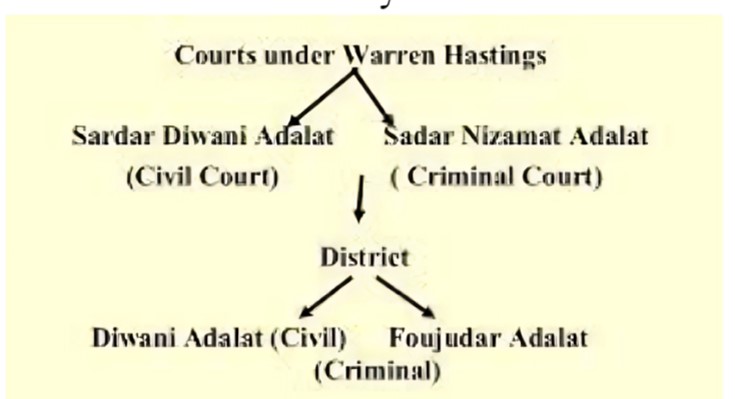
III. Reforms under Warren Hastings (1772–1785)
Warren Hastings initiated systematic judicial organisation combining Indian laws with British administrative structure.
1. District Diwani Adalats –
- Handled civil cases; presided over by the Collector.
- Applied Hindu law for Hindus and Muslim law for Muslims.
- Appeals lay to the Sadar Diwani Adalat.
2. District Faujdari Adalats –
- Managed criminal cases; headed by Indian officers.
- Applied Muslim criminal law; capital sentences required approval from Sadar Nizamat Adalat.
3. Supreme Court of Calcutta (1774) –
- Established under the Regulating Act of 1773.
- Jurisdiction over British subjects, but jurisdictional conflicts with Company’s courts created administrative friction.
4. Codification Efforts –
- Translation of Hindu and Muslim laws into accessible forms for British judges unfamiliar with local traditions.
IV. Reforms under Cornwallis (1786–1793)
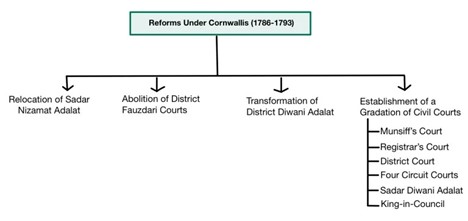
Cornwallis reorganised the judiciary with a focus on separation of powers and European control.
- Abolition of District Faujdari Courts – Replaced by Circuit Courts with European judges in Calcutta, Dacca, Murshidabad, and Patna.
- Relocation of Sadar Nizamat Adalat – Shifted to Calcutta, presided over by the Governor-General with Islamic law officers.
- District Diwani Adalats – Renamed as Zila Courts, headed by District Judges, restricting Collectors to revenue work.
- Hierarchy of Courts –
- Munsiff’s Court – Petty civil cases, Indian judges.
- Registrar’s Court – European presiding officer.
- District Court – District Judge.
- Circuit Courts – Provincial appellate courts.
- Sadar Diwani Adalat – Highest civil court.
- King-in-Council – Appeals over £5,000.
Cornwallis’s reforms centralised authority and increased European dominance in higher judiciary.
V. Reforms under William Bentinck (1828–1833)
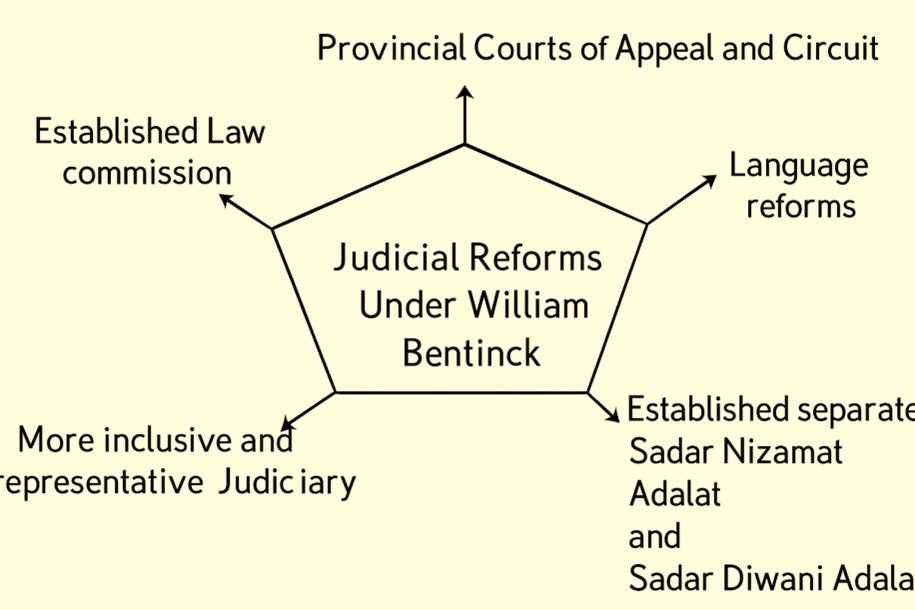
- Abolished Circuit Courts – Due to inefficiency; transferred their powers to Collectors.
- Established Sadar Diwani and Nizamat Adalats – In Allahabad for the Upper Provinces.
- Language Policy – Replaced Persian with English in higher courts, but retained vernacular languages at lower levels.
- Law Commission of 1833 – Headed by Thomas Macaulay, leading to codification of:
- Indian Penal Code (1860)
- Civil Procedure Code (1859)
- Criminal Procedure Code (1861)
VI. Later Developments (1833–1935)
1. Abolition of Special Privileges (1860) –
- Ended Europeans’ legal immunity (except in criminal trials).
- However, Indians could not preside over cases involving Europeans.
2. High Courts Act, 1861 –
- Merged Supreme Courts and Sadar Adalats into High Courts at Calcutta, Bombay, and Madras.
- Improved judicial efficiency and unified legal authority.
3. Federal Court of India (1937) –
- Established under the Government of India Act, 1935.
- Jurisdiction over Centre–Province disputes and limited appeals from High Courts.
- Marked the beginning of federal judicial structure in India.
VII. Significance of British Judicial Reforms
- Introduced codified laws and structured hierarchy of courts.
- Created dual legal system – British common law principles applied alongside personal laws of communities.
- Provided groundwork for modern Indian judiciary, though with systemic racial discrimination in higher appointments.
Administrative Reorganisation in British India after 1857
The Revolt of 1857 was a watershed moment in the history of British India. In its aftermath, the British Crown undertook major administrative reforms aimed at consolidating control, reducing political unrest, and aligning governance with imperial interests. While these reforms incorporated certain Indian elements into the system, they were primarily designed to safeguard British dominance and economic exploitation.
I. Post-1857 Reforms – Policy Orientation
- Inclusion of Indians in Administration – Aimed at better understanding local customs and socio-political sentiments, Indians were cautiously introduced into administrative roles, though mainly in subordinate positions.
- Bridging Ruler–Subject Gap – Symbolic concessions sought to reduce alienation and pre-empt future uprisings.
- Imperial Motives over Welfare – Despite appearances, reforms were guided by imperial security, trade protection, and strategic concerns rather than genuine welfare of Indians.
- Phase-Wise Implementation – Policies were rolled out gradually to ensure complete British control while countering emerging powers like the United States and Japan.
- Resurgence of Imperialism – Viceroys such as Lytton, Dufferin, Lansdowne, Elgin, and Curzon pursued reactionary policies to reinforce British supremacy.
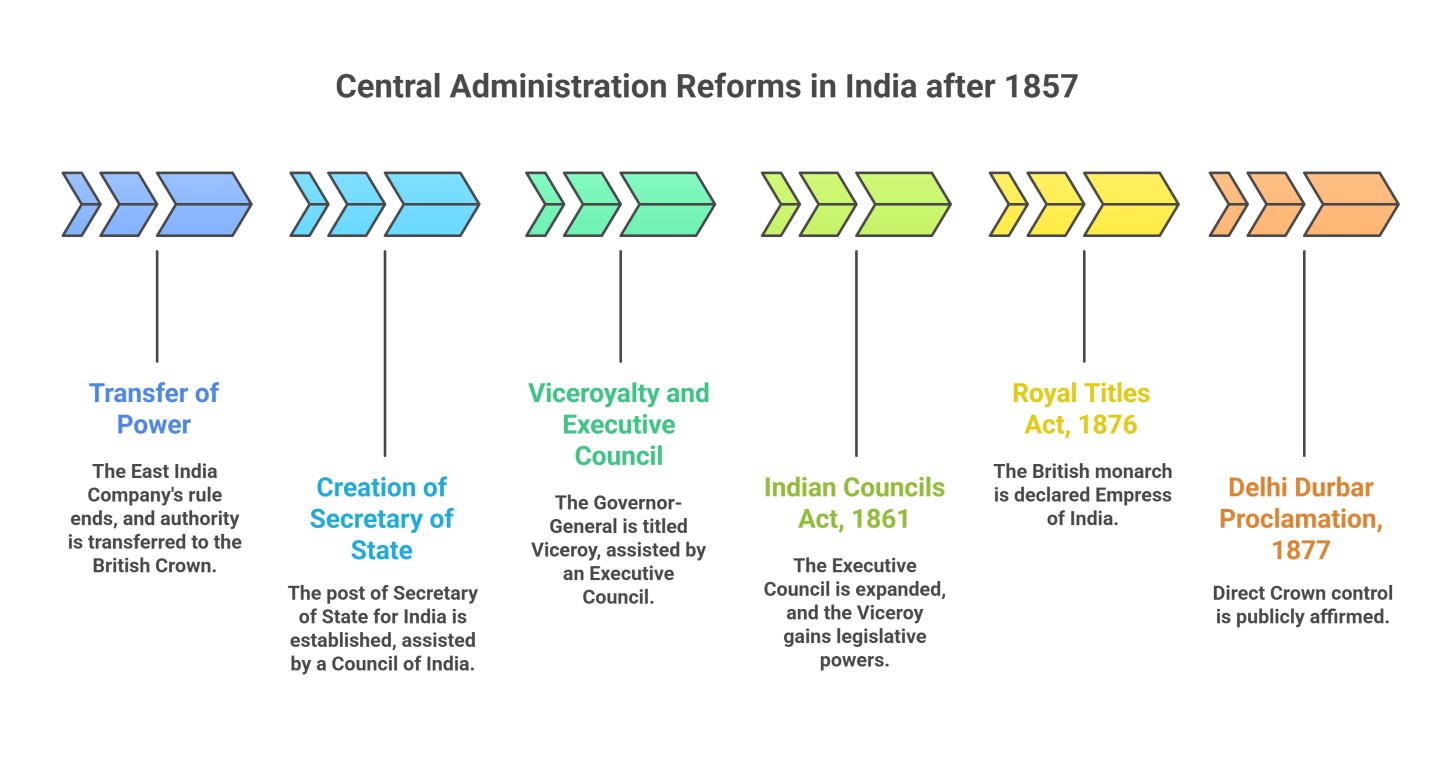
2. Central Administration Reforms after 1857
1. Transfer of Power – Act for Better Government of India (1858)
- Ended the East India Company’s rule, transferring authority directly to the British Crown.
- Created the post of Secretary of State for India (member of the British Cabinet) assisted by a 15-member Council of India.
- Parliament retained ultimate control, abolishing the dual system of governance established under Pitt’s India Act (1784).
2. Viceroyalty and Executive Council
- Governor-General was now formally titled Viceroy, representing the Crown in India.
- Assisted by an Executive Council of department heads.
- Over time, the Secretary of State’s powers overshadowed the Viceroy, enabling British industrialists and financiers to influence Indian policy.
3. Indian Councils Act, 1861
- Expanded the Executive Council by adding a fifth member.
- Empowered the Viceroy to appoint 6–12 additional members for legislative functions.
- Limitations – The Legislative Council could not:
- Discuss the full budget.
- Control the executive.
- Initiate legislation without Viceroy’s sanction.
- Represent broad sections of Indian society.
- Viceroy retained emergency ordinance powers.
4. Royal Titles and Symbolic Consolidation
- Royal Titles Act (1876) – Declared the British monarch as Empress of India (Kaiser-i-Hind).
- Delhi Durbar Proclamation (1877) – Publicly affirmed direct Crown control.
III. Provincial Administration and Legislative Decentralisation
Restoration of Legislative Powers (1861)
- The Indian Councils Act (1861) restored legislative powers to Bombay and Madras, which had been removed in 1833.
- These presidencies enjoyed greater autonomy than other provinces, which were under Lieutenant-Governors or Chief Commissioners.
Administrative Decentralisation Timeline
- Charter Act (1833) – Centralised legislation under the Governor-General-in-Council.
- Indian Councils Act (1861) – Reversed centralisation, allowing provinces legislative authority.
- Indian Councils Acts (1892 & 1909) – Expanded provincial councils’ roles, introducing indirect and limited direct elections.
- Government of India Act (1919) – Introduced Dyarchy – subjects split into Transferred (Indian ministers) and Reserved (British officials).
- Government of India Act (1935) – Established Provincial Autonomy, granting significant powers to elected ministries.
IV. Financial Decentralisation
Early Steps
- Lord Mayo’s Resolution (1870) – Introduced fixed provincial grants for services like police, jails, and education.
- Lord Lytton & Lord Ripon – Expanded provincial fiscal control.
- 1877 – Provinces gained charge of law, justice, excise, and land revenue expenses.
Divided Heads System (1882)
- Revenue from sources like excise, stamps, and forests shared between centre and provinces.
- Continued until replaced by 1919 Act reforms.
Lytton’s Reforms
- Provinces received a fixed share from income tax, stamps, and excise.
- Central government retained supremacy, with both levels answerable to the Secretary of State.
V. Local Administration and Growth of Local Self-Government
Driving Factors
- Over-centralisation strained British resources.
- Urban demands for European-style civic services.
- Nationalist pressure for Indian participation in governance.
- Local taxation seen as a way to fund services without burdening British finances.
Mayo’s Resolution (1870)
- Transferred education, health, sanitation, and public works to provincial governments.
- Encouraged local responsibility in municipal matters.
- Led to municipal acts in Bengal, Madras, Punjab, and NW Provinces.
Ripon’s Resolution (1882) – Father of Local Self-Government in India
- Advocated political education through elected local bodies.
- Recommended:
- Non-official majority in local councils.
- Non-official chairpersons wherever possible.
- Limited official interference, restricted to oversight.
- Gradual introduction of elections.
VI. Royal Commission on Decentralisation (1908)
- Recommended strengthening District Boards, Taluka Boards, and Village Panchayats.
- Advocated judicial powers for panchayats in minor cases.
- Suggested independent revenue sources and taxation powers for local bodies.
- Urged municipalities to take over primary education responsibilities.
VII. Later Developments
- Government of India Resolution (1915) – Accepted some decentralisation recommendations but with limited action.
- Resolution of 1918 – Proposed more representative local bodies after the August Declaration (1917).
- Government of India Act (1919) – Local government made a Transferred Subject under Dyarchy.
- Simon Commission (1930) – Found slow progress in panchayat development; recommended greater provincial control.
- Government of India Act (1935) – Enhanced provincial autonomy and strengthened local self-governance.
VIII. Legacy and Constitutional Continuity
- Article 40 of the Indian Constitution – Mandates establishment of Village Panchayats.
- 73rd and 74th Amendments – Gave constitutional status to Panchayati Raj Institutions and Urban Local Bodies, fulfilling the groundwork laid during British reforms.
British Foreign Policy, Famine Policy, and Policy Towards Princely States in India
I. British Foreign Policy in India
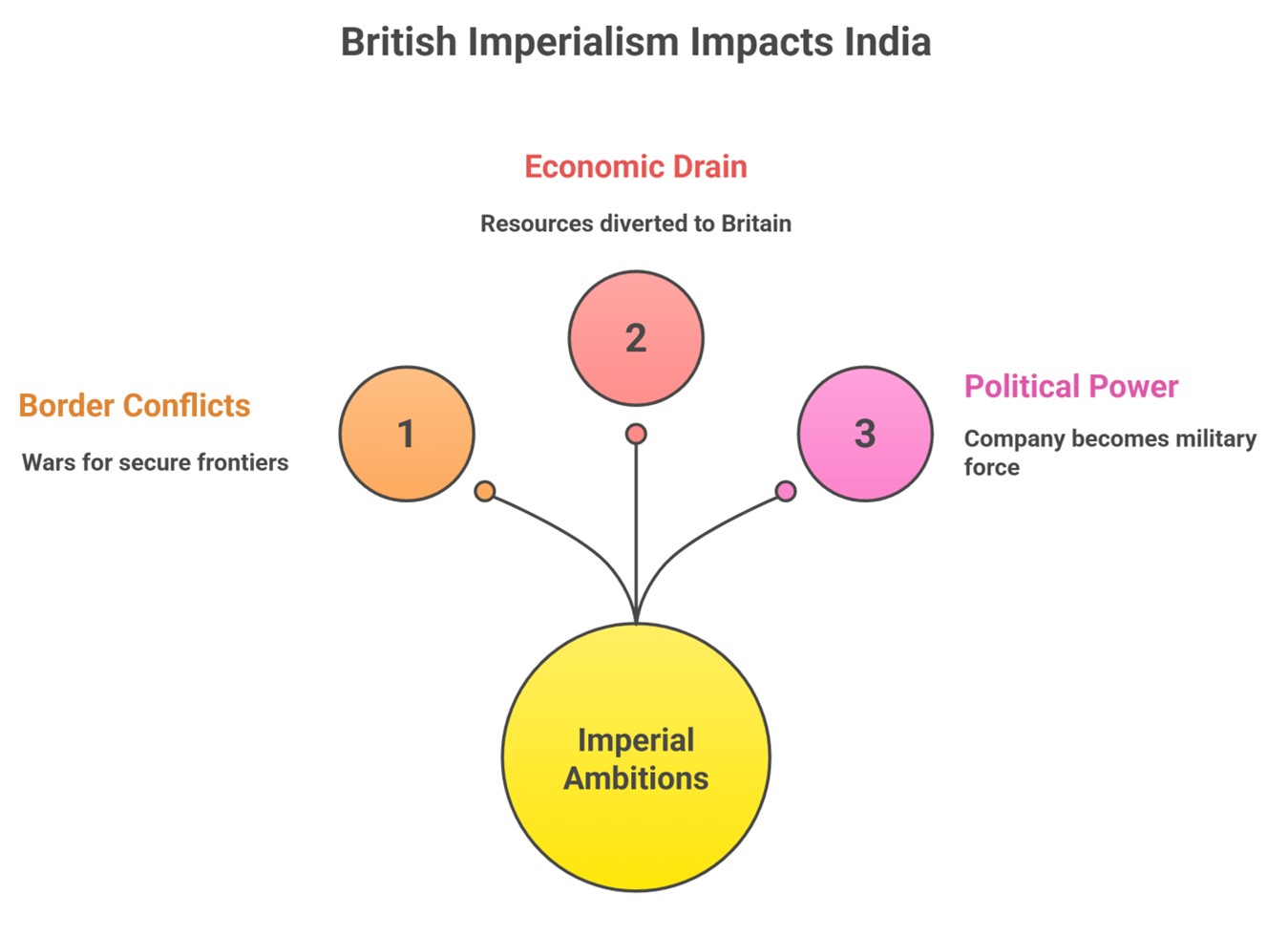
British foreign policy in India was deeply rooted in imperial ambitions, with the twin objectives of political consolidation and economic expansion. It shaped India’s relations with neighbouring regions and often drew the country into conflicts that served British, not Indian, interests.
1. Political Consolidation
- The British sought to establish secure geographical frontiers to protect internal cohesion.
- This ambition led to border conflicts, most notably:
- First Anglo-Afghan War (1839–42)
- Second Anglo-Afghan War (1878–80)
- These wars were part of the strategy to create Afghanistan as a buffer state against Russian expansion into South Asia during the Great Game.
2. Expansion of Commercial Interests
- Britain’s commercial rivalry with Russia and France often extended to India’s borders.
- The Crimean War (1853–56) heightened fears of Russian interference in India.
- The British used India as a strategic base to protect trade routes and colonial markets.
3. Economic and Human Cost to India
- The burden of these foreign adventures was borne by Indian finances and manpower.
- Example: The Second Anglo-Afghan War resulted in over 16,000 British casualties and disrupted regional economies.
- Funds that could have been used for Indian welfare were diverted to military campaigns.
4. Transformation of the East India Company
- Initially a trading company, the East India Company became a political and military power after the Battle of Plassey (1757).
- Control over Bengal enabled large-scale resource extraction.
- According to C. Dutt, between 1757 and 1765, the Company extracted £6 million from Bengal—nearly four times its annual revenue—fueling Britain’s economy while impoverishing India.
II. Development of Famine Policy
A famine is characterised by widespread food scarcity caused by natural disasters, war, crop failures, poverty, or policy failures, often leading to starvation, epidemics, and high mortality.
1. Famines Under Company Rule (1769–1857)
- The Company presided over 12 famines and 4 major scarcities.
- Key examples:
- Bengal Famine (1769–70) – One-third of the population perished; no relief measures were taken; Company officials profiteered from rice trade.
- Madras Famine (1792) – Relief works initiated.
- Guntur Famine (1833) – 200,000 deaths out of 500,000 population.
- Upper India Famine (1837) – Limited aid to vulnerable groups despite public works projects.
- Company Response – Lacked a centralised famine policy; relied on grain storage, penalties for hoarding, and ad-hoc provincial measures.
2. Famines under Crown Administration (1858–1947)
- 1860–61: First official famine inquiry (Colonel Baird Smith) – no effective relief principles.
- Orissa Famine (1866): 1.3 million deaths; government adhered to free trade principles, ignoring warnings.
- Great Famine (1876–78): Affected 58 million; ~5 million deaths; minimal government relief.
- 1896–97 & 1899–1900: Affected almost all provinces; delayed relief aggravated suffering.
- Bengal Famine (1942–43): Caused by crop failure, wartime shortages, and trade restrictions; millions died.
3. Famine Commissions and Codes
- Famine Commission (1880) – Headed by Sir Richard Strachey, acknowledged absence of prior famine relief systems.
- Famine Code (1883):
- Classified areas as scarcity or famine zones.
- Outlined duties for revenue suspension, relief works, and cattle migration facilities.
- Established cost-sharing between provincial and central governments.
III. British Policy towards Princely States
India had 562 princely states under British paramountcy, varying in size from tiny estates to territories as large as European nations.
1. Policy Objectives
- Subordination of Indian rulers to British authority.
- Using princely states as buffers for imperial defence.
- Known as the Policy of Subordinate Union.
2. Evolution of British–Princely State Relations
(a) Initial Phase – Isolation and Commerce (Pre-1740)
- British focused on trade and avoided direct interference in Indian politics.
(b) Rise to Political Power (1740–1765)
- Anglo-French rivalry; Capture of Arcot (1751) and Battle of Plassey (1757).
- Treaty of Allahabad (1765) – Company acquired Diwani of Bengal, Bihar, and Orissa.
(c) Policy of Ring Fence (1765–1813)
- Warren Hastings created buffer states (Hyderabad, Mysore) against Marathas and Afghans.
- States provided military payments to Britain.
(d) Subsidiary Alliance (1798–1805)
- Introduced by Lord Wellesley to prevent French resurgence.
- Indian rulers hosted British troops, accepted Residents, and surrendered foreign policy control.
- Key signatories included Hyderabad, Mysore, Awadh, and Maratha states.
(e) Doctrine of Lapse (1848–1856)
- Lord Dalhousie annexed states without a direct male heir.
- Major annexations: Satara, Jhansi, Nagpur, Awadh.
(f) Subordinate Isolation (1813–1857)
- States accepted British paramountcy but retained limited sovereignty.
- Annexations continued under economic and governance pretexts.
(g) Subordinate Union (1857–1935)
- Post-1857, the Crown avoided wholesale annexations.
- Lord Curzon redefined treaties to make princes subordinate collaborators.
- Montford Reforms (1921) – Created the Chamber of Princes for advisory purposes.
- Butler Committee (1927) – Recommended that states not be transferred to an Indian legislature without their consent.
(h) Equal Federation Policy (1935–1947)
- Government of India Act, 1935 proposed a federation including princely states—never implemented.
IV. Integration of Princely States (1946–1956)
Phase I – Instrument of Accession
- By 15 August 1947, all except Kashmir, Hyderabad, and Junagarh had acceded to India for defence, foreign affairs, and communications.
Phase II – Political Integration
- Merged small states into unions like Kathiawar Union, Madhya Bharat, and Travancore-Cochin.
- Princes given privy purses; some appointed as Rajpramukhs.
Special Cases
- Junagarh: Plebiscite favoured India.
- Hyderabad: Annexed via Operation Polo (1948).
- Kashmir: Acceded to India after Pakistani invasion in 1947; granted Article 370
Seventh Amendment (1956)
- Abolished Part B states, creating a uniform administrative structure.