
INDIAN NATIONAL MOVEMENT (1942-47)
QUIT INDIA MOVEMENT (1942)
The Quit India Movement, famously known as the August Revolution, marked one of the most decisive phases in India’s freedom struggle. It was launched in response to the failure of the Cripps Mission (1942) and the urgent need for complete British withdrawal from India during the Second World War.
Unlike earlier campaigns, this movement was notable for its spontaneous, decentralised, and leaderless character, where mass participation surged beyond Congress’s direct control. Its aim was twofold: to secure immediate independence and to prepare for non-violent resistance against a possible Japanese invasion.
Background and Responsible Factors
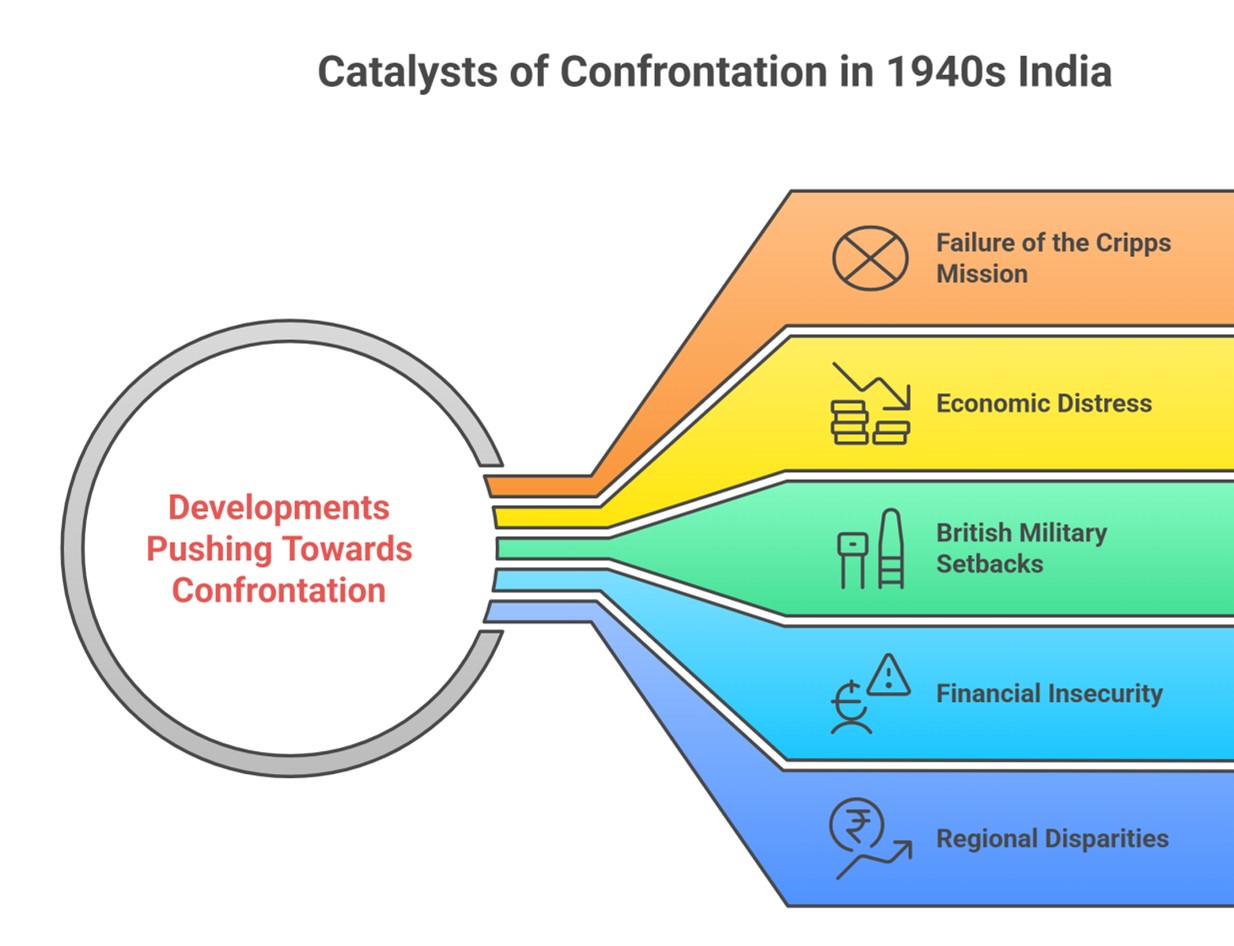
Several developments in the early 1940s pushed the national movement towards confrontation:
- Failure of the Cripps Mission (1942) – The British refusal to grant complete independence and their insistence on retaining control over defence exposed their unwillingness to make real concessions.
- Economic Distress – Wartime inflation, acute shortages of essential goods, and rumours of a scorched-earth policy in eastern India created fear and resentment.
- British Military Setbacks – The fall of Singapore, Rangoon (Burma), and other Southeast Asian territories heightened fears of a Japanese invasion of India.
- Financial Insecurity – Panic withdrawals from banks, gold hoarding, and rising black-market activity deepened public anxiety.
- Regional Disparities – The movement found particularly strong roots in Eastern Uttar Pradesh and Bihar, but remained relatively weak in Madras Presidency.
Wardha Meeting and the Quit India Resolution
- Date – July 14, 1942: The Congress Working Committee (CWC) met at Wardha and passed the Quit India Resolution, empowering Mahatma Gandhi to lead a non-violent mass struggle for British withdrawal.
- Proposed by – Jawaharlal Nehru; Seconded by – Sardar Vallabhbhai Patel.
- The resolution was later ratified at the All India Congress Committee (AICC) meeting held at Gowalia Tank Maidan (August Kranti Maidan), Bombay, on August 8, 1942.
- Gandhi was convinced that the time was ripe for decisive action, stating that half-measures would no longer suffice.
Kurnool Circular (July 29, 1942)
- Issued by the Provincial Congress Committee of Andhra, drafted by Kala Venkat Rao, and sent for CWC approval through Dr. Pattabhi Sitaramaiah.
- Provided strategic guidelines for the movement’s conduct.
- Seized by the police during a raid on the Kurnool Congress Office, revealing British intelligence’s proactive suppression efforts.
The Gowalia Tank Resolution (August 8, 1942)
The All India Congress Committee (AICC), meeting at Gowalia Tank Maidan in Bombay (now August Kranti Maidan), adopted the historic Quit India Resolution on August 8, 1942. The resolution contained four key demands:
- Immediate and Complete British Withdrawal from India, without delay or preconditions.
- A solemn pledge by Free India to fight against fascism and imperialism in all forms.
- Formation of a Provisional National Government upon the British departure to guide the country towards a democratic future.
- Granting full authority to launch Civil Disobedience on a mass scale if the British refused to accept these demands.
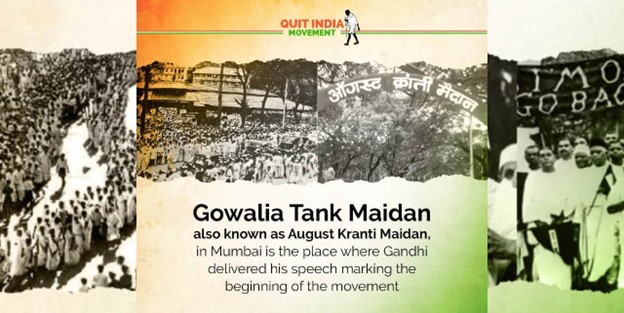
Mahatma Gandhi, in his emotionally charged address, gave the movement its immortal slogan — “Do or Die” — urging Indians to dedicate themselves wholly to the cause of freedom, even at the cost of their lives.
Gandhi’s Direct Instructions to Different Sections of Society
- Hindus & Muslims – Discard communal animosity and work together in the spirit of national unity.
- Government Servants – Continue in service if necessary but maintain loyalty to the Congress and the nationalist cause.
- Indian Soldiers – Refrain from firing on fellow countrymen and support the movement morally.
- Students – Leave educational institutions if prepared to actively contribute to the struggle.
- Peasants – Refuse payment of rent to pro-government zamindars and landlords.
- Princes and Rulers – Align with the people’s aspirations and stand against colonial domination.
Course of the Movement
British Repression and Mass Arrests (August 9, 1942)
Within mere hours of passing the resolution, the British administration acted with swiftness and severity. Gandhi, Jawaharlal Nehru, Vallabhbhai Patel, and the entire top Congress leadership were arrested. The Congress was declared illegal under the Criminal Law Amendment Act, and public meetings were prohibited under Rule 56 of the Defence of India Rules.
Aruna Asaf Ali’s Symbolic Defiance
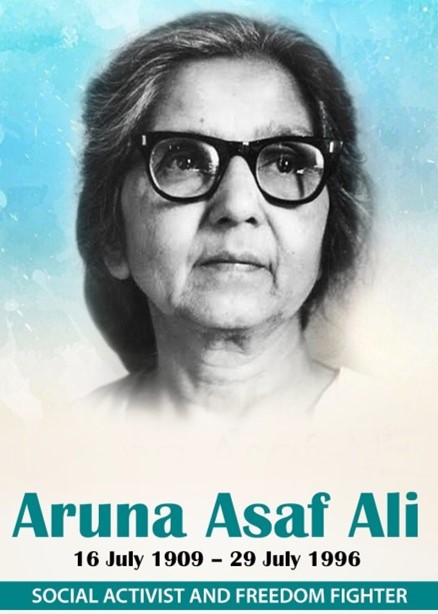
In the absence of senior leaders, Aruna Asaf Ali emerged as the symbol of resistance. She hoisted the tricolour at the Gowalia Tank Maidan, inspiring crowds and signalling that the movement would not be silenced by repression.
Forms of Public Protest
- Sabotage and Direct Action – Destruction of railway tracks, bridges, telegraph lines, and other communication networks, especially in Eastern U.P. and Bihar, to disrupt British control.
- Student and Worker Strikes – General strikes paralysed industries in Ahmedabad, Bombay, Jamshedpur, and Poona. Students played a crucial role in circulating underground literature and organising protests.
- Underground Resistance – With leaders jailed, underground networks coordinated activities from safe houses, evading British surveillance.
- Usha Mehta’s Congress Radio – An illegal, underground radio broadcast from Bombay that kept the spirit of resistance alive and spread nationalist messages, often changing locations to avoid detection.
Prominent Underground Leaders
- Aruna Asaf Ali – “Heroine of the August Revolution” for defying British orders and inspiring the youth.
- Jayaprakash Narayan & Rammanohar Lohia – Orchestrated underground resistance in Bihar.
- Usha Mehta – Operated the clandestine Congress Radio to counter British propaganda.
- Biju Patnaik – Used his aviation skills to transport literature and messages.
- Achyut Patwardhan & Sucheta Kripalani – Mobilised workers, students, and women in various provinces.
Individual Efforts to Resolve the Constitutional Crisis
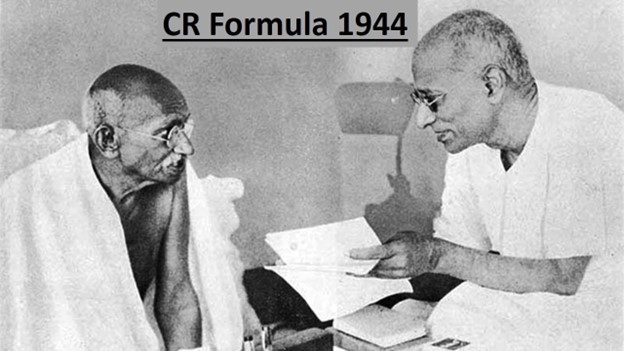
Rajagopalachari (CR) Formula – 1944
Proposed by C. Rajagopalachari to bridge the gap between Congress and the Muslim League, the plan was a tacit recognition of the League’s demand for Pakistan.
Key Provisions –
- Congress-League Cooperation – The Muslim League would support the Congress’s demand for full independence.
- Provisional Government – Both parties would jointly form an interim government at the Centre during the war.
- Post-war Plebiscite – In Muslim-majority areas of the North-West and North-East, a plebiscite would be held to decide whether they wished to form a separate sovereign state.
- Post-partition Agreement – Both entities would have joint arrangements for defence, commerce, and communications.
- Voluntary Population Transfer – Any migration would be voluntary, avoiding forced displacement.
- British Transfer of Power – Implementation depended on Britain’s immediate and complete transfer of powers to India.
Reactions –
- Gandhi supported the plan, signalling Congress’s willingness to negotiate.
- Jinnah rejected it, demanding acceptance of the Two-Nation Theory, limiting plebiscites to Muslims only, and opposing a common central authority.
- Hindu Mahasabha under Vir Savarkar condemned it as a surrender to separatism.
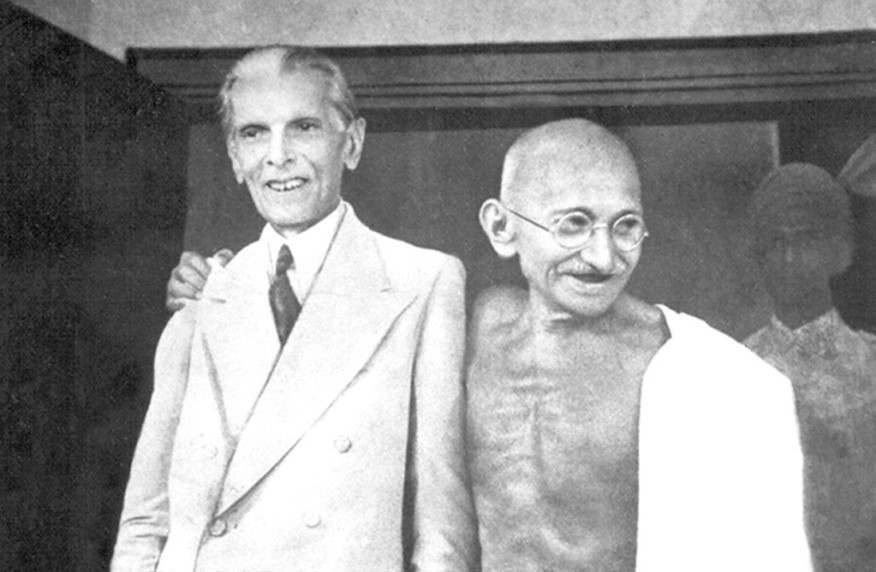
Gandhi–Jinnah Talks (1944)
Following his release from detention on May 5, 1944, Mahatma Gandhi initiated direct negotiations with Muhammad Ali Jinnah, basing the dialogue on the C. Rajagopalachari (CR) Formula. The talks aimed to bridge the deepening rift between the Indian National Congress and the All-India Muslim League, but they instead exposed the irreconcilable ideological differences between the two parties.
- Gandhi’s Position – Strongly opposed the Two-Nation Theory, insisting on the vision of a united and independent India. Gandhi argued that independence should be for all Indians, irrespective of religion, and rejected any constitutional arrangement that would permanently divide the country on communal lines.
- Jinnah’s Position – Asserted the Muslim League’s demand for Pakistan as the only acceptable solution, claiming that Muslims were a distinct nation entitled to full self-determination. He demanded that any plebiscite in Muslim-majority provinces be restricted to Muslim voters only, excluding non-Muslims from the decision-making process.
Key Deadlocks –
- Scope of the Plebiscite – Gandhi proposed that the entire population of Muslim-majority provinces be consulted, while Jinnah insisted it be limited to Muslims alone.
- Structure of the Central Authority – Gandhi envisioned a strong central government for defence, foreign affairs, and communications, whereas Jinnah favoured minimal central control if Pakistan came into being.
Outcome
After nearly two weeks of discussions, the talks collapsed without agreement. The episode deepened mistrust, hardened communal positions, and signalled that the political impasse was far from being resolved.
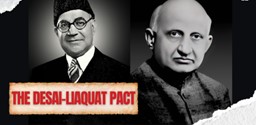
Desai–Liaquat Pact (1945)
In early 1945, an informal political understanding was attempted between Bhula Bhai Desai (representing Congress) and Liaquat Ali Khan (representing the Muslim League). The aim was to reduce political tensions and agree on a provisional central government framework until a permanent settlement could be reached.
Key Proposals –
- Equal Representation – Congress and the Muslim League would have equal numbers in the Central Legislature for the interim period.
- Minority Safeguards – 20% of seats would be reserved for minority communities other than Hindus and Muslims.
Outcome
No formal agreement was signed. While the pact demonstrated a potential willingness to move towards parity between the two parties, deep-rooted political distrust prevented its realisation.
The Wavell Plan (1945)
With the end of World War II in Europe, the British government sought to resolve India’s constitutional deadlock. Lord Wavell, the Viceroy of India, proposed a new plan to bring Congress and the League together in a shared governing arrangement.
British Motives –
- Upcoming British General Elections – The ruling Conservative Party wanted to project an image of being committed to solving the Indian issue.
- Allied Pressure – The Allies urged greater Indian political cooperation in the ongoing war against Japan.
- Strategic Aim – To maintain British influence while making concessions that appeared conciliatory.
Main Provisions of the Wavell Plan –
- All members of the Viceroy’s Executive Council, except the Governor-General and Commander-in-Chief, to be Indians.
- Equal representation in the Executive Council for caste Hindus and Muslims.
- Interim government to function under the Government of India Act, 1935.
- The Governor-General’s veto power would remain but be exercised on ministerial advice.
- Parties could nominate members jointly or from separate lists.
- Post-war discussions would finalise a new constitutional framework.
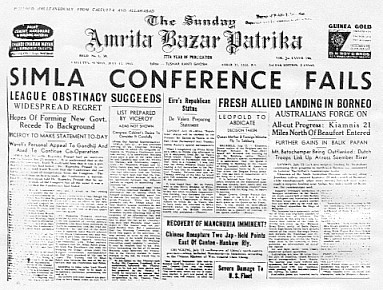
Shimla Conference (June 1945)
To implement the Wavell Plan, Lord Wavell convened a conference at Shimla in June 1945, inviting the Congress and the Muslim League.
Muslim League’s Stand –
- All Muslim members of the Executive Council must be League nominees.
- Decisions affecting Muslim interests should require a two-thirds majority veto power.
Congress’s Stand –
- Congress should have the right to nominate members from all communities, not be restricted to representing only caste Hindus.
Breakdown of Talks –
- Wavell prematurely declared the conference a failure, effectively granting the Muslim League a de facto veto over future arrangements.
- The collapse of negotiations strengthened Jinnah’s bargaining position and further deepened communal divisions, influencing the outcome of the 1945–46 provincial elections in favour of the League.
Subhas Chandra Bose and the INA Movement
Early Life and Education
- Birth: January 23, 1897, Cuttack, Orissa (now Odisha).
- Family Background: Born into a prominent and educated Bengali family. His father, Janakinath Bose, was a respected lawyer, and his elder brother, Sarat Chandra Bose, later emerged as a key figure in India’s freedom struggle.
- Education: Bose displayed exceptional academic talent from a young age. After schooling in Cuttack and Calcutta, he moved to England, securing a degree in Philosophy from Cambridge University in 1919. He also qualified for the Indian Civil Services (ICS) but resigned in 1921, driven by his nationalist ideals.
Role in the Indian National Movement
- Entry into Politics: Bose joined the Indian National Congress (INC) in the 1920s, aligning initially with the younger radical wing. He opposed Mahatma Gandhi’s gradualist approach and strongly advocated immediate independence.
- Presidency of the INC:
- Elected Congress President in 1938 (Haripura Session) — emphasised industrialisation, planning, and a socialist economic framework.
- Re-elected in 1939 (Tripuri Session) but resigned soon after due to ideological differences with Gandhi and the right-wing faction.
- Formation of the Forward Bloc: Founded in May 1939 to consolidate the left-wing within the Congress and pursue aggressive anti-colonial action.
Ideology and Vision
- Advocated complete independence (Purna Swaraj) as a non-negotiable objective.
- Anti-imperialist and socialist outlook — envisioned a secular, egalitarian India.
- Supported armed struggle as a legitimate means against British rule.
- During World War II, sought alliances with Germany and Japan to liberate India.
- Slogan: “Give me blood, and I will give you freedom” — became a rallying cry for revolutionaries.
- Death: Officially reported to have died in a plane crash on August 18, 1945, in Taipei — circumstances remain controversial.
Azad Hind Fauj (Indian National Army – INA)
- Initial Formation (1941): Organised by Captain Mohan Singh from captured Indian soldiers in Malaya with Japanese backing.
- Indian Independence League: Led by Rash Behari Bose, who coordinated expatriate Indians in East Asia for the nationalist cause.
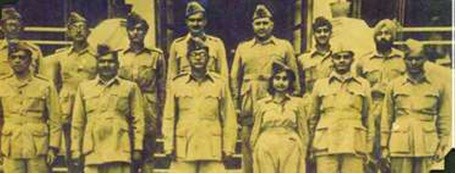
Subhas Chandra Bose’s Leadership
- Arrived in Singapore in July 1943; assumed Supreme Command of the INA.
- Proclaimed the Provisional Government of Free India (Azad Hind Government) on October 21, 1943 in Singapore — recognised by Axis powers.
- Key appointments included C. Chatterjee (Finance) and Lakshmi Swaminathan (Women’s Regiment – Rani Jhansi Regiment).
Military Campaigns
- Headquarters: Shifted to Rangoon (January 1944).
- “Chalo Delhi” Call: INA marched towards India via Burma.
- Andaman & Nicobar Islands: Handed over by Japan in November 1943; renamed Shaheed Dweep and Swaraj Dweep.
- Imphal Campaign (1944): INA forces crossed into Manipur; INA flag hoisted at Moirang on April 14, 1944.
- Campaign faced severe shortages, discrimination from Japanese command, and eventual retreat (July 1944).
- Following Japan’s surrender (August 15, 1945), the INA also surrendered.
INA Trials and Mass Movement
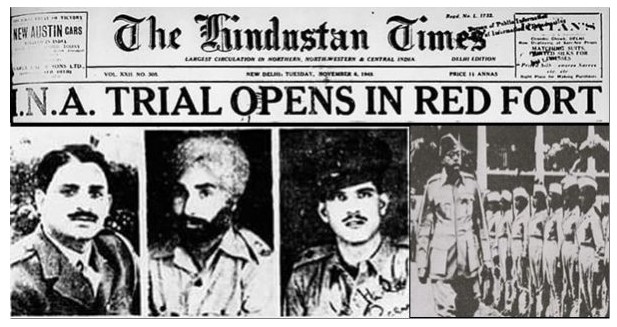
- First public trial at Red Fort in November 1945 — accused: Prem Kumar Sehgal, Shah Nawaz Khan, Gurbaksh Singh Dhillon — symbolised Hindu-Muslim-Sikh unity.
- Nationwide campaign for INA release — supported by Congress, Muslim League, Communists, Akalis, Hindu Mahasabha.
- INA Day (November 12, 1945) and INA Week (November 5–11) saw widespread hartals, rallies, and fundraising.
- The agitation questioned Britain’s moral right to rule India.
Three Upsurges (Winter 1945–46)
- Calcutta Protest (November 21, 1945) — students clashed with police over INA trials.
- Calcutta Demonstration (February 11, 1946) — against sentencing of INA officer Rashid Ali.
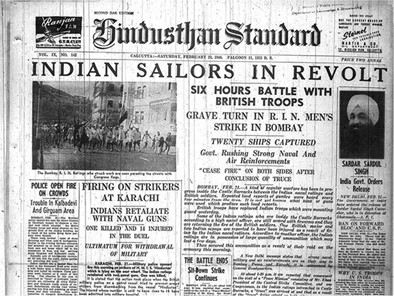
- Royal Indian Navy (RIN) Mutiny (February 18, 1946) — 1,100 sailors in Bombay struck against racial discrimination; joined by Royal Indian Air Force units and civilian protests.
Impact of RIN Mutiny:
- Showed the fragility of British control over armed forces.
- Garnered support from both Congress and Muslim League.
- Increased international pressure for British withdrawal.
Lord Mountbatten’s Arrival and the Path to Partition
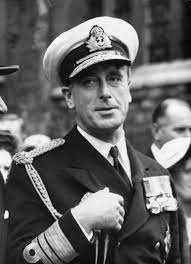
Lord Louis Mountbatten assumed office as Viceroy on 24 March 1947. Unlike his predecessors, he had:
- Full authority for on-the-spot decisions.
- A clear mandate to complete the transfer of power quickly.
Recognising that Jinnah was uncompromising on Pakistan, Mountbatten abandoned hopes of reviving the Cabinet Mission Plan.
The Mountbatten Plan (3 June 1947)
The Mountbatten Plan, also called the Plan for the Transfer of Power, was the final framework for ending British rule in India. It laid down the political, administrative, and territorial arrangements for India’s independence, while simultaneously addressing the demand for Pakistan.
Main Provisions
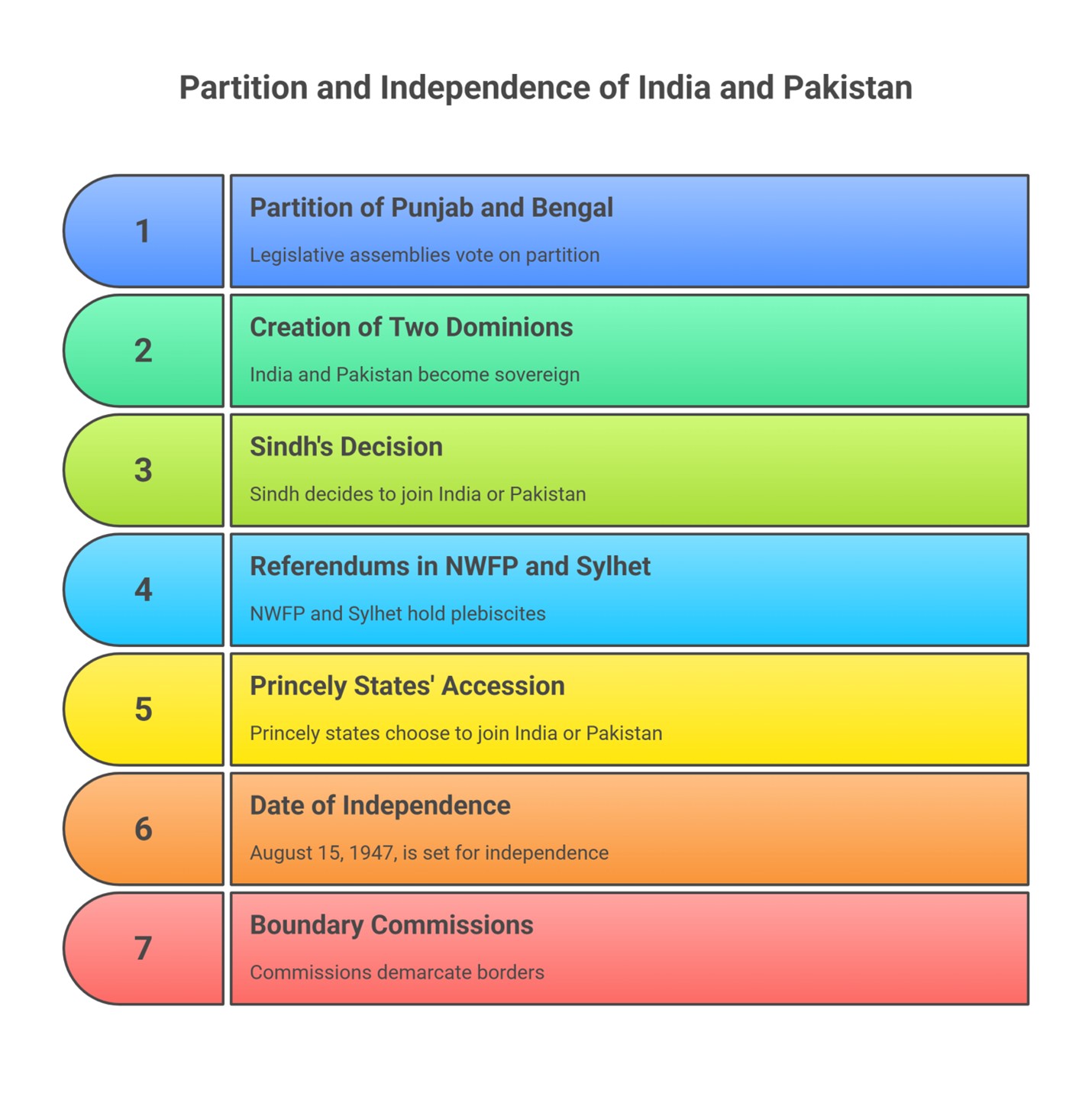
1. Partition of Punjab and Bengal
- The Provincial Legislative Assemblies of both provinces were to vote in separate sittings as Hindu-majority and Muslim-majority
- If a simple majority in either group favoured partition, the province would be divided along communal lines.
2. Creation of Two Dominions
- Two sovereign dominions—India and Pakistan—would be created.
- Each dominion would have its own Constituent Assembly to frame its constitution.
3. Sindh’s Decision
- The Sindh Legislative Assembly was empowered to decide whether Sindh would join India or Pakistan.
4. Referendums in Specific Areas
- North-West Frontier Province (NWFP) and the Sylhet district of Assam would hold plebiscites to decide their accession.
5. Princely States
- All princely states were to accede to either India or Pakistan; the option of complete independence was explicitly ruled out.
6. Date of Independence
- 15 August 1947 was fixed as the date for the formal transfer of power.
7. Boundary Commissions
- Independent commissions were set up for Punjab and Bengal to demarcate borders between the two new dominions.
Congress Concessions
While abandoning the ideal of a united India, the Congress ensured:
- Prevention of independent princely states.
- Rejection of Bengal’s proposal for separate independence.
- Prevention of Hyderabad’s accession to Pakistan (with Mountbatten’s support).
- Immediate independence rather than a prolonged interim period.
Reasons for Early Transfer of Power
- The British wanted to reward Congress for accepting dominion status.
- Avoid responsibility for escalating communal violence.
- Fear that administrative collapse could occur if the transfer was delayed.
- Mountbatten believed speed would reduce political resistance.
Reactions to the Plan
- Mahatma Gandhi: Deeply pained by the idea of partition; urged Indians to reject it in favour of unity.
- Maulana Abul Kalam Azad: Strongly opposed the Congress leadership’s acceptance, calling it a capitulation to communal division.
- Muslim League: Welcomed the plan as the realisation of Pakistan, though sought maximum territorial advantage.
Execution of the Mountbatten Plan
- Punjab & Bengal Assemblies: Voted in favour of partition.
- Sylhet Referendum: Majority voted to merge with East Bengal (Pakistan).
- Radcliffe Commission:
- Chaired by Sir Cyril Radcliffe, tasked with finalising the Radcliffe Line.
- Boundaries were announced on 17 August 1947, two days after independence—a deliberate delay to avoid British accountability for post-partition violence.
Indian Independence Act, 1947
The British Parliament passed the Indian Independence Act on 18 July 1947, giving legal effect to the Mountbatten Plan.
Key Provisions:
- Creation of two independent dominions, India and Pakistan.
- Each dominion to have its own Governor-General as the King’s representative.
- Government of India Act, 1935 to remain in force until new constitutions were adopted.
- Dates of independence: Pakistan on 14 August and India on 15 August 1947.
Integration of Princely States
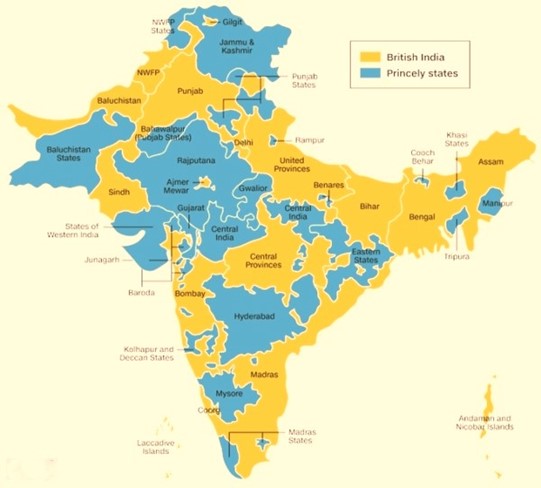
At independence, India had over 560 princely states with varying sizes and levels of autonomy. Their integration was handled in two phases:
1. Instrument of Accession (August 1947)
- All states except Jammu & Kashmir, Hyderabad, and Junagadh signed the Instrument, ceding control over defence, foreign affairs, and communications.
2. Internal Consolidation
- Smaller states were merged to form viable administrative units like Kathiawar, Rajasthan, Madhya Pradesh, and Himachal Pradesh.
- Privy purses were granted as compensation to rulers.
- Many princes were appointed as Governors or Rajpramukhs in the new Indian Union.
Travancore
- Travancore was among the first princely states to refuse accession to the Indian Union.
- Sir C.P. Ramaswamy Aiyar, the Dewan of Travancore, declared that the state would remain independent after British withdrawal.
- Travancore possessed rich mineral resources, especially monazite, from which thorium—a vital material for nuclear reactors and atomic weapons—could be extracted.
- It is widely believed that Sir C.P. Aiyar maintained secret ties with the British government, which supported Travancore’s independence in exchange for exclusive access to monazite, potentially giving Britain a nuclear advantage.
- However, after negotiations with the Indian government and mounting pressure, Travancore acceded to India on 30 July 1947.
Manipur
- Just days before independence, Maharaja Bodhachandra Singh signed the Instrument of Accession with the Indian government on the assurance that Manipur’s internal autonomy would be respected.
- Under public pressure, the Maharaja introduced constitutional reforms and held elections in June 1948, making Manipur the first part of India to hold elections based on universal adult franchise.
- Political divisions emerged—while the Manipur State Congress supported full merger with India, other parties opposed it.
- In September 1949, the Government of India signed the Merger Agreement with the Maharaja without consulting the elected Legislative Assembly, causing widespread resentment—the effects of which continue to be felt in the region.
Junagadh
- Nawab Muhammad Mahabat Khanji III of Junagadh ruled over a majority Hindu population but decided to accede to Pakistan in 1947.
- This led to political unrest and economic collapse in the state. Eventually, the Nawab fled to Karachi.
- Sardar Vallabhbhai Patel deployed troops to secure Junagadh and its surrounding principalities.
- Facing financial crisis and lack of resources, Junagadh’s Dewan agreed to join India.
- A plebiscite held on 20 February 1948 revealed that 91% of voters supported accession to India.
Jammu and Kashmir
- Before independence, Maharaja Hari Singh sought to keep Jammu and Kashmir independent.
- Pakistan claimed the state due to its Muslim-majority population, but Sheikh Abdullah and the National Conference opposed joining Pakistan.
- In October 1947, Pakistan sent tribal invaders to capture Kashmir, prompting the Maharaja to seek Indian military assistance.
- On 26 October 1947, the Maharaja signed the Instrument of Accession to India in exchange for military aid.
- The Indian Army launched operations to push back the invaders, securing the Kashmir Valley.
Hyderabad
- In 1947, Osman Ali Khan Asaf Jah VII, the last Nizam of Hyderabad, refused to join India and sought independence.
- The people of Hyderabad, under the leadership of Swami Ramanand Tirtha, launched a movement demanding accession to India.
- The Nizam relied on his private militia, the Razakars, who engaged in widespread atrocities—torture, looting, arson, and suppression of dissent.
- A Standstill Agreement was signed with India on 29 November 1947, but the Razakar violence escalated.
Operation Polo – Hyderabad’s Accession
- By September 1948, the Indian government concluded that peaceful settlement was impossible.
- On 13 September 1948, the Indian Army launched ‘Operation Polo’ (also called Operation Caterpillar) to integrate Hyderabad.
- Within five days, the Nizam surrendered (18 September 1948), and Hyderabad became part of India.
- The Indian Army was welcomed by the people as a force of liberation, ending the Razakar terror and Nizam’s oppressive rule.