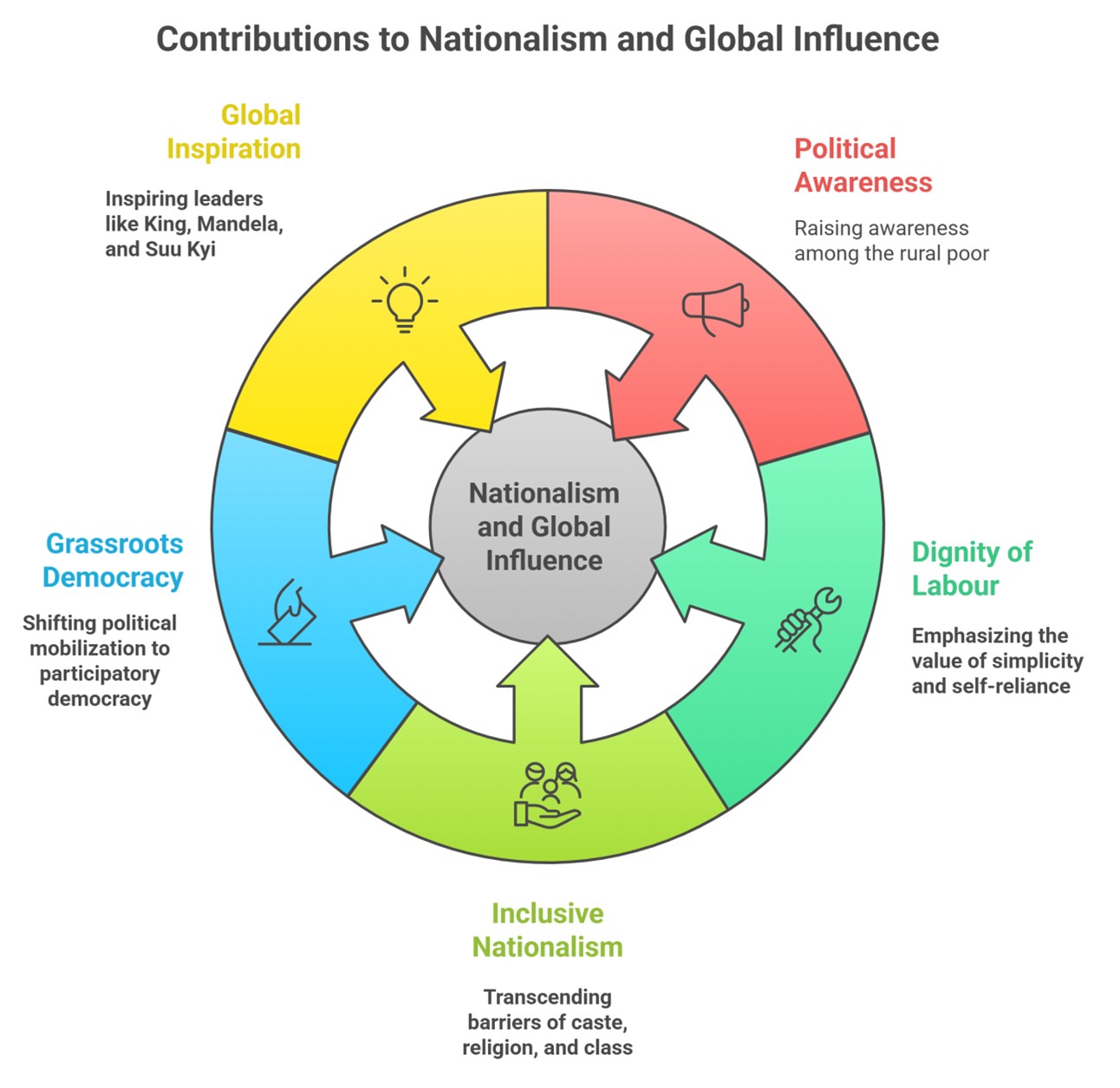
Indian National Movement: 1918-22 Gandhian Phase
Mahatma Gandhi (1869–1948)
Mohandas Karamchand Gandhi, popularly known as Mahatma Gandhi, was born on 2 October 1869 in Porbandar, a coastal town in present-day Gujarat. Revered as the ‘Father of the Nation’, Gandhi played a central role in India’s freedom struggle through his philosophy of non-violence (Ahimsa) and truth (Satyagraha).
Early Life and Family Background
- Father: Karamchand Gandhi, served as the Diwan (Prime Minister) of Porbandar.
- Mother: Putlibai, a deeply religious woman, profoundly influenced Gandhi’s early spiritual inclinations.
Education and Foreign Influence
- In 1888, Gandhi travelled to London to study law at Inner Temple and became a barrister.
- During his stay in England and later in South Africa, Gandhi encountered various philosophical texts and socio-political ideologies that shaped his worldview.
Major Intellectual and Literary Influences
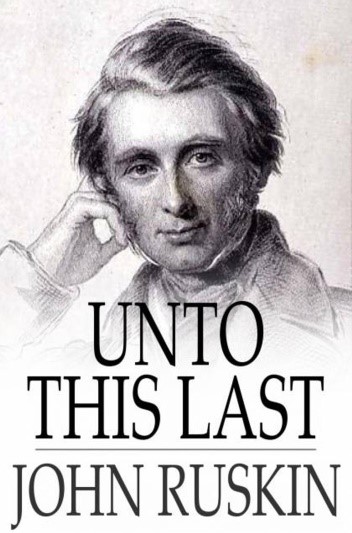
- John Ruskin’s Unto This Last: Inspired Gandhi to embrace economic self-reliance and social equality.
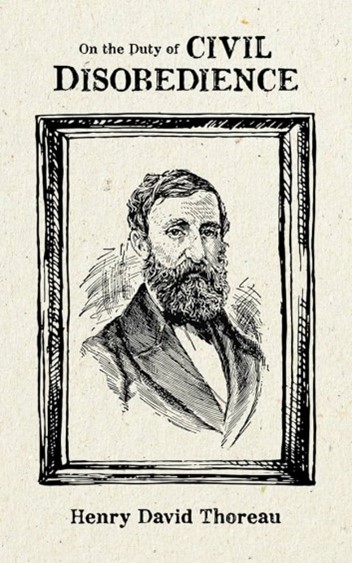
- Henry David Thoreau’s essay on Civil Disobedience: Influenced Gandhi’s methods of peaceful non-cooperation.
- Leo Tolstoy’s ideas on Christian anarchism and non-violence.

- The Bible and The Bhagavad Gita also shaped his spiritual and ethical worldview.

Political Guru
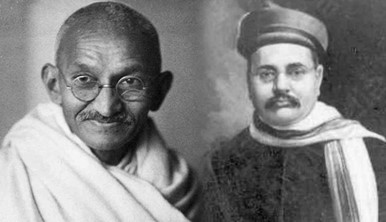
- Gandhi considered Gopal Krishna Gokhale as his political mentor, whom he greatly admired for his moderate stance and ethical politics.
Key Literary Works
- Hind Swaraj (1909): A critique of modern civilisation and colonialism; outlines his vision for self-rule.
- The Story of My Experiments with Truth: His famous autobiography.
- Indian Opinion (1903–1915): Edited while in South Africa.
- Harijan (1933–1948), Young India (1919–1932): Platforms for mass awakening, social reform, and political messages.
- Song from Prison: A translated anthology of Indian spiritual poetry in English.
Popular Epithets and Titles
- “Mahatma” (meaning ‘Great Soul’) – bestowed by Rabindranath Tagore in 1917.
- “Malang Baba” / “Naked Baba” – nicknames given by Kabilies in 1930.
- “Half-naked Fakir / Traitor Faqir” – pejorative label by Winston Churchill in 1931.
- “Rashtrapita” or Father of the Nation – conferred by Netaji Subhas Chandra Bose in a 1944 radio address from Rangoon.
International Recognition
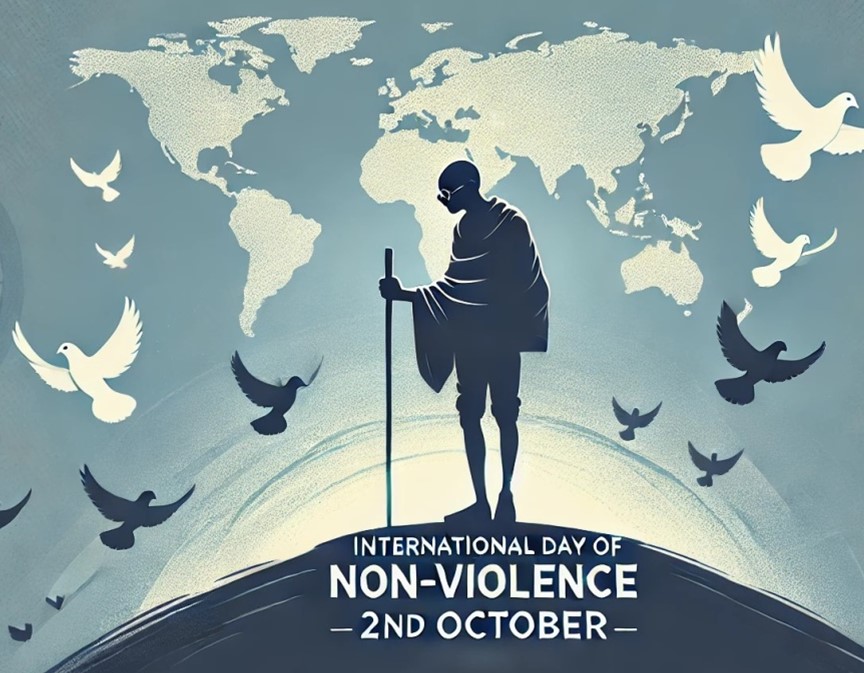
- UNESCO has designated 2 October as the International Day of Non-Violence (Ahimsa Diwas) in honour of Mahatma Gandhi’s philosophy and legacy.
Work for Dalit Upliftment and Eradication of Untouchability
- On 30 October 1932, Gandhi established the All India Anti-Untouchability League, later renamed the Harijan Sevak Sangh, in Bombay (now Mumbai).
- The organisation aimed to:
- Eradicate untouchability
- Promote inter-caste marriages
- Improve the socio-economic condition of Dalits
- Establish schools and welfare centres
- Gandhi began to use the term “Harijan”, meaning “children of God”, to refer to Dalits, emphasizing their dignity and spiritual worth.
Mahatma Gandhi’s unique blend of moral authority, spiritual conviction, and practical leadership made him the most influential figure in India’s freedom struggle and a global icon of peace and resistance.
Mahatma Gandhi in London (1888–1891)
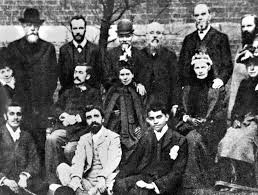
- At the age of 18, Mohandas Karamchand Gandhi sailed to London to pursue a degree in law, arriving in Southampton on 29 September 1888. His decision faced stiff resistance from his caste members in Gujarat, who believed that crossing the ocean would result in loss of caste purity. Nonetheless, Gandhi stood firm and embarked on the journey.
- During his early days in London, Gandhi grappled with cultural shocks but gradually adapted. In 1889, he encountered members of the Theosophical Society, who introduced him to Sir Edwin Arnold’s English translation of the Bhagavad Gita. This spiritual experience was deeply formative. It was also during this period that he came into contact with Annie Besant, another influential personality in his later political life.
- Besides pursuing his legal studies at Inner Temple, Gandhi also cleared the University of London matriculation examination in June 1890. He maintained a simple lifestyle and stayed away from political organisations, including the British Committee of the Indian National Congress, which had been recently formed.
- In 1891, after qualifying as a barrister, Gandhi returned to India, hoping to establish a legal career in Bombay. However, due to a lack of practical experience and confidence in public speaking, he struggled. Eventually, he shifted to Rajkot, where he modestly earned by drafting petitions and legal documents for litigants.
Mahatma Gandhi in South Africa (1893–1914)
Initial Experience and Racial Humiliation
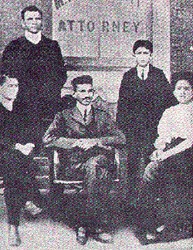
- In 1893, Gandhi was offered employment by Dada Abdullah, a Gujarati merchant based in Natal, South Africa, to represent him in a legal dispute. Gandhi accepted and arrived in Durban on 25 May 1893.
- On 26 May, in a Durban court, Gandhi was asked by the magistrate to remove his turban—a symbol of his identity. He refused and walked out in protest. Days later, on 31 May, while travelling to Pretoria, Gandhi was forcibly removed from a first-class train compartment at Pietermaritzburg, despite holding a valid ticket. That chilling night spent at the station profoundly impacted Gandhi. It marked the turning point in his life, prompting him to dedicate himself to fighting racial injustice.
The Reality of Indian Life in South Africa
- Gandhi soon realised that Indians in South Africa, mostly indentured labourers and a few merchants, were subjected to severe racial discrimination:
- Labelled as “coolies”
- Barred from walking on footpaths or being outdoors after dusk without permits
- Denied entry into first and second-class compartments on trains
- Excluded from hotels reserved for Europeans
- Confined to unhygienic ghettos in Transvaal
- Burdened with a poll tax of three pounds
- For Gandhi, who had never faced such indignity in India or during his stay in London, this treatment was shocking and unacceptable. His British education gave him the confidence to assert his rights, making him one of the first Indians in South Africa to challenge white supremacy.
Rise of Indian Political Consciousness
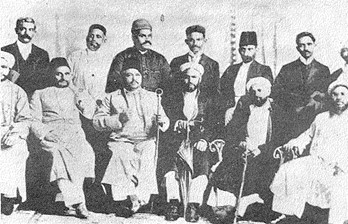
- Gandhi initially planned to return to India in June 1894, but stayed back after learning of a bill in the Natal Legislative Assembly that sought to disenfranchise Indians. At the request of the local Indian community, Gandhi took charge of organising opposition.
- He drafted detailed petitions to the Natal Legislature, the British Colonial Office, and even the Queen of England, signed by hundreds of Indians. Though the bill passed, Gandhi managed to bring widespread attention to the issue through the Indian and British press.
- Recognising the need for a formal platform, Gandhi founded the Natal Indian Congress in 1894 to coordinate political resistance and protect the interests of Indians.
Transformative Years (1896–1901)
- Gandhi briefly returned to India in 1896 to fetch his wife Kasturba and two sons. During his second phase in South Africa, his lifestyle drastically changed. He embraced simplicity, frugality, and self-discipline:
- Cut his own hair and washed his clothes
- Volunteered as a compounder in a charitable hospital
- Immersed himself in public service and moral self-improvement
Role in the Boer War (1899–1902)
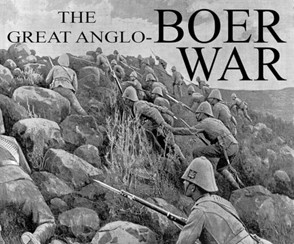
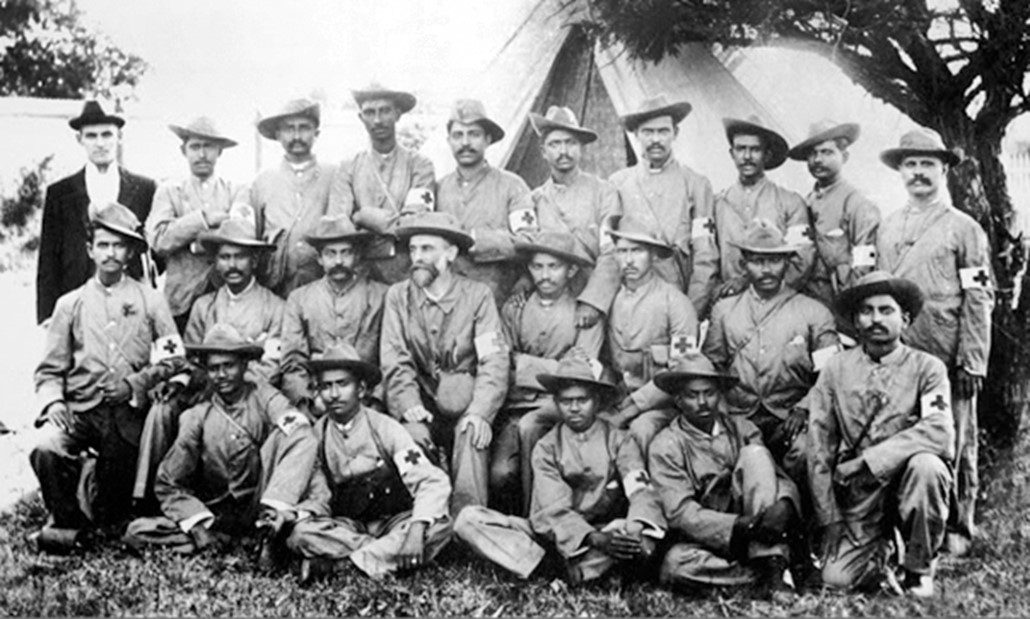
- During the Second Anglo-Boer War, Gandhi formed the Indian Ambulance Corps, consisting of around 1,100 volunteers, to support British troops with medical aid. He believed that loyal service might earn Indian goodwill from the Empire and lead to better treatment of Indians.
- Despite sympathising with the Boers, he felt that duty to the Empire required Indians to support the British. For his services, Gandhi was awarded the Kaiser-i-Hind medal.
Phoenix Settlement (1904)
- In 1904, Gandhi established the Phoenix Settlement near Durban, promoting communal living, self-sufficiency, and non-materialistic values. It became the training ground for many of his future Satyagrahis.

Birth of Satyagraha (1906–1914)
Moderate Phase (1894–1906)
- Initially, Gandhi believed in the British sense of justice and fair play. He relied on petitions, memorials, and press campaigns to address grievances of South African Indians.
- To create awareness and unity, he launched the weekly newspaper Indian Opinion in 1903, which became a critical mouthpiece for the Indian community.
Advent of Passive Resistance (1906 Onwards)
- In 1906, the Transvaal Government passed the Asiatic Registration Ordinance, which:
- Required mandatory fingerprinting
- Enforced carrying of passes
- Allowed police to enter Indian homes to check compliance
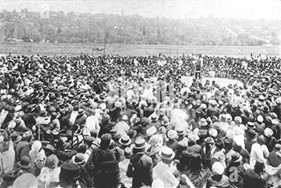
- On 11 September 1906, at a mass meeting in Johannesburg, Gandhi launched his unique tool of resistance—Satyagraha (truth-force), a non-violent but firm refusal to obey unjust laws.
- Despite public protests, the law was passed, and Gandhi was arrested in January 1908, beginning a series of imprisonments:
- Volkrust (1908)
- Pretoria (1909)
- Volkrust again (1913)
- In August 1908, Gandhi famously led a pass-burning protest, demonstrating his commitment to civil disobedience.
Hind Swaraj (1909)
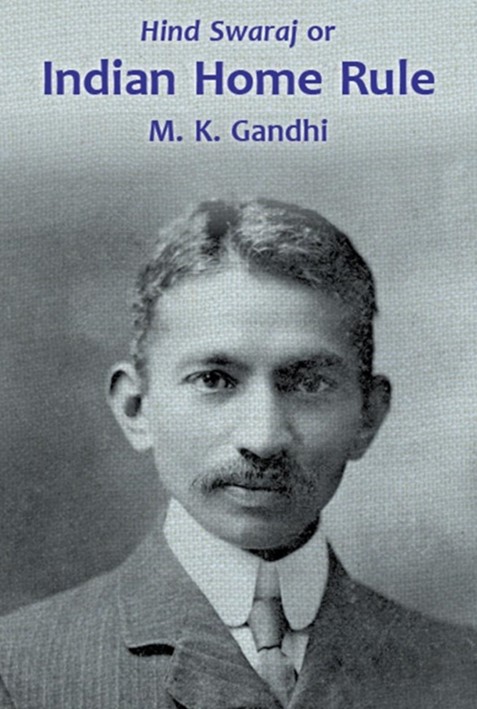
- During a sea voyage to South Africa, Gandhi penned his political manifesto Hind Swaraj or Indian Home Rule. It condemned modern Western civilisation, celebrated Indian spiritual values, and articulated his vision of non-violent self-rule. The book was banned in India in 1910.
Volkrust Satyagraha (1913)
- In 1913, the South African Supreme Court ruled that non-Christian marriages were invalid, delegitimising the marriages of Hindus, Muslims, and Parsis.
- Gandhi expanded the Satyagraha campaign to include:
- Abolition of pass laws
- Recognition of Indian marriages
- Removal of the poll tax
- Opposition to Immigration Restrictions Act
- Women, including Kasturba Gandhi, participated actively and were imprisoned.
- The struggle culminated in the Indian Relief Act (1914), which:
- Abolished the poll tax
- Recognised Indian marriages
- Eliminated the term ‘Asiatic’
- Established voluntary registration
With the passage of this Act, Gandhi ended his mission in South Africa and sailed for India on 19 July 1914, reaching Bombay on 9 January 1915—now commemorated as Pravasi Bharatiya Divas.
Indian Volunteer Corps in London (1914)
- Before returning to India, Gandhi stopped in London in August 1914, hoping to meet Gopal Krishna Gokhale, but missed him.
- With the outbreak of World War I, Gandhi formed the Indian Volunteer Corps in support of the British war effort, believing it was India’s duty as a loyal part of the Empire. However, disagreements with British officials led him to withdraw his support shortly after.
Gandhi’s Evolution in South Africa:
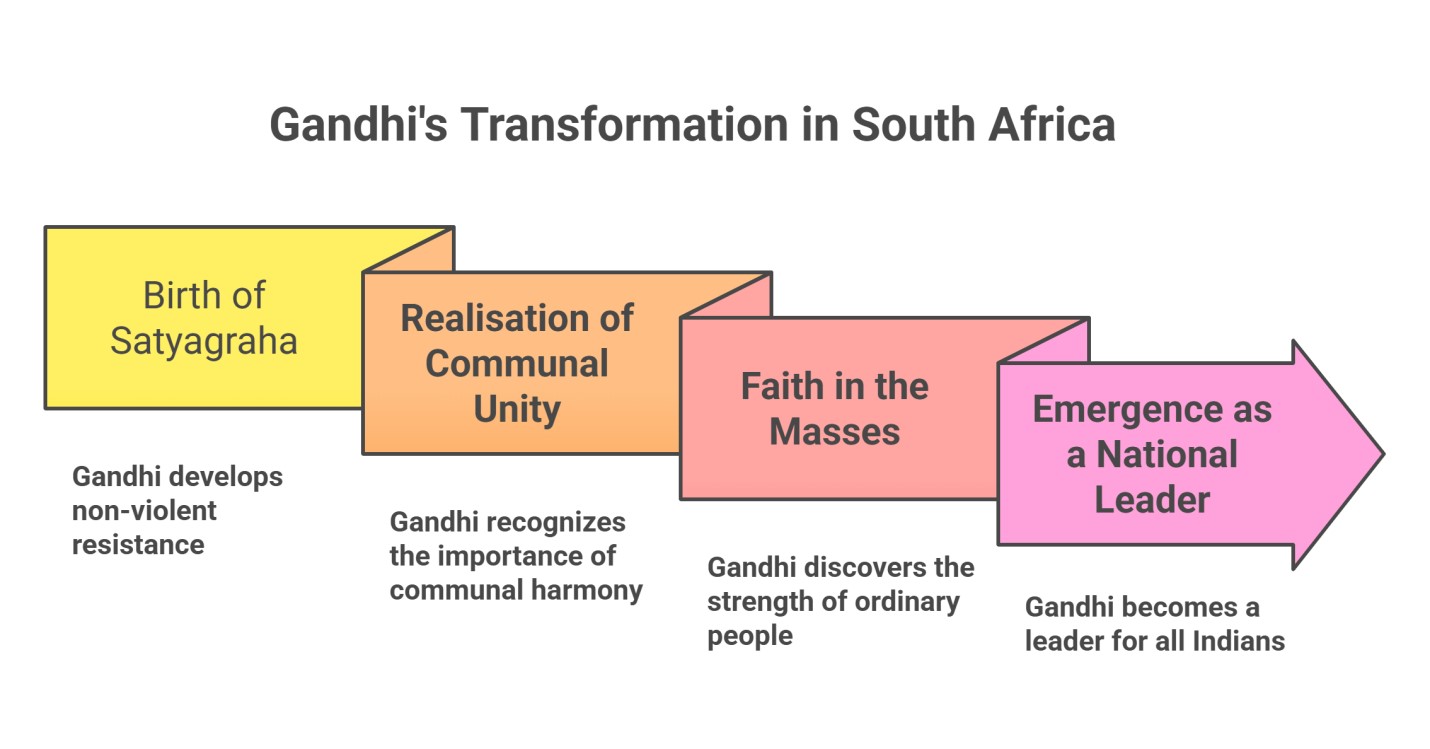
When Mahatma Gandhi left South Africa in 1914, he was a transformed figure—vastly different from the young, hesitant barrister who had first set foot in Durban in 1893. Over a span of twenty-one years, the crucible of South Africa profoundly shaped his ideology, methods of struggle, and leadership vision. It was here that Gandhi was moulded into the Mahatma, and South Africa came to be remembered as the place of his spiritual and political awakening.
Key Lessons and Transformations:
- Birth of Satyagraha: The persistent and principled resistance against racial injustice in South Africa led to the conceptualisation and practice of Satyagraha—a new technique of non-violent resistance grounded in truth (Satya) and non-violence (Ahimsa). This approach would later become the cornerstone of India’s freedom struggle.
- Realisation of Communal Unity: Gandhi recognised through his South African experiences that communal harmony, especially Hindu-Muslim unity, was not only necessary but achievable. He witnessed that people of different faiths could come together on shared issues of justice and dignity.
- Faith in the Masses: Perhaps one of the most profound realisations during this phase was Gandhi’s discovery of the immense strength and moral courage of ordinary people. He understood that even the uneducated and the oppressed possessed a deep capacity to sacrifice and participate in collective action for truth and justice.
- Emergence as a National Leader: The South African struggle transformed Gandhi into a leader of the Indian people as a whole, not merely a representative of any specific region, class, or religious group. He was no longer a passive observer or a legal consultant—he had become a moral and political guide of the oppressed.
Gandhi and Leo Tolstoy:
One of the most influential philosophical connections in Gandhi’s intellectual journey was his engagement with the works of Leo Tolstoy, the Russian writer, thinker, and pacifist.
- In 1893, Gandhi read Tolstoy’s book The Kingdom of God is Within You, which had a profound and lasting impact on his mind. The book’s emphasis on truth, non-violence, morality, and civil disobedience resonated deeply with Gandhi’s evolving beliefs.

- Gandhi was inspired by Tolstoy’s principled defiance of institutional religion, his advocacy of moral autonomy, and his unwavering commitment to non-violent resistance against injustice.
- In 1910, Gandhi initiated a direct correspondence with Tolstoy. He sent him a copy of Joseph Doke’s biography of himself and an English translation of Hind Swaraj (Indian Home Rule), Gandhi’s own political manifesto critiquing modern civilisation and promoting self-rule.
Tolstoy Farm: The Cradle of Satyagraha
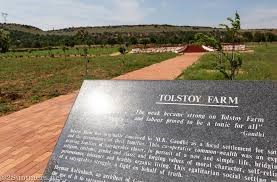
- In the same year, 1910, Gandhi established Tolstoy Farm, located on the outskirts of Johannesburg, as a communal settlement and training ground for Satyagrahis. The Farm was named in honour of Leo Tolstoy, whose teachings had deeply influenced Gandhi.
- At Tolstoy Farm, volunteers lived together in simplicity, discipline, and equality, engaging in manual labour, collective living, and spiritual education. It functioned as a model of self-reliant living, where the values of truth, non-violence, celibacy, and service were practiced daily.
- The Farm served as a precursor to the Sabarmati Satyagraha Ashram, which Gandhi would establish upon returning to India in 1915. It was here that the concept of a disciplined cadre of non-violent warriors took shape—ready to resist injustice not with weapons but with moral force.
The years spent in South Africa were not just a prelude but a foundational phase in Gandhi’s life. It was during this time that he transitioned from Mohandas Karamchand Gandhi to Mahatma Gandhi—a spiritual, political, and ethical leader who would go on to lead India’s non-violent struggle for independence. The ideals he forged in South Africa—Satyagraha, communal harmony, moral discipline, and faith in the people—would become guiding principles of the Indian national movement.
Arrival of Mahatma Gandhi in India (1915)
- Mahatma Gandhi returned to India in January 1915, at the age of 46, after two transformative decades in South Africa. He was given a hero’s welcome upon his arrival, having earned respect for his successful struggle against racial discrimination abroad.
- On the advice of his political mentor Gopal Krishna Gokhale, Gandhi did not immediately plunge into politics. Instead, he spent a year travelling across the country to understand India’s social conditions, its people, and their grievances. He visited Shantiniketan, the school founded by Rabindranath Tagore, and observed Indian society at places like Kumbh Mela in Haridwar.
Satyagraha Ashram
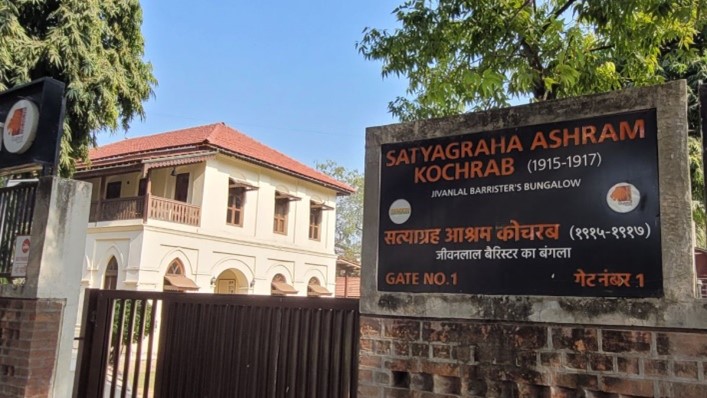
- In May 1915, Gandhi established the Satyagraha Ashram at Kochrab, near Ahmedabad, with the aim of training his followers in truth, non-violence, and self-discipline. In 1917, the ashram was relocated to the banks of the Sabarmati River and came to be known as the Sabarmati Ashram.
- The ashram served as a base for Gandhi’s experiments in communal living, education, and self-reliance, and became the nerve centre of future Satyagraha movements.
- On 26 June 1915, Gandhi was awarded the Kaiser-i-Hind Gold Medal by Lord Hardinge for his humanitarian services during the Boer War in South Africa.
- Despite his growing stature, Gandhi kept away from political agitation during World War I, and even declined Annie Besant’s invitation to join the Home Rule League, as he did not want to disrupt the British war effort.
First Major Public Appearance – BHU Speech (1916)
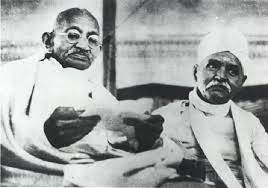
- Gandhi’s first significant political speech in India was at the inauguration of the Banaras Hindu University (BHU) in February 1916.
- In this speech, Gandhi criticised the elitist character of Indian nationalism, pointing out that it was driven by lawyers, doctors, and zamindars, while ignoring the real backbone of the nation – the peasants and common masses.
- He asserted that “the salvation of India lies with the farmers, not with the lawyers or landlords”, thereby signalling his intent to make the freedom struggle more inclusive and mass-based.
Entry into Indian Politics: Gandhi’s Early Satyagrahas (1917–1918)
Between 1917 and 1918, Gandhi actively intervened in three local disputes that showcased his leadership, mass mobilisation skills, and new methods of political resistance:
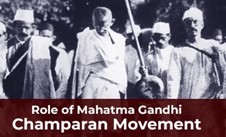
1. Champaran Satyagraha (1917)
- In Champaran, Bihar, European indigo planters forced peasants to cultivate indigo on 3/20th of their land (known as the Tinkathia system) and sell it at unprofitable rates. With the rise of synthetic dyes, indigo lost profitability, and planters began demanding illegal dues from peasants to release them from contracts.
- At the Lucknow Congress session in 1916, a peasant, Rajkumar Shukla, invited Gandhi to visit Champaran.
- Gandhi arrived in April 1917, accompanied by Rajendra Prasad, Mazhar-ul-Haq, B. Kripalani, Narahari Parikh, and Mahadev Desai. He refused to obey official orders to leave the area and was prepared to face jail, initiating his first civil disobedience in India.
- The British were forced to set up the Champaran Agrarian Committee with Gandhi as a member. The committee recommended the abolition of the Tinkathia system, curbing illegal exactions and granting a 25% refund of dues, which damaged the prestige of the British planters.
2. Ahmedabad Mill Strike (1918)
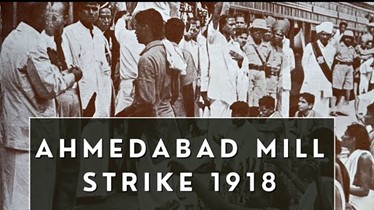
- In 1918, mill workers in Ahmedabad went on strike demanding a 50% wage hike, as the ‘plague bonus’ given during an epidemic was withdrawn despite continued inflation.
- Gandhi was requested to mediate by Ahmedabad’s Collector. He engaged with both workers and millowners, including Ambalal Sarabhai, and proposed a 35% wage hike.
- When negotiations failed, Gandhi launched a hunger strike on 15 March 1918 to support the workers. By 18 March, the millowners agreed to arbitration, and the workers eventually received the full 35% wage increase.
- Gandhi was aided by Anasuya Sarabhai, who played a critical role in organising the workers. This event strengthened the foundation for labour rights in India.
Ahmedabad Textile Labour Association
- In 1920, Anasuya Sarabhai founded the Ahmedabad Textile Labour Association (Majoor Mahajan Sangh), formally inaugurated by Gandhi. This became India’s first successful labour union and introduced non-violent collective bargaining.
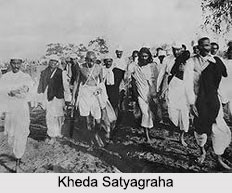
3. Kheda Satyagraha (1918)
- In Kheda district, a famine had reduced agricultural output to less than 25% of the normal. According to law, revenue should have been waived, but the colonial government insisted on collection.
- Local leaders like Mohanlal Pandya and Shankarlal Parikh initiated a campaign. Gandhi, urged by the Gujarat Sabha, joined the movement.
- Gandhi advised peasants to withhold payment of taxes, while remaining non-violent. He was supported by Vallabhbhai Patel, Indulal Yagnik, and Kasturba Gandhi.
- Eventually, the government softened its stance, agreeing not to collect taxes from those unable to pay, which Gandhi saw as a moral victory.
Role of Women
- Women played an active role in this movement, including Kasturba Gandhi, Anasuya Sarabhai, Miraben, Anandibai, and Maniben Patel. They spread awareness through public addresses and bhajan mandalis.
Gujarat Sabha’s Contribution
- Founded in 1884, the Gujarat Sabha was instrumental in organising the Kheda campaign. Gandhi served as its President from 1918 to 1919, transforming it into a platform for mass mobilisation.
Significance of Early Movements
- These initial struggles transformed Gandhi into a national leader and demonstrated the power of non-violent resistance.
- They helped Gandhi build grassroots networks and mobilise the masses, including students, women, peasants, and industrial workers.
- Future stalwarts of the freedom struggle like Rajendra Prasad, B. Kripalani, and Vallabhbhai Patel emerged during these campaigns under Gandhi’s mentorship.
Movement | Year | Gandhi’s Novel Methods |
Champaran Satyagraha | 1917 | First Civil Disobedience Movement |
Ahmedabad Mill Strike | 1918 | First Hunger Strike |
Kheda Satyagraha | 1918 | First Non-Cooperation Movement |
In each of these movements, it was the local population that initially raised their voices and organized resistance. Gandhi’s involvement followed, often at the invitation of regional leaders.The introduction of Gandhian non-violence brought a new, powerful, and morally compelling approach to protest, transforming the nature of resistance into a more effective and legitimate movement.
Gandhian Ideology: Foundations of India’s Moral and Political Awakening
Mahatma Gandhi’s ideology was profoundly ethical, spiritual, and practical, encompassing his views on politics, society, economy, religion, and culture. At its core were the principles of Satyagraha (truth-force), Ahimsa (non-violence), simplicity, and self-reliance. These principles not only guided India’s freedom struggle but also laid a moral framework for national reconstruction.
Influences on Gandhiji’s Ideological Framework
- Family and Upbringing: Gandhi was deeply influenced by his mother Putlibai, whose religious devotion and discipline shaped his early moral compass.
- Religious Traditions: The values of Vaishnavism, Jainism, and sacred Hindu texts like the Bhagavad Gita instilled in him a commitment to non-violence, truth, and self-control.
- Western Thinkers:
- Leo Tolstoy: His work The Kingdom of God is Within You greatly impacted Gandhi’s philosophy of non-violence and spiritual resistance.
- Henry David Thoreau: His essay on Civil Disobedience inspired Gandhi’s concept of non-cooperation with unjust laws.
- John Ruskin: His book Unto This Last shaped Gandhi’s economic thought based on the dignity of labour, simplicity, and the rejection of industrial exploitation.
Satyagraha: The Soul of Gandhian Philosophy
- Satyagraha literally means “holding firmly to the truth.” It is a moral method of non-violent resistance against injustice, first formulated by Gandhi during his South African campaigns and later refined in the Indian context.
- Key Tenets of Satyagraha:
- Resistance to evil must be non-violent, involving self-suffering rather than harm to the opponent.
- It seeks not to defeat the enemy, but to transform their heart and conscience.
- Satyagraha was manifested through non-cooperation, civil disobedience, peaceful picketing, fasting, and constructive work.
- Gandhi believed that only a just and moral method can lead to a just end. Hence, for him, means were as important as ends.
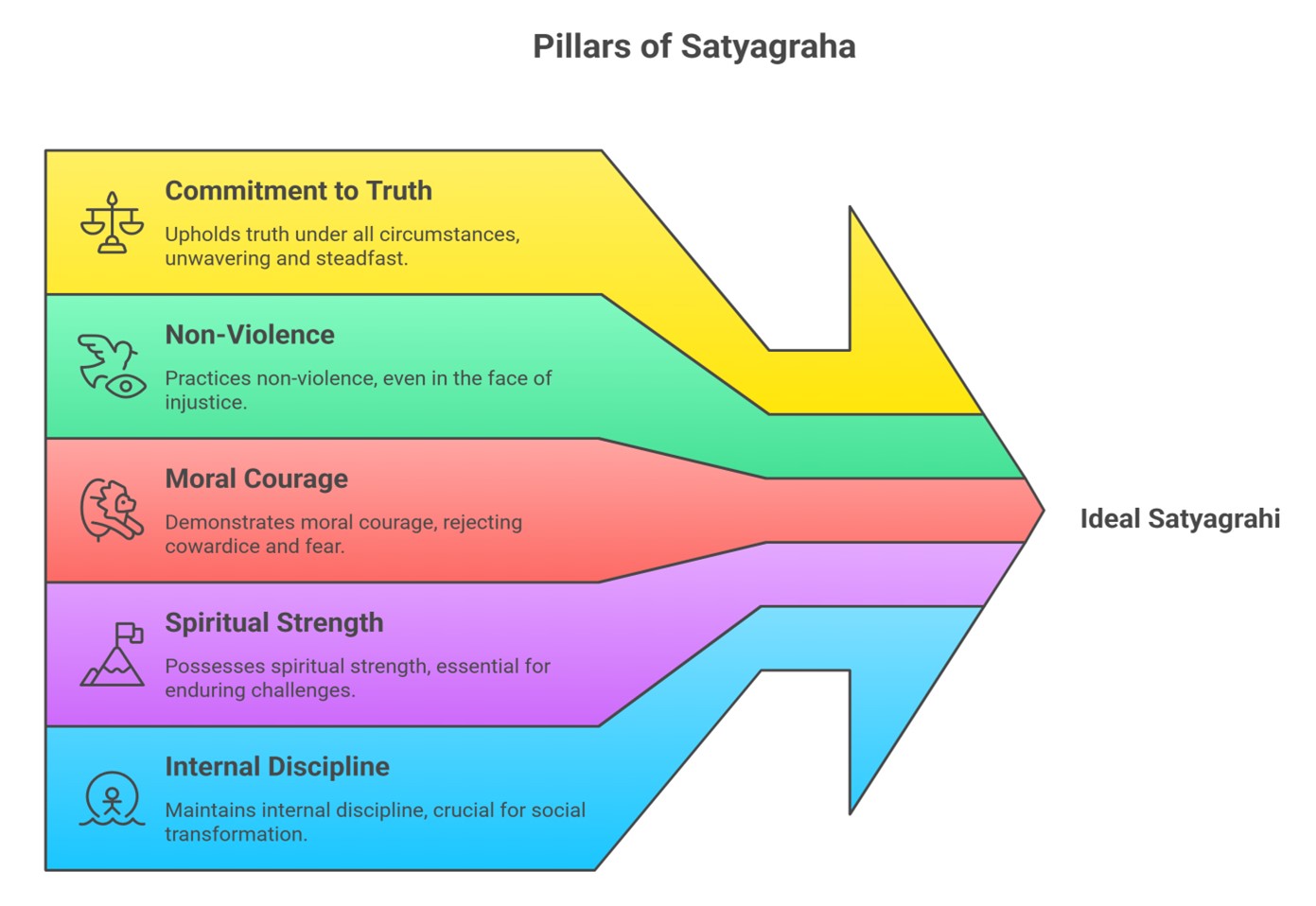
Characteristics of an Ideal Satyagrahi
- Committed to truth (Satya) and non-violence (Ahimsa) under all circumstances.
- Refuses to cooperate with unjust laws or authorities, but always without hatred.
- Accepts suffering willingly without retaliation or resentment.
- Upholds moral courage and spiritual strength, rejecting cowardice.
- Abstains from violence, lies, and anger, believing that internal discipline is essential for social change.
Satyagraha vs. Passive Resistance: A Philosophical and Moral Distinction
Mahatma Gandhi made a clear and principled distinction between Satyagraha and passive resistance, despite their apparent similarities.
- Passive resistance, according to Gandhi, is often employed as a temporary strategy, rooted in expediency or weakness. It may allow the use of force or violence under extreme conditions and does not necessarily arise from a deep commitment to non-violence or truth. It is a tactical withdrawal rather than a transformative force.
- In contrast, Satyagraha is a proactive, moral, and spiritual method of resistance. It is grounded in truth (Satya) and non-violence (Ahimsa) and is pursued only by those possessing moral courage and spiritual strength. Satyagraha is not a weapon of the timid or fearful—it is the tool of the ethically resolute, who willingly embrace suffering rather than submit to injustice.
Thus, Satyagraha is not merely passive defiance but an assertive, transformative, and moral force, designed not just to resist evil but to convert the evildoer through self-suffering and love.
Non-Violence (Ahimsa):
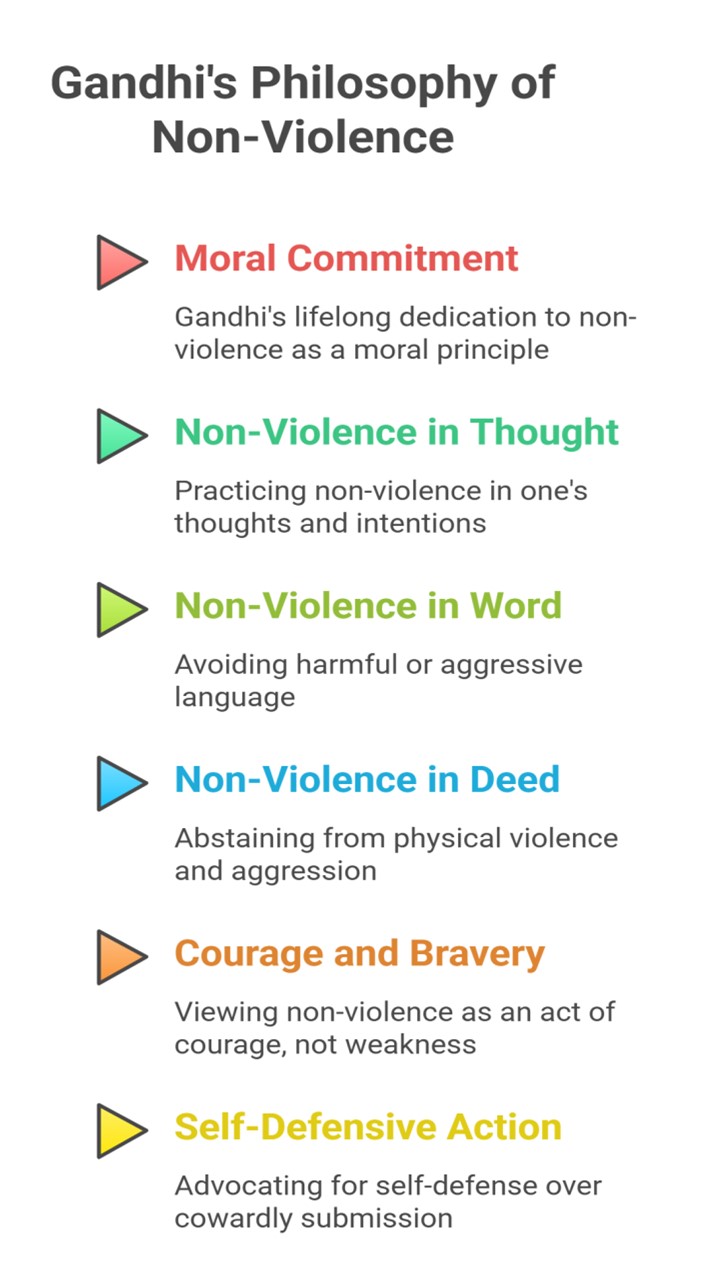
- For Gandhi, Ahimsa (non-violence) was not a mere political expedient but a lifelong moral commitment. He considered non-violence as the supreme virtue, not of the weak, but of the courageous and brave.
- He believed that true Ahimsa meant non-violence in thought, word, and deed. It demanded not only abstinence from physical violence but also the elimination of hatred, revenge, and aggression from one’s heart.
- While Gandhi staunchly opposed violence, he acknowledged that cowardly submission to evil was worse than violence. In such cases, he advocated self-defensive action as morally superior to spineless surrender.
Gandhiji’s Religious Outlook:
- Gandhi’s concept of religion was deeply universalistic and inclusive. He did not view religion as adherence to a set of rituals, dogmas, or scriptures. Rather, he defined it as a quest for truth (Satya) and a guiding force for ethical conduct.
- Religion, for Gandhi, was not a private matter but a vital part of public and political life. He believed politics devoid of religion was immoral, though his understanding of religion transcended sectarian boundaries.
- His religious convictions shaped his political actions:
- Khilafat Movement: Gandhi supported this movement not for theological reasons, but as a means to forge Hindu-Muslim unity.
- Ram Rajya: Gandhi invoked this term not as a religious theocracy, but as an ideal of just, moral, and egalitarian governance.
Critique: Gandhi’s religious symbolism helped mobilise the masses, but it also blurred the boundaries between religion and politics, leaving space for communal tensions that would emerge later in India’s political journey.
Cultural Perspective and National Identity
- Gandhi was a proud Hindu, yet he had a remarkably inclusive and pluralistic cultural outlook.
- He envisioned Indian culture not as a monolith, but as a composite civilisation, enriched by Hindu, Islamic, Christian, Sikh, and other traditions.
- He urged Indians to remain rooted in their cultural heritage, while also being open to the wisdom of other civilisations. He believed in cultural introspection, rather than blind imitation of the West.
- Gandhi’s idea of national identity was civilisational, not racial or religious. His vision of Indianness was ethical, moral, and inclusive.
Swadeshi and Economic Views:
- Swadeshi was a core tenet of Gandhi’s economic philosophy. He advocated economic self-sufficiency through indigenous production, especially through the revival of hand-spun Khadi and village industries.
- Gandhi’s economic model was ethical and decentralised, rooted in trusteeship, non-exploitation, and community welfare.
- Although opposed to Western industrialism, Gandhi was not anti-industrialisation. He supported humane and decentralised industries, and maintained strong relationships with industrialists like Ambalal Sarabhai and D. Birla.
- He proposed the doctrine of “Trusteeship”, whereby:
- Capitalists must act as trustees of their wealth, managing it for the welfare of society rather than private gain.
- There should be mutual respect and cooperation between labour and capital, promoting class harmony over class struggle.
- Gandhi discouraged class-based politics and favoured moral persuasion and unity across all social divisions, believing that ethical transformation was more enduring than political agitation.