
Nationalist Movement 1905-1918
Militant Nationalism in India (1905–1917)
The rise of militant nationalism in India marked a shift in strategy and ideological temperament within the Indian national movement during the early 20th century. This phase, also known as Extremist Nationalism or Assertive Nationalism, was a response to colonial repression, moderate failure, and the growing realisation that constitutional methods alone would not achieve freedom.
While it came to the forefront during the anti-Partition movement in Bengal in 1905, the roots of militant nationalism can be traced back to the growing discontent since the Revolt of 1857.
Characteristics of Militant Nationalism
- The extremists or militant nationalists rejected the belief in the benevolence and justice of British rule, a principle that earlier moderates had clung to.
- They denounced petitions, memorandums, and constitutional methods as ineffective.
- They believed in the moral strength of the people, emphasised self-reliance, and advocated for aggressive political agitation against British colonialism.
Three Geographical Centres of Extremism
The extremist movement drew strength from various parts of India, each led by towering personalities:
- Maharashtra: Led by Bal Gangadhar Tilak
- Bengal: Represented by Bipin Chandra Pal and Aurobindo Ghose
- Punjab: Led by Lala Lajpat Rai
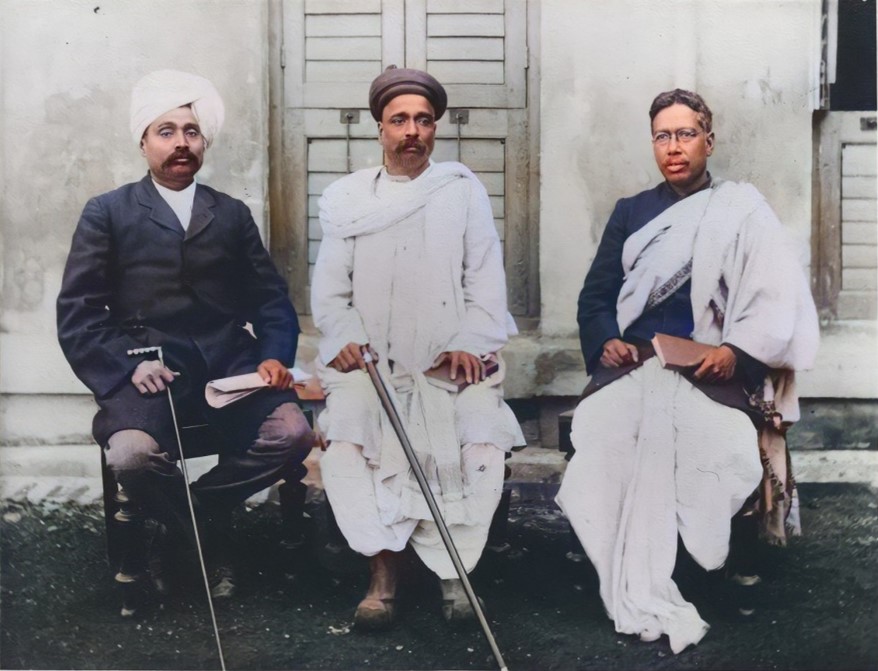
These leaders collectively came to be known as Lal-Bal-Pal, symbolising the assertive phase of nationalism.
Methods of Political Action
The extremists adopted a multi-pronged militant strategy, which included the following key components:
- Boycott of British goods and simultaneous promotion of Swadeshi products, to boost indigenous industries and reduce economic dependence on Britain.
- Non-cooperation with colonial institutions, including refusing government posts, boycotting colonial courts, and disrupting administrative machinery.
- Establishment of national schools and colleges, which imparted education in Indian languages, fostered pride in Indian history and culture, and promoted patriotism, self-discipline, and nationalism among youth.
- Passive resistance, which involved refusal to pay taxes, denial of government services, and creation of parallel indigenous institutions in villages, talukas, and districts to challenge colonial authority.

The extremists believed in complete devotion to the national cause, making political activism a full-time mission. They mobilised the masses through cultural and religious symbols, such as Shivaji, Ganapati, and Goddess Kali, to foster a sense of unity and resistance.
Factors behind the Rise of Militant Nationalism
The emergence of extremist nationalism was influenced by a combination of domestic disillusionment and global developments. Below are the major causes:
1. Failure of Moderate Politics
- The moderates had played a crucial role in exposing the exploitative nature of British rule, but their constitutional and petition-based methods failed to yield substantive results.
- The British Government rejected even their most reasonable demands, and key acts like the Indian Councils Act of 1892 proved disappointing.
- This generated frustration and disillusionment, especially among the youth, and prompted a shift towards more assertive methods.
2. Recognition of the Real Nature of British Rule
- By the late 19th century, many Indians no longer believed that British rule could be reformed from within.
- Political repression during 1892–1905 further exposed the colonial state’s authoritarianism:
- Deportation of the Natu brothers (1897) without trial
- Imprisonment of Bal Gangadhar Tilak and others for sedition
- Passage of repressive laws, including one in 1898 criminalising “disaffection” toward the government.
These developments eroded the legitimacy of British rule and reinforced the belief that only self-government could secure India’s future.
3. Growth of Education and Rising Unemployment
- Western education, introduced by the British, unintentionally created a new class of politically conscious Indians.
- However, by the end of the 19th century:
- Employment opportunities were scarce
- Educated Indians faced poverty and frustration
- Many were forced to take low-paying government jobs or remain unemployed, leading them to question the colonial structure.
This educated class became the vanguard of the extremist movement, spreading political ideas, mobilising youth, and demanding complete Swaraj.
4. Growth of Self-respect and Confidence
- Influential leaders like Tilak and Bipin Chandra Pal instilled in people a sense of pride in India’s past and confidence in self-governance.
- They emphasised self-help, self-reliance, and belief in Indian capacity for nation-building.
- The idea of depending on British goodwill was replaced by belief in Indian strength and destiny.
5. Presence of a Militant School of Thought
- Even during the early stages of the national movement, a militant ideological stream existed.
- Pioneers included:
- Rajnarain Bose
- Ashwini Kumar Dutt
- Vishnu Shastri Chiplunkar
- The later generation of militant nationalists included:
- Bal Gangadhar Tilak
- Bipin Chandra Pal
- Aurobindo Ghose
- Lala Lajpat Rai
They envisioned Swaraj as the ultimate goal and believed it could be attained only through mass mobilisation and political resistance.
6. Influence of International Events
Events outside India played a crucial role in shattering the myth of European invincibility:
- Ethiopia’s victory over Italy in 1896
- The Boer resistance to British imperialism in South Africa (1899–1902)
- Japan’s defeat of Russia in 1905, which particularly inspired Asian nations, including India, as a symbol of non-Western strength.
These events proved that even mighty imperial powers could be defeated, and they greatly boosted the morale of Indian nationalists.
7. Repressive Policies of Lord Curzon (1899–1905)
Lord Curzon’s administration became a turning point in radicalising Indian political opinion. His autocratic decisions undermined Indian autonomy and sparked mass resistance.
Key Controversial Acts:
- Calcutta Municipal Amendment Act (1899): Reduced the number of elected Indians in the Calcutta Corporation, curbing civic representation.
- Indian Universities Act (1904):
- Decreased Indian representation in university senates.
- Gave colonial officials control over grants and affiliations.
- Seen as an effort to suppress nationalist education.
- Indian Official Secrets Act Amendment (1904): Further curtailed press freedom and public dissent.
- Partition of Bengal (1905):
- Announced by Curzon in July 1905
- Seen by Indian nationalists as a deliberate attempt to divide Bengalis on religious lines and weaken the growing nationalist movement
- Led to widespread outrage, galvanising the Swadeshi and boycott movements.
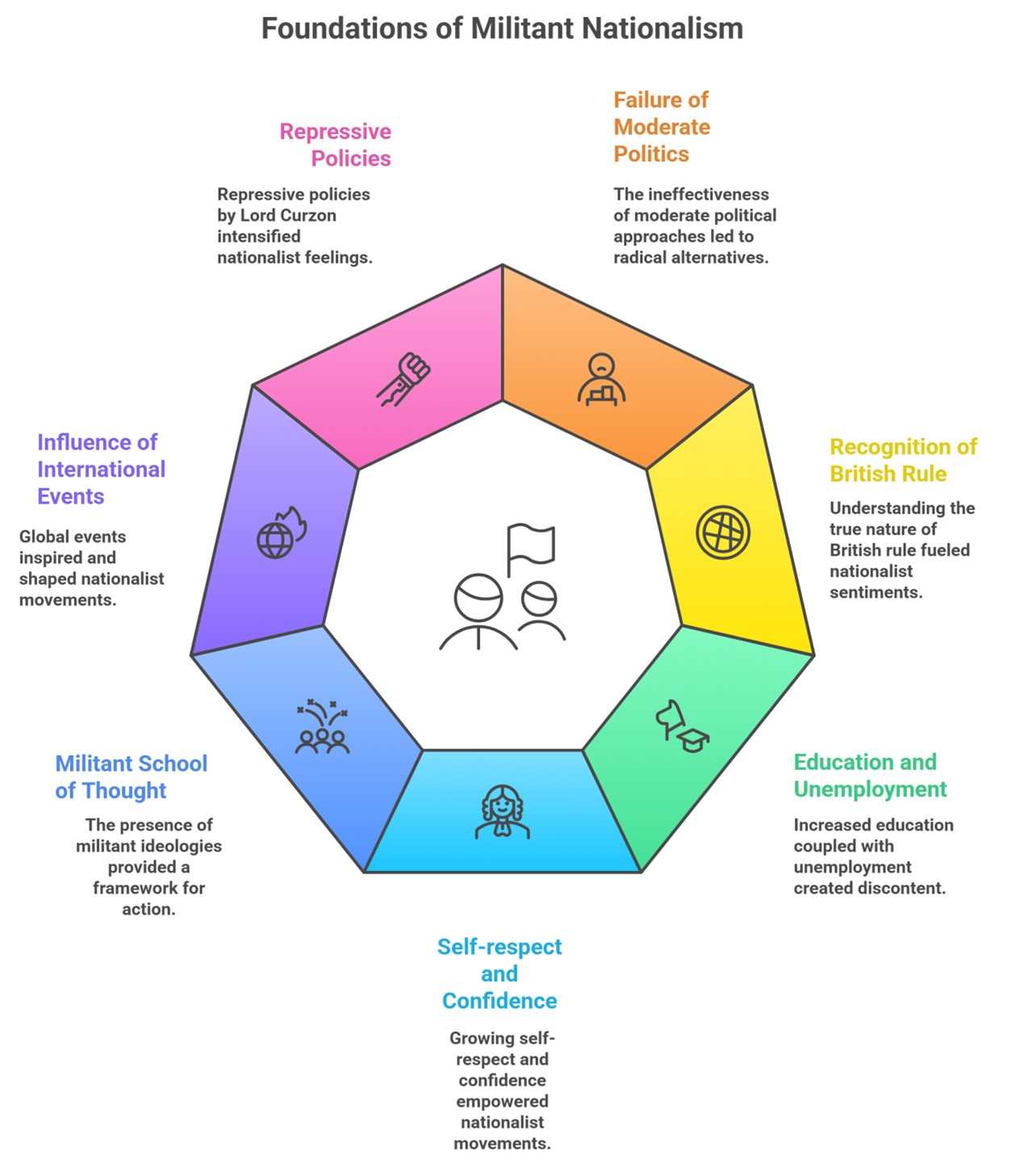
The militant nationalist phase of India’s freedom struggle was a logical outcome of political awakening, moderate failures, and increasing awareness of colonial exploitation. Leaders like Tilak, Pal, Lajpat Rai, and Aurobindo Ghose gave the national movement a new dimension—one that emphasised self-rule, mass participation, cultural pride, and moral courage.
Partition of Bengal (1905):
The Partition of Bengal, implemented on 16 October 1905 by Lord Curzon, was a pivotal turning point in the history of the Indian freedom struggle. Although the British administration claimed the move was made for administrative convenience, the Indian public widely perceived it as a deliberate strategy to divide and rule, aimed at weakening the burgeoning nationalist sentiment, particularly in Bengal.
The Bengal Presidency before Partition
Before the partition, Bengal Presidency was the largest province under British India, encompassing modern-day West Bengal, Bangladesh, Bihar, Odisha, and Assam. With a population of nearly 80 million, the British cited administrative inefficiency as the rationale behind dividing the province. However, nationalists revealed the ulterior political motives:
- To diminish the political influence of the Bengali intelligentsia.
- To disrupt Hindu-Muslim unity by creating religious divisions.
- To destabilise Calcutta, the epicentre of Indian nationalism.
The Division: Official Declaration and Implementation
The British Government justified the partition by citing the unwieldy size and population of the Bengal Presidency, which then comprised Bengal, Bihar, Odisha, and Assam, housing a population of nearly 80 million.
Under the partition:
1. Eastern Bengal and Assam
- Capital: Dacca (now Dhaka)
- Population: 31 million
- Majority: Muslim
2. Western Bengal (including Bihar and Odisha)
- Population: 54 million
- Demographics: 18 million Bengalis, 36 million Biharis and Odias.
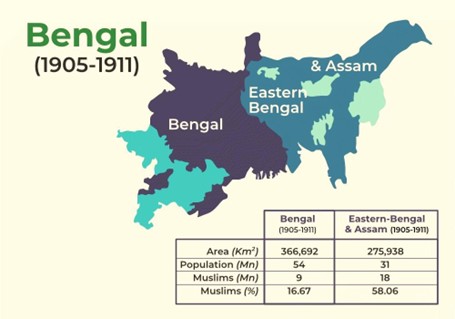
This restructuring marginalised the Bengalis, who were reduced to a minority in both provinces, thereby diminishing their political and administrative influence.
Contributions of the Swadeshi Movement
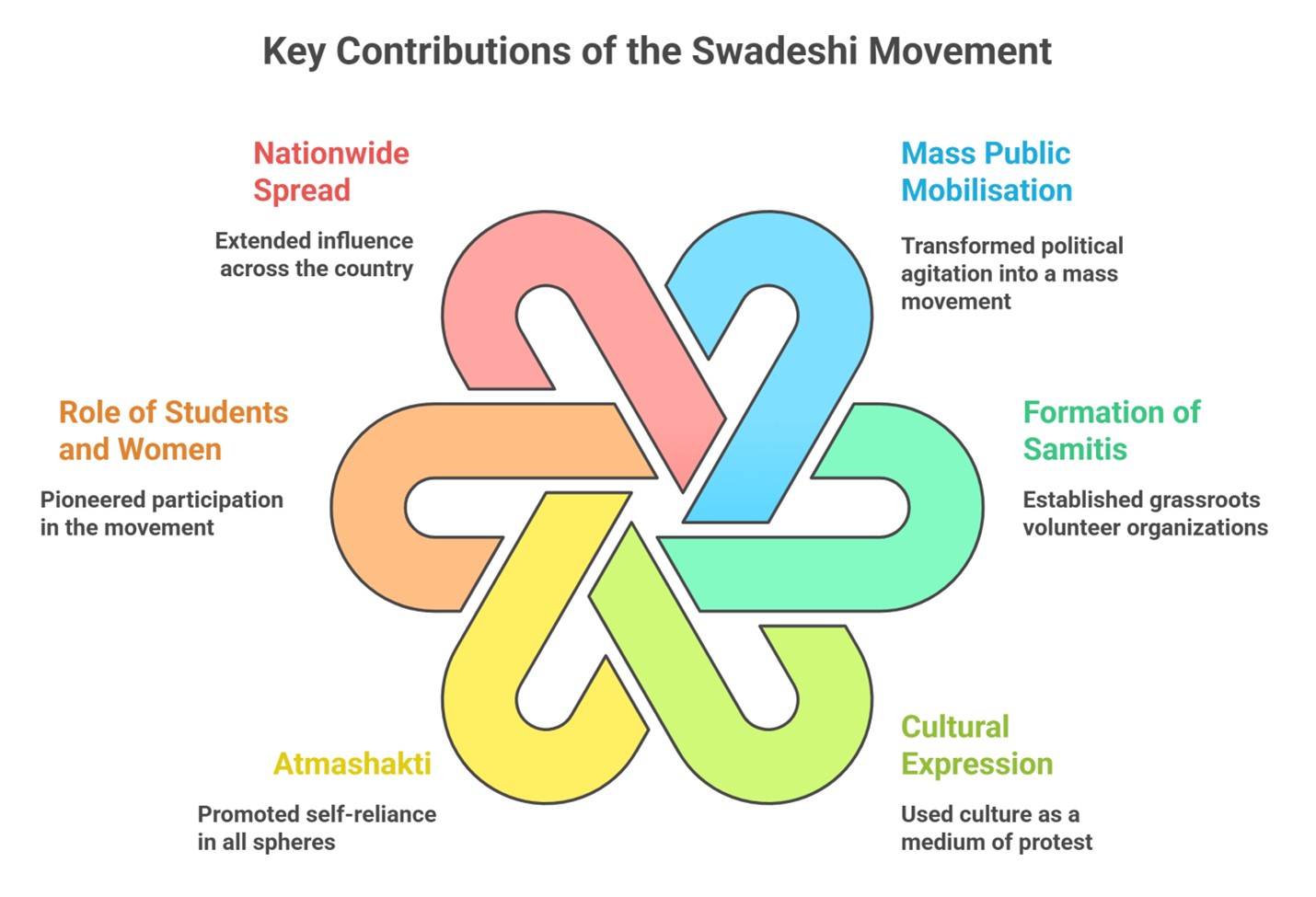
1. Mass Public Mobilisation
The Swadeshi Movement marked the transformation of political agitation into a mass-based movement.
- Public meetings, street processions, lectures, and demonstrations became powerful tools for spreading nationalist sentiments.
- These efforts politicised the common masses, creating unprecedented levels of national consciousness among students, women, traders, and artisans.
2. Formation of Samitis (Volunteer Organisations)
The movement saw the establishment of numerous grassroots volunteer organisations, the most notable being the Swadesh Bandhab Samiti.
These Samitis took up multi-dimensional roles:
- Dissemination of Swadeshi propaganda
- Relief during famines and epidemics
- Village-level arbitration and dispute resolution
- Health services and sanitation drives
- Promotion of indigenous crafts and traditional industries
- Establishment of national schools to counter colonial education.
These groups served as parallel civil institutions, building a foundation of self-governance and social service.
3. Cultural Expression and Use of Festivals
Nationalist leaders ingeniously employed culture as a medium of protest.
- Folk dramas (jatras), patriotic songs, and storytelling were used to communicate political messages to illiterate and rural audiences.
- Tilak popularised Ganapati and Shivaji festivals in Maharashtra and Bengal, transforming them into forums for nationalist mobilisation and unity.
- These events combined spiritual devotion with political awakening, building solidarity among diverse communities.
4. Atmashakti (Self-Reliance):
The idea of Atmashakti, or self-strengthening, lay at the heart of the Swadeshi Movement. It promoted self-reliance in all spheres—economic, educational, and social.
Economic Self-Reliance:
Several indigenous industries were established to reduce dependence on British imports:
- Bengal Chemical and Pharmaceutical Works – founded by Acharya P.C. Ray in 1901
- Swadeshi Steam Navigation Company – launched by O. Chidambaram Pillai in 1906, to challenge British shipping monopoly.
National Education Movement:
The movement gave birth to institutions aimed at imparting education rooted in Indian values and culture:
- Bengal Technical Institute (1906)
- National Council of Education
- National College, Calcutta, with Aurobindo Ghose as its first Principal
- Inspired by Rabindranath Tagore’s Shantiniketan (1901), these institutions fostered patriotism, scientific temper, and cultural pride.
Social Reform Initiatives:
The Swadeshi spirit extended into societal transformation, with active campaigns against:
- Caste discrimination
- Dowry practices
- Child marriage
- Alcoholism and other social evils.
These reforms reflected the movement’s holistic vision of national regeneration.
5. Role of Students and Women:
Students:
- Students became foot soldiers of the movement, leading picketing drives, awareness campaigns, and anti-colonial protests.
- They braved expulsions from schools and colleges, endured physical assaults and incarceration, yet remained unshaken in their commitment to the nationalist cause.
Women:
- Broke social barriers by stepping into the public sphere—leading rallies, participating in boycotts, and mobilising support within families and communities.
- Their bold presence marked the beginning of active female participation in India’s freedom struggle and symbolised the awakening of a new national consciousness.
6. Nationwide Spread and Enduring Legacy
Though the epicentre of the Swadeshi Movement was Bengal, its ideals and influence radiated across the country:
- In Andhra Pradesh, the movement gained the name “Vandemataram Movement”, symbolising unity and resistance.
- Bal Gangadhar Tilak played a crucial role in expanding the Swadeshi message to western and southern India, using festivals, newspapers, and public speeches to inspire regional participation.
7. Impact at a National Scale
- The movement deepened the roots of Indian nationalism by integrating economic, cultural, and social dimensions of resistance.
- It marked the first significant mobilisation of students and women, setting a precedent for future mass movements under leaders like Mahatma Gandhi.
- The ethos of Atmashakti and Swadeshi remained foundational in later movements like the Non-Cooperation Movement (1920) and the Civil Disobedience Movement (1930s).
Achievements and Limitations
Achievements:
- Deepened nationalist consciousness.
- Extended political awareness to students, women, artisans, and traders.
- Sparked a cultural and intellectual renaissance in literature, science, and arts.
- Popularised economic self-sufficiency and non-cooperation as tools of resistance.
Limitations:
- Limited Muslim participation, as the British successfully fostered communal divides.
- Birth of the All India Muslim League (1906) under British patronage.
- Peasants and labourers remained marginalised, making it an urban middle-class movement.
- Extremist leaders struggled to sustain mass momentum after initial mobilisations.
- The movement waned post-Surat Split and due to severe repression.
Achievements | Limitations |
Deepened nationalist consciousness | Limited Muslim participation due to British-fostered communal divides |
Extended political awareness to students, women, artisans, and traders | Birth of the All India Muslim League (1906) under British patronage |
Sparked a cultural and intellectual renaissance in literature, science, and arts | Peasants and labourers remained marginalised—movement largely urban and middle-class |
Popularised economic self-sufficiency and non-cooperation as tools of resistance | Extremist leaders struggled to sustain momentum after initial mobilisations |
Movement declined after the Surat Split and due to severe British repression |
Indian National Congress (1905–1914)
The period between 1905 and 1914 marked a critical phase in the history of the Indian National Congress (INC), as it witnessed intensified nationalist agitation, internal ideological divisions, and significant constitutional developments.
1. Impact of the Bengal Partition on Congress
The partition of Bengal in 1905, orchestrated by Lord Curzon, had a profound impact on Indian politics. It united various factions of the Congress against a common cause and fuelled nationalist sentiments across the country. At the Benaras Session (1905), Gopal Krishna Gokhale, who presided over the session:
- Condemned the partition of Bengal as a deliberate attempt to divide Indian society.
- Criticised Lord Curzon’s autocratic governance.
- Extended Congress support to the Swadeshi and Boycott movements initiated in Bengal.
This period marked the emergence of a rift within Congress between the Moderates and Extremists (Militant Nationalists).
2. Ideological Divide and the Calcutta Session (1906)
By 1906, internal tensions between the two factions intensified:
Extremists, led by Bal Gangadhar Tilak, Bipin Chandra Pal, and Aurobindo Ghose, advocated for:
- The expansion of the Swadeshi and Boycott Movements beyond Bengal.
- The boycott of British-controlled institutions and complete political severance.
Moderates, including leaders like Gopal Krishna Gokhale and Dadabhai Naoroji, wanted to:
- Restrict the movement to Bengal.
- Limit the boycott to foreign goods
Presidential Conflict
The extremists proposed Tilak for the presidency of the Calcutta Session (1906), while the moderates rejected it. As a compromise, Dadabhai Naoroji, revered across factions, was chosen.
Significant Resolutions Passed
Four major resolutions were adopted:
- Swadeshi
- Boycott of foreign goods
- Promotion of National Education
- Attainment of Swaraj (self-government)
In his presidential address, Naoroji famously declared Swaraj as the ultimate goal of the Indian National Congress, envisioning self-governance within the British Empire, akin to the status enjoyed by colonies like Canada or Australia.
3. Surat Split (1907):
The Surat Session (1907) marked the culmination of ideological friction:
- Extremists wanted:
- The session to be held in Nagpur, ensuring the selection of Tilak or Lala Lajpat Rai as president.
- Retention of the four Calcutta resolutions.
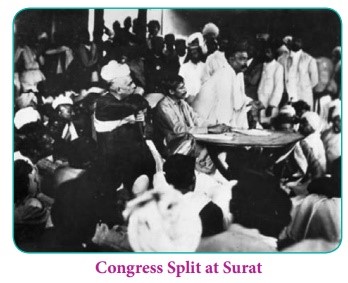
- Moderates planned the session in Surat (Tilak’s home province) to disqualify him from the presidency. They proposed Rash Behari Ghosh as the president and attempted to drop the Calcutta resolutions.
The meeting descended into chaos. Verbal altercations escalated into physical confrontations—turban-throwing, stick-brandishing, and broken chairs. Ultimately, the Congress split, with Moderates retaining control of the Congress machinery and Expelled Extremists forming a separate pressure group.
Aftermath of the Surat Split
- The Moderates abandoned the radical agenda of earlier sessions.
- They gradually lost public confidence, while Extremists like Tilak gained mass sympathy.
- The British government exploited this divide through a calculated policy of “Divide and Rule”.
- Extremists faced severe repression, while Moderates were pacified through conciliatory gestures.
4. British Strategy- The Carrot-and-Stick Policy
The government adopted a threefold policy:
- Mild repression of Extremists to intimidate Moderates.
- Appeasement of Moderates through offers of constitutional reforms.
- Full-scale suppression of Extremists once Moderates were pacified.
Both factions failed to grasp this strategy:
- Moderates overestimated their leverage with the government.
- Extremists failed to see the Moderates as a protective buffer.
- A united front, crucial in a country of India’s size and diversity, remained elusive.
The Indian Councils Act of 1909, popularly known as the Morley-Minto Reforms, was enacted during a period of intensifying political awakening in India. The early 20th century was marked by increasing dissatisfaction with British rule, sparked by events such as the Partition of Bengal (1905), the rise of revolutionary activities, and the internal division within the Indian National Congress (notably the Surat Split of 1907).
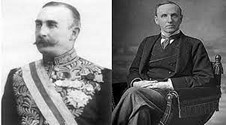
In response to these developments, the British Liberal Party came to power in 1905, with John Morley as the Secretary of State for India, and Lord Minto as the Governor-General. The colonial administration, facing mounting pressure both at home and in India, sought to implement measured constitutional reforms to pacify Indian demands while retaining effective imperial control.
Key Features of the Indian Councils Act, 1909
1. Expansion of Legislative Councils
One of the key provisions of the Act was the significant expansion of the legislative councils at both the central and provincial levels.
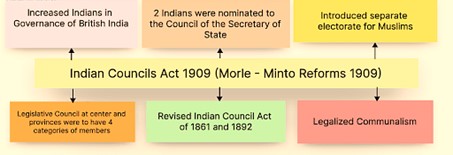
- The Imperial Legislative Council was expanded from 16 to 60 members.
- Provincial Legislative Councils were similarly enlarged:
- 50 members in provinces like Bengal, Bombay, Madras, United Provinces, Bihar, and Orissa.
- 30 members in smaller provinces such as Punjab, Assam, and Burma.
While this appeared to be a step forward, the official majority was retained, ensuring that real power remained with the British.
2. Introduction of Indirect Elections
The Act introduced indirect elections for the first time in India’s legislative system.
- Members were not elected directly by the people, but through a complex process:
- Municipal bodies, district boards, and universities elected representatives to the Provincial Councils.
- These Provincial Councils, in turn, elected members to the Imperial Legislative Council.
Although this brought Indian participation into the legislative process, it fell short of genuine democratic representation.
3. Communal Electorates for Muslims
Perhaps the most controversial feature of the 1909 Act was the introduction of separate electorates for Muslims:
- Muslim voters could vote only for Muslim candidates, a move justified by the British as a safeguard for minority rights.
- In reality, it was a calculated strategy to divide Indians along religious lines, thereby weakening the emerging sense of Indian nationalism.
Consequences:
- Fostered communalism and sectarian politics.
- Undermined national unity and the potential for a united anti-colonial front.
- Shifted focus from collective socio-economic demands to communal identities.
4. Principle of Weightage
The British further appeased Muslim interests by implementing the principle of weightage:
- Muslim representation was deliberately exaggerated beyond their proportion in the population.
- This was a form of political appeasement designed to win over the Muslim elite and fragment nationalist consolidation.
5. Enlargement of Council Functions
Although limited in power, the Act provided certain rights to Indian members within the councils:
- Members could now ask supplementary questions.
- They were allowed to vote on specific budgetary items, though most budget matters remained off-limits.
- They could move resolutions on public issues, albeit non-binding.
Examples:
- In 1910, Gopal Krishna Gokhale moved a historic resolution demanding the abolition of indentured labour in Natal.
- Madan Mohan Malaviya delivered influential speeches opposing the Rowlatt Bills and the Indemnity Acts, highlighting the growing assertiveness of Indian voices within limited forums.
6. Inclusion of Indians in Executive Councils
For the first time, the Act allowed the Viceroy and provincial Governors to nominate Indians to their Executive Councils:
- In 1909, Satyendra Prasad Sinha was appointed to the Governor-General’s Executive Council, becoming the first Indian to hold such a position, responsible for Legal Affairs.
This was symbolic progress, intended more for British image management than meaningful power-sharing.
7. Inclusion in the Secretary of State’s Council
In 1907, two prominent Indians—Krishna Govinda Gupta and Nawab Syed Hussain Bilgrami—were appointed to the India Council in London, which advised the Secretary of State.
Though significant on paper, this body held limited influence, and these appointments were largely cosmetic gestures.
Evaluation of the Morley-Minto Reforms
Despite the façade of liberal reform, the Indian Councils Act of 1909 was deeply flawed in intent and execution.
- It failed to democratise Indian administration, as real power continued to rest with the British executive.
- Legislative councils remained advisory bodies without effective decision-making authority.
- The introduction of separate electorates sowed the seeds of communal division, weakening the broader nationalist movement.
- The reforms were intended to placate Moderate nationalists, undermine Extremists, and divert attention from genuine self-rule.
The Act was a tactical response, not a step towards democratic governance.
The decade from 1905 to 1914 stands as a pivotal phase in India’s nationalist struggle. While it showcased the rising political maturity of Indian leaders and the emergence of mass-based movements, it also highlighted deep ideological rifts. The Surat Split, coupled with the Morley-Minto Reforms, fragmented the national movement, enabling the British to consolidate control. Yet, this period laid the foundation for future unity, and sowed the seeds for Gandhian mass mobilisation that would follow in the next phase of the freedom struggle.