
Major Factors Contributing to the Rise of National Consciousness
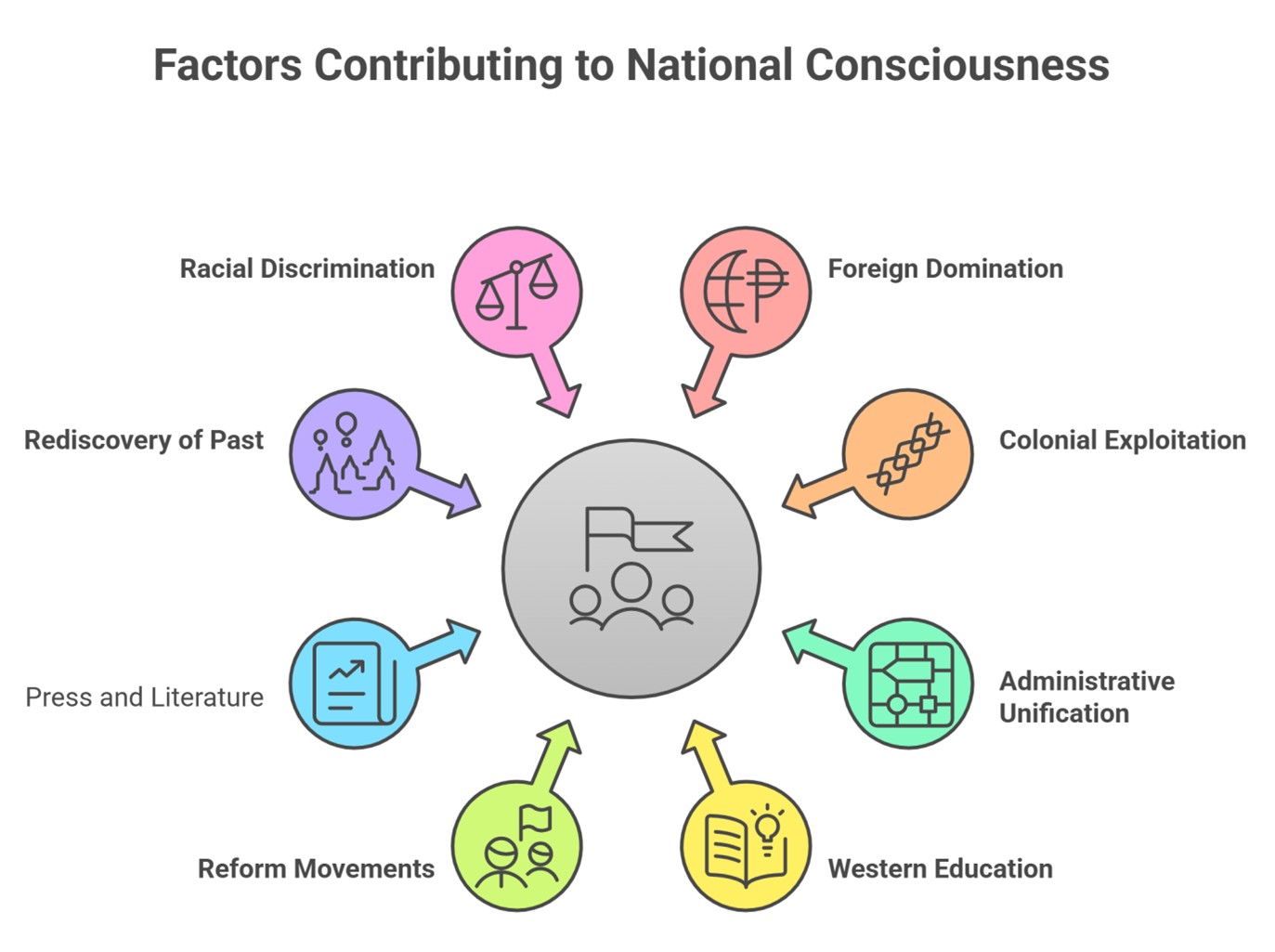
1. Foreign Domination and Its Consequences
- The alien nature of British rule, its exploitative policies, and racial arrogance sowed the seeds of patriotic resistance among Indians.
- The rule of a foreign power for economic and political gain, with no commitment to Indian welfare, created a shared sense of suffering across all sections of society.
- This conflict of interest between India and Britain formed the material basis of the Indian national movement.
The national movement became inclusive as various classes—peasants, workers, artisans, and educated Indians—transcended their differences to unite against a common foreign adversary.
2. Class-Based Realisation of Colonial Exploitation
Peasantry
Peasants came to understand that:
- The colonial government imposed exorbitant land revenue, burdening rural cultivators.
- It actively protected zamindars and landlords, who often exploited and oppressed the peasantry.
Artisans and Handicraft Workers
They realised that:
- The colonial administration promoted the influx of cheap, machine-made imports, which severely damaged local artisanal industries.
- There was no initiative to revive traditional crafts or provide alternative means of livelihood.
Industrial Working Class
Workers in plantations and factories observed that:
- The British government aligned itself with foreign industrialists.
- Labour rights were neglected, and working conditions remained exploitative and harsh.
- The potential for industrial development, which could have reduced unemployment, was stifled under imperial control.
Educated Indians
This class became the core of the early nationalist movement.
- Their Western education enabled them to critically examine British colonialism.
- Economically, they observed that Britain had transformed India into a supplier of raw materials and a market for British products.
- Politically, they felt betrayed by British claims of promoting Indian welfare, as Indians were now denied self-governance and civil liberties were curtailed rather than expanded.
Indian Capitalists
Initially politically dormant, Indian capitalists gradually realised:
- Imperial policies hindered the growth of Indian industries.
- The colonial administration favoured foreign capitalists in matters of taxation, trade, and transport.
- A national government was essential for creating a supportive environment for industrialisation.
Zamindars, Landlords, and Princes
While these groups generally supported British rule to safeguard their privileges.
- A significant number of individuals from aristocratic families joined the national movement, motivated by growing patriotic fervour and rising nationalist ideals.
3. Administrative and Economic Unification of India
- The British, in their quest to control the Indian subcontinent, unintentionally unified India administratively and economically, laying the groundwork for national integration.
Administrative Unification
- A uniform system of governance—ICS, police, judiciary, military—was extended across provinces.
- Railways, telegraphs, and the postal system connected distant regions and facilitated communication and exchange of ideas among Indians.
Economic Interdependence
- The destruction of self-sufficient village economies made different regions economically interlinked.
- Events like famine in one area affected markets across the country, highlighting a shared economic fate under colonialism.
This increasing interconnectedness fostered a common anti-colonial sentiment, which laid the psychological and material basis for pan-Indian nationalism.
4. Impact of Western Education and Thought
- Western education exposed Indians to liberal, democratic, and secular ideas.
- Enlightened Indians embraced values like freedom, equality, justice, and nationalism.
Role of Educated Indians
- They became the first critics of British rule and organised the earliest political associations.
- Though the education system was colonial, it produced leaders who infused democratic ideals into the national movement.
English as a Common Language
- English became a medium for inter-regional communication among the educated elite.
- However, its role should not be overstated—Sanskrit, Persian, and later vernacular languages also played a role in national exchange.
English: A Barrier for Masses
- Modern ideas remained limited to elites due to the language barrier.
- It was the Indian language press and literature that truly spread political awareness among the common people.
5. Socio-Religious Reform Movements
- 19th-century reformers—Raja Ram Mohan Roy, Swami Vivekananda, Dayananda Saraswati, Syed Ahmed Khan—sought to:
- Eliminate social evils like casteism and untouchability.
- Promote religious tolerance, unity, and rational thinking.
These movements reconciled modernity with tradition, unified fragmented social groups, and fostered a pan-Indian sense of identity.
6. The Press and Literature Function
The Indian press emerged as a vital political weapon during colonial rule:
- It actively criticised oppressive colonial policies.
- It promoted ideals of democracy, nationalism, and self-governance.
- Played a crucial role in shaping nationalist public opinion.
Key literary contributions included:
- Neel Darpan revealed the brutal exploitation of indigo farmers under British planters.
- Anandmath by Bankim Chandra Chatterji, with its patriotic anthem ‘Vande Mataram’, became a cultural symbol of the freedom struggle.
7. Rediscovery of India’s Glorious Past
To refute the British narrative that Indians lacked a tradition of self-rule, Indian nationalists:
- Celebrated the achievements of ancient rulers like Ashoka, Akbar, Chandragupta, and Vikramaditya.
- Emphasised India’s rich cultural, philosophical, and spiritual legacy.
However, over-glorification of ancient history led to distortions, neglecting medieval contributions and fueling communal divisions.
8. Racial Discrimination and Humiliation
Racial arrogance was a daily reality under British colonialism:
- Indians were denied access to public spaces like railway compartments, clubs, and key government positions.
- Europeans routinely treated Indians as racially inferior.
- These humiliations fostered a shared sense of injustice and were instrumental in building a unified national identity.
Immediate Catalysts to National Consciousness
Reactionary Policies of Lord Lytton (1876–1880)
Lytton’s tenure was marked by repressive and discriminatory actions:
- Abolition of import duties on British textiles, crippling Indian weavers.
- The Delhi Durbar of 1877 was held with extravagance while famine ravaged India.
- The Arms Act (1878) disarmed Indians while exempting Europeans.
- The Vernacular Press Act (1878) severely curtailed the freedom of Indian-language publications.
- The ICS age limit was reduced from 21 to 19, widely viewed as an effort to exclude Indians from civil services.
These measures exposed the exploitative and racist character of colonial rule, sparking widespread nationalist resentment.
Ilbert Bill Controversy (1883)
- Lord Ripon proposed a bill to empower Indian judges to try European offenders.
- Fierce opposition from Europeans forced the bill to be diluted.
- The incident made it clear to Indians that:
- Racial equality was unacceptable to the British elite.
- Only through mass mobilisation and national unity could such injustice be challenged.
Reforms under Lord Ripon (1880–1884)
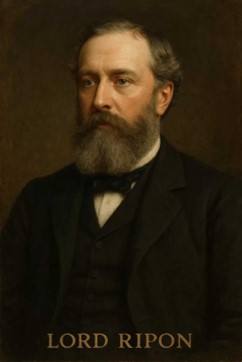
Despite limitations, Lord Ripon introduced several progressive reforms:
- Repealed the Vernacular Press Act, restoring press freedom.
- Encouraged local self-government, laying the groundwork for decentralised administration.
- Supported educational reforms and took steps toward ending the Second Anglo-Afghan War.
Though working within the constraints of colonial rule, Ripon was widely respected by Indian nationalists and is remembered as a liberal and reform-minded Viceroy.
Pre-Congress Political Associations in India:
The rise of political consciousness in 19th-century India was not a spontaneous development but a gradual outcome of evolving socio-political awareness, administrative grievances, and emerging nationalist ideals. Several early political organisations, formed before the advent of the Indian National Congress in 1885, played a crucial role in building a sense of unity and political identity among Indians. These associations worked toward educating the Indian public, influencing colonial governance, and laying the groundwork for a national movement.
East India Association (1866)
The East India Association was established in London in 1866 by Dadabhai Naoroji, one of the earliest Indian political thinkers and the first Asian to be elected to the British Parliament. The primary aim of this association was to discuss Indian issues on British soil and to educate British citizens and lawmakers about Indian realities with the goal of fostering sympathy for Indian welfare.
- It served as a platform to influence British public opinion in favour of India’s socio-political and economic needs.
- Later, branches of the association were established in key Indian cities like Bombay, Calcutta, and Madras, furthering political awareness among Indians.
- The association emphasized rational discourse and policy reform rather than confrontation, which was instrumental in forming the early political culture in colonial India.
Poona Sarvajanik Sabha (1870)
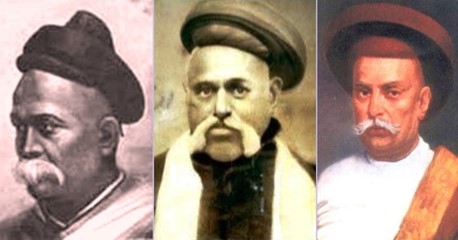
The Poona Sarvajanik Sabha, officially founded in 1870, traces its origin to 1867 when Ganesh Vasudeo Joshi, also known as Sarvajanik Kaka, initiated its formation. He was later joined by Mahadev Govind Ranade, S. H. Chiplunkar, and others. The Sabha was one of the earliest attempts at creating an organised platform to mediate between the British government and Indian citizens.
- It aimed to represent the interests of Indians in front of colonial authorities by submitting petitions, conducting inquiries, and organising public meetings.
- The Sabha consisted of prominent citizens, including landlords, businessmen, government officials, lawyers, and teachers, representing the upper and middle-class interests.
- In 1875, the Sabha submitted a historic petition to the House of Commons, demanding Indian representation in the British Parliament, showcasing its commitment to constitutional methods of reform.
- During the Deccan Riots of 1875, it supported peasants’ grievances and advocated for their welfare.
- In 1876, it played a major role in organising famine relief operations, proving its responsiveness to grassroots issues.
- The Sabha also established arbitration courts (Nyay Sabhas) to help citizens resolve civil disputes without expensive litigation.
- The Sabha expanded beyond Pune and set up branches in the Satara district, including Satara, Wai, and Karad, led by Ganesh Narayan Kolhatkar, Nanasaheb Vaidya, and Gundacharya Ghalsashi, respectively.
The Poona Sarvajanik Sabha is regarded as a forerunner of Indian political associations, and its leadership significantly influenced later nationalist politics.
India League (1875)
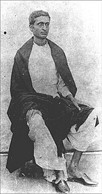
The India League was founded in Calcutta on 25 September 1875 by Sisir Kumar Ghosh and Sambhu Charan Mukherjee. It was an urban, middle-class political organisation with a vision of promoting national consciousness and encouraging political education among Indians.
- The League was committed to non-provincial, non-communal politics and promoted an all-India nationalist outlook.
- It actively worked toward fostering national unity across religious and regional boundaries, which was a significant departure from the prevailing fragmented political scenario.
- Prominent nationalist leaders such as Ananda Mohan Bose, Durga Mohan Das, Nabagopal Mitra, and Surendranath Banerjee were associated with this organisation.
- The League functioned as a precursor to later nationalist organisations, emphasising inclusive and modern political values.
Indian Association (1876)
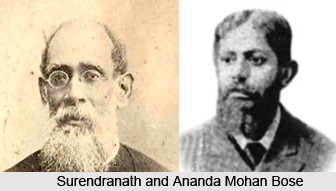
One of the most prominent political associations of pre-Congress India was the Indian Association, founded in 1876 by Surendranath Banerjee and Ananda Mohan Bose in Calcutta. It was envisioned as a pan-Indian political platform that could unite different sections of society under a common political programme.
- The Association aimed to create strong public opinion on key political issues and to foster unity among Indians.
- It was committed to sustained political agitation and worked tirelessly to represent public interest through peaceful and constitutional means.
- Major campaigns and issues taken up by the Indian Association included:
- Agitation for reform in the Indian Civil Services: It demanded an increase in the age limit for appearing in the ICS examination and equal opportunity for Indians.
- Opposition to the Arms Act and the Vernacular Press Act, which were discriminatory and curtailed Indian rights.
- Campaign for tenant rights: It sought changes in the Rent Bill to protect tenants from exploitative landlords.
- Support for workers’ rights, especially in British-owned tea plantations, by advocating better working conditions.
- The Association also played a pioneering role in national-level organisation by sponsoring the first All-India National Conference in Calcutta in 1883, attended by leaders from various parts of the country.
- The programme and ideology adopted by this Conference closely resembled the agenda later followed by the Indian National Congress.
Historians often regard the National Conference of 1883 as a “dress rehearsal” for the INC, and the Indian Association eventually merged with the Congress in 1886, strengthening the national movement.
Political Association | Year of Foundation | Region | Founders / Key Figures |
East India Association | 1866 | London (Britain) | Dadabhai Naoroji |
Poona Sarvajanik Sabha | 1870 | Poona (Bombay Presidency) | M. G. Ranade, G. V. Joshi (Sarwajanik Kaka), S. H. Chiplunkar |
India League | 1875 | Bengal Presidency | Sisir Kumar Ghosh |
Indian Association | 1876 | Bengal Presidency | Surendranath Banerjee, Ananda Mohan Bose |
Madras Mahajan Sabha | 1884 | Madras Presidency | M. Veeraraghavachariar, G. Subramania Iyer, P. Anandacharlu |
Bombay Presidency Association | 1885 | Bombay Presidency | Phirozshah Mehta, K. T. Telang, Badruddin Tyabji |
Indian National Congress | 1885 | All-India Association | A. O. Hume |
Indian National Congress: Genesis, Evolution and Role in National Awakening
During the 1860s and 1870s, numerous political associations were established by educated Indians. While these organisations rendered important services by raising political awareness, they remained limited in scope, being provincial in nature and dominated by local elites. They mainly addressed local grievances, lacked national representation, and rarely coordinated across regions.
By the early 1880s, the need for a national political organisation became evident. This demand was widely discussed in the Indian vernacular and English press. The idea matured during the National Conference of 1883, organised by the Indian Association, where representatives from various parts of the country assembled. However, it failed to transform into a truly all-India body.
The desire to consolidate the efforts of politically aware Indians into a single national platform found a concrete expression through A.O. Hume, a retired British civil servant. His initiative brought together Indian leaders under one umbrella, marking the beginning of the Indian National Congress (INC).
Foundation of the Indian National Congress
- The Indian National Congress was formally founded on 28 December 1885 by Allan Octavian Hume, in collaboration with Indian political leaders.
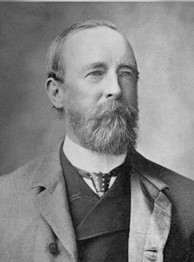
- The first session was held at Gokuldas Tejpal Sanskrit College, Bombay, under the presidentship of Womesh Chandra Bonnerjee and attended by 72 delegates from across the country.
- It marked the first organised expression of Indian nationalism on a pan-Indian level.
- Notably, Surendranath Banerjee and other Bengal leaders did not participate in the inaugural session as they were engaged with the Second National Conference in Calcutta.
Significance of the First Session
- At its conclusion, it was resolved that the Congress would reconvene annually, with the next session scheduled for Calcutta in December 1886.
- This decision showcased the commitment to building a permanent, unified political platform rather than a one-time event.
Subsequent Sessions and Participation
- The second session (1886) was held in Calcutta and presided over by Dadabhai Naoroji. It was here that the decision to rotate the annual session venue across different parts of the country was taken.
- In 1890, Kadambini Ganguly, the first female graduate of Calcutta University, addressed the session—marking the beginning of women’s formal political involvement in the national movement.
- The 1889 session saw participation from ten women delegates, including Pandita Ramabai and Swarna Kumari Devi (sister of Rabindranath Tagore), reflecting Congress’s progressive outreach.
Prominent Leaders Associated with Early Congress
- Dadabhai Naoroji
- Pherozeshah Mehta
- Badruddin Tyabji
- Gopal Krishna Gokhale
- Surendranath Banerjee
- Madan Mohan Malaviya
- Bal Gangadhar Tilak
- Ananda Mohan Bose
- Subramaniya Iyer
- Sisir Kumar and Motilal Ghosh
- Mahadev Govind Ranade
- Dinshaw Wacha
Aims and Objectives of the Indian National Congress
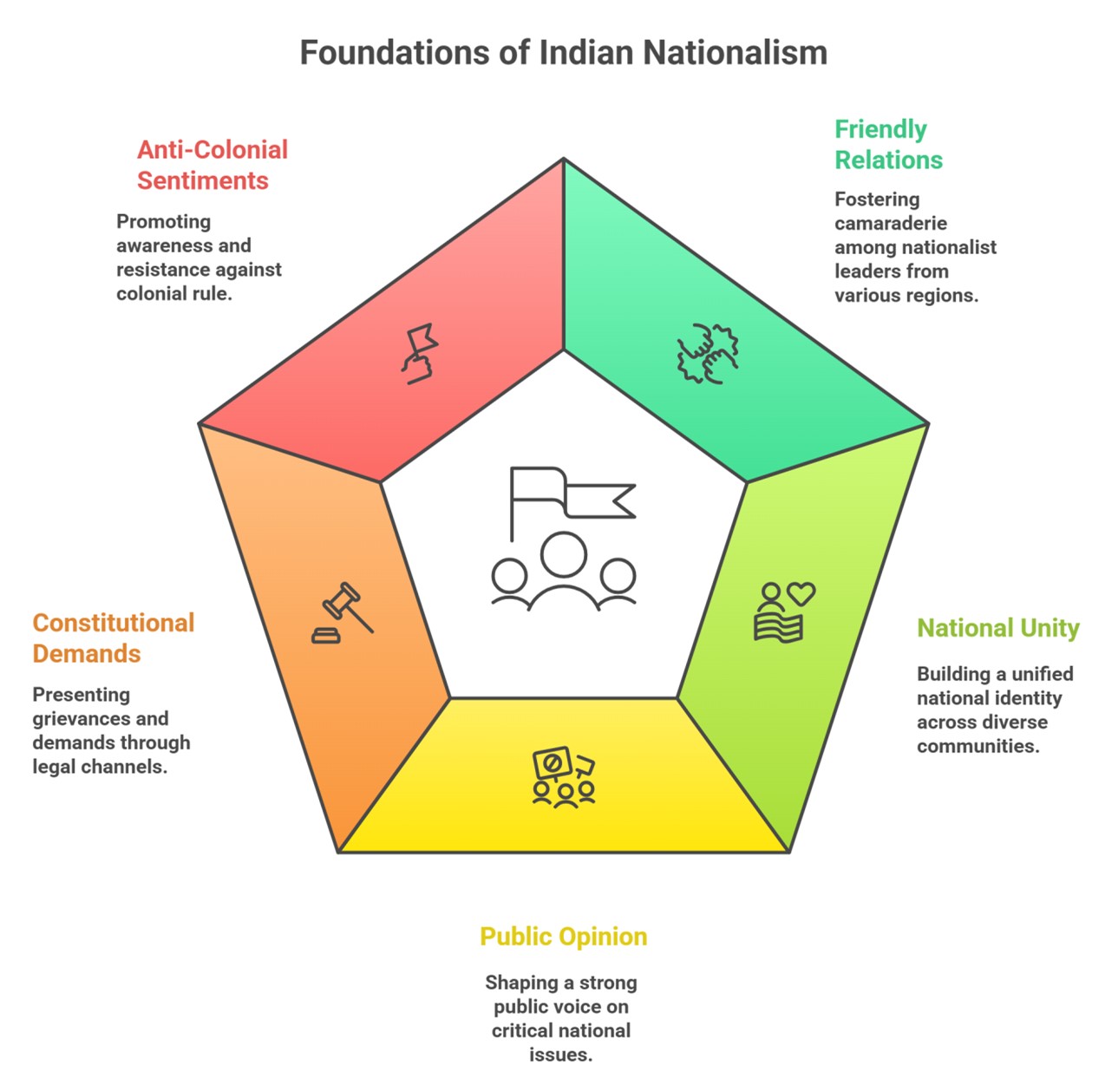
The Congress declared the following objectives in its formative years:
- To promote friendly relations among nationalist political workers from different regions of India.
- To develop and consolidate the sense of national unity, cutting across caste, creed, and regional boundaries.
- To create a strong body of public opinion in the country on vital political and administrative issues.
- To present popular demands and grievances before the British government through constitutional means.
- To foster anti-colonial sentiments and promote political awareness among the Indian masses
Controversies Surrounding the Origin of INC
The “Safety Valve” Theory – A Myth
- Some critics, especially extremist leaders like Lala Lajpat Rai, alleged that the INC was founded as a “safety valve” by the British to channel Indian discontent into harmless constitutional activity, thereby averting a mass rebellion.
- This theory gained traction after William Wedderburn’s 1913 biography of A.O. Hume and was reinforced by leftist historians like P. Dutt and M.S. Golwalkar, who viewed the INC’s origin as a colonial conspiracy.
The Reality
- The safety valve theory is a partial truth at best. It obscures the long-standing efforts of Indian nationalists to build an all-India political platform.
- O. Hume, though British, was a genuine sympathiser of the Indian cause, and worked tirelessly to ensure the survival and growth of the Congress. He served as the General Secretary of the INC from 1885 to 1906, guiding its growth through critical early years.
- Indian leaders strategically accepted Hume’s support to avoid early colonial suppression, using him as a “lightning conductor” to deflect official suspicion while they consolidated nationalist energies.
Congress and Social Reform
- The primary goal of the early Congress was to build national political unity, not to address controversial social issues that could divide the movement.
- At the 1886 Calcutta session, Dadabhai Naoroji emphasised that the Congress would only deliberate upon political matters of all-India importance, not regional or religious reforms.
- In the 1888 session, a resolution was passed that no motion would be adopted if opposed by the majority of Hindu or Muslim delegates, an effort to maintain communal harmony.
Moderates on Social Reforms
- Leaders like Gopal Krishna Gokhale and G. Ranade, although Congressmen, took up social reform separately through other organisations and publications, advocating against child marriage and for widow remarriage.
Unsung Heroes of the Indian Nationalist Movement
While the mainstream national movement in India is often associated with towering personalities like Gandhi, Nehru, and Tilak, several lesser-known yet immensely influential individuals played pivotal roles in laying the ideological, journalistic, and organisational foundations of Indian nationalism. Among these unsung heroes, Sisir Kumar Ghosh and Ganesh Vasudeo Joshi stand out for their courage, intellect, and early resistance to colonial rule.
Sisir Kumar Ghosh (1840–1911)
Sisir Kumar Ghosh was a pioneering journalist, social reformer, and freedom activist from Bengal. A passionate writer and fearless critic of colonial exploitation, he used the power of the press to awaken national consciousness and challenge British imperialism.
Role in Highlighting Indigo Exploitation
- During the Indigo Revolt (1859–60), Ghosh wrote extensively in the widely circulated Hindu Patriot, exposing the atrocities committed by European indigo planters on poor Bengali peasants.
- His bold articles during this period brought peasant grievances into the national discourse and laid the groundwork for future peasant-based movements.
Founding of Amrita Bazar Patrika
- In 1868, Sisir Kumar Ghosh founded the Amrita Bazar Patrika, initially a weekly Bengali newspaper which became bilingual in 1869 to cater to a broader readership.
- In a significant editorial dated May 22, 1874, he famously declared the Indigo Revolt as the “First Revolution of Bengal”, underscoring its historical importance in the Indian freedom struggle.
Defiance of Vernacular Press Act
- When the British government enacted the Vernacular Press Act in 1878 to suppress nationalist voices in Indian languages, Ghosh ingeniously converted Amrita Bazar Patrika into an English weekly within just seven days, thereby circumventing censorship.
- By 1891, the newspaper had evolved into a daily, emerging as one of the most influential nationalist dailies in colonial India, inspiring future freedom fighters and political thinkers.
Founder of the India League (1875)
- In 1875, Ghosh founded the India League in Calcutta, with the aim of stimulating patriotic sentiment and promoting national awakening among the Indian middle class.
- The League maintained a broad national vision, remaining free from regional or communal biases, and helped lay the intellectual groundwork for later pan-Indian organisations like the Indian National Congress.
Ganesh Vasudeo Joshi (1828–1880)
Popularly known as Sarvajanik Kaka, Ganesh Vasudeo Joshi was one of the pioneers of organised political activism in Western India. He played a vital role in mobilising public opinion, promoting women’s welfare, and strengthening the Swadeshi movement in its formative phase.
Founding Member of Poona Sarvajanik Sabha
- Joshi was instrumental in the establishment of the Poona Sarvajanik Sabha in 1870, an organisation that became a bridge between the Indian public and the colonial government.
- The Sabha acted as a proto-parliamentary institution, taking up public grievances, advocating administrative reforms, and promoting national consciousness.
Champion of Women’s Welfare
- Demonstrating his progressive ideals, Joshi established the Stree Vicharavati Sabha, an early women’s welfare organisation focused on social reform and education for women.
- This initiative was notable during a time when women’s rights and welfare were rarely addressed in public discourse.
Early Advocate of Swadeshi
- In 1871, well before the official Swadeshi Movement began, Joshi took a personal vow to use only Swadeshi products, including Indian-made clothes, thereby becoming a trailblazer in the economic nationalist movement.
Legal Support and Advocacy
- Joshi served as the defence lawyer for Vasudev Balwant Phadke, one of the earliest revolutionary nationalists, during his trial. This act highlighted his commitment to justice and nationalist causes.
- He also lent strong support to Justice M.G. Ranade, collaborating in social reform movements and advocating for judicial independence and equality.
Representation at the 1877 Delhi Durbar
- At Queen Victoria’s Delhi Durbar in 1877, Joshi boldly represented Indian interests. In a symbolic address, he appealed to the Queen for equal political and social rights for Indians, including equal access to governance and administration, placing himself among the first Indians to make such demands at an imperial forum.
Legacy and Relevance
- Sisir Kumar Ghosh demonstrated how journalism could be wielded as a weapon of resistance, laying the foundation for future nationalist media.
- Ganesh Vasudeo Joshi epitomised the spirit of early political activism, combining legal expertise, social reform, and nationalism.
- Their work not only inspired future leaders like Tilak, Ranade, and Gokhale, but also played a crucial role in shaping early political institutions and public opinion during colonial rule.
The Indian National Congress, founded in 1885, was not a British gift nor merely a “safety valve”, but a culmination of sustained Indian political awakening. Its establishment marked a historic turning point in India’s freedom struggle, uniting politically conscious Indians across the subcontinent and laying the foundation for mass nationalism in the 20th century. The Congress grew from a moderate, elite platform into the principal vehicle of India’s anti-colonial movement, shaping modern Indian democracy in the process.
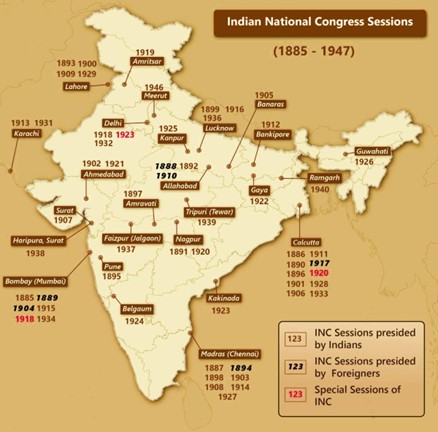
Year | Location | President | Key Resolutions / Events |
1885 | Bombay | W.C. Bannerjee | First session of INC; attended by 72 delegates. |
1886 | Calcutta | Dadabhai Naoroji | Merger with National Conference; strengthened INC. |
1887 | Madras | Badruddin Tyabji | First Muslim INC President; appeal to Muslims to join INC. |
1888 | Allahabad | George Yule | First Englishman to become INC President. |
1896 | Calcutta | Rahimatullah M. Sayani | Vande Mataram sung for the first time by Rabindranath Tagore. |
1905 | Benaras | Gopal Krishna Gokhale | Proclamation of Swadeshi Movement and boycott of foreign goods. |
1906 | Calcutta | Dadabhai Naoroji | Resolutions on Swaraj, Boycott, Swadeshi, and National Education. |
1907 | Surat | Rash Behari Ghosh | Split between Moderates and Extremists. |
1910 | Allahabad | Sir William Wedderburn | M.A. Jinnah criticized the separate electorate system. |
1911 | Calcutta | B.N. Dhar | Jana Gana Mana sung for the first time in a Congress session. |
1915 | Bombay | Sir S.P. Sinha | Constitution amended to include Extremists. |
1916 | Lucknow | A.C. Majumdar | Lucknow Pact signed with Muslim League; unity between Moderates and Extremists. |
1917 | Calcutta | Annie Besant | First female INC President. |
1918 | Bombay (Special) | Syed Hasan Imam | Discussion on Montagu-Chelmsford Reforms. |
1919 | Amritsar | Motilal Nehru | Support for Khilafat; condemned Jallianwala Bagh massacre. |
1920 | Calcutta (Special) | Lala Lajpat Rai | Resolution on Non-Cooperation Movement by Gandhi. |
1920 | Nagpur | C. Vijayaraghavachariar | INC reorganized on linguistic basis; Jinnah left INC. |
1922 | Gaya | C.R. Das | Swaraj Party formed due to ideological differences. |
1924 | Belgaum | M.K. Gandhi | Only session presided by Gandhi. |
1925 | Kanpur | Sarojini Naidu | First Indian woman President of INC. |
1927 | Madras | Dr. M.A. Ansari | Boycott of Simon Commission; resolution for Purna Swaraj. |
1928 | Calcutta | Motilal Nehru | Formation of All India Youth Congress; Nehru Report accepted. |
1929 | Lahore | Jawaharlal Nehru | Poorna Swaraj resolution passed; Jan 26 declared Independence Day. |
1931 | Karachi | Vallabhbhai Patel | Endorsement of Gandhi-Irwin Pact; Resolutions on Fundamental Rights and National Economic Programme. |
1934 | Bombay | Rajendra Prasad | Amendment of Congress constitution. |
1936 | Lucknow | Jawaharlal Nehru | Shift toward socialist policies. |
1937 | Faizpur | Jawaharlal Nehru | First session held in a village; focus on rural India. |
1938 | Haripura | Subhas Chandra Bose | Formation of National Planning Committee. |
1939 | Tripuri | Subhas C. Bose / Raj. Prasad | Bose re-elected, later resigned; Rajendra Prasad presided; Bose formed Forward Bloc. |
1940 | Ramgarh | Abul Kalam Azad | Gandhi given final authority on launching Civil Disobedience Movement. |
1946 | Meerut | J.B. Kripalani | Last session before independence; Kripalani was president at time of independence. |