
Babur’s Early Life and the Central Asian Legacy
The roots of Babur’s ambition can be traced to the political turbulence in Central Asia during the late 15th and early 16th centuries. Following the disintegration of the Mongol Empire, Timur had managed to unite vast regions, including Iran and Transoxiana, into a powerful empire. This empire extended from the Volga River in the west to the Indus River in the east, encompassing modern-day Turkey, Iran, Central Asia, Afghanistan, and parts of northwestern India.
After Timur’s death in 1405, his grandson Shahrukh Mirza retained control over much of the empire, with cities like Herat and Samarqand flourishing as centers of Islamic art, culture, and scholarship. However, the Timurid practice of dividing territories among multiple heirs weakened the empire significantly. This internal disunity led to the rise of new powers: the Sunni Uzbeks in Transoxiana, the Shia Safavids in Iran, and the expanding Sunni Ottoman Empire in the west.
Babur ascended the throne of Farghana at the tender age of 12 in 1494. His early reign was dominated by attempts to recapture Samarqand, the symbolic heart of the Timurid empire. Despite briefly seizing the city twice, Babur was ultimately driven out by the formidable Uzbek leader Shaibani Khan. Realizing the difficulty of reclaiming his ancestral lands, Babur turned his attention to Kabul in 1504, which he captured and ruled for over a decade. During this period, he continued to harbor ambitions of reconquering Central Asia.
In 1510, when Shah Ismail of Iran defeated Shaibani Khan, Babur briefly regained Samarqand with Iranian support, but the triumph was short-lived. With the Uzbeks tightening their grip on Transoxiana, Babur was compelled to shift his imperial vision toward India, where political instability presented a timely opportunity.
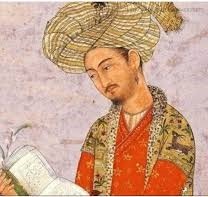
Legacy and Significance of Babur’s Rule
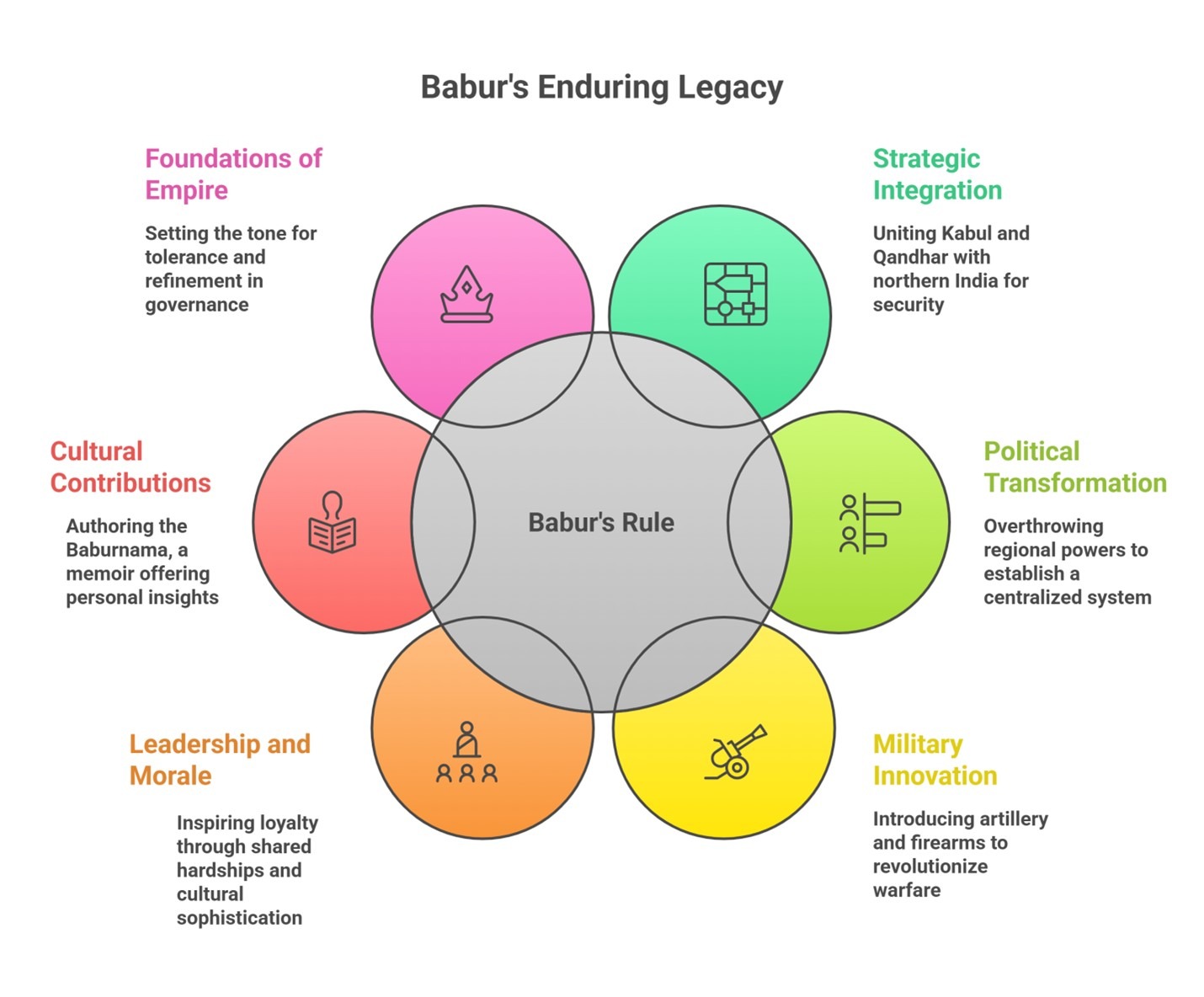
Babur’s brief but impactful reign laid the foundation for one of the most enduring empires in Indian history. His military brilliance, administrative foresight, and personal charisma made a lasting impression on the Indian subcontinent. Key aspects of his legacy include:
- Strategic Integration: For the first time since the Kushana era, the regions of Kabul and Qandhar were integrated with northern India, providing strategic depth and long-term security against invasions.
-
- Political Transformation: The defeat of the Lodis and the Rajputs disrupted the fragmented regional power structure, creating space for a centralized imperial system that his successors would further develop.
-
- Military Innovation: Babur demonstrated the revolutionary potential of artillery and firearms in Indian warfare. His campaigns introduced a new military culture that quickly gained traction across the subcontinent.
-
- Leadership and Morale: A bold and resilient commander, Babur shared in the hardships of his soldiers, earning their unwavering loyalty. He was also known for his magnanimity and cultural sophistication.
-
- Cultural Contributions: A gifted scholar and poet, Babur authored the celebrated Baburnama (Tuzuk-i-Baburi), his memoirs written in the Chagatai Turki language, which offers invaluable insight into his personality, worldview, and times.
-
- Foundations of Empire: Babur’s establishment of strong central authority, combined with his emphasis on tolerance and refinement, set the ideological and administrative tone for the Mughal Empire’s golden age under Akbar and beyond.
Babur’s entry into India was not just the start of a dynasty but the beginning of a new political and cultural chapter in the history of South Asia. His life, though short, altered the course of Indian history forever.
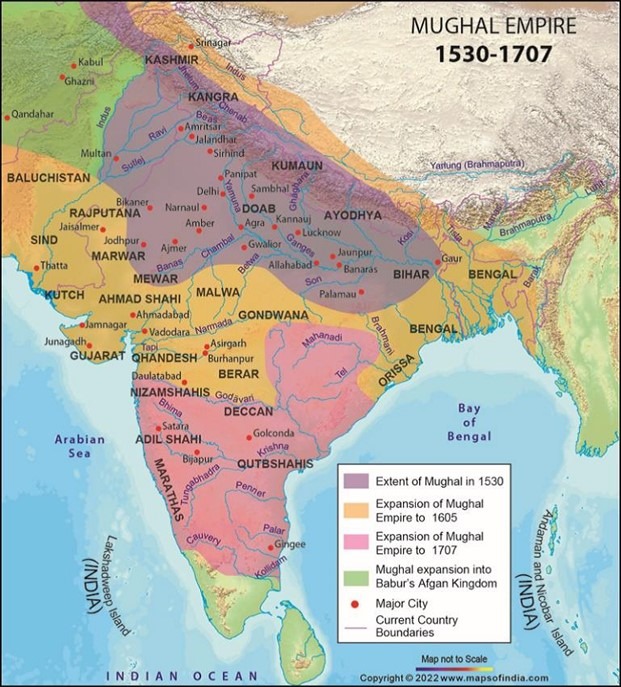
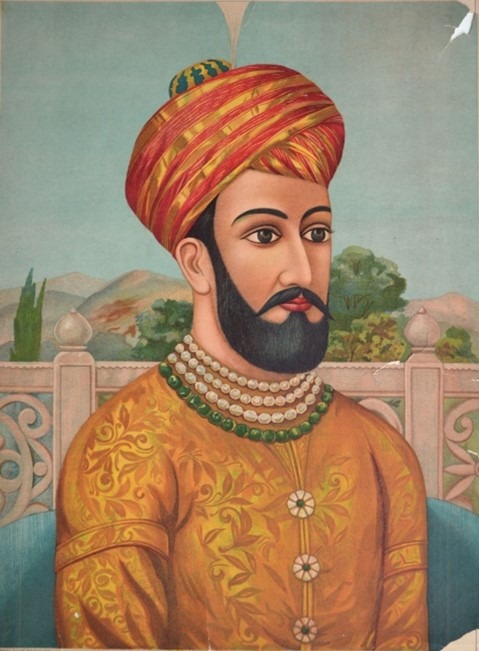
Humayun (1530–1540 CE, 1555–1556 CE):
Nasir-ud-Din Muhammad Humayun, the eldest son of Babur, succeeded his father to the Mughal throne in December 1530, at the age of just 23. Despite being the heir to a formidable empire, Humayun’s reign was riddled with internal strife, unstable governance, and external threats that tested his leadership at every step. Unlike his father Babur, Humayun lacked military prowess and strategic decisiveness, which contributed to his initial failures as a ruler.
Challenges at Accession
Humayun inherited a fragile empire from Babur that was still in its formative stage. Among the pressing challenges he faced were:
- An unstable administrative system that had not yet taken deep roots in India.
- A depleted imperial treasury, leaving the government financially vulnerable.
- Rising Afghan resistance, particularly in the eastern regions, where leaders like Sher Khan (later Sher Shah Suri) aimed to displace the Mughals.
In addition, Humayun had pledged to his father on his deathbed to treat his brothers with kindness. True to his word, he divided the empire among them:
- Kamran received Kabul and Kandahar
- Askari was granted Sambhal
- Hindal obtained Alwar
This division, although rooted in goodwill, sowed seeds of disunity and rivalry within the imperial family.
Sher Shah Suri (1540–1545 CE):
Sher Shah Suri, originally named Farid, is remembered in Indian history as one of the most efficient and visionary administrators of medieval India. Rising from humble origins, he not only ousted the Mughal emperor Humayun but also laid the foundation of what came to be known as the Second Afghan Empire. His reign, though brief, left an indelible mark on India’s political, administrative, and infrastructural systems.
Early Life and Rise to Power
Sher Shah was born in Sasaram, Bihar, into a modest Afghan family. His father, Hasan Khan, was a jagirdar (landholder) of Sasaram. From a young age, Farid displayed exceptional military and administrative skills. While serving under Bahar Khan Lohani, the Afghan ruler of Bihar, he earned the title “Sher Khan” after reportedly killing a tiger in a single combat—an act of remarkable bravery.
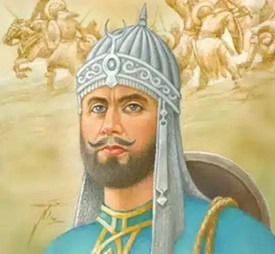
He was a pious Muslim, yet known for his religious tolerance. Sher Shah employed Hindus in key administrative positions, recognizing their abilities irrespective of religion. His inclusive policies allowed him to consolidate his rule across a diverse empire.
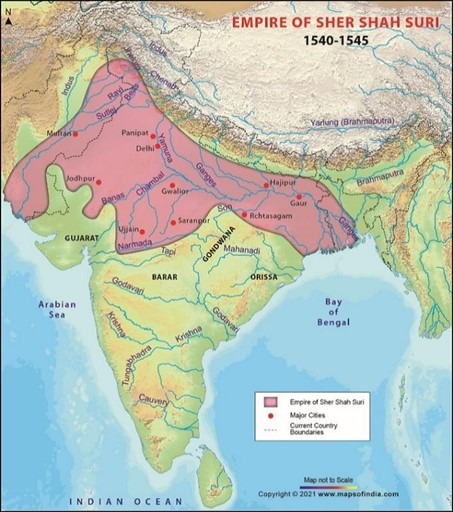
Akbar (1556–1605 CE):
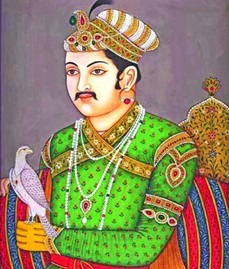
Jalal-ud-din Muhammad Akbar, popularly known as Akbar the Great, ascended the Mughal throne in 1556 CE at the tender age of 13, following the untimely death of his father, Humayun. Despite his youth, Akbar would go on to become the most illustrious and effective ruler of the Mughal dynasty, transforming a fragile inheritance into one of the most powerful and enduring empires in Indian history.
Accession and the Second Battle of Panipat (1556)
- Upon his ascension, Akbar faced significant threats from powerful Afghan and Rajput forces who sought to reclaim power from the weakened Mughal presence in India.
-
- Fortunately, Akbar was guided and supported by Bairam Khan, a trusted noble of Humayun, who assumed the role of regent and Wakil (prime minister), bearing the title Khan-i-Khanan.
-
- Meanwhile, the Afghans regrouped under Hemu, a brilliant Hindu general serving Adil Shah, the successor of Sher Shah Suri. Hemu swiftly captured Gwalior and Agra, defeating the Mughals near Delhi and taking control of the capital.
-
- In November 1556, the young Akbar marched with Bairam Khan’s forces to reclaim Delhi. The decisive Second Battle of Panipat Though initially on the verge of victory, Hemu was struck in the eye by an arrow and lost consciousness. His troops, leaderless, fled the battlefield. This pivotal Mughal victory re-established Akbar’s rule over northern India.
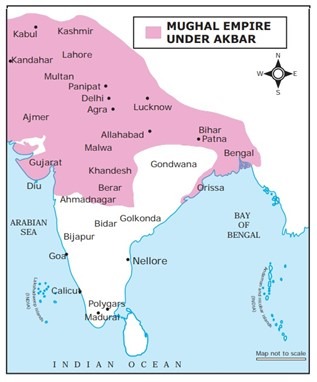
Territorial Expansion of the Mughal Empire under Akbar
Akbar’s reign witnessed a systematic and extensive expansion of the Mughal Empire, marked by strategic diplomacy, military excellence, and integration of diverse regions into the imperial structure.
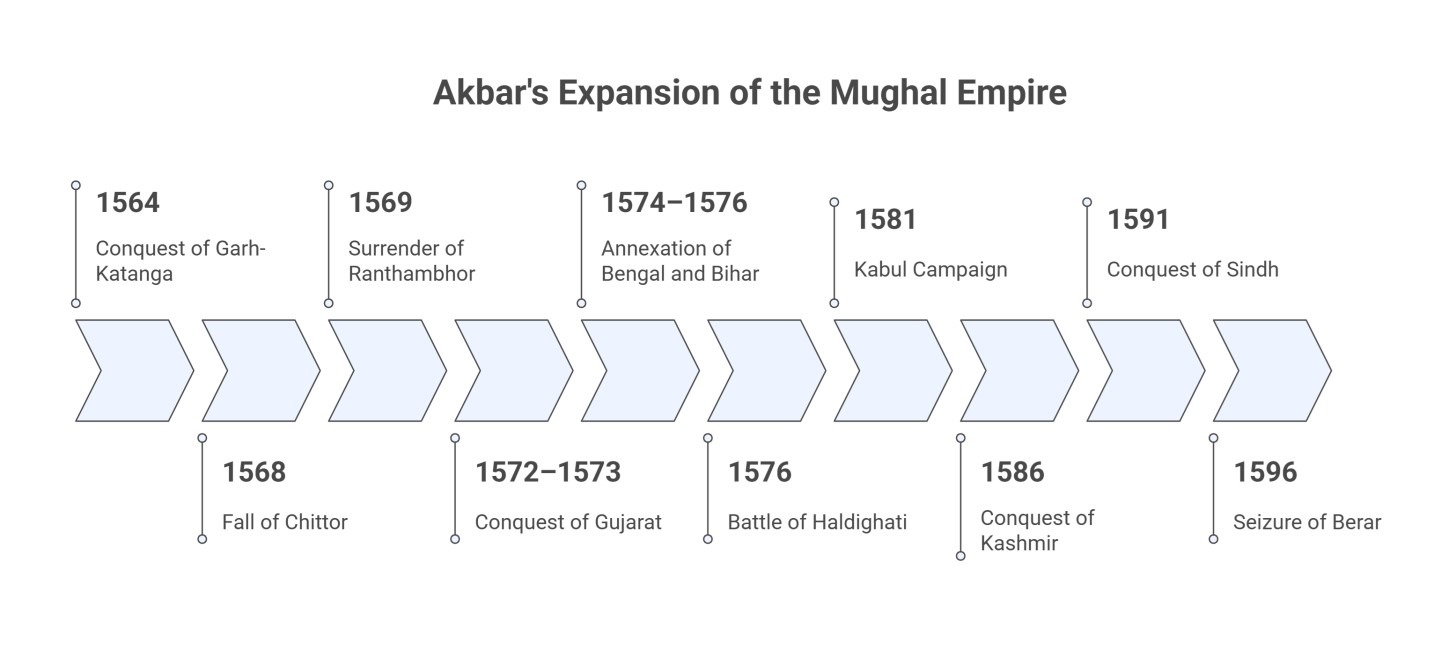
Garh-Katanga (1564)
- The Garh-Katanga kingdom, located in present-day Madhya Pradesh, included Gond and Rajput principalities in the Narmada valley.
- Rani Durgavati, the regent of her son Bir Narayan, valiantly resisted Mughal forces but was defeated and martyred. This campaign brought the central Indian tribal belt under Mughal control.
Chittor (1568)
- The fortress of Chittor, a stronghold of Rajput pride, became a symbol of Akbar’s resolve to subdue Rajput resistance.
- After a six-month-long siege, Chittor fell. Rana Udai Singh had retreated to the hills, leaving Jaimal and Patta, two legendary warriors, in charge.
- In their honour, Akbar commissioned statues of Jaimal and Patta riding elephants at the Agra Fort, demonstrating respect for valour even in victory.
Ranthambhor (1569)
- Following Chittor, Akbar targeted Ranthambhor, considered Rajasthan’s strongest fortress.
- It was defended by Surjan Hada, who eventually surrendered.
- With victories in Jodhpur, Bikaner, and Jaisalmer, most Rajput rulers accepted Mughal suzerainty, except Mewar, which continued to resist.
Gujarat (1572–1573)
- Akbar marched into Ahmedabad, which surrendered peacefully. He then subdued the rebellious Mirzas, who held Surat, Broach, and Baroda.
- In Cambay, Akbar saw the sea for the first time and met Portuguese merchants, who were attempting to extend their influence inland. Akbar’s conquest curtailed their ambitions.
Bengal and Bihar (1574–1576)
- The Afghans remained strong in eastern India and had overrun Orissa, killing its king.
- Daud Khan Karrani, the last independent Afghan ruler, declared himself sovereign. Akbar responded by invading Bengal.
- After defeating Daud in a major battle in 1576 CE, the Mughals executed him and annexed Bengal and Bihar, ending Afghan rule in northern India.
Mewar and the Battle of Haldighati (1576)
- The fierce Battle of Haldighati was fought between Maharana Pratap of Mewar and the Mughal army led by Man Singh I of Amber.
- Though defeated, Maharana Pratap escaped and continued guerrilla resistance, refusing to submit to the Mughals.
- His lone resistance became a symbol of Rajput honour and patriotism, contrasting with other Rajput houses that allied with Akbar.
Kabul Campaign (1581)
- Mirza Hakim, Akbar’s half-brother and ruler of Kabul, attempted to aid rebellions in Bihar and Bengal.
- With the help of Raja Man Singh and Bhagwan Das, Akbar defeated Mirza Hakim.
- Rather than annexing Kabul, Akbar handed it over to his sister, showcasing his liberal outlook and faith in women’s administrative capabilities.
Northwest Frontier and the Uzbek Threat
- Abdullah Khan Uzbek, a long-standing rival from Central Asia, posed a significant threat by capturing Badakhshan in 1584.
- Akbar launched campaigns to block Uzbek expansion, capturing:
- Kashmir (1586) from Yusuf Khan and Yakub Khan
- Sindh (1591) from Jani Beg Mirza
- Baluchistan, and reopened the Khyber Pass, which had been closed by tribal insurgents.
- During one expedition, Raja Birbal, Akbar’s beloved courtier, lost his life fighting rebellious Afghan tribes.
Deccan Expeditions
- By 1591, Akbar’s forces occupied the strategic Khandesh region in northwestern Deccan.
- In 1596, the Mughal army seized Berar from Chand Bibi, regent of Ahmednagar, who had fiercely defended the fort against Mughal aggression.
- By 1600, parts of Ahmed Nagar had fallen into the hands of Mughal forces.
Akbar’s Religious Policy: A Vision of Tolerance and Unity
One of the most celebrated aspects of Akbar’s reign was his liberal and inclusive religious policy, which not only marked a significant departure from the orthodoxy of earlier rulers but also served as the foundation for cultural integration and imperial stability. His approach reflected both personal conviction and political pragmatism, rooted in tolerance, dialogue, and respect for diverse faiths.
Factors Influencing Akbar’s Religious Outlook
Several elements shaped Akbar’s liberal religious worldview:
- His early exposure to Sufi teachings, which emphasized spirituality over ritualism and encouraged religious harmony.
- His interactions with Hindu Rajput nobles, particularly after his marriage alliances with Rajput princesses.
- The need to administer a vast, religiously diverse empire, where Hindus formed the overwhelming majority.
Key Features of Akbar’s Religious Policy
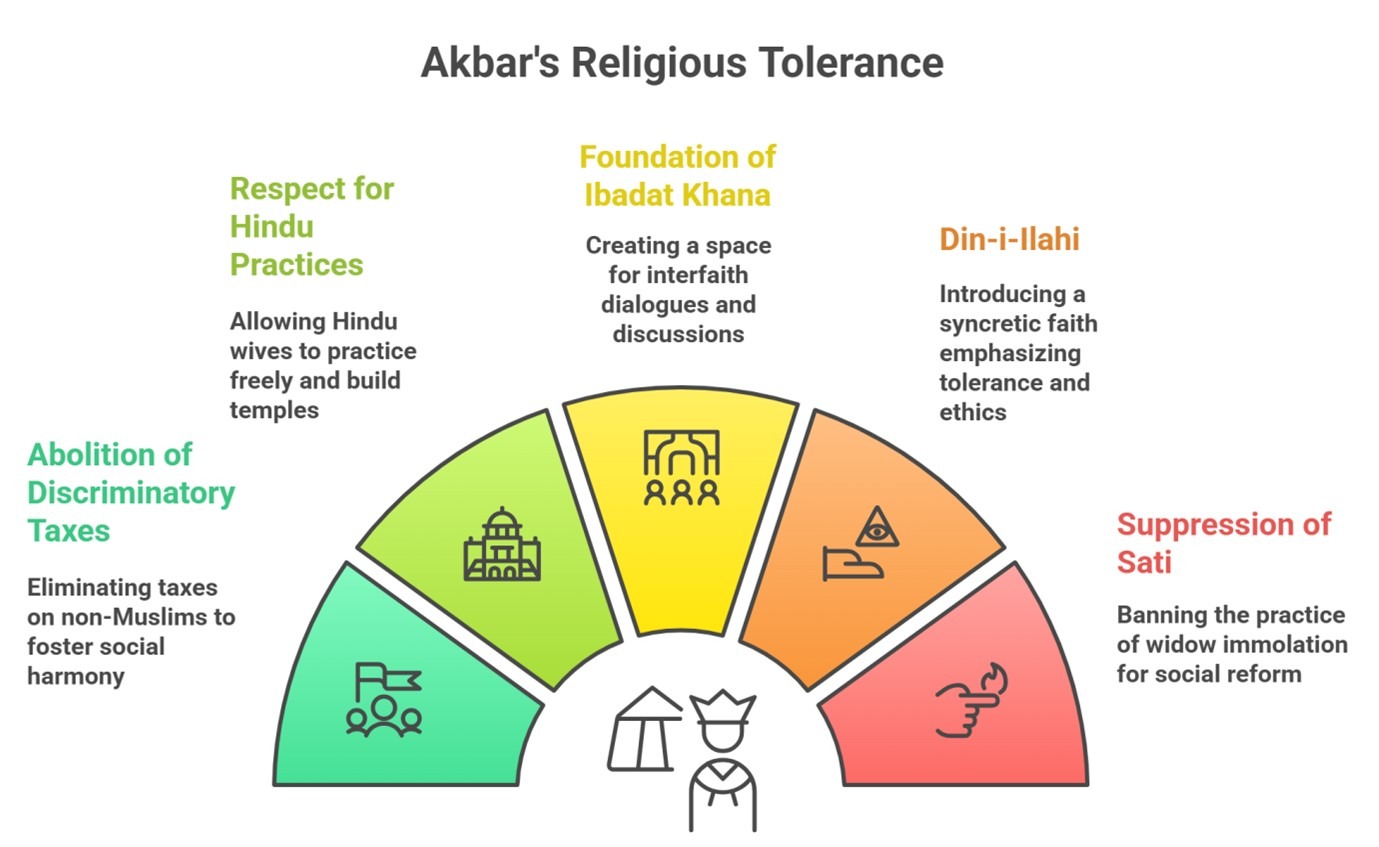
- Abolition of Discriminatory Taxes: In a bold and historic move, Akbar abolished the pilgrim tax and the Jizya, a tax traditionally imposed on non-Muslims. This enhanced social harmony and won the goodwill of the Hindu population.
-
- Respect for Hindu Practices: Akbar allowed his Hindu wives to freely practice their religion and construct temples within palace premises, demonstrating unprecedented religious tolerance for a Muslim ruler of that era.
-
- Foundation of the Ibadat Khana (1575 CE): At his newly established capital Fatehpur Sikri, Akbar built the Ibadat Khana or House of Worship, where interfaith dialogues were held. Scholars and theologians from various religions—Islam, Hinduism, Jainism, Christianity, and Zoroastrianism—were invited to engage in discussions on theology and ethics.
-
- Din-i-Ilahi (1582 CE): Inspired by these interfaith exchanges, Akbar introduced a new syncretic religious philosophy called Din-i-Ilahi (Divine Faith). This faith sought to synthesize the best moral and spiritual values from various religions, emphasizing monotheism, rationality, tolerance, and ethical living. However, Akbar never imposed this belief on his subjects, and it remained a personal, elite-oriented faith rather than a mass religion.
- Suppression of Sati: Akbar also took steps toward social reform, most notably by discouraging and banning the practice of Sati, wherein Hindu widows were immolated on their husband’s funeral pyre.
Rajput Policy: Political Alliance Through Diplomacy and Matrimony
A key pillar of Akbar’s success was his conciliatory and strategic policy toward the Rajputs, who were among the most powerful warrior clans of the time. Instead of outright subjugation, Akbar chose diplomacy, mutual respect, and marital alliances to integrate them into the Mughal Empire.
Salient Features of Akbar’s Rajput Policy
- Matrimonial Alliances: Akbar forged multiple marriages with Rajput princesses, thereby creating a strong political and cultural bond with their kingdoms.
- He married Harkha Bai (popularly known as Jodha Bai), the daughter of Raja Bhar Mal (also called Bihari Mal) of Amber.
- He also married princesses of Bikaner and Jaisalmer, expanding his influence across Rajasthan.
- Prince Salim (later Jahangir), born of Harkha Bai, married the daughter of Raja Bhagwan Das, further strengthening imperial-Rajput ties.
-
- Inclusion in Administration: Rajput nobles were granted high-ranking positions in the Mughal court, particularly in the mansabdari system.
- Raja Man Singh, grandson of Raja Bhar Mal, became one of Akbar’s most trusted generals.
- Raja Bhagwan Das played a crucial role in diplomacy and military campaigns.
- Raja Todar Mal, though a Khatri by caste, rose to become Diwan (Finance Minister) due to his expertise in revenue matters.
- Birbal, a Brahmin known for his wit and wisdom, was one of Akbar’s closest companions and advisors.
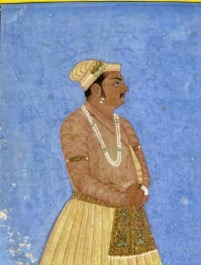
This inclusive policy not only ensured peace in Rajasthan but also brought loyalty, military strength, and administrative talent into the Mughal fold.
Jahangir (1605–1627 CE):
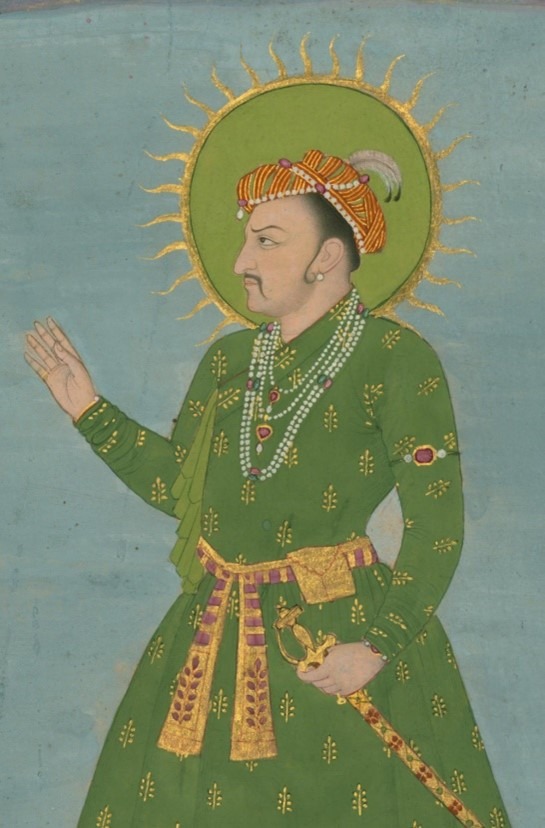
After the death of Emperor Akbar in 1605 CE, his son Salim ascended the Mughal throne under the regal title Nur-ud-din Jahangir. His succession was uncontested, primarily because his rivals, including his younger brothers, had died earlier due to alcoholism and internal conflict.
Rebellion of Khusrau and the Execution of Guru Arjan
- Early in his reign, Jahangir faced a rebellion from his eldest son, Khusrau, who declared himself emperor and gained some support from nobles and the Sikh community.
- Jahangir’s forces defeated Khusrau near Lahore, captured him, and had him imprisoned and blinded.
- The fifth Sikh Guru, Guru Arjan Dev, was arrested for allegedly blessing the rebel prince. He was ordered to convert to Islam, and upon refusal, he was tortured and executed in 1606 CE. This marked a turning point in Sikh-Mughal relations, as the Sikh community began its transformation into a militarized order.
Marriage to Nur Jahan and Her Political Influence
- In 1611 CE, Jahangir married Mehrunnisa, the widow of Sher Afghan, a Persian noble. She was later given the title Nur Jahan (“Light of the World”).
- Nur Jahan played a dominant role in state affairs, influencing court politics, royal appointments, and imperial diplomacy.
- She encouraged Persian art, literature, and court culture, introducing new fashions, etiquette, and patronage practices in the royal household.
Rebellion of Prince Khurram (Shah Jahan)
- In 1622 CE, Prince Khurram, later known as Shah Jahan, rebelled against Jahangir’s authority. Some historians attribute this to Nur Jahan’s political ambitions, while others believe it was due to Khurram’s reluctance to campaign in Kandahar.
- The rebellion persisted for four years, weakening imperial administration.
- After Jahangir’s death in 1627 CE, Shah Jahan returned to Agra with the support of the military and nobles, defeated rivals, and assumed the Mughal throne.
- Nur Jahan was granted a pension and spent the remaining 18 years of her life in seclusion.
Shah Jahan (1627–1658 CE):
Shah Jahan, the son of Emperor Jahangir and his Rajput queen Jodha Bai, ascended the Mughal throne in 1627 CE. His reign is often referred to as the Golden Era of Mughal architecture, courtly refinement, and cultural prosperity. Under his leadership, the Mughal Empire reached its peak in terms of art, literature, urban planning, and architectural excellence.
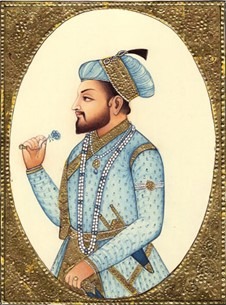
Northwestern Campaigns and the Kandahar Conflict
Shah Jahan was determined to restore Mughal dominance over ancestral lands in Central Asia and Afghanistan, which led to several military campaigns:
- In 1638, Mughal forces successfully recaptured Kandahar, a region previously conquered by Akbar but lost during Jahangir’s reign.
- However, in 1647, Kandahar was retaken by the Safavids of Persia, and despite repeated attempts to regain control, the Mughals failed. These military expeditions cost the Mughal army over 5,000 lives.
- The emperor also attempted to conquer Balkh from the Uzbeks, but this too ended in failure, marking a significant setback in the empire’s northwestern frontier policy.
Deccan Campaigns and Southern Consolidation
Shah Jahan’s campaigns in the Deccan region were notably more successful:
- In 1632, the Mughals annexed the Ahmadnagar Sultanate after a decisive military victory.
- By 1636, the sultanates of Bijapur and Golkonda acknowledged Mughal supremacy by signing formal treaties, thereby extending the empire’s influence deep into the southern peninsula.
- To consolidate control, Shah Jahan carved out four new Mughal provinces in the Deccan—Khandesh, Berar, Telangana, and Daulatabad—and entrusted them to his capable son, Aurangzeb.
Architectural Achievements: A Legacy in Stone
Shah Jahan’s reign stands as a monumental chapter in the history of Indian architecture:
- The crowning jewel of his legacy is the Taj Mahal, constructed on the banks of the Yamuna River in Agra. Built as a mausoleum for his beloved wife, Mumtaz Mahal, who died in 1631, it remains a symbol of eternal love and a masterpiece of Mughal architecture.
- Other landmark structures include:
- The Red Fort (Lal Qila) in Delhi, a massive citadel of power and splendor.
- The Jama Masjid in Delhi, one of the largest and most revered mosques in India.
- The Peacock Throne, an extravagant seat of royalty encrusted with precious gems, valued at approximately 5 million pounds sterling, according to French traveler Jean-Baptiste Tavernier, a jeweller by profession.
Foreign Visitors and Accounts of His Reign
Shah Jahan’s reign drew the attention of several European travellers, who recorded rich accounts of life at the Mughal court:
- Jean-Baptiste Tavernier (French gem merchant)
- François Bernier (French physician and political observer)
- Peter Mundy (English trader and chronicler)
- Niccolao Manucci (Italian writer and adventurer)
These visitors described Shah Jahan as a ruler with a keen sense of justice, a universal vision of peace, and a court characterized by immense wealth, discipline, and grandeur.
War of Succession and Final Years
In 1657, Shah Jahan fell seriously ill in Delhi, sparking a violent war of succession among his four sons:
- Dara Shukoh, the designated crown prince and a liberal scholar
- Aurangzeb, the governor of the Deccan and a strict orthodox
- Shuja, the governor of Bengal
- Murad Baksh, the governor of Gujarat and Malwa
The most ruthless and ambitious of the four, Aurangzeb, emerged victorious after defeating his brothers. He executed Dara Shukoh, declared himself emperor, and confined Shah Jahan to the female quarters (Zenana) of Agra Fort under strict watch. However, the deposed emperor was treated with respect and lived in relative comfort, attended by his devoted daughter, Jahanara Begum.
Shah Jahan remained a prisoner for eight years, gazing at the Taj Mahal from his window until his death in 1666 CE. He was buried beside Mumtaz Mahal, fulfilling his eternal wish to rest beside his beloved.
Aurangzeb (1658–1707 CE):
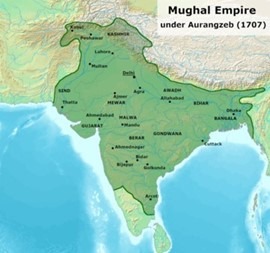
Aurangzeb, who ascended the Mughal throne in 1658 CE under the regnal title Alamgir, meaning “World Conqueror,” ruled for nearly five decades, making him the longest-reigning Mughal emperor. His reign witnessed the greatest territorial expansion of the empire but also sowed the seeds of its eventual decline due to continuous warfare and religious orthodoxy.
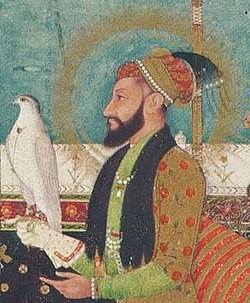
Division of Aurangzeb’s Reign
- First 25 Years (1658–1682): Aurangzeb governed primarily from Delhi, dealing with internal rebellions and administering the empire’s northern territories.
- Last 25 Years (1682–1707): He remained stationed in the Deccan, personally directing military campaigns against the Marathas, Bijapur, and Golkonda.
Rebellions in Northern India
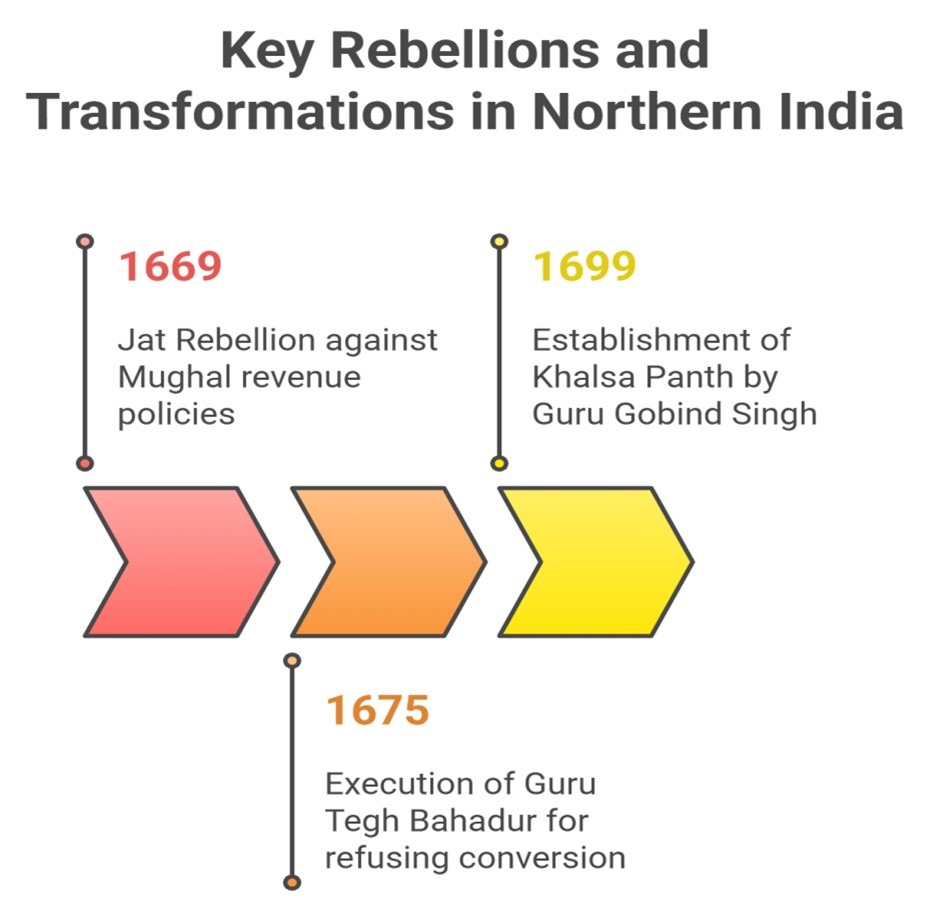
- Jat Rebellion (1669): The Jats of Mathura rebelled against oppressive revenue policies. Although their leader Gokla was executed, the resistance persisted and eventually led to the emergence of an independent Jat state in the 18th century.
- Satnami Revolt: The Satnamis, a socio-religious sect in Haryana, revolted against Mughal authority but were crushed with the support of local Hindu zamindars.
- Sikh Resistance: Tensions escalated when Guru Tegh Bahadur, the ninth Sikh Guru, refused to convert to Islam and was executed in 1675. His son Guru Gobind Singh established the Khalsa Panth in 1699, transforming the Sikhs into a formidable military force.
Rajput Affairs and Rebellion
- The death of Raja Jaswant Singh of Marwar without a male heir led to a succession crisis. Aurangzeb’s attempt to impose a puppet ruler provoked armed resistance.
- Rani Hadi, the queen, and later Ajit Singh, Jaswant Singh’s posthumous son, led the resistance against the emperor.
- Rana Raj Singh of Mewar allied with Prince Akbar, Aurangzeb’s rebellious son. Though the rebellion was ultimately crushed, Rajput–Mughal relations were deeply strained.
- In 1681, a treaty with Mewar marked the end of this phase of conflict.
Deccan Policy and Maratha Conflict
Aurangzeb’s Deccan policy was the most ambitious and draining part of his reign:
- Chhatrapati Shivaji Maharaj, founder of the Maratha Empire, initially cooperated but later turned against the Mughals.
- Treaty of Purandar (1665): Signed between Shivaji and Raja Jai Singh, it was short-lived. Shivaji was summoned to Agra, imprisoned, but made a dramatic escape and resumed guerrilla warfare until his death in 1680.
- His son Sambhaji continued resistance but was captured and executed in 1689. This act intensified Maratha hostility, giving rise to what historians call the “Deccan Ulcer.”
- Annexation of Deccan Sultanates:
- Bijapur (1686) and Golkonda (1687) were conquered.
- These victories brought the Mughals face-to-face with the Marathas, escalating the conflict.
- Aurangzeb’s continuous presence in the Deccan from 1682 until his death in 1707 severely strained imperial finances and administration.
Religious Policy: Orthodoxy and Intolerance
Aurangzeb’s religious policy marked a radical departure from the liberal and inclusive practices of Akbar and Jahangir:
- He was a devout Sunni Muslim, committed to enforcing Sharia law throughout his empire.
- Established a department of moral policing, led by a Muhtasib, who enforced Islamic codes, banned music, and monitored public conduct.
- Strict bans were imposed:
- Construction and repair of Hindu temples were prohibited.
- Important temples in Mathura and Banaras were destroyed.
- Jizya (poll tax on non-Muslims) and pilgrimage tax were re-imposed.
- Shia practices and festivals were suppressed.
- Sufi saints and their liberal views were also targeted.
- He ended public ceremonies like Jharokha Darshan, banned Nauroz (Persian New Year) celebrations, and discontinued the inscription of Kalima on Mughal coins.