
Vijayanagara and Bahmani Kingdoms
The Vijayanagar Empire emerged in 1336 CE when the brothers Harihara I and Bukka I, former commanders in Muhammad bin Tughlaq’s army, broke away from the Delhi Sultanate. Guided by the sage Vidyaranya, they established a new capital—Vijayanagar (modern Hampi)—on the southern bank of the Tungabhadra River. The city’s location provided natural fortification and easy access to fertile hinterlands, allowing the founders to consolidate a realm that drew together the diverse cultural zones of Kannada, Telugu, and Tamil India.
The empire would eventually be ruled by four dynasties:
Dynasty | Dates | Notable Features |
Sangama | 1336 – 1485 | Founders of the empire; laid administrative and military foundations |
Saluva | 1485 – 1503 | Transitional house that restored stability after a brief crisis |
Tuluva | 1503 – c.1570 | Age of Krishnadevaraya; zenith of territorial and cultural expansion |
Aravidu | c.1570 – 1670s | Continued resistance after the Battle of Talikota; gradual decentralisation |
Contemporary travellers—including Niccolò Conti, Domingo Paes, Fernao Nuniz, Duarte Barbosa, and the Persian envoy Abdur Razzak—left glowing accounts of Vijayanagar’s monumental architecture, bustling markets, and cosmopolitan court.
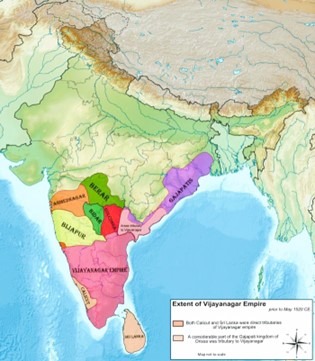
Saluva Dynasty (c. 1485–1505 CE)
The Saluva Dynasty marked a brief but significant chapter in the history of the Vijayanagara Empire. This dynasty was founded by Saluva Narasimha Deva Raya, a prominent general and minister under the preceding Sangama rulers. His rise to power was an attempt to rescue the weakening empire from internal strife and external threats.
- The Gorantla inscription offers valuable insights into the foundation and lineage of the Saluva rulers.
- Saluva Narasimha Deva Raya reigned from around 1486 to 1491 CE. Although his rule was short-lived, he made efforts to stabilise the declining empire.
- During his reign, the famous saint and Carnatic music composer Annamacharya (Annamayya) flourished, composing devotional hymns in praise of Lord Venkateswara.
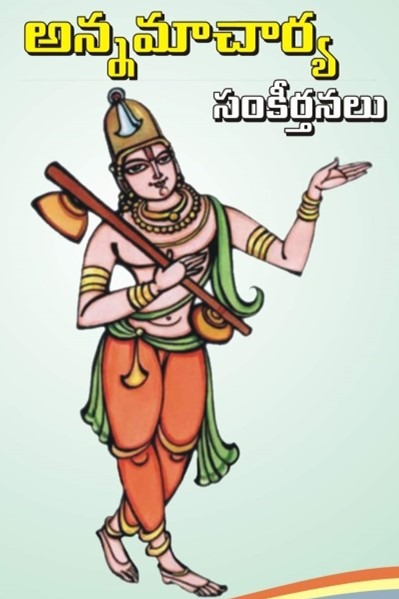
- After Narasimha’s death, his minor son Thimma Bhupala briefly ascended the throne, but due to his inability to govern, the empire fell into the hands of the powerful military commander Tuluva Narasa Nayaka, father of the future emperor Krishna Deva Raya.
- Eventually, Narasimha Raya II, the last of the Saluva rulers, was dethroned by Vira Narasimha of the Tuluva lineage, bringing the Saluva dynasty to an end.
Krishna Deva Raya (1509–1529 CE)
Krishna Deva Raya is universally acknowledged as the greatest ruler of the Vijayanagara Empire and one of the most illustrious monarchs in Indian history. His reign marked the peak of the empire’s power, prestige, and cultural brilliance.
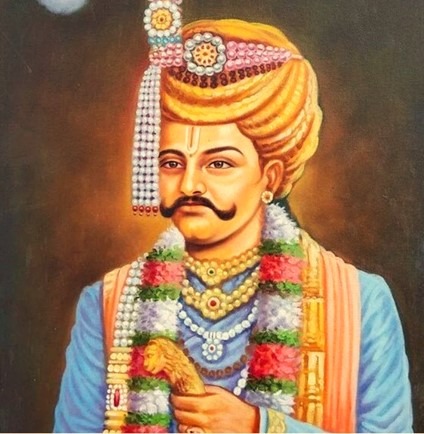
Political and Military Achievements:
- He successfully restored law and order, bringing internal stability after years of unrest.
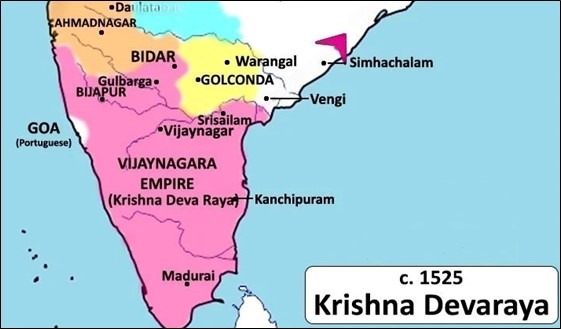
- He launched successful military campaigns against the successor states of the Bahmani Sultanate, especially Bijapur, securing the Raichur Doab (the fertile land between the Krishna and Tungabhadra rivers).
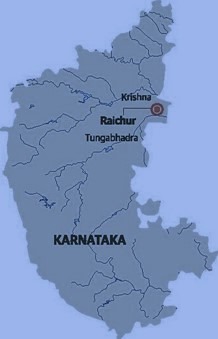
- He subdued the Gajapatis of Orissa, forcing them to retreat beyond the Krishna River and reclaiming territories for Vijayanagara.
- Krishna Deva Raya maintained diplomatic and trade relations with the Portuguese, who were establishing themselves on the western coast. Ambassadors like Albuquerque visited his court, and a monopoly on the import of horses from the Portuguese was established.
Religious Policies and Temple Patronage:
- Though a devout Vaishnavite, Krishna Deva Raya was known for his religious tolerance and patronage of multiple faiths.
- He built monumental temples such as the Vittalaswamy Temple and Hazara Ramaswamy Temple in Hampi.
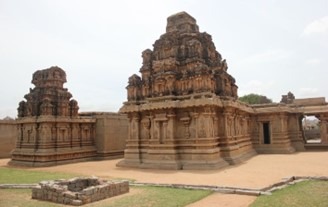
- He also enhanced the grandeur of many existing temples in South India by constructing tall gopurams (gateway towers).
- A new township named Nagalapuram, in honour of his mother, was established near Vijayanagara.
- He invested in public infrastructure, including the construction of large irrigation tanks.
Art and Literature:
- Krishna Deva Raya earned titles such as Andhra Bhoja and Andhra Pitamaha for his profound contributions to art and literature.
- Telugu literature flourished under his reign, with the emergence of the legendary Ashta Diggajas—the eight literary luminaries of his court:
Poet | Title / Recognition | Notable Works |
Allasani Peddana | Andhra Kavita Pitamaha | Manucharitam, Harikathasaram |
Tenali Ramakrishna | Vikata kavi | Panduranga Mahatmyam |
Pingali Suranna | Renowned Literary Figure | Garuda Puranam, Prabhavatee Pradyumnamu, Raghava Pandaveeyam, Kalapurnodayam |
Nandi Thimmana | Court Poet of Krishnadevaraya | Parijatapaharanam |
Dhurjati, Madayyagari Mallana, Ayyalaraju Ramabhadra Kavi, and Ramaraja Bhushana also contributed richly.
Krishna Deva Raya himself was a multilingual scholar, authoring the Telugu classic Amuktamalyada and Sanskrit works like Jambavati Kalyanam and Ushaparinayam.
Foreign Accounts:
- Domingo Paes, a Portuguese traveller who visited his court, described Krishna Deva Raya as a charismatic and disciplined ruler. Paes was impressed by his regal routine, which included a rigorous morning workout, wrestling, horse riding, prayer, and then court duties.
Sadasiva Raya (1543–1576 CE)
- Sadasiva Raya was the nominal ruler, while real power rested in the hands of Aliya Rama Raya, Krishna Deva Raya’s son-in-law and a shrewd statesman.
- Rama Raya sought to consolidate power by removing old nobility and installing loyalists.
- His diplomatic strategy involved balancing the rival Deccan Sultanates by pitting them against each other, but this ultimately backfired.
- His political manipulations led to the formation of a formidable coalition of the Deccan Sultanates—Bijapur, Ahmadnagar, Golkonda, and Bidar (except Berar).
- In 1565 CE, the Battle of Talikota (also known as the Battle of Rakshasa-Tangadi) was fought. The combined forces of the Deccan Sultanates decisively defeated the Vijayanagara army.
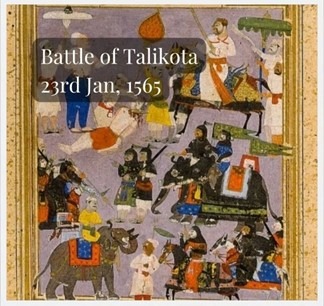
- Rama Raya was captured and executed, and the magnificent capital city of Vijayanagara was looted and destroyed. This battle is widely regarded as the beginning of the end of the Vijayanagara Empire, though it continued under the Aravidu dynasty for some time in a diminished form.
Administration of the Vijayanagara Kingdom
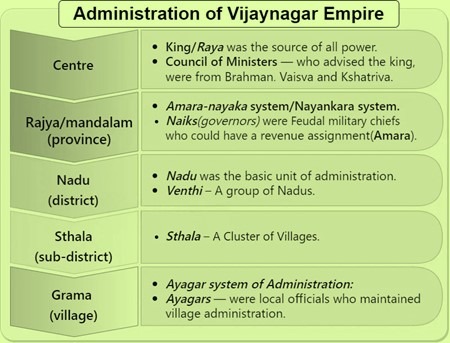
The Vijayanagara Empire, one of the most remarkable South Indian kingdoms in medieval India, was known for its highly efficient and well-structured administrative system. The administration was monarchical in nature, with the Raya (king) at its helm, exercising absolute authority in all spheres of governance—executive, legislative, and judicial.
Central Administration
The king was the supreme authority in the empire and was regarded as the fountainhead of justice and the ultimate lawmaker. His decisions were final in all civil and criminal matters, and he acted as the highest court of appeal. In matters of justice, the punishments prescribed were often severe and harsh, reflecting the need for deterrence in a large and complex empire. These punishments included mutilation, public flogging, and execution by trampling under elephants, which were meant to instill fear and maintain strict law and order.
The succession to the throne was generally based on hereditary principles, following the dynastic traditions. However, instances of usurpation were not uncommon, particularly during periods of political instability. For example, Saluva Narasimha Deva Raya seized the throne by overthrowing the declining Sangama dynasty, marking the beginning of the Saluva line.
To aid in governance, the king was assisted by a council of ministers known as Amatyas. These ministers were usually chosen from among the nobility and the loyal aristocracy, and they played a critical role in advising the monarch on administrative, military, and financial matters. While the king retained the final say, the council’s input was important in day-to-day functioning.
Religion and Tolerance
Religion played a central role in shaping social and political life in the Vijayanagar Empire. The Sangama dynasty, the first ruling house of the empire, was primarily Shaivaite in orientation and Virupaksha, a form of Shiva, was their dynastic deity. However, subsequent dynasties such as the Saluva, Tuluva, and Aravidu were inclined toward Vaishnavism, particularly Srivaishnavism, a sect popularized by the saint Ramanujacharya.
Despite these sectarian affiliations, the Vijayanagara rulers practiced remarkable religious tolerance:
- Muslims were employed in administrative and military roles.
- Under Deva Raya II, Muslim soldiers were recruited and given jagirs (land grants), and a mosque was constructed within the capital for their worship.
- Jainism, though declining, was still present in parts of Karnataka and continued to receive support.
- The construction of grand temples during this period — such as Hazara Rama, Vittalaswamy, and Virupaksha Temple — demonstrates both religious devotion and artistic excellence.
The temple complexes often functioned not just as spiritual centres but also as economic and social institutions. They controlled large endowments, engaged in internal and overseas trade, and served as centres for education, culture, and welfare.
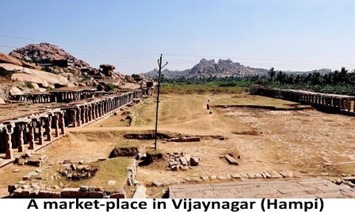
Cultural Contributions of the Vijayanagar Empire
The Vijayanagar rulers were not only patrons of power and prosperity but also great connoisseurs of art, culture, literature, and religion. Their reign is marked by a cultural renaissance that left an indelible impact on the Indian subcontinent.
Temple Architecture and Sculpture
The most striking cultural legacy of the Vijayanagar Empire lies in its temple architecture. A revival and transformation of earlier South Indian styles, Vijayanagar architecture is distinguished by its tall, ornate gopurams (gateway towers) and intricately sculpted Kalyanamandapams (marriage halls) within temple complexes.
- Pillared Mandapams: These large open halls with hundred or even thousand pillars were used for festivals, rituals, and public gatherings. Each pillar was carved with elaborate motifs, especially horses, warriors, and deities, symbolizing the vitality of the empire.
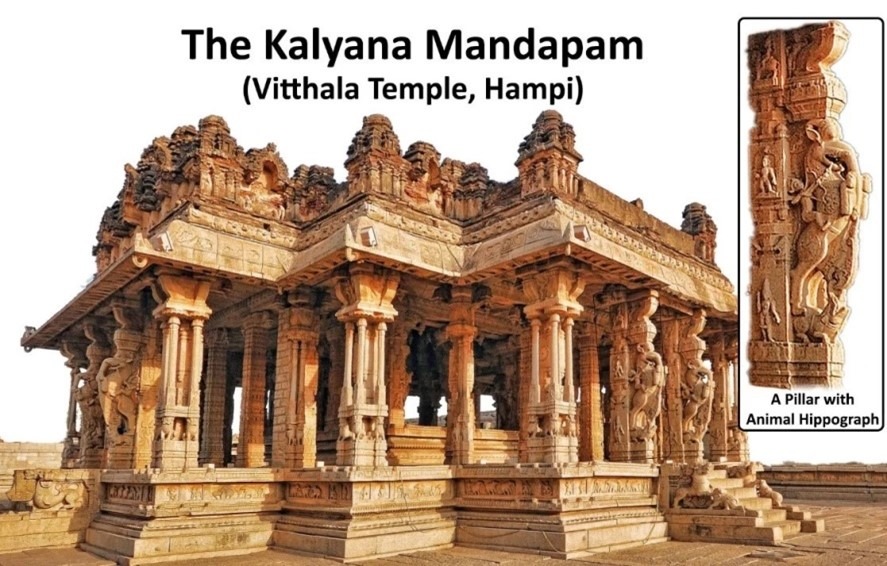
- Amman shrines and sub-temples were added to existing temple complexes, reflecting a deepening of religious inclusivity and worship practices.
Important temples that represent this style include:
- Vittalaswamy Temple and Hazara Ramaswamy Temple at Hampi
- Varadharaja Perumal and Ekamparanatha Temples at Kanchipuram
- Raya Gopurams at Chidambaram and Thiruvannamalai
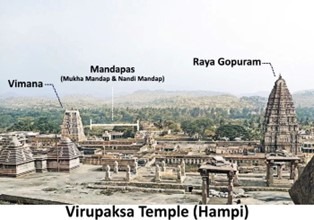
These structures reflect both religious devotion and architectural genius. The metal images of Krishna Deva Raya and his queens at Tirupati exemplify the high standards of metal casting and iconography of the time.
Music and Performing Arts
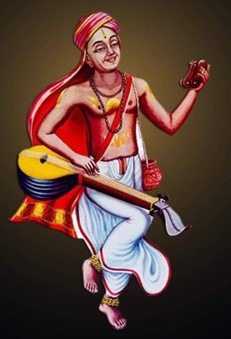
Music and dance flourished under royal patronage. Classical music evolved, and instruments such as the veena, mridangam, and tambura were widely used. The Bhakti movement and temple rituals further nurtured devotional music.
The famous composer Purandaradasa, known as the Father of Carnatic Music, lived during this era and laid the foundations for the structured teaching of music.
Literary Achievements
The Vijayanagar period witnessed unparalleled literary activity, especially under Krishna Deva Raya, who was not only a patron but also an accomplished poet himself.
- Languages Patronised: Sanskrit, Telugu, Tamil, and Kannada
- Peak of Telugu Literature: The Ashtadiggajas (eight literary gems) of Krishna Deva Raya’s court, including Allasani Peddanna, Tenali Ramakrishna, and Pingali Suranna, elevated Telugu literature to new heights.
Krishna Deva Raya’s own compositions include:
- Amuktamalyada (in Telugu), a lyrical work blending devotion and polity
- Jambavati Kalyanam and Ushaparinayam (in Sanskrit), demonstrating his literary finesse
The cultural legacy of the Vijayanagar Empire is thus defined by an unparalleled integration of religion, art, language, and architecture, leaving behind a tradition that continued to inspire even after the empire’s decline.
Architecture of the Vijayanagar Empire
The architecture of the Vijayanagar Empire represents a fusion of Dravidian traditions with Islamic and local influences, creating a distinctive style that left a lasting impression on South Indian temple architecture.
Structural Features
Vijayanagar architecture is characterized by:
- Massive granite structures due to the availability of hard rock in the Deccan and the military needs of the empire.
- Raya Gopurams, or towering gateway structures, adorned with life-sized figures of deities and mythical beings.
- Ornate pillared mandapams, often square or rectangular in shape, used for religious and ceremonial purposes.
- Monolithic sculptures, such as the massive Narasimha and Ganesha statues in Hampi.
- Water structures, such as step wells and royal baths, demonstrating engineering skill.
Material and Design Innovations
- While granite was preferred for its durability and local availability, soapstone was also used for detailed sculptures in certain regions, drawing from Hoysala and Western Chalukya
- The secular architecture, including royal palaces and administrative buildings, shows Islamic elements such as arches, domes, and vaults, a result of cultural exchange and the employment of Persian and Turkic architects.
Architectural Heritage
Some of the finest examples of Vijayanagar architecture can be seen in:
- Hampi: The capital city, now a UNESCO World Heritage Site, is home to dozens of temples, markets, and royal enclosures.
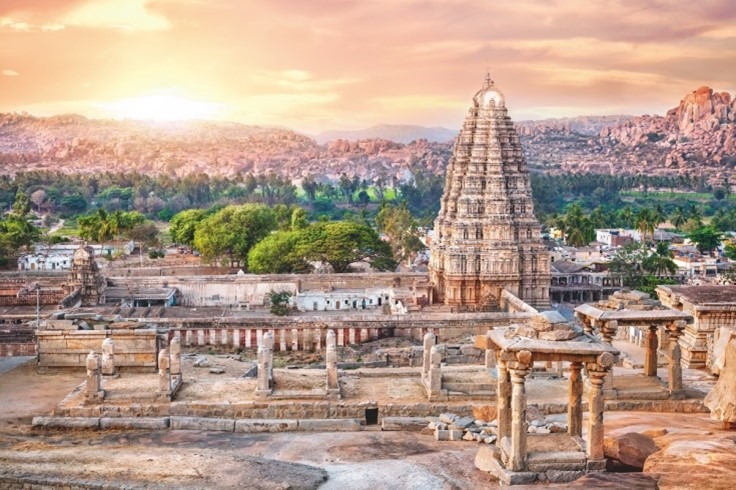
- Chidambaram, Thiruvannamalai, and Kanchipuram: Sites where Raya gopurams were added to existing temples, amplifying their grandeur.
- Nayak successors of Vijayanagar continued and expanded this architectural tradition in Madurai, Tanjore, and Rameswaram.
The Vijayanagar Empire stands as a monument of cultural resilience, economic prosperity, and artistic brilliance in the history of India. From the fertile fields of the Tungabhadra valley to the monumental temples of Hampi and beyond, the legacy of its economic strength, architectural innovation, and literary brilliance continues to inspire historians, artists, and travelers alike.
Bahamani Kingdom
The Deccan region, once an integral part of the provincial administration of the Delhi Sultanate, witnessed a gradual shift towards autonomy in the 14th century. This transformation began under the rule of Muhammad bin Tughlaq, who appointed an officer titled Amir-i-Sada or Sada Amir to oversee stable governance in the Deccan. The Sada Amir was an administrative head responsible for overseeing one hundred villages, reflecting a structured rural administration.
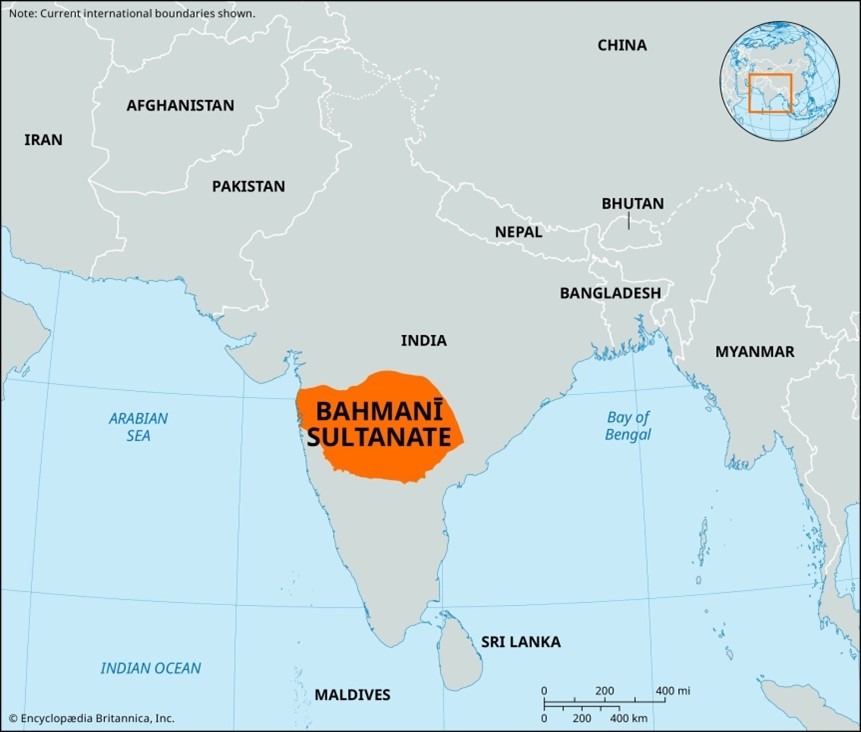
However, starting around 1337 CE, tensions escalated between the officers of the Delhi Sultanate and the regional powers in the Deccan. This growing discontent culminated in the establishment of an independent Deccan kingdom in 1347 CE, with Gulbarga (in present-day Karnataka) as its capital. The founder of this kingdom was Haran Kangu, who assumed the royal title of Alauddin Hasan Bahman Shah, thereby laying the foundation of the Bahmani Sultanate, one of the earliest and most powerful Islamic kingdoms in the southern part of the Indian subcontinent.
The Bahmani Sultanate was divided into four major administrative divisions or provinces, known as Tarafs. These included:
- Gulbarga (the initial capital)
- Daulatabad
- Bidar
- Berar
Each Taraf was overseen by a governor (Tarafdar), who held significant autonomy and influence within his territory.
Mahmud Gawan (1461–1481 CE) – The Great Vizier
The Bahmani Sultanate reached the height of its power under the stewardship of Mahmud Gawan, a Persian scholar, merchant, and administrator. He came to India at the age of 42 and quickly rose through the ranks to become the Wazir (Prime Minister) under Humayun Shah. He was honored with the title ‘Malik-ul-Tujjar’ (Chief of the Merchants) and later ‘Khwaju-i-Jahan’ (Minister of the World).
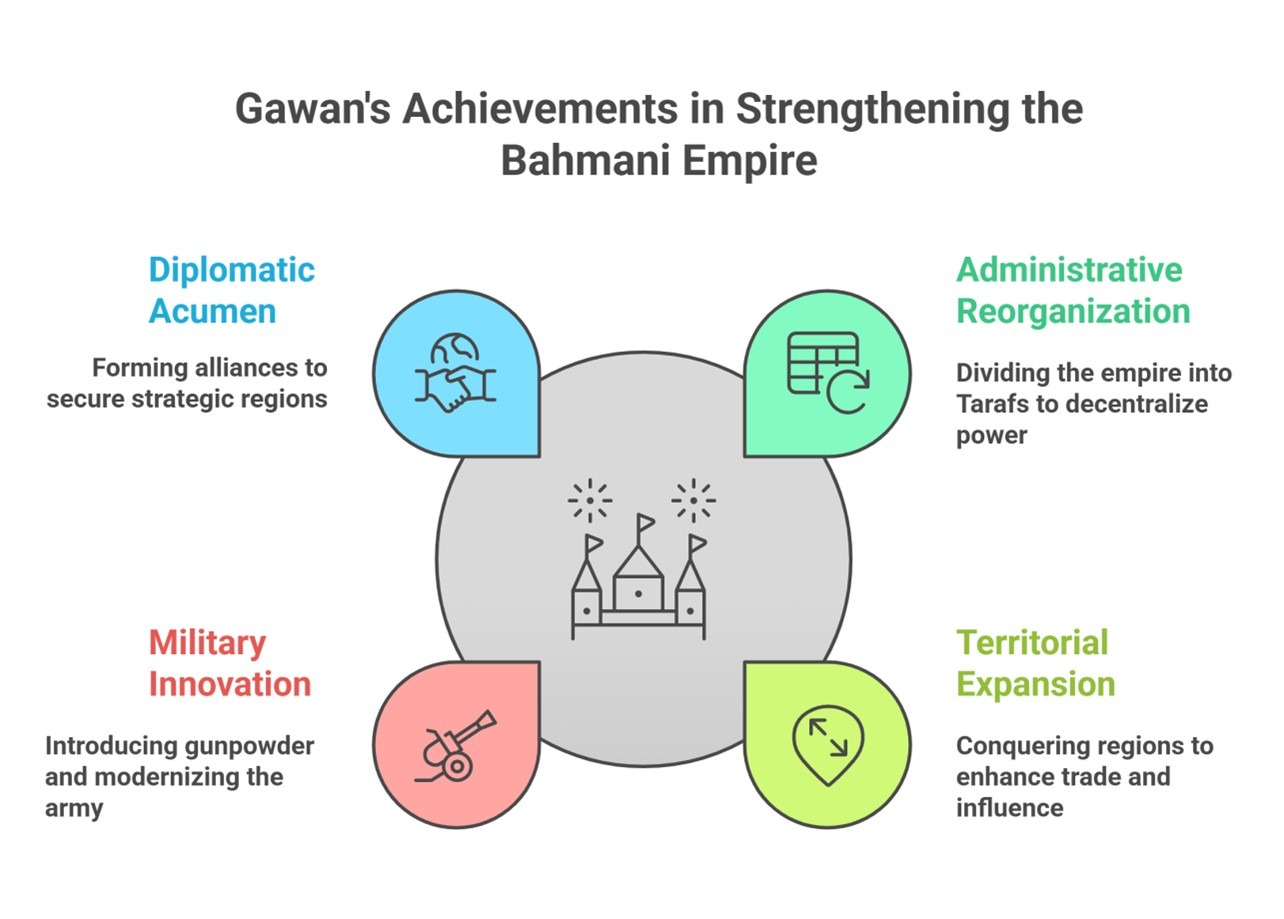
Gawan’s political and military achievements included:
- Reorganization of administration: He divided the empire into eight Tarafs to decentralize administration while curbing the excessive powers of provincial governors. Each Tarafdar was allowed control over only one fort to prevent rebellions.
- Territorial expansion: He conquered regions up to Kanchipuram in the south and extended Bahmani influence over Goa and Dabhol on the western coast, enhancing trade links with Iran and Iraq.
- Military innovation: He introduced the use of gunpowder in warfare and invited Persian chemists to train the Bahmani army in its application, significantly modernizing their military capabilities.
- Diplomatic acumen: He defeated Mahmud Khalji of Malwa with the support of the Gujarat Sultanate, thereby securing the strategic region of Berar.
Tragically, internal court politics led to his downfall. A faction of jealous Deccani nobles falsely accused Gawan of treason, resulting in his execution in 1482 CE. His death was deeply regretted by the Sultan, who later honored him with a dignified burial. Gawan remains one of the most revered figures in Deccan administrative history for his vision, reform, and statesmanship.
Legacy of the Bahmani Sultanate
The Bahmani Sultanate played a pivotal role in shaping the political, cultural, and administrative landscape of medieval South India. It acted as a bridge between the northern Islamic traditions and southern Indian socio-cultural systems. Despite its eventual decline, the Bahmani kingdom laid the foundation for the Deccan Sultanates that emerged later, including Bijapur, Golconda, Ahmadnagar, Berar, and Bidar.
Its architectural innovations, administrative reforms, and pluralistic society left a lasting imprint on the history of the Indian subcontinent.
Deccan Sultanates: Successor States of the Bahmani Kingdom
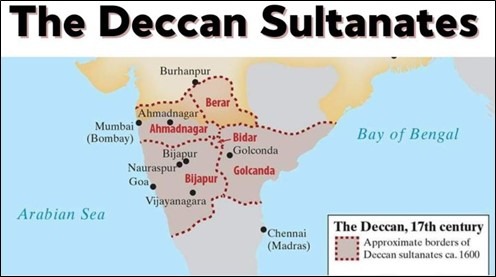
Following the execution of the capable minister Mahmud Gawan in 1481, the Bahmani Sultanate began a gradual decline marked by internal discord, noble rivalries, and weakened central authority. As the kingdom disintegrated, various provincial governors and military commanders declared independence, leading to the emergence of several regional powers. Ultimately, by 1518 CE, the Bahmani Sultanate splintered into five independent states—collectively known as the Deccan Sultanates—which ruled over significant parts of the Deccan Plateau and played a crucial role in shaping South Indian politics during the 16th and 17th centuries.
2. Adil Shahis of Bijapur (1490–1686 CE)
The Adil Shahi dynasty was established by Yusuf Adil Shah, another former Bahmani governor who declared his independence in Bijapur in 1490. Under the Adil Shahis, Bijapur emerged as a powerful and culturally rich kingdom in southern India.
- Muhammad Adil Shah, one of the prominent rulers, constructed the iconic Gol Gumbaz, renowned for having the world’s second-largest dome and its celebrated “whispering gallery.”
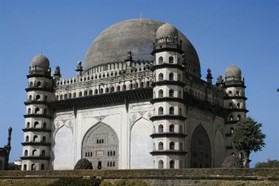
- Ibrahim Adil Shah II, a poet and patron of the arts, composed the musical treatise “Kitab-i-Navras” in Dakhani Urdu, blending Islamic and Hindu cultural elements.
- The Adil Shahis played a pivotal role in the Battle of Talikota (1565), forming a confederacy with the other Deccan Sultanates to defeat the Vijayanagara Empire.
- The dynasty eventually collapsed when Aurangzeb conquered Bijapur in 1686, incorporating it into the Mughal Empire after several years of military engagement.
4. Qutb Shahis of Golconda (1518–1687 CE)
The Qutb Shahi dynasty was established by Sultan Quli Qutb-ul-Mulk, who declared his independence in 1518 and made Golconda his capital after building the renowned Golconda Fort.
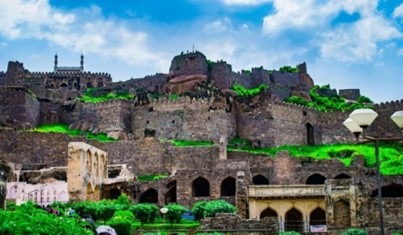
- The most celebrated ruler of the dynasty was Muhammad Quli Qutb Shah, a visionary leader, poet, and city builder.
- He founded the city of Hyderabad and constructed the Charminar, which became a lasting symbol of Indo-Islamic architecture.
- The most celebrated ruler of the dynasty was Muhammad Quli Qutb Shah, a visionary leader, poet, and city builder.
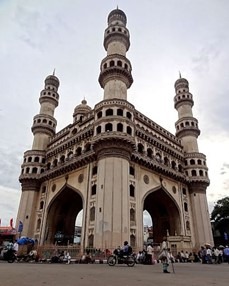
- He authored the Kulliyat-i-Muhammad Quli Qutb Shah, a collection of poetry in Dakhani Urdu, showcasing his literary prowess.
- The Qutb Shahis were Shia Muslims of Turkmen origin, and their court culture reflected a blend of Persian and local Deccan traditions.
- Their rule came to an end in 1687 when Aurangzeb’s Mughal forces besieged and conquered Golconda, thus integrating it into the Mughal Empire.
Art and Architecture of the Bahmani Sultanate
The Bahmani period witnessed the flourishing of a distinct style of Indo-Islamic architecture that blended Persian aesthetics with local construction traditions. This unique architectural synthesis was characterized by the use of indigenous materials, elegant calligraphy, strong arches, large domes, slender minarets, and prominent crescent motifs crowning the structures.
Some of the most remarkable examples of Bahmani architecture can be found in Gulbarga and Bidar, the two successive capitals of the kingdom.
- At Gulbarga, the earliest capital, monumental structures such as the Jama Masjid, Haft Gumbaz (Seven Domes), and Shah Bazaar Mosque reflect the grandeur of early Bahmani ambitions.
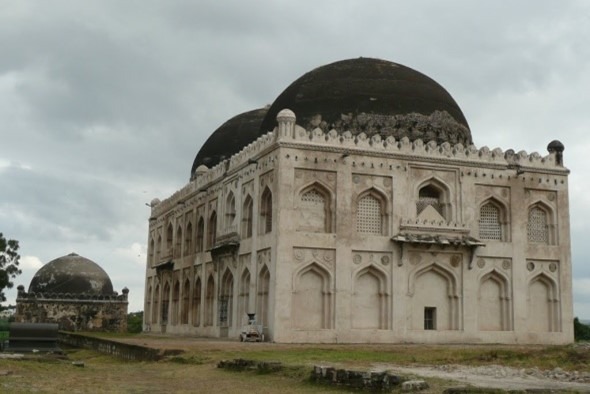
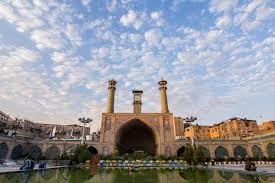
Haft Gumbaz (Seven Domes)
Shah Bazaar Mosque
- Bidar, which rose to prominence under Ahmad Shah I, became a hub of artistic innovation. The city is home to the famed Mahmud Gawan Madrasa, a center of Islamic learning and Persianate scholarship, notable for its Persian tiles and impressive minarets. Other architectural gems include the Sola Khamba Mosque, Rangeen Mahal, Jannat Mahal, and Tarkash Mahal.
Literature also flourished during this period, particularly in Persian, Arabic, and the evolving Dakani Urdu dialect. Mahmud Gawan, a Persian himself, was a distinguished scholar and poet who authored works like Riyaz-ul-Insha and Manazir-ul-Insha. Meanwhile, Khwaja Bande Nawaz Gesu Daraz, the revered Sufi saint of Gulbarga, contributed significantly to the development of Dakani prose, laying the groundwork for the future evolution of Urdu literature in the Deccan.
The Bahmani rulers also supported scholars, poets, and theologians from across the Islamic world, transforming their courts into centers of intellectual exchange and cultural fusion.
The Bahmani Sultanate, which ruled large parts of the Deccan for nearly 180 years, left an indelible mark on the political, cultural, and architectural landscape of South India. It emerged in 1347 as a challenge to the Delhi Sultanate’s weakening control over the Deccan, and under rulers like Alauddin Hasan Bahman Shah, Firuz Shah Bahmani, Ahmad Shah Wali, and especially Mahmud Gawan, it achieved significant territorial expansion and cultural consolidation.
Despite its accomplishments, the Bahmani kingdom was plagued by factional conflicts, especially between Deccani nobles (local Muslim elites) and Afaqis (foreign-born nobles), which weakened its internal cohesion. The unjust execution of Mahmud Gawan in 1481, who had tried to suppress these divisions, accelerated the decline of central authority.
By the late 15th century, the kingdom began to fragment into five independent Deccan Sultanates: Bijapur, Ahmadnagar, Berar, Bidar, and Golconda. Though politically independent, these states continued to rival one another and often found unity only in opposition to the Hindu kingdom of Vijayanagar.
This rare unity was displayed in 1565 at the Battle of Talikota, when four of the five Deccan Sultanates (except Berar) formed a confederacy and decisively defeated the powerful Vijayanagar Empire, leading to the sacking of its capital. This event marked a watershed in South Indian history and demonstrated the lingering strategic importance of the Bahmani legacy.
In the decades that followed:
- Berar was annexed by Ahmadnagar in 1574,
- Bidar was absorbed by Bijapur between 1618–1619,
- The Mughals under Akbar and Shah Jahan gradually conquered Ahmednagar,
- And finally, Aurangzeb annexed Bijapur and Golconda in the late 17th century, completing the Mughal conquest of the Deccan.
Despite its fall, the Bahmani Sultanate’s contribution to Deccan polity, culture, architecture, and literature remained significant, laying the foundation for the uniquely syncretic and cosmopolitan character of the region for centuries to come.
Bahmani Officials
Officer | Role |
Vakil-us-Sultana | Equivalent to Naib Sultan of the Delhi Sultanate (Deputy to the Sultan) |
Peshwa | Assistant or subordinate to the Vakil |
Wazir-i-Kul | Prime Minister; Supervised all other ministries |
Amir-i-Jumla | Head of the Finance Department |
Wazir | Deputy Chief of the Finance Department |
Wazir Ashraf | Head of Foreign Affairs and the Royal Court |
Sadr-i-Jahan | Head of the Judiciary and Charitable Endowments |
Kotwal | Head of Police; Responsible for law and order in towns |
Tarafdar | Provincial Governor |