
TOne Academy

Turkish Invasions of India

Home / Indian History / Turkish Invasions of India

Turkish Invasions of India

Political Fragmentation after Harshavardhan

     The death of Harshavardhan, often regarded as the last powerful Hindu ruler of northern India, left a significant power vacuum in the subcontinent. The absence of a strong centralized authority gave rise to numerous small, often warring kingdoms, especially in North India. This political fragmentation and rivalry among local rulers made the region vulnerable to external invasions. Sensing this weakness, foreign powers began to view India not only as a land of immense wealth but also as an easy target for conquest and expansion. The Arab powers, fresh from their victories across West Asia and North Africa, were the first to respond.

Early Arab Invasions and the Conquest of Sind (712 CE)

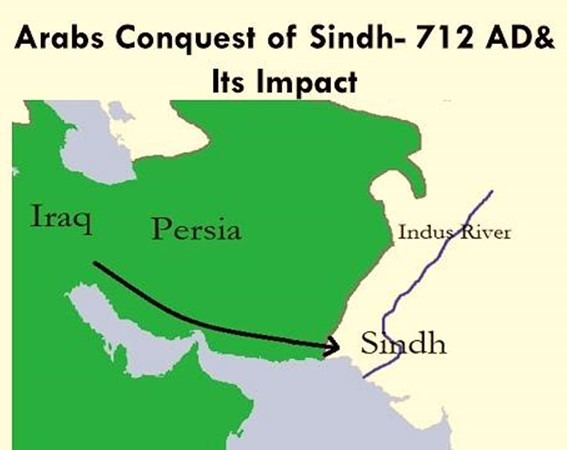
      The rise of Islam in the 7th century CE had transformed the Arab world into a dynamic and expansionist power. After establishing dominance over regions such as Syria, Palestine, Egypt, and Persia, the Arab forces turned their attention eastward toward the Indian subcontinent. The first Arab naval raids along the Sindh coastline were recorded as early as 636 CE, during the reign of Caliph Umar. However, a full-scale and sustained conquest did not occur until 712 CE under Caliph al-Walid (705–715 CE) of the Umayyad Caliphate.
 

Muhammad bin Qasim: The Conqueror of Sind

      In 712 CE, Muhammad bin Qasim, a young and ambitious general barely 17 years old, was appointed to lead the military expedition into Sind. Despite his youth, Qasim proved to be a brilliant strategist and fearless commander. His campaign marked the third attempt by the Arabs to subdue Sind, and it turned out to be decisively successful.


Several factors contributed to this victory:

    • Social Disunity: The population of Sind was ethnically and religiously diverse, including Hindus, Buddhists, Jains, Jats, and Meds. There was a lack of social cohesion, and mutual distrust among these groups weakened resistance to foreign forces.
  •  
    • Internal Conflict: The subjects of King Dahir, the ruler of Sind, lacked unity and loyalty, which further compromised the defence of the region.
  •  
    • Religious Motivation: The Arab invaders, driven by the ideals of Islamic expansion, had a strong sense of mission and unity.


After defeating Dahir, Qasim brought large parts of Sind and Multan under Arab control. These regions were gradually integrated into the Muslim Caliphate and governed with the dual objective of administration and propagation of Islam. Sind became known as “Bab-ul-Islam” (Gateway to Islam), symbolising its role as the first region in the Indian subcontinent to come under Islamic rule.


       Despite this early success, Arab influence remained geographically limited, confined largely to Sind and parts of southern Punjab. Their expansion beyond this frontier was halted by stiff resistance from the Rajputs and other regional powers.

Mahmud of Ghazni (Reign: 998–1030 CE)

      After the decline of the Samanid Empire in Central Asia, the Ghaznavid dynasty rose to prominence. Its most celebrated ruler, Sultan Mahmud of Ghazni, ascended the throne in 998 CE. A key figure in the spread of Islam and Persian culture, Mahmud was not only a political and military leader but also a patron of art, literature, and science.


     Though of Turkic origin, Mahmud was deeply influenced by Persian civilization. Persian became the official court language, and Mahmud even claimed descent from the mythical Iranian king Afrasiyab, highlighting the dynasty’s strong Iranian cultural identity.


     However, in the Indian historical memory, Mahmud is remembered not for cultural achievements, but primarily for his seventeen raids into northern India between 1000 and 1027 CE. His major invasions included:


    • The sacking of Mathura, Kannauj, and Thanesar
    • The famous raid on the Somnath temple (1025 CE), which became symbolic of his iconoclastic zeal.
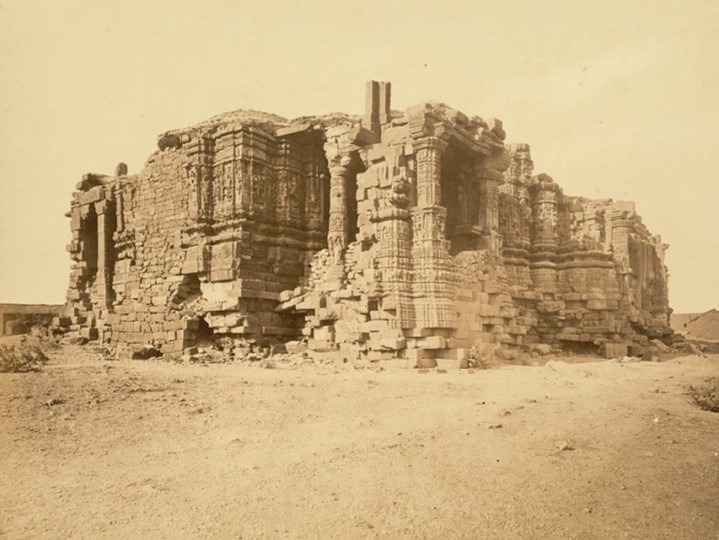


While these raids were largely motivated by the lure of wealth, Mahmud also claimed to be waging jihād—holy war—against infidels. He carried off enormous amounts of treasure, destroyed Hindu temples, and established his military prestige in both the Islamic world and beyond.


      It’s important to note that Mahmud never intended to establish a lasting empire in India. His raids were economic and religious expeditions rather than campaigns of territorial conquest.

Muhammad Ghori (1175–1206 CE): The Founder of Islamic Rule in India

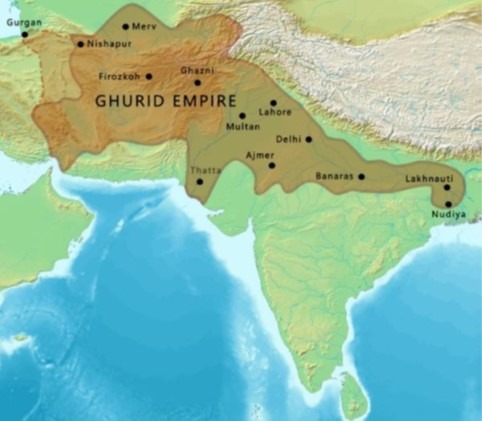
      While Mahmud of Ghazni’s legacy was one of plunder, Shahab-ud-Din Muhammad Ghori, also known as Muhammad Ghori, was a conqueror with a different vision. Ruling the Ghurid Empire alongside his brother Ghiyath-ud-din, Muhammad Ghori ascended the throne of Ghazni in 1173 CE.


     Unlike Mahmud, Ghori aimed to establish permanent political control over Indian territories. He was well aware of the fragmented political landscape, religious divisions, and military vulnerabilities of the Indian subcontinent. His objective was not just material wealth but also Islamic expansion and state-building.

His major campaigns in India include:

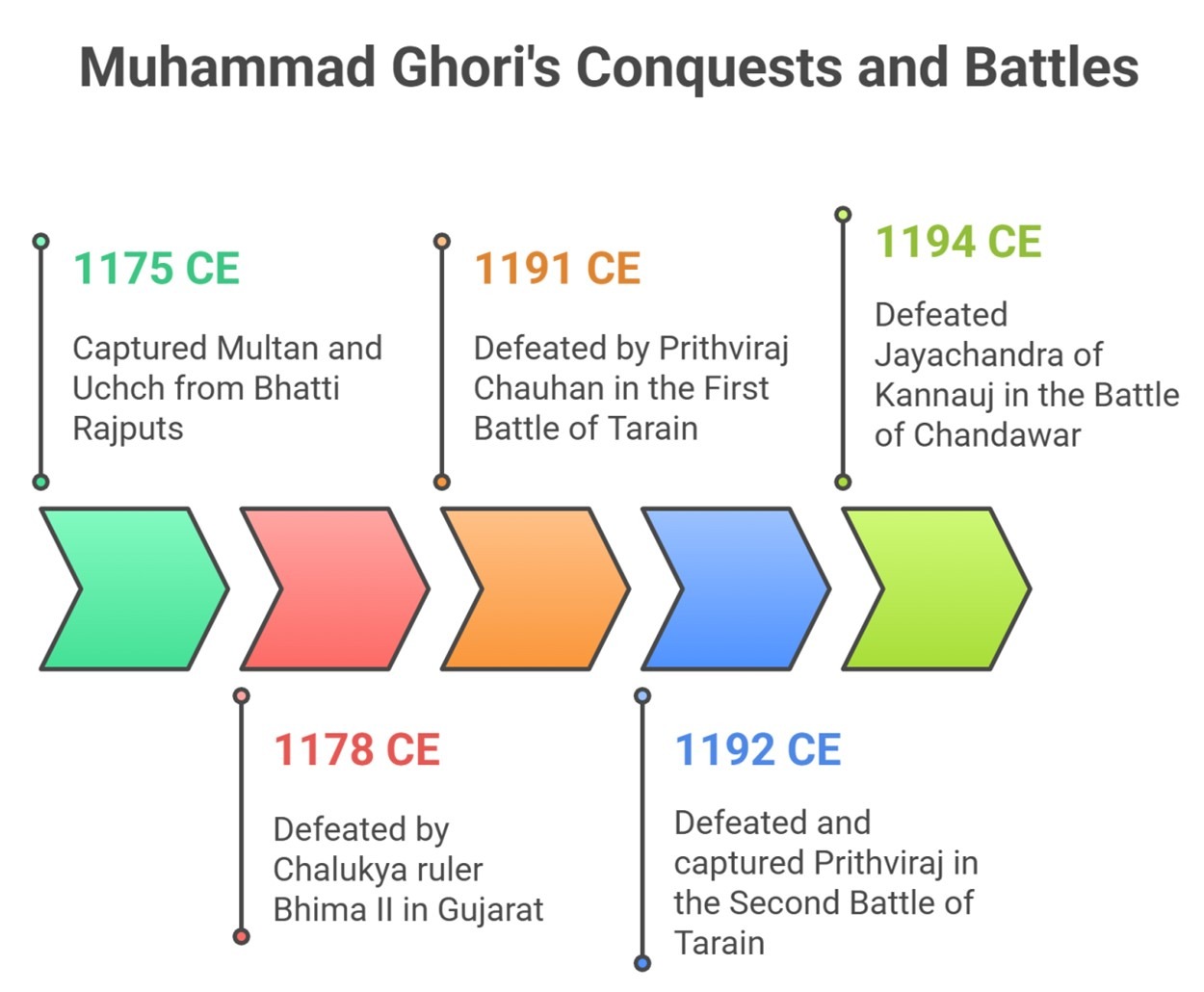
    • 1175 CE – Successfully captured Multan, followed by Uchch (Upper Sindh) from the Bhatti Rajputs
    • 1178 CE – Suffered a setback in Gujarat at the hands of Chalukya ruler Bhima II in the Battle of Kayadara
    • 1191 CE – First Battle of Tarain, where he was defeated by Prithviraj Chauhan
    • 1192 CESecond Battle of Tarain, a turning point in Indian history. Ghori defeated and captured Prithviraj, thereby establishing a firm base in Ajmer and Delhi
    • 1194 CE – Defeated Jayachandra of Kannauj in the Battle of Chandawar, expanding Ghurid influence into the Gangetic plains


These victories allowed Muhammad Ghori to lay the foundation of Muslim rule in northern India. He entrusted his trusted general, Qutb-ud-din Aibak, with the administration of the newly conquered territories.

Raids of Muhammad Ghori: Campaigns of Conquest and Consolidation

   Following his rise to power in 1173 CE, Muhammad Ghori launched a series of strategic military campaigns aimed at expanding his dominion into the politically fragmented landscape of northern India. These invasions were marked by a calculated understanding of India’s regional weaknesses, as well as a relentless ambition to establish lasting Islamic rule.


     Over the span of three decades, Ghori is believed to have carried out at least seven major invasions into India, most of which resulted in decisive victories that laid the foundation for future Muslim rule on the subcontinent.

1. First Expedition: Conquest of Multan and Upper Sindh (1175–1178 CE)

      Muhammad Ghori’s first expedition into India began in 1175 CE, targeting the region of Multan, which was then under the control of the Ismaili Shias. The campaign was a resounding success, and Multan was annexed into the Ghurid Empire. Following this, Ghori turned his attention to Upper Sindh, where he launched an assault on Uchch, a stronghold of the Bhatti Rajputs.

The capture of Uchch and the construction of a fortified outpost provided Ghori with a crucial military base for future operations deeper into the Indian subcontinent. This marked the beginning of a permanent Ghurid presence in the region.

2. Failed Campaign in Gujarat (1178 CE)

     In 1178 CE, emboldened by his earlier successes, Muhammad Ghori set his sights on Gujarat, then ruled by the powerful Chalukya (Solanki) dynasty under King Bhima II. However, the campaign did not go as planned. At the Battle of Kayadara, located near Mount Abu, Ghori’s forces were soundly defeated by the well-organized and resilient Solanki army.


    This unexpected setback forced Ghori to reconsider his strategy. Instead of pressing westward, he realized the need to establish a stronghold in Punjab, a geographically and strategically favorable region that could serve as a launchpad for future campaigns across northern India. This recalibration of military focus marked a turning point in his long-term conquest plan.

The Battles of Tarain: A Turning Point in Indian History

1. First Battle of Tarain (1191 CE)

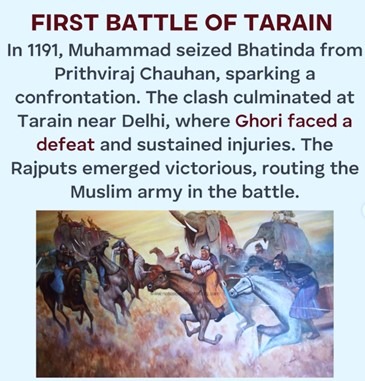
    By the early 1190s, Ghori had consolidated his position in Punjab. In 1191 CE, he advanced toward Delhi and Ajmer, territories ruled by the formidable Prithviraj Chauhan, the ruler of the Chahamana dynasty. In response to the growing threat, several Rajput kings of northern India united under Prithviraj’s leadership to resist the Ghurid advance.


     The two armies clashed near the town of Tarain, not far from modern-day Delhi. In this First Battle of Tarain, the Rajput alliance emerged victorious. Ghori was seriously wounded in battle and had to retreat in haste to Ghazni. The victory brought widespread acclaim to Prithviraj Chauhan, who was hailed as the defender of Indian sovereignty.


2. Second Battle of Tarain (1192 CE)

     Despite the earlier defeat, Muhammad Ghori returned the very next year with a much larger and better-prepared army. In 1192 CE, he once again confronted Prithviraj Chauhan at Tarain. This time, Ghori employed superior military tactics, including feigned retreats and cavalry-based attacks that overwhelmed the Rajput forces.


    The result was catastrophic for the Rajputs. Prithviraj was captured and later executed. The Second Battle of Tarain was a watershed moment in Indian history. It signaled the collapse of unified Rajput resistance and firmly established Muslim rule in northern India, with Ajmer and Delhi falling under Ghurid control.



Battle of Chandawar (1194 CE): Fall of the Gahadavala Dynasty

     Following his victory at Tarain, Muhammad Ghori left the governance of his Indian territories in the hands of his trusted general, Qutb-ud-din Aibak, while he returned to Ghazni. However, Ghori’s ambition for complete domination of northern India was far from over.


    In 1194 CE, he launched another campaign—this time directed at Kannauj, ruled by the Gahadavala dynasty under King Jayachandra (also known as Jayachand Rathor). The two armies met near Chandawar, located between present-day Etah and Kanpur in Uttar Pradesh.


    In the ensuing Battle of Chandawar, Jayachandra was defeated and killed. This victory allowed the Ghurids to extend their control over the entire Gangetic Doab, a fertile and economically crucial region. The fall of Kannauj marked the final collapse of effective Rajput resistance in the north and gave the Ghurid Empire a secure territorial and financial base in the heartland of India.

Aftermath: Death of Muhammad Ghori and the Rise of the Delhi Sultanate

     Despite his military achievements, Muhammad Ghori did not live long after his conquest of northern India. In 1206 CE, while returning to Ghazni, he was assassinated near the Dhamyak region of Jhelum, in present-day Pakistan.


     Following his death, the empire he established in India was inherited by Qutb-ud-din Aibak, who became the first Sultan of Delhi and founder of the Slave (Mamluk) Dynasty. This event marked the beginning of the Delhi Sultanate, a pivotal era in Indian history that would last for over three centuries and profoundly influence the subcontinent’s politics, society, architecture and culture.


Factors Responsible for the Success of the Turkish Invasions in India

      The remarkable success of the Turkish invaders in establishing their authority in northern India during the 12th and 13th centuries was not accidental. It was the result of a unique combination of political, military, economic, religious, and cultural advantages that the Turks possessed over the fragmented and internally divided Indian kingdoms, especially the Rajput states. Each of these factors played a crucial role in the rapid consolidation of Turkish power, particularly under leaders like Muhammad Ghori and his general Qutb-ud-din Aibak.

1. Politico-Administrative Factors: Absence of Centralized Authority in India

     When the Turkish incursions began in earnest, northern India was politically disunited and lacked any strong central leadership. The vacuum created after the decline of powerful empires like those of Harshavardhana and later the Palas had given rise to several small, independent Rajput kingdoms, each more interested in local supremacy than collective defense.


      There was no unified response to the Turkish threat. Mutual suspicion, inter-dynastic rivalries, and a lack of diplomatic foresight prevented Indian rulers from forming a meaningful and lasting alliance. Although a few half-hearted attempts at unity were made—for instance, in 991 CE—they failed to materialize into an effective confederacy.


      Moreover, the Indian political class remained largely unaware of the changing power dynamics in Central and West Asia, which allowed the Turks to exploit the element of surprise and use their growing power with devastating effect.

2. Military Superiority: Advanced Tactics and Equipment

     A critical reason behind the Turkish triumphs was their military efficiency. The Turkish armies were well-organized, disciplined, and commanded directly by the Sultan, which ensured a high level of centralized command and swift decision-making.


       In stark contrast, the Rajput military structure was feudal, fragmented, and heavily reliant on traditional warfare techniques, particularly the use of elephant corps, which, although formidable, were slow and increasingly outdated. The Turks, on the other hand, relied on light cavalry, mobile archery, and strategic formations that allowed for rapid movement and sudden attacks.


     They also employed psychological warfare. It is recorded that elephants—despite their intimidating size—could be easily frightened by noise or fire, tactics that the Turks used effectively. In addition, they used iron stirrups, horseshoes (Naal) for increased mobility over rough terrain, and powerful long-range bows such as the navak, which allowed them to attack from a distance with lethal precision.


      The Rajput armies, by comparison, continued to use rope stirrups and did not innovate in weaponry or battlefield strategy, putting them at a disadvantage despite their valor.

3. Economic Factors: Weak Fiscal Foundations of Indian Kingdoms

       Economically, the Indian kingdoms, particularly in the north, were primarily agrarian in character. While agriculture remained the backbone of the economy, secondary economic activities such as urban trade, commercial exchange, and craft industries were relatively underdeveloped in many regions. This economic structure placed a limitation on state revenues and the capacity to sustain a large, permanent standing army.


       In contrast, the Turkish sultans had access to wealth from plunder, tribute, and trade routes across Central Asia and Persia, which enabled them to finance better-equipped and well-maintained armies. The conquest of the Gangetic Doab and fertile regions like Punjab further enriched their resources, allowing for continued military campaigns and administrative expansion.

4. Religious Motivation: The Role of Jihad and Gazi Spirit

      The religious zeal of the Turks played a key motivational role in their campaigns. The idea of Jihad, or holy war, was actively used to instill a sense of divine purpose among soldiers. The Gazi spirit, which glorified warriors who fought for Islam, helped create a cohesive and motivated fighting force that believed in both a religious mission and territorial conquest.


   This religious unity among Turkish troops was starkly different from the religious and social fragmentation within Indian society. The Rajputs, though personally devout, lacked a collective religious-political ideology strong enough to bind them together in a united defense of the subcontinent.

5. Cultural and Strategic Factors: Decline of Rajput Power and the Rise of Delhi

     The Second Battle of Tarain (1192 CE) marked a turning point in Indian history. It did not just symbolize a military loss for the Rajputs, but also the beginning of their gradual political decline. After this battle, the Ghurid general Qutb-ud-din Aibak was entrusted with overseeing the administration and expansion of Turkish territories in India.


       The Turks chose Delhi as their capital, a move of great strategic foresight. Located at the crossroads of the north Indian plains, Delhi was historically significant and offered easy access to the Gangetic basin and the Punjab region. It became the ideal base for controlling north India and further military expansion.


      Wherever feasible, the Turkish invaders retained local rulers as vassals, provided they acknowledged Turkish supremacy. For instance, Prithviraj Chauhan’s son was allowed to rule Ajmer under Turkish overlordship. However, such arrangements were often unstable and were frequently overturned as Turkish power consolidated.


      Later campaigns under Aibak included the conquest of Kol (modern Aligarh) and Kannauj, where the Gahadavala ruler Jayachandra was defeated at the Battle of Chandawar (1194 CE). These victories extended Turkish rule deep into the Gangetic heartland.


     Eventually, regions like Magadha and Bengal also came under Turkish control, thanks to aggressive campaigns led by generals such as Bakhtiyar Khilji, who is known for his conquest of Bihar and Bengal, further cementing the foundation of what would become the Delhi Sultanate.

A Multifaceted Triumph

      The success of the Turks in India was the result of multiple intersecting factors—disunity and weak administration among Indian rulers, outdated military practices, a fragile economy, religious cohesion among the invaders, and bold strategic moves such as the occupation of Delhi. Together, these allowed a relatively small but determined group of foreign conquerors to overthrow powerful kingdoms and establish one of the most enduring political regimes in Indian history.

Al-Biruni and Firdausi: Cultural Bridges Between Civilizations

Al-Biruni (973–1048 CE): The Scholar of Civilizations

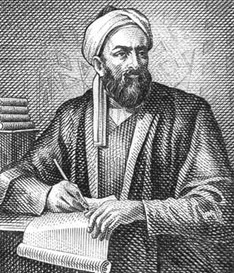
      Abu Rayhan Muhammad ibn Ahmad Al-Biruni, widely known as Al-Biruni, was one of the greatest intellectuals of the medieval Islamic world. A polymath of extraordinary depth and breadth, Al-Biruni was a mathematician, philosopher, astronomer, geographer, linguist, and historian. He is most celebrated in the Indian context for his immense contribution to the study of Indian culture, science, and society, especially through his seminal work Kitab-ul-Hind.


Early Life and Scholarly Background

     Al-Biruni was born in 973 CE in Khwarizm (present-day Uzbekistan), a region known for its vibrant scholarly atmosphere. Gifted with a remarkable intellect, he mastered several languages early in life, including Arabic, Persian, Syriac, and Hebrew, and later Sanskrit. Although he did not know Greek, he was deeply familiar with Greek philosophical texts through Arabic translations, especially those of Plato, Aristotle, and Euclid.

From Hostage to Scholar in Ghazni

      In 1017 CE, the Central Asian kingdom of Khwarizm was invaded by Mahmud of Ghazni, the powerful Turkish ruler. Al-Biruni, along with several other scholars, was taken to Ghazni. Though he initially arrived as a political prisoner, he quickly earned respect and recognition due to his extraordinary erudition. He chose to stay in Ghazni voluntarily and spent the remainder of his life there, engaging in rigorous academic inquiry.


     During his stay in Ghazni, Al-Biruni became fascinated with India, especially after the Ghaznavid conquest of Punjab, which opened avenues for direct cultural interaction. His scholarly curiosity led him to travel extensively in India, where he learned Sanskrit and engaged in philosophical and scientific dialogues with Hindu scholars, particularly the Brahmanas.

Kitab-ul-Hind: A Landmark in Cross-Cultural Scholarship

      Al-Biruni’s most celebrated work, Kitab-ul-Hind (The Book of India), written in Arabic, stands as a comprehensive ethnographic and philosophical study of Indian civilization. Structured into 80 thematic chapters, the book covers a wide range of topics such as:

    • Religion and philosophy
    • Festivals and rituals
    • Astronomy and astrology
    • Alchemy and science
    • Manners, customs, and daily life
    • Laws, weights and measures, iconography, and metrology


Each chapter typically follows a unique structure: it begins with a question or theme, followed by a detailed explanation based on Sanskrit sources, and ends with a comparative analysis involving Greek, Persian, or Islamic traditions. Scholars often note that this methodical structure reflects Al-Biruni’s mathematical mindset, where precision and logic underpin his academic approach.

Linguistic Mastery and Translation Work

      Al-Biruni’s linguistic genius played a vital role in his cross-cultural scholarship. He not only translated Sanskrit texts into Arabic, such as Patanjali’s grammar, but also rendered key Greek works, including those of Euclid, into Sanskrit for the benefit of his Indian interlocutors. He was among the first to introduce Indian scientific knowledge—notably Aryabhata’s astronomical theories—to the Islamic world and, through it, to Europe.


    His translation of Aryabhatiyam, which explains the rotation of the Earth on its axis, is considered a significant contribution to global scientific thought. Al-Biruni thus served as a cultural and intellectual bridge between India, the Islamic world, and the West.

Reflections on Sanskrit and Indian Society

   Al-Biruni found Sanskrit to be immensely rich yet complex, with an expansive vocabulary and numerous synonyms for a single concept. He observed that words could carry multiple meanings, often requiring specific qualifiers for accurate interpretation. This complexity, he noted, was comparable to the intricate structure of the Arabic language.

Caste System and Social Observations

      Al-Biruni’s understanding of Indian society was largely shaped by Brahmanical literature, such as the Vedas, Puranas, Bhagavad Gita, Manusmriti, and the works of Patanjali. Based on these texts, he studied the varna system, or caste hierarchy, and described it in detail. However, he acknowledged that the rigidity portrayed in scriptures did not always align with practical social realities.


To make the Indian caste system more relatable to his readers, he drew a parallel with the Persian social order, which also had four primary social groups:

1. Knights and Princes

2. Monks, Fire-Priests, and Jurists

3. Physicians, Astronomers, and Scientists

4. Peasants and Artisans


Despite this comparison, Al-Biruni highlighted that Islamic social philosophy differed fundamentally from the Indian system, particularly in its emphasis on egalitarianism. In Islam, all individuals were considered equal in the eyes of God, with distinctions made only on the basis of piety and moral conduct.

Significantly, Al-Biruni rejected the notion of social pollution, a key feature of the caste-based system. He deemed the idea unnatural and irrational, arguing that it went against universal laws of nature.

Firdausi: The Voice of Persian Identity

Firdausi and the Shahnamah

      Firdausi, a contemporary of Al-Biruni, was a celebrated Persian poet who gained prominence as the poet laureate in the court of Mahmud of Ghazni. His magnum opus, the Shahnamah (The Book of Kings), is a monumental epic written in classical Persian, consisting of over 50,000 couplets. It is regarded as one of the longest and most influential epics in world literature.
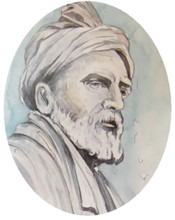


      The Shahnamah chronicles the mythical and historical past of Persia, from the creation of the world to the fall of the Sassanid Empire following the Arab conquests. Through tales of heroism, justice, betrayal, and love, Firdausi sought to preserve Iranian cultural heritage and national identity in the face of growing Arab influence.

Cultural Significance

    Firdausi’s work not only symbolized Persian literary excellence, but also served as a cultural and political statement. At a time when Persian identity was undergoing transformation under Islamic rule, the Shahnamah rekindled a sense of pride in pre-Islamic Persian history and values.


      Though he was honored in the court of Mahmud, tensions are said to have arisen between the poet and the Sultan, possibly over unpaid dues or ideological differences. Firdausi’s devotion to Persian traditions and his poetic resistance to Arab domination make him a towering figure in the literary and cultural history of Iran.

Architects of Cross-Cultural Knowledge

     Both Al-Biruni and Firdausi, though vastly different in their contributions—one a scientific scholar, the other a literary giant—played transformative roles in shaping the cultural and intellectual world of their time. Al-Biruni bridged civilizations through scholarship, opening Indian thought to the Islamic and Western worlds. Firdausi, on the other hand, reinvigorated Persian identity through poetic mastery.


    Together, they exemplify the vibrancy of medieval Islamic scholarship, where science, literature, philosophy, and history flourished side by side, leaving an enduring legacy for generations to come.