
By the seventh century CE, the ancient city of Kanauj had emerged as a vital political and strategic center in northern India. Its prominence was firmly established when Emperor Harshavardhana shifted his capital from Thanesar to Kanauj, transforming it into a hub of administrative and cultural activity. However, after Harsha’s death in 647 CE without a clear successor, Kanauj fell into a period of political instability, creating a power vacuum that would later give rise to a fierce and prolonged conflict over its control.
Nearly a century later, around 725 CE, a ruler named Yashovarman rose to power in Kanauj and established the Varman dynasty, which reigned until approximately 770 CE. While Yashovarman was a competent and ambitious king, his successors lacked his vigor and failed to maintain the same level of influence. The dynasty eventually weakened, and the last known ruler, Bhoja, was defeated by Vajrayudha, who went on to establish the Ayudha dynasty in the late 8th century.
It was during this politically volatile period that Kanauj became the epicenter of a three-way power contest involving three major regional dynasties:
Each of these dynasties aimed to control Kanauj, recognizing its symbolic and strategic value as the gateway to political supremacy in northern India. However, while each of them succeeded in capturing Kanauj temporarily, none could hold it for a long duration. This ongoing competition for dominance is known in history as the Tripartite Struggle—a landmark political conflict that spanned over a century.
Among the three powers, the Rashtrakutas were particularly significant. Their empire was not only politically dominant for a longer duration than their rivals but also played a crucial role in connecting northern and southern India through cultural exchange and trade networks. This integration helped foster economic and religious interactions between the two regions, contributing to a broader Indian cultural identity.
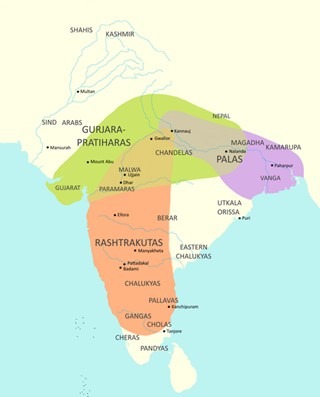
The Ayudha dynasty, established by Vajrayudha, succeeded the Varmans in ruling Kanauj from the late 8th to early 9th century CE. Vajrayudha’s rule marked a transitional phase, as Kanauj continued to be a contested territory. He was succeeded in 783 CE by his son Indrayudha, who soon found himself entangled in the wider Tripartite Struggle. Indrayudha faced military defeats at the hands of two of the era’s most powerful rulers—Dhruva Dharavarsha of the Rashtrakuta dynasty and Dharmapala, the mighty Pala king of Bengal.
Following Indrayudha’s defeat, Dharmapala refrained from directly annexing Kanauj. Instead, he installed Chakrayudha, Indrayudha’s brother, on the throne as a vassal ruler, thereby ensuring Pala influence over Kanauj without overt political absorption. During Chakrayudha’s tenure, the Ayudha dynasty functioned essentially as a client state of the Palas, reflecting the fragile and subordinate nature of their rule.
However, this arrangement did not last long. The balance of power shifted dramatically when the Rashtrakuta ruler Govinda III launched an invasion into northern India. He successfully defeated both Dharmapala and Chakrayudha, plunging the region into deeper political chaos. Exploiting this instability, Nagabhata II, a dynamic ruler of the Gurjara-Pratihara dynasty, launched his own campaign. He decisively defeated Chakrayudha and seized control of Kanauj, declaring it the new capital of the Gurjara-Pratiharas.
This conquest not only marked the end of the Ayudha dynasty but also firmly established the Gurjara-Pratiharas as a dominant political power in northern India. The fall of the Ayudhas was symbolic of the larger trend of feudal fragmentation and dynastic rivalry that characterized early medieval India.
The Pala Empire, one of the most prominent imperial powers in eastern India, played a crucial role in shaping the political, cultural, and religious landscape of the Indian subcontinent from the 8th to the 12th century CE. The roots of the Pala dynasty can be traced back to a period of political disarray in Bengal following the decline of the Gauda kingdom, ruled earlier by Shashanka, the first prominent independent king of Bengal. Shashanka controlled a wide territory that included parts of modern West Bengal, Bihar, and Bangladesh during the early 7th century CE. However, after his death, Bengal was left fragmented, plagued by constant power struggles among numerous petty chieftains.
In this atmosphere of instability, a significant event occurred around 750 CE: local chieftains convened and collectively elected a Kshatriya nobleman named Gopala as their ruler. Though Gopala had no known royal lineage, he demonstrated exceptional leadership abilities that earned him the respect and allegiance of rival chiefs. His rise to power marked the beginning of the Pala dynasty. Gopala’s early rule was centered in Vanga (East Bengal), but he quickly expanded his domain, successfully uniting the region of Bengal and even annexing Magadha (modern-day Bihar) under his authority.
Gopala was succeeded by his son, Dharmapala, under whose reign the Pala kingdom rose to prominence on the Indian political stage. A vigorous and ambitious ruler, Dharmapala not only consolidated his father’s gains but also extended the empire’s influence deep into northern India. His reign was marked by the famous Tripartite Struggle, a prolonged conflict involving the Palas, the Gurjara-Pratiharas of western India, and the Rashtrakutas of the Deccan—each vying for supremacy over the prized city of Kanauj, a symbol of political legitimacy and imperial authority.
Dharmapala initially gained the upper hand when the Pratihara ruler was defeated by the Rashtrakuta king Dhruva, forcing the Pratihara prince into exile in the deserts of Rajasthan. With the Rashtrakutas temporarily withdrawing to the south, Dharmapala occupied Kanauj and convened a grand imperial assembly, which was attended by numerous vassal rulers from regions including Punjab, eastern Rajasthan, Malwa, and Berar, who acknowledged his suzerainty. However, his control over northern India was short-lived. The Pratihara power revived under Nagabhatta II, who defeated Dharmapala near Mongyr, leading to the loss of Kanauj and parts of Bihar.
Despite these setbacks, Bihar and Bengal remained under Pala control for the majority of the dynasty’s reign. Dharmapala is best remembered not just for his military and political endeavors but also for his patronage of Mahayana Buddhism. He founded the Vikramashila Monastery in the Bhagalpur district of Bihar, which grew into a major center of Buddhist learning known as Vikramashila University. It rivaled Nalanda in prestige and became a crucial institution for Vajrayana Buddhist education. The esteemed Buddhist monk Atisha Dipankara, who later played a central role in spreading Vajrayana Buddhism to Tibet, served as its abbot. Dharmapala also revived Nalanda University, which continued to flourish throughout the Pala period as a world-renowned center of Buddhist scholarship.
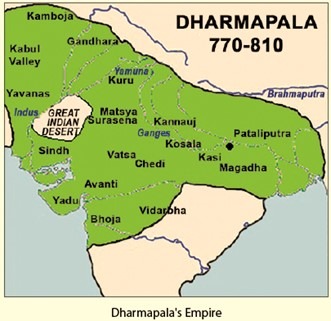
Dharmapala was succeeded by his son Devapala, under whose leadership the Pala Empire reached the zenith of its territorial expansion. He extended the empire’s boundaries into Assam (Pragjyotishpur), parts of Odisha, and even secured Pala suzerainty over Nepal. Historical records suggest that Devapala extracted tribute from kingdoms stretching from the Himalayas to the Vindhya hills, demonstrating the wide reach of Pala influence during his time.
In his campaigns, Devapala successfully defeated the Rashtrakuta ruler Amoghavarsha by forging alliances with other regional powers opposed to Rashtrakuta dominance. Like his predecessors, Devapala remained a staunch patron of Buddhism. One notable example of his international engagement includes the endowment of five villages to Balaputradeva, the Buddhist king of the Sailendra dynasty of Suvarnadwipa (modern-day Sumatra, Indonesia), to support a monastery built at Nalanda. This gesture exemplifies the strong cultural and diplomatic ties that the Palas maintained with Southeast Asia.
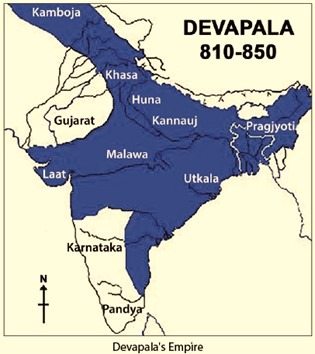
Although the Palas remained dominant in eastern India throughout the 9th century, the empire gradually began to weaken due to dynastic conflicts, succession disputes, and the resurgence of rival powers. After Devapala’s reign, a series of less capable successors failed to preserve the strength and cohesion of the empire. Over time, regional governors and feudatories asserted greater independence, further eroding the central authority of the Palas. By the mid-11th century, the empire had shrunk considerably.
The final blow came in the mid-12th century when Vijayasena, the founder of the Sena dynasty, expelled the last Pala ruler, Madanapala (1130–1150 CE), and established Sena rule in Bengal. However, the Senas too were eventually overthrown in the 13th century by the advancing Muslim armies of the Delhi Sultanate, marking a new chapter in Indian history.
The economic prosperity of the Pala Empire was fueled not only by agriculture but also by vigorous maritime trade. The port city of Tamralipti, located in Bengal, emerged as a key hub for commercial exchanges with Southeast Asia, bringing an influx of wealth, gold, and silver into the empire. This enabled the Palas to support elaborate religious institutions, educational centers, and cultural development.
The Palas served as a crucial cultural bridge between India and Southeast Asia. Their connections with the Buddhist Sailendra dynasty in regions such as Java, Sumatra, and the Malay Peninsula reflect a shared religious and artistic tradition. The monasteries of Nalanda and Vikramashila hosted monks and scholars from across Asia, fostering intellectual exchange. The spread of Vajrayana Buddhism to Tibet was also facilitated by the Pala rulers, particularly through the efforts of renowned Indian scholars such as Santarakshita and Atisha Dipankara, who were invited to Tibet and left a lasting impact on Tibetan religious culture.
The fame of the Pala Empire extended beyond India’s borders. Arab merchant Sulaiman, who visited India in the mid-9th century, provided detailed accounts of the empire. Referring to it as “Ruhma” (a derivation of Dharmapala), he noted the military strength of the Palas, mentioning an army said to include 50,000 elephants and thousands of soldiers employed even in auxiliary services. While these numbers may be exaggerated, they reflect the perception of the Palas as a formidable military power. Sulaiman also confirmed the constant conflicts with rival dynasties like the Pratiharas and Rashtrakutas.
Tibetan chronicles further praise the Palas as great patrons of Buddhism and as founders of major monastic universities. Vikramashila, in particular, is described as an institution of immense learning situated in the scenic highlands along the Ganga in Magadha. The Palas constructed numerous viharas (monasteries) that housed large communities of monks, nurturing scholarship, philosophy, and Buddhist art.
The Pala Empire not only united eastern India under a strong and stable political system but also revived and propagated Mahayana and Vajrayana Buddhism on an international scale. Through their patronage of learning, their role in trade, and their foreign diplomacy, the Palas left an enduring legacy that profoundly influenced the religious and cultural history of India, Southeast Asia, and Tibet.
King (Ruler) | Reign (Rule) | Important Points |
Gopala I | 750 CE | • Founder of the Pala Dynasty |
Dharmapala | 770 – 810 CE | • Defeated by Rashtrakuta kings Dhruva (780–793) and Govinda III (793–814) • Defeated by Pratihara emperor Nagabhata II (795–833) • Founded Vikramasila University in Bihar • Revived Nalanda University |
Devapala | 810 – 850 CE | • Defeated Rashtrakuta ruler Amoghavarsha (814–878) • Granted five villages to Balaputradeva of the Sailendra dynasty (Suvarnadipa/Sumatra) for a monastery at Nalanda |
Madanapala | 1130 – 1150 CE | • Last ruler of the Pala dynasty |
The Gurjara-Pratiharas, often referred to simply as the Pratiharas, were one of the most prominent Rajput dynasties of early medieval India. Their origin is believed to trace back to Gurjara, a region in southwestern Rajasthan, which is why they are commonly known as Gurjara-Pratiharas. This dynasty played a significant role in northern India’s political, military, and cultural affairs between the 8th and 11th centuries CE. They initially established control over Malwa, Rajputana (modern Rajasthan), and Gujarat, later expanding to dominate Kanauj, a city that became the nerve centre of their imperial ambition.
The early Pratiharas were likely local officials or military governors, who gradually asserted their independence and carved out territories amidst the political fragmentation following the decline of the earlier imperial powers. One of their earliest accomplishments was resisting Arab invasions from Sindh into Rajasthan during the early 8th century. Although the Arabs posed a substantial threat, they were ultimately defeated decisively by the Chalukyas of Gujarat in 738 CE, effectively ending the Arab push into western India. However, the Pratiharas’ staunch resistance against the Arabs greatly enhanced their prestige and helped them consolidate their position in Rajasthan and surrounding areas.
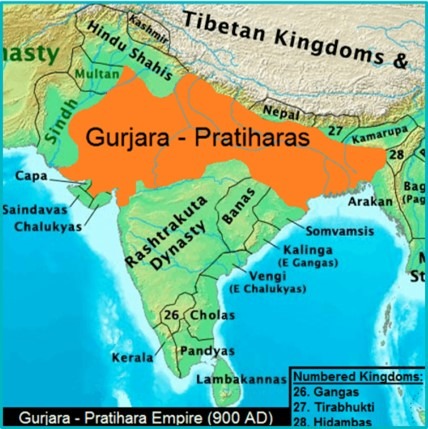
The imperial lineage of the Pratiharas began with Nagabhata I, who ruled from 730 to 760 CE and established his capital at Ujjain. He extended his territory across modern-day Rajasthan and Gujarat, laying the foundation for future expansion. However, the ambitions of the early Pratihara rulers to dominate the upper Ganga valley and Malwa met with stiff resistance from the powerful Rashtrakutas of the Deccan. Kings like Dhruva and Govinda III dealt them significant defeats in 790 and 806–807 CE respectively, forcing the Pratiharas to temporarily retreat from their northern ambitions. The Rashtrakutas’ primary interest was the control of Malwa and Gujarat, both of which were strategic and commercially significant regions.
Nagabhata I was succeeded by Nagabhata II (795–833 CE), who made significant military and political strides. He defeated Chakrayudha, the then ruler of Kanauj, and also overcame Dharmapala, the powerful Pala emperor of Bengal. However, Nagabhata II too suffered a major defeat at the hands of Rashtrakuta king Govinda III, which led to the loss of Malwa and Gujarat once again. Despite these setbacks, the Pratiharas persisted, and under the leadership of a truly exceptional monarch, they experienced their golden age.
The most illustrious ruler of the Pratihara dynasty was Mihir Bhoja (836–882 CE), widely regarded as the real founder of the Pratihara Empire. A zealous devotee of Lord Vishnu, Bhoja adopted the title ‘Adivaraha’, which is prominently displayed on many of his coins. Under his rule, the Pratiharas reached the pinnacle of their power and influence. Bhoja recovered Kanauj, which became the imperial capital and remained the epicenter of northern Indian politics for nearly a century.
Bhoja initially attempted to expand his dominion eastward but was countered by the Pala emperor Devapala, leading him to redirect his expansionist strategies towards central India, Gujarat, and the Deccan. This rekindled hostilities with the Rashtrakutas, but Bhoja’s political acumen and military strength helped him maintain Pratihara supremacy for decades. Following Devapala’s death and the subsequent weakening of the Palas, Bhoja made gains in the east, extending his empire’s frontiers.
An inscription from this period claims that Bhoja’s empire stretched to the western banks of the Sutlej River, marking a significant territorial extent. Arab sources, especially travellers like Al-Masudi, confirm the grandeur of the Pratihara state. According to them, the Pratiharas maintained the finest cavalry in all of India, largely due to the active import of horses from Central Asia and Arabia, which was a vital component of India’s international trade during this period.
Despite their military strength and vast territorial expanse, the decline of the Pratihara Empire began in the early 10th century. Between 915 and 918 CE, Rashtrakuta king Indra III launched a successful attack on Kanauj, causing widespread destruction and effectively undermining Pratihara authority in the region. Gujarat, the empire’s economic lifeline and major overseas trade hub, likely fell into Rashtrakuta hands, further crippling the empire’s financial stability. In 963 CE, Krishna III, another Rashtrakuta monarch, invaded northern India and dealt a decisive blow to the Pratiharas, leading to their rapid disintegration.
The weakening of central authority encouraged the rise of regional kingdoms, and the once-powerful empire fragmented into smaller principalities. By the early 11th century, the Pratihara Empire had lost much of its former glory and political influence, though its legacy endured in the cultural and administrative fabric of northern India.
The Pratiharas were not only warriors and administrators but also great patrons of art, architecture, and learning. Under their rule, Sanskrit literature flourished. The renowned poet and dramatist Rajashekhar, who served at the court of Mahipala, the grandson of Mihir Bhoja, is one of the most celebrated figures of this era. His works provide valuable insights into the life and literary tastes of the Pratihara court.
Additionally, the 8th and 9th centuries witnessed an active intellectual exchange between India and the Islamic world. Several Indian scholars, traveling with diplomatic missions, visited the Abbasid Caliphate in Baghdad and played a significant role in introducing Indian scientific and mathematical knowledge to the Arab world. Notably, mathematics, astronomy, algebra, and medicine were some of the fields where Indian expertise left a lasting impact. Despite the Pratiharas’ political hostility toward the Arab rulers of Sindh, the movement of goods, ideas, and scholars across regions continued, testifying to a vibrant cultural milieu.
Arab traveller Al-Masudi, who visited Gujarat in 915–916 CE, left a detailed description of the Pratihara Empire, highlighting its power and opulence. He referred to the kingdom as al-Juzr (a derivation of Gurjara) and spoke highly of Bhoja, whom he identified as the reigning monarch. According to his account, the Pratihara Empire encompassed 1,80,000 villages, towns, and rural settlements, spanning approximately 2,000 kilometers in both length and breadth.
He also provided fascinating details about the organization of the Pratihara military, stating that the emperor commanded four major armies, each consisting of 700,000 to 900,000 soldiers. While such numbers are likely exaggerated, they indicate the reputation for military might that the Pratiharas enjoyed. Al-Masudi also emphasized the quality of their cavalry, describing it as the finest in all of India, and mentioned the presence of 2,000 trained war elephants, further underlining the scale and power of the empire.
The Pratiharas played a crucial role in resisting foreign invasions, stabilizing northern India, and reviving classical Indian traditions during a time of political flux. Their reign marked a golden phase for Sanskrit literature and temple architecture, while also facilitating cross-cultural exchanges with regions as far as West Asia. Though their political power eventually declined, the Pratiharas left behind a legacy of valor, statecraft, and intellectual vigor that significantly shaped the early medieval history of India.
King (Ruler) | Reign | Important Points |
Nagabhata I | – | Founder of the Gurjara-Pratihara dynasty |
Nagabhata II | 795 – 833 CE | Defeated the Pala ruler Dharmapala (770 – 810 CE) |
Mihir Bhoja | 836 – 882 CE | Greatest ruler of the Gurjara-Pratihara dynasty |
The Rashtrakutas emerged as one of the most powerful dynasties in the Deccan region between the 8th and 10th centuries CE, providing political stability and military strength to a vast stretch of the Indian subcontinent. The word Rashtrakuta literally means “chieftain of a Rashtra”—a term that could refer either to a territorial division or a kingdom, depending on the context. The dynasty is believed to have originated around Lattalura, corresponding to present-day Latur in Maharashtra. Inscriptions referring to the Rashtrakuta kings as Lattalura-puraveshvara—“lord of the great city of Lattalura”—corroborate this association. Initially, they may have served as feudatories under the Chalukyas, but they soon established their independent rule with Manyakheta (modern Malkhed, near Sholapur in Karnataka) as their capital.
The founder of the Rashtrakuta dynasty was Dantidurga (735–756 CE), also known as Dantivarman. He was instrumental in laying the foundation of the empire by defeating the Chalukya king Kirtivarman, thus asserting independence and expanding control over regions between the Godavari and Vima rivers. Dantidurga is credited with conquests over Kalinga, Kosala, Kanchi, Srisailam, Malava, and Lata, bringing Maharashtra firmly under his command.
He was succeeded by Krishna I (756–774 CE), another significant ruler who consolidated and extended Rashtrakuta authority. Krishna I completed the conquest of territories that remained under Chalukya control and annexed the Konkan region. He also defeated Vishnuvardhana of Vengi and the Ganga king of Mysore. One of the most remarkable achievements of Krishna I was the construction of the magnificent Kailasa temple at Ellora, an architectural masterpiece hewn out of solid rock, showcasing the Rashtrakutas’ patronage of art and religion.
The Rashtrakuta legacy continued under rulers like Govinda II (774–780 CE) and Dhruva Dharavarsha (780–793 CE). Dhruva, in particular, launched successful military campaigns against the Gurjara-Pratihara king Vatsaraja, the Pallavas of Kanchi, and the Pala ruler Dharmapala of Bengal, even capturing Kannauj for a brief period. These victories highlighted the Rashtrakutas’ military might in the Tripartite Struggle—a prolonged contest among the Palas, the Pratiharas, and the Rashtrakutas for control over northern India.
Dhruva’s successor, Govinda III (793–814 CE), further extended the empire. He defeated the formidable Nagabhata II of the Gurjara-Pratiharas and asserted authority over the Vindhyan and Malava regions in the north, while maintaining dominance over territories stretching down to the Tungabhadra River in the south. His rule exemplified the peak of Rashtrakuta influence in the Indian subcontinent.
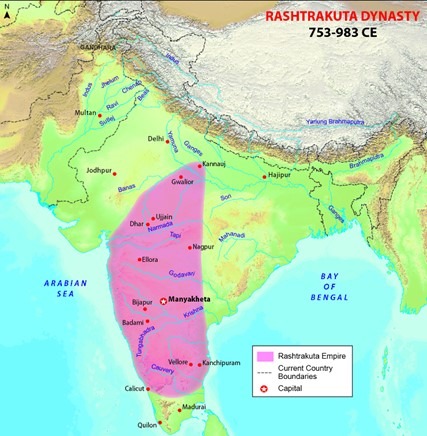
The greatest ruler of the dynasty was undoubtedly Amoghavarsha I (814–878 CE). Renowned not only for his administrative acumen and military competence but also for his patronage of religion and literature, he ushered in a cultural golden age for the Rashtrakuta empire. Amoghavarsha shifted the capital to Manyakheta (Malkhed) and developed it into a thriving cultural and political hub. The port town of Broach (Bharuch) flourished under his reign, becoming a major center for overseas trade.
Converted to Jainism by the monk Jinasena, Amoghavarsha ruled with remarkable religious tolerance. He supported Shaivism, Vaishnavism, and Jainism, embodying a spirit of inclusivity and secular governance. Arab traveller Sulaiman, who visited India during his reign, placed Amoghavarsha among the four greatest kings of the world, alongside the rulers of Baghdad, Constantinople, and China. His reign, which lasted an impressive 63 years, stands as a testament to the Rashtrakutas’ capacity for enduring leadership and diplomatic sophistication.
The Rashtrakuta dynasty is particularly noted for its religious tolerance and cultural openness. Not only did they patronize Hinduism and Jainism, but they also allowed Arab Muslim traders to freely settle within their territories. These merchants were permitted to construct mosques and practice Islam without interference—an early example of religious pluralism in medieval India. The Rashtrakutas maintained vibrant maritime trade routes, connecting the Deccan to West Asia, East Africa, and Southeast Asia. This international commerce brought wealth, cultural influence, and increased diplomatic contacts to the empire.
The Rashtrakuta dynasty, which ruled the Deccan region from the 8th to the 10th century CE, was not only renowned for its military and political achievements but also for its deep patronage of literature, art, and architecture. Their contributions significantly enriched both Sanskrit and Kannada literature, and their architectural legacy remains among the most magnificent in Indian history.
The Rashtrakutas were enthusiastic patrons of Sanskrit literature. Their courts attracted scholars, poets, and grammarians, who produced important literary and scholarly works during this golden era. One of the most notable Sanskrit poets of the time, Trivikrama Bhatta, composed the Nalachampu, a celebrated champu (prose-poetry) narrative based on the story of Nala and Damayanti. Another distinguished figure, Halayudha, authored Kavirahasya, a significant literary treatise during the reign of Krishna III.
Jinasena, a prominent Jain scholar, contributed richly to religious literature. He composed the Parsvabhudaya, a poetic biography of Parshvanatha, the 23rd Jain Tirthankara. Jinasena was also the author of the Adipurana, which narrates the lives of various Jain saints and spiritual leaders. Sakatayana, another eminent scholar, compiled Amoghavritti, a major work on Sanskrit grammar, reflecting the intellectual rigor of the period. In mathematics, Viracharya stands out for his treatise Ganitasaram, demonstrating the Rashtrakutas’ interest in science and quantitative studies.
Perhaps one of the most significant achievements of this era was the emergence of Kannada literature. The Rashtrakuta king Amoghavarsha I, who was himself a scholar and poet, authored the first known poetic work in the Kannada language, Kavirajamarga. This landmark composition set the tone and style for future Kannada literary works. Among the luminaries of early Kannada literature, Pampa holds a distinguished place. His epic poem Vikramarjuna Vijaya (also known as Pampa Bharata), a retelling of the Mahabharata from Arjuna’s perspective, earned him immense fame. Another iconic Kannada poet was Ponna, who authored the Santipurana, further enriching the region’s literary heritage.
The Rashtrakutas also left behind extraordinary monuments of stone architecture, especially at Ellora and Elephanta, which stand as timeless marvels of Indian art and devotion. The most celebrated architectural feat of this era is the Kailasanatha temple at Ellora, built during the reign of Krishna I. Carved out of a single massive rock, the temple measures around 200 feet in length, 100 feet in width, and 100 feet in height. This monolithic structure exemplifies the Rashtrakutas’ engineering skill and aesthetic grandeur.
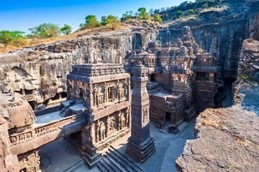
The central plinth of the temple is adorned with majestic sculptures of elephants and lions, ingeniously designed to appear as though they support the entire weight of the temple. The main shrine features a three-tiered shikhara (tower) reminiscent of the rathas (chariots) at Mamallapuram. Inside, a large pillared hall supported by sixteen intricately carved square pillars leads to the sanctum. A remarkable sculpture of Goddess Durga slaying the buffalo demon Mahishasura is featured prominently, capturing the dynamic artistry of the time. Another captivating sculpture depicts Ravana’s attempt to lift Mount Kailasa, symbolizing both strength and devotion.
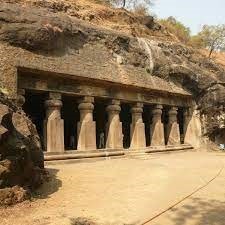
Close to Mumbai lies the island of Elephanta, originally known as Sripuri. The name “Elephanta” was given by the Portuguese, who were astonished by the colossal elephant sculpture at the site. The rock-cut cave temples of Elephanta, stylistically similar to those at Ellora, contain majestic figures of dwarapalakas (guardian deities) at the entrance. The crown jewel of the Elephanta sculptures is the iconic Trimurti, a towering six-metre-high representation of Lord Shiva in his three forms—Creator (Brahma), Preserver (Vishnu), and Destroyer (Rudra). This awe-inspiring image has become symbolic of India’s rich sculptural tradition.
The later Rashtrakuta rulers included Krishna II (878–914 CE), Indra III (914–929 CE), Govinda IV, Amoghavarsha II, and Krishna III (939–967 CE). Under Indra III, the Rashtrakutas once again captured Kannauj, reaffirming their role in the Tripartite Struggle. Krishna III, the last effective ruler, extended the empire deep into southern India, even defeating the Cholas. He patronized temple construction and encouraged Sanskrit literature.
However, the dynasty’s fortunes gradually waned due to internal strife, succession disputes, and increasing pressure from emerging regional powers. The last known ruler, Karka (972–973 CE), witnessed the final collapse of the Rashtrakuta empire, which was eventually overtaken by the Later Chalukyas of Kalyani.
Through their support for literature, spectacular temple construction, and inclusive religious policies, the Rashtrakutas significantly influenced the cultural and intellectual development of South India. Their rule is remembered not only for political power and military success but also for creating a syncretic and thriving society where multiple religions and languages flourished. The Ellora and Elephanta caves, the rise of Kannada literature, and the patronage of scholars and poets reflect the rich legacy of a dynasty that blended strength with sophistication.
The period between 1000 and 1200 CE in northern India is often referred to as the “Age of Conflict” due to the intense political instability and fragmentation that characterized the region. This era witnessed the disintegration of the once-powerful tripartite powers—the Rashtrakutas, Palas, and Gurjara-Pratiharas—into several smaller regional kingdoms. The vacuum created by the collapse of these major empires gave rise to a number of Rajput dynasties, who emerged as the dominant ruling class in northern and central India.
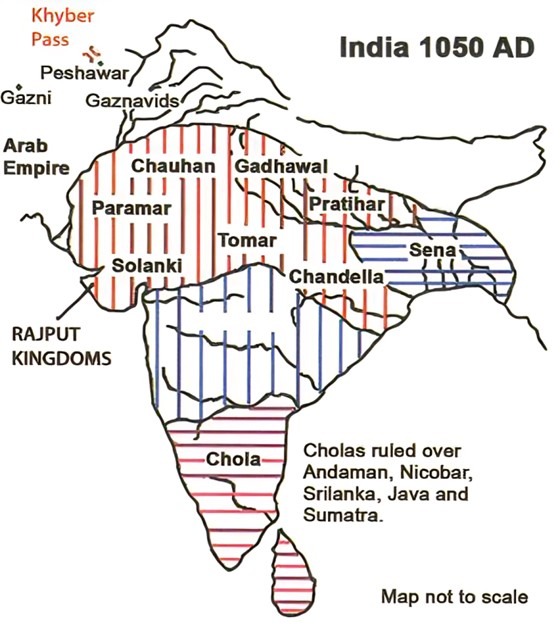
Following the decline of the Gurjara-Pratihara Empire, several prominent Rajput states emerged, each asserting control over specific regions. Among the most notable were the Paramaras of Malwa, the Chandelas of Bundelkhand, the Chaulukyas (Solankis) of Gujarat, the Chauhans of Ajmer, and the Gahadavalas of Kanauj. These dynasties not only played a pivotal role in shaping regional politics but also contributed richly to Indian culture, art, and temple architecture.
One of the most enduring legends regarding Rajput origins is the Agnikula theory, which claims that four Rajput clans were born from a sacrificial fire (Agni Kunda) performed by the sage Vashishta on Mount Abu. According to this myth, the Pratiharas, Chauhans (Chahamanas), Chandelas, and Paramaras were the four clans born from this divine ritual. While this account may be symbolic, it reflects the Rajputs’ strong desire to associate themselves with divine and heroic origins.
The rise of the Rajputs can be seen as a historical outcome of two major developments: the death of Harshavardhana, which led to the end of centralised imperial power in North India, and the eventual fragmentation of the Gurjara-Pratihara Empire, which had once acted as a bulwark against foreign invasions. As these larger empires crumbled, ambitious warrior clans and local chieftains began to assert their independence and carve out autonomous territories. The Rajput dominance, which began in earnest during the 7th and 8th centuries, continued until the 12th century, when Muslim rulers from Central Asia began to penetrate deeper into the Indian subcontinent.
During the early phases of the Islamic invasions, the Rajputs played a key role as the defenders of Hindu religion and culture. Their resistance to invading forces became a defining feature of the medieval Indian political landscape. Though often fragmented and divided among themselves, the Rajputs fiercely protected their kingdoms, temples, and traditions against the advancing forces of the Ghaznavids and later the Ghurids.
By the 11th and 12th centuries, northern India was a patchwork of powerful Rajput states. Key regions of importance included Kashmir, Gandhara, Sindh, Gujarat, Kanauj, Ajmer, Malwa, Bengal, and Assam. Among the most powerful Rajput dynasties were the Gahadavalas of Kanauj, the Paramaras of Malwa, and the Chauhans of Ajmer, each of whom played crucial roles in resisting foreign invasions and preserving regional autonomy. Other notable dynasties included the Kalachuris, Chandelas, Chalukyas of Gujarat, and the Tomars of Delhi, each contributing to the complex political and cultural milieu of the time.
The origin of the Rajputs remains a subject of debate among historians. Several theories have been proposed, ranging from foreign descent theories—suggesting links with Central Asian tribes like the Shakas, Hunas, or Kushans—to those asserting that the Rajputs were descendants of ancient Indian Kshatriyas, reasserting their status through valor and ritual purification. Another popular narrative, often linked to the Agnikula myth, traces their lineage to divine or semi-divine ancestors, such as Lord Rama, Lord Krishna, or Agni Devta (the fire god). According to this view, the Rajputs were ordained by sacred fire to defend dharma and uphold martial values.
Among the earliest and most influential Rajput rulers were the Gurjara-Pratiharas, whose founder Harischandra laid the foundations for Rajput political assertion. Under their leadership, northern India experienced a brief phase of unity and cultural development before their empire eventually fragmented, paving the way for other Rajput houses to rise.
In essence, the Rajput period (c. 7th to 12th century CE) was one of regional assertion, cultural patronage, and military resistance. Despite their internal rivalries and eventual defeat by external forces, the Rajputs left an indelible mark on Indian history through their valour, chivalry, and contribution to Indian architecture, literature, and heritage.
Kingdom | Period of Rule | Capital(s) | Founder | Notable Rulers |
Tomars of Delhi | 8th to 12th century | Dhillika (Delhi) | – | – |
Chauhans (Chahamanas) of Ajmer | 6th/7th century to 1192 | Ajmer, Delhi | Vasudeva | Vigraharaj IV, Prithviraj Chauhan |
Gahadavalas (Rathores) of Kanauj | 11th to 12th century | Kanauj, Benaras | Chandradeva | Govindachandra |
Paramaras (Pawars) of Malwa | 9th to 14th century | Dhar | Siyaka II (Sri Harsha) | Bhoja |
Chandelas of Bundelkhand | 831 – 1315 CE | Khajuraho (Jejakabhukti) | Nannuka | Vakpati, Jayashakti, Vijayashakti |
Kalachuris of Chedi | 850 – 1211 CE | Tripuri | Kokkala I | Gangeyadeva |
Solankis (Chalukyas) of Gujarat | 940 to 1244 CE | Anahilavada (Patan) | Mularaja I | Siddharaja Jayasimha, Kumarpala |
Pratiharas (Gurjara-Pratiharas) | 730 – 1036 CE | Avanti, Kanauj | Nagabhatta I | Mihir Bhoja, Mahipala |
The foundation of Rajput society rested firmly on the clan system, with each clan tracing its lineage to a common ancestor—whether historical or mythical. These clans were typically centered around compact territorial units consisting of 12, 24, 48, or 84 villages, which they dominated and controlled collectively. The Rajputs held deep attachment to land, lineage, and honour (referred to as maan), which formed the core of their social and ethical framework.
Governance in Rajput principalities followed a decentralized structure. Each state was led by a rana or rawat, who ruled alongside his chieftains—often close kinsmen or clan members. Warfare was both a duty and a sport for the Rajput’s, and martial valour was highly celebrated. Although war was the primary occupation, agriculture and trade also flourished under their rule, supporting economic stability and urban development.
The Rajput’s were ardent patrons of Hinduism, playing a critical role in preserving and promoting its practices during times of foreign invasions and political turmoil. Many rulers also extended support to Jainism, reflecting a certain level of religious tolerance. Substantial land grants and endowments were made to Brahmins and temples, and Rajput kings often positioned themselves as defenders of Brahmanical traditions and the caste hierarchy.
Rajput society was deeply hierarchical, marked by stark inequalities in lifestyle and access to resources. The upper classes—comprising ministers, feudal chiefs, and royal officials—lived in opulence and enjoyed exclusive privileges. In contrast, the lower castes and working classes—such as weavers, barbers, fishermen, and tribal groups—faced harsh treatment and social discrimination. These marginalized groups were often exploited by the feudal lords and had little control over their lives or labour.
While honour and dignity of women were given significant symbolic value, the actual status of women remained constrained within a patriarchal and restrictive framework. Rajput women were expected to uphold the family’s honour, sometimes even through extreme acts like jauhar (self-immolation to avoid dishonour). Education for women was unequally distributed—women from lower strata were denied access to Vedic learning, while daughters of the elite were sometimes educated in literature and arts. The legal and societal norms governing women were rigid and often harsh, limiting their autonomy.
The Rajputs made a lasting contribution to Indian art and architecture, especially in temple construction. The Nagara style of architecture flourished under their patronage. Characterized by its tall, curvilinear spires (shikharas) over the sanctum (garbhagriha) and pillared halls (mandapas), this style reached its zenith in temples built during this period. Outstanding examples include the Parsvanatha, Visvanatha, and Kandariya Mahadeva temples at Khajuraho, which exhibit exquisite sculptural detailing and aesthetic balance.
In Orissa, temples such as the Lingaraja Temple (11th century), Sun Temple at Konark (13th century), and the Jagannath Temple at Puri also reflect the architectural brilliance of the time. The walls of these temples were richly carved, showcasing the refined artistry of the Rajput period.
Beyond temples, the Rajputs were skilled builders of infrastructure such as irrigation canals, reservoirs, and dams, many of which are still admired for their engineering precision. They also founded several cities that are today famous heritage sites, such as Jaipur, Jodhpur, Jaisalmer, and Bikaner. Iconic structures like the Victory Tower at Chittor Fort, Lake Palace at Udaipur, Hawa Mahal, and the Astronomical Observatory at Jaipur built by Sawai Jai Singh in the 18th century stand as enduring symbols of Rajput architectural grandeur.
Rajput contributions to painting were significant and gave rise to two major schools: Rajasthani and Pahari. Deeply influenced by Bhakti traditions, these paintings often depicted themes from the Ramayana, Mahabharata, and the divine love of Radha and Krishna. Rich, vibrant colours and stylized figures were hallmarks of both schools. These paintings not only adorned palaces and temples but also played a vital role in the cultural and religious life of the people.
The Rajput age witnessed a revival of Sanskrit literature, thanks to the generous patronage extended by Rajput rulers. Cities like Ujjain and Dhara, under the Paramaras, became celebrated centers of learning. Eminent personalities like Vastupala, a minister in the court of the Chalukya ruler Bhima in Gujarat, were not only scholars but also patrons of learning and architecture, as evidenced by the Jain temple at Mount Abu.
In addition to Sanskrit, literary works in Apabhramsha and Prakrit languages also flourished. Jain scholars, particularly Hemachandra, made significant contributions in both Sanskrit and Apabhramsha. Over time, Sanskrit began to replace these vernacular languages among the elite. However, the common people’s languages gradually evolved, giving rise to modern North Indian languages such as Hindi, Bengali, and Marathi.
The Rajput period, thus, was not only a time of military courage and dynastic rivalry but also one of cultural creativity, architectural splendour, and literary evolution. Despite social inequalities, their era left a rich legacy that continues to shape Indian heritage and identity.
In the aftermath of the Gupta Empire, northern India witnessed a significant transformation in its administrative structure. The political landscape became highly feudal and decentralised, with numerous petty kingdoms emerging across the region. These smaller states were often governed by local chieftains or military aristocrats who asserted authority over their respective territories. Among them, the Gurjara-Pratiharas of Rajasthan and Gujarat played a notable role in regional administration, introducing innovations in water management through the construction of tanks and stepwells. These systems helped bring arid lands under cultivation, boosting agricultural productivity.
The military forces of these kingdoms were large and diverse, comprising infantry, cavalry, and war elephants. Accounts from Persian and Arabic sources praise the size and strength of these armies, notably referencing the vast military establishment of Dharmapala, the Pala ruler. These armies were often engaged in regional conflicts as well as in resistance against external invasions.
Society during this period was deeply hierarchical and governed by rigid caste-based norms. The Brahmins held a privileged status, bolstered by land grants and influential roles in administration and religious affairs. The Kayasthas, originally scribes and record-keepers, rose to prominence as essential administrative personnel across many royal courts.
Social norms increasingly reflected conservative values. Practices like sati—the self-immolation of widows—became more prevalent, especially among Rajput aristocracy, as a symbol of honour. The caste system further entrenched disparities, with upper-caste officials and feudal lords enjoying luxury and power, while the lower castes and occupational groups like weavers, fishermen, and barbers faced oppression and exploitation. Tribal communities, too, were often treated harshly and marginalized from mainstream society.
The urban and economic fabric of northern India experienced both decline and revival during the post-Gupta period. Initially, between the 7th and 10th centuries, trade suffered a setback due to the fall of the Roman and Sassanid empires, leading to the disruption of trade routes and a sharp reduction in the inflow of precious metals like gold and silver. This economic decline was reflected in the stagnation of urban centres and the virtual disappearance of gold coinage. Additionally, religious texts such as the Dharamshastras began to discourage foreign sea travel, likely in response to fears of ideological influences from Islam and Buddhism. However, these taboos were not universally enforced, as Indian merchants, artisans, scholars, and physicians continued to travel to regions like Baghdad and beyond.
The later revival of trade was spurred by the rise of the Arab caliphate, which restored commercial links between India, West Asia, and China. Ports such as Tamralipti in Bengal, supported by the Palas, emerged as key hubs for maritime trade. Gujarat and Malwa also benefited significantly from this revival, owing to their strategic positions along trade routes and their well-established shipbuilding industries. India exported spices, sandalwood, ivory, textiles, and camphor to China and re-exported goods like African ivory and West Asian glassware, functioning as a vital intermediary in international commerce.
As trade expanded, the demand for efficient financial instruments led to the growth of indigenous banking practices. Local bankers and moneylenders—known as sarrafs, mahajans, and sahukars—began to accept deposits and extend credit to merchants and officials. The most significant innovation during this time was the use of the hundi, a type of financial instrument similar to a bill of exchange. It was a written order promising payment of a specific amount either on sight (darshani hundi) or after a predetermined period (miyadi hundi).
Hundis served two primary functions: they enabled the safe transfer of money across cities by eliminating the need to physically carry cash, and they acted as a mechanism for credit, allowing merchants to borrow funds for trade. These financial instruments marked a sophisticated understanding of commerce, credit, and banking in medieval India.