
Post-Mauryan India
After the decline of the Mauryan Empire, a succession of foreign powers rose to prominence in northwestern India, leaving a lasting impact on the region’s cultural and political landscape. Among the earliest were the Indo-Greeks, descendants of Alexander the Great’s eastern campaigns, who established the Greco-Bactrian Kingdom in the 2nd century BCE. Prominent rulers like Menander I embraced Hellenistic ideals while also adopting local customs, including Buddhism. They were succeeded by the Indo-Scythians, or Sakas—a nomadic group from Central Asia—who settled in India during the 1st century BCE. The Sakas assimilated into Indian society and continued the trend of cultural fusion.
The Parthians, originating from the Iranian plateau, also held brief control in parts of northwestern India. Though their rule was short-lived, they introduced Zoroastrian elements into the region’s diverse cultural fabric. However, the most influential among these foreign dynasties were the Kushans. Descended from the Yuezhi tribe of Central Asia, the Kushans established a powerful and expansive empire during the 1st to 3rd centuries CE. Under emperors like Kanishka the Great, the Kushan Empire became a hub of commerce and culture. They significantly advanced trade along the Silk Road, supported the spread of Mahayana Buddhism, and fostered a rich, syncretic civilization blending Greek, Persian, Indian, and Central Asian traditions.
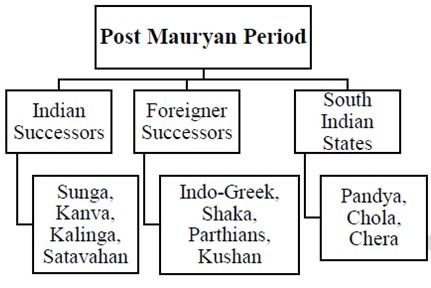
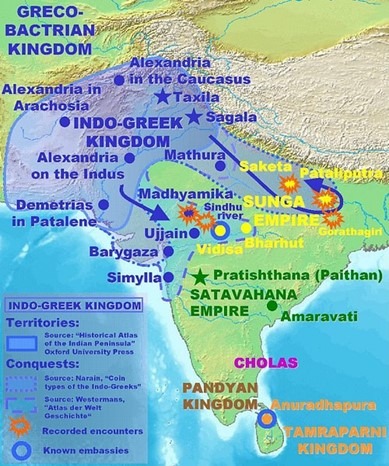
Foreign Invasions and Cultural Interactions in Ancient India: From Seleucids to Indo-Greeks
Following the death of Alexander the Great in 323 BCE, his vast empire began to fragment, leading to the emergence of several regional kingdoms ruled by his former generals. One of the most prominent of these was the Seleucid Empire, founded by Seleucus Nicator in West Asia. This empire shared a common border with the Mauryan Empire in India, setting the stage for diplomatic exchanges and eventual conflicts in the northwestern frontier.
Rise of Successor States: Greco-Bactrians and Parthians
By the mid-third century BCE, the Seleucid hold over Central Asia began to wane. Two prominent regions, Bactria (modern-day northern Afghanistan) and Parthia (in parts of eastern Iran), seceded from Seleucid control. These breakaway territories established themselves as independent kingdoms—the Greco-Bactrian and Parthian empires, respectively. These regions would go on to play a pivotal role in shaping the political and cultural dynamics of northwestern India.
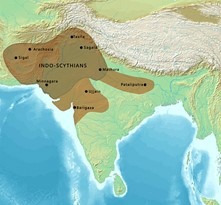
Nomadic Movements: Shakas and Kushanas
Around the same period, waves of Central Asian nomadic tribes began migrating and exerting pressure on settled empires. The Shakas (also known as Scythians), a horse-riding nomadic people from Central Eurasia, began moving southwards due to internal conflicts and external pressures in Central Asia. Their movement destabilized the power balance in the region, particularly weakening the Greco-Bactrian and Parthian realms.
Another significant nomadic tribe, the Yuechi (also spelled Yuezhi or Yuchi), lived in the northwestern borders of China. Originally displaced from their homeland by the more powerful Xiongnu tribes, they moved westward into Central Asia. In the process, they defeated the Scythians and occupied regions like Uzbekistan, setting the stage for the rise of the Kushana Empire, which would later play a crucial role in Indian history.
Scythian Impact on India and China
The relentless raids and migrations of the Scythians created instability not only in Central Asia but also in the neighboring civilizations of India and China. The Chinese emperor Shih Huang Ti (247–210 BCE), recognizing the threat posed by these nomadic invasions, commissioned the construction of the Great Wall of China around 220 BCE. This defensive measure inadvertently pushed the Yuechi westward, triggering a domino effect in Central Asia.
As the Yuechi displaced the Scythians, the latter moved further south and west into Greco-Bactrian and Parthian territories. This led to a collapse of Bactrian power and, eventually, a wave of Indo-Greek and Scythian invasions into the Indian subcontinent. The Shakas later migrated into the Indus region and established their rule in western India, significantly altering the subcontinent’s political landscape.
The Shakas (c. 1st Century BCE – 4th Century CE)
Following the decline of Indo-Greek dominance in northwestern India, the Shakas—nomadic Central Asian tribes—emerged as formidable invaders and rulers. Unlike their predecessors, the Shakas encountered little resistance from the local rulers and populations and swiftly established their authority across vast regions of India. They founded kingdoms spanning the northwestern, northern, and western parts of the subcontinent, ultimately controlling a significantly larger territory than the Indo-Greeks.
Moga or Maues (c. 50 BCE) was the earliest known Shaka ruler in India. He laid the foundations of Shaka power in the region of Gandhara. His successor, Azes, dealt a decisive blow to the last Indo-Greek rulers in northern India, annexing their territories and consolidating Shaka control.
The administrative structure of the Shakas was influenced by the Achaemenid (Persian) model. Their empire was divided into provinces administered by mahakshatrapas (great satraps), which were further divided into smaller regions governed by kshatrapas (satraps). This decentralized but hierarchical system enabled them to efficiently manage their vast territories.
Branches of the Shakas in India
The Shakas were not a single unified polity but comprised multiple branches that ruled over different regions. There were five prominent branches, each establishing a seat of power across parts of India and Afghanistan:
1. Afghanistan Branch – The first Shaka settlement occurred in Afghanistan.
2. Punjab Branch – This group settled in Punjab with Taxila as their capital.
3. Mathura Branch – Another branch ruled Mathura for nearly two centuries, playing a prominent role in north-central India.
4. Western Kshatrapas – Perhaps the most influential, this branch ruled over western India, particularly Gujarat, Rajasthan, and parts of Maharashtra. They had frequent confrontations with the Satavahanas and maintained control until being vanquished by Chandragupta II in the 4th century CE.
5. Upper Deccan Branch – The fifth branch established its dominance in parts of the upper Deccan.
Of these, the Western Kshatrapas held sway the longest—around 500 years—largely due to their control of prosperous sea trade routes in Gujarat and their prolific issuance of silver coins, which facilitated commerce and economic stability.
Western Kshatrapas (c. 1st – 4th Century CE)
The Western Kshatrapas, known in modern historiography as the “Western Satraps”, governed significant parts of western and central India. Their territories included present-day Sindh, Gujarat, Rajasthan, Malwa, and parts of Maharashtra. Although the term “kshatrapa” traditionally meant a subordinate ruler, these kings were largely independent in their domains.
Some ancient sources, like Ptolemy, referred to them as Indo-Scythians, and while some historians argue that they were vassals of the Kushanas, this theory lacks strong evidence. The title “kshatrapa” was possibly a retained cultural identifier rather than a mark of subordination.
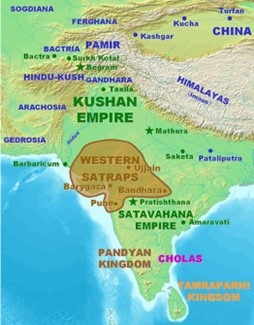
Kshaharatas and Kardamakas: Dynasties of Western Kshatrapas
There were two major dynasties within the Western Kshatrapas:
1. Kshaharata Dynasty
This dynasty included three notable kings:
- Abhiraka
- Bhumaka
- Nahapana
Nahapana was a powerful ruler who extended Shaka authority over Maharashtra and western India, displacing the Satavahanas temporarily. However, he was later decisively defeated by Gautamiputra Satakarni, a Satavahana king, who reclaimed the lost territories and eradicated the Kshaharata lineage.
2. Kardamaka Dynasty
Founded by Chashtana around 78 CE, this dynasty marked a revival of Shaka power. Chashtana used the title “kshatrapa” on his earlier coins and “mahakshatrapa” on his later ones, signaling a rise in status. He ruled alongside his grandson Rudradaman I, who became the dynasty’s most renowned monarch.
Rudradaman I (130–150 CE): The Eminent Shaka Ruler
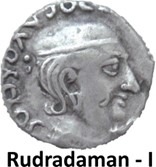
Rudradaman I was a pivotal figure in Shaka history. He expanded his kingdom to include Sindh, Gujarat, Konkan, Malwa, the Narmada valley, and Kathiawar. A patron of culture and governance, Rudradaman is best remembered for his Sanskrit inscription at Junagadh, the first long inscription in chaste Sanskrit, despite his foreign origins.
The Junagadh Rock Inscription describes his efforts in repairing the Sudarshana Lake, originally built during Chandragupta Maurya’s time. After a storm destroyed the embankments, Rudradaman undertook the restoration using his personal funds and did not impose any additional taxes on his subjects. This inscription, written in Brahmi script, also details the achievements of Rudradaman and highlights the continuity of Indian irrigation and public welfare traditions.
The Vikrama Era and the Title of Vikramaditya
In 58–57 BCE, a king of Ujjain defeated the Shakas and drove them out of his region. In celebration of this triumph, he adopted the title Vikramaditya, and began an era known as the Vikrama Samvat. Over time, “Vikramaditya” became a prestigious honorific, adopted by many Indian rulers to mark their prowess and legitimacy. Up to 14 kings in Indian history are known to have used this title, the most famous being Chandragupta II, who also defeated the Western Kshatrapas. The Vikram Samvat calendar, still in use in many Indian states and in Nepal, runs approximately 57 years ahead of the Gregorian calendar (or 56 years ahead from January to April).
The Parthians in India
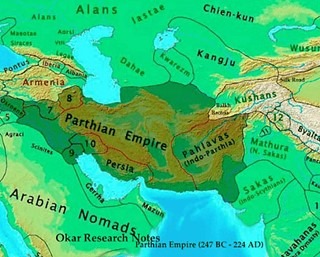
The Parthians, originally from Iran, established their authority in northwestern India around 20 BCE, following the decline of Shaka dominance. For a brief period, both the Parthians and Shakas coexisted and ruled parts of the region. Indian texts often club them together under the term “Shaka-Pahlava”, indicating their cultural and political proximity.
Though they controlled a relatively smaller territory, the Parthians assimilated into Indian society, much like the Shakas. The most renowned Parthian ruler was Gondophernes, during whose reign St. Thomas, one of the twelve Apostles of Jesus, is believed to have arrived in India to propagate Christianity. This episode illustrates the growing interconnectedness of India with other parts of the world during the early centuries of the Common Era.
The Kushanas (c. First – Third century CE)
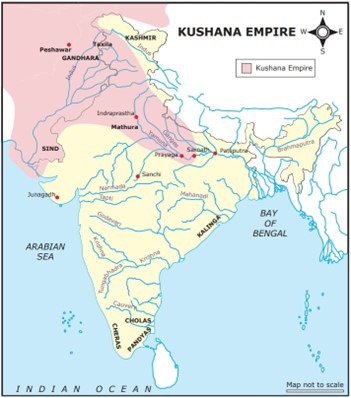
The Kushanas (circa 1st–3rd century CE) emerged as one of the most significant and influential dynasties in Indian history following the decline of the Parthians. Originating from the Yuezhi tribe—a nomadic group from north-central Asia near the borders of China—the Kushanas were one of the five Yuezhi clans. Their rise to power began with the occupation of Bactria (modern-day northern Afghanistan), displacing the Shakas, and later expanding their territory into the Kabul Valley, Gandhara, the lower Indus Basin, and large parts of the Gangetic plain. Eventually, the Kushana Empire stretched from Central Asia to the Ganga River, encompassing regions of present-day Afghanistan, Iran, Pakistan, and northern India.
Coins and the Kushana Empire
Introduction of Gold Coinage: The Kushanas were the first rulers in India to issue gold coins extensively, beginning around the first century CE. These coins, primarily discovered west of the Indus River, were notable for their high metallic purity—superior even to that of the later Gupta gold coins. Strikingly, the weight of Kushana gold coins closely matched those of contemporary Roman emperors and Parthian rulers of Iran. Their circulation across North India and Central Asia reflects the vast scale of economic transactions during this period.
Trade and Roman Coin Finds: The discovery of hoards of Roman coins at archaeological sites in South India indicates that trade flourished well beyond political borders. Though South India was not under Roman rule, it maintained strong trade relations with the Roman Empire, highlighting the region’s integration into extensive international trade networks.
Kushana Coinage and Rulers
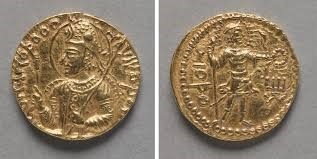
Early Kushana Coins: The earliest Kushana coins typically depicted the king on the obverse and a deity—often of Greek origin—on the reverse. These coins were bilingual, bearing Greek inscriptions on the front and Kharosthi script on the back. While Kujula Kadphises is sometimes credited with issuing the first copper and silver coins, scholars largely attribute the introduction of Kushana coinage, particularly gold coins, to his successor, Vima Kadphises.
Kanishka’s Innovations: Emperor Kanishka issued both copper and gold coins (notably the gold dinar). His coins featured the image of the king performing a sacrifice at an altar on the obverse and a deity on the reverse. Kanishka departed from the earlier bilingual coinage tradition by replacing Greek and Kharosthi inscriptions with the Bactrian language. Initially, his coins included Greek deities, but over time, he introduced legends and figures from Bactrian, Iranian, and Indian mythologies. Notably, Kanishka continued the depiction of Shiva—referred to as “Oesho”—from earlier coinage and was among the first to portray the Buddha on coins, signifying a shift in religious iconography.
Gandhara and Mathura School of Art
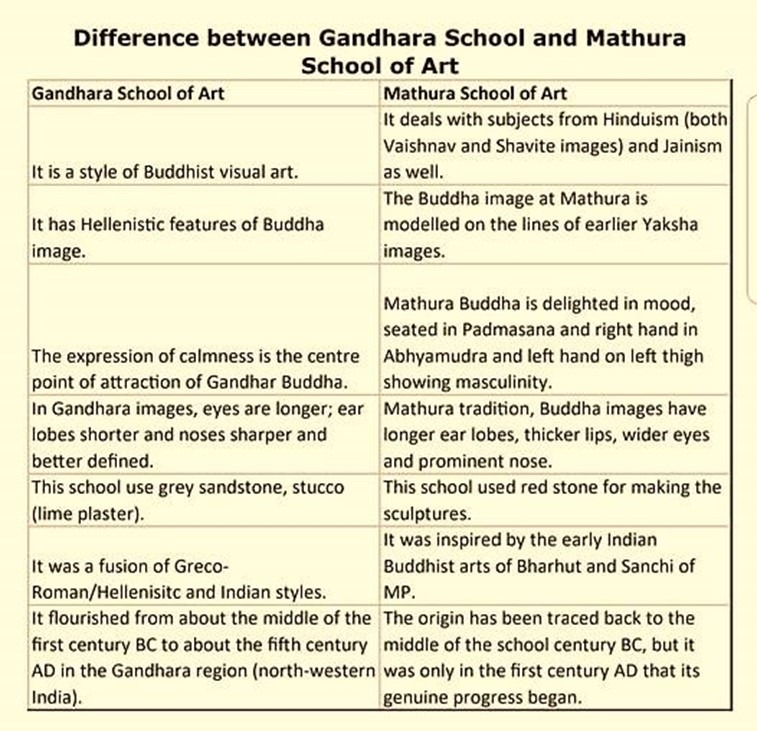
During the Kushana period, two major schools of art emerged on the Indian subcontinent—the Gandhara School and the Mathura School. Though they developed around the same time, their distinct styles, geographical settings, and cultural influences set them apart. Both schools played a vital role in shaping the religious and aesthetic narratives of ancient India.
Gandhara School of Art
The Gandhara School of Art flourished on the western frontiers of ancient India, primarily in the regions corresponding to present-day Afghanistan and Peshawar. Its development reached its peak during the reign of Kanishka the Great, the most prominent ruler of the Kushana dynasty. A notable patron of art and architecture, Kanishka supported the growth of this unique artistic tradition.
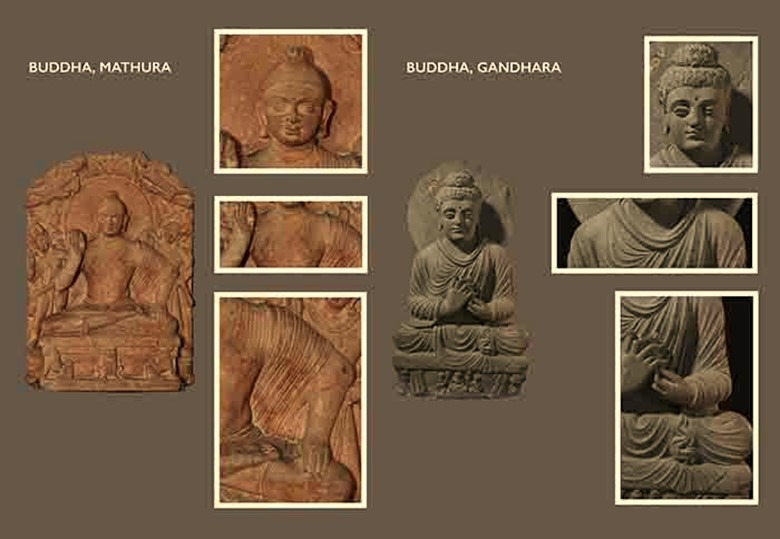
The Gandhara School is widely known for its Greco-Roman influence, a result of cultural interactions with Greek invaders who had settled in the region centuries earlier. This confluence of Hellenistic and Indian elements gave rise to what is often referred to as the Greco-Buddhist art or Greco-Indian School of Art. The sculptures produced during this period reflect realistic human forms, naturalistic drapery, and intricate detailing, all hallmarks of classical Roman and Greek sculpture. Buddha was often portrayed with wavy hair, Roman togas, and a calm, meditative expression, resembling Apollo-like figures in appearance.
The Gandhara style was heavily focused on religious themes, particularly Buddhist iconography, and laid the foundation for the depiction of the Buddha in human form, which became a lasting legacy in Buddhist art across Asia.
Mathura School of Art
In contrast, the Mathura School of Art developed in the heart of northern India, specifically around the banks of the Yamuna River, in what is now modern-day Uttar Pradesh. This school began to emerge as early as the first century BCE, and continued to thrive well into the third century CE. Unlike the Gandhara style, which reflected foreign influence, the Mathura School was deeply rooted in indigenous Indian traditions and symbolisms.
One of the distinctive features of the Mathura style was the use of spotted red sandstone, a locally available material that gave its sculptures a bold and vibrant appearance. The figures created in this school initially lacked the serene spiritual quality seen in later Buddhist art. Instead, early representations of the Buddha and Bodhisattvas appeared more joyful, fleshy, and earthly, emphasizing vitality over transcendence.
What set the Mathura School apart was its inclusive representation of multiple religious traditions. Sculptures of Buddha, Jain Tirthankaras, and a variety of Hindu deities were produced in abundance, indicating a harmonious coexistence of religious ideologies. The Mathura artists also drew inspiration from Yaksha figures—nature spirits popular during the Mauryan era—infusing their work with a sense of divine presence rooted in Indian mythology.
The Mathura School played a crucial role in shaping the visual language of Indian spirituality. Its artistic vocabulary influenced the development of sculptural styles across Hinduism, Buddhism, and Jainism, making it a central force in ancient Indian religious art.
Together, the Gandhara and Mathura schools represent two artistic currents that emerged in response to diverse cultural, religious, and political influences. While Gandhara reflected a synthesis of East and West through its Greco-Roman aesthetics, Mathura remained deeply Indian in form and content. Their coexistence during the Kushana period exemplifies the rich cultural tapestry of ancient India and underscores the importance of artistic expression in shaping religious identity and heritage.
The post Mauryan period was a significant transition in Indian history, characterised by the fragmentation of political power, the rise of regional dynasties, and the deepening of cultural exchanges with Central Asia. Despite the political instability and foreign invasions, this era witnessed the flourishing of trade, the spread of Buddhism, and the integration of new cultural elements into the Indian subcontinent. While the absence of a centralised authority posed challenges, it led to a rich tapestry of cultural diversity and the emergence of unique regional identities. The legacies of the post Mauryan dynasties, especially their contributions to art, religion, and trade, continue to shape India’s cultural and historical landscape.